Matt Britton Live At TMRE - "Amazon's Data Renaissance" Orlando FL 10/24/17
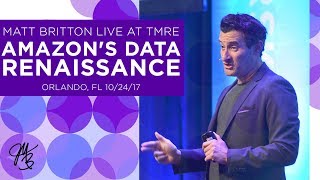
Matt Britton argues Amazon is winning by making customer data and convenience the core competitive advantage. Millennials and Gen Z are driving direct-to-consumer brands, voice commerce through Alexa, and AI-powered predictive buying. Market researchers and brands need to collect first-party data and rethink their entire product and channel strategy.
I'm gonna try to give you guys some energy. I've been all different types of conferences over the last month, and I feel like this one's in need of a little bit of fucking energy. So I wanted to try to give you guys some, get you guys going, add a little EQ to this iq. I used to think that when I had a millennial in the audience, I'd say, wow, you're a millennial. You're super young. But the reality is that millennials really aren't that young anymore. In fact, the youngest millennials are 21 years old. So as we kind of phase out for the millennial generation and we move in to the Gen Zs, it's kind of time to take a step back and take a look back at the mil in terms of what are the lasting legacies of this generation, because they become the hallmarks of what Gen Z will be built on. I get asked all the time by companies, why are millennials such a big deal? Why are there so many books on millennials, so many millennial gurus? Why is every brand so obsessed with millennials? And my answer is pretty simple. Millennials were the first generation that grew up with the Internet in the household, okay? And if you think about it, I didn't grow up with the Internet in the household. I just missed that millennial generation. I try to act like a millennial, but the truth is, I'm really not. I'm a Gen Xer, and I grew up with Encyclopedia Britannica, and I grew up having to actually call my friends, and I didn't have im and I had to go to the library. Right? If you think about it, my brain is a wire, completely different than a millennial's brain. Somebody's brain who actually grew up with all these technologies. And what really fascinates me is that the C suites of big companies right now are not filled with millennials yet. They're filled with Gen X. They're filled with boomers. They're. Many large organizations are made up of boards of old white men who aren't diverse, don't reflect the generation that they're going after. I always say I love all white men because my dad's an all white man. So if you're not a white man in the building, no disrespect, but the fact is that brands need to diversify not just in terms of socioeconomic board bases, but also gender, obviously, and also age. Because the fact is that a lot of these companies that will become the next circuit cities that will become the next Kodaks, become those things. Because the people who run it didn't grow up with the Internet in the household. They're not trying to bring their company down. Right? Blockbuster didn't try to bring their company down. The people there just didn't understand a world would ever be where you wouldn't actually go on a Friday night and pick up that dvd. So when that shift happens, when Millennials enter the C Suite, a lot of what I'm talking about is going to happen real quickly because the rate of change is going to accelerate faster and faster and faster. If you think about 12 years ago, there was no Netflix, there was no YouTube, there was no Facebook, there was barely Google. 12 years ago, where are we going to be 12 years from now? So some of the things I'm going to talk to you guys about today, you're going to say you're crazy, because I'm going to talk about where things are headed. But if I told you 12 years ago that I could push a button and talk to somebody in Ghana in high def for free right now from a device in my hand not connected to any wires, you'd say I was crazy, too, right? So I think the rate of change is going to accelerate so much more quickly, and it's really going to drive us all nuts. And it also creates a lot of opportunities. So if you haven't noticed by now, I talk pretty fast, which is cool. If you guys need to take notes, you need me to slow down, just go like this. My Twitter handle is Addieb. It's on every single slide. So if you have any questions, if you have any comments, any compliments I could always use, hit me up at mattyb and I'm gonna jump into it. And today I'm here to talk about Amazon, because to me, Amazon, I thought about market research when I flew down here from Philadelphia this morning, where I went to see my Eagles kick some butt last night, Monday Night Football. And I flew down this morning, I thought about market research in terms of what's the big change in market research? And to me, the big change is Amazon. And there's a lot of reasons why. But Amazon now means data is more important than ever before. It means knowing your customers more important than ever before. So that's why I'm centering on Amazon. Not because it's the next hot best thing, but because I think every market researcher, anybody who's in insights, anybody who's in data, needs to reverse engineer their thinking about Amazon. So, as I mentioned, Earlier. It's been a long time since the encyclopedia. It's funny, I work on a charity called Pencil of Promise, which builds schools. Schools and underprivileged areas around the world. I was in Laos, in Southeast Asia, in a town with no running water, no electricity. And I showed a young child my phone with a camera inverse, so he could see his own face. And his older brother told me it was the first time he'd ever seen his face because they actually don't have mirrors there. And I'm thinking about that as a polar opposite of America, where when kids come out of their mother's womb, sometimes they don't see their mom's smiling face for the first time. They're staring at themselves on the phone. So from the second they're born, seconds old, they're already seeing a phone. They're already understanding the power of this machine. And by age 3 or 4, they're already learning to become Brooklyn hipsters, right? Dressed up this way on their phones. Kids are going up to TVs and actually starting to swipe them. And then by age 10, they're forming group committees using their iPads, using big fancy corporate terms like, I'll circle back with you later at age 10. So this is the future, right? This is your future customer, who for them not being on Amazon is just not even something that will even ever cross their mind, right? Not buying directly from a brand is something that's not going to cross their mind. But if I asked how many companies, how many brand marketers are here, even know who their customer is, because they've been selling for so long to big retailers, they've never had to figure out their customer. It's really mind blowing. So this is the shift that we're going to talk about. And when the millennials fill the C suite, I think you're going to see that shift really accelerate. Another thing that's a byproduct of this millennial generation is the version of the American dream has really taken a U turn here in the United States. So when we were growing up, the version of the American dream was this beautiful house with a boy, picket fence, a two car garage, 1.7 children, maybe a dog. This is the version of the American dream. And you'd graduate college, you'd meet somebody, you'd move out the suburbs, and you'd actually start a family. And that's what people thought you would do. You'd live in a cul de sac, you'd have a nice little suv, maybe a Toyota Highlander, you'd bump some Shania Twain heading into the cul de sac. And that was the American dream. That's what people thought you would grow up to aspire to be. But the reality is this millennial generation, their view of the American dream has taken a U turn. The city is now the life that they imagined for themselves. The version of new American dream isn't the white pickup fence. It's not a two car garage. It's actually having an apartment in the city. This generation, the millennials, Gen Z, every generation after it is looking to be a generation that will sacrifice space and privacy for the proximity and connectivity of cities. And in doing so, it's going to change that they look at brands, and the inverse is going to change the way that brands need to look at consumers. Another major factor that's happening in the United States is the notion of the barbell economy, which is something that I think a lot of brands need to pay better attention to. For the first time since the 20s, 0.1% of the population controls nearly 20% of the wealth. And globally, the 12 richest people control nearly 25% of the wealth around the world. So what's happening is the middle class, especially here in America, is eroding. We all know that, right? Jobs are getting offshored and outsourced, and companies that are in the middle, like the gap, that close 40% of their stores, they're going to lose. Because the fact of the matter is the value side of the equation wants to buy Lee jeans at Walmart for $20, and the luxury side wants to buy SIS and brand jeans for $200. And in the world where the middle class is roding, there's not really a lot in between. So another hallmark of this millennial generation, it's really the erosion of the middle class. And that brands really need to pick a side of being a luxury brand or a value brand. But if you find yourself in the middle, if you find yourself in a place where you're not Vizio for $199 flat screens, right? Or Dollar Tree, Dollar Store, Dollar General on that side, right? Or Apple, who's selling the iPhone X for $1,000, if you're not one side or the other, you're really going to find yourself in a really hard time connecting with, with this generation. We talk about urbanization a lot. And another thing that really fascinates me is what's doing to the landscapes and the socioeconomic landscape of this country. This is Washington D.C. for example. So Aries in the purple are the creative class Those are people who are going deep into an art. Whether you're in advertising, you're a creative, or you're a writer, you're a designer. The middle is the service class, who's really kind of the link between the creative class and the working class. And the blue is the working class. And if you look at this, you don't really see a lot of light brutal here in Washington, D.C. do you? What's happening is the working class is actually getting pushed out because real estate and prices continue to go up as level boundaries get pushed outwards, and millennials don't want to leave the city. And what happens is the notion of the inner city blue collar worker is now actually moving to the suburbs, which is really, when we grew up, it was the rough inner city. Now that inner city is actually pushing the suburbs. It just shows you how the priorities have changed for this generation. And they're really staying in cities. And since they're staying in cities, it's pushing the working class out, which changes the whole value side of the equation in terms of. So maybe malls will survive, maybe the value side will survive. Maybe it makes sense that Walmart and Costco are out there because the reality is that the working class is being pushed out to the suburbs anyway. Urbanization has forever marginalized retail. So you talk about home growth, and the trends that we're talking about in terms of millennials wanting to stay in cities is shown in this graph. How the growth in urban areas is now, for the first time, really starting to pace and create distance between the growth in suburban areas. It was inverse 10, 15 years ago. Now you're actually seeing it driving. Another thing driving it is there's a very strong strength of the Chinese currency against the dollar. So you're getting a ton of overseas investments as well. That's propping up real estate prices. So you probably ask me, why am I talking about real estate? We're in a market research conference. But there's a reason why we're talking about market, real estate, real estate and how it actually impacts this industry, which is as prices go up on Main street, retailers can no longer afford to stay in business. As millennials stay in cities, retailers can no longer stay in business. And retailers mean everything for most brands because that used to be their channel. Right? What percentage of brands really have gone direct? If you look at the Fortune 500 and most prolific brands, so many of them sold through these very retailers that are going out of business because of the urbanization trend. And now the new version of the American Dream is people living in 1200 or maybe 800 square foot studios which cost $3000 a month in New York or San Francisco. And when they have these apartments, they actually no longer even have the space to go to Target and fill up their shopping carts with tons and tons of stuff. Yes, doorman buildings are stacking up Amazon boxes as high as a doorman can see right now. But, but the reality is that although these boxes might look like they're shopping just as much as they used to, the boxes actually usually only have like one or two products in it. Right? One of those huge boxes might only have a toothbrush in it. So consumers are not buying as much anymore. And again, they don't have space to house as much stuff. They don't have the big car to throw their stuff in from Target. They don't have the tons of space in homes because of it. They're actually buying less stuff, they're being more choiceful and they are choosing Amazon v Commerce, which actually I don't know if it's an industry term yet, but if not, I kind of want to patent it, which is voice commerce. I think it's going to further pressurize brand equities. So obviously we all know more and more consumers are ordering from mobile devices. We all know more and more consumers are buying via E Commerce. But one thing that's really going to accelerate quicker than anybody else in this room probably thinks is the growth of consumers buying products over voice based devices. How many people in the room have an Amazon Echo device in their home? Okay, so for those of you who don't, if I can give you one takeaway from this, one piece of homework, spend $50, buy an Amazon Echo dot and bring it back to your house and actually try out all the different skills and things it can do. And it has over 10,000 skills. The way that you actually interact with it, the way that over time maybe your kids will start to interact with it intuitively. And you're actually going to start to see why Amazon through Alexa and why Google through home and why Microsoft through Cortana and why Apple through Siri are, are investing billions and trillions of dollars literally in voice technology. Because in the end of the day, anything that saves consumers time, where they can actually order from sitting on their couch without actually having to get up and actually type into a keyboard, they'll gravitate towards. Because time is the one thing we can't create more of. And what's really fascinating about Amazon Alexa device is if you say Alexa, buy Batteries, Amazon. Alexa will say, buy, I will get you Amazon Basic batteries. And if you say, no Amazon, I want door cell batteries, Alexa will say, I will sell you Amazon Basic batteries. See, what Alexa is doing, what Jeff Bezos is doing is they're making a bet that the ease and ubiquity of Alexa will outpace the value of billions of dollars of brand equity in a brand like Dorcel. And it's batteries today and it's toothbrushes and toothpaste tomorrow. And they'll start in the low involvement categories and, and they're actually gonna work their way up because Amazon knows the form factor of buying is more important than the brand of buying. Right. And in the world where experiences are new social currency, not brands, I believe that actually brands matter less than ever before. A will for this generation. And I think Amazon's proving it. They're putting their money where their mouth is. They're gonna start to imagine Walmart not selling. Now, Walmart has private label, but they certainly sell Doris Sell and Energizer batteries. Right. But the reason why is they don't offer different levels of convenience for the consumer. But what Amazon's saying is we're going to make your life so easy and in exchange we're going to sell you our products. They're just as good anyway. So think about what that means for a brand that has focused on building consumer insights on the why consumer buys and what are the brand equity pillars that are around so much billions and billions of dollars of research when in the day all that can be thrown out by just actually having a device that makes it easier for the consumer to buy. How's that for an insight? Where does that come up in market research and how does that change the way that brand marketers have to look at actually building their business moving forward? And I actually think it's just the beginning of voice. I think the future of the phone, and this is another controversial point that many of you may disagree with, I actually think the future of the phone probably as soon as five years is going to look like that. I think the AirPods are actually the start of what the phone is going to look like. Because the reality is most things that a consumer needs to do on a device they can actually do via voice. Whether it's sending an email, whether it's actually searching for the nearest pizza place, whether it's actually texting somebody. Most use cases for the phone on an everyday basis. You actually don't need a screen for. And Apple's already betting on that. With the AirPods. What about visual, what about the ability to see things? I believe in Augmented reality is another thing that's going to be coming a little bit closer than what people think, especially because Apple's building the augmented reality kit in their new iOS 11. And in that world, for those of you who don't know what augmented reality is, I don't know where my phone is, but you can hold your phone up right at a Walmart and you could see how much everything cost over the product itself. Or I could be at a conference and be like, where's that person that works for Coca Cola? Right? And I can actually look and actually see, does it overlay their brand? Or how much is that overpriced apartment in San Francisco? Because Trulia might actually have an app, an augmented reality app that allows me to overlay. The most recent example is Pokemon Go, which had people kind of walking around like zombies in Central park, kind of searching for imaginary figures. People didn't know what was going on, exploded. So augmented reality, I think is going to be in the form of contact lenses that consumers are going to have very soon. And when they put them on their eyes, they'll actually have a mixed reality or augmented reality world, actually overlay things. Does it mean we're all going to become robots soon? Probably, but I think you have a little bit of time for that. But I think augmented reality is closer because Apple's building it actually into the actual form factor of the devices. So think about it. In this world, we're in a world we're not staring at a phone screen anymore. We're where we're asking Siri to deliver search results for us. And when we're asking Siri to deliver search results for us, Apple doesn't even necessarily have to deliver it from Google anymore because they have the hardware. And to me, the last mile and the hardware is going to trump everything because they actually can drive the consumer convenience. And because of that they're going to have a lot more power, which is why Alexa doesn't even. Amazon doesn't have Alexa. They're actually investing in a television screen in the home as well. So they can actually have the last mile. So I think the last mile is going to matter. But in the last mile, in a voice driven world, brand is unseen, design is unseen. So the insights between actually having a consumer order from your pizza store or somebody else's can't stick out the same way it used to, because consumers aren't going to look at it anymore. They're just going to talk as they're going on their way. If you have seen the movie her or you haven't, rather I would definitely check it out because I think it's the best movie that kind of shows this nearby future where a guy actually falls in love with his phone, but his phone is actually a voice. It happens to be Scarlett Johansson's voice, which makes it more understandable. But that's actually who he's talking to when he falls in love with his phone or the notion of an operating system. And it's I think, the best, most entertaining way to showcase where things are really headed. Next Gen Y economics has changed our legacy approach to selling stuff. This is where all the real estate facts. This is where everything we're talking about in terms of urbanization and change the consumer is really the rubber meets the road. For packaged goods manufacturers or really anybody who sells anything to a consumer directly, this used to be the game you'd fly down the Bentonville, Arkansas and a relatively uneducated buyer. Sometimes I hope we didn't just lose Walmart as a client will basically buy a product and they'll put something in an end cap and then you're good to go, you'll leave and you know you're going to have a good year because that's where consumers shop. And you go to Minneapolis and you do the same thing at Target, right? You, you go to retailer after retailer and as long as the retail buyer who had their own set of data, which a lot of times the merchants didn't have access to, would buy it, your product would actually move and it would move and move. But there's a couple things happening. A, as we talked about this new generation, they're not buying at Target and Walmart as much anymore. They don't have the cars to drive to the places to throw the stuff in the back of the car and drive into the. That world's kind of over with. And another change is the retailers themselves are starting to see it and they're really stepping on the Gaza private label because they're saying, you know what, we have all this customer data. What are we going to do with it? What are the retailers going to do with it? And what they're going to do with it is they're going to sell higher margin private label products like they do right here with mustard. And they're essentially making the same bet in a slightly different way that Amazon's making that a consumer would rather buy this great value which they're putting value actually in the name right Mustard versus French's or a brand name Mustard brand that you've known forever. And they're doing this in almost every low involvement category right now. I talk to a lot of retailers all the time. They're like, we're scared of going direct. We don't want to piss off the big retailers yet. Look at the big retailers are actually doing to the brands. So in the end of the day, everybody needs to go for the last mile. Everybody needs the consumer data. The retailers have the consumer data right now. The manufacturers don't, which is why they're at such a disadvantage. And they need to really innovate the way to actually go to market for the consumer moving forward. And think about the brands we're talking about. Almost every single brand on this screen has barely any information on any of the consumers. Now, some of you guys might sell them really expensive marketing research reports and things like that, which is totally cool, right? But they don't have email addresses of everyone who's bought a Dr. Pepper in the last two years, do they? They have no idea. I've spoken to brands that are massive, that really don't know why consumers buy their products. They come up with insights for advertising that they run TV spots on. But in terms of really understanding the who, the who to them in the past was just moving the needle and getting a couple extra inches of shelf space at Walmart or Target. Now the who is completely different. Right now, the who is, where does my brand fit into a world of a consumer who's swiping 24 7? How do I make my brand design for the flick? What time does my consumer want to actually buy my product? What time of day does mom most likely to buy mustard? Does the weather impact the way that mom buys mustard? Because you know what? It actually may. Are there certain areas of the country where mustard is bought? From a seasonality standpoint, this is the type of information and data that brands really need to uncover if they're going to win in this new direct world. And this is going to drive new buying habits, which is going to emerge new D2C models. So it's not just the Amazon E Commerce model, which we'll talk about, but there's all these new models coming out. We all know about the access of our ownership trend, right? And the access of our ownership trend. I think the biggest place that's really taking part right now with the Millennial generation is the place where consumers traditionally spend the most amount of the discretionary expenditures, which is cars and housing. Cars you live in Cities, the cost of a car combined with gas, tolls, parking, insurance, it makes no sense to buy a car, right? Ease and ubiquity of Uber or Lyft make it so easy. So they're accessing cars over owning them. Houses they cannot afford to buy. Most young consumers, when they move into cities where they want to stay, they cannot afford to buy apartments. They certainly can't afford to buy that monstrosity. So what they're doing is they are traveling. A lot of them are seeking more freelance gigs, which is another presentation in its own right. And they're living mobile lifestyles where they're not bound by a mortgage, they're not bound by a car payment. They'll rent out their apartment while they're traveling. They'll rent somebody else's apartment in a new city. They. So they're not buying houses either. So think about that. The fundamental rights of passage, which is owning a car, owning a house really are no longer a part of that American dream, because living in cities and renting houses really don't fit into that. And it's not just cars and houses they're renting. You're gonna see a lot of big ad campaigns coming out next couple months from a company called Rent the Runway. And they're betting on not just cars and houses, but women would rather rent clothing. So instead of spending $1,000, right, on a super expensive dress, you can rent one of these dresses for $75 or $100, right? Save $900 for a great vacation. Take plenty of instas with the picture. No one knows that you actually don't even own it. Right. And you'll return it the next day and be incredibly happy. So this is a new model as well. In a consumer direct world where you're creating marketplaces. Now, obviously there's certain categories like toothbrushes that no one's going to want to use, like a used toothbrush. But in clothing, it's happening. There's a watch company that actually has a rental watch, luxury watch company. The name escapes me right now, but you can actually. They send you a new watch every month. You actually send it back. So rental models marketplaces is going to be a way that brand can actually succeed. Less inventory, much higher margins, really unique model. Think about how much money the rental Runway actually makes on these dresses. If they take care of them the right way and they rent them over and over and over again. It's actually pretty fascinating. Think about how the consumer actually wins. They started off being an online only business, now they're going to brick and mortar as well. The uberfication of service industries is another thing. How reason how businesses are going to change. I think services is a great way in for a lot of big brands. So this is Glam Squad. You guys hear of Glam Squad? So Glam squad is, think about how expensive it now is on Main street for a salon to do hair and makeup and give women blowouts and things like that. Glam Squad, you hit a button, you have a team of stylists come to your apartment. A bunch of ladies want to go out for a night out. Glam Squad actually comes and does it for you. Glam squad wins. You don't have to pay expensive Main street real estate costs and then the consumer wins. So they actually don't even have to leave their house. Again, convenience, convenience, convenience. There's handy where you can hit a button, actually have a cleaning service come in. There's zeal where you can hit a button and actually get massages in the home. So one thing I've told a lot of companies, if you make laundry detergent, well, maybe you actually should start a laundry dry cleaning service. Because service could actually be the new way in. In a world where you can't rely on having self space in a big retailer, maybe actually having that intravenous selling model for through we're going to come in, we're going to clean your apartment, but we're only going to do so with our products. Becomes a new way in. So I think a lot of companies that traditionally sold packaged goods the regular old fashioned way are going to be gobbling up services. And it just actually occurred to me that Ikea bought TaskRabbit which is a perfect, perfect, perfect example. So TaskRabbit's a company. You hit a button and people, somebody would show up at your house and put together those really hard 300 piece dressers that IKEA's. Well, Ikea bought that company, right? So now they have a service layer on top of their retail layer to actually have a way where they can actually collect more consumer data. And they're actually a retailer already. But that's actually a great example of that happening which just occurred to me. I think there's a big opportunity for packaged goods companies to get into the hardware game as well. So I brought up laundry detergent, right? If I were a company that sold laundry detergent, I would actually get in the hardware game because I mentioned earlier the same way that Apple has leverage with having the iPhone in people's hands. Same with Alexa does where having The Amazon does with the Alexa in people's houses. I think a company that makes detergent could actually should focus on the big real estate developers in cities and say, you know what? We are going to give away our dishwashing machine or our laundry machine for free. We're going to install it in your house, we're going to make it smaller so it fits in a drawer or small space built for apartments. But it's going to be a connected device and every time it runs out, it'll actually notify us and we'll deliver the product. It's a Gillette model. Give away the razors for free. The razor for free and sell the blades at a high margin. This is a way in because people are renting apartments. If this is the washing machine, that's an anti Amazon strategy. There's got to be data behind that. I would make it look super cool. It's actually the first ipod, which I don't know how that made its way into my presentation, but super interesting. But getting into the hardware space, think about the different applications for that, right? Giving that away for free, making it easy, having it be data driven. I think the smart home is coming very quickly and this is a great application. This intervene selling model, this is called the Amazon Dash, I think it's called. And you actually hit a button and you can get this in any brand you want. Every time you hit the button, it sends a new one to you automatically. So convenience. You don't have to even pick up anything. Great place for Todd to have this on the washing machine. It'd be even better if it was actually built in to the washing machine and if it was their washing machine. Right. But I think a lot of brands are going to try to figure out how can I actually get buttons in people's homes. Services to people's homes a lot different than actually having to drive them to your site or sell directly. In a world where Amazon's going to try to sell Amazon Basics laundry detergent and unless Tai does this, Amazon Basics is going to kill them, period. Right. Unless P and G and J and J and SC Johnson, all these companies figure out ways to get in the services or get in the hardware versus relying on the power of their brand, which consumers care less and less about, Amazon is going to kill them. So that's really what it comes down to. So it's not about waving the white flag. And the problem is again, you have non millennials in a C suite and try going to the CEO of a big packaged goods companies and Telling them that they should manufacture washing machines. Right? Good luck with that. But that's kind of how they have to think about themselves, right? But Ikea knew that they should buy TaskRabbit. So companies do know that that's the case. Artificial intelligence, machine learning, that stuff. To be honest with you, it's way above my pay grade. I don't know what half of that shit means, but what I do know it means is that the dishwasher does know when you run out of detergent, right? Amazon one day will know what you want before you know it. Netflix already knows what you want to watch. Facebook knows every single thing you talk about. Whether you whisper it as quietly as possible, they just know, right? I don't know how that happens, but in a world where Amazon knows, I think the way that Amazon's going to start to use artificial intelligence is, you know, right now they get about $1,500 from every prime shopper in, you know, wealthy urban areas. They're going to try to move that number up to 5, 6, 7, $7,000 a month. And the way they're going to do that is by shipping you stuff before you've actually even bought it. Because they're going to see trends of consumers. You're buying these diapers every six weeks and just going to send it to you, and if not, they'll ship you a box back. It's going to be easier and easier. They bought Whole Foods, so now they have a tremendous refrigerated warehouse distribution network in well lit urban areas across the country, which is a byproduct of an incredible acquisition that they made. That's how they're going to make it easier. That's what artificial intelligence means. I read this morning that Uber paid this AI specialist. They got like a LeBron James contract, like 1 million or something to join. There's only like 1,000 people that really understand artificial intelligence. But think about how it can pay off. Because if the machines know and they send it to you and actually gets good enough, think about how much time to actually change consumers. Tomorrow's brands will be built direct and not built at all. So the new brands are not going to be built through retail. The new electronics brand isn't going to be built through Best Buy. The new packaged goods brand is not going to be built through Walmart. Right? It's just not going to happen. The new fly fishing company is not going to be built through Dick's Sporting Goods. Right? They're going to have to build direct brands and some brands have Been very successful at building these direct models. Warby Parker has been very successful eyewear company. Took on an 800 pound gorilla in Exotica. And basically what they did is they said we can source better, we're going to have better customer service, we're going to go direct to consumer. We're going to simplify our offering. They first started online and then they built actually a bricks and mortar infrastructure. What's really great about Warby Parker is the retail layout is the very same on the left hand and right hand side. They actually have a mirrored retail strategy. Simplicity, simplicity, great customer service. That's how they're winning away. Away is a company that started, I love this story, two women in their late 20s. They sell the suitcase $200. One model, just different colors, has an iPhone charger built in, direct brand, not selling through big department stores. You know, I had one and actually broke. They sent me one before I sent them the other one back. Right. These are ways that new companies are understanding what, what really matters to the consumer. Simplicity, great customer service, protecting the brand, not allowing it to end up in some discount wreck at some big box retailer. They're really controlling the brand at all costs. A lot of small businesses now can go direct to consumers very easily through Shopify, which is absolutely exploding for the middle to lower market. For those of you who don't know what Shopify is, Shopify is essentially a plug and play platform where you can upload a logo, have an e commerce site running overnight, it tags in with Amazon and you're actually off to the races. You can outsource fulfillment. A lot of companies aren't going direct now. Even the biggest brands in the world think it's like they have to hire Accenture or some very expensive consulting company to go E commerce. I would just say set up a Shopify site, right? Sell Coca Cola over Shopify because it's just as good. And now you can go direct. The issue with Amazon that I'm surprised not more has been made out of is when you sell over Amazon, you don't have customer data. Amazon does not allow you to capture the customer data. You have addresses, but they don't allow you to capture the email addresses. As Amazon catches you taking customer data, you sell over Amazon and marketing it differently. They're gonna slap you on the wrist first time and kick you off of Amazon the second time. So brands have a couple tough conversations, decisions to make. Number one, are you going to stop being scared of retailers and go direct? Are you going to make that decision? And number Two, are you going to go through Amazon or are you going to go through a Shopify type platform? The positive to Amazon, one click Prime. Easy downside, you never really will be in control. But companies like Nike have seed it and they're actually creating brand pages. You go direct like Warby Parker or away. You have to build a powerful brand. You have to actually drive them to you. But if you do, you have the customer data. I can tell you those companies are succeeding. They know me and they know customers like me and they're able to market to me extremely effectively. Other companies are betting the brand won't even matter at all. There's a company called brandless. They raised $50 million recently and the whole notion they're betting on is consumers don't care about brands. Amazon's right. We're going to sell every low involvement category product for $3 each. We're going to have the best possible ingredients and we're not going to put a brand on anything. Consumers would rather buy this maple syrup called maple syrup than Aunt Jemima if it's $3 and has better ingredients because the brand actually doesn't matter and no one's showcasing their bling bling Aunt Jemima bottle when they're going out at night. So consumers don't even really care about those brands. It doesn't build their own personal social currency. So it's going to be interesting to see how companies like this actually go. And then lastly, all media is going to soon become addressable. So while it's important that you're a direct marketer in an Amazon driven world and on a Facebook driven world that's gonna one day connect with the television. Because the most fascinating thing about both Apple and Amazon announcing that actually making TVs is for the first time, very soon the TV and the computer are gonna become one. Because kids do not know what NBC or ABC or CBS even is. No idea. Ask a 12 year old what ABC is and they're gonna say the Alphabet. They don't know what a TV network is. If you work for a TV network, sorry, it's the truth. The other thing that's true is that young kids go up to TVs and they try to swipe them because they think you should be able to swipe a tv. And a TV very soon is going to become a giant iPad hanging on your wall. And when the TV's a giant iPad hanging on your wall, you're going to be in a logged in Facebook addressable state. Which means that Joe's Pizza is going to be able to advertise during the super bowl to people within one mile of their Duluth, Minnesota location. Or the NFL is going to be able to advertise towards women because women actually it's the most live watched program on TV is the NFL amongst women. But every ad for GMC and Budweiser, right? Well now if a woman actually watches an NFL game, she can be targeted with an ad that's focused towards her because TV's going to become addressable. So the data you collect on your consumer is not just going to impact you in terms of how you build your product and relationship with them. It's going to allow you to target them not just on social, but actually on TV itself. And while the Apple TV interface is like this today, tomorrow it's going to look like this. The networks are going to go away and the new networks are going to be people. Because while young kids don't know what ABC is, they sure know what a 12 year old YouTuber is. Who you guys have never heard of before. Right? And those are the people who actually have the new networks. The live sports obviously isn't going anywhere and the shows themselves. This is a new future of tv. I have a whole other presentation called Instagram Killed the Television Star. It goes deep in this, but super cool. So wrapping up, what are the implications of the future of market research for this? Number one, you need to know your customer and too many brands don't and you need to start somewhere. And what does that mean? Well, if you still were relying on the big retailers, find ways to collect email addresses, run sweepstakes, so many companies do it and then they just don't even care about the data anymore. At one point big brands actually thought, oh, we'll just build a big Facebook audience. Right? So Hyundai, remember one year they had about 10 million Facebook fans and they ran a Super bowl spot. And the call to action was not go to Hyundai.com, go to Facebook.com Hyundai thinking they'd build an audience that would be theirs. And then two years later Facebook said, guess what, if you want to reach that audience, we're going to need to get paid. Right? So it wasn't even actually their audience whatsoever. So that's how brands short term thought they were building their modern day CRM. But it's really about good old fashioned starting to collect the data. Because on platforms like Facebook you can upload email addresses and target consumers. So emails are actually gold because it's still a great universal identifier. But any type of Information you get on the consumer as you go to a direct model will happen. And ultimately it's about understanding how these four companies work, because these four companies are controlling the future of commerce. There's a book by a really great writer named Scott Galloway, and he just came out with it, it's called the Four. And he talks about these four companies and he talks about them in the context of basic human needs. So he calls Google God, because people ask Google something that they would never ask anybody else. Do I have cancer? Does he love me? Right? What's the meaning of life? People ask crazy esoteric shit on Google and they also ask very everyday things. We all have the need for a higher power to answer something, and Google has filled that role in our lives. He calls Apple sex because Apple has always been about fashion over function. For the same reason. My brand new Apple can't even plug in any of these projectors here. But I like it because it looks cool. And he makes the point that the lower people make decisions from their head down to their torso, the higher the margins go, right? Because you're not actually thinking the right part of your body. And Apple actually is the ultimate genetic status symbol. It's a sign of wealth, it's a sign of actually attracting people. Facebook is love because the fact is that when young girls put posts up on Instagram, they actually refresh with the fervor of a Fortune 500 company to see how many likes they get to get self validation, which is a terrible thing, but it's really where the world is headed. And unfortunately it's going to grow even further, which puts a lot of pressure on parents to educate their kids. But in a lot of ways, Facebook is love and Apple is consumption. Amazon's rather consumption. Back to the days, the Roman era, where people were feeding themselves grapes. The big kings, right? Get as much as you can. Amazon makes it so easy to buy. And that thrill of buying stuff is there. This is the new world. And if you have data, you can market via search and YouTube on Google, you can market via people's mobile devices via Apple. You can, you can hit them on the constant feed of Facebook and Instagram via Facebook and you'll be able to understand who your consumer is on Amazon. The wealth disparity. We talk about the barbell economy. The people, your children, if you have any that can touch this ecosystem, work for these companies, be in their ecosystem in some way, shape or form, they're gonna be the winners. The ones who don't understand this are gonna be on the Outside, to me, it is that black and white. And it doesn't mean these companies are going to be around forever. That's just the state right now. But there's very few industries that these companies will not take over and disrupt in the next five to 10 years. And every data point is actually headed towards it. And that's probably not new news to you guys. And there's a lot of tools you can dig in. There's audience insight on Facebook where you can actually understand anything about any consumer audience. There's hello Profit, which is a platform that you can actually deploy to understand the buying habits. One plug I'll make for us. We've launched a new real time marketing research insights tool called Suzy where you can find out what your consumer is thinking about at any minute of the day. Any question you want during the same meeting, you can get feedback back. Because to me, after being in this business for so long, running an agency for 15 years, the one thing I saw is that so many decisions are made on hunches and guesswork and now no assumption should be left untested and every single idea or thought or initiative should have data behind it. So that's what we're building at Crowdtap for Susie. So that's all I have for you guys today. I don't think we have time for Q and A because they're kind of violently pushing me off stage. So if you guys have questions, I'll hang around here for a couple minutes. You can hit me up on Twitter. You guys have been a great audience. Thanks so much.
More from Matt




MikMak’s Rachel Tipograph on Consumer Spending, Retail Media & Holiday Shopping Trends



Jaguar Land Rover’s Charlotte Blank on Luxury, Purpose & Experiential Storytelling



