Matt Britton Live From Oslo, Norway - Millennials & Money 2018 (Keynote Speaker) | Millennial Money
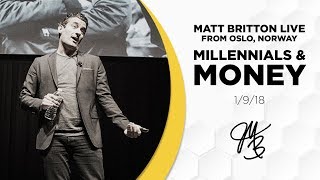
Matt Britton examines how millennials and Gen Z reshaped consumer behavior through social media, experiences over ownership, and the gig economy. He argues Amazon and direct-to-consumer brands are disrupting retail, voice assistants will change how people search, and Big Tech companies may enter banking.
Thanks, guys. I think I should just play that video and leave and hopefully that'll be good enough. But I actually have to talk now, unfortunately. Are there any millennials in this audience? If you're a millennial, raise your hand. Okay, one millennial. You guys got to give her a raise, first and foremost. It's funny, because one thing I've realized, I spent 15 years running a big ad agency in New York City, helping big brands target youth and college students, and I worked with half of the Fortune 500. The one thing I saw over and over and over again is these big corporate executives would talk about Mark Zuckerberg, right from Facebook, or Evan Spiegel, the founder of Snapchat, as these sort of cultural gods and innovation gods. Yet Evan Spiegel is 26 years old, Mark Zuckerberg's 31. These are young people, and the people who are saying it are in their 50s and their 60s and the 20s and 30 year olds in their organization they don't even know and they don't even talk to yet. Those are the people who are living this new world. Those are the people who were born staring into a phone. Right when we were born, we looked into our mother's loving eyes. That's what we saw. But now kids that are born, they're staring into their phone because their mom wants to capture the video and she wants to share it on Instagram. By the time this generation is three years old, they're already learning how to be hipsters. They are wearing clothes that are worth more than your clothes and my clothes, and. And they're understanding social media, and they're so incredibly advanced. And by the time they're 10, 11 and 12 years old, I'm sure a lot of you people in this audience have kids that are 10, 11, 12 years old. You guys could probably associate with this or understand this, that they're having group status meetings all with their devices. This young generation is so incredibly advanced. One thing I see with the consumer in general is that kids are growing up fast, but adults are growing old slow. So you look at somebody like Eric Schmidt, who recently just left as a chairman of Google, who was once a CEO of Google. The reason that Eric Schmidt was hired as CEO of Google is he went to Burning man, which is a huge festival just outside of Las Vegas in the United States, where it's a very. Let's just say it's an incredible party. And the founders, Larry and Sergey of Google, hired him because of how well he did and how well he fit in at Burning man, not exactly the business prototype that we had in the past. So we are dealing with a new consumer, and I was asked here to talk about Millennials. But the reality is the new young consumer is Gen Z. In fact, the youngest millennial is actually 21 years old. So millennials really aren't even that young anymore. And what's coming in next is Gen Z. That's the new generation. This is the new young consumers. But the break from Millennials to Gen Z is going to be nowhere near as stark as the break from Gen X to Millennials. Millennials are unlike any other generation in history. And I'm often asked why. And the reason why is this is the first generation that grew up with the Internet in the household. So the access to information, rapid communication, ability to intuitively understand technology makes Millennials and every generation born after it really a different species than myself and everyone else in this room. Besides one person who's a Millennial that was growing up with the Internet in the household, their brains are hardwired differently for them. They grew up and said, why would I need to call a car service so I could just hit a button and have a car come to me? That generation. It makes sense that thinking is very intuitive. And one thing that really fascinates me is as the millennials get older, soon they're going to enter the C suite. So the millennials now are 21 to 30, 33 years old. Soon they're going to be the new executives. And when the millennials enter the C Suite, the things that they do are going to be part of that intuitive thinking. And then you're going to see big bellwether companies, whether it be AT&T or Microsoft or Coca Cola, really make shifts. Because the Millennials are going to come into the C suite and say, why are we doing things this way? This is based on the old world. We're going to disrupt things. So today I'm talking about lasting legacies of the millennial generation. Because as Gen Z fades in, the Millennials have left a footprint that's undeniable. There are things that they have done to change the world that we aren't going back to. I often get asked by parents all the time. And isn't it bad that kids are staring at their screens? Doesn't that make them not easy to communicate with one another? Yet when those kids are in college, you're going to have no problem with them staring at their screen to facetime with them when they're a couple hundred miles away. When the airplane was invented, People said it was a bad thing because it's going to take people away from their families. Well, it did, but it also makes it possible for me to be here today with you. So with every progression in society, there are negatives, but there's a ton of positives. So what I'm going to be talking about with these legacies today is the negatives and positives of these legacies. But more importantly, what are the business impacts? What are the sectors and businesses that are going to thrive as a result of this new world and these legacies? And what are the companies that are really in danger? And what are the sectors that are really in danger? So we're going to jump into it. If you haven't noticed already, I talk incredibly fast. My Twitter handle, MattyB, is almost on every screen. So if you use Twitter, which not as many people do as Twitter would hope right now, which I'll touch on you, you can send me a tweet and I'll try to address it. Otherwise, hopefully we'll have time for Q and A. And I'll hang around afterwards if you have questions because I'm going to cover a lot of stuff in the next 38 minutes. So let's kind of dive into it. I'm going to take a sip of water because as you'll see, you guys are about to be drinking from a fire hose here. So let's get it going. Ok? The first legacy. The status update is the new status symbol. The status update is the new status symbol. And in the 80s 90s, early 2000s, consumers would define who they were by their cars, their house, their watches, their sneakers. It was the brands that they bought. Nike, Adidas, right? To show everybody what they were all about. That was the social badge that brought in a whole world of consumerism, right? Somebody had a luxury car and they drove it around. It connotated status to their social symbols. But now products don't do that anymore. Experiences do. If you think about it, before Instagram, if you went to an amazing concert and sat front row, or you met a celebrity, or you hiked to an incredibly high mountain, or you skied down an incredible slope, okay, no one could see it unless they were right in front of you and you could show them your photo album. But now you could post it instantly and have the world see it. And because that opportunity exists, it experiences have now replaced product as a new social currency. And because of it, it's changing the way that consumers spend their time and their money. Now, today's presentation isn't just about the millennials, because millennials have had a reverberating impact on the world. Think about it. Facebook started on college campuses, and now today, billions of people use it every single day. So nothing I'm talking about today is just limited to a younger generation. It's really reverberated across to everybody, as evidenced by by Eric Schmidt. So one of the first causes of the status update being new status symbol is something I coined in my book Youth Nation called diffty, which stands for did it for the Instagram. And what that means is people are pursuing experiences now not so much to actually enjoy them, but to actually prove that they were there. How many of you go to your kid's piano recital or see them on a play and actually stare through the phone instead of with your own eyes in high def, Right? That's dfty. You want to capture that video and actually share it with people. When everyone's at a concert, instead of actually enjoying the music, everyone's holding up their phone. In many ways, if it wasn't shared, it actually never happened. And people now are pursuing experiences just to share them. And in fact, over a dozen people died last year in the United States taking selfies, right? Standing at the side of a cliff or on a tall building and actually falling over because they actually wanted to get that selfie. That's how important it is. Why? Because that's how people are being portrayed to society. Like the Nike shoes used to do it for them. The relationships they get into, the job opportunities they get. Maybe the colleges they get into are defined by what's on their Instagram profile. That's what people look at when they're introduced to somebody. Right? That's the new resume. It's the new way to show the world what you're actually about. And because of it, a lot of crazy things are happening in in Russia, people are renting grounded private jets so they can take pictures of them. Okay. They are paying to go into a private jet that actually never leaves the Runway so they can take a picture to make people think that they're wealthy or affluent. Yes, this is actually happening in Russia. There is a place in New York City called Black Tap that makes incredible sundaes that are incredibly overpriced. They're sold for $22 to $24 a Sunday because they make incredible Instagram photos. And the lines are actually around the corner. Most my kids wanted to go. There was a two hour line. I wouldn't wait into it. I hired a tax rabbit, which is Basically paying somebody to wait in line for me. And I showed up when I got to the front. But they were super happy about it because they got in there, they posted a picture of the sundae and everyone knew that they were at Black Tap and they actually got a picture of it. It was more fun than actually eating the sundae. There's a museum in America that's taking off that's about to go global called the Museum of Ice Cream. When people go to the Museum of Ice Cream, they. They do not learn about the pasteurization of ice cream or actually how it's made. There are 12 different rooms where people can take incredible selfies, like the sprinkle room, which you're looking at here. Okay. The Museum of Ice Cream has lines around a quarter. It sells out instantly because this is an experience that people are going to, that they can take pictures of. So if you're a hotel, what can you put in your lobby that's going to want to make people take a picture of it? Because things are being learned about, not through television ads, because the younger generation isn't watching TV ads, right? They're streaming all the time. It's through other people posting about it on Instagram. And the reason that the Museum of Ice Cream had lines around the corner is that everybody went there just to share it. So essentially, they have advertising built into the product. And the best companies moving forward are going to be able to do that. The best hospitality companies are going to build sharing into their product. When people come here to Oslo, they go on Instagram and they search Oslo and they see where, what are the best posts for Mosul and they go there and they take pictures. And if you're a restaurant or hotel near there or you are that place, your business is going to be doing incredibly well. This drives so much time, so much attention, so much energy, and it's creating a global hospitality renaissance. Companies that are in travel, whether they're an airline or a hotel or a music festival or an event, and every company, a byproduct of it, is really thriving as a result of it creating. Because this is where dollars are being shifted. There's an app that's an upstart called GTFO which stands for get the Flight Out. Okay? And what get the Flight out does is allows you to search where's the furthest place that you can fly on a Friday afternoon for the cheapest amount of money. And all of a sudden you're going to go there. Bucket list, right? Diffty. Take a picture of it. Show everybody you were there. Go home. It's not even actually explore the place so much. It's actually be able to go there. This is actually happening right now. It's happening everywhere. Festivals are huge. It's the Glastonbury Music Festival that happens here in Europe. The festival business is really surging and there's no sign of it stopping. I spoke to a major beverage company last week and they told me their number one channel is no longer the big retailers. It's not the Walmart of the world. It's actually these events that people are going to because it's so important for people to shift money there. Actually, the companies that sell beverages, whether it's a beer company like AB InBev or a company like Coca Cola or Pepsi, it's becoming a bigger and bigger channel for them. Has anyone done Tough Mudder in the audience? I got a couple people. So Tough Mudder costs $350, and it's essentially a race that people do to make them feel like they're in the Army. They spend $350 to climb through dirty water and under barbed wire. And I can tell you, not one person is doing this without bringing their phone with them. Okay? It shows people that they're rough and they're rugged. Maybe they're an accountant, but once they get to Tough Mudder, they're a badass. Right? All of a sudden, you know, these are people who can be in the army. And Tough Mother is now a global phenomenon. And any company that's in the fitness space actually is going in this direction. They're creating these experiences. There's something else called Color Run, which happens all throughout Europe where people show up wearing white T shirts. And the second they're there, they're doused with colorful powder, creating a perfect Instagram moment. The the races are untimed. There's no winners or losers at the end, there's a live DJ concert. People are spending money on that and not traditional gyms. So again, if it's not shared, it didn't happen. One of the next major trends of the millennial generation, and we heard about this morning, is how urbanization is going to transform the global footprint. Since experiences are so important to building one's Persona, and since people have access to a phone in a 24 hour news cycle and see what's going on, they have no interest. And since they're growing up slower, they have no interest in leaving the city. So Gen X would be age 25, 28, 29, try to get married, move out to the suburbs. Get a house with a two car garage, white picket fence and a dog, right? But now people are getting married later than ever before and they have no intention of leaving this city. This generation is driving a massive wave of urbanization. The American dream was this. The American dream is now this. And it's not just an American dream, It's a global dream. You're seeing it around the world. Real estate prices in cities are skyrocketing while they're flattening out and going down. In many suburban areas, we are seeing gentrification, where the livable boundaries of cities get pushed outward and outward and outward. In Brooklyn, where I live, there are $2 million townhouses being sold where five years ago you couldn't walk outside because there were so many shootings that were actually happening. Right? It's happening so quickly because the millennials aren't leaving the city. The city just keeps expanding outward and outward. It can grow up and it can grow out, and that's actually where it's going. And that has reverberating impacts on so many different industries. The creative class is now taking over the middle of the city. This is Washington D.C. the purple is primarily the creative class. The light blue is the working class. The light blue is nowhere to be seen here in the Gen X world. It was the inner city blue power worker. It was the rough and tumble and inner city. Now the blue collar worker is getting pushed out to the suburbs because they can't afford to live in the major cities. And the cities are becoming full of the creative class of the millennial generation, which is transforming and it's creating pressures on mega consumer sectors. First of all is auto. For the first time in seven years, auto sales globally are down. They were down 1.7% last year. Why? Because when people live in cities, they do not need to own a car. They're not getting in their SUV anymore and driving to a big store and throwing stuff in their suv. They, they are pushing a button and a car is showing up for them and it's taking them wherever they need to go. Owning a car combined with the cost of gas, tolls, parking insurance versus the ease and ubiquity of Uber, forget about it. And many major auto manufacturers are now trying to think, how do I build a car that can actually be part of Uber's fleet? That's actually the new channel. So I am not long on automotive companies based upon this new generation becoming urbanized. Now, this is not binary. Of course there's going to be some young people that Move out to the suburbs and actually buy cars. But this trend is truly undeniable. And I believe it's only going to accelerate as Gen Z actually comes into the picture. And second is housing. As young people stay in cities, many of them can't afford housing. So buying a house used to be a rite of passage in savings, right? You're going to own your home. More and more consumers, instead of being tied down to one location when they want to travel a lot, are not actually being tied down by a mortgage or a car payment. They're renting. And when they actually travel, they're renting out their apartment on platforms like Airbnb, which is a multibillion dollar company that should IPO either this year or next year. Okay? You travel, you rent out your apartment in Airbnb, and you rent out other people's apartments while you're traveling. So cars and housing, the two amount of places where consumers used to spend the most amount of the discretionary expenditures of, are really being put in the backseat, right? No pun intended. Instead, consumers are spending more and more dollars on experiences. Experiences over stuff is a major trend. Retail. We all know about retail. This is a shopping mall in the middle of America which is now shut down. And there's trees that have started to grow in and make themselves at home here in this shopping mall. Why do malls need to exist if the shopper isn't going there, but they don't have a car to put stuff in? And just like the ease and ubiquity of Uber is impacting cars, the ease and ubiquity of Amazon, which I'll talk a lot about in a minute, is actually impacting big retailers and big malls. So retail is tremendous amount of pressure in almost every major category, even cars. You look at Tesla. Tesla actually has the new model for auto dealerships, which is a 2,500 small square foot showroom in affluent urban areas. You walk in, there's one car there, and it's a showcase versus going out to this huge complex with a million cars on a big parking lot. Tesla has kind of reinvented how automotive companies retail their products. And I think you're going to see Volvo, Ford, all the big companies, Toyota, all kind of mimic that model and not having the traditional automotive retail model, but at the same time, it's generating massive opportunity for the service sector. This is something called Glam Squad, which is exploding. And what Glam Squad is, is a bunch of women want to go out for a nice night, they used to go to the salon, right? To get their makeup and hair done, etc. Glam Squad is actually a service where you hit a button and a teen comes to your apartment and they'll do your hair and actually make up for you. Glam Squad doesn't have to pay Main street real estate prices, right? So they don't have that cost infrastructure of having a physical location. Because as the price of real estate goes up on Main street, salons actually can't afford to be in business anymore. This is a service. They're capturing data from every person you're going into. And if I were a company like l' Oreal that made hair product, I would buy Glam Squad because that's a much better distribution channel to get your products in people's hands than actually being sold at a retail outlet, which less and less people are going into. This is Rent the Runway, which is now going global. It's an incredible phenomenon. It's essentially rental of high end clothing. Instead of a woman spending $1,500 on a dress, which she's gonna wear one night and put in a closet, right, she can rent it for $75 and take an Instagram of it. No one's gonna know that she actually doesn't even own it, right? And the thing about Instagram with women in clothing that I found over time is if you take a picture in that dress, you can't wear it again. Because the next week, even if those people weren't there, they saw it on Instagram. So clothing actually gets recycled a lot more quickly through people's wardrobes. So Rent the Runway is exploding for that reason. So these are marketplaces, right? Rent the Runway has a physical retail location. But think about the margins they're making off that one dress. You know, they're not buying it for retail prices. They're probably buying that fifteen hundred dollar dress for $500. And they rent it out five times and they're breaking and then it's 100% margin on the dress that they actually get back. They deliver it to you. So they actually have a digital model and they have a physical retail model. If you want, you can actually buy it. So to me, marketplaces and delivery services are actually the new way that retail is going to be done. So while urbanization has created issues for auto, and while it's created issues for the housing sector, and the housing sector is doing fine because people need to live somewhere and they're going to rent, it's created tremendous opportunity for companies in the service sector. Urbanizations also transform the fabric of the global workforce. When we were growing up, it was get a job at a good company and stay there for 20 to 30 years and move your way up into the C suite. But now the average age of a company on the Fortune 500 is less than 10 years old where it used to be 30 years old. Companies are not staying around very long, much longer. Disruption ma so many outside factors means that you don't even know if that company's actually going to exist. And with all this digital disruption that's going on, people aren't sure if they should invest things in a full time job. And instead of, of getting a job, they're getting gigs, they're becoming freelancers. I often get asked by parents, what should I have my kid do in this crazy world? And I say teach them a specialized skill set, either deep into an art or deep into a science. Deep into an art, become a designer, become a copywriter, do something that the machines can't. Or go deep into a science, learn to operate the machines. But if you're in the middle, if you want a job in middle management, that job's going to be outsourced, are offshored, right? And if you actually have a job that's either deep into an art or deep into a science, you have a specialized skill set where you can offer those services on free agent marketplaces or freelancer marketplaces, where companies can actually come in and hire you for a job. And there's more and more people every day now that are becoming freelancers or free agents, which has caused a huge rise in a whole new industry called the collaborative workforce or workspace. They this is WeWork. WeWork is valued at $12 billion. They are the number one tenant of commercial real estate in places like Tel Aviv and New York City and San Francisco and London. And what they do is they rent huge warehouses in affluent millennial urban areas. And they rent out desks. So I can rent a desk for $150 sitting across from that guy in a snazzy blue shirt. And he may be a designer and the guy next to me might be a coder. I have a culture that rivals Google. We all share a receptionist. I can rent out conference rooms. They have massage therapists come in for you. It really is like working at a very cool company, except you're working for yourself. And these companies cannot fill their place up fast enough. The company is exploding because people do not want to take full time jobs. They want to become free agents. And that's why Weworked started by two guys in their late 20s and now has a $12 billion valuation. And because of it, companies are actually following suit. And they are moving from these huge suburban enclaves and moving their headquarters back into cities where they can recruit the millennial talent. And when they're doing so, they're contracting their workforces and they're using freelancers to keep up with the fluctuations that are going on in their business. Next, the barbell economy is here to stay. The barbell economy means that there's the haves and have nots. Right now, the middle class on a global basis is rapidly withering away. We're seeing it in America like never before. There's tremendous wealth on the coast, but if you get into middle America, where the traditional manufacturing jobs used to be, they no longer exist. They're all in China right now. And that's happening all over the world where there's no middle class. There are people who understand digital and they're thriving because of it. And there's people who are left out for a variety of different reasons, and they are really struggling. And there's not many people in between. The fact that eight people control as much wealth as the poorest 50% of the world is just a staggering, staggering statistic. Just think about that. Enough people to fill this table have more wealth or as much wealth as 4 billion people. That is shocking right now. And it's not just on the very edges. Of the eight richest people in the world, nearly two thirds, or actually over 2/3 of of the world makes under $10,000 a year. Where's the middle going to be when two thirds of the world makes less than $10,000 a year? So what that's doing, it's creating tremendous opportunity to companies that are either going very luxury or very value. Those are the companies that are going to win super luxury or super value. This is Maniso. It's a value store that sells products for as cheap as possible in China. In the U.S. there's Dollar Tree, Dollar Store, Dollar General. Right. They are basically providing the best possible product for the cheapest possible price. Buying from China and winning on supply chain innovation. Catering to the value side of the equation, there's Wish, which is a tremendously popular e commerce site which can't sell things quickly enough. You buy stuff from China, you get it in two to three weeks, but you can get stuff for a dollar that Amazon would sell for $10. These are companies that are doing incredibly well. There's JetSmarter in the US a private jet rental club. These jets actually take off, off the Runway. Okay. People spend $12,000 a year to basically become part of this private jet rental club. And they can charter private jets everywhere. They're doing incredibly well. Right. Value, luxury. But who's not doing well? Companies in the middle. This is the Gap. The Gap used to be one of the biggest retailers in the world, but now the Gap is closing more and more stores each year. Why? The value side cannot afford to shop at the Gap. The luxury side would never shop at the Gap. Right. They're buying boutique jeans from ag. And because of that, the Gap doesn't have many shoppers anymore. So whether you're an automotive or airlines or any product that's selling. And if I was investing, I'd look at who are the luxury brands. Those are brands that are going to win because Prada and Louis Vuitton not having many problems right now. Right. And neither is Walmart. And if you actually look at the world and companies through that lens, I think you'll start to see why companies are successful and why they're not. Next, Amazon may be. I'm saying may, I'm not saying definitely don't call me in December if I'm wrong, but I believe Amazon could be closer to 2 trillion in value than 1 trillion by the end of 2018, which would essentially mean their stock would go about 60% this year. You see it, I was in Australia over the summer and they could not wait for Amazon to arrive in Australia. There are many major markets around the world that Amazon hasn't even launched in yet. And if you look where Amazon's done in America, where now it's a de facto way where people are buying anything. I do not see this happening in a world of urbanization and mobile ubiquity everywhere. E commerce is now a de facto way to purchase things. Amazon bought a company called Whole Foods for a couple billion dollars this year, which is one, one of the number one groceries. So now they're getting into groceries and low involvement categories. Basically, anywhere that consumers are, they're going. Amazon prime, which caters towards the luxury consumer, okay, gets about $1,500 a year from the average Amazon prime consumer. I believe they're going to try to push that to about $7,000 a year. One thing Amazon's gonna start doing is predictive shopping. Sending you things that it thinks you want to buy before you even buy them. Based upon your buying history, you. You buy diapers every six weeks. Six weeks. Now you're going to have diapers arrive. They're going to look for ways where they can actually extract more dollars from consumers. And apartment buildings are starting to look like this, where 80% of apartment buildings and lobbies are filled with boxes from Amazon. Right. In an urban world, Amazon Basics, which is their private label brand, is really starting to pressure low involvement categories. It used to be if you sold detergent or soap or toothpaste that your brand actually mattered. And as long as you can get Walmart or a big mass retailer to buy your stuff, you'd be fine. But in the world of Amazon, that model actually doesn't exist anymore. And what Walmart's starting to do is create its own brands. They're starting to create their own private label brands like Great Value. Right? So if you're a consumer, what are you going to spend more money on? Great Value, the Walmart brand or French's mustard? When you don't really care about the brand of the mustard, you're not going to put that on your Instagram. So in these low involvement categories, the brand actually matters less. And Amazon now is creating its own private label brand called Amazon Basics. And they're going into low involvement categories. And I think they're really going to start to wipe out a lot of these CPGs. Now it doesn't mean that Coca Cola is going out of business tomorrow, but they best be looking to evolve their model because one day Amazon Basics soda is gonna be much cheaper than consumers and it's not gonna taste much different. And then what actually happens when those brands matter less? Because again, those brands are not part of somebody's personal brand. In fact, if you look at the most 10 valuable brands of 2017, you don't see any Coca Cola or Procter and Gamble brands or any consumables. Right? These are all utilities people love brands that are utilities that help them in some way shape or formula. You don't actually see Hershey's, Nestle brands that people used to love. Where are they all? They used to be part of this list. They're no longer here because they don't matter as much to consumers anymore. So these low involvement categories have a tremendous amount of work ahead of them, which is going to force a new wave of innovation in packaged goods. Some companies are saying, I'm going to leverage a platform like Shopify. Shopify just went public. It allows anybody to go on E commerce very easily and, and sell directly. There's a billion dollar private company in the US called Warby Parker that sells eyewear that took on a global behemoth called Luxottica that sells glasses for a Lot cheaper. They started off online. Now they have a tremendous retail platform. They allow you to actually try on your glasses virtually with your phone. Who needs to actually go into a store and actually get them shipped to you. If you don't like them, you send them back. These are the brands that matter because they have direct relationships with consumers. There's a company that just got funded in Silicon Valley called brandless. They raised $50 million. They are trying to provide products with the best ingredients for the cheapest price. Again, the value side of the equation. No brand, just the best ingredients. $3. We're not going to charge you $3.50 anymore so you can pay for our advertising your brand. Because consumers don't care about the brand of their maple syrup. So they're just going to spend $3 on a brand that Brandless. And this company is doing incredibly well. A suitcase company called Away that has an iPhone charger built into the suitcase sells for $200 only selling direct. They're not selling at big retailers. You're not going to see them at a big department store. This is the new model of brands building direct relationships and going direct and aren't selling on Amazon. It's really the only way some of these companies are going to be able to survive. And if I'm tied a company that makes laundry detergent, you know what I'm doing? I'm buying a company that makes washing machines. I'm buying the hardware. And what I'm going to do is I'm going to make small washing machines. And my focus is going to be on companies that are making big apartment buildings. And I'm going to install those washing machines in every apartment building. And those washing machines are only going to take very patented products. Packaging of Tide that only fits in those washing machines. And when it runs out of detergent, it's going to automatically order more Tide. That's a distribution model that works a lot better than hoping somebody's going to go back to to a big store and buy your products. This is how these companies need to disrupt. Just how Apple won at the very beginning when they were a hardware and software company versus Microsoft. That was just software, right? Apple had both the software and hardware. I believe that packaged goods companies needed to do the same thing. Otherwise I think they have a long road ahead of them. And Alexa is soon going to cause typing to go the way of hieroglyphics. Voice is this new way where consumers are entering copy our thoughts into a mobile device. I believe in three to five years we will no longer be typing whatsoever because voice recognition with Siri and Alexa is getting so good. You're going to talk into your phone and we'll transcribe it with 99.99% accuracy. So I believe typing will go away right now. Anybody have Amazon Alexa in their home right now? So that is shocking because in the US it probably has about 20 to 25% penetration right now here it looks like it's 1%, but I guarantee you next year it's gonna be 15%. Cause they're pricing it lower and lower. And what Alexa does, it allows people to speak into their phone, speak into this device and order food or tell them the news or turn their lights on, right? And they're selling them for $50. And it's going down to $25. People are putting them into every room. And I would actually, if I've given you one piece of advice, it's $25 to $30 right now. Order it and check this thing out because it'll show you a lot about what the future of the connected home's gonna be and what's really interesting about Amazon Alexa. If I say Alexa buy batteries, Alexa will say, I will send you Amazon Basics batteries. And I can say, Alexa, no, I want Dorasan batteries. And you know what? Alexa says I will send you Amazon Basics batteries. What Amazon is doing is betting that the ease and ubiquity of Alexa will will trump the power of a multi billion dollar brand. Again showing the pressure that they're going to put on these low involvement categories. My next legacy is that Apple is going to permanently transform the very nature of mobile devices in the next five to seven years. I believe the phone's going to look a lot like this. The AirPods are the future of the phone. I don't think we're going to be staring because we can type things in by talking. So instead of googling something, we're just going to talk. It's going to give us the feedback. Where's in there is pizza place. It'll tell you where the nearest pizza place is. If anyone here has seen the movie her, it's an incredible movie. It's about this person falling in love with his phone and it's an amazing movie and you can see what's in his ears. I think this is really predictive of what the future of the phone's going to look like and I think it's tremendous pressure on Google's core search business. Because if I'm speaking into my phone and asking where the nearest Pizza place is. Guess what? Apple can decide who's going to be delivering that search. They have all the power because they have the last mile of the consumer. Maybe they'll deliver Google search results, or maybe they won't. Maybe they'll create their own search engine. So I actually think Google, out of the big four companies, Facebook, Apple, Amazon and Google, I think Google actually has the most trouble ahead of it because of this. I think in a world of voice, Google really has to reinvent themselves. Apple's also going to be turning the TV into a giant iPad hanging on your wall. The future of the TV is going to look a lot like this. Can kids go up to TVs and they try to swipe the TV, they think you should be able to swipe it. And one day you're going to be able to the TV and the computer. Very soon. Apple just announced they're selling TVs, actually physical TVs, as did Amazon. And those TVs are going to be connected to devices. And when the TV and the computer are one, TV networks are going to no longer exist. So while Apple TV looks like this today, where you can actually go to a network like Showtime or HBO or mtv, right. Tomorrow it's going to look like this. The networks are going to be people because people actually have all the power right now. Celebrities have followers in the tens of millions. They are networks on their own. These people are getting the money because they have the eyeballs. TV networks don't anymore. And they're building it over platforms like YouTube. So with the exception of live sports, which really is controlling the future of television, it's FIFA here in Europe, it's the NFL in the United States. It's really the individuals that actually are having the power in media. So if you think about all these big TV networks, whether it's Viacom or News Corp. Or Time Warner, these companies are in a lot of trouble moving forward because distribution now is at their fingertips. And now in a world where companies were paying these big networks billions of dollars a year to advertise, now they can pick and choose and say, I want to target this woman who is within 10 miles of this store. So TV is also going to become what's called programmatic or addressable, where you no longer have to market to an 18 to 34 demographic. You could market to an individual, because the TV's going to know who you are. And the reason why the TV knows who you are is because of Facebook, Facebook state. And your TV's going to know who you are because Facebook has logged nearly 3 trillion pieces of information about consumers around the world. And now they touch 1.8 billion people on Facebook alone. Not to mention a billion on WhatsApp. Right. And a billion on messenger and half a billion on Instagram. So their power and the data is gonna allow Facebook to power every single ad that happens around the world on television. So if you're an advertiser and you wanna target consumers who own a Ford or own a Volvo, you'll be able to only target those consumers or who have a car lease that's running out or target woman who just had a baby. Right? You'll be able to target those consumers directly where right now you just have to target consumers age 18 to 34. And the reason why is that Facebook has the data. And that's why I think Facebook's on its way to becoming a trillion dollar company. Yesterday I did an interview with reporter. He showed 22 brands. He said, if you had a million dollars, what where would you invest? I circled Amazon, I circled Facebook and that's because Apple wasn't on the sheet. I say put 50% there and 50% there and I wouldn't invest a dollar anywhere else. It's just where we are right now. And the only thing that's really gonna stop it is regulation. There is a risk of regulation from these companies. Microsoft got, you know, as we all know, had a lot of legal issues and regulation issues where they got broken apart in the 90s and early 2000. There's a chance to happen. You probably know what happened in the United States with the election and the alleged Russian meddling in the election. Facebook is at the center of that. So Facebook is now at the eye of government around the world. Privacy, data, power. These companies may get deregulated. And I think if any of them does first, it's probably Facebook and Amazon maybe is a close second. So that's the only risk I see in the way of these companies kind of continuing their march. However, in financial services, the Trump administration is creating massive deregulation in almost every other area. While he might look the Trump administration, that is to kind of come in and intervene in technology because of the fear of media and free press, in other areas like financial services, the red tape is being cut dramatically. And because of that, I believe that fintech adoption and could impact the financial services area dramatically. In places like wealth management, there's companies like Wealthfront where young people who don't have as much money and can't afford a wealth manager, they're gonna Upload all their money here and be able to track on an everyday basis how they're doing. And I think companies that are in wealth management are gonna need to acquire technology. The big banks, you know, bank of America, Citibank Chase, you name it, the biggest banks in the world, they're gonna have to very quickly, Barclays are gonna have to quickly turn are acquiring fintech. That wasn't possible a couple years ago because these were so heavily regulated. But now the deregulation's happening, especially with the big banks of America, which is going to really make fintech take off and it's going to take off everywhere. I believe that peer to peer payment adoption is going to start to eliminate cash. Young people, the millennial generation, very rarely pull cash out of their pocket, right? Everything's peer to peer. If you want to split a taxi or split a dinner bill, people, people are using Venmo and now Apple just announced that they're integrating peer to peer payments into imessage. So you want to pay somebody, it's as easy as saying a text message. That's going to start to eliminate cash because usually cash is used for very small denominations. It's used in QSR and convenience stores, certainly not used for things like clothing or higher end items. But now this last bastion of the use of cash I think is going to be eliminated. So I don't think we're going to be seeing cash for much longer. I think our children are going to tell their children, my parents actually used to use this thing called cash. We actually could hold it. I don't think it's going to be here for much longer. And speaking of cash, now we have the blockchain and we have bitcoin. I've already been asked about that probably 12 to 15 times since I've been here, and I understand why. First, my take on bitcoin is I think there's going to be a shakeout. So if you look at 2000 that there's a dot com shakeout, right? There were so many companies advertising and 90% of them went out of business, Right. But then there was still an ebay and Amazon that came out of it. I think cryptocurrency is going to be the same thing. What should be driving up prices right now is scarcity. There needs to be scarcity. If there's endless supply because there's new ICOs coming out every day, then how can the prices keep going up? It would go up with scarcity. So I think there's going to be some core brands which will become the new cryptocurrencies. I think one of the issues again is going to be government intervention because the thing about money is that the government likes to know who has it and how it's being used. And I think we already hear about China starting to shut down bitcoin mining. So I think that's a big risk that's going to start to happen. There was a huge scandal with something called Silk Road, which was an illicit marketplace where bitcoin was being used. So I do think bitcoin and cryptocurrency is going to be there. I, I think the underlying technology behind blockchain though, which is really an authentication measure, it's going to be used to authenticate and tackle things like counterfeiting of artwork. So I think you're going to start to see the blockchain technology enter a lot of startups. There's going to be a ton of M and A with big companies with the blockchain technology going to this year. And lastly, I think the big four, these big four companies, assuming that they don't get broken apart by governments, are going to enter their way into the banking ecosystem. If you think about financial services companies, they have the lowest amount of trust amongst consumers. And that really happened because of the big financial collapse of 2008. Consumers inherently don't trust big banks. But look who they do trust. They trust technology companies. And the funny thing about technology companies is they're the ones that are capitalized right now look at 2007, the four biggest capitalized companies were Citibank, bank of America, ICBC and JPMorgan Chase. Well, guess who the biggest four most capitalized companies are today? And what's the number one rule for being a financial services company? Be capitalized. So I think these companies are going to start to enter banking. Amazon's already making small business loans, right? Apple, through Apple Pay and now their peer to peer payments, they're getting heavily into the space. Same with Facebook. So I think these companies banking is going to be one of the next places these companies are going to enter and it's going to put a ton of pressure on traditional banks because they lack the trust and they lack the capital. And if you don't trust them and they don't have the money, well then are they really a great bank? So I think that's going to be really fascinating going into this year. So that's all I have for you guys. I know it's a ton of information, but hopefully you guys got good value. We are in A different world. It's an incredibly exciting time. And are we doing questions or do we have time or what are we doing? You're the boss.
We've got a few minutes. Matt, I know by the speaker that you're talking. You can probably. 10.
Let's do it.
10 questions.
Okay, cool. Awesome. Let's do it. Thank you. Let's go. Got some more. So.
Now I'm sure that somebody here will be tweeting questions, but one of the things that you mentioned, which is one of the big risks for maybe 2018 or beyond, are those my scorecards. We'll see in a minute. Is sort of the regulation part of it. And you mentioned also tech firms moving into banking. But banking is highly regulated.
Was.
Was. At least in. In the US but it looks to be certainly much more than the tech industry has been so far.
Yeah.
So the question is, you know, as these two sectors are merging, more or less not merging completely, but they're sort of sniffing out opportunities, what are the risks, really, that these big tech giants are going to be fined, as is happening in Europe right now?
I think the only thing that's going to get in the way of tech companies is government invention. I mean, the only thing that's going to stop Amazon from completely knocking out businesses in nearly every single category. I mean, Amazon is going to start selling cars sooner or later, and they're going to have a showroom. There's not really many categories and sectors. And if I told you five years ago that the company I bought books from, I'm going to be buying groceries from, you'd think I'm crazy. But you are. So I really think the only thing that's going to get in their way is government intervention. And of course, that's going to vary on a global basis. There's going to be some countries that say no and others that can't. Look what China's done to Facebook. There are no go there. China shut out Facebook. So there's certain markets where I think that it could impact them, and I think that's really the risk.
Now, what do you think the biggest misconception is about Millennials?
I think the biggest misconception is they have a different value system. I think ultimately Millennials are the same as humans always used to be. They want attention, but they don't seek it out with a fancy car. They seek it out with a fancy Instagram post. So I think that's really the biggest. The human traits haven't changed the options and the way they actually express those human Traits have changed. I think that's generally the biggest trait. I get that all the time. Oh, they don't care about communicating. They're apathetic. Well, not exactly. They just go about things in a slightly different way.
Sorry, now I lost my question. I have one quick one for you, which goes to the notion that millennials are supposed to at least care a little bit more about, not so much about necessarily generating returns in the market, but some certainly doing something good with money. Now that we're looking at a barbell economy and either brands are moving to the very high end or the low end, isn't there a pressure for these deflationary prices? There's a reason a dress is $5. You know, questionably.
You know, it might be child or the labor practices. Right.
You don't know. So where do you think?
I think a lot of. There's a lot of companies that, especially on the luxury side of the equation, are saying they're American made or they're made here in our country and we don't have questionable labor practices. It's funny, because Apple, which is the darling, they apparently a lot of people think they're the one with the most questionable label practices, and they have tax loopholes to get out of paying money on their massive $300 billion war chest. But it's not stopping consumers from buying Apple. So there's a difference between what people say and actually how they act. And if they can buy $5 dresses and save that money to go out to a nice dinner in that dress, ultimately that's probably what they're going to be doing.
That's a good question. One last, I think, before we take a little coffee break. I don't think you need caffeine, do you? But maybe the rest of us. And by the way, I hope everybody's doing gifties. I didn't even know what that was before today, so I'm showing my age. But investors today are looking at various opportunities to catch on to these mega trends. And if you were a brand management, a company that's looking to reposition yourself in this world where things are moving in a barbell and you're kind of in the middle, what. What would you do? What would you advise?
I would first understand my consumer, who my consumer is and what they say. A brand isn't what you say you are, but it's what people talk about you when you're not in the room. I think a lot of big companies don't really, because they're not in touch with the younger people in their organization. There's a reason why Kodak is Kodak, that Kodak didn't invent Instagram. Why didn't Kodak invent Instagram? Because while the younger people are taking pictures of their phones, they were still on their blackberries or they were still on their flip phones. They weren't in touch with the younger people. So I think ultimately, it's putting your ear to the ground, because the biggest thing right now is the decisions of the future aren't made in the boardrooms on the 31st floor. They're made on the sidewalks. They're made with the people with the phones and the people who are changing things. And I think a lot of big executives are stuck in the boardrooms and they're not hearing what's going on. And by the time they finally do, it's too late. And I think the millennials, once they do take over the C suite again, you're going to see a lot of big companies starting to disrupt themselves, because these young people are going to walk in and say, why? Why is this this way? It shouldn't be this way. And that's going to be the biggest change.
Kind of like Kodak doing bitcoin today.
Right? Which their stock's up, but, I mean, which is incredible. That goes back to the other point. Yeah, that's a whole other presentation.
Excellent.
Thank you so much. Thank you so much.
Thank.
You.
More from Matt




MikMak’s Rachel Tipograph on Consumer Spending, Retail Media & Holiday Shopping Trends



Jaguar Land Rover’s Charlotte Blank on Luxury, Purpose & Experiential Storytelling



