Matt Britton Live Keynote From Lincoln Center NYC - July 2015
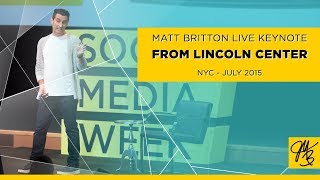
Matt Britton argues that young people now drive culture and commerce through social media, shifting status from owning things to sharing experiences. He traces this shift across retail, real estate, jobs, education, and wealth, citing examples like Sweetgreen, WeWork, and the gig economy.
I want to welcome Matt Britton and please join me in talking about disruption in terms of youth. Thank you. You guys want to come in? That's what everyone kind of filter in. So I am like the ADHD poster boy. When I was in high school, I couldn't even write a paragraph. So when Wiley called me and asked me to write a book, I was completely shocked. And I was like, holy shit, how am I going to write a book? I literally cannot focus. People in the audience here who know me and work with me will tell you that they were shocked when I agreed to write a book. And when they asked me to write a book. They asked me to write a book about how I started an advertising agency and started it from one person to 500. And I actually started my ad agency here in the Upper west side in an apartment here, not too far away. But I knew I couldn't write a book about how I created an agency from one person to 500 people, because in doing so, I would have had to get permission from Coca Cola and P and G and Microsoft to disclose all of our business dealings, which meant I would have had to have dealt with lawyers. And I had no interest spending a year dealing with lawyers. Any lawyers in the audience here? Awesome. Okay. That would have sucked. So instead I came back and said, instead of me writing a book about how I built my business, I'd rather talk about what I see going on in the world. And what I see going on in the world right now is that young people are in control and in the driver's seat of the future of the world and especially the United States. Now some people ask, well, wasn't that always the case? Yes and no. If you think back to the 60s and 70s, youth culture was largely a fringe counterculture. Sure, there are protests and be ins and happenings and Woodstock, and young people sort of want to revolt against big business and big government, but their voice and their impact was largely limited to those who were right in front of their face. They didn't have mass reach, they didn't have access to technology. So they would fight and push and push. But because they weren't able to impact mainstream culture, they largely existed as a fringe counterculture. And that's why they were always sort of in rebellion and in revolt, because they actually couldn't push through. Fast forward to today. Youth culture isn't only not a counterculture anymore, it's the culture. It's a driving force behind business, behind politics, behind commerce, behind geopolitical landscape. And there's two reasons why? First of all, young people have a bigger voice than ever before. So in the past, you only could be heard by the people who were in front of you. So you had to stand on a soapbox and actually get heard. Today, many young people, some of the YouTube stars that you mentioned, have bigger reaches than Viacom and News Corp and Yahoo and major media corporations because they've been able to leverage social media to have a massive reach, which in the past really was only reserved for media companies. And secondly, young people have commanded the use of technology. They've grown up with the Internet in the household, and because of that, they have an intuitive understanding of technology and how to use technology to break down corporations and institutions that have been around for centuries. And that's why you see companies like Blockbuster going away and Radio Shack, and the list goes on and on and on. The list will continue to grow because now taxis, right, because of Uber, soon to be Hilton and Starwood, because of Airbnb. There are so many companies that are going to be disrupted and, and ruined forever. And that's not a bad thing. But because young people have understood technology intuitively and said, why should I have to pick up a phone and call somebody to get a car when I could just hit a button and actually have it show up to them? That's how life should be. And young people growing up think differently. Their brains are hardwired differently than the rest of us. So because they have a voice, because they understand technology, and because they think about things intuitively, they're disrupting the world. And that's why you saw in the last couple presidential campaigns, the candidates couldn't ignore Millennials. Now Millennials, you hear over and over and over again. Used to be only five years ago, you only heard brands like Doritos and Xbox talk about Millennials. But now you hear life insurance companies talk about Millennials and luxury brands like Mercedes, because they are the people who are influencing the rest of the world. You look at platforms like Facebook, which now has the biggest population in, in the world if it were a country that started in a college campus. Same with Instagram, which is the fastest growing and most powerful social network. And now Snapchat is going to be something which I believe is going to be more broadly used. How many people use Snapchat in this audience? Ok, well, I think a couple years from now, you're going to have everyone raise your hand, just like the case with Facebook. So young people are really dictating the future. And that's what Youth Nation is about. It's about our youth driven culture. And one of the biggest things about a youth driven culture is sort of a flipping of the switch or a flipping of the card in terms of what's important. If you look back to Gen X, Gen X would largely define themselves by the physical items that they owned. So it was about the cars, it was about the sneakers, it was about getting the house. And the reason why is that that's how young people and people in general would generally identify themselves. The status symbols were actually the physical things that you could accumulate. And the reason why is that that's all people would see. If you had experiences, if you went to great places and you traveled, sure you'd have photos, but you wouldn't be able to share those photos with a lot of people. It would only be your families and friends. The things that you could broadcast to your social network in a larger sense were actually the things that you owned. But now with the growth of social media, that script has been flipped. And now it's actually the experiences that people collect which is building their personal brands, which is what I call in the book, moving from status symbol to status update. It's the status update, what people are sharing, which allows them to kind of define their personal brands. I mentioned Instagram. Instagram is the fastest growing and most powerful social network in the world, especially amongst the youth audience. And what people are sharing on Instagram isn't the picture of their new sneakers or that new Toyota Camry that's in their driveway. They're sharing the places that they've traveled to. They're sharing the adventures. They're sharing selfies with Kanye West. They're sharing. In fact, there's a picture of Kanye west where he. He's standing in a store and nobody's facing him. Everyone's like this, taking a selfie with him, right? Because that's actually the experience. Selfies are the new autograph. Autographs are going away. Nobody wants to get an autograph anymore. Autographs are not valuable selfies because selfies actually capture the experience. Autograph is very transactional, right? So we are living in a world where experiences are building and defining personal brands. And it's causing young people and I think the population in general to pursue experiences for the ability to showcase to the world what they are about. And businesses have been taking note as well. Has anybody heard of sweetgreen? All right, cool. So sweetgreen is a very fast growing, fast food store, except they sell all natural ingredients, salads, things of that nature. And it's exploding amongst the Millennial set. So sweetgreen knew, since they're targeting this millennial audience, that they had to differentiate themselves. It couldn't just be about the salad that they sold. So they spend almost their entire marketing budget on the Sweet Life Festival, which happens every year just Outside of Washington, D.C. this year, I had Calvin Harris, who's the top grossing DJ in the world, and Kendrick Lamar and others perform. This is the festival that they actually own. The people who sit front row at the festival, who actually get to meet the artists, are the most loyal consumers of sweetgreen. They take content from the festival and use it for their advertising throughout the year. Now, all of a sudden, a company that just sells salad is known for being an experience brand. They get to own this. Instead of putting up a banner at somebody else's festival, they create their own. And now young people associate them in a whole different light, and they associate them with experiences. They even stream music in their store locations from the music that's actually happening at the festival. This is the future of marketing, creating experiences that are actually becoming owned. Whole Foods Market, and this is a location in Brooklyn that just got built a couple years ago. They've redefined the supermarket shopping experience. Instead of it just being a store where you just buy your groceries, there's windmills in the parking lot that power the store. There's a produce garden on the roof where they grow produce that's actually sold in the store. There's remnants from the Coney Island Boardwalk in the store. There's local speaking circuits that come through in the supermarket each week. So now, all of a sudden, Whole Foods is an experience. Young people can talk about it. It's Instagramable, it's shareable, It's. It's differentiated from the rest of the supermarkets out there. Color Run. Who's heard of Color Run? Wow, you guys are really progressive. I love it. So colorun has redefined the fitness space, along with companies like Barry's Bootcamp and SoulCycle and Flywheel, because it's been about experiences. A company called Bally's, which is now bankrupt and out of business, had a very old school gym model. You had a membership, it had a cancellation fee. You couldn't bring your friends if you were traveling. You still got billed. And when you went there, it was just about the weights and the treadmills, and you actually went home. That is not about the experience. It's about exercising. If you look at colorun, people show up, which, exercising is important, but when you layer on an experience, then it becomes a movement. So you look at colorun and everyone shows up wearing white shirts to colorun, right? And then you get doused with color power and everyone is looking like this. About 20 minutes in. Perfect, Instagramable, shareable moment. It's an experience you're gonna share with everybody. The race is untimed.
It's.
It's not about winning or losing. It's actually about the experience of exercising. But people are still doing the run. At the end, There's a live DJ performance. This is turning fitness into an experience. SoulCycle, Barry's Boot Camp. Pumping music. Pay as you go. You can bring your friends, but you don't have to be stuck to a membership program. It's something that you're going to talk about that's turning the fitness space into an experience. So every brand, the Apple Store, obviously one around the corner from here. A perfect example of a retail environment turning into an experience. So all this has changed also the soundtrack of our youth. So if you look at the 80s and 90s and even early 2000s, the top 40 was really full with hip hop music. That was the soundtrack of our youth. And hip hop music was largely about the bling bling and the collection of material items in a pre Instagram age. That's how people describe themselves. And actually hip hop culture had a massive influence in the United States of bringing status symbols to the mainstream. And that's why the explosion of sneakers and suburbs and all these new kind of accessible status symbols arose from the hip hop era. But now you see a shift in the top 40, moving away from hip hop to electronic dance music. And the reason why is electronic dance music has tenants of peace, love, unity and respect. It's about actually bringing people together. The lyrics actually are about love and connections and friendships. And it's almost like a. A throwback to the 60s, but with a whole different sound and a whole different meaning. The festival circuit, as a result of the growth of edm, is exploding. Every single weekend this summer, somewhere in the country, there's a festival that will get at least 50,000 people to show up. The Electronic Daisy Carnival, which happens every year in Las Vegas, draws more people every single year than came to Woodstock, an event which defined an entire generation. So this is about experiences. Festivals are exploding. EDM is exploding. People are going to these things because they are able to capture experiences. And it's experiences which is building their personal brand to their social network. So all of this is creating, which I love this, which is creating a phenomenon which I call DFTY did it for the Instagram. And what difti means is that while Facebook had a massive influence on communications and Twitter did on how we actually get our news, Instagram, in my opinion, had the biggest impact on how people spend their money and their time. Because people are now pursuing experiences not only for the ability to actually enjoy those experiences, but to share them with others to prove that they did it, to actually prove that they went to experiences to show other people they're going to jump off that cliff so they can get that picture, so they can show everyone I jumped off a cliff. They're going to travel to a far off place or actually fight down to pretend like they had front row seats or zoom on their iPhone with that blurry picture. Even though they're not seeing front row, they to share it. Right? That's all examples of dfti. People are waking up every day. And for better or for worse, kids as young as age 8 are posting pictures on Instagram and refreshing with the fervor of a Fortune 500 company to see how many likes they get. Because that's for personal validation. Not a great thing. But it's the world that we're living in right now because people are validating themselves by how other people validate their experiences. Case in point, this is Mission Peak in Fremont, California. It's been around for a long time because it's a mountain and they're usually not created overnight. But in the last three years, Mission Peak has been plagued with overcrowding, complaints from local residents, pollution, lack of parking. Why? Because at the top of Mission Peak, there's an ultimate selfie picture pole that people climb up and actually take a selfie. Now all of a sudden, everybody wants to go to Mission Peak. It's right up the highway, it's easy to get to, and it's not that hard of a hike. But you'd never know by looking at this picture. And now everybody wants to climb up and actually take this picture. Hiking has not become more popular in the last three years, but what has? It's the ability to show other people that you are an adventurer. And you're seeing this happen all over the place, national parks, anywhere where you can get that great picture, that great view, people are going there. So for a business, it's what's my Instagramable moment? What am I offering that's going to want to make people share? Because that's what's going to actually drive people there. Because people's time is finite and they're only going to spend it in places where they can actually grow their brand. But young people only have so much money. So if the pie chart of their expenditures are actually going more towards experiences, it has to come at the expense of something. And for young people, it's actually them spending less money on the areas where people traditionally have spent the most money, which is on automobiles and housing. Automobiles. I mentioned Uber. For many young people, they never think they need to own a car. Uber is so ubiquitous, pervasive, and convenient, especially as more millennials stay in cities. When combined with the cost of gas, tolls, parking, and insurance, they're saying, I never need to own a car. And Uber is becoming so popular that many people think that they're going to be able to dictate the future of the automotive industry, actually saying what car should be built and what shouldn't. I was in France two weeks ago, and there was a riot where the. The local cab drivers actually blocked the streets and didn't allow anybody who was at the Cannes Advertising Festival, which is where I was, get to the airport to try to stop Uber drivers from driving, throwing rocks over overpasses into cars. It was actually a very violent situation they were fighting. But ultimately, as a result, more people downloaded Uber in France. So that just shows you can't fight where things are going. But because of Uber, less people are buying cars.
So.
So the American dream of buying a car is going away, as is the American dream of buying a home. Airbnb is exploding. They just got valued at, I think, $30 billion. More people stay Airbnb hotels on any given night in New York City than all the other hotels combined. That's how big Airbnb is right now. And for young people, they're saying, I could rent out my place that I'm renting when I travel, I can rent other people's places where I travel. I don't need to own a house anymore. So the American dream of living in the suburbs, big house, two car garage, white picket fence, that's kind of going away. Young people really don't envision that as the future they imagine for themselves. They want to stay in cities. Cities are becoming more safe. The parks are becoming better, the schools are becoming better, and younger people are saying, I want to stay in cities. I'd rather have connectivity than space and privacy. I'd rather be where all the action is I'm seeing in my news feed than actually moving out and actually being away from everything. So cities are all the rage. And especially with stuff like Uber, now, they can get around, and it's Actually more convenient. And there's so many Ubers for everything that. Have you guys heard of Rent the Runway? Rent the Runway is exploding. So Rent the Runway and Rent the Runway, Uber, Airbnb, Spotify, they're all examples of what I call access over ownership, which is accessing things is more valuable than owning those things. So Spotify, you're paying to actually access music, but, but you're actually not owning it. Uber, you're not owning a car. Rent the Runway, you can rent a dress for a night for $100 that you normally would pay $1,500 for. You could still Instagram the picture of you wearing it. No one knows that you don't own it and you return it the next day and you're saving that money to actually spend it on the thing that you're doing while you're wearing the dress, which is going out to a concert or a nightclub or whatever it may be. So access ownership is changing things. And it's allowing people to stay in cities where they can access these great services and, and not feel like they need to save up for the big house and the two car garage. And so people are staying in cities, which is driving gentrification in every major city in the United States. Brooklyn, best example here. Real estate in the last 10 years up 100%. The livable boundaries of Brooklyn keep getting pushed out. Areas that were crime ridden three years ago, five years ago are now selling townhouses for a million, two million dollars. Right? That's happening in Wynwood, outside Miami, it's happening in Oakland, outside San Francisco and Capitol Hill outside of Seattle University, you name the city at Jamaica Plains, outside of Boston. That gentrification is happening because more young people want to stay in the cities. So cities are gentrifying, being pushed outbounds. The blue collar workers who used to define the inner city are now actually getting pushed to the suburbs. For better or for worse. That's what's happening. And it's impacting the fabric of our country. It's also impacting the fabric of real estate because the cost of real estate are so high that for most retailers and cities, they, they simply can't afford to have a traditional retail location in the city. Especially when Amazon or companies like Postmates are delivering anything to you within an hour in a city. So how can a company actually survive? That's why every time that there's an open retail establishment, either is a Duane Reade or a Starbucks or a Chase. Why? Because those are things that you need within an hour. But Anything that you need later than an hour, Amazon can get to you, or ebay now can get to you, or Postmates can get to you. So these retailers are dropping off one by one by one because they can't compete with Amazon. So big retailers are not going to be in the cities anymore, and most big retailers are ultimately just going to become showrooms. So it's really impacting the fabric of real estate in the country. Amazon is getting FAA clearance to have drones actually deliver stuff to your house, flying through the sky in cities and dropping items on your doorstep. This is real. This is. This is not a hoax. It might happen one day soon, and it's scary to think about, but this is sort of the Jetsons era that we always kind of imagine coming to life. So not only is people living in cities changing the way they consume items, it's also changing the way that they actually derive income. TaxRabbit allows people to actually perform odd jobs for other people who are in close proximity to them, like assembling furniture, doing their laundry, actually even reading a book for them and allowing them to get a summary so they don't have to read it for their book club. All these things people are doing. And basically what happens is you go online, you Go on the TaskRabbit app, and you say, this is a task that I want done. I want somebody to come to my house and organize or do this or walk my dog. And there's so many people willing to do it, and we're in such highly dense cities that there's always somebody that will do it. Right now. And the interesting thing right now is over 70% of the taskers, the people performing the task, have a college education or higher. These are not underemployed people. These are people that are seeking additional income streams so they can have financial freedom, which is really giving rise to something that we spoke about earlier that Alex mentioned, which is the free agency movement. There is now unlimited income streams for people who have specialized skill sets in these highly dense areas. This is an app called Odesk. Odesk has over 8 million users and over 2 million companies as customers, where people can actually provide freelance services to over 2 million companies. Things like being a YouTube search engine optimizer or a humor writer, things that are super niche, super specialized. There are unlimited opportunities. I know a guy who's a Ruby on Rails developer, which is a very popular software development platform that makes a million and a half dollars a year working from his apartment in his boxer shorts, eating fruity Pebbles every day because he just puts his services up there and he just stays home. And there's unlimited demand for the service, those services in a highly dense area. He has no boss. He's the CEO of himself. He doesn't need to worry about coming into work every day. He doesn't need to worry about getting laid off. There's unlimited opportunities. So if you have a specialized skill set and you know how to market it with tools like Odesk or tools like TaskRabbit, there are unlimited income opportunities, which is also making young people question their career path. Should I really go work at a big company when companies are going bankrupt and doing layoffs and all sorts of things, when I can actually have a specialized skill set and actually become the CEO of me and actually market my skill set to people with unlimited income opportunities? So that's what the free agent movement is. People are not seeking careers anymore, they're seeking gigs. And this is actually growing. 53% of all millennials now are freelancers. And I don't see that number going down anytime soon. So the notion of becoming an entrepreneur has indeed become democratized. Now, I'm not talking about everyone thinking that they can be the next Mark Zuckerberg and build a multibillion dollar global organization. What I'm saying is young people are saying, you know what? I can actually become the CEO of me, and I don't need to go work at a company. The average age of companies on the Fortune 500 have went from 70 years old to 13 years old. And the reason why is companies are getting bought, they're going under. There's so much disruption and change. It's not a guaranteed thing anymore. And that goes for any industry, whether you're a lawyer or you're a doctor. When I was growing up, my parents said, be a lawyer or you're a doctor. You make six figures, you'll be all set, you'll get a nice goal, you have a family. That's not the case anymore because even those industries are getting disrupted. Doctors, they're outsourcing radiology reads to overseas places where they can be done a lot more cheaply. In the medical field, there's all these walk in kind of intensive care things, urgent care things are happening around the city, which is changing the entire health care system. So there's no job that's safe from these changes that are actually going on. So the growth in being an entrepreneur is creating a massive surge in a city called Collaborative Workspaces. This is something called WeWork. WeWork is now a $10 billion company, what they do is they rent out desks for as little as $150 a month. I wish I had this when I started my company, instead of rolling out of bed and working in a desk right next to my bed. Because for $150, I. I could sit in that desk right there, surrounded by other entrepreneurs doing all different things. Networking, sharing conference rooms, a coffee bar, health benefits. It's a culture that rivals Google, and you can jump around to any WeWork location around the city and around the world. WeWork is now the largest tenant of commercial real estate in New York City. They are a $10 billion company. They're redefining real estate, and they're redefining what it means to be an entrepreneur for millennials. Why is this happening? Because all these free agents are actually having these massive opportunities to work for themselves, which is really what the American Dream should be about. It used to be about work for a company for 40 years, work your way up to the C suite, put money away. But ultimately, that version of American Dream, that's not the American Dream anymore. People want freedom, flexibility, the ability to travel, the ability to be their own boss. That's really what. That's the new vision of the American Dream, and it's changing the way that people pursue families. In 1968, over half of Americans were living on their own with a family by the age of 30. Now it's only 23%. People are getting married later, starting families later, because there is so much freedom and because of Tinder as well. But there's so much access to people. There's so much access to experiences that people are putting off getting married, they're putting off having a family. So companies that are marketing the young moms, they're slowly marketing to an older version of a young mother, because people are actually pushing off. And as they stay in cities, it just makes sense for them to put off having a family because space is more expensive. And we're seeing this trend go on and on and on where people are having children later in life. We're also seeing a major push right now for specialized skill sets in education. The education space needs to change. People should not. I don't think young kids should be taught handwriting. And the reason why is the time when our young children are being taught handwriting. Kids in Japan are being taught how to build algorithms. And when we compete against them in a global workforce, in 15 years, they're going to run circles around our script. Right? Or why should kids be taught how to do traditional algebra? Where I can just say, siri, what's the root of this? Or what's this? Plus this? It's going to tell me it. So that level of thinking is, I think, romanticizing education. We need to educate kids for the world that we're living in. Mark Zuckerberg says the language of code is going to be more powerful than the language of English in 15 years. I agree with that. Mark Zuckerberg and Bill Gates are behind something called code.org, which teaches kids as young as age 7 to learn an hour of code each week. That is fabulous. That's being pushed throughout public and private schools throughout the United States. Kids need to learn code at an early age because compute everything is becoming computerized. We need to kind of get our grips of where the world is headed, not where it is. And the education system of people getting into debt for four years with these expensive colleges, I also think are going away. MOOCs, massive online open courses which allow the best professors in the world from Harvard and MIT to teach millions of people at once online. That's powerful. It's actually democratizing education. It's giving people opportunity all over the place. And right now the education system is still somewhat exclusive and leaves people out. So I think education has to change. Education has to change because we are entering a true global workforce. People here are going to be competing with people all over the world because companies are totally fine in the United States outsourcing any type of work anywhere where they can get it more cheaply. It's not just manufacturing anymore. It's now creative services, you name it. If it can be done more cheaply, then a company is going to outsource it. So every young person that's going into the workforce is competing with everyone around the world. And the most progressive education systems are, are going to be the ones that are going to win. And countries that embrace the future, that understand technology, where it's going to be hard to compete against them. And the ideals of America could quickly slip away. Now, obviously you look at the United States, that's where Apple and Instagram and Facebook and Twitter and Tesla and all these amazing companies were built. That's for a reason, because we've always stressed innovation, but we'll be able to continue in the future. Who knows? So all this technology and all these changes have created massive wealth disparity in the United States. For the first time since the roaring twenties, 0.1% of the population controls nearly 25% of the wealth. And you look at this huge spike in actually wealth disparity. And it happened around 1993, around the time when the Internet started. We're living in a nation of the haves and have nots. And I think this wealth disparity is going to continue to spread. There's going to be people on the inside that are actually commanding the use of technology and disrupting industries, and people on the outside that have no idea what's going on. And, and that's why the 0.1%, not the 1%, but the 0.1% is going to continue to grow in power and influence. And this is just where our world is headed. It's not good, it is actually bad. But it's because the wealth disparity is creating. I travel to places like Cincinnati, Pittsburgh, St. Louis, Detroit. In Cincinnati, in the nicest hotel there, there are locks on the door where you need to type a keypad in the bathroom to get into the bathroom to keep homeless people out. The nicest hotel, hotel. Imagine that being the case in the Pierre or the Four Seasons in New York or even the Marriott. Right. Would never be the case. Why? Because there's so much poverty and crime in those areas. In middle America, people who live on the coasts are largely immune, actually, what's going on. But actually where this wealth disparity gets exposed is in middle America. It's a big issue because the manufacturing jobs that used to be there are now getting offshored and the factories are now getting offshored and technology is just intermediating. People who don't understand. You go into a Duane Reade and there's no checkout person anymore. There's just. You're scanning it yourself. That's getting rid of jobs. Easy pass, got rid of jobs. Tollbooth collectors, Uber is getting rid of dispatchers, you name it. Those jobs are all getting eliminated and the middle class is basically becoming gone. So there's countries where you have the rich people that are living up the hilltops and everyone else is kind of going through their trash. We're heading in that direction that these numbers don't lie. And what it's creating is barbell economics, which means that there's two types of companies that are really thriving right now. It's the value side of the equation. Dollar Tree, Dollar Store, Dollar General, Walmart, Vizio that's making flat screens for $250. Hyundai, companies that really understand supply chain economics and how to provide the best product for the cheapest amount. Even if they're outsourcing to China, which is what they're all doing, they're winning. What other companies are doing well? Ultra high net worth luxury companies. Coach Michael Kors. Porsche, Apple, GulfStream, Private Jets, Four Seasons. Those companies are exploding in the luxury market. Who's losing? Companies caught in the middle. The Gap just announced they're closing 40% of their stores. Why? The wealthy people. They're not going to buy clothes at the Gap. The value side of the equation can't afford the Gap. They're in no man's land and that's what's happening. Target used to be a value play. Then they tried to become a fashion company. They did a deal with Isaac Mizrahi. They tried to push up stock stream, disenfranchise their value shopper. The luxury shopper is never going to buy clothes at Target. They got stuck in the middle. Walmart stuck to low prices every day. Right? That's what they're about. They're owning the value space. And these companies, Dollar Store, Dollar Tree, Dollar General are doing incredible. You think, how could they? They're only selling stuff for a dollar. There is such a market in the value side of the equation. So one thing I tell brands is you need to pick a side right now. You need to pick a side. You cannot be caught in the middle of the Abercrombie and Fitch. Another company caught in the middle, really struggling. They used to have a 5th Ave location. They're going to be shuttering it now. 5th Ave is just all Chanel and Louis vuitton and Yves St. Laurent and all these luxury companies. No one else can afford to be on that. And you know why? Because who's living near Fifth Avenue? It's the people who are worth $100 million or more. That's who's actually shopping there. And what's funny about those people is they're putting. New York City is now becoming a city of vacant apartments that no one ever visits. Because real estate in New York City has become such a safe place for people to put their money. They're actually just buying $100 million apartments and just leaving them empty. They don't care to rent it, but they know that it's going to hold its value. So it's becoming like in the Time Warner center, where some of the most expensive apartments in the world are. It's completely empty. No one actually lives there. People just own beautiful apartments and they might go there for two days a year. It's really shocking. But that's kind of what's happening right now. And all these changes are also having a massive impact on marketing and advertising. As well. So I'm going to talk about some predictions I see happening in the marketing and advertising space as a result of this technological boom. The first thing is phones. I believe we're going to be moving to a world of one device. What the iPhone 6 showed everybody is that there's not really a need for a tablet anymore. You only need one device. But I think that one device is actually going to be where every piece of information you see comes from. Now, sure, you might have what's called a lean back experience, where you're sitting on your couch and watching a flat screen tv, but that content's going to come from your phone. When you go buy a billboard, the content is going to come from your phone. When you go into your car, your car is going to become a docking station. You put your phone in and the navigation and the climate and the music is all going to be controlled by your phone. The phone is going to be everything. Which means to brands, if you can't reach a consumer on their phone, you're going to be invisible. Everything is about actually reaching them on their phone. Television is going to change as we know it. Right now there's two things holding up what I call the TV industrial complex, which means why does NBC, cbs, abc, Fox. These companies exist. Well, right now they exist to curate what they think America should be watching Thursday night at 8 o' clock and they're actually distributing content into your home. But the Internet actually does both of those things for you, right? So if you actually use Netflix or Hulu, you're getting that content from the Internet, you're actually not tuning in to traditional tv and you don't need them to tell you what to watch. At 8 o', clock, you want to binge watch Orange is New Black. If you want to binge watch that and you don't care what time it is, if it's 4 o' clock in the morning, you actually want to do it. But TV still exists in the advertising world. Companies are still spending 60 to 80% of their annual budget during the upfronts, which happens here in this area on traditional television advertising. But I think two things are going to happen in the next three years. It's going to break tv, TV as we know it. The first of all is that televisions are going to become smart devices, meaning they're going to become a lot more like giant iPads hanging on your wall. You're going to be able to go, kids still go up to TVs right now and they swipe TVs because they think you should be able to swipe it well, you're going to be able to have your tv, you're going to be able to push the Scandal app, and it's going to bring up Scandal. There's no more tuning into abc. There's no more taping things. Everything's going to kind of go through that. The second thing is the NFL is going to change its rights. The NFL is holding up. Traditional television in this country right now is the only thing that's watched live at scale in the United States. Last year, Sunday Night Football in the NFL was the most watched program both amongst males and female audiences. The NFL is the only reason a lot of people have traditional cable right now, and they still have deals with ABC, CBS, Fox, and DirecTV. But once a Google or an Apple or a Microsoft, all of which have way deeper pockets than traditional television companies, buys the rights, and you actually have to use Apple TV to stream the NFL instead of tuning in, I believe the entire country will cut the cord and cable will be dead. And once that happens, a lot of interesting things occur. If you actually think, if all TVs like Apple TV and I'm a consumer and I want to watch Scandal, I actually will have the option. I can pay $2 to watch Scandal without commercials, or I can watch it for free and see commercials. But in the barbell economy, does that only mean commercials or are seen by the value side of the equation? Because the people with money actually can pay not to see them. So then does TV advertising become worth it for brands? Where are they actually going to spend their money? So it's going to be really interesting to see. And then what's the role of TV networks at all? What is NBC if I can just pull it open, if I'm creating the next house of cards, why would I even consider distributing it on a TV network if I could actually just distribute it directly? TV networks I actually believe are going to go away. I don't think they're going to make sense anymore, because what's the point of them if you can actually just pull up content directly now, they'll argue. And what they're actually trying to do right now is start creating content on their own. But so is Google, and so is Apple. And all these companies have much deeper Pockets. All these YouTube stars are YouTube stars, not NBC stars. And that's who teens line up to actually see. Some of these YouTube stars have lines around the block, like every single day for people to actually sign their autograph. And you would never recognize them or hear of them. It's incredible the star power that these YouTube stars have commanded by creating their own videos and actually own content. That's the future of television. It's actually democratized celebrity in this country. It's no longer like you're a Hollywood star or you're a consumer. There's sort of like a long tail of celebrities that brands can take big advantage of because they have massive audiences. And the last thing I see changing is the telephone is largely dying. If you think about the telephone, the reason why it's always been great, especially for young people, is it's ephemeral, right? You have conversations but it's not being recorded. So you can say whatever you want and it's going to be gone. But you can't share emojis and pictures. You can't communicate with more than one person at once. And it's literally a disconnected device. When you make a phone call, there's no guarantee someone's going to be on the other side. You look at Snapchat right now and why Snapchat is exploding and why a lot of young people actually dragging out the phone icon from the bottom four apps of their iPhone. Dragging out the phone and dragging in Snapchat, it's become the de facto communication go to place for people to communicate with each other. Why? It's ephemeral. What does that mean? Young people realize that they don't want everything they say to follow them forever. They love the fact that it disappears. It's not just because they're sexting, obviously there's some of that, but they actually just don't want anything they see to actually follow them for the rest of their lives. They're being taught that that's not a good thing. Snapchat actually gives them security in knowing relative to any of the other platforms, it's going to go away. It also allows them to communicate in a new multimedia format. Emojis are becoming the new hieroglyphics. They are becoming kind of the modern day way that people are communicating with each other. They're talking in emojis and brands are now starting to talk in emojis. It's scary, but emojis are communicating emotions in ways that words actually never could. So you take emojis and images, that's kids love young people and consumers in general love communicating in a multimedia format, not just with words. And you can also carry multiple conversations at once. So it's beating the phone, it's becoming a new phone. Voicemail's already dead. I Think Goldman Sachs just banned voicemails and that's a big bang. So think about young people. They don't acknowledge voicemails, but while young people have, while young people have the phones as an appendage to their body, it's a actually not to make phone calls and they are not making phone calls at all. They are using Snapchat to communicate, which is they talk to each other when they're in person. But I thought maybe five years ago that FaceTime would be it, everyone would be video chatting. But no, they'd rather just communicate in emojis and images over Snapchat than actually do FaceTime, which I think is really profound. And the last prediction I have is I think these four companies to really change the world and change our economy may become so big and so powerful that they might be broken up by the US Government because we can't have a free market capitalist society with them still being in their current form. I think the biggest, most powerful company will be Facebook. They've recently logged over 1 trillion posts from consumers. The amount of data that they have on consumers is going to allow companies to target people in such a niche area to give them what they want when they want it. It's just too powerful. And in a world where the TV and computer combined, I think Facebook's going to power all television advertising. Because if you think about it, think about the NFL. It's the most watched female show as well. But you never see female marketers, Mr. Clean advertise during the NFL. Why? Because it's still more males than females, even though it's the most watched female show. But that shouldn't be that way. If it's capturing that much scale, the TV should be able to detect who's watching it. And if you're in a logged in Facebook state while you're watching tv, a brand could say, I want to target females. If I'm dodge, I want to target people who like Ford. I want to target people who live within 10 miles of Minnesota. And I'm going to do local advertising on the NFL or hyperlocal. That's how TVs going to change and become hyper targeted. I think Facebook's going to power all that because of the data they have. Amazon, forget about it. They are changing the face of retail and real estate. They're delivering products within one hour in cities. Anything you want they can get faster, cheaper, quicker. And they're knocking out mom and pop shops left and right and they're changing Main Street America. Main Street America can no longer compete. Even those towns that don't allow the, the Starbucks and the cvs, they're still getting killed by Amazon because people are very price sensitive. So they're going to buy from Amazon and the local hardware store is going to go out of business. They just can't compete anymore. So I don't think Main street retail is going to be a thing in five to seven years because of Amazon. Apple, I mean, Apple has changed communications forever. And they're going to get. They're going to reinvent the television, and I think they're going to reinvent the car. I think Apple is going to build a car and I think they're going to be sort of the future hardware and technology company. Apple is a company that has mastered the integration of hardware and software. Like, why did BlackBerry die? They didn't get software. They had great hardware, but they had really bad software. Microsoft good at software, awful at hardware. With the exception of Xbox, Apple did it all well and they've created the kind of the preeminent brand for the new generation. And I actually think the company that. It's funny because I thought they were the strongest when I put this presentation together about six months ago. Now they're probably the weakest is Google. And the reason why is as voice recognition gets stronger, people are just going to search with Siri. They're going to say this, that they're not going to type in Google anymore. Everything's going to be voice recognition. A lot of people gave up on Siri because it didn't work when it first came out. It is so good right now that the voice recognition is incredible that I think typing is going to go away soon. I think people are just going to talk and that's going to be what's typed and it's going to be 99.9% accuracy. And I think there's going to be no reason for people to type moving forward. So that hurts Google because if Apple owns the device and they can integrate Siri, then people might not search from Google anymore. And that's their core revenue stream. So I think Google actually out of the four, has some issues ahead of them. But I think companies like Airbnb and Uber are going to continue to grow and redefine housing and transportation. And I think companies. There are so many interesting companies out there that are going into sectors and they're actually just like you look at dry cleaning. Dry cleaning should be better. You should be able to track your clothes, know where they are, know when they're coming back. There's going to be an Uber for dry cleaning. Right. And you'll never have to call a dry cleaner again and you'll never miss an item of clothes again. Your luggage, you should always know where your luggage is. Right. You should never lose that. There are so many opportunities out there that things should be done better and easier. And it's a youth nation that's building these technologies that are kind of changing the game. So that's all I have for you guys today. I'd love to open up time for questions and take it from there. Yes, right here at the green.
Google's trying hard to match that they.
Are, but the problem is that. So they have Android, right. And they tried to have a hardware play when they tried to buy Motorola but then they sold it off. Since Google has never got hardware. Right. It's the hardware which actually is the interface with the consumer. So if everybody has an iPhone and they're using Siri to actually ask questions, then Apple can determine what powers that search. So those search queries can come from Bing or they can come from. Or Apple could charge Google a ton of money to make that search be delivered. But it's actually the device that's in consumers hands that the person that makes that, which is increasingly Apple is going to be able to control it. I'm not saying Google is going to die and they're obviously doing really well, but they have a lot of pressure in their business because they haven't cracked the hardware space and it's a place for Apple to be able to own it. Yes. Over here.
Elite class and massive.
Yep.
So where does that tension break?
Well, I mean, I think that it's going to manifest itself in different ways in different categories and different industries. I mean, there's geopolitical consequences to our nation, you know, I mean, what's this going to mean for unemployment and Social Security and things like that? You know, how is this country going to be able to survive if there's so much poverty and wealth disparity that's happening? I think that it gives people opportunity. I think there's tremendous opportunity right now more than ever before for young people to be in any income class to be able to take these tools and actually become successful. But the fact is a lot of them won't. A lot of them are going to be schooled in the 1980s world in 2015 and they're going to be ill equipped to take advantage of these opportunities and they're going to be on the wrong side of wealth. And that's that's what I see happening. So I think there's opportunity, but it's also a scary time. Awesome. You're not the first one.
Along those lines. Do you see that there's a role in your business and marketing and messaging and rebranding and rebalancing the inequality? And what advice would you give us? I mean, this is a group of.
Educators that are trying to change that.
Yes. Well, I mean, it has to start with education, right? I mean, education is the future. And ironically, somebody asked me last night, I did a presentation, where does the biggest opportunity lie in business to take advantage of this? And it's education. Education is so severely broken. People are being taught the wrong things and being incentivized the wrong way, starting in grammar school and college is completely broken right now. And I think education needs to change. Now, there's things like Skillshare and Code Academy that are actually and General assembly, which are incredible organizations that are redefining ways to get educated on skills that are needed for this new economy. But I think my answer would be, see where things are going and focus on teaching young people the skills and embracing the tools that they need to be successful. And don't make them think that they should be just trying to get good grades so they can get a job at a big company and they're going to be set for life. That's not what it's about. It's about specialized skill sets. And I think the areas that really win is going deep in an art or deep in a science, because everything else is going to be offshored. So middle management, if you walk into work every day and expect what to be told by a boss, your boss could tell somebody in Costa Rica to do it for a lot more cheaply. Right? So that job's going to go away. But if you go deep in an art, meaning in the creative world, you can be creative and innovative and actually think it's hard to actually replicate that. So what's that deep creativity? Whether you're an artist or a creative designer, or you name it, or deep into science, being an engineer, being a coder, being somebody who understands technology, going deep in either the arts or the science, very deep, very specialized, very niche. But the kind of whole general studies or liberal arts or these kind of very generic terms where you're learning a little bit of everything, master of all, jack of all trades, master of none, those people are not going to be able to succeed in the new economy. So I think it's about specialized skill sets and redefining Education. Yes. Over here. Yeah, I know. And Starbucks. Right. Well, I think a lot of cities are actually investing in beautification and investing in the arts, because as younger people stay there, like I live in Brooklyn, and there's so many opportunities to beautify parks and public spaces. And I think artists can redefine what it means to actually have a space and actually seek public spaces, to display arts and actually push the arts. But you're right, I mean, I. Artists are who are obviously the pioneers of gentrification. Right. They move to areas that no one want to live in, and they buy these big warehouses, they rent these big warehouses, and then all of a sudden they rent. They rent. Well, I actually think real estate for young people is largely becoming unattainable, which is why they're moving to an Airbnb model is. And that's going to push more wealth equality. I mean, you think about townhouses in New York City. 30, 40, $50 million. So nobody but the 0.01% can buy a townhouse in New York city. Well, now, three bedroom apartments in this area are $4 million, and in 10 years they're going to become 10. Who can afford $10 million? Even if you make $200,000, $300,000 a year, it's never going to happen. So it's like the new Rockefellers. There's going to be a lot to them, and they're going to be the people who actually are owning real estate. And it's not just Americans, it's the foreign investors that are coming in. It's going to create more wealth disparity. It's just the way the world is actually headed right now. And that's why young people are saying, screw it. I'm not even going to try to own real estate. I. I'm just going to be free. The American dream for me is not buying that house because it's unattainable to me anymore. But what is attainable is me renting and actually having my own gigs and traveling around the world and redefining the American dream. And that's kind of where it's headed over here, right? Yeah. I mean, I think I spoke to students last night, like rising juniors and seniors in college, and I told them, embrace risk, because not embracing risk is the biggest risk in this world moving forward. And you know those couple years when you're out of college and you're making a 40, $50,000 salary, that's the most expensive money you'll ever make. Because if you take that, then you're Going on a path and then you have a family and you have a mortgage or maybe not. And basically then you can never go off on your own and do your own thing. It becomes too late at a certain point in life. But if you actually try to embrace risk and embrace this free agent movement early in life, you could have that financial flexibility and freedom to explore the world and live the life you want to live. But if you're scared of risk and if you think that, I mean, Americans hate risk and they love knowing that there's a clear path which is what's created our society. But I don't think that clear path is the clear path that it once was. So I think we need to embrace risk moving forward because the world is a whole different place. Over here in the corner. Yeah, I mean, it's an awesome question. I mean, I think that education is, I think online education is becoming more and more real. It started with like the University of Phoenix, but that was seen as like, oh, it's not a real school. But now there's companies that are taking University of North Carolina and actually putting it online for $50,000 a year and allowing people to actually do it from anywhere. Which means. And so if one teacher can scale that way, yes, it could eliminate jobs for teachers. It's not really the, it's not necessarily the phones, but it is technology. That's the same way that young people have a bigger voice now. Well, so do the most powerful teachers. That's another form of the wealth disparity that's being created. I also think there's a business opportunity in allowing kids to go into an education mode on their phone where you flip it and all you can do is learning oriented things on your device. Because the confiscated device is counterintuitive to the world that we're headed. But you want to make sure they're not on Instagram the whole time. So I think that there's some opportunity there to actually embrace that. Right here it's just a website. Code.org if you actually go to the site. Yes, yes. Check it out. It's amazing. It's a big part of it is empowering teachers.
Yes.
Over here.
You talked about the changing restructuring in society of business. Where do you see our business? Where are we going?
The education sector. I mean, I think that it's going online. I think it's becoming more scalable. I think it's becoming more specialized. I think that the traditional schooling system of grammar school is going to. When you take education and government combined, those are like the two most slow moving. So that's going to be the most like the biggest laggard. But I think that higher education, especially private higher education, I think that's going to evolve very quickly. I think like Mark Cuban, who is a big voice in the tech space, has said he thinks college is going to be dead. He doesn't think people are going to do it anymore, that they're going to go into debt, take four years away from advancing the real world, learn things that are largely not applicable to the real world. So they have this degree which they think they can hang up. Because I can tell you, I've been burned by so many Ivy League resumes. You know, like what all I care about when I interview a young person is what have they created? Show me something that you've built. Is it a blog? Is it a video of your. Of your younger brother's birthday party? I don't care what it is. Do you have. Are you big on Twitter and are big on cooking and you have a big audience? Those people that have the initiative to actually create and build things are the people that succeed. They not people who have got straight A's and walk in with a Harvard education. To me that means nothing right now. It means nothing. And I think that's where it's changing. So if that means nothing. Well, what means everything? It's those specialized skill sets that are in need by big corporations and the world in general. And that's where I think the opportunity lies. Yes.
I'm just trying to piece together, because you can talk earlier about the importance of experience.
Do you think there's a way to.
Channel that desire for experience, to bring it into education?
Absolutely, because online experience is a totally different experience.
It's not an authentic experience.
True. I mean, I think experiential education. I mean, private schools in the city are taking kids that, you know, it's about, you know, the Hudson river project. Right. And it's like you're going up and down the Hudson river and you're learning about the history and you're traveling all over. And that's experiential learning. That's amazing. That's combining experience and education. I think there's a huge opportunity there. And there's a huge opportunity for young people to get involved in charities and causes and actually learn about the world through the eyes of doing something good, which is another way that you can actually get involved. So I think that there's a huge opportunity there for sure. Yes. For those of us who have now.
Educated our kids in the 80s and 90s and we have all this college debt.
Exactly. Yeah. We send our kids to go all.
These a.
I'll get back to you on that. Over here.
Festivals, what are you seeing in the world around maybe more traditional fine arts venues like museums, concerts?
They're growing. I mean, they're all growing. I mean, they just opened up the Whitney here in, you know, in the Meatpacking District area, which is like a very trendy area. And it's exploding. It's doing incredibly well. The arts are not just in DJ festivals, but in every area where people become entertained and invest in experiences. They're continuing to grow and people are sharing those experiences, and it's impacting who they are. I think that what we're finding is that some of these companies that have a very old world philosophy, so it could be like a ballet and Lincoln center, for instance, if they want to appeal. It's almost like I look at the ballet and Lincoln center, like Major League Baseball. Right. They're beautiful things, but they were things that were built for a different generation. Major League Baseball is too slow. So the millennial audience doesn't. They want NFL and NBA. They have a problem. They need to change the game to bring more people in to a great experience. Ballet maybe as well. Maybe it's too slow. Maybe they need to integrate more contemporary music. Maybe museums need to actually have more interactive things and more shareable things. So I think that they just need to change the way they package what they're offering to be to talk to this new generation. But there's definitely demand and interest there. Yes. In the corner. I just wanted to go back. No worries.
To the question about what educators can do and your suggestion that we need to be teaching code in school from a very young age. And it just brings up for me some issues.
It's not my suggestion. Yeah, yeah.
If we're to teach code to all kids starting from a young age, it would be no different than teaching them English. They're not all going to become novelists. So I can only see two things happening. One would be we'd end up with an underclass of code writers who get paid very little because there's not much demand for them, or they wouldn't be able to compete with all the code writers that are now being sourced from other sources.
So right.
Here at Lincoln Center. Not to be commercial.
That's cool.
Why aesthetic education is so important? Because it's kids that learn how to adapt to change, respond to trends, engage in their environment in different ways that will survive these type of shifts.
So I would compare code to Mandarin. Right. So. Or French or a secondary language that's being taught. I don't suggest that they should be learning code instead of English, but I think that I would argue that young people having understanding at a cursory level what code means and the tenets of code is more important than them understanding French. And I think so young kids are taught a secondary language. I agree that code is a more important secondary language, but than French or Mandarin or another language. Because it's going to be the language that drives everything that people interact with. So at least understanding how it's built and how things are made. I agree. If you just go so deep into it that you don't even know how to talk to other people or you don't understand how to be creative. But I think the presence of it and a cursory understanding of how things work when everything in the world is powered by computers and nobody has any idea how any of it works. Well, that's scary. As well as more and more things get powered by computers, how are people, you know, how are people supposed to understand how to solve complex problems if they don't even understand the language that powers it? I think that's the thinking behind it. Yes, that's right. Or parents who are at the kids recital going like this, not watching in their high def with their eyes, but through their phone. I don't have those. But.
But I see a generation of people that don't know how to communicate with people that know very well how to integrate technology into their lives but do not know how to communicate with people.
Yep.
You're saying that the future is holding independence for them because they can each just have their own skill set and thrive independently, corporation or whatever. And I see that getting them even further away from relationships and connections with other people. And that to me is making the world a very scary place.
It is, Yeah. I mean, I think with every societal advancement, there's positive and negatives that come out of it. Right. I mean, some could say that the car, you know, the automobile or the airplane brought families away from each other. Now families live all over the country where they used to just all live in a village together and families would stay together forever. Right. But now actually if I had a meeting in la, I can be there later today. So that's the ups and downs and I think you're just identifying a negative from a societal advancement that I don't think is 100% the case. Because people are going to festivals, and they're doing these things. They are communicating, and they are together. And if they're going to a wework. Right. They are interacting with other people. Where. When I started my business before wework, I truly was alone. I actually really was by myself. So I don't know if it's 100% the case. I think people communicating in emojis and images with other people is a form of creativity, but it's sort of a different form of creativity. So I think there's an element of what you're talking about. Right, right. And that's. But that's what's happening to our society. You're right. It's just. Right. Right. I didn't invent this stuff. Don't. Don't kill the messenger. So please thank me.
Join me in thanking Matt.
Thank you.
More from Matt




MikMak’s Rachel Tipograph on Consumer Spending, Retail Media & Holiday Shopping Trends



Jaguar Land Rover’s Charlotte Blank on Luxury, Purpose & Experiential Storytelling



