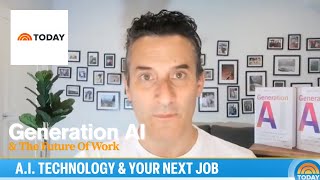
This TODAY Show segment (featuring Matt Britton and Savannah) discusses how generative AI is reshaping work — from warnings by AI pioneers about job displacement (Geoffrey Hinton) and predictions from industry CEOs to public attitudes measured by an NBC News Decision Desk poll. The hosts balance doomsday warnings with examples of new AI-adjacent roles (consistency coordinator, AI plumber, designers) and practical advice: learn to use AI tools and teach kids about them. The piece emphasizes both risks (potential unemployment/inequality) and opportunities (new jobs that manage or design AI).
Questions this video answers
Geoffrey Hinton (on the Diary of a CEO podcast).
Just over half of those surveyed said they rarely or never use AI tools like ChatGPT or Gemini.
The CEO of Anthropic (as reported to Axios).
Does all the scheduling.
It's a struggle employers have faced for decades, but scheduling is the main part of my job.
You still have a human being in charge of booking tennis courts. What is this, 1990?
But finding the balance of jobs done by people versus machines is rapidly becoming more complicated with the rise of generative AI. Now one of the men who pioneered the technology warns it could pose a threat to workers in nearly every sector.
For mundane intellectual labor, AI is just going to replace everybody.
Geoffrey Hinton, considered the godfather of AI, saying on the Diary of a CEO podcast without steps to reform how it's developed and implemented, we could see jumps in unemployment and wealth inequality.
If AI can make everything much more efficient and get rid of people for most jobs, or have a person assisted by AI doing many, many people's work, it's not obvious what to do about it.
Hinton's not alone. The CEO of the AI company Anthropic recently told told Axios he believes AI could wipe out half of all entry level white collar jobs. Amazon CEO also telling employees expanded AI use will reduce our total corporate workforce in the coming years. When it comes to using AI, a new NBC News Decision Desk poll finds a pretty even divide, with just over half of those surveyed saying they rarely or never use AI tools like ChatGPT or Gemini, and a nearly even split when it comes to whether they think AI will make the life of them and their family better.
We marveled at our own magnificence as we gave birth to AI.
While it might seem overwhelming, experts say the idea of AI taking over is more science fiction than reality, suggesting it will even create new jobs, many of them surrounding AI itself, including how to train it and figuring out just when and where it could be used.
So the skill sets that are going to be in demand are less about how to solve the problem and more about being adept and identifying the problem that needs to be solved.
Author and AI expert Matt Britton making this comparison.
So for a while you need to know how to operate a camera in order to be a good photographer. Now most of the best photographers just need to know where to point the camera to. And I think it's a great analogy for AI.
I mean, hearing that warning from one of the guys who created this technology is a little dry. So if Savannah, if you are worried about artificial intelligence, you know, taking away your job, what about opportunities for, for people who might want to get into AI?
Yeah, absolutely. Or even just as jobs start to transform within companies right now, as companies start to use more new jobs, you've never probably even heard of one called, for example, a consistency coordinator. Have you ever noticed when you see some of these AI generated images, it's like somebody can like kind of look different from frame to frame. It's like something's a little off. So as companies start to use this technology, it gets more complex. Somebody to make sure that it's consistent throughout.
Another one is a plumber.
Okay, one note is real skilled trade jobs are going to continue to be important. An actual plumber, an actual electrician, but this is an AI plumber. As there's layers and layers, cars and layers and layers of complexity, things can go wrong and somebody's got to kind of go in there, figure out what went wrong, and then fix it across company wide implementation. Finally, the last one, designers. Even though these computer systems are going to be doing so much of the technical work, that human touch, something that actually has kind of that eye for design will make a big difference. So we still need humans. We do need humans. And actually the best advice I heard in reporting this story out yesterday was you really should start familiarizing yourself with AI, Even if it seems hard. Play around with the chat bot, start to kind of see how it works.
It seems like the type of story that you would, wow, this won't happen on my watch. But then you hear so much about the timeline of AI and like, oh my gosh, it's going to impact me now.
We've been playing with it for the last few months. You turned me on a couple of weeks ago to a new AI app that. But you're right, you make a good point. Just kind of.
And for parents, also your kids using it in the classroom and to understand how it works so that you can help them.
Thank you.
We still need meat for Pop Star. You need plumbers and you need Pop Star.