Matt Britton: Millennials & Hospitality: Live In Anaheim CA 10/12/17
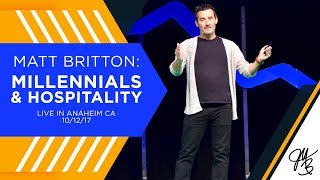
Matt Britton, CEO of Crowdtap, breaks down how millennials are reshaping hospitality and travel. They prefer access over ownership, share experiences on social media for status, and trust influencers over traditional ads. Hotels and restaurants need to rethink strategy around Airbnb, Instagram moments, and voice assistants.
My name is Charles Harris. I'm the vice president of marketing for Visit Anaheim. So happy to have you all here for our second annual Digital Marketing Summit Series. Before we get started, I wanted to recognize the folks from Visit Anaheim that you may or may not know. We've got a whole bunch of folks sitting in the back, but if you work at Visit Anaheim, please stand up so the folks in the room can't see you. Pepe, I need you too. This is our effort to help provide a lot of value for our partners. The first time we did this, we opened this up to our hotel partners. And now in our second series, we're opening this up to all of our partners. And a lot of work went into this from our communications team, Tanya Winkle, who will help run today's event, as well as Lindsay and Erin in the back of the room. We appreciate all your work and your efforts. We are very fortunate to have some great partners that we work with and they are here to help educate and entertain and hopefully provide some great resources for you and its partners that we have worked with and helped move our social and digital platform forward. So without further ado, I'm going to turn it over to Tanya and let her walk you through the day and lead us. So thank you for being here.
Good morning. I'm really psyched to have you all here today for our Digital Summit series, the Power of Influence. As Charles mentioned, I wanted to make sure that we highlighted our communications team. Erin Rose and Lindsay Miller. A lot of you have worked with them in the past and they're fantastic. So, you know, if you have any communications needs or would like to partner with us on any opportunities, those two are your winners. So about today's event. You know, our team, our communications team is always looking for new and innovative ways in which we can tell and promote our destination story. Our ultimate goal is always to tell her story and make people, make sure people are listening and hearing and understanding who we are as a destination. One thing that we found has worked time and time again is when we work with our partners. You really do help us tell our story. You help us show really what our destination has to offer. All of the wonderful, amazing things that, you know, our destination has and that we can tell our visitors about, whether they're business guests or leisure visitors, ultimately, you help us help them fall in love with Anaheim and Orange County. After today, if you're interested in learning more about how you can partner with us, we'll be sending a follow up email with our contact information all the communications team. We're always open to, you know, experimenting and seeing different ways in which we can really reach out to, to visitors and potential visitors. We're so excited that you chose to join us today, and we have an amazing group of presenters. These folks will really help us understand that power of influence and how we, as a destination, can expand that influence. We're always trying to figure out how to spread our influence, and, you know, these folks really, really would help us with that. We find the idea of influence to be fascinating because there's so many different ways we can interpret that and how you can apply it to your brand. Each speaker today has a different way that they use influence to connect and to create. I want to make sure I touch on all the points. So without further ado, I really want to get the show started. Our first speaker is Matt Britton. We're really excited to welcome Matt. He's the CEO of marketing technology firm Crowdtap. Matt is a leading expert on millennials, having consulted for over half of the Fortune trucks, 100 companies over the past two decades. Matt's unique ability to connect the dots between the new consumer culture of today and business trends of tomorrow is what offers what offers unique value for his clients. Help me welcome Matt to the stage.
How many millennials in the audience right now? Okay, those of you who aren't, did you at least act like millennials last night? So it used to be when I was on stage, when I asked who was a millennial, I was like, wow, that person's super young. It's really impressive. They're there. But millennials actually aren't even that young anymore. In fact, the millennials, the youngest millennials, are actually 21 years old. So soon, they're not going to be the cool, young, new, disruptive generation that we knew them to be. They're going to be a generation that we look at in the rearview mirror. And I often get asked, what's the big deal about millennials? Why do people care about millennials so much? Why are they a generation that everyone talks about on CNBC and New York Times, and every single time you turn around, there's another millennial conference? Well, there's a reason why. The millennials were the first generation that grew up with the Internet in the household. So I'm a Gen Xer. I just missed by three years. Sometimes I lie and I say I'm a millennial, too. But when I grew up, I had Encyclopedia Britannica, right? I had actually dial the phone and talk to people. I did not have access to the Internet. I did not have the intuitive understanding of how to break down businesses that had been around for a century. I didn't have the ability to do research instantly or, or text my friends at 3 o' clock in the morning. The people who grew up with the Internet in the household, the millennials, Gen Z, everyone else on I look at as really a different species. They really are not like every other generation before them. They're not like Generation X, they're not like boomers, et cetera. If you think about businesses like kodak that took 100 years to build and a couple years to kind of implode, or the New York Times took 100 years to build to a billion dollars in value. In Instagram, which took a year to build to a billion dollars in value. You see the acceleration of change and you see how this generation is kind of used to a reality that's unlike a reality we understand. And what's been fascinating to me over the last 20 years in working with major companies in every single industry is that they have a C suite that is filled with people who aren't millennials yet, right? So they're making decisions based on an old world. They're spending 80% of their money on television, when the reality is that my 12 year old daughter has no idea what a television network even is. She does not know what NBC, abc, Fox or CBS is yet. That's where major advertisers are spending their money. And what's really frustrating to me about big companies is that they talk about Mark Zuckerberg or Evan Spiegel, the CEO and founder of Snapchat. Yet the 20s and 30 year olds in their organization are eight floors buried down and have no voice. So one thing I tell big companies to do is think about creating a shadow board, a board of younger people, your young stars, and actually have your board sort of like almost report to them, have them ask why they're wasting so much money on television, or why they're not promoting people based upon the impact they have to an organization rather than seniority or actually years there. I think companies that listen and open up their ears to actually what's going on in the world are ones that can really disrupt themselves. And it's not just big companies. It's companies of all types that have grown up or have founders or CEOs that did not grow up in this generation. And when I talk about millennials, it's more the millennial mindset, because there are people and I'll talk about in this presentation that are 50, 60 years old, that have a millennial mindset. So it doesn't matter how old you are, it just matters how willing you are to adopt change and transform the way that you actually look at business. So I know we're all today in a hospitality business. And as the millennials are getting older, it's time to look at the legacy of this generation. When we look back 10, 20, 30 years from now, when we look at the millennial generation, what impacts have they had on society? And more specifically, what impacts will they have on your industry? Today I'm going to talk about 10 reasons why millennials have forever changed the hospitality industry. I gave a lot of thought to this over the last couple days in terms of when we look back and when all of your businesses are so different, three, four, ten years from now, why will they be different? What were the things that millennials had brought to society that had brought the culture, that brought the business reality, that made this world different? That's what we're going to talk about today. I talk extremely fast. If you guys need to maybe slow down. Jill, slow down a little bit. That's good. My Twitter handle is addyb. If you guys have questions that you want me to answer, I will check my Twitter handle after this. I can answer you guys directly in DM if you guys have any questions. Use me as a resource moving forward. I also want to thank Visit Anaheim for having me. I love Southern California, have a lot of family here, and I'm really thrilled and privileged to be here today. So you guys ready to rock? Let's do this. Number one, the American. I didn't even want to wave you right there. So the American dream has taken a U turn. So we all know the version of the American dream, right? The big white house in the suburbs with the white picket fence and the two car garage. Growing up, 60s, 70s, 80s and 90s, that's what we thought that the version of reality was. And the version of the American dream was, you know, it was go to a good college, choose a really good tried and true career path, like being a doctor or being a lawyer, go out of college and graduate, meet a nice person, move to suburbs, start a family, right? That's the vision of the American dream. And obviously the vision of the American dream now transformed to maybe the 90s and 2000, obviously included the big SUV that you'd roll, you know, your Lexus into the SUV or the cul de sac with as kind of the ultimate status symbol, which you would drive to Target and suburban sprawl and fill up the back of your car and you would send your kids. And that was sort of the version of the American dream. But the American dream is really taking a U turn because this millennial generation is really all about urbanization. They do not want to move out to the suburbs because the action in a 24 hour news cycle is not happening out in the burbs, it's actually happening in major cities. We didn't have the ability growing up, we, meaning we Gen Xers, us old people, to actually see when we're 30 or 40 years old what 20 or 25 year olds were doing. But now you do. And now you see everything that's going on. And everything that's going on is actually happening in the cities. It's actually making people want to stay in cities. And when they're staying in cities, you, they're sacrificing the proximity or they're sacrificing the space and they're sacrificing the privacy for proximity and connectivity. They're in cities, in smaller abodes with not nearly as much space, but they're where the action's at and they're where all their friends are and they're where the jobs are. And this is really changing kind of the demographic, psychographic and social economic landscape of the United States. This is Washington D.C. and you can see actually there's three different classes on this graph. You have the creative class, which are people who are in creative industries, right? They're people who can go deep into an art, whether it's basically design or you're a graphic designer, or you're a copywriter, or you're some type of creative or innovator. The second is the service class. Those are the people who are in service class. A lot of people in the hospitality industry obviously operate in the service class. And you have the working class right? Blue collar America. Now if you were to look at this graph, maybe 10, 15 years from now, it would actually be the inverse. You have the working class in the inner cities, but now the notion of the blue collar inner city worker is actually being flip flopped or reversed. The blue collar workers actually are the ones that are being pushed to the suburbs, as the millennials say, in cities, real estate prices are going up and the working class can't actually afford to stay in the cities anymore. Which is really fascinating on so many levels. If I would have told my parents growing up, you know, I wanted to live, I would go outside Philadelphia, I want to live in center city Philadelphia. They would have thought I was crazy, right? Because it's just not what people used to do. Now you have people staying in cities, Schools are becoming better, there's more parks, they're becoming safer. And again, that's actually where the action is. And because of that, it's changing the way people think, it's changing the way people act. People are staying in apartments and because of that they don't have as much space anymore. And because they don't have much space anymore, they're actually not buying as much stuff, which is number two, stuff is increasingly being accessed and not owned when we don't have a lot of space, right? And we don't have cars because think about how expensive cars are in major cities. We don't have the ability to go to Target anymore and load the back of our cars and actually come and load our kitchen with tons and tons of stuff and go to Costco and just buy stuff just because you can actually buy it. Right? We have to be more choiceful because we actually don't have as much space anymore and we're in cities. So there's just more to do than just kind of collect stuff anymore. So this is an apartment, right? This is a one bedroom, actually it's a studio apartment in New York City which costs, I don't know, $2800, 3000 dol. In Anaheim you could probably get a three, three bedroom with a nice parking spot, maybe a tennis court and a pool in a shared environment. This is what you get in New York. And it's not just New York, it's Washington D.C. san Francisco, Los Angeles, all the major cities. Where's all the stuff go? But since there's not, there's not stuff in the house. But there's plenty of stuff to do which we'll kind of get into because this generation is staying in cities. It's driving tremendous growth in real estate prices in cities. So let's take Brooklyn, New York, where I currently live. In the last 10 years, real estate prices in Brooklyn are up 120%. Okay. And there are areas that used to be crime ridden, like Bed Stuy, which you know, and Jay Z wrapped around about State street, where he used to actually sell drugs out of, which is now across from the Barclays center, which he owns, is a part owner of. And those apartments on State street are now selling for two and three million dollars. Right? So areas that were crime rated were now selling for millions and millions of dollars. Since millennials are staying in cities, the livable boundaries of cities are Getting pushed further and further and further outwards. And what's happening is you have this huge increase of real estate costs and it's really killing these retailers who used to have great locations on Main Street. They don't have a business anymore that they can afford. And let's face it, the young people, they're not going to stores anymore because they don't have time, they don't have cars, et cetera. So the notion of filling up your shopping carts right at Target, I'm sure some of us still do it. And I personally love Target. Sometimes I just go to walk around, they think it's one of the greatest places on earth. This is what it looks like now, right? The doormen do not know what to do with all the Amazon boxes. They stack up, they stack up, they stack up. And while you might say to me, well, Matt, well, that just. Doesn't that fly in the face of what you're saying? I thought they didn't buy stuff. These boxes maybe have one or two things in them. So it takes up more space in the lobby, but not necessarily as much space in the apartment complex. So this generation is not living in suburbs. And because they're not living in suburbs, they're spending more money on less space. And they also aren't spending money traditionally on things that consumers used to spend money on, namely the two places where consumers traditionally spent the most amount of discretionary expenditures, cars and housing. So let's start with cars. The ease and ubiquity of Uber in major cities far, far, far outweighs the the cost of a car when combined with gas, parking, tolls, insurance. What is the point of owning a car? The only people who argue that this generation is going to buy less and less cars when I speak all around the world at conferences are people who work for automobile manufacturers. And if I were an automobile manufacturer, I would specifically just build for Uber and build for Lyft and these sharing economy cars. Because this generation, they just don't care about it needs to be a rite of passage, right? Get that new car even in high school. Drive a car, it's just not a thing anymore. People rather access a car versus owning it with a tool like Uber, which I do not see going away anytime soon. And I think ride sharing is really the future, which I think is a positive benefit to this economy in a lot of ways. Housing, real estate prices are going up in cities. Young people cannot afford houses anymore, and actually they don't even think they could save up to afford houses. The cost of a One bedroom apartment in major cities. San Francisco, New York, a million dollars, a million two, even Austin, Texas, $600,000. These people cannot afford apartments anymore. When I moved into the city in 2000, it was, you know, I couldn't buy a townhouse. It was like Rockefeller money and old money. Well, now it's kind of the way with almost every apartment, it's not accessible. So they're renting homes. But the good news about them renting is they use tools like Airbnb where they can, and that's a very cool Flintstone looking house. Still have to figure out where it is. But they use tools like Airbnb to rent out their house or their apartment when they're traveling and rent other people's. So they're okay with rentals because it kind of gives them the freedom and flexibility and mobility and they actually find themselves way down. Because we'll talk a little bit about the career path a little bit later, but the career path of this generation, how it's not, you're going to work for the same company 30 years anymore because of it. A lot of young people are coming out of college and saying, well, you know, I might not even be in the city for the next two, three years. Maybe I want to live in Europe. Maybe I want to live in a different area of the United States. So why get bogged down with a mortgage anyway? So home ownership again. And a lot of people say, well, it doesn't impact people's savings long term, maybe. But then people in 2008 who had houses kind of sink under and you know, they had a mortgage that was on the water, maybe they would say that that's not a tried and true saving method anymore either. But houses and cars are things that people used to save up for, but now they're accessing it over, owning it, and even clothing. Have you guys heard of Rent the Runway? So Rent the Runway is a fascinating business. So you have a group of girls, you're going for an important night out. You can all buy $1,000 dresses from Diane von Furstenberg, and you can spend all your money and you can wear it for a night out. You can put it in your closet, you might wear it once or twice. And sure, you'll get that great insta with the dress, but why not just rent it for $75? No one knows that you don't own it anyway, right? People say, oh, you're so fashionable, you have so many great coats. Well, the real secret is maybe you're just renting the dresses and you're actually returning it. So that's what Rent the Runway does. They're online and now they have physical retail stores. We can actually rent clothing, even music. The one thing Steve Jobs got wrong is he thought that consumers would own music. But the reality is there's only so many times you could listen to Despacito, right? So why buy it when you can listen to it 100 times in the month of July and never listen to that shit again, Right? So with Spotify, and that's why Apple bought Beats, you can access music over owning it. So almost everything is now about the sharing economy. It's about sharing stuff and using stuff and actually giving it back again. The very notion of borrowing clothes and giving it back for a wealthy, affluent millennial base would just be such a foreign concept years ago. But they're saving money by doing it. They're saving money on lots of stuff. And because they're staying in cities and because they're more connected, they're actually acting younger for a lot longer. And they're waiting and pushing off marriage for, for the first time. The average age of a male who had their first baby is over 30 years old. And females is 26 years old. If you look back 10 to 12 years from now, it was actually 24 years old. If you go back 20 years from now, it was 22 years old. People are getting married later and later, they're starting families later and later. Why Tinder? That's number one. Number two, let's face it, it's more expensive to live in cities. A lot of cities, if you want to raise kids there, you have to put them through private school. That's, that's driving more two person incomes that are coming into the household. So a lot of the women are working longer later in life. They're just working forever, which is such a great thing. But that's making people push off getting married, push off starting a family. And because of that, they can live younger later in life, which means they can travel later in life and act younger later in life. So here's the median age at the first marriage and first birth. This is first birth unmarried woman, which is a whole different kitten balloon, which I won't get into. But the median age of first birth of a woman was 22 in 1970. And now you'll see it is up to 26 and 27. So. And men's at 30. So you can actually see people getting married later. And this is something that we don't see stopping anytime soon. And there's obviously a lot of issues, byproducts of that. People say, well, that's why, you know, you have so much autism and all this other, you know, health related issues. I'm no doctor, but everything I say at these conferences, people come up to me and say, well, isn't that bad, right? Isn't it bad that people aren't buying houses? Isn't it bad that people are getting married later? But when the airplanes were invented, there are people that actually said, you know, well, people are going to be moving away from their families. Well, it's true, but if I didn't have an airplane, I wouldn't be able to speak to all you guys today. So basically every single progression that happens in society does have positive and negative connotations. I'm not saying all this is great. I'm not saying gentrification is great. We have businesses that have been around for 100 years, mom and pop shots, they get knocked out of business because of Amazon. But it's just where the world is headed. And if you hold on to where it was, you're gonna get trampled. Right? And that's what happened to Polaroid. That's what happened to Circuit City. That's what happened to Toys R Us, which just declared bankruptcy. Hold on to the past, you're gonna get trampled. So I admire Wall Street. Gordon Gekko. So talking about people, I think younger later, this is kind of the opposite. This is a very good looking Michael Douglas back in the day, pre meltdown, Charlie Sheen. And this is what the ve used to be. This was the modern vision of the CEO back in the 80s, right? You wore a suit to work every day. All about capitalism. It was all work and no fun. And here you have Eric schmidt, the former CEO, now chairman of Google, at Burning man, at 48 years old, Definitely on something, although actually sort of made perhaps allegedly on something, because 90% of the people at Burning man are. And he actually, the reason that he got hired as the CEO and chairman of Google is that so Sergey and Larry, the founders of Google, one of the most important companies ever, right? If not the most important company, actually met him at Burning Man. And that was actually the cultural indication they actually wanted to hire him. So talking about people living younger later, Burning man is travel. Burning man is people exploring. Burning man is people focusing on experiences that would never happen in the 80s. You think Gordon Gekko would go to Burning Man? Not a chance. Right. So people don't believe that, that they have to get older anymore because they see the youth and they see the experiences and the excitement, right? And they see the spontaneity of youth and they feel like it's more accessible than ever before on their mobile devices or in the proximity that they have through cities. So it's making people do things that you never would have thought they would have done before. Like this woman stage diving in her 50s, right? And God bless her for actually doing it. Number four, the status update is now the new status symbol. So I actually found this amazing. This is a 1997 Oldsmobile print advertisement, right? Which is pretty amazing. It was a full page spread and it was in the height of the era where brands were the ultimate status symbol, right? So if you think about the 90s with Gap and Fubu and Benetton and all these brands, they were actually badges for people. They would actually build social currency and tell the world who they were by the brands that they patronized. Oldsmobile is saying, if you have this, you're looked at as sort of like middle, upper class or upper class. This is ultimate status symbol. Buy an old mobile and people will think you're rich, people will think you're influential, right? But now when people buy their new car, the first thing they don't think to do if they buy one anymore is actually put it on Instagram, right? Instagram is not about people showcasing their stuff. The new status symbol is actually the status update. It's actually people showcasing experiences. Experiences are the new social currency. Experiences are the new social currency. That is one of the biggest changes and probably the biggest impact that's impacting your world and what's happening in your industries. People chase experiences so much. It's created a whole new trend that I coined in my book called diffty, which stands for did it for the Instagram. Okay? Did it for the Instagram means that experiences are so important and so impactful for building social currency that people pursue them not even so much to enjoy them, but to show everybody they were actually there. Because if it wasn't shared, it actually never even happened. Autographs are not a thing anymore. Selfies are new autographs because no one wants to share autographs. I think if you think about it, if you basically climbed an incredible mountain or snuck down front row of a game and took a picture, picture made it seem like they were seats, but they actually really weren't. Like zoom. You're not fooling anyone when you zoom because it's super blurry. We all know how bad your seats are, right? But when you were there in the past, the only people you could share it with were actually the people who you could actually show pictures to right in front of you. But now you could show your experiences at scale. So Instagram really brought in this whole notion of the status update being a new status symbol, because your experiences, which are new to social currency, can now be shared at scale. This is Mission Peak in Fremont, California. Anybody been there before? Okay, cool. So when I talk to the east coast, no one's been there. So Mission Peak is a mountain. So it's been for a very, very, very long time, as most mountains were. Right. But in the last three to four years, Mission Peak has been plagued by traffic, pollution complaints from local visitors. Is there a massive resurgence? Any interest in hiking? No. But Mission Peak is conveniently located within minutes to two major highways. And this hike, which it looks like is the top of Everest, is actually only a quick 15 minute walk up. Not too strenuous at all. And on the top, there's a pole which provides for the perfect selfie. Okay? Now all of a sudden, everybody's outdoorsy because you can leave by 9 and be back by 10 with the perfect Instagram back walking the Kardashians again. And everyone thinks that you are an incredibly active, outdoorsy person. And now everybody's waiting in line to climb up this pole and take the ideal selfie, right? They aren't enjoying the natural scenic beauty of Mission Peak in Fremont, California. They're not doing it because fitness is more important than them. They're doing it because if the people see that picture, the perception is maybe it will impact the next relationship I get into. Maybe someone will invite me on that new trip. Maybe it will impact the job I get. So now people want to climb Mission Peak. This is Color Run. Anyone know Color Run? Okay, so there's a gym called Bally's. It was around for a very long time. It was a perfect gym, right? You went there, there were machines, you actually had a membership. You worked out there perfectly fine. Bally's is now bankrupt, right? Cause they did not understand actually how to create an experience at the gym. Let's talk about Color Run. It's a race. It costs $250 to actually run the race. People show up wearing white shirts, and the moment they show up, they're doused with colorful powder, creating the perfect Instagramable moment. Okay? The race is untimed. There's no winners and losers. At the end, there's a DJ where people are treated to a live DJ concert. Okay? Now, if you guys watch the Boston Marathon and you see the Kenyans running 26 miles, it don't look like that, right? You don't see the Kenyans doing selfies in the middle of it. So this is fitness meets experience. This is experience driving fitness. If someone's going to spend $250 and travel somewhere, it's, it needs to be a shareable moment. Otherwise they're probably not going to do it. Think about that. For you guys in the hospitality industry, are you creating shareable moments? Because if not, someone's going to pick somewhere else over yours. Even if you have the better amenities that actually might have mattered in the past, the shareable moments mean everything. Because it is about 50 people are doing it for the Instagram. They are doing it for the social currency Tough Mudder. Anyone know this? This is my favorite one. 300 hours to race, climb through freezing cold water and mud and get dragged up. That guy ain't having fun. This guy looks like he's crying, okay? But in the middle of the blood streaming and the sweat down his face, he's like, wait, can I actually get this one picture? Because they want to show everyone I'm an army, I'm outdoors, I'm tough as shit. Like, I never, I was never in the army, but I pledged my paternity. But now I'm actually in Tough Mudder. Perfect example of diffusing. Why would anyone do. No one. Nobody is doing Tough Mudder and not getting a picture. Diffty has driven Tough Mudder, Diffty has driven Colorado, Drifty has taken down Valleys, and Diffty will take down so many businesses. If you're not in a place where you can provide charitable experiences. Number five, travel is now and forever spontaneously mobile. So this is really fascinating to me just in terms of. So travel is so spontaneous now because let's think about it. I spoke about earlier how people are living in cities and their assets and stuff over owning it, right? They're not buying their house, they're not buying their car, some are not even buying their clothes. So they're saving a lot of money because they're not buying this stuff. And they're putting the money towards experiences. And since they have this free discretionary expenditures set up for a very experience driven lifestyle, they be super, super spontaneous in the way they actually book travel. And that's why last minute travel is growing so quickly is that it's not even about, oh, let's plan, let's go to Disney World and you're gonna plan a month out. It's like, let's go to Disney World on Friday. Let's try to actually find a good deal. Oh, you're free. Let's do something great. And actually we'll put the whole thing on our stories, our Instagram stories, or in Snapchat so everyone actually sees the type of life we live. Let them see how we evolve. Right? That actually is really how it's about. Last minute trip YOLO and they're actually gonna go. But again, it's not 20s and 30s, it's peaceful people of all ages. Last minute travel is booming. We all know about hotel tonight, right? And for business people as well, I don't book hotels in advance. I land in a city, I live, you know, by the edge and actually book a hotel when I land. I mean, why not? The whole city is not going to be sold out. And I found that I can actually get the best deal. So some of you guys might not want to hear that they're trying to move stuff on rap rates, but it's where this generation is actually living. Anyone here? GTFO stands for get the Flight Out. Okay. I did a panel of millennials a couple months ago for a financial services company. I asked every single one of them, what app are you using that people haven't heard of? And eight out of nine people said travel app is one of their top three. Get the Flight out is you're on a Friday. You've actually seen the furthest place you can go to and download it after I speak, please. Okay, you can see the furthest place that you can go to for the cheapest amount of money. Oh, $150 to go to Guatemala. I guess we're all in Guatemala, right? Check off the bucket list. That's where we're gonna go. So it's spontaneity. And of course they're gonna go on the Instagram and search Guatemala and see other pictures and who got the most likes. And that's actually where they're going to go. So when they go to Guatemala, they're not going to go to folders, they're not going to look at a normal travel guidebook. They're going to go on Instagram and they're going to type the location and actually see where the pictures were taken, where people got the most likes, and that's going to dictate the restaurants and the hotels and the leisure activities that they go to. Instagram is the ultimate travel guide. It's literally filtering the entire travel experience. No pun intended. And since they're booking spontaneously, they're also booking on mobile devices. So because they're not sitting at a desk. They're at Starbucks or wherever they may be. And you can actually see. I mean, this is fascinating. So let's see. 2016, 50% of people book travel with a smartphone. It's gonna go up to 77% by 2021, which is only four years from now. So mobile is everything. It fascinates me that there's still these incredible hotels that they're not even mobile optimized. When you go on your phone, I mean, people will just leave. The website means nothing right now. It has to be mobile first for everything. The entire mobile experience has to be optimized before anything else, because this is where people are booking travel. This is your future consumer. As I spoke about earlier, millennials aren't these young kids anymore, right? The youngest millennials, 21 years old, which means the millennials are the CFOs of the household. Millennials are young business travelers. This mind frame is no longer on the edge. This mind frame is now a mainstream mind frame. And the stats are actually backing up. The stats are showing it number six. If it isn't shared, it never happened. Okay? This is a restaurant called Vandal in the Lower east side. It's run by friends of mine who started a company called the Tao group, which runs four out of the top 10 highest grossing restaurants in the United States. And there's a reason why, when you walk into Vandal, one of probably 10 restaurants that they have in the New York City area, you see this dancing Bunny, okay? Now, there is not one person that leaves Vandal without taking a picture in front of the dancing bunny, okay? You just don't do it. In fact, the dancing Bunny, this is actually Dancing Bunny's own Instagram handle, okay? They own a restaurant chain called Tao in New York and Las Vegas and Los Angeles. And it's a gigantic Buddha. And no one's not going to leave there without taking a picture of the Buddha. That is their advertising, right? They're not marketing to people. They are marketing through people. They found the perfect shareable icon, the perfect shareable place at the entrance of the restaurant. So you don't get it when you come in. You get it actually, when you leave, they ask you to tag it. Everybody else sees it. It looks super cool. More and more people want to come. They want to get that picture. That means something. That is a new status symbol. Not the Oldsmobile, right? This is Black Cat. It's in New York City. This is what their sundaes look like. Yum. Right? These are Sundaes made for Instagram. Okay, this place has exploded. Okay? My kids wanted to go to Black Cap. The line was an hour and a half long. I hired a tax rabbit, admittedly, to have them wait a line for me, because I don't have time for that. So I hacked that system. But most people actually do wait in line. And why do kids want to go there and young people? Because they want to take a picture in front of it. They have 288,000 followers on Instagram. A small chain. They have two locations. This is probably more than like a big TGI Fridays has or a big franchise. Why they have created the perfect meals. And it's not just sundaes. It's also burgers. Everything they make, it looks aesthetically pleasing. And now the lines are still around the corner. People want to go there because they're taking a picture. Do they have the best homemade, organic ice cream? Probably not. But they know how to dress things up to make it shareable. And that's really what matters more, right? So I think so many people focus on the wrong things. They focus on things that don't matter to this generation. What this generation cares about is how they're gonna actually build their personal brands. The points guy, I'm sure a lot of you guys know about him in the travel industry. He recently posted a story. 9 most Instagramable hotel lobbies in the world. Okay, here's one at a Hotel Indigo, Los Angeles downtown. It's another example of the dancing bunny, right? Is how is your lobby look? Are people gonna take a picture when they come there? And now you might not be able to afford an incredible staff, but there's something you can do, whether it's the thing with the face cutout. You go in it, you take a picture. Okay? That's probably the bottom of it. But there's things that you can do that people are wanting to take pictures out of. And that's the best way to advertise because you're creating shareable moments. The Museum of Ice Cream. It's here in LA right now. A perfect example. This is a museum that's built for Instagram, Built for it. Okay? The Kardashians rented it out, and they basically had a whole Instagram shoot. And then every single young girl wanted to go to the Museum of Ice Cream. And. And they sell out tickets instantly. People are not interested in the history of ice cream when they come here or how it's pasteurized. They don't care about anything. They care about, get out of my way. I don't want anybody in this picture move yelling at their boyfriends, yelling at their husbands, and actually taking a picture of it, okay? That's what the Museum of Ice Cream is about, and that's what it's driving it. Number seven, the global middle class is rapidly evolving. We are in, and make no mistake about it, a barbell economy. For the first time since the 20s, 0.1% of the population in the United States is controlling nearly 25% of the wealth. The middle class is rapidly evolving. Jobs in middle America are getting offshored and outsourced. I travel all around the world when I go to middle America, when I go to Cincinnati, St. Louis, Pittsburgh, etc. The nicest hotel in Cincinnati, the Westin, has a lock on the door with a passcode in the bathroom in the lobby to keep the homeless people out. And the nicest hotel in Cincinnati. Right. I didn't see that. The case here in Anaheim or in Orange County. It's not the case in New York. It's really bad in middle America because companies are saying, I'll just shift the jobs overseas or I'm gonna have technology automate jobs out. When you scan that product at cvs, that's somebody's job that actually used to be there. And what's happening right now is the middle class is withering away, and we actually have a world of haves or have nots, right? You have the luxury value side of the equation. Dollar Tree, Dollar Store, Dollar General. Right? You have Vizio that sells flat screen for $199. Walmart, everyday low prices. These companies are winning through supply chain innovation and providing the best possible product to the lowest possible price. Because there's people out there that don't have the choice of actually picking their brand. They just. They have to feed their families. Right? So value side of the equation. SPE Spirit Airlines exploding right now. They saw it in the travel category, right. Hostels are now having a huge resurgence because even the people who are on the value side of the equation that are millennials, don't want to travel. They're just staying in hostels. So if you're in this business, what side of the game are you on? Let's look at the luxury side. IPhone just announced that they're selling a phone for $1,000. Right. In Detroit, you could probably buy a house for $1,000. Right? Which is funny and sad at the same time, right? But the iPhone, selling their iPhone X for $1,000. But that's also happening in the travel industry. JetSmarter a private jet club that you spend $15,000 a year for. So you can pretend like that again. You're the ultimate baller. This is another kind of dipty situation where people get on private jets and everybody Instagrams when they get on it. But basically you can access a private jet from time to time for $15,000 a year. Blade, which shovels people back and forth from the Hamptons to New York City for $600 instead of having to drive for two hours. This company is extremely floating. This is the luxury side of the equation. Amman Resorts, which are charging $2,500 a night for people to stay there. But who is actually struggling? Well, the Gap struggling. The Gap just announced that they're closing 35% of their stores. Why? Well, the value side of the equation, they're going to buy $20 Elite jeans at Walmart. The luxury side of the equation, they're going to buy Seven or Citizen Brand jeans for $250. Who's going to buy DAP jeans for $50? They're in the middle. They're in no man's land. So now every industry you look at, the travel industry, and that's why you see, like, Star wars having, like, a loft at kind of their lower end. And now they're actually pushing, you know, higher up. Or like Mario has Waldorf Astoria at the higher end. It's kind of always been that way, but now there's more and more and more of a divide. So if you're in hospitality, you have to figure out what side of the equation. Because those black hat Sundays, they ain't $3. They're like $20. And people don't care. Right. It's in Tribeca. It's in the meatpacking district. People will pay for it. So it creates opportunity at both ends. You have to decide what side you're actually going to be on. And there's no shortage of opportunity on both sides. And that's just a core business strategy moving forward, right or wrong. And unfortunately, I don't see it changing, because there's no way that the iPhone is suddenly going to say, let's manufacture our iPhones in middle America, because then it'll be $2,000 instead of $1,000. Right. They're going to continue to manufacture in China, and it's a big problem. Not even going to touch politics, obviously, but that's obviously a big issue in this country right now. Number eight, which has huge impacts on your industry. Hospitality. We are now seeking gigs instead of jobs. Again, I'm talking about When I was growing up, parents told me, be a doctor, be a lawyer, work for a big company, work your way up to the C suite. But the problem with that is that in the 60s, the average age of a company in the Fortune 500 was 30 or 40 years old. Now the attitude of the company, the Fortune 500, is less than 10 years old. Companies are getting acquired, they're going out of business, they're merging, they're getting disrupted. There's no clear pathway for success anymore by working for a big company. In some ways, that is actually the ultimate risk. Companies are getting tremendous pressure to drive earnings. And since they're not getting it from the top line in the Spar Bell economy, they're driving addition through subtraction and they're cutting costs wherever they can, which makes it even harder for people to work their way up to C suite. So. But there is opportunities for this generation and it's in freelancing. It's actually called the gig economy, where if you can have a marketable skill set where you're either going deep into an art, you're a designer, you're a copywriter, you're an innovator, you're something that can't be outsourced or the machines can't do, or you're deep into a science, you operate the machines, you code the machines, and you can extract marketable skill sets like a YouTube search engine optimizer, right? Or Ruby on Rails developer or coder. You have unlimited opportunities to actually market your services directly from companies working from wherever the hell you want, right? You can work in your own apartment drinking Mountain Dew, eating Doritos and playing Xbox all day long and make a half a million dollars a year because companies would rather pay you that because you don't have to be added to their payroll. They don't need to provide you with benefits. Obamacare for now has made it easier for younger people to actually stay on their parent's health insurance plans for longer. Freelancing is a real thing. And as this generation ages out to Gen Z, Gen Z is going to go with the mindset that I don't want to be a master of all, you know, Jack of all trades, master of none. Because the reality is that if you have to come into work every day and wait for your boss to tell you what to do, your boss is going to tell somebody in Costa Rica or India what to do for a fraction of the cost. So middle management, liberal arts, all this stuff where people are moving papers from one section to the other, those Jobs are just going to be gone. They're going to be disintermediated, outsourced, or technology is going to take those jobs over. And that's driving the rise of the collaborative workforce and collaborative workspaces. So this is WeWork. Anybody hear of WeWork in here? Number one tenant of commercial real estate in the United States, soon to be the world. They're worth over $20 billion, started by two guys in their late 20s, of course. And what WeWork allows you to do is I can rent a desk right here where it says Addy D. Crossing this spiffy guy in a blue button down shirt. And he may be an accountant. I'm just making that up. And maybe the person next to me could be a coder and the person next to me could be a graphic designer. And I pay $150, $200 a month, and I sit at that desk and I can run my own business. And I have a receptionist that we all share, conference rooms that I can actually book out. I can get a massage therapist, health insurance, and a culture that basically rivals Google. Right? That's why WeWork is taking off. That's right. And the good thing about WeWork is they're all over the world. So if I want to travel and stay at one of your great hotels or eat at one of your restaurants, if I'm a freelancer, I could just work at a WeWork anywhere. So now I'm a mobile worker, which basically means travel is more important than ever before because people could even be traveling during the week, Right? Leisure travel and business travel for this world, for this gig economy, is actually now merging into one. They're always working and always kind of not working people. And then companies are saying, wow, we want to contract our workforces, we're going to hire freelancers. And because of this, our big suburban enclaves, Microsoft and Redmond, Washington, Visa in Foster City, California, right? These companies, Pepsi and Purchase, New York, who moved out to the suburbs for tax breaks, right? And all this space are now saying we can't hire millennials who are living in cities. So we're going to move our headquarters back into the cities. We don't want to be in the suburbs anymore. Now companies are actually following suit and people are just chilling, working on the beach, right? And I want to be that guy who doesn't want to be this guy. But now people growing up actually know that they can be that guy because they know that they're a freelancer. So everyone kind of wins in the freelancer movement. As long as you have a marketable skill set. So again, parents always ask me all the time, how do I make sure my kids are gonna not be on the wrong side of the digital divide. And first thing I say is, well, tell your school to stop teaching kids handwriting. When our counterparts in Japan are teaching kids age nine how to code and write algorithms. That's step one. Education is so far in the rearview mirror. There's a lot of private education starting to be more progressive, but public education is so far behind. But again, I tell the parents, tell your kid, go deep into an art or deep into a science. Deep in one area, not in the middle, right? No more liberal arts, no more master of all. And I think it's going to drive resurgence of trade schools and very specific tool sets, because that's what these companies are looking for. Because things that can be disintermediated or things that can be outsourced or offshored are just going to happen and it's not going to stop anytime soon. Number nine, speaking of handwriting, typing, even typing will go the way of hieroglyphics. Got to a huge argument with a teacher at a school probably two, three years ago and said they shouldn't teach handwriting anymore. No one's going to be handwriting for much longer anymore. Now I'm making the argument that she probably shouldn't even teach typing anymore because Voice is going to take over typing very, very, very soon. Sooner than everybody in this room thinks. So when people talk about augmented reality and virtual reality and all this stuff, I think that's much further out than people think. But Voice is much closer because Siri has been on their phones for five years. And Amazon is now investing in how many people have an Amazon Alexa device in this room. Okay, so it's about 30%. Everybody. You might find one piece of advice. Spend 50 bucks and get yourself an Amazon Alexa dot. Okay, it's $50. Bring it to your house and play with it, because that is the future. People are not going to be looking at a phone for much longer. They're going to be talking into things. I'm already finding myself so many things. I used to look at a device for just talking to Alexa. I have one in every single room. It's $50. If you're a marketing, advertising, hospitality, et cetera, just get it. You need to understand how it works. If not, then don't blame yourself in five years from now, when your competitors have Alexa skills that allow them to figure out great things to do in San Antonio and you don't and you guys are completely invisible to them. So we talked about Amazon Alexa. Now there's Google Home and Microsoft has Cortana. The best companies in the world are investing in voice for a reason. And the reason why is that anything that saves consumers time is ultimately going to win. And it's a lot easier to speak into something than it is to type into something. You don't have to look down. Think about how many people perish every year when they're texting while driving. People didn't really trust voice recognition and they still don't. But the new iPhones are coming out. You're gonna see it's gonna be 98, 99% accuracy and sooner or later you're gonna talk to your device like it's a person. And a lot of companies are taking advantage of this that are in the voice space, especially Amazon. So this is the Amazon Alexa and what they're trying to do with their whole Alexa model is actually get into the home and as many different places as possible. They actually just announced that they're creating a physical TV that they're selling as well, as did Apple. The war for the living room is on. And what's interesting about this is Amazon is betting that if it's so easy for you to actually be able to order via voice, they're gonna even take away more market share. And they're actually being a little bit ruthless in their way to do it. If I wanna order batteries over Amazon Alexa, I'll say, alexa buy batteries. And Alexa will say, we will send you Amazon Basics batteries, which is their private label bag. No Alexa, I went door cell. We will send you Amazon basic batteries. Bezos doesn't want to sell you door cell because he's making the bet that low involvement categories like toothpaste or batteries, the convenience of ordering, not having to even type anything or look at a screen will trump the power of a billion dollar brand like dorsal. So they're betting on the channel over the power of the brand. And that's going to happen everywhere. Check. Travel will be booked this way very soon. You know, people are already listening to their daily flash on Amazon in the morning. It's just so much easier. And this isn't at home now, but this is actually the future of what the phone's gonna look like. So the AirPods are the way they are for a reason. Anyone see the movie, her amazing movie, right? So this guy falls in love with his phone. His phone is really what's in his ears and he just talks to his phone and these are gonna be so powerful that most of what you do, whether it's write email or text or actually search for what's the best pizza place in Charlotte. Right. You're just going to ask. And what really is troubling for Google in this scenario is I'm not typing Google, I'm not opening Google's app. I'm asking my air cards, which are owned by Apple, so now they can control who delivers the search and they create ultimate power over Google because I'm not looking at things anymore. So that's really fascinating as well. Now, what about imagery? I still think people have a tablet, they want to watch a movie. Obviously there's certain use cases, making presentations, et cetera. And I also think when it comes time for augmented reality, you're gonna have contact lenses which you charge every night and give you that augmented reality overlay, meaning you're at Target and you actually see all these products and you like, how much is this? And it shows you the bottle of Tide how much it is. Or you wanna know where Space Mountain is at Disneyland. Right. They'll tell you the directions of where to get to. Okay, so basically that's gonna be the future, and that's the augmented reality. Does that mean we're all gonna become Robux one day? Absolutely, we're all gonna become Robux one day. But we have a little bit of time for that. But that's the future of the phone. The phone. The future of the phone is not the phone. And you may think I'm absolutely crazy right now, but if I told you 10 years ago or 15 years ago that I could push a button and speak to somebody that's in Ghana high def for free and have it broadcast, you would have thought I was crazy, right? Or if I could send everyone a dollar right now and have it in your bank account instantly, like pushing a button, you would have thought I was crazy. Or push a button and have a car take me back to the airport without talking to anybody walking out, you would have thought I was crazy. And, and, and, and, and, and the rate of change is only accelerating faster and faster and faster. So things that you don't think are going to happen for long are going to happen a lot sooner. And lastly, Fame and Influencer is now completely democratized. I know Influencer is sort of like a big topic here. It's democratized because young kids don't know who Tom Hanks is anymore or Tom Cruise. Right. Or the traditional actors. Thank God they don't know Harvey Weinstein. Right? So traditional Hollywood actors, that's now been democratized. The people who are creating fame in a world where young kids don't go to NBC or ABC or CBS, but they go to YouTube is actually bottoms up or top down. The decision on curating fame is no longer happening in the boardrooms in Studio City, but it's happening on the sidewalks in suburbs and cities all around America where people pick up phones every day and say, hey, it's Jill today. I'm talking about the mascara of today. It's Jill who's actually able to tell. People and kids are tuning into these people. People are actually the new network. Brands are people, people are brands. And when they're tuning into people, that's how they're curating experiences. And as it relates to travel, I'm not gonna go to photos anymore. I'm not gonna go to Travel and Leisure magazine. I'm going to search a destination. I'm going to see all the pictures on Instagram that people post. And whoever's influential has the most likes or followers. I'm gonna see where they posted that picture. And. And that's where I'm going to go. And if I can't afford to stay at the hotel, I'm going to go to the lobby and take a picture. So people think I can afford to stay there, right? So fame is completely democratized. We all know this girl who I don't know their names, but they obviously are banking it, where basically she traveled all around the world and they had that famous picture where she was leading her boyfriend in different areas around the world. This kind of invented the whole notion of the travel blogger. And of course, today you have this Instagram famous blog and probably get to 7,000. I guess that's euros, which is probably $7,500 every day to post a single photo. They're traveling all around the world. These are people that obviously appeal to the luxury set, and they're curating travel for people. No one curates and no one sells shit. And no one has influence out there like the Kardashians, who I argue at conferences, which always results in death threats over Twitter, that they had more. They're having more impact on media culture than the Beatles did. Now people think I'm crazy, and I'm not saying I want to hear them play an acoustic version of Let It Be. Okay, make it very clear. What I'm saying is they have mastered the art of influence. And what they've done is they've taken a mass audience on television for now 10 years okay. And actually they started on TV and then on an individual basis, have built relationships with tens of millions and hundreds of millions of women around the country who now hang on everything they do, everything they shop, everywhere they stay. Okay? Everybody wants to stay in the Kardashian Suite. I've heard that 10 times already. I stayed at the Ganzeborne Park Avenue. We're staying in the Kardashian Suite. It might not even be it, but it doesn't even matter, right? That is influencing the nth degree. When they post fit tea or sugar bear hair vitamins, literally, websites go down. Websites go down. Like they crash. Products sell out immediately. So if you wanted to sell stuff right now, you wouldn't go to Vogue or Marie Claire or Seventeen magazine. You would actually just call the Kardashians or individuals. They are actually a new network. They have more power than Viacom and News Corp. They now have their own audiences. And these are names that young kids know, they don't know. Abc with young kids, ABC has less brand awareness than Kim Kardashian. Just think about that for a minute. So a person is more than an entire TV network. So for your business, who's influential in your area, who's posting wherever your venue might be, search that venue. You can go into Instagram. Why do I keep saying Instagram? Instagram. Instagram, that's right. Now that's it. That's like the gospel for this younger generation, especially when it comes to experiences. Facebook is more about love, and it's more about if somebody dies or has a baby or gets married or graduates or you want to stalk your ex. Well, you're going to Facebook, right? It's kind of like universal identity layer. Twitter is a media source which is now just hell. Right? Twitter. So stay away from that until 2020. We'll see what happens. So basically, and Snapchat, it's not really a social network. Snapchat existed because people didn't want their parents to see what they texted their bae at 2 o' clock in the morning. So they stopped texting anywhere on Snapchat. YouTube is a new TV, but Instagram is really the experience curation tool for everything. That's where people are curating experiences. So if you're not on Instagram, if you wake up every day and saying, what am I doing on Instagram? And you're in hospitality right now, you're literally just shooting yourself in the foot. Like, you might as well put padlocks on your door, like, infest your venue with rats. I'm not kidding it sounds crazy, but ask one younger person. And again, this is not kids anymore, right? These are people who are graduating college. This is the affluent millennial base that's traveling more. They don't have kids, they don't have families yet. They are the ones who are gonna go to your places. They're actually gonna be the ones that are gonna share. And now Instagram has live, where people are sharing stuff live and in person. So now you see Instagram really coming full circle with television. So that's all I have for you guys today. You guys have been amazing. I think we have time for a Q and A. Do we? Awesome. So, first of all, thank you guys. It's been great. I really appreciate all your attention. So, tons of questions. I just wanna give a special shout out to my brother Joey, who lives here, here in Orange county, who came to come visit me, see me speak. So great to see you, bud. Questions? Yes. You know, I hear all this time about millennials prefer urbanization, like you said. How much of that has to do with the generation versus what age they actually are at the moment? Well, I mean, it's kind of part and parcel, right? Like, the millennial generation is people who grew up in the Erin household. The oldest millennials were born in 1980. About the youngest millennials were born in 1996, 1998, depending upon, you know, how people slice and dice it, age, generation. The fact is that the Internet didn't exist when I was growing up, and the Internet did exist when my brother was in college. Right. So I remember I visited him at University of Maryland and he had Napster, and they were all pirating and stealing music. So you guys should all arrest him. But basically, you know, it's a different way of thinking. So something happened that was bigger than anything that will happen in any of our lifetimes. From a communications and business standpoint, that happened in a period of time that didn't impact a lot of our upbringings. And things that impact your upbringing have a big. Have a big impact on the way you think. You know what I mean? So people get caught up in these generational stuff. To me, it's pre and post Internet. So when people ask me about Gen Z, it's more Millennial ness, in my opinion, further acceleration of change. But the gap between Gen X and Gen Y is going to be. There's nothing like it versus Gen Y and Gen Z. I just think it's going to be more of a smooth transition. Yes.
So you talk about influencers and how we can leverage that for Our brands.
What do you think is the best way to seek out and partner with those influencers? Like do you suggest the websites that pair or do you suggest just going on Instagram and looking at the top? So great question. So when people go on the social web, they don't want to like look at toothpaste, right? They don't even want to look at like, you know, know that you guys have wi fi, right? Remember hotels just say color TV right? On the outside of it. They go to Instagram to follow their passions, you know, sports, music, travel, technology, entertainment, etc. So ultimately it's about connecting with passions. So you have to look at all passions that your audience, whatever your audiences really cares about, who was most influential in those passions and who you can land in your local market. And the best way to do that is again, just search like whatever city, what city is your venue in or where do you operate? Anaheim. Anaheim. Okay. So if you searched Anaheim right now and you actually search the pictures that people took at Anaheim and see who actually got the most exposure and who got the most likes and who had the most more engagement. Because you can buy likes, but engagement in terms of who's really coming, then you know, these people influential, see who they are, where they're from, and that can kind of lay out. Because if they're at your venue or near your venue and they're posting stuff and they're getting engagement, well then if you get a lot of out of town travelers, then whoever that person is is a pretty good archetype of the type of person that you want. So I mean, you have the ultimate research tool at your disposal and I would use it. I'm going to give you guys another really incredible tip that I usually don't share. So on Facebook ads there's something called audience insights where basically it's for free to everybody. Where if you type in your venue, if you have enough likes, you can actually pull information on your venue of what the person's, the average person's age is, of people who like your venue, what other things they over index in, whether it's a celebrity or another restaurant or another venue, where they're more likely to live, what their demographics are, what their socioeconomic status is, the information incredibleness for. So if you have enough engagement on Facebook or Instagram, you could actually see an incredible snapshot of who your audience is. So it'll say stuff like for people who, like your hotel, people are 177% more likely to like ke$ and then you actually can start seeing, oh, this is the type of music my audience lets you actually find out about them. So that's. It's a huge way for you to actually really be able to decode. Because advertising is now as much Math Men as it is Mad Men. Right. It's really about understanding the data and what behind it. Any other questions? Cool. Okay. You guys have been amazing. Thanks so much. Appreciate it.
Thank you so much, Matt. I'm not sure whether I feel young or old right now. We're just going to take a quick 15 minute break through our refreshments and snacks and then we'll come back. Thank you.
More from Matt




MikMak’s Rachel Tipograph on Consumer Spending, Retail Media & Holiday Shopping Trends



Jaguar Land Rover’s Charlotte Blank on Luxury, Purpose & Experiential Storytelling



