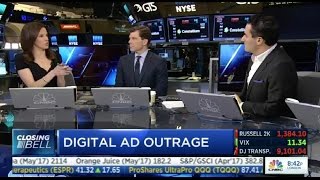
Matt Britton and Mike Jackson discuss how advertisers are shifting $83 billion to digital versus $70 billion to TV. The problem: platforms like Google and Facebook offer better measurement but less control, while 300 hours of video upload every minute make brand safety harder to guarantee.
Questions this video answers
$83 billion
$70 billion
300 hours per minute
Data they're providing advertisers. All this is tech. Giants like Google and Facebook continue to gain power in the digital ad space. In fact, according to marketer, digital ad spend is coming in this year at $83 billion versus $70 billion currently spent on television, which has much stricter standards in the Internet. What impact could it all have on how much control advertisers have on platforms like Google? Joining us now are Mike Jackson from 2050 Marketing and Matt Britton here at Post 9 from Crowdtap. Welcome to you both. And Matt, it's understandable that now that the spend is so big, bigger than tv, there needs to be more accountability. So, you know, I can't imagine that Silicon Valley firms will be able to argue against this.
Well, I find that funny where everyone says accountability, accountability because television has had no accountability in terms of metrics, viewership selling, broad 18 to 49 cookie cutter demographics. With platforms like Google and Facebook, you can actually target people at pinpoint accuracy.
See attribution something slightly differently. So yes, you can plac something. You have a more granular sense of who's seeing it and where. Sure, digital versus tv. But do you actually know where your content is going when it goes into some of these ad and you know.
I think that this issue is somewhat of an easy fix for Google. I mean the issue with a platform like YouTube is there's 300 hours of content being uploaded every single minute. So it's incredibly hard for these platforms to keep up with the content and be able to properly categorize it as is appropriate. We want to juxtapose this advertiser next to it. I do think once new technologies come about where you can have facial recognition and content recognition technologies that can analyze images and actually see type of content it is, maybe then they'll catch it, but it doesn't exist yet. So it happens to be just a risk that a lot of advertisers have to take.
Mike do. So in the case being referenced here as well, there are a lot of established consumer brands whose ads might show up after a white nationalist, for example, and they were outraged. So should there be more accountability in the sense that firms will know if I'm putting my ads out there to this firm and they're putting it on one of these platforms that that's not going to happen.
Yeah, I agree. I think they need to adopt a zero tolerance policy. I mean when you look at the sheer amount of ad spend that is being shifted to digital, I think it's just going to be Imperative for Google and Facebook to figure it out irrespective of the amount of content being posted. If I'm an advertiser, I want to pay, I want to know what I'm paying for. And frankly, I want my brand represented on sites that I agree with.
Mike, what would it mean though, to sort this out? I mean, obviously part of the move to digital has been the move toward these kind of programmatic ad exchanges. So essentially you're kind of putting it in the box and seeing what content your ads get put up against. Almost after the fact. It was going to have to be a higher touch process.
Well, you know, it's funny because there are huge benefits in your ability to understand the data and use tools like dynamic targeting and the fact that these integrated campaigns, they really work. So, you know, if you just take a step back, I think if you went with a zero tolerance policy in the short term, if you utilize kind of third party audits and then ultimately provide some sort of window for a technical solution, I think advertisers could be satisfied with that.
I'm also Matt, thinking about, because you said your firm works a lot with influencers. For example, the people who share the content have tremendous power. Perhaps one of the most powerful is PewDiePie. That was a huge problem recently with some of his Nazi imagery and other things coming to light. So that's another example of not that you can control how people behave, but if you're relying on these individuals to place, you know, money and content and ads, ultimately what I mean, that's another example where there's not much control.
Right? But the fact is that, well, now you're a consumer, they're on their phone and when they're looking at their phone, they're looking at content mostly from other people on social platforms. And other people are much less likely to be controlled by than big network. So back in the days when you can place a magazine ad, knew exactly where it was going to be and how it was going to be, you know, that might have worked in terms of control, but you didn't get the amount of measurability and accurate reach. I think a lot of advertisers and brands I work with, they sort of understand that there's a give and take in terms of the amount of control and risk that it comes along with it. We're in a different world. On the same token, if you advertise during a news program, you don't know if you're going to agree, especially in this political climate. What if, you know A commentator supports, you know, a political view that the brand doesn't, and the brand runs an ad afterwards, does that mean they should be able to come back?
Do you think that this is all going to change? So you mentioned magazines and tv. You know, right now, as Robert Thompson, the CEO of News Corp, put it on Friday, he sort of said, hey, look, we have standards. We have established controls. We've been doing this for years. You know, we have a way of handling this. Do you think that the same kind of thing is going to happen where TV or the magazine starts to say, okay, and we'll give you more granular data because we're able to collect it now? Are they never just going to get to that?
Well, print magazines can't really collect. I think television is becoming more programmatic. The televisions are going to become an addressable connected device where soon brands are going to be able to buy programmatically. And targeting John smith, who lives 10 miles away from Joe's Pizza, the same way you can on the Internet is all coming together. I believe the TV is not that far away from being a giant iPad hanging on your wall.
Mike, we got to go. But I was just going to ask you, do you think there's going to be, you know, sort of a peak, a high watermark for the amount of money spent on digital? Is this all going to start to push people away from it at all, do you think, going forward?
I don't think so. I think ultimately a technical solution will be at the forefront of really giving the advertisers kind of the trust, confidence, and really transparency that they're looking for. As was stated earlier, I mean, the most effective way to reach people that are in market for your product is via their mobile device. And I think it's a challenge, but ultimately, I think Google and Facebook and others will figure it out.
All right, Mike Jackson, Matt Burton joining us this afternoon. Thank you so much.