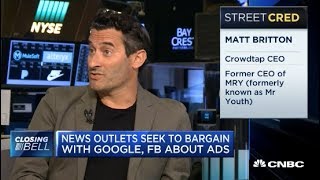
Matt Britton discusses how Google and Facebook dominate digital advertising, squeezing traditional newspapers out of revenue. The panel examines whether antitrust action is needed and how media companies can survive against tech giants that control where ads go.
Together. How necessary is a move like this?
Well, if the newspaper industry wants to have these kinds of conversations with Google and Facebook, then they do need to make sure that they're not running afoul of antitrust laws. I mean, each one of these are separate companies, and if they act in a collective manner, then they could be in fact seen as running afoul of the law, and they certainly don't want to do that.
Matt, what about you? I mean, would you take issue with the fact that Facebook and Google have effectively become a digital duopoly with their control over online information, They've become a.
Digital duopoly, but in terms of the global advertising market, there's still only 20%, which means there's 80% of a market that these newspaper traditional media companies can still partner with on a global basis. Newspaper companies still generate around 150 billion in revenue when counting in circulation revenue, versus 100 billion combined between Google and Facebook. So I kind of find it interesting that they're coming together, yet they still more revenues, obviously the lower margin, but they have had and still have some time to catch up. Don't see companies like Vice or buzzfeed complaining because they very early understood the shift happening. So I really think in a lot of ways, they only have themselves to blame and they need to re look at their business model, not trying to kind of come together and fight really what consumers want, which is sort of open social platforms.
Yeah, I mean, Dan, I guess I would wonder. I've been trying to think of an analogy for this, whether it be, you know, studios going up against the movie theater business, which is kind of tightly controlled with, or in the old days, if one or two companies controlled every newsstand in the country, would these companies have been able to collectively negotiate here? Do you actually think there's a prospect, given all the politics surrounding both the big tech companies and the media business right now in Washington, that they will get clearance to at least make this effort?
Well, that would require a prediction, and predictions are fraught with all kinds of problems. A couple of things I would note about the finances of this is that advertising revenue for American news papers has dropped from about $50 billion a year to under $20 billion a year over the last decade or so. But more than that, the digital share of that advertising revenue has been stuck at about $3 billion a year since 2007. So it really isn't going anywhere. And I think that there was a time when the newspaper business hoped that simply by driving traffic to their websites, they would be able to put ads on the site and that would monetize their content. But it really hasn't worked out because in the digital space, advertising is such a commodity, it's so ubiquitous that it really isn't particularly valuable, especially for news organizations that have to employ a lot of journalists and in order to provide the information that we need in a democratic society.
That is a paradox, Matt. Which is why if the ad space is so valuable, at least once was, arguably still is in the physical newspaper. Once you get online with, you know, at least for the Journal, you have to be an authenticated user to access most of the content. Why can't that be equally as valuable? Or what more do you think they need to do to ramp up?
Well, I think a lot of the traditional media companies have just embraced an advertising model which is juxtaposing a paid sponsored message versus the content that consumers want to see. But advertising really isn't what brands want right now. They want content. They want things that consumers actually seek out, which is why you see these new age, untraditional companies.
So you're saying the only way is for the Journal to start running articles with that little thing that says sponsored post?
That's like, well, there's other ways to do it.
But yes, and guess what?
They're doing it. They're creating branded content rooms. It's blurring the lines. I would also question the traditional way, in terms of these huge staffs that newspapers have. I would question if they really need it. Does each newspaper need their own photographer when it can be crowdsourced? When there's a news event, you can go on Twitter and actually find that image. So I think that they actually really need to blow up their entire model.
Dan, we'll give you the last point here, since he's raised some good ones quickly.
Well, you know, I mean, the fact is, I think that since the election in particular, we've seen kind of a flight to quality. And I think that what people want from newspapers, and I say newspapers, for the most part, they're going online to consume the news, is that they want a brand, branded identity. They want some guarantee of quality, and they don't particularly want crowdsourced news. I think that's what a lot of people fear is leading them to fake news.