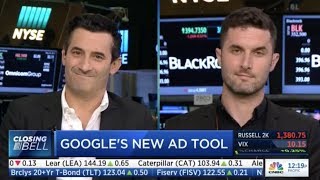
Matt Britton and David Yaris discuss Google's new Attribution tool, which links online ads to offline credit-card purchases to measure store sales lift. Google claims custom encryption protects privacy, though less than 15% of sales happen online, and marketers are watching how this compares to Facebook's cross-platform targeting.
Questions this video answers
May 24, 2017
Less than 15% of all sales occur online (verbal claim in segment).
Matt Britton (CEO, Crowdtap) and David Yaris (founder, Millennial).
New tools available in the digital advertising space. Google out with an ad measuring tool called Google Attribution. And it shows whether online ad clicks lead to actual in store purchases.
How?
For those nervous about Google tracking your data, the company tells us, quote, we have developed a new custom encryption technology that ensures users data remains private, secure and anonymous.
Let's talk about it. Joining us about how this could impact the future of digital ads, Matt Britton, CEO of Crowdtap and David Yaris, the founder of Millennial, which is a millen marketing agency. What do you think? I mean, I'm still trying to get my arms around how this works, this Google part, the Facebook thing we'll talk about later, but the Google part, are they measured? How do you find a measurement that tells me exactly how effective a particular digital ad has been in terms of the sales is what they're doing.
They partner with a variety of different third party companies to have credit card transaction data and what they're doing is matching that credit card transaction data to ads. So if you see an ad for a brand, let's say Victoria Secret on a Google property, and then you purchased at Victoria's Secret, Google can connect that same user to seeing an ad online and connecting offline. Because if you think about it, only 15% or less than 15% of all sales are happening online right now. If Google wants to grow to become a trillion dollar company, they have to show they can drive sales offline, not just on.
But they don't know exactly what I bought.
They don't know what you bought.
They just know I bought something from.
A particular retailer that that advertise on a Google property.
So David, I guess what Google's able to do here is tap credit card information, overlay that with what I've searched for. You guys aim at millennials in particular. Do you think that there's going to be any kind of pushback to this or does this to you just represent the next phase of advertising?
I think it's the evolution. I think millennials in general at this point we've accepted that you pretty much know everything about us and in fact you could have all of our data so long as you make the media in our lives value additive. So enhance my experience and you can know whatever you want to know about. It's true.
It's just I know everybody has all my information and you know, as long as you don't charge me for, you know, as long as I benefit somehow.
From it, it's fin as social login, as an experience becomes more prevalent across the web, we're getting used to touching with one button and giving people access to our information. So is there sensitivity? Sure. Is it still an important issue? Privacy? No. No question. But in general, I think we're getting more used to the idea that advertisers know pretty much everything about us, maybe better than we do, and then make our lives better and distribute specific tailored media because of that.
Do you agree? Do you think consumers are that acquiescent?
I think privacy concerns are way overblown with this millennial generation. I mean, this is a generation that chooses to broadc real time. This is a generation that's overly voyeuristic and looking at everybody else's life.
Gen Xers and boomers not click on these ads? Is that what we're saying?
I click on their ads, but their concerns of privacy, getting their Social Security number, credit card number stolen is way more than the millennial generation. Their concerns is who. Who I'm texting at 2:00 in the morning, Is that going to come out? Which is why you saw the growth saying, like Snapchat, it's way more personal in terms of privacy than on the business basis.
David, I still wonder about the efficacy of a lot, a lot of this already. When I'm online and I buy something, I see an ad for it and it's that exact product in that same color and it's like, no, I just got it.
It's like Twilight Zone time.
If this is executed correctly, it's truly a game changer right now. In terms of attribution, the way we attribute media success, it's typically a view through. So I've seen an ad and then I bought something or I click through. So I've clicked on an ad and then I bought something. If we can now additionally layer on I saw or I clicked and then I bought in store. So it wasn't just view and then click directly to buy online. It changes the game.
What about the Facebook strategy? They're using their own data of who's using Facebook to help advertisers target better.
So I believe one day Facebook's going to power nearly every advertisement, including us, on TV, on billboards, on radio, because they've logged over 2 trillion clicks or likes or pieces of information about consumers. So they have a rich data set on consumers around the world unlike any other company. And what they're trying to do to continue to drive growth is not just use themselves as a destination to market the people while they're on Facebook, but use that data to market on third party platforms. In this case, third party publishers real.
Quickly have to go, David, but is Google unique in having access to this or does it, you know, are other companies going to be able to follow suit and do the same?
I think everyone's going to try to follow suit, especially because it's all done through third party data warehouses that Facebook will get on and other social platforms will try to access as well. They're sort of proving the concept and then as soon as they do, everyone else will join in.