Matt Britton Reveals 2025's Most Impactful Consumer Trends 'A To Z''
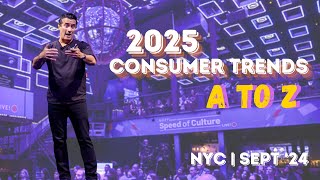
Matt Britton walks through 25 consumer trends for 2025, from AI personal healthbots and Gen Alpha as the first AI-native generation to GLP-1 drugs, creator culture, and AR wearables. He maps shifts in the barbell economy, education, longevity tech, and household finances for marketers and business leaders.
Please welcome back to the stage Suzy founder and CEO Matt Britton for a look at the state of the consumer 2025. So we've heard from some amazing speakers in the morning, and as I was listening and partaking in the panels, I kept getting new ideas of new things I wanted to present because that's just kind of how my crazy brain works. The one constant is obviously change in this world, and anybody in this room needs to keep on top of change. That's why we called our podcast the Speed of Culture, because the speed keeps accelerating each year. And I see it every day. I see people who have amazing titles, great pedigree, who just talk jargon and buzzwords and really have no idea what they're talking about. And some of them are really successful, actually, which is a whole different story. And I see other people who are incredible talents, who have hands on keyboard that know how to build, that are kind of struggling and aren't actually breaking through. And I think there's a lesson in both those things. I think for the people that are talented and aren't breaking through, really the key and the barrier on the side of where you are today and success is just content. I think over and over and over again. The people who I've seen successful in the business world disproportionately are people who do one thing consistently and that's create and post content. We are in a world where people are spending the majority of their time staring at phones. And when they were staring at phones, more often than not they are staring at content not from NBC or abc, but from other people. And if you can be one of those other people and you can actually keep a top percentage of somebody's mind share. So they're thinking about you for opportunities, whether you work for them in your company or whether they're a customer that you want to win, your chance of success is so much higher. And I think one thing that stops people, even at older ages, we have these kind of like childhood wounds is like we're scared. We're scared that people aren't going to like it, right? If I post this and three people like it, what will everybody think? And that's ultimately the reason that most people don't post something like LinkedIn. And there are many people in this room who I know are very talented that I don't see posting on LinkedIn. And I guess you're at this event today. Post a picture of me on LinkedIn. No, just kidding. Talk about the event, talk about how great it is, and build your brands, because building your brands will really allow you to really optimize your potential in a world where it's really hard to break through. And for those of you who speak buzzwords and jargon and don't do the work, do the work, but that's an easier conversation to have. So I speak all around the world about consumer trends. I've always been fascinated with consumer trends. I like looking at people and their behaviors and always trying to connect the dots between what they're doing today and how it impacts business of tomorrow. And I do this fun little thing when I present where I go through the Alphabet and I use every single letter A to Z and every letter correlates with a trend. And I'm gonna do that today. It's super fun, super high paced. At the end we're gonna talk about the implications of these Trends. A is AI. Duh. Right. I have spent probably 80 to 90% of my professional time over the last six months in AI. The reason I'm doing it is when I first came out into the workforce in the year 2000, the Internet was first actually being adopted. I'm that old, yet I'm still cool enough to be at marquee. And I saw the change and I saw companies that were flat footed that didn't react quickly enough and what ended up happening to them as a result. I saw the same thing happen all over again in 2008, 2009 when the iPhone came out and we shifted to mobile. And so many businesses overlook the power of having what 20 years ago was the power of all of NASA in their pockets and what that would mean for society and how we consume content and media. When I talk about something like LinkedIn, it's a perfect example of it. And now we're seeing it happen all over again. And these cycles happen every 10 to 15 years. And I can tell you, as strong as the Internet was, and it's pretty strong, let's be real in terms of a thing, right? Or the mobile device, AI is magnitudes more impactful than any of those things. And there's a couple of reasons why. And the biggest reason I think AI is going to have an outsized impact on our society is it does not require any change in human behavior. So even the phone, you need to get used to watching video on your phone or typing on the iPhone with something that didn't even have a keyboard. You know, before the iPhone came out, I had a BlackBerry. I never thought I'd adopt the iPhone. AI, a lot of people think, oh it's just for the kids. You know, I spoke at a conference with a bunch of senior citizens, right? And I was telling them, you need to be on AI, you actually disproportionately should be on it. And their perception is, oh, AI is just for the young whiz tech kids. But it couldn't be further from the truth, because the only thing you need to use AI is an understanding of the problem that you want to solve and the ability to communicate in any language or any way you want. And those problems can be solved. And you first start with solving problems that are most near and dear to you, and then you extend it further and further and further. For me, I want to stay alive longer, right? I have young children. So what I did is I created an application that essentially allows me to take all my medical history, X rays, MRIs, blood tests, anything that I can pull together and create my own healthbot. And I use that for everything. If I feel off one day, if I know I need to book doctor's appointments, I could say, what five doctor's appointments do I need to make this year to make sure I stay alive? And it will tell me, and it will tell me truths in a way that my doctor won't. And it's free. Because let's face it, healthcare is really expensive. By going through that process of creating my own healthbot and going through the kind of practice of gathering all the data, pulling it together, and then basically telling the model how to read the data, I then learned how to do it for business and then took similar problems in business, like, we need to grow, we need to keep our customers happy, and figured out what's the analogy of my health data, what's the X ray or MRI for my business, and how can I build similar things? And when you look at it that way, when you start to first think about problems that are most important to you and then can solve them, that then all of a sudden things open up for you. From a business standpoint, what I've seen is people get fearful of it because it's such a big thing. They think they need to be able to have tremendous coding powers right away to be able to use it. And as a result, it just seems like it's too insurmountable and they just push it off, and they push it off, and they push it off. And I can tell you, every day that you push off, not fully understand the capabilities of AI will be another day that you're going to be hamstringing your ability to move ahead in your career, regardless of it, is that you do. It could be a whole presentation. I'd give many on AI, but obviously AI is letter A for a reason. But it's not the only letter A, right? Actually have two letter A's. Because there's another equally important letter A that I bet nobody in this room could guess. Anyone want to guess what it is? It's not Apple. It's not Amazon. It's Gen Alpha. So Gen Alpha right now, age 0 to 15, is the first generation to grow up with AI in a household, which means they will never know a world where AI did not exist. Okay, Gen Y was defined by the Internet. They never knew a world where the Internet didn't exist. Gen Z was defined by the mobile device. They never knew a world where the iPhone didn't exist. And now you have a new generation, age 0 to 15, that will be coming into a world where. Where the powers of AI are baseline expectations for every single thing that they do. So 5, 10, 15 years from now, when this cohort enters the workforce, think about the impact that they're gonna have on every facet of the business world. Think about the impact they're gonna have on every facet of society. And there's implications not just in terms of the power of this generation, but their parents. Because Gen Alpha, for the most part, their parents are gonna be millennials who grew up with the Internet. So for the first time, we're going to have the first digitally native household. Right? So when you think about Gen Z, their parents were Gen Xers, and Gen Xers did not grow up with the Internet. And there was that divide going on where they didn't really understand the language. So you're going to have this progressive digitally native household. You're going to have people coming in the world that only know AI, and they're going to be wanting to impact the professional marketplace sooner and in bigger ways like we've never seen before. So this is a topic that fascinates me and I have a lot of passion for in terms of new cohorts of citizens and future professionals and how it's going to impact society. So with that, I decided to write a book that's coming out in May called Generation AI. It's my second book, and all of you are going to get a free copy when it comes out in May. So, side note for that, but for those of you who left after lunch, you're not getting a copy. But really excited about this. I'm in the process right now of writing it. Writing a book is no fun, but it's always worth it in the end. And exploring Generation Alpha and AI in terms of how it's going to impact every corner of society, from health care to jobs to parenting, it's really fascinating. And we are entering a whole new realm in a way like I've never experienced in my career. And I just hope everybody realizes the ultimate potential that exists with this technology. And it really is, like Vineet said, it's a great time to be a marketer. It's a great time to be in business. B stands for the barbell economy. And this has been a trend that's been happening for quite some time. When I did my A to Z presentations pre pandemic, this was actually the letter B, and it's still the letter B. And what the barbell economy means is that there's tremendous momentum on both sides of the economy. So you look at the value side of the equation, right? You have Costco and Dollar Store and Dollar Tree, right? You have a lot Wal Mart, you have a lot of value players. You have Vizio that's selling flat screens for $199 a month. You have TJ Maxx and Marshalls. And that company is doing so well. TJX companies, because they're about value. And in a world with inflation, in a world where costs keep rising above the level of wage increase that's happening in this country, there's always going to be a big segment of our population, especially here in the United States, that's going to veer to the value side of the equation. And then you have the luxury side of the equation, right? You have Amman Hotels, which is getting away with charging $4,000 a night during the holiday season. You have LVMH selling Birkin bags for $40,000, right? And you have places like Marquee that are selling bottles of vodka that cost $20 in retail for $2,000 because they have a big DJ and people will part ways with the money, all on the luxury side of the equation. Because we've seen such unprecedented wealth accumulation come out of this digital divide. And especially post Covid through these tech entrepreneurs that are figuring out better ways to automate and create value. So you're a winner. Obviously, if you're marketing to the luxury side of the equation, you're a winner if you can figure out the supply chain. And we'll talk about companies like Sheehan and Timu later, other examples that are wearing on the value side of the equation. But you're not really a winner if you're selling $100 jeans. If you're selling jeans, sell jeans for $15 at Walmart. Sell jeans for $250 at a fancy boutique in Soho. But do not sell $100 jeans because the market for $100 jeans in a nation where the middle class is continuing the road is not a good business strategy. That's why my letter B is for barbell economy. C is for creator movement. And we've spoken a lot about the. The power of creators. And I opened up this presentation about the power of creators, where we're increasingly spending so much more time staring at our phones. And it is such a profound shift from a world not too long ago where the airwaves were controlled by clear channel, whatever they spun in heavy rotation used to be the only music that anyone ever listened to. And we had TV stations that could dictate from fancy boardrooms what people were going to watch. And at that point, culture was truly dictated from the boardrooms. And now with this creator movement, culture is really built from the ground up, from the sidewalks. The future trends, the shoes that people wear, the way that they spend their time, the hobbies and habits that they enjoy are being driven from individuals, and that's what the creator movement is all about. We spoke at length this morning with Sophia Hernandez about what she's seeing in TikTok and the power of a platform like TikTok, which has created so, so many successful businesses. And you're only going to kind of see that continue over time. You had the CEO of Michael Kors talk about yesterday how hard it is for him to build sustainable new fashion brands and designs, because the long tail of fragmentation of styles which are being driven by creators, make it so hard to really put your arms around something that truly has scale and staying power. So creators, everything, they're only going to continue to grow. This is not a trend that's going to go away anytime soon, because the power of these platforms is only growing. And with AI, the power to build content is only growing. D is for digital Twins. And this is something that you can use for a lot of different iterations and a lot of different categories. But essentially what digital twins is is the ability for you to take an individual, a Persona, and basically replicate them. So say you're Bradley Cooper, a famous actor, and you're being asked to film a movie in Tokyo and Los Angeles, and you also got an offer to shoot a TV spot in Miami. Well, the only limitation of you doing that is the time space continuum, right? You can't be in three places at once. Or maybe you can. If you are an individual that that has power, if you have IP value as an individual, what AI is going to unlock is the ability for you to essentially clone yourself. Now, you could say it seems weird, but if you've looked at some of the latest technology, it's getting less and less distinguishable. If Bradley Cooper, for example, trains a model, if it's him talking or AI talking, and over time, if people just want to see him in an action movie, him in a commercial, he may at a certain point say, you know what? I'm going to train a digital replica of myself to be in those movies. Maybe I'm going to want people to put me in a video game. And we're going to see that happening more and more and more. And what that's going to do is that's going to make the 0.01% in Hollywood the 0.001%. Right? Because all of a sudden, Brad Pitt can be in that many more movies in a year. And as soon as that becomes indistinguishable, now people may say, oh, people are going to know. They're going to know it's not really him. Well, I was at a concert at the Barclays center with a deejay that was pushing buttons and there was 28,000 people there. And he wasn't creating the music on the spot. Right. Ultimately, it's about the entertainment value. Ultimately, it's about the brand. And I think the notion of digital twins and market research. We're going to talk about areas we're looking at. How do you create a synthetic version of real people for market research purposes? If you're delta, does it make sense for you to create digital twins of all your diamond sky miles medallion holders? And then you could ask people that are replicas of those people questions if you don't want to always bug your diamond medallion holders. Right. Now, is that completely accurate now? No. Maybe it's 85% accurate now. But if you know anything about the power of AI, it's at the rate of change and improvement is unlike any other technology we've ever seen. And I think the notion of digital twins is saying you're going to be hearing a lot more about heading into 2025. Education is one topic I'm incredibly interested and fascinated by. I know by putting kids through an overpriced private school, what they learn and how there's a disconnect with that and what you really need to know in this new world, new economy, and with the rate of change, forget about textbooks. Like, I'm writing a book and I'm pretty much in touch with where the world's headed. And that book, despite the fact I'm giving it to you guys I want you to read it, is going to be somewhat irrelevant in May, let's face it, because the things I'm going to write are going to be kind of ancient history by then. So if I have a hard time being in the tech industry and writing a book, how are professors supposed to keep up? How are they supposed to use textbooks that were written in essentially a completely different world? And what does that mean for the student? What should we be teaching young people? And does it make sense for them to get into debt by going college if what they're learning they're actually not going to apply into the real world? The example I always give people when they ask, because I speak at conferences all the time, people come to me, oh, my God, I'm so scared. What should my kids learn? I say always the same thing. You need to go either deep into an art or deep into a science. Right. Deep into an art or deep into a science. What's deep into an art? Deep into an art is doing things that the machines can't do, doing things that are innately human, doing things that are creative art, writing, coming up with ideas, being on stage. Right. Because I don't think you'd want to watch a robot on stage yet maybe one day, right? That's going deep into an art. Going deep into a science is learning how to operate and develop and take advantage of these machines. Everything else in the middle, you know, master of all trades, jack of none, Good luck. You're going to be offshored and outsourced and automated. And is that good? Probably not. But we're not going backwards. We always get that all the time. Oh, that wasn't good. But people said that when the car was invented, when the airplane was invented, when the Internet was invented, when the telephone was invented, it wasn't good without the airplane. My two brothers who live in California probably wouldn't live there, but they do, and they get benefit from that. And there's a downside. There will be downsides, is automation. And if I sound happy about this, I'm not. I'm more passionate about it because I know where it's going. And I know, especially for younger people coming to the workforce, if they educate themselves the same way that their parents educated themselves, they're going to find themselves in a world of hurt and surprise. Coming out into the workforce. So what does that mean for colleges and universities? It means that I believe there should be a whole new realm of colleges. If I were Google, I would start a college and I would teach people on the things that they know and basically make sure that people perform high enough that they get a job there. Right. And then they're breeding their own future professionals. I think that's going to start happening more and more where companies and the private sector is going to get involved, because I just don't believe the public sector can respond quickly enough of where we're going. I also think we're going to see a huge emergence in trade and professional schools where people have to learn very specific skill sets, whether you're an electrician or you know, how to build things that have a physicality to them that we're still going to need in this world, albeit even if technology is involved. So I think getting a degree in liberal arts, which many of us in the room probably got, is going to seem laughable 20 years from now. And I think that's just the reality. And we are still in this complex where parents want to send their kids to the best schools because they want them to get the best education and put them. But I just, I'm not convinced that that makes sense anymore. And I don't know if there's a solution for it besides making sure that kids can follow their passions and they're following passions in areas where there's opportunities moving forward. Because you can be deep into an art, deep into a science, in so many different places and so many different areas. But again, you don't want to be stuck in the middle. F is for family matters. The version of the American family that we knew is no longer. We heard Shelly Zalas, who by the way, how amazing was she and is she so inspiring in terms of equality in the workplace and addressing the pay gap and gender. Gender inequalities. And we are in a world right now where given rising costs, given inflation, given financial pressures, you know, most households are increasing, becoming two income households. And if you look at the stat here, the average age of first time mothers in the US continues to go up. So what does that mean? It means if you're in a CPG category, right, and you're marketing household products, your version of the American mom is not the version of the American mom that it used to be. Right. People are also having children later. There's obviously huge adoption of in vitro fertilization and, and people leading this technology to have kids later in life. People are staying alive longer, which we're going to get into. So what does that mean for the future generations in terms of their family upbrings? How they're looking at their lives is going to be really interesting. We see, we saw a huge rush towards urbanization pre Covid, which also was a big driver of this. People want to live younger later in life. You went to Coachella and you saw a bunch of 45 and 50 year olds there wearing cool Nike sneakers. Why? Because Instagram made them realize how they could be cool. Right. And now, you know, when I wrote about this, my first book, Youth Nation, people are living younger later in lives. And when they live younger later in lives, they stay in cities later in lives and they usually don't have lots of room for kids. So they push it off and they push it off and push it off. Now on urbanization, post Covid and in a zoom world, which we'll get into, we've seen a kind of a little bit of a reversal there where you don't see that huge push towards urbanization. People are going to secondary and tertiary cities. We've seen huge booms in places like Charlotte and Denver and Austin really kind of take off. It'll be interesting to see how the urbanization movement and this sort of family trend continues. But it's definitely something to keep an eye on for. For anybody whose job it is to market to the CFO of the household. G is for sports gambling, which the impact on sports gambling, particularly for the young male, is mind boggling. I'm a huge fan of the Philadelphia Eagles. Tough loss Monday night. I was there and the main thing that struck me leaving is when we were ordering pretzels, which in Philadelphia, pretzels are amazing. I'm from Philadelphia. The guy who was selling it had the FanDuel app open. This is somebody who was working probably at a lower wage job. He's working in concessions at a stadium and he's betting on sports. And then the guy in front of me had bet $5,000 on the Eagles and when they blew the game at the end of the game, it looked like somebody just took his dog away from him, right? He was incredibly sad. And I was sitting there with my son who's a teenager, and like, this is why sports betting isn't good. He should be here enjoying the game and yes, he should be pissed off that his team lost, but it shouldn't feel like he got punched in the stomach. Now, all that being said, I bet on sports now. I bet an amount that I can afford to lose, but I do it because I want to feel closer to the game. I want deeper engagement. And if you look at something like the sphere in Las Vegas, right, this incredible immersive entertainment experience, people go to the sphere because they want more immersion VR, more immersion, bigger TVs. That's sort of the dopamine hit that this younger generation is predicated on, which fits perfectly into the business model of sports gambling, because sports is incredibly exciting. And it's one thing to watch a game, but to have a stake or skin in the game is even more so. I think this is going to have a tipping point, though. I can afford to lose $100, but the guy who was selling me the pretzel at the stadium maybe can't. And maybe he was betting $500. I hope for his sake he was betting $5, right? But ultimately, it's just too prevalent and too addictive for young men for it not to have consequences on our society. And the crazy thing is the leagues are pushing it. So if you watch the leagues are behind it and all those things, and I just don't know where it's all headed. I can't see the future, but I would keep an eye on this moving forward. And I would also try to extract learnings for your brand. So if there's other passions or even sports is a passion, how can you allow your customers to feel a deeper, more rooted kind of sense of ownership in whatever they're engaging in, right? Whether it's a TV show or a YouTube video or your brand? Because there's a learning here, and the learning here is gamification works, and that people want deeper immersion in the topics that they're most passionate about. H stands for home ownership. And we talked about homeownership in terms of urbanization, and homeownership just, quite frankly, is getting less and less affordable for most Americans. One thing we've seen post Covid is people can be digital nomads. I mean, our company, Suzy, had 65 people in March of 2020. And I remember going back there in September of 2020, and the March 2020 newspaper was still there. It was like, we're stuck in time and our lease was just about to end. And we've never been a cohesive office again. We started hiring people from all over the country, which has been great for us. We were able to have a distributed workforce. We can get the best possible talent. There's obviously downsides to being in a remote environment, but this also has a massive impact on homeownership because people don't need to root the way that they used to route. And many companies, as a result of COVID 19, have offices all over the place. So what does this mean for homeownership? Right. Obviously in the last year and a half, with the skyrocketing of interest rates, the, you know, the home market has basically been locked up. But as it starts to creep down again, I'm going to be particularly interested next year looking at what it means for the housing market. Right. Because it could go two ways. The housing market could explode because those people who have had children the last couple of years but didn't want to leave a low interest mortgage for, for, for a high interest mortgage just stuck and hung on and there's going to be a tremendous amount of demand. Or people could say, you know what, I can't afford it, or it's not worth it to me, or there's too much inventory, flight in the market and cost drop. But ultimately, from a behavioral standpoint, it used to be get a job, get a Fortune 500 company, work your way up the corporate ladder, you know, buy a house with a white picket fence and two and a half kids and be done with it. And that's just not the world that we live in anymore. But that is the world. And the segmentation strategy that I see a lot of brands still kind of bestowing on their business and homeownership is certainly a big part of it. I stands for instant gratification. And we heard Kofi this morning from DoorDash. Just talk about how people want things instantly. Right. And I think there's so many applications towards this because the reality is people just don't want to pick up the phone anymore. So when we talk about Gen Z being the first generation to grow up with the iPhone, phone really shouldn't be in the name because they're not using the iPhone for the phone. Right. They're using it for texting, social media, shopping, content, everything else. And if I were a business that either was a restaurant or an airline or a cable company, God forbid, or any business that requires people to pick up the phone and call them, I would figure out a way immediately to not have to have them be called because I can't think of any experience in the last several years where I called a company and tried to get signed down. When I left, being like, that was an awesome use of my time. That was such an amazing call with the airline. I wish I could have it forever. No, there's an anxiety of calling Companies, there's anxiety of even calling the restaurant to make a reservation. And that is about instant gratification. You want to book the doctor's appointment now. You want to book the restaurant reservation now. You want to book the airline ticket now. And you don't want to have to talk to somebody. You want to hit submit or click and be done with it. And I think instant gratification is what our customers want. They don't want to go through hoops to do anything they want. It instantly has to be built for the flick. We're in a world where flipping through social media and the attention spans of our customer become smaller and smaller and smaller over time. So it's about reducing friction, eliminating steps and a phone call is the ultimate friction in a society that is enamored with instant gratification. J is for jobs. And you know, the world of jobs is just going to change. You know, we talked earlier, I talked earlier about college and education and what matters and what doesn't. Well, jobs are interesting as well because if you can go deep into an art and deep into a science, there is now a world as a freelancer in this gig economy where you can have more freedom, more income, more flexibility as a freelance worker and with the tools accessible today. We talked about AI and the power of AI. If you can adopt these tools and be disproportionately powerful in these tools, well then you can have an impact on a business that maybe an agency of 20 people could have as of a year ago. And there's an opportunity right now in the short term, especially in 2025, for freelancers to really dive into that area. So what are jobs going to mean moving forward? It's going to be interesting. Amazon. Yes. They announced they're bringing people back five days. It'll be interesting to see as bigger companies enforce that if, when the younger generation comes in, if they're going to be okay with that, are we going to go back to a pre Covid world when it comes to jobs? Are we going to be still in a more distributed society? It's obviously move more towards the way it was in the past. But we actually have not had a booming economy since that has occurred. And if we shift to a world where the employer versus the employee has leverage again, then we'll see, I think the remote dynamic and how strong it really is. So that'll be interesting. And that could start to happen next year, which is why I have my eye on it. K is for knowledge workers. Knowledge workers are most of us in this Room, right? We are people who essentially spend time leveraging our knowledge to create things and drive business impact. And knowledge workers are the area of the workforce that are most at risk as a result of AI. We've seen technologies in the past that disproportionately impacted blue collar workers. That is not the case today, which is why it's so important to figure out why, where you sit in the pecking order of importance and differentiation in this world. Another area that I should have mentioned earlier when I talk about going deep into an art is relationships, human relationships. We are doing this event for relationships. Some of the best people I know, especially in sales and people deal with customers, they know how to create relationships and trust with their customers. That is something that is also deep into an art and uniquely human. So if I were a knowledge worker, I would figure out what size of the art science equation that I really want to veer towards and I would dive in with reckless abandon because again, a lot of knowledge workers take knowledge from this table and run it to this table and drop it off. And that's the knowledge worker jobs that I think are going to be increasingly at risk in this new world. L stands for longevity. And I talked about my little health bot that I created. People want to live longer, obviously, and are living longer than ever before. The expectations of Gen Z in terms of their lifespan is 12 years longer than the expectations were of Gen Xers. And because of that, we've obviously seen a huge boom of people adopting healthy alternatives, sugar free alternatives, as well as what I'll call alternative medical approaches. So what you see here is Pre Nouveau, which is a company that charges $22,500 for a full body MRI scan. And basically people who can afford it go in and it scans your entire body and you can find out anything that's wrong. Some parts of the medical community think it's terrible because it sends you on a lot of false goose chases. Other people think if there's something going on, you should know about it. But that's just one of many examples of people prioritizing their health and really understanding that staying alive is the game before anything else. And longevity, especially again, post Covid has been. It's crazy how much I say post Covid or pre Covid just how impactful that was to our society. You know, talk about Gen Alpha. When we're gonna tell Gen Alpha kids about COVID they're like, what you, you stayed at home all those times like you watched Tiger Blood, like what was that all about? So it's gonna be really interesting to see where we are with this. But longevity is a trend I expect to continue. Music is another area that ultimately is something that is innately an art, right? It's something that people have obviously created a lot of emotion around, build great businesses, but now even AI is entering that category. There's a tool called suno. Anyone in the audience hear suno? So Suno is probably the most incredible tool I've used in the last several months. And what Suno does is it allows you to give a prompt to create a song. You can create a song about the girlfriend that dumped you, or your dog or your son or the boss that you hate, or a great experience you had, and you tell the genre that you want it to be in, and you hit generate and it'll give you five awesome songs. So I figured, you know, I always talk about kind of walking the walk, so I made a song for this conference.
Speed of cultures on the rise Monkeys wearing uncle Eyes from all across the globe Sharing secrets breaking codes Marketing like never seen Creating futures Living dreams Seat of culture Feel my be visionaries can't be be marketing Visions come alive and market we thrive we thrive we thrive.
Club I just had to do that. So that song took me 30 seconds to write. If you think about what brands do to create jingles for their TV spots, if you think about any type of content that you want to create and the ability to do this, it's mind blowing. And now even allows you to sing a tune that maybe you have in your head. Maybe you made up a song that you sing with one of your children or one of your friends. You can record just the chorus of that and it'll make a song based upon that. By the way, don't log in now and make a song on stage, for God's sakes, but do it afterwards, okay? Because I got many other good tidbits that you don't want to miss out on. And it's for neobanks. And this is a topic that I'm personally fascinated with. Because if you walk down any street, you'll see a lot of banks, right? Banking locations. And it used to be a world where if you wanted a mortgage, if you want to refinance something, if you wanted a loan, you'd walk in and you would talk to somebody, right? But now everything is done online. And the question is, what does the future of banking look like? Is the future of banking a world where it's completely digital? Do we still value the relationships with our bankers? How Are people, what is people's relationships with money going to be moving forward? One area that I think is a huge opportunity for banks is to create better tools for people to generate more financial literacy. I used to use a tool called Mint where I ferociously tracked every expense and Mint got shut down and now I use a different tool. But there's no reason that my bank shouldn't create. If my bank created it, it wouldn't see everything else I'm connecting and it will know the financial products I, I need and it will be able to contextually offer them. So I think marketing in the financial services world is about utility and I think that's how I think the legacy banks can get ahead and really thinking about the consumer and how they're looking at financial services. O is for Ozempic and obviously the impact of Ozempic has been like unlike anything we've ever seen. Especially when you look at the food and beverage and CPG space. There's been reports how Ozempic has lightened the load, no pun intended, on United Airlines and how their, their, their gasoline costs have gone down as a result of it. Obviously it has a trickle down impact into how often people eat the fast food industry, the types of food they want to eat. You know, obviously it stands to create a boom in more physical activities. We've seen, you know, things like pickleball take up over time and new sports even for older people. And obviously it's sort of the wild west now you have a couple players. Nobody really knows the long term impact, but doctors are actually surprisingly more positive than negative in terms of the long term implications. Which means this could be a drug that, you know, could be our new penicillin for society. Because obesity has been such a big issue. And this is a drug that's still largely unaffordable to most Americans but is coming down. There's regulation, there's a lot of things that are being discussed that could make ozempic and glp1 drugs like it more accessible. And I'm going to have my eye on this in 2025 is the year of GLP1s and its impact on businesses, all different types of businesses. Because I think this is something that's really in early phases. P is for podcasting and I run the speed of Culture podcast. It's probably one of the most successful business activities and ventures I've gone to in my career. There are more podcast listeners growing in their desire to listen to podcasts than there are new podcasts being created. Most people don't get past the second or third episode, we're nearing our 200th episode, and I think a lot of it just, just having staying power. It's about adding value. But we are a mobile society. We're always on the go. And podcasts provide a personalization and a convenience in ways that the radio in a lot of ways doesn't. And it's a great medium and art form and something I think every brand needs to figure out. What is your podcasting strategy? Are you integrating your brand on top podcasts? Are you creating your own podcast? Because this is a genre that's not going away anytime soon and is only going to continue to grow in its value. Q stands for quantified self and going back to health. There are so many devices out there, like the Whoop Band, like the Apple Watch, like the Withings WI Fi Scale, like sleep trackers that essentially allow you to garner information about your body and what it means in terms of how it's benchmarking over time. For example, the Whoop Band, which is a very popular product, gives you sort of like a readiness score each day in terms like how well did you sleep? And that information is going to become increasingly valuable to people in an age of AI where it can take all these raw data points from your WI Fi scale, your Apple Watch, maybe your doctor, all these places, and actually tell you what it means, actually interpret it with all the other information it has and say, hey, maybe you don't need that second burger, or maybe you need to exercise, you haven't exercised in a month, or maybe you know, your blood pressure is raising when you're in these situations or whatever. It may be quantified self unlocks that because it collects the data that I needs to make the recommendations that matter most to you. I think quantified stuff to be a huge trend in 2025 as these devices get smaller, less invasive, and the power of AI makes the utility even greater. I do think 2025 is going to be finally, finally the world where augmented reality takes shape. So I gave this product to our executive team as a holiday gift last year. The Ray Ban Meta glasses. And they are amazing in terms of their capability. This is by Facebook, a partnership with Ray Ban. It didn't require humans to take on a new behavior. We all wear sunglasses, right? It's not just like you need prescription. You didn't have to wear some huge thing on your head. But now. So right now, what it does, it allows you to take calls on it, listen to music, and there's a little camera that you can take pictures. So you know if you're somewhere you want to keep taking out your phone, you can take those pictures. But now you can say things like what am I looking at? And they'll tell you what you're looking at. It's using AI to understand what's coming out of your glasses. Okay, what are you looking at? Like it would tell me you're looking at a group of very good looking marketing executives. That's what it tell me right now. Right. So, but no matter where you are, it'll give you that information. And that's just really the tip of the iceberg in terms of what's going to enable you where not too long, you'll be able to look at a house, it'll have an overlay from Zillow. It'll tell you how much that house costs. Right. Or what are the ingredients of this product that you're looking at. Right. And this technology is easy. It's seamless again. It doesn't require a change in human behavior. We've talked a long time about virtual reality and the Apple glasses are an incredible technology, but the form factor and the pro made it so it wasn't widely adopted. This is $300. This is sunglasses that you would otherwise buy for $150. And over time could this become contact lenses? Could this be the future of what the phone is? Right. Because as long as there's a screen and an overlay, well then you can read your emails and already it allows you to take FaceTime calls over it or look at your messages. So the notion of a phone in our pocket that we're staring at could be something we look at 10 years now and say, remember when people used to do that? And right now that seems so foreign. But it may be closer than we think. Shein is an incredible story in the fashion space. It's about supply chain innovation. It's about fast fashion in the truest sense. Shein basically is a software company. They're able to understand data points from the customer in terms of what you're most likely to buy in terms of fashion. And they bring the cost down to the lowest level you can ever imagine. And it's about a volume game. Very bad for the environment because people are just cycling through clothing all the time. But Sheen and Teemo are the two big players in this space where they're shipping directly from China. They're allowing you to buy things way cheaper than even Czar and H and M, which was considered fast fashion and young People love it. And this is going to be a new model that the biggest retailers in the world have their eye on in terms of are they going to go in this space? For a while we thought it was about access, not ownership and renting. And remember rent the Runway when people were renting their clothes, that was a model that may be great on the higher end, but for younger people, they just want to buy things for five to seven dollars and wear them once and it's okay. If it's not high quality, they'll get rid of it. And it's a trend that we continue to see adopted. I couldn't have a tea without the Queen Taylor Swift. Taylor's impact obviously is fascinating. I've been with my daughter at a couple of her concerts and it's just she, I think for people who are fans of hers and the parents of the people who are fans of her, she just understands how to build community, right? She knows how to get back to her community, engage with her community, be consistent. And she has shown that global brands can still be built in this day and age. Because one thing I have a lot of questions about is, can global brands be built in an age where we're not all watching television on the same channels? And she has become a global brand where everything she does matters. So if you want to understand the roadmap for creating a global brand and one that has staying power, you don't need to look much further than what Taylor Swift has done. U is for Uber. And you know, when you look up Gen Z in cars, you're going to get two disparate headlines. One, Gen Z's fueling the car driving boom. Two, Gen Z doesn't want cars. Nobody really knows. Young people obviously have the ease and ubiquity of Uber, although it's, I used to say, cheap. And it's not that cheap anymore, right? The costs have come up. But when you own a car, you know, and you have to park it and pay for that, and gas, tolls, parking insurance and the car itself, that's not so cheap either. Young people want the freedom and flexibility. The more we go towards an urbanization movement, I think obviously the better for Uber and its business model long term. If we find that remote work takes off and people, you know, companies capitulate in a world where employees maybe have more leverage, then maybe we'll see a world where people do gravitate towards buying more vehicles. We don't really know. There's so much unknowns. There's also driverless vehicles and what's going to happen with that? Where I think you're going to start to see driverless vehicles pop up is first in commercial, like long, long form trucking. But Waymo in San Francisco and LA is everywhere right now and people trust it and they bring their families in cars without drivers. So it's happening sooner than we think in terms of driverless vehicles. It probably was happening further away than we thought five to seven years ago, but now it's really here. And what role does that have in a company like Uber is another thing I'm keeping my eyes on. V is for virtual companionship. And how many of you have seen the movie Her? Okay, so that movie was 2013, so we're now 10 years later. It is about Joaquin Phoenix falling in love with his phone. And it didn't hurt that his phone had the voice of Scarlett Johansson, but that's who he fell in love with. And the operating system got to know him over time. And he fell in love with his operating system, his phone. And he gets intimate with the operating system of his phone, which is super weird, right? But she gives him something that other people aren't able to, she meaning the operating system. And you're starting to see this already. You're starting to see people turn to AI for therapy. You're starting to see people turn to AI for coaching. You're starting to see AI have memory, so it has context to the people that is interacting with. And it obviously presents opportunity and risk, just like all of it. You know, on one hand, there are a lot of lonely people that need something or someone to talk to. And AI might give them words of encouragement which stops them from going into a really dark place. Right. But then there's people who might gravitate towards this instead of getting on the railroad and actually making real friends. But I think as this technology gets more powerful, as the digital twins technology takes hold, this is going to be a real thing to keep an eye on in 2025 in terms of virtual companionship, which is something that seemed so far away 10 years ago and is now right here and already being used. W is for wall wallet and wallet size. And I spend a lot of time thinking about the economy and what it means for our business and in general. And what you see here is the personal savings rate is nearly an all time low, which means the percentage of savings as a percentage of income is at a level lower than what we've ever seen. The total credit card debt is at an all time high. So what does that mean? People are saving less and spending more money on credit cards. If any of you were saving less money and spend more money on credit cards, would you say that you're in a great spot to make a luxury purchase? Probably not. What we saw happen during COVID is a tremendous amount of fiscal stimulus enter society and the pockets of Americans, in which case they adjusted their lifestyle towards it and now the fiscal stimulus is basically gone. Right. But it's not easy to change your lifestyle. So what happens? People dip in the savings, people put more money on credit cards and now you have something like this. And I think this is a recipe for a big economic downturn like we haven't seen. We saw a dip with the rise of interest rates. Now interest rates are becoming lower and they might have to become even lower than what we've seen because of this dynamic that's actually happening. And there's so many things that are actually driving this. But I'm surprised that by, oh, by the way in the stock. Stock market's at an all time high. So you figure that out because I can't. So, you know, we will see the impact of AI and productivity, we will see the impact of lower interest rates on spending and we will see what happens with the job market, which has definitely gotten softer, especially in areas like technology over the last three to six months. But the wallet of Americans is something I have my eye on as well. In 2025, this looks like my last slide about turning marquee in another nightclub. But spending on experiences versus things is another thing that, you know, you looked at. People obviously couldn't experience things in 2020 and how that has continued to rebound. People want experiences, People want to be out there. That's why we see the sports betting phenomenon. That's why we see a lot of streaming TV companies seeing more churn and less demand. People want to get out there and we had a huge experience economy pre Covid and it's coming back big time, evidenced by Taylor Swift's tour. Right. As evidenced by every NFL show getting sold out, the prices of tickets to concerts. And I think the experience economy is only going to continue to grow as people are millennial and Gen Z age get higher incomes that the ability to spend on those things. Why is for YouTube and I'm going to wrap up here because I want to get to the second part of the presentation. But YouTube obviously is the new TV. You know, if you drop your kid off at college, they do not have a TV anymore. When I went to college, everybody had TVs, right. So you know, we're talking with the need about 30 second spots. Well, YouTube is where they go, it's where they curate content. It's more of a laid back experience than even TikTok which is obviously mostly mobile. YouTube now is used everywhere. It's used on laptops, it streamed TVs. The stars that are building YouTube are bigger than stars that are built on television. On laptops, stream TVs. The stars that are built on YouTube are bigger than stars that are built on television. And YouTube I think is still in the early stages of what's ultimately going to become. It's just been such an incredible brand and something that has such power with this younger generation that again is not going to be watching traditional tv. And then lastly, zoom. So we talked about remote work and what that means. We don't need to get into it. So there's my Alphabet. Super excited to have you all here and that's all I have for you today. So thank you so much, really appreciate it.
More from Matt




MikMak’s Rachel Tipograph on Consumer Spending, Retail Media & Holiday Shopping Trends



Jaguar Land Rover’s Charlotte Blank on Luxury, Purpose & Experiential Storytelling



