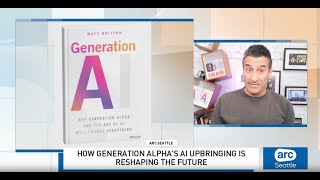
Matt Britton, author of Generation AI, explains how AI is reshaping Gen Alpha's education and future. Teachers aren't ready for household AI. By 2030, many jobs that don't exist yet will be in demand, making creativity and problem-solving more valuable than memorization.
Questions this video answers
By age 2 (90% of people in Gen Alpha).
80% of the new jobs that will be created in 2030 don't even exist today.
The book is coming out in May (2025) and is available for pre-sale on Amazon; contact/info mentioned: content@Matt Britton.com.
Everything from breaking down data to ordering your morning coffee.
Yeah. So many changes. People are often surprised at how prevalent it's become, but for the younger generation, it's really no surprise. They're growing up with it, learning alongside of it, and building a relationship with that technology that may have some long term impact. So joining us to continue the conversation this morning is Matt Britton, a consumer trends expert and the author of Generation AI. Hey Matt, how you doing?
How are you? Thanks for having me.
Of course. Thanks for being with us. So Generation Alpha consists of kids born between what, 2010? Meaning that the oldest of them are around sophomores in high school at the moment. Despite their young age, they already have some of the most in depth digital footprints. Tell us about that.
Yeah, I mean, 90% of people who are in Gen Alpha will have a digital footprint by age 2. So it's now commonplace for parents to want to create that digital footprint for their kids because they know how important it is for kids to stand out in an increasingly digital world. Of note of Gen Alpha is they're the first generation to grow up with AI in a household, that their entire worldview and their expectations of companies and how they expect to be interacted with and served is completely different than any other generation we've seen in the past.
Wow. To me, two years old, you can start learning. Even with the younger members of Gen Z. Pairing AI with education has its fair share of issues. How are those issues magnified with Gen Alpha and how can or are teachers adapting to all of this?
Yeah, I mean, teachers are going to have a very hard time adapting this. I spoke last year at a conference from 700 college professors and after I gave my presentation, you know, they were a little bit befuddled because the reality is they are teaching students on textbooks that were written in a pre AI era. So think about this transformational technology, arguably the most important technology we've seen, and they are teaching textbooks that are devoid of that huge topic for younger kids. If you think about the education complex, kids are usually taught to memorize information and then regurgitate it. What makes you a good student is performing well on tests, which is largely based on your ability to spit out what you are taught. But in an AI driven world, facts are becoming much more commoditized. Instead, it's skills like critical thinking, problem solving, creativity. Creativity is really what's going to be valued moving forward. So teachers and students and parents are really going to have to reinvent themselves to truly future proof for an entirely new world.
Let's talk about that moving forward, Matt. So those of us already in the business world are learning how to use AI in everyday life as a tool. But I know that you say by the time this younger generation enters the workforce, it'll be much more than that. What does that mean?
Well, 80% of the new jobs that are going to be created in 2030 don't even exist today. And that's just staggering. To think about the world we're going to be entering just five years from now. And we're already seeing the implications of that impact the corporate world. You're seeing many companies look for autom and offshoring and really AI driven technologies to eliminate jobs. And it's going to, I think, impact the economy in a negative way in the short term. But over time you're going to find that companies are much more efficient, much more productive, and they're going to start investing in far more innovation. The question is, can people reskill for what's needed in this new AI driven world? And it's so much bigger and it's going to come on so much faster than I think anyone realizes. Besides, folks like me that are spending all of their waking hours really trying to decode and figure out what this does mean.
We all need to start adapting and learning.
I know.
A terrifying glimpse.
Your game on. I don't think you guys are going to be replaced by anytime soon, but you got to dive in.
Okay, well, Matt, how is AI affecting consumerism? And in this younger generation, are there more enhanced digital footprints making them more susceptible to targeted ads?
Yeah, I mean, first and foremost, one of the biggest ways that a lot of experts are theorizing it might impact the way that companies interact with consumers is in the area of search. If you think about Google, it's basically a noun right now and a household name and really the de facto way we all get information. But with new tools out there like ChatGPT, many younger people are gravitating towards AI chatbots to get information versus the traditional search engines that have become such a staple of our way of life. So the question is, how are companies like Google, who in their own right is investing a lot in AI, going to react? But that's really, you know, just the tip of the iceberg in terms how it's impacting consumer behavior, how and where they're going to want to search for products and services is going to be completely reinvented in a world where an AI chatbot knows who they are, knows their budget, knows their tendencies, and in many instances through the notion of AI agents will be able to go out and do shopping for them or plan their trips for them. So any company that sells any product or service really needs to understand the changing world we're a part of and more specifically, how consumers are going to search for products and services that they want to procure.
So, Matt, as somebody who looks into this all the time, you know, where do you think that this is going for Gen Alpha? Is this good thing, bad thing, somewhere in between?
I think with every technological evolution, it's created positives and negatives on society. If you look at the Internet, it's created so many families, brought so many people together, created such great businesses. But it's also caused a lot of violence and a lot of negativity and arguably contributed to an increasingly polarized society, especially here in America. So I think AI is going to be the same. I think AI is going to create a lot of prosperity, it's going to create new opportunities, it's going to create a lot of benefits to consumers, but will also create a lot of harm. Obviously, there's a notion of deepfakes and nefarious actors using AI for the wrong purposes and of course, the aforementioned job loss. So I think you're going to see a balance of both. But the reality is it almost doesn't matter. We're not going backwards. AI is here to stay. Any CEO knows that the core mandate right now is figuring out how it can help drive their company forward. And the byproduct of that is going to be that consumers will be left with no choice and employees and parents but to deal and, but. And to future proof themselves for this new world.
Oh, my goodness. Well, we want to learn more. So where can people find your book?
So my book is coming out in May, but it's already on pre sale on Amazon. Just search Generation AI and you can learn more about me and my content@Matt Britton.com.
All right, Matt, thank you so much. Congrats on the book. And I'm a little nervous.
Don't be nervous.
You got this coming. But hey, it's here, so jump on board, right? Thank you, Matt.
You got it.
Yeah.
Thanks everyone.
Jump on board. You got to stay ready. So in the future, you're prepared, you can adapt, you're. Hang on, hang on. Exactly.
Yeah. I think for most of us, we don't even realize just how much AI is already part of our lives. I mean, yeah, there's things like ChatGPT. You can go to a website and punch in something to come up with, for whatever. But you know, even on social media, when you're using social media, there's AI in that. When you're doing banking, there's AI in that. It's just changing the way that we do so many different things at a rapid pace.
What makes me nervous is the fact that multiple jobs are going to be eliminated because I can do it for you. Now, I don't know if you've noticed when you, when you do a Google search, there's like auto populated responses for you about what thing is AI.
It's AI. Yeah. And what are those jobs going to be? Who are they going to impact? And like he said, can they sort of retrain themselves to be in that new world of AI being involved in everything?
It's a lot.
All right, so let's bring in our producer Jordan. Now for the Arc Seattle question of the day, we asked on social media, what do you think are some of the benefits and challenges of using AI? And I'm sure we got a lot of replies to this, right?
Yeah, we did. And a good variety of different responses. So we'll start on a positive note from Karen, who thinks a benefit is genealogy, saying it's a game changer for that and for the family search tools. So then from Mary, she says, I want to talk to a real person and when I need help on the phone same, which I know has been an issue even before AI.
Yeah.
Amelia says we should only use it to benefit, not to replace. People still need to know how to do things.
That's a good point too. Yeah.
And I really love this one from Terry because I fully agree.