Mazda’s Brad Audet on Move & Be Moved, Brand Evolution & Emotion
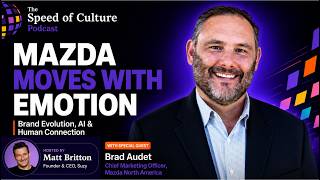
Brad Audette, Mazda's CMO, talks about the brand's shift from "Zoom-Zoom" to "Move and Be Moved," a platform built on purpose and emotional connection. He's transformed 380+ dealer locations into strategic partners, uses creator-led content that outperforms traditional ads, and takes a cautious approach to EVs and autonomous vehicles while embedding AI across marketing operations.
Chapters
Up today on the Speed of Culture podcast, we are thrilled to welcome Brad Audette, the Chief Marketing Officer of Mazda North America. Brad joins us to dive deep into Mazda's groundbreaking new brand platform, Move and Be Moved, which is reshaping the company's identity and forging deeper emotional connections with consumers. Brad, so great to see you today. Thanks so much for joining.
Yeah, thank you for having me on.
Absolutely. So I saw right before you joined as CMO at Mazda, you spent a lot of time working for their agency, which is called the Garage Team Mazda. And, you know, I know in the auto industry, it's quite common that agencies kind of create their own, I guess, pop-up agencies, if you will, to service a big brand like Mazda. And I know a lot of other automotive manufacturers have the same setup with their agencies. What do you think the benefit was working on the agency side, specifically focused on Mazda, in terms of how it prepared you for the CMO role?
Well, I did cross the chasm, I guess, from the agency world into the client world, into Mazda, 4 years ago, right at the onset of the pandemic. And I think the agency experience was really important in setting the foundation. One of the things that I think you realize when you work at a manufacturing company or any large marketing company is they don't have the same level of creativity that creative agencies do. And so As a CMO in an operation like Mazda, you have the ability to create inspiration across all the various business areas. And I think that part of it is really important. I mean, I was running the agency there at Garage for 7 years. Prior to that, I worked at a WPP team agency at another automotive account. So I had a really thorough understanding of the automotive marketplace and how to navigate to get the best out of the agency resources. So I think one of the things that we really done is try to reshape our capability towards a more modern marketing point of view, leveraging data and technology in a more sophisticated manner, which I think would've been a little bit more difficult if I had not had the experience beforehand.
Yeah. And almost like the inverse question I've always wondered is in the advertising industry, agencies put the CMO on a pedestal and everybody wants to have dinner with the CMO and meet them in Cannes, et cetera. And now you're actually in that seat. I guess, what do you know now that maybe you wish you knew when you were in your agency days about the reality of a CMO and what's really important to them?
Well, I mean, I think CMO's responsibility is value creation for the company.
Yeah.
Right? And I think sometimes when you're at the agency, you think, at least when I was at the agency working at, at Grazi Mazzucchi, I spent all my time thinking about marketing for Mazda, even though I'm responsible for marketing at Mazda and I have customer experience and motorsports and a PR, huge crosshair of different responsibilities. But I actually spend a very small amount of time thinking about the agency. And it's not because I don't value the agency. It's because our business is growing increasingly complex. There's more demands on the CEO in terms of creating orchestration and integration throughout the enterprise. Making sure that the voice of the customer is represented in everything that we do. So I think in that regard, had I known what the true challenges were of the CMO in any one of the other agency environments I worked in, I think I would've been able to serve them better. And so I think one of the things that I have been talking about with all of our partners and other forums that I've spoken at is talking about the importance of being empathetic and understanding the business dynamic that the CMO is going through because, you know, the agency only looks at it through the lens of what they're offering.
Yeah. And I think just to dissect what you're saying a little bit, because I ran an agency for almost 2 decades and I'm guilty of that as well. You think about the lens of through what you sell through, right? But you and your CMO, you talk about delivering value and ultimately it's shareholder value and ultimately it's growth. And that comes in the form of business results, right? You're trying to move cars. If you don't move cars off the lot, then ultimately you're next on the line. And I think there's a lot of things that contribute to that. Obviously it's product, it's the positioning, it's advertising, it's, it's how you work with operations, et cetera. And I think often agencies get disconnected from the business results and they stay focused on the marketing results.
They think very narrowly to your point about the channels in their capability areas versus saying to themselves, how am I creating value for my client's business? Versus making advertising or communication widgets. And so that transition, I think some companies are making that better than others, but I think there's still a long ways to go there.
Absolutely. So let's shift gears to your current role as CMO of Mazda. Talk to us about the brand of Mazda and how it's kind of evolved over the years and who the ideal customer profile is for your brand.
Well, I think Mazda had largely been known and still is largely known in the United States for zoom zoom.
Sporty.
Fun to drive. Affordable. And you talk to anybody I ever meet and they always have a Mazda story of their youth and a very delightful, inspiring story of the role of Mazda in their lives. So Mazda has a very strong heritage and a lot of equity in fun and stylish, but it almost comes across as too youthful for where the marketplace is right now. And I think we see the opportunity to take the brand take the business into a more premium space. And when I say premium, I don't mean luxury, but more premium, right? Getting customers to pay more for the product because the brand provides them with a strong emotional engagement, strong emotional bond. So we have been over the course of the last decade transforming our brand under our kind of philosophy of brand value management. Which has included how we redesign our customer experience in our dealerships. So we have 380 or so dealerships that have gone under what we call our Retail Evolution program, which is a dramatic transformation of the physical space, but also the customer experience design. Obviously, we've continued to introduce new products and increase the premiumness of our products. And now lastly, you know, we're bringing our brand platform to life in a more meaningful way for all of our customers and stakeholders. So We're reaching out to people that live their lives with intentions, that want to live a life well lived, that still want an engaging driving experience, but maybe want a bit more refinement, still desire a certain degree of utility. Obviously crossovers are a very big space in the United States. That vehicle utility is something that customers are demanding. So we think we have a pretty good formula for success right now.
That's great. And of course, to get consumers to think differently about your brand or, or think in an evolved way about what Mazda represents, you need to put out different messaging. And I know that you have a brand platform, Move and Be Moved, which is a kind of a critical new phase in how you overall build the brand. Talk to us about what that brand platform means and, and why you're excited about it.
Well, so Move and Be Moved is really, I think, a summation of our our purpose as a company to enrich lives and our promise of lifting people. And then our core values, right around being radically human, having a challenger spirit and ometenashi, which is how we treat people with empathy. And I think it's expressed real nicely as move and be moved. And while we've used move and be moved a little bit as a tagline in certain instances, it's really more of a multi-stakeholder inspiration and a grounding of what we want to. give people. And I think the brilliance behind Move and Be Moved is it speaks to the joy of motion and all of the core characteristics that we're already known for, but it adds on that idea of human potential and being moved and going to new places and becoming one's best self and Mazda being a champion of that. So I think what we are able to do in this environment with this platform is to continue to talk about the strengths of our product, but also open it up to how we appreciate our drivers, how we appreciate communities, how we appreciate society and the role and the value that we bring to everybody that interfaces with Mazda.
Yeah. So obviously you need to mention the unique selling propositions of the product and how the product itself is evolving. But I think the second part that you just explained is really about content to make people not just know, but feel the brand. So when Mazda looks at content, and I guess throughout your entire stint of working on the Mazda brand, what types of content do you think are most effective at conveying the brand purpose?
Well, I think mostly it comes through most authentically in the social environments, I think, where we're able to do audience-specific creative, channel-specific, platform-specific creative. I think that always works. Very well. I would say any of the work that we've done, the stuff that performs the best and what we always go back to is the stuff that is born out of a genuine customer insight. What problem are we solving for the customer versus what problem are we solving for ourselves? So that's always kind of been our rule of thumb as it relates to content development.
Absolutely. So you mentioned earlier about dealers and obviously I think that's probably one thing that maybe outside partners don't really understand as much as the importance of your dealer network. They're the frontline for your brand. They're how most consumers can really touch and feel your brand. And usually they're interacting with dealers at a very critical phase of the funnel, at the bottom of the funnel. How much of your time is spent thinking about and working with your dealers to make sure that the promise of the brand carries through to the dealer experience?
Well, I would say, look, our dealers are an incredibly valuable stakeholder in an environment where a lot of automotive manufacturers have turned a cheek to the dealers and said, we're gonna create new distribution channels. We've actually embraced our dealers as a key, a strategic advantage. I mean, if you're gonna be a radically human brand, if that's one of your values, then you need to harness the power of people. So we spend a fair amount of time consulting with our dealers, understanding our dealers' issues, and trying to work with them in partnership to grow their business. Because when their business grows, our business grows. And so they are very important. In Mazda's situation, unlike maybe some of the other OEMs, we actually, at the factory level or at the manufacturer level, we spend almost the same amount of money as our dealers spend, right? It's pretty evenly split. So we very much believe that we need to be aligned and we need to be coordinated and we need to work in a true spirit of partnership in managing the customer journey. Our dealers have been very receptive to that. So I've worked at a number of, around a number of different automotive manufacturers over my career, and I will say there's nothing like the relationship Mazda has with its dealers. It's a very genuine, trusting, and respectable partnership.
And is there sort of a two-way dialogue that goes on where you're hearing what the dealers are hearing from the end consumer, which then impacts maybe the way that you tweak your messaging or think about your future strategy as a marketer?
Yes, absolutely. I mean, we have a national dealer council and we listen to their input. They collect input from all their dealer colleagues. So We're very much believe as an organization, particularly a marketing organization, that if we wanna enrich people's lives, if we wanna be radically human, if we wanna treat people with empathy, we have to be great listeners, right?
Sure.
And respond to the needs of people and how they're feeling about things. Because at the end of the day, our value creation is about creating feelings with people. And the only way you can do that is by listening to people, And then shaping the artifacts and your go-to-market strategy based on that listening. So we've really spent a lot of time just listening to all of our stakeholders, customers, employees, and dealers to really understand what motivates and moves them.
And in terms of the product side of the equation, Brad, I mean, obviously electric vehicles are so important to your industry and the adoption curve is varied by both types of consumers and frankly the brands in your industry. Some brands are way further ahead and, and others take a more measured approach. Where is Mazda along that continuum and what are your hopes for the brands in the EV space moving forward?
Well, we've taken a more measured approach to how we're handling EV in particular. I think we have a very good multi-solution powertrain strategy and approach. We're actually putting more emphasis on different hybrid variants right now, which really seems to be where the market is moving. Clearly we're working on electrification and that's gonna be an important aspect of our business to the regulations that the governments and states are imposing. The challenge there is that consumer demand's not there for a variety of reasons. It's still quite expensive. The infrastructure doesn't exist. So we'll do what we need to do to always follow and deliver on the needs of our customer. That's the most important thing for us right now. And that's what's guided us over the course of the last several years.
And just to take it even a step further, how do you see the industry evolving in areas like autonomous vehicles? Because that's something that obviously so many people think it's so far away. And then there's some people who would never go in a driverless vehicle, but then you have Waymo in LA and San Francisco where people are jumping in it all the time. So I'm just curious for your own personal opinion and Mazda's, if they have a strategy and where that's headed.
Well, I think the adoption curve of autonomous driving is still somewhat TBD.
Yeah.
It's even like where we are with AI right now. Some people will say it's going to fundamentally change everything in 2 years. Some people say 5 years, 10 years. What I do know is that the amount of computing power required for AI and autonomous driving far exceeds the capacity that we have as a country right now.
Right.
Then you throw EV on top of it. And so you say, okay, can we effectively power EV Can we effectively power autonomous? Can we effectively power AI? I mean, you hear about these self-contained nuclear power generation facilities being built by the likes of Google and Amazon and others. And I think I heard something the other day that an AI-based search inquiry takes 10x the power of a simple text line inquiry, right?
Oh, 10x the power.
Yeah. So I think that there's a lot of infrastructure-related issues there that are going to have to be dealt with. I would just say in the most simple sense though, Mazda is a company that celebrates the joy of driving and wants to be the champion for the driver. And so we will likely always have a car with a steering wheel.
I think that's probably the case for most manufacturers and totally makes sense. You mentioned AI. How do you as a marketer and as a CMO use AI on a daily basis and what are some of the ways it impacts the way that you're going to market with some of your activations in the marketing and advertising realm?
Well, we use AI in just about every facet of the business right now, whether it's in advertising technology, marketing technology. We do our media mix modeling, how we do our audience analysis, how we manage it through analytics, creative variations, power personalization. AI is essentially embedded in everything. And it's kind of funny because we have been using it for some time, but It's only been in the last couple years that people have really started to talk about it more dramatically.
Popularized, right? ChatGPT kind of brought it to the masses.
Yeah, I think so. And one of the things that we've done or in the process of doing too, I think where AI can be very beneficial is in using AI large language models to create like brains, if you will, a brand brain, an audience brain, right?
Yeah.
That allows you to put a lot of data and information together and synthesize it really easily. So if you are, looking for an answer, you're designing a brief, you're able to be a lot more efficient and I think a lot more pointed as a result of those tools being available.
Yeah. I mean, if you think about the driver's manual that you get with a car, you know, I think that every automotive manufacturer just gives somebody a chatbot that basically has been trained with the manual. Because why you use a manual, you want to get information. If you could talk to it and the manual should just be built into the car, really. You should be able to ask the car how to fix something and it'll tell you and it's powered by the manual.
Yeah, I mean, there's going to be certain things where you have a legal obligation to disclose certain stuff. But if you think about it from a user experience standpoint, in-car, audio-enabled, frequently asked questions, just Q&A, how do I do this? How do I turn this on? When should I change my oil? I mean, there are a lot of things that you can do.
Or is the vehicle net blinking?
Yeah, exactly. Right.
Exactly.
But I think the role of the car can also expand beyond just providing information. You think about the, the car as a wearable in the future state. In a lot of ways, it could provide a lot more value to customers. And I think we're seeing some of those expressions in the industry.
You were talking right before the pod about Apple and, and how great of a brand they are. And I'm personally fascinated with just the idea of like a car as a docking station. And CarPlay is such a great technology. And do you see like moving forward, just the car plugging into your personal devices and it just kind of brings up whatever it is that you're interested in, whether it's music, the destinations you go to, like how do you see, I guess, someone's personal data and personal cloud of things they like connecting with the car? Is it just as simple as CarPlay or do you have thoughts on how that might evolve moving forward?
Well, I'll give you my personal point of view about it.
Yeah.
Not the Mazda point of view, but I do, I can't imagine where there's a convergence of these two different hardware platforms into a singular user experience.
Right.
Right now it's still largely disconnected, but I think we're only limited by our imagination. In that space, right? And so the electric vehicle platform provides us with some unique opportunities that we don't have with the mechanical platforms.
Yeah.
And so whether it's CarPlay or if it's some type of other bespoke interface, I think all of these things are quickly converging together where you'll create your own individual ecosystem. Maybe you're not part of somebody else's ecosystem. So I think that presents some opportunities to brand marketers of how you are controlling the customer experience in your role as a providing a brand experience. What does that look like in the future state?
Absolutely. So you had mentioned earlier about social media, and obviously it's a great platform, the platform to share content and more and more consumers obviously getting more and more content and things that dictate their buying decisions through social media. Gen Z, which the oldest, which is 27 years old, over the next 5 to 10 years, they're gonna be a core decision maker and buyer for families and households. And Gen Z, of course, is the first generation to grow up with the iPhone. They knew, never knew a world that didn't have the iPhone. So moving forward, obviously getting into the, I guess, attention span of consumers who are staring at the phone all day is gonna require you working more and more with creators and people who dominate the attention span of people using phones.
Yes.
How do you look at creators as part of your overall strategy in building the brand and getting your messaging across?
I think they're absolutely essential. I mean, I think creators are parts of communities and I think brands to be successful now have to be able to infiltrate those communities and provide value into those communities. So actually when we launched the video work for Move Be Moved, there are a number of influencers, not creators specifically, but influencers that actually play their real life roles in the television work. And we did that intentionally we didn't celebrate them as influencers in their environment, but we brought them in as talent. And that was a different way of thinking about that. But what it did is it allowed us to kind of authentically tap into their communities. We've since gone back and have done more thoughtful kind of content against those various communities. But I think it's really critical.
It's—
everybody right now with their phone is their own content creator, right?
Yeah.
And the question is, is What part of that journey do you want to participate on or with? I think that there's environments where it's easier for a brand to do that than some other environments, but it's one of those things that's, that's ever-changing and ever-evolving. It goes back to me a little bit of the notion of listening. You gotta pay really close attention to what those communities are saying and understand how you can help either fight along with them and that whatever cause that they're fighting for, Right? Or help them solve a problem.
Absolutely. You mentioned this earlier, but I think a lot of marketing goes bad, focuses on a strategy or an approach where a brand just thinks about themselves and how do they espouse their story onto consumers. And what you said earlier really stuck with me in terms of like, it's about what the consumer wants. And in the case of the creator, what the creator wants and how's your brand fit in to add value. Because once you do that, then you can capture attention and not force your way onto them, force your attention on them.
Yeah, I think so. I think it's really important that, at least in our model, what we try to do is listen to what various communities are saying and then put artifacts into the environments that allow the consumers to create their own variation, their own personalized rendition of the brand, right?
Exactly.
I don't think we're in an environment anymore, given all the fragmentation, all the different creator options out there where you can control the brand. What you can say is, I kind of want to generally exist in this space and how do I get all of those people to help me get there? How do we take the journey together?
Yeah, absolutely. So shifting gears to wrap up here on you and your career, you know, just looking at your career journey, you've worked at so many of the most prominent and iconic Madison Avenue ad agencies from BBDO to McCann to JWT, kind of along your way to finally ending up on the brand side in the CMO role. And that is sort of like the classic, I guess, dream of most people entering advertising. They end up where you are becoming CMO for an iconic brand. What are some of the decisions that you think you made right along the way in the agency world, kind of moving your way up the chain, so to speak, to then have the gravitas and knowledge to be able to come into a CMO role on the brand side?
Well, I think there's a couple things. One is that you have to be respectful of the business. And what I mean about that is advertising agencies, marketing agencies exist to create value for clients' businesses. Yeah. And if you have a stronger strategic orientation about what your contribution is into your client's value equation, then you're gonna be much better and you're gonna provide that client better service and you're gonna get rewarded for better results. And I think that's been a point of view that I've tried to adopt is to say, hey, I'm not a communications person, I'm a business person, and I happen to be an expert in communications. So I think that's kind of one thing. I think the second piece of it is, is that we are in a business, both in the automotive side and on the marketing communication side, that is going through significant and continuous evolution over the course of the last 30 years, and it's gonna accelerate even more so in the next 10 years. So I think you have to be a student. Yeah. And you can't give up learning. I'm fascinated every time I go to a concert, I read a new article about everything that's happening, and it's almost difficult to comprehend it at all. Take it all in.
Yeah.
But I think you have to be able to evolve your mindset and evolve your capability. And a lot of people, I think, sometimes get very comfortable in a certain kind of role or doing a certain kind of thing. And that oftentimes limits them. So I think curiosity is a super important piece of being, you know, successful. I think the last thing is, is just recognizing the power of people. As you grow up in your career, you're often rewarded and promoted because of your individual contributions. And then at a point in time, you shift to being rewarded based on the contributions of your team. And how you're starting to uplift people. It was funny the other day on a college game, Nick Saban was telling a little story about how he was not a very good coach when he was at Michigan State, cuz he was too transactional. He was all about winning or losing. When he started focusing his attention on making each one of the young men that were playing for him, the best players, the best people they could be, everything in this program started to change. And he's like one of the most winningest coaches of all time right now. So I think there's a really key lesson in there. It's not about necessarily focusing on the goal, it's about focusing on the journey to get to the goal and what do you need to enable that with the people that are on your team.
Yeah, I think that's awesome advice. Speaking of advice, so say you are just leaving college and entering the advertising world and you someday hope to be the CMO of a big brand. What advice do you have for younger people? And maybe you're seeing this in some of your more successful impactful younger team members in terms of where they should focus, the areas they should be spending their time on to set themselves up for a successful career?
Well, I think you have to be persistent. That's a really important piece.
Love that.
Because it's so easy to give up or to become overwhelmed because it is a very dynamic business and there's a lot of change occurring. And I think if you can adopt a mindset that allows you to be intellectually and emotionally nimble and responsive to your environment, you're gonna have a much greater opportunity. I think a lot of times people internalize too much or have maybe almost too much perfection and too much rigidness when they think about how they manage themselves. And they look at things in a very linear kind of way. And there is no linear career trajectory. It's a series of tacks. If you're a sailor, you gotta play to where the wind is. You gotta move to where the wind is. And you're going to have some setbacks along the way, and that's okay. And I, I clearly think the younger generation of people right now probably have a slightly different mindset about company loyalty and things of that nature moving forward in their careers. So I think that's one thing. The other thing I think is really important is you got to spend time in yourself, and it's easy to want to give your entire self to your job and to your company. But you have to make time for personal enrichment. And I think that's super important in the complex world that we're navigating right now.
For sure. And also they say, be yourself, everybody else is taken. And I think the older and more, I guess, confident I got as a person, I found that my emails at work didn't really sound that much different than my emails in my personal life. I felt like I no longer need to be work Matt and home Matt. I was just Matt.
Yeah.
And that was enough. And I think some people feel like they need to fit into some type of mold. Earlier in their career to fit in and set themselves up. But the reality is if you're just authentic and true to yourself, that's the best form of you. And ultimately that's gonna come out anyway, so you may as well embrace it.
Yeah, I agree with that for sure. Yeah.
To wrap it up here, Brad, I mean, is there a mantra or, or saying that you can think of that kind of summarizes your career journey? You shared so much knowledge, but I wouldn't say anything that comes to mind.
Well, I guess just for myself, it gets back to the persistence and never giving up. I mean, we all face a lot of headwinds and different challenges in our lives, and I never really aimed at being a CMO. In my career. It kind of just happened. I'm really delighted that I've had the opportunity to work with so many amazing people and dealers here at Mazda. I think persistence, right? Because as you said, like, you have to be your best self. And as long as you know that you're doing what's good for you, what's right for you, then I think that you'll always find an opportunity to succeed.
Yeah, that's awesome. Well, I'm glad we persisted to get you on the podcast because—
Well, thank you.
—this is an awesome chat and you definitely are gonna offer a lot of value to our listeners. So thanks so much and I continue to be a fan from afar and admire what you've been able to do at Mazda.
Great, thanks so much.
Thanks so much, Brad. On behalf of Suzy and Adweek Keen, thanks again to the great Brad Audette, the CMO of Mazda North America, for joining us today. Be sure to subscribe, rate, and review the Speed of Culture podcast on your favorite podcast platform. Till next time, see you soon. Take care.
Hey!
More from Matt




MikMak’s Rachel Tipograph on Consumer Spending, Retail Media & Holiday Shopping Trends



Jaguar Land Rover’s Charlotte Blank on Luxury, Purpose & Experiential Storytelling



