McDonald’s Tariq Hassan on Data, Customer Experience & Human Marketing
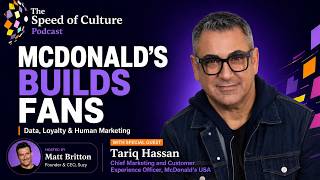
In this Speed of Culture podcast episode, host Matt Britton interviews Tariq (Tarek) Hassan, Chief Marketing and Customer Experience Officer at McDonald’s. Hassan reflects on his career trajectory from agency account planning to corporate roles across technology, finance, retail, and finally QSR, emphasizing how agency experience taught him to balance business objectives with consumer insight. He discusses the transformation of marketing through data, highlighting the power of first‑party data collected via McDonald’s loyalty program (now approaching 40 million known customers) and the shift from mass‑dart advertising to intimate, permission‑based relationships. The conversation moves to culture, where Hassan outlines McDonald’s four‑pillar approach: influencing taste (e.g., Szechuan sauce), enabling fan‑generated menu hacks, treating data as cultural currency, and shaping culture through fan‑to‑fan dialogue (e.g., Famous Order, collaborations with Cactus Plant Flea Market). He stresses the importance of listening, leveraging nostalgia only when grounded in consumer insight, and maintaining brand relevance. Sustainability, nutrition transparency, and regional market differences are addressed as ongoing priorities. Hassan explains McDonald’s AI pilots aimed at contextual, personalized messaging while navigating privacy concerns, and he underscores the need for fast learning, failing greatly, and celebrating risk‑taking. Finally, he offers career advice: stay curious, ask questions, embrace eclectic experiences, keep intuition alongside data, lead with empathy, and create safe spaces for vulnerability. The episode weaves together strategic, cultural, and human‑focused perspectives on modern marketing at a global icon.
Chapters
Up today, we're going to be speaking with Tarek Hassan, the Chief Marketing and Customer Experience Officer for McDonald's. Tarek, so thrilled to have you on the show. Thanks so much for joining.
Thanks for having me, Matt. Great to be here.
Uh, so we're going to dive right in and, and get to know a little bit about your background and your career. What struck me in terms of looking at, at your career history is that you started off on the agency side and spent a good deal of time on the agency side before jumping across, uh, the river to the brand side, so to speak. What benefits did you find you gained from starting off on Madison Avenue?
Yeah, you know, like, I started in, in the account planning space back in the early days when it was really, you know, coming to fruition in the U.S. And I think it was originally— my original traction was actually to the corporate side, if I'm honest, when I graduated. But I found this connection between really getting into the consumer insight business strategy and then the articulation into the creative— found this intersection between the consumer strategy and the creative expression that I really fell in love with. It took me into the agency world. And what I loved about being in the strategic area in the agency world is it gave me access to both sides of the business, right? As a planner, you're engaged in the business issues with your client, but then you are put in a position to really go translate that in a way that you can then have a creative outcome that's meaningful to the customer market. And I don't know that I knew it at the time, but I think that sort of unlocked my ability to look at the business in a broader sense, both from understanding really what the client was trying to achieve, but then constantly keeping that customer at the center. And so it quite often happens— I made the transition, I would love to say by design, but it wasn't, right? It's as often as often happens in the agency world, a former client. Convinced me to come over to the corporate brand side when I made the leap over to HP. But I was, you're right, I probably almost the first half of my career in the agency world.
Yeah, and the one thing I found about being in the agency world is that you get to touch so many different businesses. Yeah. And on one hand, the businesses are completely unique and distinct, but when you actually just peel back the layers of the onion, you find that they all have very similar challenges. Yeah. And kind of they have to come up with similar solutions in order to execute. Did you find just working with a handful of different industries helped you kind of become more worldly in your view of the consumer marketing early on?
It's a really great point and it is something that I draw on constantly. Yeah. And it, you know, for me, I'm very seldom fixated on a category. My fixation tends to be on the business problem and the consumer opportunity.
Right.
Which to your point is universal across the work that you work on in the agency world. And I think you get a view to those, frankly, those businesses that do it well and those that maybe have some deficiencies in there that you learn how you might not do things. Um, but I think that's absolutely shaped it. And I loved working across not only multiple categories, but also working on, you know, US businesses and global business. I spent a lot of time working in international. And I think the combination of working across categories and also working in international markets has been two major influences on, on the way I've approached my life on this side of the business. Absolutely.
And before even diving into the agency world, did you always know that you wanted to be in the world of marketing? A lot of people always ask me, how did you know? When did you know what you wanted to be? I think everyone's answer is a little bit different. Uh, you know, when did you figure that out?
I kind of joke around and I say anyone that tells me they've always known they were destined for marketing and advertising, I'm usually a little suspect of, you know, unless they're, unless their parents were, or they were like dyed in the wool around it. Um, no, my, my life is, you know, it's the old funny thing happened on the way to law school. Um, it was more about what I decided I didn't want to do. And then, and as I looked at things, decided to go back and do my graduate work. And when I was doing that, as much a product of the time of early shifts in the marketing world around thinking about integration and really the interrelationship between marketing strategy and communication strategy. And I would say it was a really positive accident for me to have discovered what I was able to find out. I think what does go back all the way in time for me, and my mom would probably be the first to confirm this for you, I've always been a question kid. I've always been far more enamored with the question—
Curious.
—in many ways than the actual answer. And I think I found a place where where that curiosity was not only allowed to sort of come to life where I could pursue the answers, but then put it into a creative expression. And I don't think I really knew that much about the industry prior to actually falling into it in a way that it then, I found something that really met my passions and my interests. Yeah, absolutely.
I was talking to my son over the weekend just about all the stuff that's going on with AI right now, which we'll get into in a little bit more detail, but it just struck me the type of world that kids are going to be entering the workforce in now and how the whole world has shifted and the whole game has changed. And it sort of reminds me of the time when you and I both came into the workforce, uh, 1995 to 2000, where the internet itself was just being formed and rolled out. Um, as a marketer now, you've been in market for over 20 years. How has all these external changes sort of changed the role of a marketer in your opinion? How has it changed over time from when you first entered to now in terms of how you look at your job and what success looks like?
Yeah, look, I think, I think what's fascinating is our industry has always been going through some form of evolution, right? Yeah. Whether that's the product you're working in or the service you're working in or the way that we go to market. And we did, you know, we grew up in a pretty— I would say almost equates to what we're going through now, right? In terms of major, major industry change being brought about as a result of technology. If I look back to even my early graduate work, I'm actually doing more now with what I learned in grad school around integration and back then what we would have called direct marketing, right? Now, what we talk about is direct-to-customer. Right. We were working so much in theory now, and it's crazy that almost 25 years later, I'm actually able to apply those theories now far more than I was back then. But the concept— and I now look back and think about how lucky I was to have done that program at Northwestern. Around early thinking about data signals and how we'd be able to use those, um, I feel like I've been prepared for it. But I'm also found that the things you hang on to that haven't changed, right? And so how do you ensure you don't end up in a world where it's the data made me do it, right? But yet you keep the customer at the center and you're still focusing on insights and you're still understanding need states of your customers. The difference to me now is the speed at which we can learn the range of insights we can get from the data, the accuracy of the insights, but then also the measurement, right? And we can learn and fail fast. Um, but also the one where the marketplace where we put that, where we put that investment now, right against data signals is just empowering. It's just a completely different landscape to, to the way we can approach it.
100%. It's almost like the more things change, the more they stay the same. I remember being really inspired early in my career by a book by, uh, Seth Godin called The permission marketer, where it's all about you can't spam people, you need their permission. If you have their permission, you earn it, then you have the right to enter their, you know, their mindshare and build a relationship with them. And I think we've been through a lot of kind of fits and turns, but ultimately that when you talk about data signals, right, you ultimately want permission. You want to drive the permission from the consumer for engagement. And in the world of engagement is where you can really build those lifelong customers.
Yeah, I talk a lot to my team about creating value sign-in, right? And, you know, in acquisition marketing, nobody wants to be acquired. No customer wants to be told they've been acquired, right? What they, what they will respond to is, have you connected with them? Have you earned them, right? Are you providing value for them to participate? And just like in all of our— what I love about it is we've been able to get— ironically, the data is actually allowing us to leverage more human approach to developing a relationship. Because if I can use that data to understand you and connect with you and provide value to you, that's such a more meaningful way than the, frankly, the darts we were throwing when I first started in the industry. And so if you use it, I talk a lot about the intimacy of data, right? If you can use that data and then overlay it again with those consumer insights and with sociological inputs and other third, other soft and hard data elements, you really start to shape a very different kind of relationship. And to your point, if you do that well, customers will provide that value exchange, right?
100%. But it has leveled the playing field, right? Because throwing darts, it used to be anybody with a checkbook could throw darts, right? And you were able to kind of force your message into consumer psyche just by generally frequency. But now everybody has access to the same tools, and now everyone has the ability to kind of enter that consideration frame if they can just be contextual and deliver on what the consumer is really looking for.
Yeah, with one really significant differential, which is what I'm loving about both my last two— that my last gig and this new one— um, those who can do it in a way where you're actually developing your own really significant first-party data set. Yeah, right. That's, that's now become the separator. But now the question is, not only can you collect that data Can you keep it? Can you expand it? And the only way you can do that is do what you're talking about, which is create a value relationship with a customer where they want to engage with you so you can add richness and enhance what that data looks like. That's, to me, that's the most exciting part of where we're at right now in the industry.
Yeah, and I mean, I think in order to deliver value, you also have to know what the consumer wants, right? Exactly. Because it's their definition of value, not yours. How have you found, and we'll get into your current role at McDonald's, in a minute, but how have you found your ability to continually evolve with the consumer and understand what their changing needs are over time, especially as you look at, you know, audiences like Gen Z who seem to have a different, uh, distinct taste every single day?
Well, I think it's a combination of two things. I think I go back to my roots in, in strategy and in account planning where I just grew up constantly being dyed in the wool of the customer, understanding them, spending time with them, um, and doing it in both— like I said, doing it both hard data ways but also those softer elements of being out there, much more anthropological and actually listening and learning and looking for tangent data that actually ties to it as opposed to narrowly focused. I think that is one of the differences of sort of having that breadth of experience that you were talking about. When you work across multiple categories, you learn to ask a set of different questions. And sometimes those questions come from other category experiences you had that you initially think, "Well, why would you even approach that in this category?" Yet there's an interrelationship to that learning you can have. So that'd be the first part. And the second part, I would say, is a little bit of luck, right? If you look at my background, it's pretty eclectic in terms of once I left the agency world, I spent time in technology, I spent time in financial services, I spent time in retail, and now I'm here in the QSR world with McDonald's. And yet, looking back, by luck in many cases and by happenstance of being in the right opportunities, as with HP from roughly 2008 to 2012, right? IPhone came out in '07, Facebook '06, '07, so really significant shifts in the technology world when I was in technology, right? So it gave me an opportunity to really get that firsthand understanding, development of the apps and what the role of apps would be in our lives, really true development of what our connection to our mobile phones would be like. The next chapter, when I rolled into Bank of America, you know, there was a financial institution where one of every other household had a B of A product in it. And so that really gave me the ability to play in big data. Before I even knew what our potential of unlocking in the use of that big data was. It was on the beginning forefront of it, but it just now has played so significantly. It's how it's influenced the work that I do and the experiences I had there. And then the retail motion has proven to be really interesting as I move into, into the McDonald's experience, just because I was able to really start to dive into the loyalty aspects and really start to— how do you think about using a loyalty program How do you start to look at subscriptions? How do you start to really use first-party data to create the value you're talking about? So, you know, lucky in the sense that those experiences happened, but now they've created a really interesting set of building blocks that influence how I, how I approach the market.
Absolutely. And now here you are, Chief Marketing and Customer Experience Officer for McDonald's, an iconic American brand. I have to say, as a side note, one of my favorite movies was The Founder, uh, which depicts the life of, uh, Ray Kroc. And obviously You never know what to believe in those movies. But as an entrepreneur, I was definitely inspired about the journey. And it's just incredible to see McDonald's performance over time, especially during these rough macroeconomic tides we faced more recently. McDonald's has still sort of withstood as a well-performing stock and business. What excited you about going to McDonald's from, from PECO, where you were right before that? I know they both have a lot in common and you know, what do you hope to achieve, you know, in your current role, which I guess you're now 2, 3 years into?
Yeah, so not quite 2 years in and it's been an amazing ride. But honestly, the interest is a great brand, right? Great iconic American brand. So and that part just plays to the, to the work I've done in my past life and brand building. That's great. Love it. Really, the real intrigue for me, I joined about 2 or 3 months after we were launching our loyalty program. And so the thought of being able to build a first-party dataset at the kind of scale that we're able to achieve here at McDonald's, we're not quite 2 years into launching loyalty and we're just shy of 40 million knowns on our platform with the ability to continue to scale that, right? That's a scale that is not very common in the industry. So the thought of being able to come into a category that just 2 years ago, had some pretty basal transactional data, wasn't first party, wasn't connected in terms of the way you can connect with the customer.
It's not connected to the buying through, right? You're touching the consumer. Of course you're going to want to collect that first party data.
But it, but it, but it was new to the industry, right? It was an industry that didn't really need it to be successful. And so I'm really proud of the fact that the organization's focused on how to make this a priority. But honestly, that was the true excitement, was the thought of being able to come to a platform of this scale and start to think about how to drive connection with our customers in a way where you can create new value for them. At that kind of scale really was truly but the driver for why I was so interested in taking the opportunity.
Yeah, because most people, I would imagine, come in as a CMO of an iconic brand like McDonald's, and they don't really need to create anything new. They just kind of have to steer the ship. But here you are actually creating something net new that gets you this huge— the huge power of first-party data. I mean, you kind of can be entrepreneurial within the context of a large organization and really drive change. Yeah. And, you know, it's—
there's a couple of different dimensions to it. First of all, you know, you've always got to be guiding with your brand, right? Making sure that brand is connected because otherwise you're not going to connect first-party data to an irrelevant brand. Right. But Morgan had done a tremendous job for a couple of years prior to my coming in, really putting a shine back on the brand, finding our voice again, connecting with the marketplace through our famous orders that unlocked the confidence in what the brand could be. And it was critical again, because without that brand attraction, Because you're never going to hear us talk about brand versus performance. We talk about brand performance. I don't believe you are successful in acquiring customers or keeping that acquisition if you don't have a brand that they relate to and connect with. So that journey had started. It gave me the ability to think about how do we sustain it. And I talked a lot to my team about this idea of like, congratulations, gang, you've really connected in the market. You've called culture and culture's called you back. You're a little bit like the dog that caught the bus. Now what, right? How do you stay in culture? And in a world where you can find that connection is powerful, but in a world where cancel culture exists too, maintaining it has its own challenges. So I think we've done a really great job of continuing that connection. And we laid out a real focused strategy because culture is a big word, right? A lot of folks talking about it. We said, what does that mean to us? And we play out in 4 areas. We play in— obviously, we're a food company. So the question is, how do you continue to influence the taste of culture? And that's not just what we've always done as a brand and the things that people are familiar with and love about our brand, but how do you start to infuse the changing tastes of culture? And that's something as simple as our Szechuan sauce, for example, right? How do you infuse new reflections of your market in the way your menu tastes? The second area was just showing up and making sure we continue to live with customers in their creative universe, right? So we didn't invent the menu hack, right? It's on TikTok, but we sure as heck thought there was an interesting way that McDonald's could participate in it as a simple example by opening up our menu and creating unique menu hack opportunities for our customers to experience, tying into the way that they already engage in the internet, right? It's just a simple example. Yeah. The third area we talk about, and this is the one where people scratch their head a little bit, is we talk about data as part of culture. And when you think about who we're really focused on, the younger youth part of, of the segment, Digital-first mindset. Data is a form of currency. It's a form of communication. It's a form of language. And so we think long and hard about how do we not only collect the data, but going back to your point, use it in a way to connect, create value in a way that will actually create long-term value and relationships with our customers. And then the last one is, you know, we're McDonald's and at the scale we're at, we shouldn't just be participating in culture. We shouldn't even just be creating culture. We should actually be helping shape culture. And that's really what we've started to lean in and do as we think about how we're engaging with our fans in a unique way. And at the tip of the spear comes back to something you asked at the beginning. We do it by focusing on being fan-to-fan as opposed to being brand-to-fan. And so many businesses think about, how does my brand talk? What we've discovered is, how do our fans talk? And then how do we actually have a dialogue with them from a fan perspective, even in programs like a Famous Order? That wasn't about finding celebrities to make things big. It was actually about finding fans, because universally we all have our favorite order, who just happen to be celebrities. So how do we bring their authentic view to the connection to our brand to life in a way that we can just share broadly? And their celebrity appeal then connects, but it connects with them as a fan, not just as a celebrity. And that's, that's at the core of everything we're doing.
Yeah, you hit on an interesting point because one thing I often say is that culture is no longer created in the boardrooms, it's created on the sidewalks. And I think a lot of CMOs in the '80s, '90s, early 2000s, they thought they could become the arbiter of culture because they had the checkbook and they could, you know, obviously be on national TV, etc., and do heavy rotation, get their message across. But as we both know, that no longer works. So it sounds like what you're saying is a lot about listening, really understanding your consumer, understanding how the voice of your consumer fits into your general brand equity pillars. And kind of just unleashing them, right, to drive what your brand will become.
Yeah, it's a little bit of a yes and look, when we started in the business, you actually could create culture with a product, right? Sure. And like, you know, over the weekend I went out and saw Air, right?
And I lived through— Awesome. That's the first thing that came to my mind when you brought it up. Yep. And you know what?
And that shoe did. And the connection to Jordan did. But, you know, had they just signed Jordan, probably would have been successful, but Jordan, with the combination of the shoe created— and that was an era where products literally could. I think you can still do that. The difference is the connection to what that product is. It better have a long tail to the market and to the fans and to the authenticity. But also, you're also finding a way to connect in culture, frankly, without doing much with your existing products. If you look at what we did with our, um, Cactus Plant Flea Market, we tapped into an insight with adults around this childhood loss of the joy they had of a Happy Meal when they were a kid. And said, "How do we capture that in a way that we could give you that experience as an adult?" It came out of a tweet, right? So, are you listening right? It was a tweet that basically talked about, you know, you wake up one day and without realizing it, you'd ordered your last Happy Meal. And that little insight was around understanding the joy that was attached to that and how can we recapture that joy. But when you look at the way we executed it, product-wise, it was familiar. It's a Big Mac or it's chicken McNugget. Order, something you can get on the menu every day. But then we wrapped it around with a perspective from Cactus Plant Flea Market. We had the courage to share the pen and say, go, help us understand what this would look like. We allowed the design team to reflect again as fans and their own memories. It was their idea to come back and figure out how do we leverage those McDonaldland characters, because there was something deep-seated in their own experiences. That then was allowed to come in and reflect. So part of it is, can you listen? But then can you also create the space to allow for that creation to take place in a way that there's no way you would develop on your own if you did it strictly from the boardroom, so to speak, like you suggested?
Absolutely. Yeah. I'm glad you brought up the Air too, because one line that will stick with me forever is, the sneaker is just a sneaker till Michael Jordan steps into it. So it was just a sneaker and then he stepped into it and it became the Air Jordan. You know, Michael Jordan also was a big driver of the culture, obviously, in terms of his love for the game and his impact on, on the various communities he touched, etc. And I think one, I guess, lasting truth from that movie is that celebrities still matter, influencers still matter, especially in this world of social media, which obviously didn't exist back then in the '80s. How are you looking at influencer culture creators as sort of a catalyst to help drive some of the things that you're talking about for the McDonald's brand?
Yeah, like, I think, you know, it's equally important to understand, and if I continue to use our analogy, not just anybody can step into the shoe and make a difference, but at the same time, not just any shoe would have either, right? And so there has to be a synergy between the two. And to do that, you've got to put your brand ego down, right? You have to actually embrace your fan— we call them fans— you have to embrace your fans and understand them and allow them to reflect who they are inside your idea. And if you think about that, that's exactly what they turned to Jordan and basically said was the thing that will make us different is we're going to embody you in the spirit of what we're actually creating. Right. And that conversation between the shoe designer is a perfect moment of a designer who understood It wasn't just about creating the products that Nike had always created. It was about actually creating this relationship between the game, between Jordan, and between Nike and the product, right? And how do you bring those together? That's what we're trying to do. We get up every day fixated on where are our fans' minds, where are their passions, where are those connections? Because as you know, if you miss, the social sphere will let you know in a big hurry, right? And so that's the other big difference from when you know, when we first started in the industry, you know, you get your scorecard a heck of a lot faster today than you did back when we started, waiting 3, 4, 5 months for, you know, market mix analysis or, you know, in-market trends, etc., right? You run it and you're looking— look, we knew we were going to sell out Cactus Plant Flea Market before we even launched, just based on the pre-launch we did based on the buzz we saw in social media.
You, you also— talking about like nostalgia, you also really leaned into the Happy Meal. I know last year, uh, repackaged it, tried to make it something much more relevant to the adult fans. How does ideas like this and nostalgia in general play into the overall McDonald's experience, given how iconic the brand is?
Yeah, look, I'm not actually a big believer that nostalgia in itself is a strategy, but it's abundantly clear coming out of COVID coming of age of different segments, right? There's always some value in how you connect with it. What I would suggest is, had we just used nostalgia, but it wasn't linked to that insight of that sort of childhood lost joy that I was talking about, it's just nostalgia. Yeah. What we had to start with was an insight around that customer who remembered that joy as a child. Nostalgia was the wrapping paper to how to do it. The big joy that I got from that program was I think we actually unlocked something meaningful about your childhood relationship with McDonald's that we could continue to reignite with you as an adult. There's a lot of ways to do that. Nostalgia happened to be the way we did it that time, but that insight continues to be powerful, and there's probably a lot of different ways we can continue to explore that.
Absolutely. Absolutely. And, and moving forward, um, you know, we're in a new world now where there's some things that you as a food marketer have to obviously contend with that other people in the past haven't, like sustainability, like a bigger focus on healthy diets and balanced nutrition. How are those kind of trends playing into the way that you overall look at continuing to build and evolve the McDonald's brand?
Look, I think there's a couple of things there. What I can tell you is it's the same discipline. You understand your market, you understand what their needs are. If you look at the questions around sustainability, we're already leaning in. We have a number of impact goals that we're trying to set. We've made some commitments around our Happy Meal toys, for example. We'll hit those commitments. At the same time, you have to listen to the marketplace. The reality is the U.S. market is moving at a different pace than, for example, many of the European markets are in terms of what they say versus what they actually do. So it's a balancing act between doing the things, and you lead as a company, of doing what's right and then also truly understanding your marketplace on what's important to them and then putting those things in place. Honestly, the nutrition thing, I think we've moved as a culture to a place where it's about transparency of information more than it is having your, you know, your diet or your nutritionary elements, you know, relegated to you. So now today, if that's an interest for you, you can see what the caloric values of our, of all of our products are on the menu. You can make your own decisions. And I think you're seeing people as they look at living a macro trend of like living a life of wellness. That includes happiness, joy, pleasure, and experiences, and they'll determine how it fits into their life. So just make sure they have the information so they can make responsible decisions. Just doing that has certainly allowed us to keep moving forward. And certainly, if you look at the way the business is running, people are determining how those things fit into the balance of their lives and enjoyment and pleasure and joy that McDonald's gives people. It's still got a place. Absolutely. Absolutely.
So to shift gears a little bit, just with an eye towards the future, 2023 is flying by as we speak. Obviously this year has been, you know, the year of AI in terms of its impact on marketing, or at least the promise of its impact on marketing and so many other industries. How are you looking at the role of AI as it relates to McDonald's go-to-market strategies and what steps are you taking to make sure both you and your team, which I imagine is a big part of your overall role, have your finger on the pulse of what's next in that area?
Yeah, I think you said it's the promise of. We're excited. I think we're in the place we've always been when you've seen major technological changes like you saw in 2000 with the web and then again with the phones and sort of that 2008, 2009, right?
Yeah.
I think you've got to be prepared to, you know, listen and learn and fail fast. So we've got a number of pilots we're putting in place. We're trying to understand where we think the most meaningful impacts we can use them. The promise of it from an understanding of How do you, to your earlier point about adding value to that data signal, we think there's obviously tremendous opportunity around using AI to not only be able to speak to that customer, to find the contextual place to speak to them, leveraging AI to understand where they are in the right moment, but then also then how do you curtail your messaging in a way that you're getting more specific and more aligned to who they are, right? Because that's part of that requirement for creating value is can you actually demonstrate a knowing me? But we've also got to figure out where customers are going to lean in with us so that you don't head into the creepy factor, right? And that it's done in such a way that customers are saying, "Wow, you're listening to me. That feels like you understand and you're providing value for me," as opposed to, "You're tracking me, you're invading privacy." And I think we're going to have to see how a lot of the privacy stuff plays out as we go forward. But it's early days. I'd say we're really excited about it. And then We're also stepping back and trying to figure out how do you operationalize some of these things, right? Whether it's with your own organization, whether it's with your media companies, and ultimately with your, with your agencies. But I'm fortunate enough to be surrounded by not only a team, but partners who are excited about how we can leverage this technology if it allows us to be smarter, more connected, and more authentic. Yeah.
And, and to bolt onto that, you have now a growing proprietary dataset, which could power some of the applications that you bestow to customers and you unique and interesting ways, for sure. So, so to wrap up here, uh, Tarek, you know, you're, as I mentioned earlier, you're CMO of an iconic American brand and, and, and a seat that many people that are entering the marketing industry want to be in one day. Um, what advice would you give to younger listeners, um, here at the Speed of Culture podcast in terms of steps they can take early on and then throughout their career to optimize their chance for success and one day be in a a role like yours?
Look, I think I go back to where you and I started, which is less about a role and more about a mindset, right? I just don't think you can be in this business without having just a fervent curiosity, right? I do— I'm a big believer that the question is much more important than the answer quite often. And so that curiosity of pursuing questions and not being afraid to sort of really dig in and understand the source of that insight. And sometimes that insight comes from the customer, sometimes the market, sometimes the product, but like really be learning how to become a craftsman of interrogating your own questions, I think is a really important area of it. And then I would say, and again, I think you're gonna get different answers from different CMOs who have taken different paths. I would, looking back, I wouldn't change a thing about the sort of the eclectic pathway that's led me to this point. I'll acknowledge it's not necessarily the easiest pathway to make that move from the agency world and then, you know, successive moves to the corporate, but I don't regret it. I think it's given me the ability to participate and watch change in categories differently, to work across multiple categories, to work across different cultures, to gain a creative sensibility, because I do think one of the things marketers are going to have to really work to hang on to as we go forward The more data confirmation you get, you're going to have to work that much harder to ensure that your intuitive creative sense and your intuitive understanding of the marketplace isn't lost. And that's what I mean by intimacy of data. Don't just look at the data. Don't be afraid to look behind the data and understand behaviors because you will always find a data point that the actions don't line up. And so, that interaction is going to be really, really critically important. I would tell you, I think the global part of my career was a significant influence. I think both as a marketer, I view problems very differently as a result of spending a lot of time in different cultures. I also think it gives you a different personal pragmatism of how you work with others and how you collaborate. It helps you figure out how to scale ideas without losing the power of it, right? Because a lot of times when you're doing global things, you sometimes work to the least challenging, least risk element of it. I think there are ways you can scale without doing that. And then I would say, don't be afraid to— again, don't fixate unnecessarily on categories, but fixate on fascinating problems that are going to give you different experiences and develop different mindsets. I do believe in an AI world, there still is a significant role for human engagement. Even in the creative space. I don't think machines can do all of those things without the same human overlay on top of it. So get smart in the data, keep pursuing, understanding the technology, keep learning fast and failing fast, but maintain that sort of human connection to the things that drive, ultimately drive our creativity. Yeah, I love that.
And it's funny when you talk about not letting the data just drive everything you do without your intuition, it reminds me of an episode of the show The Office where Steve Carell is driving and the navigation tells him to drive into the river and he just does it because he's like, it has to be right, the data has to be right. Next thing you know, his car's in the river where his intuition should have told him, no, you don't want to turn that way. And I think that is the danger in this new world when people become too overreliant on data.
And here's the thing, we're getting enough data that you can try a couple of things really fast and find out whether you should turn right, turn left, or go straight. Without really significantly damaging what you're trying to get done.
Right. You don't have to turn your car into the water for you to find that out.
No, I mean, you can run enough simulations quick enough to find out what the outcome will be if you go right, left, or straight. And so, that's the other thing I work really hard with the organization on is maintaining the absolute conviction and comfort, not only with taking risks, but failing. Right. And it's a critical part of who— part of what's been successful in my career. We talk a lot. About you cannot get to greatness with fear of failure. So we celebrate failure in the organization, which we call failing greatly, because there is a great way to fail, right? If you have the vision, if you have aligned objectives, if you have accountability, if the plan is tested and it just didn't work. Last time I checked, some of the best startups have turned into amazing businesses when they pivoted from those kind of failures. So trying to infuse that into the organization make people comfortable with it, and then frankly celebrating it in order to keep taking the next risk. Because out of one great failure, you are one step away from the next big, huge success. Yeah.
So I think it's also great parenting advice for those parents listening is let your kids fail, let them learn. It's okay if they screw up. It's about trying. I think that's to be instilled at early ages as well.
Yeah, I have to admit, as a father of a 15-year-old, I think I have a harder time with that one as a parent than I actually do as a marketer. But you are spot on.
I got a 15-year-old as well, so we're on the same page there. Well, this has been so great. To close out here, Tarek, is there one mantra or quote that you like to live by that you often find yourself saying over time that kind of sums up everything we've talked about today?
Yeah, I mean, I think for me, it's something that comes from my grandfather, and then my parents used to reinforce it. I think I do better with it some days than others, but for me, it's two ears, one mouth. You know, that idea of just having yourself open to hearing and the power of listening. As I said, there are days I do so much better than other days, but it's something I think, especially the speed we're moving, it's hard sometimes just to slow down, listen, let it pour over, let it soak in for a few. That's right. And active listen, not listening to respond, but actually listening to learn.
Absolutely. I think that's such a great point and something I think we can all work harder on. And I should say running a podcast has taught me to be a better listener as well, just alone in terms of listening to what people are saying and letting them finish. And I think, but it's such a great skill set and I think one that, that can be applied in so many different ways.
And then I think the last thing I'd leave you with is, and it also then becomes a style in which you choose to lead, act, and move as a leader. And for me, the two core areas there are less about a saying but core values, you know, is lead with empathy and make it safe for vulnerability. Because again, you can't create those opportunities to take big risks and try different things if people have that fear of failure. And you really can't go after those kind of things and talk about them and acknowledge them unless it's a safe environment to be vulnerable in, or unless you know you're going to get an empathetic response as you move through it. So I think when you combine that sort of mindset of how you listen and learn with how you choose to lead, Those to me are the most critical things because now more than ever, those human elements of leadership are so much more significant than some of the functional and skillset areas. Absolutely.
So many nuggets here, so many learnings. We could go on forever and I can't wait for our audience to hear about all your wisdom and congrats on all your success and what will be continued success for you, Tarek. So on behalf of Suzy and the Adweek team, thanks again to Tarek Kassim. The chief marketing and customer experience officer of McDonald's, for joining us. What a great conversation. Be sure to subscribe, rate, and review the Speed of Culture podcast on your favorite podcast platform. Until next time, see you soon, everyone. Take care.
More from Matt




MikMak’s Rachel Tipograph on Consumer Spending, Retail Media & Holiday Shopping Trends



Jaguar Land Rover’s Charlotte Blank on Luxury, Purpose & Experiential Storytelling



