MediaLink’s Michael Kassan on Trust, Growth & the Power of Connection
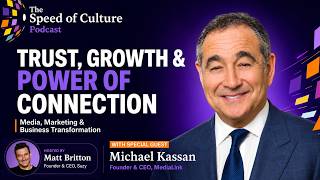
Michael Kassan founded MediaLink in his early 50s after working as a tax lawyer and COO of a major media agency. He built the company on trust and connection, using signature events like Cannes and CES to bring together brands, agencies, and creators. Kassan credits authenticity and showing up in person as the core of his networking approach.
Chapters
Up today, we're going to be speaking with longtime friend, founder and CEO of MediaLink, and really a man who needs no introduction, Mr. Michael Kassen. Michael, so great to see you.
Matt, so happy to join, and I echo at least the opening line of longtime friend, and as well my title, and appreciate being here and appreciate sharing some thinking.
Awesome. We're long overdue, as you often put it, when I see you in person, or when I used to see you out of the vent circle. So before we get started, we're gonna quickly get to know a little bit about you. And looking at your background, one of the things I have to admit that was shocking is that you were pre-dental at UCLA. Maybe it describes how you get your pearly whites, but tell us about your journey, you know, Reader's Digest version, so to speak, in terms of how you got to where you are today.
Yeah, I had a cousin who was like a big brother to me, and he was a dentist, so it just made natural sense You know, you find those people that you identify with and you—
Yeah.
You know, be like them. And then, lo and behold, as a freshman, I woke up one morning and said, "This isn't what I want to do. I really think I should be a lawyer." And I called my parents and I said, "I've really thought about this and I feel like I'm better suited to be in business and follow the path of being a lawyer." So, I quickly changed from being a dentist to what ultimately ended up being the first 10 years of my career as a tax lawyer. So, I went to college, law school, and then I went to graduate school to become a specialist in tax. And really operated, Matt, in the beltway of Los Angeles because I grew up here. I was born in New York but grew up in Los Angeles. And the beltway of Los Angeles, I know people think of Washington as a city with a beltway, but I would submit that every city, every local place has a beltway of sorts. In New York, it would be finance and culture, I would suggest, and fashion. In LA, it would be entertainment and now technology and whatnot.
Sure.
And so, you know, my flag was planted in the entertainment industry as a tax lawyer for the first 10 years of my career. And that journey led me to taking over a company that I represented in the home video business, which back in the '80s, I mean the 1980s, not the 1880s, I'm not that old. Was the largest licensor, uh, licensee rather, of children's programming. It was called Family Home Entertainment. You'll probably remember, you might be too young, Matt, but we had the video rights back then to G.I. Joe and Transformers and Strawberry Shortcake and Inspector Gadget and Rambo when it went into cartoon. We had all of those titles and it was the largest independent home video company in the world at the time. And I came in and— took over that company, ran it for several years, sold it, found myself in my early, my mid-30s, kind of having one bit of success and not sure if I wanted to go back to full-time practice of law and ended up making a transition of all things into the media industry. I had represented what was then the largest media agency in the world, a company called Western International Media, and Dennis Holt, the founder of that company, asked me to join him. And, you know, what I like to say is my very first day on the job in the media industry, very first day, I was chief operating officer of the largest media agency in the world at the time. And I'll let you in on a secret, Matt. I didn't know the difference between a GRP and a TRP, but I understood the basic business of media buying and media investment, really. And that was how I transitioned into the media business. You know, I learned on the job. I'll take a breath now because that was a long, long—
Yeah, you learned on the job and that took you to about 2003 and then you founded MediaLink. And one of the first things that's striking about you starting MediaLink in 2003, you were in your 50s at that point, right?
That's correct.
And you were known as the MediaLink person amongst other great accolades. But, you know, most people aren't known for something they started in their 50s. A lot of people feel like if they don't start what they're gonna be right now in their 20s, you know, my daughter's freaking out. She doesn't know what she wants to be at 17, right? Here you are, I don't want to say reinventing yourself, but creating this incredible success story later in life. Do you feel that all the experience you had leading up to that allowed you to do that?
Well, I would say two things. I felt like a 50-plus-year-old rookie, which was always a good feeling. And I always kept that as part of my kind of je ne sais quoi, maybe. I like that feeling, number one. Number two, reinventing is a good thing. We all talk about one of the T-words, which I'll tell you in a little bit. Transformation. So, if we think about transformation or reinventing, they're kind of the same. So, right now, companies are all going through transformations. I guess as an individual, I went through a transformation. And I stumbled on the fact that there was an opportunity because I didn't have the ability nor the foresight to write a business plan for MediaLink. It happened in the old expression, it grew like topsy. People just started calling and asking me advice and questions and were leaning on my ability to have connective and convening power in the industry. Somehow I got that. And I guess I would say I was lucky to be able to transform or reinvent myself in my early 50s. But that's only if you subscribe to the definition of luck that I learned years ago, which was— once I was told luck was the intersection of preparation and opportunity. So yes, I was prepared. And yes, there was an opportunity. But, you know, what I kind of fancy, if I was asked to give you, I don't know if they're superpowers, but things that I think I'm reasonably adept at, I'd like to say that I think I'm pretty good at identifying opportunities. So I guess you could call me an opportunist, but not in a pejorative way, I hope, but, you know, able to see opportunities maybe over the horizon or around the corner. Number one. Number two, I think I'm better than average at capitalizing on those opportunities when I see them. Mm-hmm. You know, just able to see a little bit of what you do with that opportunity, maybe faster than many. And then finally, I think where I would put down a true— what I feel is a superpower was the ability to merchandise that. So you see the opportunity, you figure out a way to capitalize on it, and then you merchandise it. And I don't mean marketing, although I think there are similarities, but you build the audience. That's what happened with MediaLink. I saw the opportunity, I figured out a way to capitalize on it, and then— Right. You know, I think we did a pretty good job at building a brand in the marketplace by merchandising.
Right. And I think at its core, you wouldn't have had the opportunity to start it if there weren't people in powerful positions that trusted you, that trusted your advice, that, you know, so that's really what you earned in your career prior, right? The ability for people that matter to trust you.
Well, look, you've now forced me to say thank you, number one, and I appreciate that. I believe there's truth to that. And because MediaLink couldn't exist if we didn't have the trust of our clients, because we deal in very— first of all, you know, we can't broadcast what we do for our clients because it's strategy and it's advice and it's stuff that is confidential to those people and to those clients and to those partners. But, you know, the good fortune is you know what you know. And so the ability to know from experience and then share that experience with others as you're advising them works out to be a flywheel. Because you know what you know. And I've described MediaLink traditionally, Matt, as being a little bit like Hamilton, having, you know, seen the show 7 times on Broadway and 3, 4 times in streaming. I think I'm pretty much an expert on it and could probably sing every lyric of every song, but I'll spare you and our listeners that. But I will tell you that I adopted back about 6 years ago a theme song for MediaLink, which was borrowed from Lin-Manuel Miranda, and that is, "No one else is in the room where it happens." Yeah. I would parenthetically add, "As much as MediaLink." That's our stock and trade. We are, we're in the room where it happens in our industry, and we're able to utilize that to be a base for the kind of advice and direction and strategic thinking that we supply to our partners.
And you're not gonna miss your shot. That would be the other thing as well.
I'm definitely not gonna miss my shot. There you go, buddy, right there.
There you go. So you kind of, you know, start to go down the path in terms of describing what MediaLink does, but the way I've often been asked, like when friends or colleagues ask me what MediaLink does, I said they're the ultimate connector. And you know, when we got Suzy started, we were a little known entity and we're still trying to grow our brand, but we tapped MediaLink and they made a host of introductions for us, which ended up, facilitating our first outside venture financing round for Suzy with Birlin Group, who we wouldn't have known if it wasn't for MediaLink. And you know, not every meeting, you know, was a great success, but it only takes a couple to transform your business. And that was one. So at least for Suzy, you guys were the ultimate connector and put us on our path to where we are today. Is that a good sort of archetype of how you work with clients? Is you connect them with the right people at the right time? Or is there more than that? Mm-hmm.
Well, it's one element of it, and we've been fortunate that so many companies like Suzy will come to MediaLink early in their journey, and we'll help them through what we call business acceleration or our growth practice. But I want to come back to something because I got to use one T word, the transformation word, and you brought up trust, which is critical in this. I want to go back for one second because as I've surveyed the market over the last months, I identified, I'm a fan of Curb Your Enthusiasm, and there was a great episode this year, this past season, where Larry David talked about the role of a middle at a dinner party, the person who's got the responsibility to get the conversation started. And I guess at the intersection that I would call where MediaLink lives, which is the intersection of marketing, media, advertising, entertainment, sports, and technology, if that were a dinner party and the people around the table represented those disciplines, if you needed to get a conversation started, if you were the job of the middle at that dinner party, I've identified 10 words, actually maybe 11 words now, that would spark a conversation at the intersection I alluded to earlier. And let me give you those words and now you'll understand why I digressed from the question you asked.
Please, yeah.
There are 5 words that start with T and now 6 that start with C. The T words are trust, transparency, talent, technology, and transformation. And you mentioned 2 of them, transformation and trust.
Mm-hmm.
The C words are content, commerce, culture, community, creativity, and the new one I've added is curation. That's really what MediaLink is about, Matt. We cover those areas. We've built trust in the market. We have trust with our clients and with the market. We're transparent about our business model, that there are many times MediaLink is engaged by both sides of a transaction. We manage more media and creative reviews than anyone in the world. And you're well aware of the fact that whilst we do that, we also do work directly for the agencies that are pitching. So our model is unique in that way, and that's not a conflict. But there's transparency around that. Technology underpins everything. Talent is critical, not only through our executive search work, which, you know, we're very proud of that part of MediaLink, but our understanding of talent and organization and design of organizations. That's all about talent. And then finally, transformation. You can fill in the blank on that because, as I said, everybody's on some sort of a transformation journey today. Sure. So those are the Ts. When I go to the Cs, you don't hear commerce anymore, not preceded by content. Content and commerce. Everybody talks about community, culture, creativity, curation. So there you have it. And those are the things we're doing. Curation plays well into what you said about Suzy. The people that we would be curating for Suzy to be interacting with is part of that part of our practice.
Sure.
The events that we put on at Cannes and CES and the advertising weeks and the like, that's around curation of thought, curation of people. And I guess for MediaLink, if I added one more C word, but I'm not gonna go to 12, I like 11 better, it would be convening and our ability to convene. And we've demonstrated that in the market that we can bring together disparate groups, and we can bring together companies that need to know one another. And I'll take one final stab at a bit of self-awareness. I've had people say to me for years, "Michael, somehow you figured out a way to build a business on the back of," in one case, introducing people to people they already know. And there's truth to that, Matt Britton. But I, going back to Hamilton, would say, if you remember that lyric in the "Room Where It Happens" when Thomas Jefferson supposedly says, "I arranged the menu, the venue, and the seating" in that famous meeting. I would submit to you that if I introduce Matt Britton to somebody he already knows or, you know, somebody he's already interacted with, but if we arrange the right menu, the right venue, and the right seating, it's a different meeting.
Absolutely.
And that's a secret sauce and that's a special sauce that I think we've been able to demonstrate to the market in those meetings so that the one you talked about that led to a financing, we throw stuff against the wall, not all of it sticks. But you said there were a lot of meetings, some of 'em more valuable than others. I would give you my final little old story, which is I'm a baseball fanatic when I was a kid, for sure.
Me too.
And the statistic that I've hung my hat on for years is if you get up to bat and you get a hit 1 out of 3 times, you're going to have a life batting average of .333. There's only 28 people who've ever done that, and 27 are in the Hall of Fame. So my bet is if you get up to bat, if you have a lot of meetings, at least 1 out of 3 should be good. And that's the way we roll the dice.
100%. And some ways when you talk about, you know, different contexts of meeting, I mean, this podcast is a version of a meeting. And we're creating content from this and I'm curating you and you're curating what podcasts you join and we're pushing this out to our community. It's just another touchpoint.
Yeah.
How you can create your brand. I love that you brought up Conveen because one way that MediaLink is definitely known throughout the industry is the events. I'm a huge fan of experiences and I've practiced that throughout my career and you have really mastered the art of bringing people together in special moments, whether it be at South Southwest or CES or obviously Cannes. How has that changed post-pandemic? And is it coming back now? I didn't have the chance to go to Cannes last year. I missed on it. But do you see that coming back or do you see that forever changing?
I think it's back. I think it's back in full splendor. Cannes was, I'll let you in on a secret, it was the biggest Cannes we've ever had. And Matt, as our listeners know, and I think you know, maybe know, I was up until December part of Essential. Company I had sold MediaLink to 4.5 years ago. As you know, I acquired it back in partnership with United Talent Agency at the end of last year, but I was partners with Cannes for 4 years, literally partners. We were in the same company. And I can tell you they had an amazing year. The pent-up demand for our industry to get together was there. It was palpable. We've seen great interest in CES now that we're in the planning cycle, now that we're almost in October and CES is early in January. We're deep into planning there, and we're seeing that. And similarly with Advertising Week and the ANA and other big conferences coming up. Brand Week just happened in Florida, and it was a big success, I understand. So people are demonstrating the desire, the willingness, and the interest in getting back together. Now, that being said, we are looking at some storm clouds and macroeconomic issues, and, you know, might that impact conferences and things? You know, you can start to hear that loop of people saying, "Oh, we just cut back this or laid off this amount of people. It doesn't look good for us to be at a conference." Sure. We need to be watching our P's and Q's. And I think we're gonna have that so that they're gonna have some competing forces, the headwinds of macroeconomic and, you know, P&L pressure and the tailwinds of people wanting to be back together are gonna, hit a, you know, an impasse at some point. I think what will win is the desire to be back together.
Yeah.
I do.
Yeah, agreed. And you actually hit on what I wanted to talk about next, which was the macro, less about events and just more in terms of what that means for dealmaking. What are companies looking at now, obviously differently than say 2020 or 2019, and how's that impacting, I guess, the way that you go about business?
Well, I would say I wouldn't even go that far back, Matt. I'd go back to the beginning of this year, not even, 2019, forget pandemic for a moment, the M&A activity was very robust end of '21 rolling into '22. Right now it's anybody's guess, you know, money is expensive. Money is becoming more expensive every single day. When that happens, that impacts valuations. One only need look at the real estate market and see living in LA, the real estate prices were so ridiculous and all of a sudden, you know, This is really a 1% story, so don't judge me on this, but I ran into one of the famous brokers here in Beverly Hills who said, I said, how's the market in real estate? And this is a good metaphor for life in general.
Sure.
I said, how's it going? He said, well, I listed a house in Bel Air the other day for $19.5 million. And he said, a few months ago, I would've had 5 over-asking offers within the first week. He said, it's a couple, 3 weeks, and I haven't gotten one offer. That starts to tell you what's happening in real estate at the upper level. I think we're going to see a similar kind of moment here across the board in people's spending habits, and that will impact M&A. You can't afford to pay what you could before because everybody has to pay for money in some way and it's more expensive. And that has a, you know, obviously a trickle-down effect on valuations.
Yeah.
Now the private equity community's got nothing but cash sitting there, and as valuations come down, this is when they're gonna strike. You know, people make money in different cycles. And right now, people who have fresh powder, I think, are gonna be able to exact some interesting opportunities because valuations are down. So, you know, when you listen to somebody like a Mark Pritchard, Global Chief Marketing or, you know, Chief Brand Officer for Procter Gamble, say earlier this summer, Procter Gamble traditionally doubles down on marketing expense in tough times because it's an opportunity to—
Right.
"You know, grant, grant market share." And so that's the same mentality when those who have the resources in tough economic times are gonna score because you can buy lower and, you know, ultimately take advantage of the trough. And, you know, that's to be very clear, Mark didn't say he was doubling his media spend. That is not what he said. And I wanna be clear on that 'cause wouldn't want him to be upset.
Yeah.
But what he says is they look at marketing in general as a place that, you continue to invest in economic slowdown.
Absolutely, and it might be a shift from less brand-based to more performance-based. There could be drops in CPMs based upon lack of demand that could let them be more efficient with their media spend.
And you brought up something right there, Matt, that we've been very thoughtful about, I think, at MediaLink. I made up a word a couple of years ago, which we have been using in the marketplace quite frequently, and it was the two words you just mentioned as two different distinct sets of marketing thought, but we put them together. You said brand or performance, and we made up a word at MediaLink back in 2018. It's called brandformance because we think, and we've learned this through the lens of several of our partners, we think that the same discipline one applies to what we would traditionally call performance marketing should be similar to what you do in brand marketing.
Sure.
In other words, brand formance. So we've put those two words together. This may go back to when I was an English major. So I make my list of 11 words, maybe 12 if I add the other one, and I make up words as I go along when I hear something where a light bulb went off with brand formance. So that's an area that we are very, very focused on.
Yeah, it's about being really about being disciplined and about connecting the high-level impression-based metrics, right?
And the data loop that you would definitely look at performance marketing and say, we need it. Well, why wouldn't you apply that same thing to branding?
100%. And I think in boom times, a lot of times companies might be a little too loosey-goosey with their spend. But, you know, I think the best companies now are the one, you know, at Google announced they're tightening. Everybody from Google down is doing it. So I think we can learn a lot from that.
Yeah, no, look, I mean, you read that there was, you know, discontent amongst the troops at Google because they're losing some of their free, lunches or—
Yep.
And gee, why? And you saw that there was a— look, and this is a talent question, back to one of the T's. You know, there was an uproar from people saying, "Oh my God, Google, we make so much money. We have so much cash in the bank. Why are you telling us we can't have free lunches?" And their CEO, I think to his credit, has said, like, "Grow up." Everybody needs to, no matter what stage you're in, everybody needs to be thoughtful about money, how money is spent. And we're not immune to it. And it was kind of a, I happen to think Sundar was 1,000% right.
Me too.
And the upfront employees was wrong. He's not saying we're running outta money or we don't, we're just being a little more judicious about how we look forward because we're seeing some economic, you know, look, none of us could prepare for a pandemic. We didn't expect that. You couldn't make moves or not make moves or make economic decisions in January of 2020 knowing that we were, you know, 2 months away from locking down our world. But in macroeconomic issues, when you can see the storm clouds, then you should be doing things more thoughtfully.
Yeah.
That's just good business.
Absolutely.
That's business 101 for me.
Absolutely. So let's get back to MediaLink for a second. So you mentioned this earlier, but you bought back MediaLink from Essential. Who's the company that owns the Cannes Advertising Festival, Cannes Lions, and then it was acquired by UTA last year. What was behind that deal? Obviously you can see a strategic fit, like, from a million miles away, but tell us about that.
MediaLink and Essential were great partners. We sold to Essential 4 years ago, February of '17, at the end of that 4th year, and it was a wonderful partnership, and I kid around and say Duncan Painter, the CEO of Essential and MediaLink, didn't get divorced. We were more like Gwyneth Paltrow and Chris Martin. We got consciously uncoupled. We still love each other. It was just, I envisioned MediaLink if I was going to continue to do this, which I am and I want to, and I'm excited to, I saw it reimagined in a different corporate structure. And, you know, I'll take you back to the beginning of MediaLink, Matt. I always thought MediaLink made sense as part of a talent agency. And, you know, I literally had a moment when I was starting MediaLink where I walked up and down, proverbially, Wilshire Boulevard, where all the talent agencies used to be located, and, you know, chatted with each and every one of them, including UTA, about setting up MediaLink within the context of a talent agency. 'Cause I always thought there was a natural connection between what I had as a vision for a strategy advisory firm and the talent business because of the proximity to content. Even back then, I saw the importance of that. Well beyond branded integration or product placement. The idea of programming and marketing being joined up with culture and entertainment made sense from a strategic perspective. I didn't get a tumble from the talent agencies back then. So I started MediaLink and built it and was fortunate that it worked out. When I went to Duncan Painter at Essential at the end of 2020, as I was looking down, you know, coming out of the pandemic and my last year on the contract and having had a successful sale and earnout and all of that, I said, Duncan, I kind of think MediaLink lives better somewhere else. You're going one way with digital commerce. And to a tribute to Duncan and Essential, they have the leading digital commerce engine in the world today in terms of optimization through a group called Flywheel. And it was a great bet for them., but it was different than the bet I saw. And I needed to reimagine MediaLink closer to the creator economy and closer to that content engine. And UTA was the perfect partner. So we partnered, I became a partner in UTA, we transacted, and then we together bought MediaLink back from Essential.
Got it.
And it's turned out to be a great partnership. 9 months, almost 10 months in.
Has that changed your job at all in terms of how you spend your day?
No, I mean, yes, in that I have a much broader remit. We have entertainment and culture marketing that we never had before. We now have access to music and sports and esports and gaming and fine arts and the greatest engine of creative talent in the industry. And, you know, as I said, sports and music, I have all of that now within the context of MediaLink living at UTA. And so if I were to carry a quiver, just imagine the arrows that I now have in that quiver that I get to pull out when we're sitting in conversations with the brands, the publishers, the financial investors. Our client base is a, you know, fortunately a great cross-section. Just for nothing, Matt, we work for 75% of the Fortune 50 brands. Forget the publishing side, you know, the publishers and all the media companies. And as well as all, not all, but, you know, a large majority of the boldface name private equity firms that, you know, seek our counsel and advice on investment. So having that proximity to the entertainment and creator economy with, again, sports and music, and it's unparalleled and it's kind of an unfair advantage for us. I'm sorry to say for our competitors.
Absolutely.
And I say that in a very humble way. We have an advantage.
Yeah, you sure do. So, and I want to wrap things up. Just, you know, I look at you and many others do as sort of like the ultimate connector, the ultimate networker. And, you know, you might call it opportunistic, which it should be in business, but it never feels that way. When interacting with you, you generally come across as somebody who cares and wants to help people. And, you know, I imagine you have to feel that way to be successful because authenticity is so important. For younger people starting their career right now, what advice would you give them in terms of how to build and nurture a network over time? What are some of the things that have worked for you, you know, that really stood the test of time for you and your business?
Well, first of all, authenticity is important and paying attention and going that extra mile. You know, I'll tell you that my career was influenced by a commercial telephone company back in the early, mid-'80s, PacBell. If anybody listening remembers the regional Bell operating companies, NYNEX, Bell Atlantic, Bell South, Pacific Telephone, Southwestern Bell, it all became AT&T eventually. But when the Bell system was broken up back in the day, when AT&T was broken up, you had these regional Bell operating companies, as they called 'em, or RBOCs. And the RBOC in my neighborhood was PacTel. And in the day, Matt, if you had a home phone, you paid a $14.27 per month basic fee for a home phone. And the only thing you got charged for above that was what we used to call toll calls, something out of your area. If you called New York, or even if you were living in the San Fernando Valley and you called downtown LA, it would be a toll call 'cause it was out of your, area, so to speak. If you had a business line, on the other hand, you paid maybe $25 a month, but you only got a certain amount of calls. Any call over that, you paid per call. Difference between a home phone and a business phone. So PacTel was in the business of wanting to get people to use their business phones more because they were charged after a certain amount of calls.
Sure.
And the campaign that I think FCB, the old Foot Cone and Belding, I think, So, if I'm giving credit to the wrong agency, I apologize. But the campaign that they did to get people to be motivated to use their business phones more was one little line. It said, "Some of the best business calls are personal." And that had a high level of influence on my career in terms of building relationships.
Love that.
Make friends with the people you deal with. Care about them. Know what's going on in their life. Pay attention. Make that call. Go out of your way. I used to say if you had a choice of using your feet— this is really dated because it doesn't talk about email or text messages— but if you had a choice of using your feet, your fax, or your phone, because that was the only way you could communicate in the old days, I would always tell people, use your feet. Get in front of the person. Go to that event. Go to that conference. Go to that place that you didn't, that you'd rather go home that night and just hang out. And you go, gosh, do I need to go to that charity event?
Or it's always easier to go home and turn on Netflix.
It's always easier to go home and just say, you know, they're not going to miss me. Show up. And if you show up and if you're sincere and if you actually care about the people that you're interacting with and you build what I would characterize as something I've been very, very fortunate to build, which is meaningful relationships.. It's the greatest gift that I could give anybody, 'cause it's the greatest gift I've gotten, is to be able to have the relationships and the friendships that I have, you know, on a broad base. But it just comes from showing up as— what was it? 80%?
Yeah.
Is showing up.
It's true. Yep. Absolutely. That was amazing. And I love that analogy. I'm gonna have to look up that spot after this. So to close out here, you know, this is amazing and thanks so much for doing this. Again, obviously you, you are always on the go and you're running a million miles a minute, but I would imagine there's some things in your life that are worth slowing you down for. So, despite the fact we're on the Speed of Culture Podcast, what are some things that actually slows down Michael Kassen?
Well, there's one thing that's front and center for me, and that's my family and the great fortune of having 7 grandchildren. They slow me down.
I'm sure they do. Well, that's amazing. Well, congratulations on that, and they're very lucky to have you as a grandpa.
Papa Michael is the best club, best name ever.
Exactly, exactly. Well, I can't wait for our audience to hear this. I've been trying to make this happen for a while. I'm so glad we did. I'm looking forward to seeing you in person next time instead of over the Zoom. But on behalf of Suzy and Adweek team, I wanna thank our special guest, Michael Kassen, for joining us. Be sure to subscribe, rate, and review the Speed of Culture Podcast on your favorite podcast platform. Until next time, everyone, see you soon. Take care. Hey!
More from Matt




MikMak’s Rachel Tipograph on Consumer Spending, Retail Media & Holiday Shopping Trends



Jaguar Land Rover’s Charlotte Blank on Luxury, Purpose & Experiential Storytelling



