Mercedes-Benz’s Melody Lee on EVs, AI & the Future of Luxury Cars
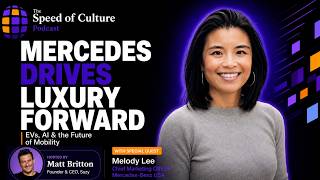
In this Speed of Culture podcast episode, host Matt Britton interviews Melody Lee, Chief Marketing Officer of Mercedes‑Benz USA. Lee discusses how the COVID‑19 pandemic sparked an unexpected surge in vehicle demand and highlighted the need for flexible powertrain options—ICE, hybrid, and electric—while emphasizing that offering the right choice to customers is more important than focusing solely on electrification. She recounts her career trajectory, from crisis‑communications work at an agency to senior roles across industries, stressing the value of taking high‑stakes risks, immersing oneself in new sectors, and listening before proposing solutions. Lee explains why luxury automobiles are deeply emotional purchases, often becoming heirlooms, and describes how Mercedes‑Benz engages younger audiences through culturally resonant initiatives such as a Clifford safety book, LEGO displays, and partnerships with Formula 1, the Masters Tournament, Eastside Golf, Buc‑ee’s, and Starbucks. She outlines the “Pick Your Powertrain” (Trinity) 360° campaign that positions Mercedes‑Benz as a brand of choice across powertrains, and details the company’s EV strategy—six fully electric models, upcoming plug‑in hybrids, a proprietary high‑power charging network, and educational efforts to reduce range‑anxiety. Lee also highlights Mercedes‑Benz’s leadership in autonomous driving (Level 3 in the US, Level 4 in China) and its cautious, safety‑first rollout. AI is portrayed as a thread through the organization, powering customer‑service tools, dealer configurators, and in‑vehicle experiences like ChatGPT integration. Finally, Lee shares her philosophy on building teams: championing ideas from younger, culturally‑savvy staff, fostering curiosity, and maintaining direct dialogue with dealers and customers to stay attuned to market needs.
Chapters
Up today, we are thrilled to welcome an exceptional leader in the marketing automotive industry, Melody Li, who's the Chief Marketing Officer at Mercedes-Benz USA. Melody, so great to see you.
So glad to be here, Matt.
Absolutely. Such a cool setup you have there. Do you have the Mercedes-Benz studio because you do a lot of content? Like, give me the background behind the studio, 'cause it's not a normal thing when I interview podcast guests.
No, it's really important to us that we stay in, in, in very close touch with everyone with whom we work. So whether that's Germany or our dealers, we use a studio to, to do big webcasts or meetings to keep those communications lanes very clear.
Very cool. And you know, it's crazy because in a pre-pandemic world, doing a podcast like this in a Zoom-like interface would've, would've not been a normal thing. And now it's the world we live in. How do you think the automotive industry has changed in a post-COVID world?
We had this moment during COVID where we couldn't even supply enough cars for the demand that was out there in the market. Everybody suddenly had a need for mobility in a way that they hadn't before. I was in New York City during that time, and even New Yorkers who disavowed cars and said, "We'll never need a car again," were buying cars. And so you had this enormous demand. You had all those supply chain challenges that were going on. Cars were flying off the lots way above sticker. It was just a really interesting time for the industry. And at the same time, while all that's happening, we're introducing this new powertrain, this new form of electrification, right, in our vehicles. So I often say that the pace of change over the last 10 to 15 years has been much more than I would say even over the last 100.
Yeah.
And that's where we are at this moment. And I— however, I will say this, Matt. I think that the fixation on powertrains is overblown, right? What it really comes down to at Mercedes-Benz is we need to make the right car with the right powertrain that a customer wants. We need to give them the choice. That's where we are at this moment in the industry.
Absolutely. So let's rewind the clock a little bit. To your career journey? Because obviously being the Chief Marketing Officer of Mercedes-Benz is a very prestigious role. It's an iconic brand and you didn't get there overnight. What were some of the steps that you've taken along the way through your career journey that you think were pivotal in putting you in a position you are now?
Without a lot of risks along the way, there wouldn't have been the rewards that came along with them. I would say that early on, I put my hand up for some of the most high-stakes assignments. I started my career on the agency side in PR. And at that time, there's not a lot of people who put their hands up and say, I'd like to specialize in crisis communications. But I felt that in any moment, it was, it was like dog years. I would learn more in just 6 hours, right?
Right.
Than I would learn in 6 months. And, and over a span of nearly a decade, starting my career that way, I just learned a lot in really intense, high-stakes rooms, war rooms, parachuting into client offices to help them manage through a crisis, a financial transaction, whatever it was. Those were big risks for me. Many times I got on airplanes not knowing how long I'd stay for a particular situation. I took CEOs on, on a, you know, into Congress to testify. There were just really moments where I definitely was just walking into rooms not knowing what was gonna happen next. And—
Mm-hmm.
I would say in many ways that has paid off because I've adopted the same approach to my career.
And as you've gone throughout your career and you've, you've gone from industry to industry, how have you been able to kind of immerse yourself in each industry? Obviously starting off in the agency world is great because you get to kind of dive in and out of multiple different categories, which kind of gives you more of a broader worldview. But then as your career evolved, I see that you, you know, you spent some time outside of the auto industry before you dove into the auto industry. So tell us about the steps you've taken when you've gotten into a role to really immerse yourself.
I think I've learned this the hard way, if I'm being honest, Matt.
Yeah.
I came into the job at Cadillac, actually, a while back. And I know you had a guest on from that brand recently. I started in that role thinking I had all the answers. And I could probably put people on the record with you who would attest to this. So I would say I really came in guns a-blazin', sayin', "I know how to fix this. I can see from the outside exactly what's wrong, what's needing fixing, and how we're gonna get there." And that's not the way to do it. I think jumping industries requires an openness and a willingness to understand why things might have been done a certain way before you start to say, "Okay, maybe there's a way we could optimize, improve, try something new." I think I just never in the beginning took enough time to do so. And as I've progressed through my career, I've learned the importance of really slowing down to listen and to understand before coming in with solutions.
So, what's different about the auto industry that maybe people don't know versus CPG or tech or maybe other financial services, other categories that people might jump into for their career?
I love the automotive industry and the automotive business because as a marketer in this business, you are putting in front of consumers one of the biggest and most emotional purchases they're gonna make, right?
Yeah.
The, probably the biggest one being a home. And after that, it's a vehicle. And, and if it's a luxury vehicle, sometimes those cost as much as homes, right? And you're buying this piece of metal, well, now a piece of metal with a lot of computer software technology behind it that is so precious to people that they end up naming it. And there's just not that many prod— you don't buy toothpaste and name it, with all due respect to my CPG friends, right?
That's for sure.
But you buy a car, and it becomes something that you have for a long time. In some cases, it becomes an heirloom that you pass on to the next generation. There's just so much meaning that's ascribed to a vehicle. And it also represents so much, especially in the American market. It's much more than just a— a product. It's something that represents freedom. It represents independence. The American road trip is so iconic as well. So there's something about the automotive business that is just irresistible in that sense. And the other thing that I think is really interesting and sets it apart from the other industries that I, I've been a part of is a really long product development cycle.
Yeah.
It takes 3 to 5 years to develop a car, right? So as a marketer, you have to think about building your plans around that in a completely different way than if you're launching a lipstick, an eyeshadow, or an Eames lounge chair like I did when I was at Herman Miller. So you just have to think differently, change your mindset, and plan on a completely different horizon.
Yeah, and also safety, right? Like, you know, we were talking right before the pod started how, you know, I was privileged to get a Mercedes SUV and I have small children and obviously safety is so important. When I remember I first drove the car off the lot, I'm thinking like, is this car going to keep my family safe if, God forbid, something bad should happen on the road? So even more so than a home, where you're probably not worried about the roof collapsing or a hole being in the floor— though I'm sure that happens, but much more rarely— auto safety is a real thing and a real concern. And I know that's been a big pillar of the Mercedes-Benz brand over the last several decades.
I would say that it's core to our brand promise.
Yeah.
It's what we promise in the quality of our products. From a marketing perspective, we take every opportunity we can to talk about it, promote it, communicate it properly. And one really great recent example of how we're taking it to the next level, but putting it in the context of social responsibility, is we just worked with the publisher Scholastic to bring— and you have kids, Matt, so you'll get this. You'll know exactly what I'm talking about. But we brought to life a Clifford book. Oh, yeah. On car safety. And what's more iconic in the world of kids than that big red dog—
It's a great idea.
—that he teaches. And I'll get you a copy for sure.
Awesome.
But we just debuted this book. It features a car that looks reminiscent of the GLE SUV, one of our most popular family SUVs. And it is our opportunity to say, we represent safety from a product standpoint. But for that next generation, we're also going to teach them about the principles of safety, the right car seat, the way that you always need to buckle up, or whatever it is. And we're currently on a 5-city tour to promote that book. And we'll be distributing 30,000 copies of it.
It's a great idea. So speaking of the next generation, Mellody, I know that for a long time, luxury brands were almost intentionally exclusive of a younger demographic because maybe they thought if younger people had their brand or their car or whatever it may be— and we had a similar conversation with American Express recently— then it showed the luxury consumer that it wasn't really exclusive anymore. But that's sort of changed now, right? And now— and I wrote about this in my book, Youth Nation— that youth culture is really driving the broader culture, and people wanna act younger, older in life. And as a result, younger people driving Mercedes and athletes and celebrities, et cetera, is actually a good thing for the brand. And I'm just curious, as a luxury marketer now, how you look at that dichotomy of youth versus luxury. Yeah.
You're exactly right, Matt. Everybody wants to be younger or feel younger or be seen as younger, but it doesn't really work the other way around.
Right.
And every good marketer, especially at a heritage brand, and we've been around for almost 140 years.
Yeah.
I think we're one of the, you know, the original heritage automotive brands for sure, having invented the automobile back in 1886. It's incumbent upon us to figure out how we market generationally. You don't do it in discrete moments only with a person that can buy your vehicle. You have to balance between the long term of thinking about the next generations coming up. Maybe Gen Z and Gen Alpha are not quite at the point where they can purchase a Mercedes-Benz, but we want them to dream about the ability to be able to do so. I mean, I'll tell you a quick story. I have a 10-year-old at home who's obsessed with cars. Oh, wow. And he has posters littering his walls, right? McLaren, Porsche, Mercedes-Benz, of course. And this morning he had me bring in 4 of his LEGO cars that he had built, and he's so proud of them. They're all Mercedes cars, of course, and he wanted them displayed in my office. That's why it's important to have things that resonate with the next generations coming up, be it a LEGO set, a poster, the F1 movie coming out next year in which we'll have a big role. There's this huge rise of motorsports going on right now in the United States. We have 3 Grand Prix here now from Formula 1, right? So we have to think about, as marketers, how we're capitalizing on all these moments to reach the next generation. Even if they can't buy right now, they will one day.
Yeah, absolutely. And I think it was in the late '90s, Mercedes did introduce the A-Class, which right now is about, you know, $30,000, $34,000. So it is something that does provide the ability for more younger consumers, more of an entry-level purchase to come into the Mercedes-Benz fold.
That's right. Yes. And you're exactly right having brought up that point, Matt. It's also about having the right product portfolio that allows someone entry into the brand. And that's why CLA and GLA both do quite well for us here in the United States.
So as you continue to build the Mercedes brand amongst your core audience target, you know, that luxury buyer, what are some of the tactics that may not work with a broader audience that you're really focused on to make sure that you're hitting all the right notes?
So I think one of the things that is also very important to us as a brand is not just adding, uh, our brand equity to a partner, but also putting equity back into society as well. Let me give you a great example of that.
Okay.
The Masters Tournament is one of the most prestigious golf tournaments in, in the world of sport. And we've been a presenting sponsor of the tournament for 17 years. And this year we took a slightly different approach by bringing in a partner called Eastside Golf. Eastside Golf, if you're not familiar with them, was started by two alum of Morehouse College here in Atlanta. They both played on a, on a, a winning team here, and they started Eastside Golf to bring inclusivity, diversity, and access to the sport. Historically, I don't know if you're a golfer or not, it's not the easiest sport to get into.
Not a good one.
Who is a good golfer?
Exactly.
But it's a high barrier of entry to get into this sport. It's difficult for underprivileged communities to buy a set of golf clubs, gain entry into a golf course, and really start to begin to play the sport. And Eastside Golf was created to bring these opportunities. And so we're really proud of our partnership with them. That brings more equity to the game of golf and more inclusivity to the game of golf. We have a duty to do. We don't get to just put our cars on the grounds of Augusta National and call it a day. It's also responsible behavior of marketers to then also add something back.
So, Mellody, in terms of content that Mercedes-Benz produces, 'cause I know that it leans into a lot of its own branded content, what are some of the strategies and I guess content topics that you found to be most effective for your core audience?
We had a lot of success recently with a campaign that we colloquially call Pick Your Powertrain, but officially it's called the Trinity Campaign, E for our electric vehicles. Pick Your Powertrain was designed to be a campaign. It ran on air for 2 months, but it was a 360-degree campaign that ran below and above the line, designed to say to our customer, it's not about electric versus ICE, or electric versus ICE, sorry, ICE being internal combustion engines for your listeners. Yeah. Versus plug-in hybrid electric vehicles. It is about the luxury of choice. And if you want a Mercedes-Benz, we're just going to have the right vehicle for you. So I spoke about this a little bit as we were warming up on this interview, but we have to provide the right vehicle of choice for our customers wherever they live, because conditions are different everywhere. The electric infrastructure is different everywhere, and people's preferences are still shifting and changing. Mm-hmm. And the great thing is that there's no other brand out there but Mercedes-Benz, if I can say this as a plug, that has the width of a portfolio that we do, that has the technologies that we do, and have the powertrains that we do. And so this campaign, I would say, featuring Kelsey Asbille from the Yellowstone TV show by Taylor Sheridan was a great success for us in that regard. We were very successful in communicating that we have the powertrain of choice for you.
Yeah. Very cool. Yeah, I mean, I could see why a program like that really appeals to the audience and really touches on the key pillars of the brand, which is kind of like the needle you want to thread, so to speak, to make sure that you're being not only effective and entertaining, but to tie back to whatever the core, you know, what matters most to the brand, the drive volume to drive business results.
Yes, absolutely.
So let's talk about the category in general, and obviously EV is is huge. And the shift to electric is something where, frankly, I would have thought we would be even further along by now, 10 years ago. And I guess all these things always tend to take longer than what we think they will. Where is Mercedes-Benz and the industry at large on the spectrum of the shift to electric vehicles?
I think it's safe to say that Mercedes-Benz probably had some of the most ambitious stated goals when it came to the electric future. However, we also very carefully said that it would depend on what market conditions were.
Right.
And there are so many factors that go into you, Matt, driving an electric vehicle if you wanted to, right? As I just mentioned, the conditions are different everywhere, and they're very different from California to Texas to Wisconsin to New York. And we're very conscious of that. And so we treat the move to the electric future as a marathon, not a sprint. I think often people think that it was some sort of light bulb on-off moment where we would just all switch from internal combustion to the electric future. I think it's two curves kind of moving together, and we're watching how those curves are changing over time. Mercedes continues to do extremely well when it comes to electric vehicles. We have 6 models now out there that we're selling that are fully battery electric. But later this year, we're bringing to market the GLC plug-in hybrid for those who are, you know, not quite ready for the fully electric future.
Right.
But are ready for a plug-in and to give it a try. So it's kind of the best of both worlds. But at the same time, we have millions of cars out there in what we call the car park, right? Any Mercedes-Benz that's out there. And a lot of those are internal combustion engine cars, and they're still popular for those who want to buy them. And again, I come back to the point that that means we just have to provide what people need and what they want.
And what do you think is holding up, I guess, the demand from reaching a tipping point? Is it range anxiety and the infrastructure of charging stations? What do you think those things that are driving any level of hesitancy with the consumer?
It's still such a new technology. Infrastructure is a huge part of it. I think we've seen it roll out in varying stages of progress across the United States. I think that's why it's really important for Mercedes-Benz to do its part. It's why Mercedes has its own high-power charging network. It plans on rolling out 2,500 chargers in 400 locations over the next few years. We're also in a partnership with 7 other automakers to establish a charging network as well. So we look around and we see that we also have to do our part and not just rely on public entities to do their work or local entities to do their work. Mm-hmm. Are to start to drive the future of electric, as we think it is important for us to do as the inventor of the automobile, then we know we have to help contribute towards the infrastructure as well. So I think that's a big part of it. Education is a huge part of it as well. I think there's just a lot of still lack of understanding or knowledge about batteries. Like, what's a lithium-ion battery?
Yeah.
What does it mean? How is it different? Can I park it inside? What can I do? So I think that a big portion of the marketing of electric vehicles is actually educational.
Yeah, just getting consumers comfortable. I mean, and it's a big choice. If you're leasing a vehicle, it's still a 3- to 4-year commitment. And it's not just like— I mean, I guess you could technically return it. But people look at it as, am I really ready for this? And what is my lifestyle? And will it support an electric vehicle? And my hope is my next car is electric. I feel like this was my last non-electric. Electric car. And I think many consumers feel that. So we'll see where we are 3 to 4 years ago, because as you mentioned earlier, the rate of change is only accelerating.
Let me reassure you, as someone who is a little scared and nervous about driving an electric vehicle, and I have now driven one for the last year, I drive an AMG EQE SUV. Not only is that car incredibly fun to drive, that instant torque is something you just can't get in an internal combustion engine with that, you know, the way that it's powered. My fears were totally allayed as I drove that car over the last year. And yes, we've taken road trips in it. We, you know, oh, I failed to mention earlier, and I should mention this because we actually took advantage of this on our last road trip as a family. Mercedes has also partnered with Buc-ee's. I don't know how much you know about Buc-ee's. I'm Texan, so I am very proud of Buc-ee's and the beaver. But we're partnered with Buc-ee's to install charging stations there. We just announced a partnership with Starbucks. Where you can go in and get a cup of coffee and let your car charge up as well. And that's going to be along the I-5 corridor—
Very cool.
—over in the West. It is much easier than people think. I think there is a fear of the unknown. And that range anxiety is real. I won't deny that. But we make it so easy with the technologies we have. With Mercedes me Connect, our app, you can look up exactly where you need to charge on your route, right? And it works beautifully.
Yeah, absolutely. And let's talk about, you know, in terms of the adoption curve, obviously, you know, the EV category is at one level of the adoption curve. And now we have driverless vehicles, which is something that people are very fascinated with. And in markets like San Francisco and Los Angeles, there's Waymo, which is gaining popularity, where it's an Uber-like system that people are jumping in without a driver. And it's pretty jarring the first time you see it. But the people that ride in it say say it's great and they learn to trust it. What is your thoughts on the driverless vehicle evolution and when do you think Mercedes is going to really lean into that area?
Well, actually, I'm happy to tell you that Mercedes is ahead of every automaker in this regard. We were the first OEM to announce Level 3. So this is the SAE's, Society of Automotive Engineers, rating system. Level 3 certified autonomous driving in Nevada and California. And we launched that at the end of last year. So it's already out there in two states, and we're working on certification in more states. We also just announced Level 4 autonomous in China. So—
Wow.
We are ahead of the pack in this regard when it comes to autonomous driving. And I'll tell you this too. I mean, my— I think what is maybe not known to a lot of people is that A lot of cars out there already have technology that is semi-autonomous. I drove to work today with Level 2 ADAS, that's assisted driver systems. The car drove itself. It changes lanes for you when you put on your blinker.
I don't know if you've done it. Were you scared the first time it changed lanes for you? Like, there has to be a moment where you're like, am I really going to trust this car to change lanes for me? Maybe I'm just too anxious. I think so.
For the moment. And then once it does it for the first time, you realize you can trust this vehicle because it's a Mercedes-Benz.
Right.
Just like you trust to keep your kids safe, you realize after one time that this car is going to drive itself for you. And it does.
So how much longer is it going to be till there's more cars without drivers on the road than there are cars with drivers in your prediction?
If I knew the answer to that, Matt, I would be off on a private island somewhere.
5 years, 10 years, 20?
Can you give us a range? I really don't know. And I think it's honestly kind of dangerous sometimes to prognosticate because then what happens is that they'll say, you know, Mercedes-Benz got this totally wrong or something along those lines. And that's just not the truth. The truth is that every new technology has an adoption curve, and that curve is going to go steep and hockey stick for a bit, and then it might flatten, and then it might take a life of its own again as infrastructure develops, right? And so, I think that, you know, when I first entered the automotive industry, we were talking about cars going totally driverless by 2025, right? I don't think that's going to happen anymore, right? But we're so very well on our way when it comes to both electric vehicles and autonomous cars.
And there's so many factors, to your point, in terms of what's going to drive that total comfort and adoption amongst consumers. So it's really hard to predict, for sure.
But unlike some of our unnamed competitors, who I will not say here, Mercedes-Benz will only roll out autonomous technologies if they're truly and fully safe.
Yeah, right on. And I think you almost have to do that given the trust you built for your brand over—
Exactly.
—over a century. So you'd mentioned earlier in terms of the development cycle, and it's 4 to 5 years that you have to start thinking about before you start thinking about the next model that you're pushing out. And obviously, one technology that has really taken over the lexicon of consumers is AI. What role does AI play in the automotive industry, and how are you looking at AI in terms of your future strategies, both on the product and the marketing side at Mercedes?
AI is threaded through every conversation, I would say, every— everything that we do, from aiding our customer assistance center to better be able to service our customers, Let me give you an example, right? As cars get more and more complex and more software-based, it becomes more complex to train our customer assistant agents on how they can help a customer that needs a quick answer if they call in, right? AI gives us the ability to access that information quickly and helps our agents have that at their fingertips so they can help our customers and serve our customers better. Mm-hmm. Same thing in the dealerships. AI is driving a different way of being able to configure, shop, and buy a car. And our dealers are actively testing a lot of those technologies in store. We are thinking about the integration of AI into our vehicles. You may have read that ChatGPT is also integrated into Mercedes-Benz vehicles as a beta test. I'm actively part of that beta right now in the car, and I can say it's really fascinating.
What are some of the use cases? On how you apply that.
So, and oh my gosh, your kids would love this if your kids are like my kids. But they love messing with the Mercedes me Connect system and telling it— did you know you can ask it to tell you a joke?
I knew you could ask ChatGPT to tell you a joke. But you're telling me you can ask your car to tell you a joke?
Next time, tell your kids or give them a— they'll love it if you do this with them. But in the car, ask your GLS's system. You say, hey, Mercedes, tell me a joke. But we have already some of that basic software built into our systems, but now we're adding that layer of AI to help answer questions or to layer on. So one of those use cases could be asking the system to tell you a little bit more about how the car was built or something like that, or giving you more information about where you're going, right?
Exactly.
Like maybe previously, the system could just tell you the address or input the address through voice recognition, but now maybe it's, it'll tell you about what it's like to go to New York City or what's available there. So AI is a big part of the conversation. I think, again, it is one of those things that we want to treat seriously and think about how it can actually improve the lives of our users and our drivers, and not just do it because everyone's doing it.
Yeah. It just makes so much sense in terms of bringing your car to life in a lot of ways. You were saying earlier, people name their cars. Well, now they can actually talk to their cars. Personify it in a lot of ways.
Yes, absolutely.
So, you know, as you look at your role as a CMO, you obviously always need to be focused on your team and making sure that you're bringing in the next group of leaders who can help you because obviously you're not gonna be able to manage such a big brand with so many initiatives on your own. What are some of the things that you look for when bringing on younger professionals that you think could be future stars at Mercedes?
I think it's really important for me not to have the ideas necessarily. I think it's important to champion the ideas of those who are around me and on my team. The people who work on my team are, are younger, cooler, much more in touch with culture. They're the ones that should be coming up with the ideas. And then it's my job to help evaluate or ask the right questions to get to the idea that wins. And then enable the idea to actually come to life and come off the page. That's the role of this job. I would also say that, you know, in terms of what we look for here, we look for an ability to see around a corner, to think about the future, to think creatively, not just about a campaign or about a piece of content or about a partnership or collaboration, but about—
Mm-hmm.
How a process could be improved. Creativity can take many forms, and I think it's really important for people to understand that if they join the marketing team at Mercedes-Benz USA.
And what are some of the things you think young professionals should be doing to, to put themselves in the position to be able to see around the corner?
Keep in touch with culture. It doesn't mean that you have to watch every movie or listen to every album that comes out or, or whatever it is, but keep a finger on the pulse of what's going on out there. You know, I was raised, this is a funny part of my background, I was raised in a very strict immigrant religious household where I was not allowed any pop culture.
Yeah.
And I caught myself up in college, don't worry. But after that, I developed such an insatiable curiosity for what was going on around the world. And I think marketers need to have that frame of reference. If you are working as a marketer or a communicator for a brand, especially one that has to stay relevant, then that means staying relevant in pop culture or in culture. And the best brands are not just staying relevant, they're creating culture and they're pushing it forward. How do you know that if you're not in touch with it, right? So I think that's also very important.
Yeah, absolutely. So shifting gears as we wrap up here and focusing on you and how you spend your time, you know, there's a lot of mystique about the CMO role and given how iconic the Mercedes Ben's brand is, that's even amplified when it comes to you. And I'm just curious in terms of how you spend your time, what does the pie chart of a day or a week look like in the life of, of Melody?
Well, we're still a German company, so there's a lot of meetings. Uh, I get the most energy though when I do get to walk down the hall and just see the team doing what they do best, cuz I can see how much they're creating at their fingertips. And, um, really again, my job is just to, and I know this has become cliché, but It is to remove the obstacles that stand in their way of creativity and bringing the best ideas to life and smoothing the path for them to become born. There's not that much mystique, I have to say. Like, we just have to be very confident in being the voice of the customer, returning it always to what we think the customer needs because marketing may be mysterious to a lot of people, but what it is is acquiring and retaining customers.
Yeah.
That's all it is. Right? And we have to remember that by putting the customer at the center of everything we do. If it's the website that we manage here in marketing, an email that goes out to them, a campaign that runs during college football, a CSR partnership that's out there, we just have to think about what the customer needs.
And I know that what the customer needs obviously changes over time. What are some of the things that you do to make sure that you have the finger on the pulse of the customers, you continue to listen to them, and obviously drive that long-term loyalty?
Talk to them directly.
Yeah.
And not just talk to them directly, but spend time with our dealers. So as you're well aware, and maybe most of your listeners are as well, Matt, we're in a 3-tier system here when it comes to selling cars in the United States. And our dealers are an important— not just an important, they are as important as we are to this puzzle of selling cars, right? And talking to our dealers and understanding what they're seeing on the ground is really important. Getting out there, visiting their stores, talking to the customers that are coming in and out, getting that firsthand knowledge of what's going on with our products and whether or not our campaigns are resonating, that's really important.
Yeah, I mean, they're a critical part of the product and the product experience. I mean, they're the sort of the first line of defense if you want to purchase or lease a Mercedes. And if your interaction with them is great, it's going to obviously give you a lot of tailwinds in terms of making that purchasing, bringing somebody into the fold.
Exactly.
Absolutely. So finally here, Mellody, I mean, obviously it's not easy to end up where you are, and we've talked earlier about some of the risks you've taken, but when you look back in your career, are there other things that you focused on or kind of critical decisions that you've made that allowed you to be such a well-rounded professional and again, put you in a position where you are today?
I'll give you, uh, one piece of advice that, uh, somebody gave me a long time ago, but this was in any meeting, in any setting, if you're being asked as a leader to evaluate anything from a memo to an idea to a creative concept, ask yourself the question, am I making this different or am I making this better before saying anything? And I thought that was the best piece of advice ever. And I've tried to apply that in everything that I do. Mm-hmm. Because that really creates a different culture and environment in which the best ideas really are shared, shaped, and then win.
Yeah. And it's also about just not filling the empty void with hearing yourself talk. I think it also opens up the path for you to listen more because you're not always ready to just jump in and add something if you're not improving whatever the conversation is about.
Exactly.
Absolutely. So finally here, Mellody, is there a quote or mantra that you live by that kind of drives your professional career?
Um, I've said, I've said this one a lot, but it, it really, it, it really does encompass the way that I, I hope to lead and hope to continue to lead. My job is to make those around me successful, and I need to, regardless of who they are, what level they are, whether they're my peers, people on my team, or my boss, I need to make them successful. If I make them successful, I make the organization successful in the end. And for me, maybe personal success comes as a result of that as well, but I don't worry about that part of it. So I really focus, and it's even on my resume, to be honest with you, so I guess it is a quote that I like, but I see my ethos as— Yeah. One of making those around me successful.
I love that. Well, I have no doubt you're going to continue to do that in your journey at Mercedes. And I just want to thank you for taking time out of your busy schedule to talk with us today.
Thank you so much, Matt. Appreciate the time.
Absolutely. On behalf of Suzy and every team, thanks again to Melody Li, CMO of Mercedes-Benz USA, for joining us today. Be sure to subscribe, rate, and review the Speed of Culture podcast on your favorite podcast platform. Till next time, see you soon, everyone. Take care. [SPEAKING CHINESE]
More from Matt




MikMak’s Rachel Tipograph on Consumer Spending, Retail Media & Holiday Shopping Trends



Jaguar Land Rover’s Charlotte Blank on Luxury, Purpose & Experiential Storytelling



