Mick Batyske on Music, Networking, Investing & the Future of Culture
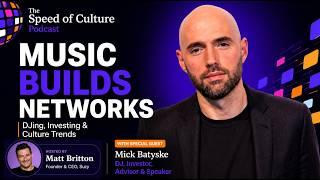
Mick Batyske built a career on personal brand and networking rather than DJing alone. He curates sets by vibe, not BPM, discovers tracks through Spotify and DJ relationships, and invests in startups the way he builds playlists: betting on people. His son Miles inspired a children's book about DJ culture.
Chapters
Up today, we're gonna be speaking with a longtime personal friend, DJ, speaker, investor, and advisor, Mick Butisky. Mick, great to see you, brother. How are you today?
I'm great, man. Thank you so much for having me.
So it's been way too long. I know we've been trying to get this together. You've obviously had a busy summer, which we're gonna talk about, but I'm super excited to finally get you on the Speed of Culture podcast. We're gonna start by getting to know a little bit more about you. You've had really a storied ascent to where you are today, lots of different experiences that make up who is Mick. Would love to hear a little bit about that story.
Well, you know, for me, Matt, it's interesting. It took me a long time in life to really realize what my purpose was, like, occupationally. And for me, it was just like DJing was something I've done since college in order to, like, A, fulfill a creative expression, but also to pay my bills. And I looked at DJing as like the main thing of what I did. And then what happened was in the middle of my 30s, I'm 44 now, I realized DJing was just kind of like the output of what my true skill, which was just literally just like being me, which is like very cliché, I guess, to say these days of just like your personal brand and the brand of you and all of that. But for me, it's like literally been the truth. And by that, I mean like my whole career, as you know, managed my own career, I've marketed my own career, I've done my own PR, I've done my own literally everything good and bad. So what I've come to realize was my actual job and my actual skillset my entire life has actually just been around putting the best version of myself out there. DJing was just the first touchpoint that people had of me as that. And it took me, I wish I would've realized that a little bit sooner in life, to be honest with you. It kind of took the birth of my son for me to really do a deep dive and figure that out. But once I did that, the whole world started opening up to me in many different avenues because I realized that the same skill set and the same thought process and the same relationships and creativity that I used to create my DJ career, I can use it in a million other ways and a million other avenues.
So you talked about your son being born and obviously you realized that from a career perspective, being a DJ, and you've told me this in the past, requires you to jump on planes and be out late nights, et cetera. And now you have a family and you obviously had to rethink think things. Where did you get your inspiration from to understand how to leverage your DJ career, so to speak, into other areas? And what are some of those other areas?
Eventually in life you get to a point where you realize what you're not, right? And that's so much more important than, than what you are. And when you hone in on what you're not, you're able to actually see that what you are is a lot stronger. And for me, you know, let's use DJing for example, but you could really apply this to any creative medium or maybe any any medium in general. For me, I started questioning a lot of things about my career, why they weren't happening. Like, why am I not doing festivals? Or why when I go on Twitter and say I'm spinning tonight, why don't 1,000 people show up when I have all these followers and all that? Like, why are these things that happen for other people not happening for me? And I started to really, you know, I went through a little frustration with it, even a little depression about it. And what I realized was like, that's actually not what my path was ever supposed to Be. be. The reason I got my career in the first place was simply because I have a career that people, they find me through more human relationships. They find me more through brand relationships. They find me more from coming to me and connecting with me just on a really holistic level, whether they love the music or they love the conversation we had at a dinner party or we met in the elevator and they liked my shoes or we had some friends. All my opportunities have never come from being a known DJ or being, quote unquote, wanting to be famous or anything like that. Everything has come from me simply because of how I live my life, who I live my life around, who I live my life with. And so when I realized that, I was like, let me lean into the opportunities that can come from that, which are being the best DJ, quote unquote, for people who like what I like and people who are into the other things that I'm into and people who want to just live their life with the same sort of like morals and standards and values of which how I do. And so once I kind of zoomed out, and actually zoomed out wouldn't even be the right word, more be like zoom out and then zoom back in somewhere else, right? Yeah, yeah. I zoomed out on what I thought I was supposed to be doing because I'm a DJ, and I zoomed in on just like what I'm supposed to be doing as me, right? And so I started getting all sorts of opportunities with investment opportunities and just like expanding my circle and people it just changed my entire life, man, because I was able to like be around people who appreciated all the things I brought to the table and didn't degrade me for the couple things I did not bring to the table.
So it's really interesting when you say that, Mick, because I think a lot of young people, they look at influencers and they look at these big follower numbers or fan numbers, and they obviously, you know, the first thing they do is compare it to themselves. And what I think it's doing is sending a lot of young people through the, you know, down the wrong path. And really it's sending them down the path of quantity over quality, right? People try to collect friends as almost like some sort of point value or point system, and they think that if they have enough of them, they're gonna be able to advance to the next level. But as you and I both know, that's not really how life works. And instead it's really about the quality of your relationships, who those people are, what's the context of your relationship, and how you can help each other. And it sounds like you you kind of went through that journey yourself where you're in a world, you know, of DJs where there are a lot of quote unquote famous people and they may have a lot of, have a big high-level popularity, but maybe they don't have those high-quality touchpoints that will allow them to do some of the things that you're doing. So I think it's really an interesting lesson to sort of extract from your journey that took you some time, but maybe for other people, maybe they can, they're listening to this, they can learn that it's really not about trying to go for being famous. It's about really those long-lasting relationships. And it seems that those are definitely serving you. I mean, I've spoken to many people in the tech industry who know you well, where you will do their company party or something like that, and all of a sudden an opportunity will arise. Is that sort of how you're finding a lot of these opportunities surface?
Yeah, for me, I just kind of like try to create a spider web, if you will, where everything kind of connects. And I want to be able to be the guy that can kind of like be— it's funny, in school I never got a lot of A's. I got a lot of B pluses. But I was able to just like kind of like phone it in and be present in a bunch of different places and get a B or B+ versus like really, really like lean in and zoom in and get an A. And it's kind of like the same thing I've done in my career, meaning that like, okay, I don't need to be the best DJ. I don't need to be the best at anything, but I could be pretty good at a bunch of things and find ways to make them all work for me. So when you zoom out and get the report card, the GPA is very, very good. It's just come from a bunch of different sources. And that's exactly kind of like what I try to do. And I, you know, I'll give you a great example. Like I spoke on a panel at a finance conference a couple weeks ago in California, and then they ended up needing somebody to DJ an event for them. So I ended up DJing that, but then I was able to invite to that party the two founders of a company that I'm advising. They were able to meet great people at that. So like, it's just like, it's just, it's a matter of like taking one thing that's not connected this thing, putting it with this thing that's not connected, and putting everybody in a room together. And then the best part is, of course, I'm playing music. So at the end of the day, all of these people that I've met from all walks of my life, uh, who've never met, they're all drinking and laughing, having a great time together, and I'm creating this environment for them to do that. But I'm enhancing my life and their lives in multiple different ways. And I'm— that's kind of like the weirdness of what I get to do, and I love it.
Absolutely. And I think one thing that You know, you do such a good job. You talk about you love playing music for people, and a big part of that, and a big part of understanding who to connect, is you essentially being a curator. The other day you, you tweeted out or put on Instagram a, a fall mix on Spotify, and I don't trust my own music curation skills, but I certainly trust yours, and I immediately played it, and it's been on heavy rotation in the Britton household for the last week or so. And, you know, your ability to do something like that is something that really can't be taught. And the question I have for you is, how did you learn how to curate sounds to actually meet a mood or meet an environment? And what work goes into that on a daily basis to make sure that you stay fresh?
That's a great question. There's two ways I would answer it. One, as far as how I learned it, actually is that I learned that skill almost in the opposite way of staying fresh, meaning that when I was a kid and I was growing up loving music and listening to music, my curation is rooted in nostalgia, which doesn't mean necessarily that the music is old, but it just means how I consumed music as a kid was so different than how my kids and my kid, my one kid, I don't believe I have another kid, a couple years maybe, but in your kids would consume music, right? And that like, it was, I was so sick. I, the way I fell in love with, let's go back even further. The way I fell in love with music and I played a lot of instruments as a kid as well. The way I fell in love with music, it taught me to like singularly like hear and see music in my head in a way, if that makes sense. So when I would— a Pearl Jam song in '92 or Snoop's song in '94 or a Tupac song in '96 or a Neptune song in 2001, for example, like I remember, like it shows itself visually in my brain. It's not like those people that can literally have that. There are people that literally see music as colors. I don't— mine doesn't go that far. There's a, there's a scientific term for that, but I'm probably like right before you get to that on that spectrum of just like how I, how I see music and how it makes me feel. I just kind of have like this weird mapping system in my brain. And then so, you know, when I started DJing, this was all way before I was like DJing, I was able to just like lean on that and put things together from a vibe perspective that I think makes sense. And then when I coupled that with the fact that I grew up playing instruments, I was able to kind of put that together in a really like logical and musical way. And I think also when I DJ, a lot of times DJs get restricted by the boxes we put ourselves in as far as genres and also even BPMs. You just think like, oh, I have to play 22 songs in a row that are 128 BPMs, or I have to play— if I'm playing a 98 BPM record, I can't go faster, I can't go slower, I gotta stay. I'm like, no, no, no, no, no. Like, I don't play off of BPM, I play off of vibe. And does the song make sense with the song before it? I have enough DJ tricks in my toolkit to get you to stay on the dance floor from any tempo change I need to go. I can go from a slow jam to a house song to a rock song to a funk song. None of those tempos make sense, but I can make that work. For me, it's just like I see the bridges between those songs. And so that for me is kind of like my secret sauce on that.
And do you spend a lot of time in record stores and like listening to very abstract types of music and things that we have, normal people hadn't heard of? Like how are you discovering some of these new tracks?
My favorite ways to discover it are honestly the same ways as everybody else now. It's like Spotify playlists, you know, things like that. And I also love like, you know, Shazam. You know, I love being at a coffee shop and hearing something like really cool that I've never heard before. And now they got like the little secret function on your phone so you could Shazam without standing there holding up the blue screen, which is great. You could add it to your little control center or whatever. So I'm in there going nuts. Like, but it's not so much what happens for me. It's like, more like the happenstance of life. It's not necessarily that particular song that I hear in there that is the one that influences me, but that sets me on the journey of writing the other stuff. Like, there's actually a song on that fall playlist you referenced that I actually did hear in my local coffee shop, and I was like, what is this? And like, you know, she wouldn't tell me, so I Shazammed it. But then I discovered so many other random things from that, and then that sets the mood. That actually inspired me to do that playlist, that hearing that person's song, believe it or not. I came home and I was like, this song feels like fall. And I was like, I'm gonna make an entire playlist off of that. And the weather was changing and everything. But the other thing I do is I just stay in touch with a lot of different DJs and a lot of really creative people, some people older than me, some people younger than me. And what I like to play in my sets is I try to very rarely, if I'm playing something new or popular, I try to find an alternative version of it to play, whether it's a really cool remix or a cool mashup, even though we don't use that term anymore, but like the general populace like still does. And you know, Or a really cool edit or a version or something to really, really make it more unique and make it really, really interesting, right? And by doing that, it gives my sets a unique DNA because nowadays, you know, also as a DJ, this is not really, this is aside of what you're saying, but I think it's really relevant. Our competition as DJs and as curators aren't other DJs anymore. It's every person in the world. Because every person in the world could make a really dope playlist and play it at their party and just choose not to hire me. And so I have to think that through now. So like, if you want to hear the same 40 songs that you want to hear, if I'm going to come to your party and play those same 40 songs, how can I make myself stand out when I play, you know, those same songs for you? So what versions of them can I play? What things can I do live while I'm DJing? Where can I change the beat, or can I change the words, or can I flip this live? Or can— like, I've even had clients tell me they want to hear stuff, and I'll go through and we'll remix some stuff before the event. I mean, this obviously depends on the budget too. Like, I'm not— of course I'm not gonna go to it, but like, if it's somebody or that's really important to me. Like, I wanna give you exactly what you want, but told through my lens and told through my musical goggles. And so, yeah, so I think it's important to have differentiation because what's— anybody could just play a playlist. And honestly, dude, 95% of the people who are at the party are gonna be just as satisfied with that at this point. Like, people are just like, oh, I'm hearing my favorite songs, I'm having a good time. So like, what can I do to elevate that? That's what I take very seriously in my job.
Absolutely. I mean, and I think music is so important. You kind of mentioned this in terms of setting a vibe, setting an overall mood. It really even has a greater importance in terms of its impact on broader trends in society. We had Marcus Collins, who's the chief strategy officer of Wieden Kennedy, you know, who's done all the Nike work, etc., just talking about culture, how culture is built. And he used to work for Beyoncé and her digital team in the early ages of her career. You know, when you look at the brands that you're working with, because you've worked with everybody from Airbnb to Cadillac to MasterCard, GQ, even done some work with NBA 2K, one of my favorite video games. Are you speaking with these brands in terms of where you think their brand and their brand ethos sort of mixes with music? How are your collaborations with brands structured?
It's all across the board. First, let me also just say, like, I think Marcus is one of the most, like, I'm a huge fan of that guy. I think he's incredible. So like, I just want to put that on the record. I think like the way he connects like culture with everything is just fantastic.
He's got a book coming out. You have to check out in May. We'll send you a copy of it on his behalf.
Yeah. Yeah. On his behalf. Very few people see it as well as he sees it. But anyways, agreed. I think for me, it's just like, you know, first of all, I try to work with brands that get it first and foremost. That's like the first level of it because like you can't really sometimes teach an old dog new tricks in a lot of ways. And so sometimes there are people that it's just like, it's not worth trying, you know? Secondly, depending on what the opportunity is, sometimes I don't try at all. Sometimes I just have to kind of just like eat it, man, and just be like, you know what? I'm just going to do the best I can with the constraints you give me. To your point, where the real magic happens is the third option of that, which is where we can say, hey, what is it that you're trying to accomplish? Is it whether it's for a game or whether it's for a party, whether it's for, you know, sending playlists out to your consumers and to your audience, like, what is it that you think you sound like? And this is what I think you should sound like. And maybe we can meet in the middle. And it's never 100% what I want. But my best example of it is if we could get somewhere in the middle where I can improve it. I just want to— I don't need you to do what I'm doing. I just need to— I just want to improve it, what you're doing. And that's good enough for me because that's going to give your audience a better situation. And I've seen that happen through music. I've seen that happen through influencer partnerships. I've seen that happen through all sorts of things. Like, I've done brand partnerships with— I did a brand partnership with a huge auto automobile company. This is maybe 7, 6, 7 years ago. And They, the first time I did some content for them, I was, they gave me this, you know, they give you the brand Bible, Matt. They give you like the whole, but, uh, you know, all these things. And I'm just like, man, this sucks. Like, this is like brutal.
Like it's putting you in a box, right? It doesn't allow you to be an artist or exercise your creative juices.
It was, yeah, it was, it was bad. And I mean, we did it the best we could and it turned out okay. But I was grateful. I mean, I got paid, like I got the car. It was great. It was fine. But like, I wasn't like, it wasn't, just didn't feel like me, you know, we all make sacrifices and stuff. And so the second time around, I started pushing it a little bit more. And by the third time around, I just was like, do you, once we reached a real level of comfort, I said, do you trust me? And they said, yeah. And I was like, let me do this my way. And they were like, okay. And I did it completely my way and they loved it. It just took some trust and it took some, you know, some honesty and transparency on both sides. But we reached a point. And so now I try to use that as what I think my goal should be with every partnership in that, like, I have to, like, social media influencing. I don't like the word influencer at all. I think it's pretty corny, but like, I understand that that's the word that people use for it. But, you know, for me, it's just like, you have to be able to tell people you're the real version of your life. People know, people are in on the joke. Like, people know you're getting paid to sit around in some sweatpants on your stoop next to a pumpkin. And I only know I'm saying that because I'm making that post next week. But like, the thing is like, what can I do to make it a little bit different? Whether I involve my kid in it or whether I make a little joke or whether I just like, like if nobody, everybody knows you're, you're why you're posting it. You write ad in the post. Everybody like, this is like a really real thing, right? So let people know that they're in on the joke and let's, instead of making them in on the joke, let's bring them into the world. And that's what I try to do.
And you mentioned your son Miles, who's I think 6 years old now. And I remember 7 now. And you've done really an amazing job in terms of authenticity, talking about your journey as a parent and your relationship with your son. Talk to us about that relationship and why you felt it was important to kind of integrate him into your overall image and some of the work that you do.
Oh yeah. I mean, I could talk about him for days as most fathers could about their kids and moms as well. Like, I mean, For starters, like, he's just the North Star to everything I do, right? Like, it's not a secret that I figured out what my life and my career should be when my son was born. It's not a secret that all these other opportunities started happening both in my brain and in my network and in my world when I started, like, living for something bigger and better than me. I don't take any of that for granted. But what I started to realize was rather than, you know, like, make my son, like, What's the expression? Like fit in or fit out? There's like a fancy expression people use, but rather than like—
Square peg in a round hole?
Right. Yeah, yeah, yeah. Like rather than try to create like an alternate life where like I have my home life and then I have my work life and then I have my kid life and all that.
I was just— Compartmentalized, right? Yeah.
I don't want to live a compartmentalized— like I'm not like my dad or your dad where we had these like different stories and these different like these different industries and this whole different worldview. Like we live in a world where we can we can kind of have all of that at one time. Not everybody of our generation can, but we're fortunate that we can. So why not just involve my son? I bring my son to events, bro. Like, I know, like, you know, he was at an event with me like, like last week, just chilling on the stage. And sometimes he gets up and he's getting to see that. My dad would take me to like when he put in carpet and tile. That's what my dad did. And I remember seeing that and I realized like my son didn't really understand. But the second part of this is my son didn't understand hard work, right? Yeah. He didn't know he's learning it now. He didn't, because I don't have a job that's like manual labor like my dad did where you would see my dad put in tiles brick by brick or sheet by sheet or whatever and build a wall and build a bathroom and put in a carpet.
Yeah, there's a physicality to it.
Yeah. Yeah. Like, because I didn't like, I'm not like a doctor where like, I'm like, I could save this person's life. You could meet him. He really didn't grasp what it is that I did. He just knew it was fun. And so I was like, let me show you like the really goes into like these 2 hours of fun. So all of these calls, all these podcasts, you could sit with your little Nintendo Switch on this chair that you can't see on the camera and sit there with me all day and watch everything I have to do. You could come with me to these lunches. You could come with me, you know, when I'm on a call, when I'm walking you to school, like you could see all of these things. And then I said, then when I go and I say, I do all of that just to get to the part where you can go see me have fun for 2 hours. And then he was just like, oh, and so once he started appreciating that, he just started wanting to be around a lot more. So brands started just noticing us like together at things and on social and all that. And so then we started getting opportunities to collab together, which was really—
How cool is that? And you guys wrote a book, right? D is for DJ.
It's right there on the wall.
So tell us about that.
Sure. You know, I just really think that our world now is so different. And I just think like, you know, any kid, what the Beatles were to like our grandparents and our parents, like Tribe Called Quest was to us, and Drake is going to be for everybody else. And so I didn't think hip-hop should be like compartmentalized as far as like an educational tool. And, you know, it's not really anymore, but like everybody's wrote these books about like rappers and all these other things and sneakers and basketball players for like kids' books. But nobody did it from the DJ culture perspective. And I just thought like, you know, every kid's going to say they want to be a rapper, but none of them are going to be a rapper. But any kid that wants to be a DJ could literally be a DJ and still go on to do a million other things in their life. And so I was like, let's give them some of like the fundamentals of the culture and the history of it in a way where they could literally be 2 or 3 years old learning the alphabet, but learning about how many books do we need where it's like M is for Michael Jordan or L is for llama. Like we've seen these books a million times and they're great. But I was like, what would be the evolution of that told through, like, I only know one way to live and the way I live is what's provided my life for my son. So if that, if this culture and this gift was able to give me this life for my son, I was like, I wanted to share that with somebody else to, you know, for the whole family. And so, yeah, so it's cool.
Incredible. So we're going to shift gears a little bit to just the music industry in general and what you're seeing out there. You're at every big event I've been to, whether it's been CES, South by Southwest, and I know you've done a bunch of gigs for me there, or, you know, Cannes, you know, the Super Bowl, the NBA, you're there and you're spinning the biggest parties for the biggest brands and celebrities. So there's very few people in the world that, you know, have a front row seat to the evolution of culture and music the way you do. So what are you seeing evolve in the music space, whether it's with social media or, you know, rising types of formats, or even artists that you think are going to be big heading into 2023?
A bunch of things. I mean, for starters, though, it's like, it's almost like a played out topic at this point. I think, you know, the music and NFT situation is just beginning to— it's just in its like baby moment right now. I don't think we know what it's going to be. I think it's, I think it's in its Napster moment, where we're still trying to like, we don't even know what the 10-year Spotify is on everybody. Day-to-day life plan is. It's still confusing to some people. It's still new. It's still— there's barriers and people don't understand it. And some people are in, some people aren't. And but it's going to be ultimately where everything nets out. So like, that's kind of like the mindset I've taken in that, you know, what's good if we're in the Napster moment of it now, what's going to be the iTunes moment of it? And then more importantly than that, what's going to be the Spotify, Tidal, like what's going to be the everyday, every use case moment for it? Because when we get to that point, it's going to be fascinating. But like, You know, that's definitely, I think, the main thing is this. I get, I get worried when people think it's not going to happen because it's definitely going to happen.
But I—
I— I— right.
Well, you know how it is, Nick. I mean, like, you know, we were both around, you know, during the dot-com crash and there was people who wrote off the internet and then, you know, there's people who wrote off crypto, there's people who are writing off NFTs. And what happens is when things are new, they get super popular, everybody jumps in, it becomes inflated, the bubble bursts.. And then the real work begins and the real people who really know what they're doing, who aren't in it for a quick buck, that wanna put down the right roots and technology and take the, the able amount of time that it really does take to build something with staying power, then that work begins. And it could be 5, 10, 15 years later. And then you have these transformational things and it's those people who have been there all along that are the ones that are gonna really make the wealth from it. And that's just generally what happens with— I've seen this happen over and over and over again, is that everybody thinks that these things happen overnight. And they don't. Trends happen overnight, but sustainable business, you know, movements take, can take decade or decades to, to really impart on the mass public.
Yeah. Yeah. And so, I mean, that's definitely, I think, the phase that we're in right now with that. And like, you know, you, you said it, you said it best. I think you just say like transformational, like it's gonna, that's where ultimately it's gonna go. It's just gonna be, and I don't think it's gonna be a 10 to 15 year thing like some of the past technologies because I think as we move forward, if through everything, that, that window gets smaller and smaller.
So yeah, yep, the rate of change keeps accelerating.
Yeah. And if it took streaming and MP3s a good 15 years to get from Napster to like Spotify on everybody's phone, this is going to take 5, if that. Yeah. You know, then whatever the next thing is, is going to take 2 or 3. So, you know, there's that. That's the one thing I, I noticed. The other thing—
how about TikTok? How about TikTok? What are you seeing TikTok doing for the music industry and how's that impact it?
I mean, I think, I think it's fascinating because for, for one of two reasons. One, I think it's just fascinating from a musical discovery point of view that people are discovering music from TikToks and Reels, and people are creating literally short-form musical content, not for radio or streaming or clubs or parties or listening in the car. They're literally just taking bite-sized things just, just for people to use.. And I know that it's been fascinating watching the rise of the TikTok producer or the Reels producer, people who get big just remixing samples in just little 60-second bite-sized increments that just have a good little energy and vibe. And it's so fascinating too from a rights perspective, cuz like they're definitely not clearing any of that stuff. So I don't know how that all works, but really interesting. And that, and that will ultimately, that's gonna all come back around on, on everybody. But I think that's really, really fascinating in, in that regard. And I think the other thing I think is really interesting is like, obviously we've seen it, what happened with so many artists from the past that have gotten these random lightning striking moments 20, 30 years later because of TikTok, where somebody is just like, oh, this random song from 1984 or 1992 becomes huge again. And then what I— and then all of a sudden their Spotify streams spike and their Apple streams spike and their YouTube streams spike. And then, yeah, maybe they— maybe their tours spike. And like, it's just It's fascinating how whatever, like, the newest of the new culture can go back and impact, like, the old school culture stuff that continues to, like, build and bubble and inspire. And then it could kind of keep going around in circles and circles, and maybe that inspires the next musician that could— that same thing could have— it's just, it's really cool. I like that for all we call it, like, you know, just, like, new, we're not looking backwards and all that, there's still so many people from the past that are reaping the benefits of this technology and perhaps getting career extensions from it. And I think that's really cool. And I don't, you know, I love, I love that aspect. So I just think for me, it's just like, I think it's fascinating. It's a device where you could learn, and by device, I don't mean like a mechanical device. I mean like a mental or emotional device where you can learn both new things and old things at the exact same time. And it synergizes perfectly.
That was great. We're going to move on to our final topic and just talk about you being an investor. You know, a lot of people dabble in seed investments. Uh, I know that you've made quite a few. You talked a little bit earlier about how some of these investments come together through some of your personal relationships. What is it about, you know, being a seed investor that you gravitate towards, and, and what is sort of your role with some of these companies that you do invest in in terms of how you add value?
Sure, thank you for asking that. I love talking about that. For me, I enjoy finding like great people who are doing really unique things. And identifying their promise very early. I look at investing very similar to like how I would look at curating a mixtape or how a label A&R person would look at putting together their label roster or helping piece together an album. I think like you never know what the finished product is gonna be, but you know how it's gonna start, right? And so it means that the person and the team around that have to be good enough to get that, I'm gonna say album on purpose right here, to get that album from an idea in a studio to a finished product that everybody can enjoy. That's right. That's perfect, right? Or as perfect as what we think perfect can be, because there's no perfect. And that to me is what I think is so important that people, people neglect when they're doing angel investing or seed investing or even venture capital. For in a lot of ways, it's like, can, can that person— you're investing in the person, not the idea. And there's been a few times where I, I went against my gut and went passed the person and looked at the idea and that did not go very well. But then there's been multiple times where I looked at the person and I was just like, oh man, I would, I'm like, I'm in love with the person. Like they are fantastic. They're just an amazing human being. I want to have drinks with this person. I want this person to be friends with my family. I want like, you know, I want to introduce this person to other, when you, when you meet somebody who's that great.
That you believe in, right?
And you believe in them. You just like, that's how you know, right? And I've been fortunate to meet some really amazing people that was able to get behind. That's one way I look at it. The other thing is like, from an investing point. And also, we do— my wife and I do a lot of this together now, which is great because she's an amazing founder and she's an amazing operator as well. I have to shout out her company, Tiny Organics, the best baby food ever. But yeah, so like the one thing that's really cool is even if I don't have— even if I don't invest in you right now, I could still potentially offer value by being on a board or advising or things of that nature. And what I try to do for me, it's just like, I'm really good at brand, I'm really good at relationships, and I'm really good at kind of like seeing a couple slots down the field, if you will. Like, as a DJ, my brain— the thing that people don't realize about DJs, right, is you think we're— when we're queuing up that next song, that we're getting ready to play that next song. In our minds, and I'm speaking from like just me and the DJs that I rock with, like the guys who are really masters of their craft— I'm not saying I'm a master of my craft, but I'm— I have longevity, I'll say that. Like we're 2 or 3 songs past that. Yeah. You know, when we're giving you song number 2 after you're listening to song number 1, I'm already 3 or 4 songs down. I know where I was, right? I once went and took a racing class like, uh, at some speedway like way upstate, and they were just like, you're going like 200 miles an hour. Shit was fucking insane. I thought I was gonna die. And you're in your car by yourself, right? And the thing they tell you, it just, it's changed my life hearing this. They're like, if you are only looking right in front of your car, you're going to wreck, you're going to die. You need to be looking like 100 yards down that track because that's where— and trust that everything else is going to like flow right in front of you if you're looking.
That makes sense.
And when— and they told me that and I had to do that when we were driving or that was not going to end well for me. But man, I could tell you, first of all, getting back into my regular car, driving home from that was a transformational experience because perspective, right? Yeah. I've never driven the same again in my life. Because obviously you have to pay, I mean, you obviously got to like look and see if like a dog goes in front of your car or something like that. But it's just like, when you start to like zoom out like that on things, it changes everything. And so I started realizing that's what I've done as a DJ my entire time. Like, I know where I want this party to go. I know where I want this set to go. I know where I want this playlist to go, right? So for me, it's never about the next song. It's about like a couple things down. And so that's for me the same thing I try to do when we're working with startups, right? It's just like, okay, I know what your idea looks like now and I know what your brand should look like now, but have you thought about this as this way? Have you thought about it this way? Have you applied this cultural component to it? Have you thought about talking to this person and bringing in this? Because like you are so focused on the now as you should be as a founder and as a creator and as a CTO and all of these things that you, you have to be focused on the now, right? Because you got it. But like I can zoom out because I don't need to be focused on the now and I could potentially offer value in those other ways.
That's a great analogy.
That's how my brain works. Yeah. So yeah, so that's what we do. We're working with some really, really, really awesome companies right now and, you know, many more to come. And yeah, the goal, the end goal is for my wife and I to eventually have our own fund. I think that's something that we're going to really start figuring out how we could do as a husband and wife team, maybe in the next couple of years. But in the meantime, we're just like, we just do it on our micro level and it's rewarding and it's fascinating. And it's one of the, it's one of my favorite parts of my career right now.
To be honest. That's amazing. It's amazing how it's evolved to that level. So amazing. We're going to wrap things up here. You obviously, Mick, are always on a plane, always heading somewhere, moving so fast. What in your life is worth slowing down for? I know you're, you're going to talk about your son, you're going to talk about you're newly married. Congratulations on that. How do you unwind with the craziness that is your life?
I like to go for like long runs. Uh, it's like, that's very relaxing to me. I finally bought an Apple Watch so I could like listen to music but like not have my phone. Yeah, that's a good—
that's a great hack.
As a dad, I didn't want to— I could never be the guy to go with like, nope, nope, right? Of course not. As a parent, I just, you know, I don't care if I die off the side of the road and they'll be fine, but like, I worry about if something else happened, like, can I be reached? You know, like, hit by a bus, they'd be like, great. But like, you know, but like, but like, if something happened to somebody else and I wasn't reachable, I would never be able to forgive myself. So like, but I found like, you know, when you see those like annoying people at the, at the stoplight and they're are running in place because they don't want to stop running. I would be that person, but I'd be scrolling Instagram, or I'd run to like some coffee shop really far away to like get a great espresso and run home. And I'm like still looking at my phone and I'm thinking about all the envy and all the jealousy and all the things that we all see, no matter who you are, when you look at Instagram and social media. And that stays in my head. And so I started thinking like, if I'm going to give myself some time, you know, and I'm never going to remove music from my equation because that would just be very much against my my DNA. I was just like, let me do this. And that was a real game changer for me. The other thing I like to do is I just kind of, we started doing that. You'd love this too. Maybe one day we'll do this and invite people over. We started to do game night on Sundays where we just drink some wine, we play a board game. We're only playing records, vinyl records. We're only doing analog. It's very analog. I'm trying not to even put my phone on the table while we do it, but we open up a great bottle of wine or Miles will drink some juice. We're literally playing like Monopoly and Life and stuff.
I love that. I'm in, count me in.
And we're playing only records and, and because, and then, you know, I just got to get up every 15 minutes and flip it over. And it's really, it's a great Sunday night detox from the weekend and get you really prepared for like Monday. And it's also, it's beautiful. So yeah, that's, that's what we do.
I love that. Well, listen, Mick, you've been, you know, a great inspiration, a sense of learning, a great friend over the years, and looking forward to doing more with in the future. And I just want to thank you for joining. So on behalf of the Suzy and Attaway team, thanks again to Mick for joining us. Be sure to subscribe, rate, and review the Speed of Culture podcast on your favorite podcast platform. On behalf of everyone, thanks again, and we'll see you guys real soon. Take care, everyone. Hey!
More from Matt




MikMak’s Rachel Tipograph on Consumer Spending, Retail Media & Holiday Shopping Trends



Jaguar Land Rover’s Charlotte Blank on Luxury, Purpose & Experiential Storytelling



