Microsoft’s Dametra Johnson-Marletti on Xbox, AI & the Future of Gaming
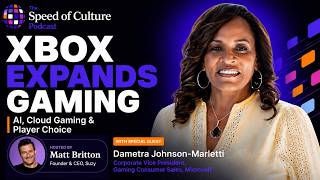
Dametra Johnson-Marletti, Microsoft's Corporate Vice President of Gaming Consumer Sales, discusses how Xbox shifted from consoles to "Xbox Everywhere," letting gamers play on any device. She explains how AI and cloud gaming will transform discovery and monetization, and why accessibility and representation aren't just ethics but business imperatives.
Chapters
Today we're thrilled to be joined by Demetra Johnson-Marletti, who spent the last 23 years at Microsoft. Today she's the Corporate Vice President of Gaming Consumer Sales and a strong advocate for diversity in gaming. Demetra, so great to see you. Thanks so much for joining today.
Thank you for having me. This is exciting.
Absolutely. So 23 years at Microsoft, I can't imagine what it's been like to have a front row seat to what the last two decades have entailed at Microsoft. What are some of the highlights and things that come to mind if you had to boil down the last two decades at such a great company?
23 years in June. It's been an amazing journey. You know, coming outta grad school, I wanted to, I know it sounds super cheesy, but I wanted to work for a company that was gonna change the world. And Microsoft has not disappointed in that regard. It's been fantastic to watch the company evolve and mature in a very positive way. During the time that I've been here, even from our culture. Satya came in and really changed this massive organization on a dime, really, to our culture, to what it is today. And it's just been fantastic to see. I feel like I'm in my dream job today. I lead the digital gaming sales team overseeing e-commerce and commerce strategy across 120 countries, millions of subscribers and players. And, you know, we have the opportunity to really impact and bring joy to millions of people around the world. And we do it from this one Microsoft standpoint where we work as a whole company and as a whole team for the greater good of the consumer, whether that's the player, the business, the enterprise, whatever it might be. So it's just been a fantastic ride.
And you say Satya came in and really changed the culture, and you're referring to, so those who don't know, Satya Nadella, the CEO of Microsoft. You know, what can leaders learn from what he's been able to accomplish at such scale at Microsoft? Like, what were some of the core things that you would say he's done right to allow the company to really kind of go supernova as it has since he's, uh, joined the company in his role?
Yeah, I would say there are a couple of things. One, I, I don't think you can undervalue what culture means to a company, particularly a— yeah, size of Microsoft. I know there's a, there's a meme out there from years ago where all the different divisions were kind of pointing guns at each other and it was like, our division, you know, is the most important thing. And Satya really came in with this notion of having a growth mindset and doing what's right for the company and the customer overall and our partners as well. And so there's this notion of one Microsoft and everything we do is from a one Microsoft perspective to serve the greater good, to empower every employee, every person and organization on the planet to achieve more. And so that has been huge. The other thing I would say is when Microsoft, this has always impressed me, when Microsoft sets his mind on a target, like we come together as a company and we move things, we make things happen. And so you've seen it across, you know, how we've tackled gaming with some of our recent growth there, how we're tackling AI and some of the growth that we've seen there and the innovation that we've seen. So I think being focused on one Microsoft approach, having the customer or the enterprise in the center of our strategy has really been the key to our growth.
Yeah, I can even tell you as a vendor, I first started working with Microsoft in, I wanna say, 2004, 2005, right? When it was all about Windows Live and there was Windows Live this, Live that. And you did kind of feel that, that each department was sort of working on its own. I didn't sense like they had their guns pointed at each other, but I did definitely, you didn't feel it was like one Microsoft. And over time, as I've continued to work with the company, you definitely feel that, that there's more of a partnership-oriented attitude. And people in one department are more likely to bring in somebody else. And I think that does, if you can actually execute it the right way, I, I, I think make 1 1 3. I think the downside of that is, yeah, what would worry me about that, making them that hard of a change, is that sometimes when you do that, people can abscond responsibility. Because if, if you are not kind of responsible for your own department, if everyone is responsible for contributing, it does, I guess, leave open the path for people aren't as committed and aren't working as hard. Have you seen any of that? And, and kind of how do you as a manager deal with when you see kind of pockets of, um, lack of productivity?
Yeah, you know, I think it's how we, how we evaluate people, how we reward people, and the values that we place on, on partnership and collaboration. You know, there's, there are other companies where, you know, you have the single-threaded nature, all the decisions rely on that individual person.
Right.
When we, we really value this notion of thriving in the matrix that our company is, you know, no, you don't just, you just don't accomplish much without partnership and collaboration with other groups. And everybody, the great thing is like everybody holds themselves accountable, their teams accountable for delivering again for that greater good of the customer, our, our partners, and for Microsoft. And so it's, I don't see that as a real issue. It's actually one of our superpowers when we come together to accomplish something bigger than what our individuals, individual teams or groups can do.
Absolutely. And you guys have certainly proven that out. So let's talk a little bit about gaming. Xbox is such an amazing brand story. I remember very famously Xbox was given sort of the autonomy when it launched to go its own path. And I was one of the buyers of the original Xbox 360 back in the day. And when you first bought the Xbox, you had then had to go buy the actual disc that went into the Xbox, and people waiting in line at places like GameStop. And obviously, we went to a world of streaming. And now, it's such an ecosystem of gaming. Where do you think gaming is headed from its early days of Xbox 360? And what are you most excited about within the category?
It's been a fascinating journey. I started in this space probably 14 years ago. And we have evolved from when digital gaming was just kind of a little bit of an afterthought. You know, we, we, we, wow, we have a massive business here. And then consumer preferences started to change. People started to vote with their feet, you know, versus going to retail. It's like, that's always an option. Our partners are super important to us and if that's what customers wanna do, we certainly embrace that. But the opportunity to sit at home and decide, hey, I want to, I want to consume this content in a different way, I want to acquire it in a different way, we embrace that as well. And so we've really evolved to embrace all the significant changes through the technology and consumer preferences today. Uh, one of the things I'm most excited about is how those preferences have driven innovation. And so today consumers expect an always-on, always-available, ubiquitous experience no matter where they are. We've seen this firsthand in Xbox. Um, we've shifted our focus and our strategy and our brand identity to really adapt to those expectations, and we've really put customer choice and gamer choice right in the center of our circle of our strategy. So if you want to play a game, you wanna download it, great. You wanna stream it from the cloud, great. You want to subscribe, you wanna buy, all those are your choices. You wanna play on a phone, a mobile device, a PC, even your smart TV. All of those are really avenues that we embrace and we support. And so gamer choice is really the bedrock of our commitment to our customers.
Absolutely. And what I think enabled obviously digital gaming at scale is really the proliferation of high-speed internet in the home, right? Because many people don't realize that it used to take, I remember when I first downloaded Madden when it was first available, it took me like 2 and a half days to download when it was still very slow. And now you can do it in 5 or 10 minutes. So I think when you think about the rails of the internet, the rails of technology, that obviously enables new applications in, in the gaming sphere.
Absolutely, absolutely, 100%. And, and it's, it's more global now. You have band— those bandwidth issues that have enabled, uh, exponential growth in some parts of the world We've seen that and realized that and enjoyed the benefits of that. But we have to realize that when you think about a global business and gamers, right, gamers in the world, not everybody has that luxury of high-speed internet. So that's why mobile devices are so important to our strategy going forward.
In what way?
Meaning, like, like I said, 3 billion gamers on the planet, most of them are not playing on a console, uh, they're either playing on a PC or they're playing on a mobile device. That's more accessible to most of those 3 billion gamers. So Our strategy is to reach gamers wherever they are, to enable them to enjoy that content wherever they are, on whatever device they're on. And so—
Gotcha.
—expanding beyond the console to those other endpoints is super important for us.
Interesting. So Xbox has kind of morphed into a larger brand because most people would associate Xbox with the actual console that you feel and touch and install in your living room or your bedroom or whatever it may be. But now what you're saying is Xbox is more of a network where you can access gaming anywhere where you have a device, which I guess is a completely different go-to-market strategy in some ways, right, in terms of how people consider the brand and, and different ways they can access everything it offers.
That's right. It, and it really, uh, under the underpinning of that is really a strategy that we call Xbox Everywhere. And so we want customers everywhere, no matter where they are. We want to enable gamers to play the games they want with the people they want on any device or wherever they are. And so that strategy of Xbox Everywhere really is the foundation of how we think about it. And it's an evolution. What brought gamers and players to Xbox to fall in love with in the beginning, way back in the 360 days, still the foundation of gaming, bringing joy and content to everybody. That is our foundation. And we will hold on to that and preserve that. But as our strategy evolves, we realize that gamers come in all different sizes, shapes, desires of the content and how they want to consume it. We want to be able to enable that as well.
And obviously, a big part of gaming in this new era is the ability to forge community. Right? So no matter what the genre of games are, it really connects people in a way that it never has before, where gaming used to be something you'd invite a friend over and maybe play with. And then all of a sudden, you could challenge people online. But now it's morphed into giant communities around the games. And you have platforms like Discord where they're discussing— how big is community and fostering that community part of your strategy going forward, regardless of the genre of the titles?
Yeah, it's foundational. Actually, it's a part of that strategy that is enabling people to play the games they want with the people they want anywhere they want. That is at the core of that building community. People love to play with the people they want to play with. And they love and fall in love with certain franchises. So expanding our content to other platforms, expanding our reach to other countries and regions around the world to bring that gaming to them and all of our first-party content, super important to us. People value us.
We value the community of our gamers. And of course, like, you know, community drives deeper engagement in the games and just playing sort of an arm's length distance. One genre where obviously community is huge and engagement is huge is in sports, right? And we started to see such an evolution of sports in general, even outside of gaming, with things like gambling being legal in many US markets and becoming more popular around the world. And we have obviously fantasy sports and people want to get closer and closer to the game, something that video games has always offered to consumers. Um, when we look at a world of VR and people wanting to be as close to the field as they can without obviously playing, where do you see gaming evolving to with some of these new technologies that are even going to drive further engagement for the consumer?
Well, look, I think like everybody else, the thing is the, the word of the day is, is artificial intelligence. And so, yeah, we see that as one of the biggest game changers for technology all across the industry, but particularly in gaming. Where we think that it can add exponential value in not only game development and assisting our creators to explore new avenues and solve problems in a faster, more interesting way, but also game discovery for our players as well, understanding their preferences, creating personalized experiences for them. AI is key to all of that. And so there's so much potential, and we're so early in this journey. But we see a great deal of opportunity there with technologies like that, as well as cloud gaming. Cloud gaming is another one that allows you to— allows us to enable that vision of creating it anywhere, Xbox anywhere, Xbox everywhere, always-on experience for our fans. And so that's also a technology that we're— that's top of mind for us.
And how do you feel about some of these virtual reality devices like Apple Vision Pro? I mean, do you see the future of consumers wearing these giant goggles in gaming 'cause it's so immersive. I've never tried one of those devices on recently, but I would imagine that it would kind of transform the gaming experiences. Are you building for that? And are you thinking about that moving forward as a big distribution point?
We think about, look, as a distribution point, there's always potential for that. When we think about making that content everywhere available for the players and how they want to consume it, that's certainly an avenue. Today, that's really where our focus is, is making sure that Xbox is a place where anyone can access— so across the 3.5 or so, 3 billion gamers. Right. And so not necessarily that we're creating a VR experience or headset experience, but thinking about our content being accessible to everybody and all the different distribution points and avenues that that entails is what's top of mind for us.
Yeah, and I know a big passion point of yours also is just making sure that gaming is accessible. You have this Gaming is for Everyone initiative. Why is that important to you? And tell me about some of Microsoft's efforts in that area.
Yeah, Gaming for Everyone is probably the umbrella theme and strategy that we have. When we think about reaching all the gamers on the planet with our content, with a safe experience and environment where everybody feels included and welcome to enjoy the content that they're seeking, that's foundational to our strategy. Strategies like Xbox Everywhere, ensuring that when our players turn on a game, they see some reflection of themselves. Representation is important in that regard. Accessibility is important in that regard. And so making sure that our content creators are thinking about that and using the tools and the research and partnership with us to build experiences where every player can see some part of their experience and lived journey in the content that they're playing. That's foundational. That creates a sticky environment, that creates a sticky community for our, our ecosystem.
And that's, that's what's important for us. Yeah, it's interesting because when you talk about, you know, the how flexible gaming is as a platform, I've always thought that gaming has a role in education. Um, you know, a lot of these younger kids grow up with screens and messages coming at them a million miles a minute. And then I think the education system thinks that kids are gonna want to be in a classroom and sit inside all day and have a very linear, almost non-digital experience in the classroom. And that may have worked in the '70s and '80s, but I don't know if it works for today's younger consumer. And I think the role of education, when you look at platforms like Minecraft, you know, by nature, they can be educational. Do you think there's a role for gaming in the classroom? And are there any applications you guys have explored in that area?
There absolutely is. When you think about Minecraft is a perfect example for that. Yeah. The ability to to create both, use both sides of your brain in, in that offering. It's just one of the, the pieces of content that we use in that way. And so there's huge potential there. We're not necessarily, we don't have it necessarily in gaming, or excuse me, an educational, uh, strategy or pillar of our approach. Right. But it's one of the many places where we see gaming being of a value add to what the overarching strategy is in those other industries. Yeah.
And what are some of the other, I guess, new and emerging areas? Like, I would think commerce within gaming would be interesting. Um, like, you know, bringing in the experience to be able to buy things within the gameplay experience. Is that an area you guys have pursued? And what are some of the other innovation areas that you'd be able to talk about that you guys have been kicking around as you look to the future?
Yeah. Um, that is near and dear to my heart when you talk about commerce. That's what I do every single day. And so commerce strategy a big part of that. When we think about creating those experiences where customers can consume, and we think about it from the notion of how do people want to consume content? How do they want to transact on that content? Right. That varies around the world. You know, in the US we're very credit card centric, you know, put in your payment instrument. In other parts of the world, it may be an app, it may be, you know, some other type of mechanism or payment instrument and approach that people are using. And so we strive really hard to make sure that we have a comprehensive set of offerings for people to consume and transact on that content. So that's one of the ways we're thinking about that, making sure that we have accessibility on every platform. So the PC, mobile devices, bringing, being able to open up places that are traditionally closed to, like there's certain platforms that are pretty closed. We wanna make sure that we can have an offering or an avenue on those platforms as well. And so that's all really important for us. Cloud gaming is another way that we offer for customers to consume content, transact on content. And then we work finally with our publishing and our content creators to make sure that what's happening in the game is also seamless for our players. And so— Right. —one of the biggest parts of our business is what we call post-sales monetization. And those are the things that happen after you buy the game. Or if it's a free-to-play game, you go inside the game. And that's a huge market for us. What is that in-game experience and in-game commerce experience like specifically for gamers? And that's where we partner really really closely with our creators on making sure that that's seamless, robust, inclusive, all of those things.
Yeah. Well, one piece that's always fascinated me is sort of like the living room ecosystem, right? Because obviously that a big part of gaming, despite the fact that mobile is emerging as a gaming, um, vehicle, you know, a lot of consumers do still game in the living room at home on the traditional television device. And you have these TV console manufacturers that, um, you know, produce these very low margin devices that consumers buy in the home, right? And that essentially becomes a conduit for the entire streaming market, um, for the television advertising market, for gaming, etc. And if you look at mobile, for example, the company that has owned the last mile, the company that actually makes the phone, has been able to wring out a lot of the profits. But in the living room, that really hasn't been the case. It's been sort of the content that goes through the TV where most of the business has been made, like with companies like Xbox and Amazon and We all know Netflix, you all know all the players, et cetera. Like, have there ever been conversations— and this is completely off script, but something I'm really fascinated with— for a company like Microsoft to actually create a TV that's built for gaming that can go in the household, that's maybe subsidized with your services, so you can kind of own that last mile to the consumer?
That's a great, a great idea. Um, but no, I don't think that we've thought about—
free consulting for you right now, Dimitra.
I don't think we've thought about creating a TV per se. What we have thought about is partnering with TV manufacturers. Like, we, we are different business, but we want to be very focused on the strategy and the businesses that we are in. And so partnering with TV manufacturers, we have that now with Samsung, where we put our Xbox experience on those Samsung TVs, um, for people in a very natural context. Boot up your TV, you want to watch a movie, great, watch a movie. If you want to flip over to that app and play a game, you can do that with our Xbox Anywhere experience. And so that's really our strategy is to partner. And that's one of the avenues. When you think about— let's take Netflix for an example.
It doesn't matter what device that you're on. Exactly.
You just log in, you open it up, it's a predictable, understandable experience that you've come to love. That's how we think about Xbox Everywhere. We want—
Yeah, I totally get it.
Yeah. Yeah. So we want that on smart TVs, we want it on PCs, we want it everywhere.
It's just the person, the company that owns the TV can obviously change the user interface to lean deeper into where they want to direct the end user based upon the remote control, based upon the interface, et cetera. I was in a meeting with Youssef Mehdi, who I know, I'm sure you know very well, probably 15, 20 years ago when Windows Phone was coming out. And I actually said to him, you should make that the Xbox Phone because gaming was becoming so big. It could have been the device for, I don't know if it would have worked or not, But you guys weren't in the phone-making business back then either, and you dove in that area. So it's just an interesting thing in terms of having that ecosystem all the way through to the physical device. But I understand that it's easier said than done. I'm armchair quarterback over here, and so much kind of goes into manufacturing. But just fascinating overall in terms of when you think about the living room and how you're fighting for mindshare with the consumer to make sure that you are the ecosystem that they're leaning into, because You know, my son does everything through the Xbox. He watches TV through the Xbox, he streams everything, he games, et cetera, and he does everything through his Xbox remote. And I just think that's fascinating that that's really all you need connected to any screen. You can essentially do everything that a TV is supposed to do. Most people don't realize that, but it's just interesting that a Gen Z consumer just gravitates towards that.
Yeah, well, I would say we've learned a few things from Windows Phone, as you can imagine. So one of the things to remember, partnership is really important. And so—
Yeah, for sure.
Take that notion and couple it with this notion of we want to meet consumers where they are. So if that's the experience that people want to have, like your son, we love that. Make Xbox input one on your TV and then consume everything that way. But if that's not your preference, we want— we don't want to rock everybody's world and force them down one avenue. So we want to give a, you know, a broad, expansive experience. Of experiences so that people can consume the way they want to consume.
For sure. And in terms of getting your message out to the consumer, what are some of the channels that you have your eye on here in 2024 to make sure that you can drive the right level of engagement with gamers? So they're, they're obviously aware and engaged in the new titles that you're rolling out.
Mm-hmm. Uh, look, there's so many, so much for consumers to consume all day long. You know, this is why people walk around for heads down in their phones between social media, and the news, and all types of new devices coming out. It's hard. But one of the things that we do is we're leading with content, and we're leading with experiences. And so we have a fantastic lineup of games that are coming for people to experience and enjoy. And so we lean into that very heavily, not only with our first-party content, but also with our third-party content-creating partners. I think when you look at our lineup that's that we have in market today, the lineup that's coming. And now with our recent acquisition with Activision Blizzard, we have a whole new set of content, both that we are taking to all other platforms, coupled with our first-party content also going, in some cases, to other platforms. Like, we have an expansive footprint. We're super excited about executing that strategy going forward.
Absolutely. It's going to be exciting to see. So shifting gears as we wrap up here, Dimitri, I'd love to talk a little bit about you and your career because obviously, You've had a great run at Microsoft and you're by no means done and in a very exciting and pivotal position for one of the most important companies in the world. When you look back at your 20-plus career at Microsoft, what were some of the decisions that you think you made right along the way that put you in the position that you are today?
Ooh, that's a big question. I will say if I could pinpoint it down to a few, Um, yeah, one is, look, I think Microsoft is a place that hires very smart, talented people who are very driven.
That's for sure.
To succeed and to drive for results. And so I think at the first order of the day is to come in and do a great job in the job that you're in. And so I've had the great fortune to be on businesses that I, that I, I was inspired by, that I was passionate by. And so I had the opportunity to have a great impact on the company. The second thing I would say is Building a great personal board of directors. These are— this is a set of sponsors and mentors along the way that can create a safe space for you to ask dumb questions, for you to get guidance and keep you out of the weeds when you're drifting off, off, off and really understand like what's most important because we all kind of need that sanity check from time to time throughout our careers if it's going to be a long career of longevity. So that is an important marker for me as well. And then one of the things that I think that has led me to talking to you here today is my decision along the way to switch to the consumer business. You know, I spent my first almost decade at Microsoft on the B2B enterprise commercial business. Yeah, I saw that. Yeah. When I jumped over to Windows Phone, which led me to Xbox, that has been fantastic. It combined— it allowed me to combine this personal passion of the consumer space with the opportunities to continue to thrive in my career. And so that's been great. I'm sure.
And in order for you to thrive in the consumer space and marketing and sales, you obviously need to keep your finger on the pulse of the consumer. And especially the last decade, we've just seen a whipsaw of new trends, new changes. We had COVID, so many things every day in terms of new technical innovations. How are you able to keep your ear to the ground of what's next and, and what do you lean into to make sure that, you, you're staying on the, on the cutting edge in that regard?
Yeah, both. I would say it's a three-prong approach. One is our team is just immersed in what's happening across the industry from a legislative legislative perspective to what's the changes that are coming down the pipe around the world from that regard. And then also our customers and our partners. We have a ton of, a ton of resources, whether it's social media surveys, consumer focus groups. So we're listening to our fans tell us what they want and how they want it. The other thing is our partners. Our partners are in this with us. We have a mutually beneficial relationship to have their content reach as many customers as possible, and then, and figure out the solutions that we want to offer to customers. So together across all those avenues, it's a pretty great way for us to keep our finger on the pulse of what's happening.
Absolutely. And you mentioned your team, and obviously there's no way that Microsoft could be as successful as it is with just a few people at the top. Obviously you want to make sure that you're always bringing emerging talent into the company and you're growing that talent. What does it take to be successful as a younger professional at a company like Microsoft? And what are some things that maybe some of the younger listeners at the podcast should be thinking about earlier in their careers to set themselves up for success in, in future years?
Yeah, I would say once you get your foot in the door, um, really understand the value of this. I tell this to people that I mentor all the time that, look, it's like being on a, on a sports team. I like to use the Lakers personally, But you make the team, you're on the team. When you get on the court, take your shot. The equivalent of that in corporate America is you've been hired, like you're on the team. Find your voice and find your voice early in your career. Know what you're talking about, be informed, but then find your voice and have the bravery and the courage to offer impact and offer a solution, offer an opinion and a point of view that will help move the entity, the organization in a different direction or consider a different direction and make an impact in that way. So I think really finding your confidence and finding your voice early in your career.
It's such a great point to use your analogy. Say you're on the court with LeBron and you're afraid that you're, you're gonna miss a shot and he'll get upset at you if you never take it. Right. And I, I, I think the analogy of that is people who get that role, they get in the door and they're afraid to post something on LinkedIn cuz they're afraid that not enough people are gonna like it. Right. And the reality is it just doesn't matter. No one's seeing how many people like your post and, and you know, one like today could be 20 likes in a couple months from now, and you just grow. But if you don't take your shot, you'll never know. And I think it's such a great message to younger people is just don't have that fear and just put yourself out there and to take your shot. That's right. Absolutely. Yeah, it's fantastic. So this has been an amazing, um, interview. So great to hear a taste of your journey, and I'm sure, um, there's so much more to uncover. But just sort of to wrap it up, um, in your terms, if you had to kind of say there's one mantra that kind of guided your career? Does anything come to mind for you?
Absolutely. My team hears me say this all the time. Uh, maintain perspective. Maintain perspective. Look, what we do at Microsoft is super important. We are changing the world in many ways. What we do in gaming brings joy to millions of people. But at the end of the day, when you take a step back and look at what's going on in our globe and our global society, yeah, real heavy things happening around the world. And whether it's in your home and, you know, understanding, like, all it takes is one loved one to be sick or a kid to, you know, be off the rails. Look at wars going on around the world. There's big things happening in the world. What we do is important, but maintain perspective and what's most important in your life and what you value. And I think that grounding is a recipe for long-term personal happiness and career success. That's fantastic.
It's fantastic advice, and it's been fantastic getting to know you and your journey today, uh, here on the podcast. So thank you so much for joining. Absolutely. Thank you for having me. On behalf of Susan and Ivy Keene, thanks again to Demetra Johnson-Marletti, the Corporate VP of Gaming Consumer Sales of Microsoft, for joining us today. Be sure to subscribe, rate, and review the Speed of Culture podcast on your favorite podcast platform. Till next time, see you soon, everyone. Take care.
More from Matt




MikMak’s Rachel Tipograph on Consumer Spending, Retail Media & Holiday Shopping Trends



Jaguar Land Rover’s Charlotte Blank on Luxury, Purpose & Experiential Storytelling



