MNTN’s Mark Douglas on Performance TV, Streaming Ads & CTV Growth
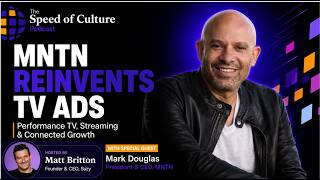
Mark Douglas, CEO of MNTN, built a platform letting brands run TV ads programmatically across streaming services like Roku and Apple TV with precise targeting and ROI measurement. The company launched in 2018 when agencies still called streaming the future while consumers were already there. Ryan Reynolds is Chief Creative Officer, coining fastvertising to make cheap ads fast.
Chapters
Up today, we're going to be speaking with Mark Douglas, CEO and President at Mountain. Mark, great to see you.
Thanks for inviting me.
You guys have been making a lot of noise in the connected TV space, and I'd love to just first start by getting to know a little bit more about you and your background, how you took the road to where you are today.
Well, me personally, I started as a coding engineer. I'm a self-taught engineer. I've been coding most of my adult life, I like building products, and that led me through a series of companies. Oracle, I was early there back in the day working with Marc Benioff, Tom Siebel, and others. And Marc Benioff was a director in desktop products division, and I was early engineer in applications division, a director in that division. So that's how he and I met. And Tom Siebel was like starting up Oracle's inside sales team. So this is quite a while ago, but a lot of fun. And then eventually internet infrastructure in the mid-'90s and then moved to LA in 2000. A series of companies I started. Then I moved to LA in the early 2000s to lead engineering at eHarmony when online dating was becoming a thing. EHarmony and Match. And then learned a lot about marketing and then eventually started MNTN and launched the MNTN to reinvent, essentially reinvent television advertising to make it—
and what drew you to the television space?
What happened, it was actually in 2017, I was meeting with a lot of agencies and asking them what they thought, like not even television, just where they saw marketing going and didn't get a lot of interesting responses. So I asked everyone, what do you think about streaming? Like, what do you think's gonna happen with streaming and advertising? Everyone I met with referred to it as, "Oh, that's way out in the future." Now, this is late 2017. This is not 2011. They were like, "Oh, this is way out in the future that people are going to move slowly. It's not going to have much of an impact anytime soon." I said, "Well, how are you watching TV?" They all said, "Oh, I have an Apple TV. I have a Roku." After a bunch of these meetings, I'm like, "I'm going all in on connected TV." Their behavior and their words were— didn't—
it reminds me, you know, that there was a time when, uh, in 2003, I was doing a lot of work targeting college students, and 30% of college students said an Apple was the next, uh, computer they were going to buy, but they only had 3% market share. So I knew at that point I should have put every dollar I had in Apple stock at that point. So it sounds like it's sort of the same experience.
It's similar thing. So I'm like, well, if you all think it's way out in the future, but all your behavior is now, then I'll make it now, right? And, and so we launched the MNTN Performance TV platform in 2018, and it's grown just tremendously. The most— the biggest thing is it's, um, more than two-thirds of our customer base are advertising on TV for the first time on MNTN's platform. Brands of all sizes who found television advertising to be, you know, very, like, expensive, hard to enter that market to become essentially a television advertiser. And creative was time-consuming. All these things we essentially said with streaming, let's just fix all these things and find a new set of advertisers. And that's what we did.
So it sounds like your product Mountain essentially creates a programmatic television advertising overlay onto like multiple OTT platforms. Is that a good way to describe it?
Probably. But yeah, the simplest way to think about it doesn't look anything like this, but at Luma Partners, The team there, founder there, Terry. So Terry, I did a demo for him a few years ago and he said, this is AdWords for television. You can do it yourself. All the tools are there. You can target any consumer you want. You literally upload your TV commercial into our platform and you're live on every TV network in America. You're live on Hulu, you're live on Roku's content, like anywhere there's ad-supported video. Were there with full targeting, full measurement, fully integrated into all your other tools like Google Analytics. So, it's— yeah, we had a real vision for it and we've really focused and stuck to that vision and it's been an exciting ride.
I mean, that's really intriguing. I spend a lot of time on programmatic tools, whether it be Facebook's platform or Google's platform, building Suzy's business. I've often tried to get on television because television has this perception of grandeur where people see you on TV and it builds a type of credibility almost like out-of-home does, even more impactful and has been something that has been out of touch for smaller advertisers for so long. So it's incredibly intriguing. How good is the targeting relative to targeting display or other mediums on the Mountain platform?
Well, similar targeting data. We partner with Oracle Data Cloud. We partner with LiveRamp for third-party data. For first-party data, we have our own first-party data system. That's very— I think it's very good. And we even allow customers to use CRM data so they can upload lists of like, let's say they have retail stores. They can take the email addresses and phone numbers they get there and they can upload those into our platform and target there. And that's actually our fastest growing method of targeting for the platform. So obviously we do our own marketing, right? And we have, we're fortunate to have Ryan Reynolds leading and George Dewey, our CMO, leading our marketing, plus some other people on team, Reagan and Ali. And so we use our own platform. That's our number 2 source of leads is MOUNTAIN advertising our brand. Right.
You're eating your own dog food.
Our number 1, by the way, is organic search on Google, which is the demo video we did with the ghost pepper and Steve-O. So organic search is number 1 and MOUNTAIN's own platform is our number 2.
That's incredible. So we have to get on that, Susie, and using that if it's working for you guys. I'd love to figure that out. We'll talk to you guys afterwards. So tell us about Ryan Reynolds. How did that relationship come about and kind of what role is he playing as you continue to build your brand in the space?
Sure. So Ryan's our chief creative officer, and so he's impacting the company in a number of different ways. So one, he's obviously very involved in Mound's own marketing effort and building the Mound brand, but he also works with our customers. So if you go back to is something I said, I think I said a moment ago, two-thirds of our customer base have never advertised on TV before. So we basic— they don't have TV commercials. Right. And so right around the time I met Ryan, which was last April, we were trying to figure out like, how do we make that easier for our customers? And Ryan has Maximum Effort Marketing, his, the marketing agency he created after the orig— or for, to market the original Deadpool movie and, and all his movies after that. And so it just kind of, as they say, it's like this marriage, just like it was love at first sight kind of deal. Right. So, you know, we have, we, we have this need and he has this agency and we just instantly connected over, you know, how we can show people and build a solution so that our customers could build TV ads, but do it cost effectively. What he calls fastvertising, where you can just do it quickly. Cost-effectively, like a TV commercial. The amount of money people spend on TV commercials compared to the amount of money they spend on like a video, on an ad for TikTok or Instagram, it just doesn't make sense.
Yeah. I mean, your addressable market is the biggest it gets, right? I mean, that's where all the— most of the money still goes in advertising despite Google and Facebook's meteoric rise. I mean, most of the big brands are spending on television, but the small brands, to your point, hasn't been accessible to them.
Yeah. And I totally agree. And then what was interesting when I first met Ryan, he said something very interesting to me. He said it took me 8— it took him 8 years to make Deadpool. But if he creates a 30-second commercial, that can be done in like 2 days and more people see it than the movie. Right.
Could have a bigger business impact than the movie.
Right. Yeah. So his— he— I mean, he's truly like this person that just loves to put out ideas and things that are culturally relevant. And so with advertising, he can just do that and like constantly, and he loves doing it. So it's been, it's been amazing working together. And I don't know, it just, it just happened. Like it took literally like less than a week for us to go from meeting each other and his team to, well, like, let's do this. Let's make— let's have Maxim effort and Mountain, um, or become one company.
And what's interesting is a lot of times when companies work with celebrities, you know, they're not really involved in the business, they're just the figurehead. But Ryan is really truly a prolific entrepreneur and has been involved in so much more than Hollywood and so much more in acting. So he's someone that's a true value add, not just somebody you're slapping next to your brand's name to build extra credibility with the masses.
Yeah, I mean, Ryan picks up the phone, like Ryan makes calls. He does sales calls for Mountain. It's wow. It's pretty— there's no one I've seen. Well, and this is probably a good time to start talking about Ryan, but it's the biggest compliment. I've never seen anyone that works as hard as him. I mean, he gets up early, he works a long day, but he, you know, he, we all are doing stuff that we really enjoy doing. So, I mean, we could go on and on and on, but that, that was the most, almost shocking thing. It was like, I send him a text message and he's reading it at like 4:30 in the morning after he slept for the night. Not through the night. He's not staggering home at 4:30 in the morning.
So one of the, you know, obviously we've seen a major shift in advertising from brand messaging to much more performance bottom funnel. And obviously that's almost had diminishing returns over time as we've seen, especially recently that Apple's iOS 14 changes, which makes it harder to to track. But that being said, I mean, a lot of advertisers, especially in this economy, still are focused on ROI. So the one thing that differentiates television from digital is I think it's more challenging to measure, right? Or is it? How does Matt look at measurement and the impact of its, of its ads on, on its end user?
Well, so we call our platform Mountain Performance TV. So it's all about all the tools to do it right for an agency, or to do what?
To do— to track, to track.
All the media buying is fully automated and they track all the visits and the conversions that come from that. How? So you're right, you, you can't click on a TV ad, right? So we use household IP and other signals. Oh, wow. So essentially you cross-device attribution. So that's something that like Google and Meta do. Now they use logins, right?
Sure.
Because they track across device. We use the household IP as the primary signal for that. And that's a core part of the value that we deliver.. And it's why we, you know, big part why we call it performance TV. This, so there are virtually relatively few brand advertising campaigns running on our platform because all of our customers, like you said, are focused on return on ad spend, cost per acquisition. And even the brand advertisers, when they now have the ability to do that for television, to think of TV as a performance channel, you know, they do. And, and, and when you think of some of the biggest performance advertisers, like someone like GEICO, Like, 15 minutes can save you 15% or more on your car insurance. That's probably the most well-known call to action in the history of advertising. Like, that is performance advertising. Absolutely. Now, they had the scale to be able to just, you know, do that on TV without a platform like Mountain. But we brought that kind of ability to essentially any size advertiser. And we have multibillion-dollar brands on our platform. We have mid-sized brands.— it's a pretty broad cross-section. You'd be surprised some of the larger brands, especially in retail, that are just not comfortable doing TV advertising without all the data that we're talking about. Or you think of internet brands. How many internet brands do you see on television? It's up there. They want the data to do it even though they know it's a powerful medium.
Right. And you said something interesting. You can't click on a TV ad, but I've been saying for years I think the TV ultimately is going to become a giant iPad hanging on your wall. And you look at, you know, the, the, the form factor of Apple TV, right? And it looks a lot like an iPad. And ultimately I think that TVs will become touchscreens and, and you will be able to interact with them and you will be able to click through. And I think you guys are just kind of getting ahead of it.
Yeah. We would love, I mean, if there are, if Samsung or LG or any, or a young emergent startup is listening, count us in, willing to test that with you. It brought back a memory of memes when the first Lar— remember when iPhones were really tiny and then they finally came out one size with Samsung? Yep. I remember seeing a lot of memes. Uh, I saw one where these guys were in the back of a taxi handing each other a TV pretending that was an iPhone because they were now so large. And it made me laugh when you mentioned that, that, that TVs, TVs are gonna become like that, that interactive experience. Yeah.
In the meantime, I do believe that the TV, the physical device of the TV is almost a commodity. In the overall ecosystem, right? And it's razor-thin margins. And one thing I've often thought would happen is a company like Apple or Amazon would buy a Vizio, you know, and then give away those TVs almost for free, almost like what they're doing with the, you know, Alexa devices. So then they can essentially control the ecosystem, control the rails. What are your thoughts on that in terms of the role of the physical TV device as part of the overall ecosystem? Is that something that's going to ultimately get commoditized?
Well, I think most people consider it commoditized now, and I think there's no more disappointing product from Apple than the current Apple TV, right?
I think it's not even a TV. That's the thing. People think everything is a TV. It's not a TV. They could make a TV and maybe it'd be less disappointing if it did.
Yeah. So I think the, the, um, I do think it's commoditized even right now, although I think increasingly the The software you see in it is considered very valuable and you see a lot of TV manufacturers becoming part of the television ecosystem. Correct. Which kind of Roku, the television advertising ecosystem, I should say, which Roku kind of led the way on. So I think there's still a lot of innovation to come there. And I don't think the television viewing experience for the next 20 years, even 10 years is like done.
Like, no way.
Okay.
Would that—
because we lived with one experience for a very long time, right? Like we had just like over the air, you got 5 channels to watch. Then we got cable, which is, you know, this over— and now we have streaming. I think obviously streaming is the way of delivering, but I think the experience for the consumer still has a ways to go in terms of making it really, really seamless and having just an incredible viewing device to do, to watch.
I agree 100%. And, you know, You know, talking about your industry, we're talking at a really pivotal time. It was just announced by Nielsen last week, I'm sure you saw this, that streaming viewership actually surpassed cable for the first time. And that was from Nielsen. So here you are, you talk about the conversations you have with that agency in terms of how much now streaming has overtaken cable.
You know what's interesting about that? Even in late 2017 and in 2018 when we launched our platform, there was already half a million households a month switching from cable to streaming, like going all in on streaming.
Yeah.
And if you just did the math, you just are like, okay, that's an unrelenting— that's a city a month that is saying, I don't want cable anymore. Like, I want all streaming experience. So if you just did the math, this was an inevitable march towards streaming. And at some point, you know, essentially cable is not even a mainstream product anymore. More. Obviously, there's even more television viewing. But, you know, if anything, it's going to accelerate from here in terms of streaming larger than cable.
And as you know, Netflix recently announced that they're partnering with Microsoft on a new ad-supported tier. Do you see Netflix kind of going direct to advertisers with Microsoft sales team? Is that competitive to you or is that additive to what you're trying to build?
No, it's definitely not competitive. I think Netflix is in a very unique position. Where they have a pretty significant percentage of television viewing hours that they're bringing into the television market. And so I think initially, I mean, they're going to focus on a very brand-heavy strategy. But I think one thing you see is if you want to grow, if you're Netflix, if you're ABC Disney, Disney with, with all their properties, ABC, sure, and stuff like that. If you want to grow, you have to bring more advertisers in the market. You cannot keep going to a few thousand. And in terms of the majority of the market, a few hundred large brand advertisers, and that's your entire business strategy.
There's no—
there's no growth there. We have to make that— believe it or not, in some ways, television advertising is not truly a mainstream product. It's only sold to a few thousand companies—
you look at the upfronts, it's a small amount of people that are invited to the upfronts—
open it up to emerging brands, so all size brands, to now be able to use this medium. And so I think Netflix's initial strategy is definitely going to be very brand heavy, but I mean, that's year one. What's, you know, year two, you're gonna— unless you want to be a market share war, you're going to have to open this up and bring new advertisers in the market. And I think, and with Microsoft involved, probably with a very tech-heavy approach. I mean, Microsoft is not— I don't see them being interested in becoming a television network. They want to basically remain a tech company and bring more tech to the television market.
Absolutely. Absolutely. And what I was saying was adding was that you look at the upfronts and the upfronts, to your point, really only does invite the P&Gs of the world and the major brand advertisers because that's who really the market is. But you look at a company like Facebook and the majority of their advertisers are small businesses. So I think in that kind of dichotomy there, I think presents the business opportunity for Mountain.
Exactly.
Exactly.
And that's how we view it. And we feel we're leading it. So we're excited about that. And we're like all— more AVOD, more ad-supported television, where we think is great. And it's not competitive at all. It's— we think it just makes it even easier to bring more advertisers, new, young, emerging and mid-sized advertisers into the market.
Yeah, absolutely. Makes sense. And, you know, the TV advertising market is one, and the television market in general has just been one that's been so dated in terms of the way it works. And you're coming in as this new disruptor. What, what has been your path to success to date in terms of disrupting? Because we face the same thing in the market research industry where there's a bunch of sleepy legacy incumbents that we're trying to disrupt, and you have a bunch of people that are holding on to the old way of doing things. But over time, you get the early adopters and you start to break through and I'm sure partnerships like Ryan Reynolds don't hurt doing that either. But what has been your playbook to be successful in disrupting the TV industry?
Well, we did literally think of it that way. The way, you know, I looked at it was you've had all this innovation in the relationship between the consumer and the content, the TV network, right? And Netflix and, and Hulu kind of led that way. And, and Netflix, did all these things in terms of just literally inventing streaming to a certain extent, and then doing where you can binge watch and all the things they did. And Hulu was pretty early there also. And but the relationship between the advertiser and that TV network essentially had not changed. And even now on streaming, you see a lot of the streaming is advertising is still bought through an upfront or part of an upfront process. So we looked at that and said, look, we can innovate that relationship between the advertiser and the TV network. Just look at it and just ask people what do they love about the current relationship and what don't they. We can make a big dent here. And so obviously they don't, honestly, they don't really like, the advertisers don't really like upfronts. They don't like spending huge amounts of money on creative. They don't like having to do media planning cycles —months to quarters in advance. Just all these things. So we kind of set out just to reinvent all those things. And then it was something really simple. It's generally going to be easier to bring new companies into that market with a new approach than to convince the existing buyers that they should switch to a new approach. So that's why we focused on bringing new advertisers in the market who were very comfortable on social, in particular, like Page social, bringing them over to television, and then those more traditional TV advertisers will follow. And that's the strategy we pursued. And it just turned out that, that what you referred to as early adopter is huge. Like when there's every one of those companies spending a lot, you know, focusing on paid social and paid search have been excluded from television advertising because of all those things, upfronts and stuff like that, that, that was a dam waiting to burst. And so when we launched, and I don't wanna pretend like I just called this, but our whole sales cycle was just demo it to just make people aware it's even possible that they can advertise on TV. And we started picking up customers. That was, we got in front of a wave and just rode that wave by essentially guiding the path and just innovating. Just take these things that are 50 years old, 50-year-old business models, and just reinvent them and just show people that and, and see how they respond. Spot. I wish it was like I could make it sound more sophisticated, but it was like build product and then show people that it's possible.
And that strategy worked. Yeah, it's a tried and true path. So let's talk about— let's shift gears a little bit and talk about your role as CEO and president of Mountain. You know, your background is in technology and engineering. What strikes me as unique about you is that you know how to talk the talk as well as being somebody who can obviously code and understands the technology. And that certainly makes you rare in the business world. All that being said, how do you spend your day? What's the pie chart of your day and what you're focused on and, and you know, what are your biggest initiatives right now?
Yeah, I mean, it used to be, it's, it's actually shifted recently. It used to be really like two-thirds and if not three-quarters of my day was on product. Sure.
And what does that mean? Relatively, like, like actually working with the engineers or is it in engineering, standing over their shoulder? Right. Yeah.
A year and a half ago was actually coding. Want to wake up every morning and code. And so I'm still very involved in the product, you know, engineering side of it. I kind of personally the crossover point between kind of the business strategy and the tech strategy. Right now, I spend a lot more time on partnerships. So it's more like a 50/50 split between product focus and then customer and partnerships. And because as our brand has grown and the company has grown, I think for partnerships has, have also grown. And, um, but I always think that like every, if there's a minute of the day where I'm like, what should I spend this minute doing? It always leans towards technology. It always leans towards— that's your default. You know, what can we do better? Right now we have a big focus on just, sometimes you can just focus on innovation so much that you forget to ask your customers, hey, do you really, is everything we've already done, are you loving that? So right now we're having a big focus on just asking our customers of everything we've delivered in the platform so far, what could we do better? So that, and I'm excited about that because sometimes, like I said, you can just get so focused on the next feature that you don't ask everyone, like you serve a meal and then you're on to the next recipe. Let's try and do this. And you're like, wait, did every, you know, is everyone, could we make what we already have even better? And so, but it's all, it's a very, very heavy focus on product and technology. And the, I enjoy the partnership side, but it's not like my DNA. It's my DNA is to get a computer out and hang out with a bunch of engineers and invent stuff.
Right. And obviously technology is expensive and you guys, thankfully you hit your timing, right? You raised just under $120 million at the end of last year. That may not be— that might not have been as easy to do right now. What are your thoughts on growth versus burn? And are you guys looking at other companies to acquire? What is your growth plan heading into 2023?
We think most of our growth comes organically. We try to grow while being really responsible on cash. So we've never been a company that has like a huge burn rate to drive growth. And, you know, we just focus on making sure we're, you know, hitting the right customers. Our own marketing metrics are really strong. I mean, and, and they were strong before Ryan, you know, got involved. And now you have literally the— I, I mean, arguably the world's best marketing team, marketing mountain. And so that obviously is going to bring even more efficiency. So we're, we're not generally going to just spend dollars to grow the company. We're going to focus on the things we've been talking about. Who's the right customer? What features do we have in the product? You know, the, the, and just delivering. And that's kind of the strategy for the company. I mean, it's keeping all these things seem to work the best when you keep them simple.
So that's so true what we're trying to do. Well, that was amazing. And you obviously have a lot going on. And again, I'm so thankful for your time and joining us at the Speed of Culture podcast. I'd love to know in this fast-paced world, Mark, what slows you down personally? What's worth slowing down for in your life to get away from the madness of connected TV?
Well, recently I really liked the water. I'm actually, I'm in Rhode Island right now, just enjoying a summer in Rhode Island of all places. That's a really pretty state. Good for you. And you really feel like it's a historic place too. It's the closest to like getting on a plane and going to the UK that I think you can get in the United States. Like you feel like his— like, wait, this is like I'm walking through history right now. So for me lately, it's just been that I travel. I really, during the pandemic, I did not stay stationary. I mean, I stayed a number of places for a long time, but I traveled a bit. And, and so for me, this ability to work from home but make home anywhere I am. Yeah. So right now that's You know, enjoy. I'm literally on a dock at a restaurant or just by a restaurant in Rhode Island and enjoying a summer day here.
Well, that's amazing. Yeah, that's amazing. You're like a duck, right? Running really quickly below the surface, but on top you're chilling. Yeah, exactly. Exactly. Well, thanks again, Mark. On behalf of Suzy and Adwee team, thanks to all of our audience for joining us. Be sure to subscribe, rate, and review the Speed of Culture podcast on your favorite podcast platform. Be sure to check out MNTN at mntn.com, um, an incredible technology platform that I'm sure is going to continue to innovate in this space. Uh, so be— on behalf of myself and the team, thanks again, and we'll see you next time. Take care, everyone.
More from Matt




MikMak’s Rachel Tipograph on Consumer Spending, Retail Media & Holiday Shopping Trends



Jaguar Land Rover’s Charlotte Blank on Luxury, Purpose & Experiential Storytelling



