Moderna’s Kate Cronin on mRNA, Brand Storytelling & Science Communication
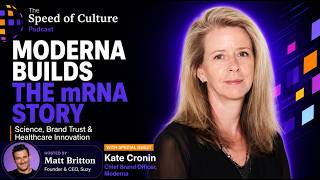
In this Speed of Culture podcast episode, host Matt Britton interviews Kate Cronin, Chief Brand Officer at Moderna. Cronin recounts her career trajectory from a scientist to PR at Porter Novelli, then to integrated advertising at Ogilvy, highlighting how PR’s scrappy, all‑in‑one mindset blended with advertising’s specialized creative and strategic functions. She explains why she joined Moderna in 2021, describing the unique challenge of shaping a brand that exploded into global awareness during COVID yet lacked a clear identity beyond the vaccine. Cronin details how Moderna’s brand strategy positions mRNA as a platform (“the software of life”), builds equity pillars across infectious disease, rare disease, and oncology, and uses unconventional sponsorships, edutainment, and partnerships with media outlets. She outlines tactics for translating complex science into lay analogies (e.g., mRNA as computer software or an app), leveraging digital, generative AI, and augmented reality to create agile, data‑driven content. The conversation also covers audience segmentation—consumers (especially vaccine‑eligible adults), healthcare providers, and rare‑disease patient communities—and how messaging is tailored for each. Finally, Cronin shares career advice: give everything to a pitch, stay uncomfortable, and take calculated risks, emphasizing that her loss of a pitch at Ogilvy ultimately led to the Moderna opportunity. The interview blends personal narrative, branding strategy, and science communication insights.
Chapters
Up today, we're gonna be speaking with Kate Cronin, Chief Brand Officer at Moderna. Kate was recently named top 50 healthcare influencer by Medical Marketing and Media and was named to AdAge's Leading Woman of 2023. Kate, so great to see you. Thanks so much for joining today.
Thank you so much for having me.
Absolutely. Really was looking forward to this discussion and, you know, diving right in. Your background was largely in the ad industry and you spent a lot of time at Ogilvy, which we'll get into, but you actually started off your career at Porter Novelli. Can you talk a little bit about kind of your experience in working at a PR-oriented firm for such a long period of time and, and how that role evolved over time?
Yes. So I started my career in PR and originally I was a scientist. I worked as an electron microscopist studying the rat hippocampus. Say that 10 times.
So going to PR from that scientific role seems like a major leap. How did that occur?
I sort of fell into it. I saw an ad back in the old days, paper ad for somebody who would lead healthcare communications. I interviewed for the job at Porter Novelli and was excited to join it. They were looking for someone who could translate high science into lay terms for consumers.
Got it.
And since I understood high science, I thought, well, I could, I could do this. And so I started off doing healthcare PR and working for large pharmaceutical companies and translating their science for consumer and patient audiences.
And did you know right away when you dove into that role that it was right for you and you were gonna kind of be in the marketing sphere for the remainder of your career?
I absolutely loved it, and I loved it because I worked with teams, I worked with clients. We were constantly solving problems in terms of communication challenges. and it required a lot of creativity and ideation, which I love doing as well, and selling because you had to sell your ideas to reporters and get reporters to cover your story. And that required you to break through the clutter and get them to care. Why should I care about heart disease? Or why should I care about whatever it is that your client is manufacturing? And so that I thought was super fun and exciting in terms of getting reporters to care about my client's products.
Absolutely. And like we, during the majority of your stint at Porta Novelli, the internet really has hadn't become a thing yet, right? So I think the notion of needing reporters to gain distribution for your story is a foreign one for many millennials because right now if you want to get your story out, obviously big media outlets still matter, whether it's New York Times or USA Today or you name it, but for the most part, if you wanna get your story out, you can go on Twitter, you can go on social media, et cetera. But back then, reporters were kind of the gatekeepers for businesses being able to tell their story.
You're so right. And I think looking back on it, it was very narrow group of reporters held the biggest stories. So yeah, the syndicated reporters, the top journalists, they decided what were the, the health stories that were gonna be published. And then, you know, with the onset of the internet and the blowup of, you know, we media and everybody became a reporter. And then of course, tons of new publications, platforms, et cetera, launched. It was simple back then, but it was also hard because there was just a few who decided what stories they would write.
Absolutely. So after 13 years at Port Novelli, it looks like you took a little bit of a break before joining Ogilvy. What was sort of the thinking behind you taking a career break after being, going at it so hard for 13 years straight?
Well, maybe that's just a gap in my resume. I didn't take a break.
Oh wow. Okay. Because a lot of people we spoke to took breaks and took sabbaticals and stuff like you didn't.
I did not. I went directly to Ogilvy from Porter Novelli. I spent 13 years and then moved on to Ogilvy and was there for 17 years. And I joined Ogilvy to lead their healthcare PR business, their global health PR business. And that was my initial role when I joined Ogilvy. After a few years of leading the healthcare business, I took on the role of running the New York office.
Got it.
And then I ended up working on other brands, consumer brands, Ford, TJ Maxx, Unilever. And so I split my time between health and consumer.
Got it. So you start to, during your time at Ogilvy, it sounds like broadening your horizon a little bit beyond just the medical field. So how was your time at Ogilvy different than Port Novelli? My experience in hiring people from big Madison Avenue firms like Ogilvy and BBDO is they come with such pedigree and the, the training and sort of the deep domain expertise is tremendous at those companies. Is that what you experienced and overall how was the experience different?
So at first Ogilvy PR was a bit separate from Ogilvy. And then after a few years, we moved and joined the Ogilvy and Mather offices and became like embedded within Ogilvy. And I think the difference is learning a lot about advertising right away and figuring out how to create true 360 holistic campaigns that incorporate PR, advertising, and as you know, eventually digital. And I think that was a big learning because I didn't really understand advertising when I was at Porter Novelli.
Right.
You know, when you think about PR, the PR practitioner is not only the creative, they're the strategist, they're the account lead, and they also know how to do the numbers. In advertising, you have a strategist, a creative person, an account person, a finance person. It is so different. Whereas PR is scrappy and you have to be everything, advertising has a department for that. I think advertising learned from PR and vice versa. Take the best of both worlds. Like what works really well with PR is being nimble and agile, and what works with advertising is deep creative ideation.
Yeah.
And so being able to bridge the two, I think was what was really enjoyable about Ogilvy.
And when you first start to work on brands like, like PJX companies or, or companies that were completely disconnected from the medical field, did it feel like the experience you had in the kind of foundational PR and marketing side make it easy to transition out of medical. And I imagine in some ways that was probably pretty liberating because a lot of those skills aren't as heavily regulated in terms of your ability to create messaging.
It's so interesting because when I was leading the, the New York office at Ogilvy, we lost our Ford account leader and I didn't have anyone. So I volunteered myself. I met with the head of comms at Ford. And interviewed to take that on as part of my job, even though I had two other jobs. And I found it really liberating because there's so much you could do that you can't do in health. Health has a lot of guardrails. You have to be really creative about getting creative. Yeah. Whereas in consumer brands, the world is at your feet. You can do all kinds of things. So it was super fun. And I took a lot of the learnings from the consumer space into health and said, why can't we think about how we could do something differently the way we do it for big brands like Ford and Unilever? So that was liberating for sure.
Totally makes sense. And in that regard, in terms of maintaining your domain expertise in health and, and kind of marrying it with your consumer learnings, you decided to take on the position as Chief Brand Officer at Moderna a couple years ago in 2021. Talk to us about that decision, how it came about, and why it was appealing to you.
So I was promoted to the CEO of Oakley Health, and it was a fantastic job, and I really enjoyed it while I was in it, the job. And during that time, I pitched the Moderna business. We were in a runoff with TBWA, and apparently the CEO was the deciding vote picking TBWA. And so we lost the pitch. And then a few months later, I got a call from the CEO of Moderna, and he asked if I would consider would you be interested in being his chief brand officer? And I surprised myself and said yes. And then I realized this is the most incredible opportunity to help shape a brand that everyone in the world has heard of and create that brand story, amplify that brand story, and expand on it because I knew there was so much more to Moderna than COVID. This mRNA platform technology could do so much more. Yeah. And wouldn't it be a fantastic opportunity to help tell that story? And that's why I took this job.
Yeah. I mean, it's crazy cuz you think about a brand like Moderna, there's probably not many other times in history where a brand had such a big spike going from unaided brand awareness of zero to wherever it was when you joined. I mean, it was literally on the tips of every reporter's tongue day in and day out for, you know, I guess a year by the time you've joined, but yet a lot of people really probably didn't know what Moderna was all about, what they did, what the company stood for, who founded it, et cetera. So you had a chance to kind of craft the brand story almost from scratch with a brand that a lot of people had already heard of, which is really unique. I can't think of another instance where that has occurred.
Yeah. If you think about vaccines, if you go and get your flu vaccine, you never knew who your manufacturer was. You just said, I want my flu vaccine. COVID changed all of that. So then people would go in, you saw the memes of Pfizer, Moderna, J&J. I mean, they were very funny. But basically you could go in and say, I want a Moderna vaccine, or I'm Moderna 3 times. And there was a pride and there was a relationship that we built with consumers. And my focus is, how do we continue to build on that relationship that was established during COVID Getting vaccinated, you're able to get back to your lives. Go to weddings, go to parties, go to restaurants. There is an affinity already created. So as a brand, how can we build on that affinity? Because we have many more products coming in the respiratory space in particular, which again, just like COVID, we have flu, RSV coming. And so we want to build on that relationship and stay what I say is relentlessly relevant. People were all about Moderna during COVID and then it's kind of as COVID, as the pandemic shifted to endemic, We don't want people to forget Moderna. We want people to remember who we are, what we're doing, and be a part of this journey because we think it's super exciting about where we're going with our mRNA technology and the future of health.
When you join as chief brand officer at a company like Moderna and your first challenge is obviously to create the brand equity pillars in terms of what the brand stands for beyond just the COVID vaccine, which is basically the hit product you kicked off on. What does that process look like? How do you immerse yourself within the company to start the frame, I guess, the tentacles for, for what the brand story will ultimately become?
So first and foremost, we are a platform company. So mRNA is the hero in our platform. mRNA technology is what feeds everything that we do. And so understanding the applications of mRNA is critical. And so when I joined Moderna, we did not have a brand team. We had a couple of people who did communications. And I have to be honest, it's amazing the job that they did during COVID with reporters calling every day, and there was news every day about COVID And so I had to reformulate the team and think about there's the media component, but then there's also the enterprise brand work and really setting up internal shop, a very small shop, if you will, of the enterprise brand. Like, what is the strategy for how we tell the Moderna story? What's the creative going to look and feel like? Where are we going to show up in the world? One of our key strategies is to go where our customers are, where our consumers are, and be more of a consumer brand. So last year, we did the US Tennis Open as one of our first big sponsorships. We sponsored sumo wrestling in Japan. Wow. So be unexpected, but go where people are enjoying themselves and be more of a reminder that Moderna is here as a partner. And we have so much more of a story to tell. And so I set up basically the core team to support our infectious disease category, rare disease, and oncology, and really tell the story of our global public health as well. And so I had to really establish the shop, create our strategies, and then hire our partners to support us because we're a very small team. And so we really rely heavily on our partners to help us with content creation, with strategy, with execution and activations.
And now it seems like you have your footing, so to speak, in terms of the brand story. You know, obviously all around this mRNA technology and the applications to different, you know, I guess, types of elements that you're trying to solve for the end consumer. What is your plan to kind of communicate that story? What are some of the tactics that you think are best suited given the needs of the company?
So we are looking at— we launched our new ad campaign called Welcome to the mRNA Age, which really tells our enterprise brand story and shows that mRNA is the future of medicine. But we're also doing a lot of partnerships. So we're working with publications like The Atlantic or The Washington Post, and we're, we're doing some paid partnerships to get our content out there. We're also creating our own content. I call it edutainment, which is really education and entertainment and combining that too, because people will remember more if they're being entertained versus lectured at. Of course. Yeah. I mean, why is Netflix so popular? They like, everyone likes to be entertained. So we're also looking at video as a, as a source, you know, many documentaries. We've got executives who are really compelling. How do we get our executives out more? We've got plans around each executive in terms of going out and speaking engagements and, and talking to key influencers about our story. And then our employees are fantastic ambassadors for the brand as well. So how do we deploy our employees to be able to tell the Madera story? First of all, we need to educate them. So we spend a lot of time working with our team in employee engagement to create content, which is highly used and downloaded, our internal intranet. So that employees feel like they can answer the questions that come from family members, like, what is Moderna working on? And make sure that they can be good ambassadors. And so we're working not just internally, but externally to ensure that our stories are told because there are so many of them. We have more than 40 products in the pipeline. Wow. We have more vaccines in the pipeline than all companies combined. So it's huge.
That's fascinating. That's fascinating. And— if it's all based on this mRNA platform, I would imagine another big piece is actually talking in layman's terms of what mRNA actually is, because I would imagine the average consumer has no idea, me being one.
Yeah.
Yeah. So what is mRNA? How would you describe it to a friend, you know, over a cup of coffee? Yeah. What mRNA does?
When you think about mRNA, messenger RNA, ribonucleic acid, it's basically an information molecule. And when it's injected in your body, we can program that molecule. We can program that to tell your body to either fight a disease or prevent a disease. And the code changes based on the genetic makeup of the virus, and we can change it really quickly, which is the great thing about mRNA technology, super agile. And so once that molecule is changed and programmed, We inject it and therefore it teaches your body then to fight or to prevent. And so that's the beauty of the technology. And we literally don't think people need to memorize mRNA, but just to understand the basics of it goes a long way. If you think about, I use this analogy, if you think about Intel Inside, I don't know what the chip does. I just know that if the chip is in my computer, my computer is probably going to run faster because I've heard about it. It's just a seal of approval. Like, and I feel like it's not as simplistic and it's not orange apples to apples, but I think it's something like that. If you understand that mRNA is what helps save the world from a pandemic, you understand that it works and you understand that there's huge potential for what it can do for other diseases.
I think you described it very well. And what comes to my mind is if the body is a computer, you're installing like antivirus software almost in terms of helping it detect and root out some of the things that—
right? Yes. We called it the software of life. And also, you know, you could think about each new product being an app and that you can update the app. So like last year's COVID variant is different than this year's variant and so on and so on. And so you just update the app or the product. To basically meet the needs of the current variant of concern and to fight off the one that's, you know, the most prevalent or virulent.
Right. That sounds like a good analogy.
Yes. Yeah. And I think the consumers understand that because everyone has iPhones, right? Or smartphones, I should say.
Exactly. 100%. I think, I think winning that story is going to be everything, especially with 40 new applications that you have coming up. Using application stick with the analogy based upon the, you know, this platform that you're building. It's fascinating. So moving on to like your role as Chief Brand Officer, you know, now that again, you have your footing and it sounds like you have a really solid foundation of the brand story and how to communicate it. What does that mean for how you spend your time and how you can continue to keep growing as a professional in such a fast-moving space?
So I'm spending a lot of my time learning about the future of how digital can be at the core of everything that we do. I've spent a lot of time learning about generative AI, learning about how we can infuse digital data and analytics and pivot real-time to creating materials that actually make a difference, have an effect, change opinions, create preference. And using the science of data analytics and also just AI to apply to our brand and corporate affairs team. We've been using AI at Moderna to create the products, and now it's just a question of how do we infuse that across all aspects of our organization so that we're smarter, faster, more agile, and efficient. And so that's really what I've been focused on doing and also challenge my team to do as well. I mean, AI isn't gonna write everything for you, but you know, it certainly can help. And so we've, you know, downloaded a form of ChatGPT so that we can protect our intellectual property and obviously not upload it so the whole world can read about what we're doing. And so we're, we're playing with that a bit and also looking at, as I said, edutainment. So looking at augmented reality for teaching audiences to learn about our technology and how do we use that in a more effective way? And how do we also build that into some of our activations that we're doing so we create an element that's more techno-focused? Because we really are a health technology company. We're not a pharma company. And so we need to reflect that in how we communicate with our stakeholders.
Yeah. And in terms of your target audience on who your message is most important to, I imagine that you, and you mentioned this earlier, you have a B2B aspect, so to speak, of your business. Where you're going communicating your message to the healthcare providers. And obviously you want to have that sort of underlying demand from the end consumer. In terms of the consumer, what audience is most important to you? Because I would imagine that your message really lands most with the millennial generation, although historically that's not who's most in need of some of the healthcare offerings that you have.
Yeah, it's a good question. I think almost everyone is a potential consumer of a vaccine, a preventative vaccine. The question is who's most likely to get it. And, you know, you kind of have to think about, obviously we want people 50+ to, and those who are immune compromised to get their vaccines, super important. Not everyone is going to feel like they need vaccines. Like there are people who go and get a flu vaccine every year. And then there are people who say, "Meh, I'm not going to get my flu vaccine this year. Maybe I'll get it in a couple of years." And so we're trying to message to all those folks to say, look, it's super important that you practice preventative care. Getting these vaccines can avoid hospitalization and death. I mean, I just saw in the news that there is— someone dies of COVID every 4 minutes still, and we're not even in a pandemic. I think the problem is that people have become— there's fatigue associated with it, right? It's like, okay, we need to move on out of the pandemic, but the reality is COVID is still a deadly— can be a deadly disease. And so we're trying to reach all audiences with that message. And when you think about healthcare providers and pharmacists, we really lean in a bit more on our science. We lean in on our efficacy and our tolerability. We want them to understand the product a bit more so that they can accurately communicate with their patients. And then as we move down the line, we're going to be moving into rare disease. And these are very, very sick patients and children, really horrible ultra-rare diseases. And so we're going to lean in on, you know, communicating with the patient organizations and the families and the doctors who treat these rare diseases because for some of these diseases there's been nothing available.
Right.
So that strategy is going to be a little different. But if you think about preventative care, everybody should be thinking about it. So we've got, you know, consumers and healthcare providers. Messaging will be slightly tweaked based on who we're talking to.
Yeah, Kate, I mean, I have to say, as I hear you talking about, especially when it comes to children and rare diseases, so many people in the advertising industry get into a tizzy with these fake fire drills that they have coming up all day. But the things that you're working on really have the potential to change people's lives and save lives. And I would imagine that just must be incredibly fulfilling to you. After your previous, you know, roles to be working on something that's so incredibly important to really the future of humanity. I mean, how do you look at that? Because it just seems like such an important role in such an important company you're working at.
It is. And I feel like coming in this role, I'm making a difference every day. And as the CEO at Moderna says, patients are waiting. And when you put it that way, you realize that everything we do is about getting these products to patients, in many cases where they have nothing, nothing has been available. These poor children who suffer from ultra-rare diseases and the families' lives are in upheaval. And it's like the idea that we can go in and change that is so motivating. And it, it's why people get up every day and come into the office. Our oncology platform is incredibly impressive. The 44% reduction in hospitalization and death when you use mRNA product with Keytruda in patients with melanoma. And so I think that is incredibly motivational too. Like, how do we get this, how do we get this individualized neoantigen therapy, which is basically a cancer therapy specifically designed for each person. So your cancer vaccine therapy Your therapy would be different from mine, would be different from hers, would be different from theirs. And the fact that we have to actually create the manufacturing to support that, think about 20,000 patients with melanoma, for example, we'd have to create 20,000 vaccines. That's how it works. Individualized, not personalized, individualized. So we basically needle to needle, we basically take a biopsy of the cancer patient's lesion. We create the mRNA. For that, come back and inject them with our mRNA medicine. And that's very specific to you. So it's just, it's almost like, you know, beyond anything I ever thought I would be working on. You never thought this would be happening at this day and age, but maybe 10 years from now we'd be creating these kinds of vaccines, therapies, but it's amazing that it's happening now. And that's why I remain incredibly optimistic about all these therapies and the future of, of our technology. It's just incredibly an exciting time to be at Moderna.
Absolutely. So to wrap up here, Kate, I mean, it's been said before that all the big moments in your life come down to one event, one relationship, one transaction that really dictate your future. And, and hearing your story, it was that pitch that you had at Ogilvy where you actually lost the pitch. And if you had won the pitch, yeah, maybe you'd still be working at, at the agency and you might have moved on to working on a different account. Maybe you'd be selling peanut butter right now. Right. But instead you're at this incredible position. Yeah. Yeah. And, but, but you wouldn't have had this opportunity if not for everything else that you experienced before. And it's those experiences that made you the person you were that impressed the leadership of Moderna. That had them consider you for this role. What do you think those things were along your journey that prepared you for that moment that maybe you can impart on some, maybe some of our other younger listeners at the Speed of Culture podcast so that they can have similar opportunities one day?
That's a big question. I think when I reflect at that moment when I pitched the Moderna business and I put my everything into the pitch,. And I do that all the time. It's like, give it your all and, you know, fight, fight for what you believe in, fight for what you want. And I did that at that time and it showed up. And I think if we had lost the pitch, it's really, you ever see that movie Sliding Doors? It's what if about two different lives anyway. Yeah. Yeah. It's like that. If I had lost the pitch, I probably would still be at OVB and I would just be pitching I mean, if I won the pitch, I'd be working on Moderna hopefully, but I would never have taken, had this opportunity. And so for me, I think there's two learnings. One is throw everything in, show up, always show up, okay? You know, that's, someone once said, show up, show up times 10 and give it your all. And the second is always be uncomfortable. Like take a risk. If you're getting too complacent, then that's a problem. And I think when I took the Moderna call for the job, I think I thought in my head, maybe I'm getting complacent. Maybe this is that kick that I need to do something completely different and do it for the right reasons because these patients are waiting. So I think that's the lesson that I would share with others is take the risk and throw yourself in.
I love that. I think taking risks is huge, and I think a lot of people are hesitant to do it. And I think complacency is definitely a big signal that you should do it, but this was certainly a risk worth taking. And I'm also glad that you took the time to tell your story in such an authentic way. We're gonna wrap up here, but Kate, I just wanna thank you so much for joining. On behalf of Suzy and the Adweek team, thanks again to Kate Cronin, Chief Brand Officer at Moderna, for joining us today. Amazing episode. Can't wait for our audience to hear it. Be sure to subscribe, rate, and review the Speed of Culture podcast on your favorite podcast platform. Till next time, see you soon, everyone. Take care.
More from Matt




MikMak’s Rachel Tipograph on Consumer Spending, Retail Media & Holiday Shopping Trends



Jaguar Land Rover’s Charlotte Blank on Luxury, Purpose & Experiential Storytelling



