Molson Coors’ Brad Feinberg on AI, Media & Next-Gen Consumers
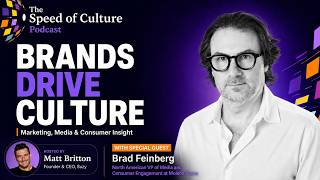
Brad Feinberg, Molson Coors' North American VP of Media, explains how the brewer is chasing Gen Z through creator partnerships with Patrick Mahomes and Lainey Wilson, localized sports marketing, and new non-carbonated brands like Happy Thursday. Linear TV is dying for younger drinkers. Bars still matter for discovery.
Chapters
Up today on The Speed of Culture, we're joined by Brad Feinberg, the North American VP of Media and Consumer Engagement at Molson Coors. Brad has led transformative initiatives for some of the most iconic beverage brands, from Coors Light to Miller High Life, and he's here to give us an insider's look at how Molson Coors is innovating to keep up with the pace of modern culture. Brad, so great seeing you today.
Thanks for having me.
Absolutely. So we're here at MediaWeek. In New York City. How much time are you spending going to conferences like this and what do you get out of them?
Probably, I mean, not a large percentage of my time. I probably spend maybe a handful of conferences that I go to over the course of the year, ones that I think that are meaningful, that have opportunities to learn something new, to bring things back to the business, as well as to meet colleagues, attend board meetings, or be inspired.
Yeah. And when you're at events like this or you're just talking to people in the industry at large, what are some of the things that are on the top of everyone's mind heading into 2025 relative to the media landscape?
I'm sure the word that comes out most frequently is AI.
Correct.
But I would just say the changing media landscape in overall and just the thinking of like how marketing organizations are transforming, modernizing capabilities. And really having a kind of a foot into what the future may look like in terms of the types of capabilities both marketing organizations, both internally and agencies externally, need to build in order to achieve success in like a modern era. Yeah.
And in this modern era, obviously it's so fragmented, but there's still some traditional mediums that are incredibly effective.
Sure.
So if you look at like the NFL, it's the most watched—
Sure.
Live program every year, usually has like 80 to 90— I know you are.
Yeah, I know you are.
At the top of the audience might not be in terms of like 80 to 90 at the top 100 most live watches against males and females.
Yeah.
So let's talk about television and how that plays an important role for your brands.
Yeah. I mean, it, it has evolved over time as you would expect. And I like to think of my role and what we look at is the intersection between consumer interests and choice and where we think we're going to sell or we're gonna create a meaningful exposure to our brands to sell more product.
Yeah.
And so It starts with the consumer at the center. And so we look at where consumers are spending their time. We look at reaching the next generation of legal drinking age consumers as well and where they're spending their time. And it shouldn't be a shock to most that they're not spending as much time in front of a linear TV, cable TV channel as they often were.
Yeah.
And so we're reflecting that through the way we kind of go to market and the way we buy media and, Yes, linear TV plays a role. Those big culture moments, whether it's live sports or big events that happen on TV, are definitely kind of mainstays for our category and where we're the most relevant. Other parts of linear TV are less relevant to—
Sure.
They were—
The time shifted. Correct.
The time shifted and/or just not appropriate for that 21 to 25-year-old as it once was. You're just not getting them consuming as much of that kind of traditional media as they once— previous generations have. And so our media investments has shifted to meet the needs of the consumer.
Yeah. And when you talk about a 21 to 25-year-old, that is Gen Z now.
Correct.
And, you know, so people think of young people as millennials. Millennials are older now.
That's right.
And the thing that distinguishes Gen Z is they were the first generation to grow up with the iPhone in the household and the smartphone at large, which means that they have a predisposition to staring at their phone for almost anything. And when consumers are on their phone, they're normally looking at content not from traditional broadcast mediums, but from other people.
Yeah.
Which is where the creator economy comes in. So how has that played a role in your overall strategy?
It plays a role, though it's an evolving approach and strategy for our business and how we think about it. And I would say definitely we have partnerships with celebrities, especially in the area of music and sports, where I would describe them more as like tastemaker, more influencers than like creators that are just creating tons of content. And we have found very effective ways to reach audiences through those partnerships that manifest their way onto those social media platforms and tap into their audiences when available. So things such as partnerships we've had with like Lainey Wilson on Coors Light is a good example where we sponsor her tour or— Mm-hmm. Patrick Mahomes, probably the most recognizable, well-known NFL star today.
Yes.
We've done some stuff with him as well as other talent and celebrities across the gamut that show up on social media that, and create this opportunity for consumers when they are scrolling, those 21 to 25-year-olds, as you mentioned, it creates a bit of a stopping power and an opportunity to kind of try to understand what's going on. And bring our brands to life in a different way.
So when you decide to move ahead with some of the celebrities you mentioned, like Patrick Mahomes, how much data is driving that decision in terms of how their audience and I guess their aesthetic and the things that they're interested in and how it overlaps with your customer? Like, how does that decision come?
Yeah, I would say it plays a role that I would, though I would say it takes a backseat to authenticity. And so I think In my opinion, and I think when we look at it overall holistically as a company too, we're really looking for authentic partnerships. We find and work with talents that have like an inherent interest in the brand or maybe have a previous kind of like experience with the brand or love of the brand. You can't fake that, right?
Yeah.
And so we see that come to life through the talent that I have partnerships with. And people like Patrick Mahomes and others love the brands. And so because of that, it just comes through so well in the type of work that we do with them. Yeah.
And besides, obviously sports, music is another huge touchpoint.
Yeah, that's right.
I know Miller High Life recently had a collaboration with Teddy Swims.
Correct.
I'm a big fan of, and obviously it's an interesting approach. Music has become so much more fragmented over the years. Sure.
Platforms like Spotify.
But there are still people that can corral a large enough audience.
That's right.
That makes sense. So I guess talk to Fluid about that partnership.
Yeah, I mean, that goes to my earlier point. So interestingly on that backstory on that is like Teddy Swims reached out to us.
Wow.
For partnerships.
He's a fan of the brand.
Because he loves the Miller High Life brand, has always loved the brand since he's been of age. It's something that I think he was quoted as saying that his father loved as well. So like he's got some kind of inherent heritage and like interest in it. So because of that, it was kind of an easy way to kind of like work with a partner with a well-known celebrity and talent. And again, He wants to go out and promote the brand because of his love of the brand. Like, it's a win-win for him because he gets the benefits of partnership. It's a win-win for us because then we get that borrowed equity and that linkage to that. And one of the overlapping interests too for us, and it goes back to like tapping into a brand's purpose, Miller High Life, really, it's an interesting brand that it taps into depending on where you live regionally in the country. It means different things to different people.
Sure.
So it can mean this kind of more urban dive bar-y type of feel to it in some markets, but also it's got a really strong rural and suburban appeal as well. It kind of fits a lot of different interests and needs, and it's just a really great legacy heritage type brand. And I think we're fortunate to have someone like Teddy Swims kind of to partner with to kind of bring it to life in the areas that are overlap with us.
Yeah. Another interesting partnership that you put together is with TouchTunes. Yeah. Which is kind of like a modern age jukebox.
It is.
In bars. And I thought that was interesting. Kind of popped out. Tell us about that one too.
Yeah. I mean, again, on-premise is a huge part of our business.
Yes.
Where we, we sell a lot of our products in and around bars and restaurants. So to your point, it's a modern day jukebox is the best way to describe it. What's unique about it though, it has the opportunity to do advertising opportunities within the platform. So we can buy ads in and around as individuals are selecting the music they want to play, kind of those, like, those tunes that are available in those individual bars, as well as the fact that we can give away opportunities through promotions and other ways where we can give people credits to also, like, play music in bars. And it becomes kind of a— beer is a communal type of beverage, right?
Yeah.
And it is done usually to celebrate occasions or spend times with friends and get together with colleagues, et cetera. And Touchstones kind of sits as like kind of that backdrop in those occasions, in those bars and restaurants that have the access to that. And music plays a big role. So tying those two things together, making people feel great when they're having those experiences and ensuring that our brands can be a part of it and maybe stand out kind of is why something like that comes to life.
So you'd mentioned earlier that Miller High Life is sort of— the brand has a different ethos in different markets.
Yeah.
And obviously that speaks to customization and personalization. And one thing that AI, I believe, will be unlocking is the ability for you to have a multitude of messages based upon consumer signals.
Sure.
How is your company looking at personalization in that realm?
We are very much tip of the spear, just trying to build and think through all the use cases for building personalization through artificial intelligence or some creative platform that allows us to do that. We do personalization though today in absentia of AI where we think it makes sense. And beer is very local and a lot of our partnerships, especially in the areas of sports and music, are very local extensions of a brand. And so for example, if you're Miller Lite and you're in the Dallas-Fort Worth area, like Miller Lite is the official beer of the Dallas Cowboys. So we do a lot of localized messaging and advertising, whether it's digital or what you see on shelf at retail through like some type of point of sale with Dallas Cowboys imagery or out-of-home advertising in around in the fall around during football season. And so that's one way to create personalization is kind of connecting the dots for the fan.
Yeah.
Like our association with that and kind of borrowing or drafting off the equity of the fan base. And we do that with teams in many markets across the country. We do the same in the music world too. We have partnerships with big festivals like Jazz Fest or Austin City Limits, and we've done customized packaging where we'll do primary packaging with some of the kind of markers of those individual events as well. And those things become kind of resonate with consumers that are attending the events or maybe weren't able to attend the event but want to be somehow kind of affiliated with it. And those go over really well. We did a promotion with Luke Combs, another big country music star, for Miller Lite, and on that we did a partnership with him where we actually put some— we created a custom Miller Lite can with him, with his image on it. And that's a form of personalization, though it's not one-to-one personalization. I describe that as one-to-many, right?
Mm-hmm.
Kind of like tapping into an attitude, behavior, or interest of a consumer. I do think the next level in personalization is more of that one-to-one, but the line is where one-to-one is, can create value in terms of them when it can be creepy, right? And so avoiding the creepiness of one-to-one. That's a key. It is a risk that all marketers need to kind of understand where that line is and ensure that you don't cross over it because that's where consumers, you add risk to your brand. And I think you kind of potentially dissuade consumers when you get there.
Yeah, nobody wants to feel like they're being watched.
Exactly, yes.
So there's obviously a blurring of the lines between what is advertising, what is content. And when you're in a platform, let's say like TikTok or say Instagram Reels, traditional advertising just doesn't work. It has to feel native to the platform, etc. What are some of the types of content that you guys have created? And you've mentioned obviously these stars, which sure make it easier, but like what types of content does work with your audience? What are they looking for?
Yeah, I mean, we try to adhere to the best practices of the platform. So we work really closely with our social media partners or even some of our other like entertainment partners as well to look for ways at which like our brands show up in a way that feels inherent to what are the best practices to drive our messaging on the platform. So a lot of Shorts and we've done a really nice job most recently in Meta's Reels product as well.
Yeah.
And we're creating I would say less polished type of advertising, but still really heavily branded opportunities that hopefully are entertaining to consumers and then drive some value to them when they're thinking about our category and our brands. And so there's no one way to do that, I don't think. And it's highly dependent on the brand. We launched a new brand this year, really targeted to that younger legal drinking age consumer, that 21 to 24-year-old primarily, brand called Happy Thursday. It was born out of an insight from social media, interestingly, in which you saw on social media consumers, right, through user-generated content, were taking foaming wands to their hard seltzers to take the carbonation out of them.
Interesting.
Because the carbonation can bloat you or you get full faster drinking with carbonation. And people are looking for a beverage like that, but without the carbonation, also known as like a refresher, kind of like what Starbucks created.
Yeah.
And so we took that insight from social media and we created a brand called Happy Thursday, which was designed as a non-carbonated, flavor-forward refresher. And flavors that audience would be things like dragon fruit and other flavors that you would expect —see in that kind of genre. And that's an example where social media can actually be an inspiration for brands in terms of the types of products they create. And then as we go back to market in terms of promoting them, really tapping into some of those culture cues or opportunities that are reflective of those particular audiences.
What's interesting is that at a lot of large companies like yours, just because that insight up appeared, that behavior appeared in social media, it wouldn't necessarily always carry through to creating a new product.
Correct.
Right? So somebody somewhere at your organization had to have heard it and then actually took the baton and ran it all the way through. How did that come about?
Yeah, no, I think we have, I would say we have a world-class innovation team, right? That are always looking into what's going on in culture, trying to really see what is next on the horizon. Even looking at things that are maybe a year or 2 years out so that we can kind of get into the development slate on them. And so they're looking at all forms of inspiration, social media, and how consumers behave on these platforms and the types of things that they're posting or what flavors or products that they may be interested in, maybe in adjacent categories, become inspiration for research and development and product development in the future.
Very cool. So you mentioned earlier on-premise versus on-premise. And for those in the audience that don't know, on-premise essentially means like a bar.
Correct.
Off-premise means like a beer or liquor store, you know, convenience store where they sell beer.
Grocery store.
Yeah, exactly. How has that shift evolved over time? Obviously during COVID there was really not much on-premise at all in terms of the consumption habits of the consumer.
I think it's dependent on the type of consumer. We for sure during COVID when all the bars and restaurants closed down, everything went to off-premise and in fact it opened the door to e-commerce as well. And bars and restaurants in some states also, like, they updated legislation at which those bars can actually sell alcohol to delivery, right?
Takeout.
Takeout or delivery, which was always prohibited prior. And some of those laws and kind of changes in legislation have stuck since COVID That behavior has kind of already become more widespread. And so I would say it's— it is a combination of the occasion. I think bars and restaurants will always play a meaningful role in our category, especially as a source of discovery for consumers on new brands. Blue Moon is one of our brands. Blue Moon was born 25 years ago. It started as a brand that— the long story short of it was that was a brand that was only offered at Coors Field. It became very popular. It was invented actually in Coors as part of a Coors Field beer called the Belly Slide. And then we started bringing it to the on-premise in and around Denver and Colorado. It was garnished with an orange. It was at the time very unusual to garnish a beer with an orange wedge.
Yeah.
And that became the bar call and people started to notice the brand. And so on-premise, born and discovered in the on-premise. And then now obviously it's materialized into the off-premise channel as well.
Good story.
But a lot of brands like in our category, it's very easy for someone that you see like the craft beer category in particular, you see what on tap, you kind of want to try something new, very low risks to get one pint of beer and try something that you may not have heard of like in an on-premise account. And if you love it, you'll kind of will go seek it out in off-premise channel like a grocery or liquor store. And that's still true to this day. But I would say it's— there's definitely more volume because we sell a lot more pack sizes, etc., on off-premise channels like grocery or big shopper club-like stores. But that being said, on-premise is still a very important segment of how we sell.
Yeah. Another important shift we've seen in recent years is just more interest in healthy alternatives or non-alcoholic alternatives in your space. What are some of your plans and innovations in that area? There's even cannabis and THC-infused beer as well. I don't know if Coors plays in that space, but a lot of—
We do not.
You don't. Yeah. But a lot of large companies are looking at it right now as well as it becomes more legalized across the country.
Yeah. No, it's definitely something, again, our innovation team I think is always looking for what—
Yeah.
Ways to meet consumers' needs. And so non-alc is something that is becoming more and more mainstream and available and more prominent. I would argue it's different in consumers' tastes. Like, not everyone wants to go out and drink beer with alcohol in it. And so we launched like a Blue Moon Zero Zero this year for the first time. It just tastes as great as a Blue Moon, but without the alcohol. We have Peroni Zero Zero as well, competing in that space. And Coors Edge is another one, all non-Elk beer brands that I think are— continue to grow in terms of you look at the category. Mm-hmm. Still grow a lot of share in the category. And people are looking for alternatives when they go out with their friends. They don't want to drink, but they want to be part of the occasion. They'll look at that. And then on the other side, there's the non-alcoholic spirits side where you see more and more alcohol-free options that try to mimic the kind of experience of drinking a cocktail.
Yeah.
And that's definitely a space by which we have a lot of interest in as well.
Yeah, I mean, I'm sure you're familiar with Liquid Death. I mean, what they've done is amazing in terms of it's water.
It's water.
But it looks like a beer.
Yeah, and that's— Great marketing. Yeah, you got to give them credit for that.
Yeah, I mean, packaging matters a lot, especially when you talk about craft beers. Why would somebody try it? Is they're like, oh, that looks interesting. The package, the name.
Yeah, the name. Yeah, correct.
Which is really interesting. So let's shift gears here, Brad, to you as we wrap up here. You've been working at Molson Coors for 15 years. You started as a senior media manager. Yeah, probably feels like lifetimes ago. And you've stayed there and kind of worked your way up the chain. How have you evolved as a professional to basically be able to keep pace and continue to elevate your role and stature at a company like Molson Coors?
Yeah, I would say I have a huge appetite for curiosity, right? And I like to expose myself to a lot of different types of things that are going on in the industry in my category or other categories to inspire things that we can do. And so I've been fortunate in my tenure at Molson Coors where I've been able to look at the outside, see what others are doing, or see where marketing is going.
Sure.
And bring that back to the company and be able to go to our leadership and say, hey, I'm noticing a sizable shift in big companies such as ours are building in-house creative agencies. And I built a whole business case about building in-house creative agency and had the leadership say, go do it, go build us an in-house creative agency. Or I said data is going to be really the way at which we kind of function as an organization in the future. And we need to kind of hone in on what our data strategy is. And really, if big CPG companies are a bit late to the game in general in terms of like having first-party data, you know, we're not a subscription-based service.
Sure.
We don't have like—
Exactly.
We're not a D2C brand. We're not like— we don't have this kind of like baked in solutions. And so I said, we need to really kind of invent what first-party data or what data strategy means for a company such as ours. And we have thousands of touchpoints with consumers. How are we not kind of like looking for ways and huge fans of our brands? I mean, people, people put tattoos of our logos on their bodies, right?
So they're— so they love our brand.
You have a tattoo on your body? No, I do not.
Okay.
But people do. I've seen them.
We are live, so I could ask the server right now, but we're not going to.
Yes. But I would say that, like, so I said, here's what we need to build a first-party data strategy. Here's the structure I need, the team I need dedicated to do that. And I've been fortunate enough to have leadership say, all right, go do that, go build that. So that to me is where having like leadership that really understands what you bring to the table and very open with the right support for it really kind of gives you the opportunity to do that. And that obviously is why I've been able to grow in my career.
And a lot of what you talked about is really predicated on you having your ear to the ground in terms of what's happening with your category in the industry. What are some of the ways that you do that?
I know a lot of people in this industry. I'm very connected to— I like to meet people. I've gone to a lot of industry dinners where I don't know anyone else around the table, but I'll sit there and kind of introduce myself and meet people and kind of hear what they are doing. One of the benefits of being in that kind of a media role too is that you're connected with all these different media companies and—
And they're inviting you to everything.
They know me, I know them. So they introduce me to people and I get to meet people. I participate in industry trade groups like the ANA and the MMA. And so those also open up the opportunity and door for me to kind of hear what others are doing. So that gives me a kind of like that way you described, like kind of my ear to the ground to understand what's available. Very cool.
So to wrap up here, is there a saying or mantra you like to live by, Brad?
Uh, it's a good question. I wouldn't say a mantra, but there's like a quote that I've heard and I honestly don't know who it was attributed to, but I keep like a list of quotes in my notes on my phone.
That's cool.
And one of them was, "Marketing is not a science, it's an art that sells." Which I really love that idea of, even though I'm very much on the science side of marketing, one of the things that always attracted me to this industry from the start was the art part of it.
Yeah.
And so you can't science everything into marketing. There really is the art piece of it. And I truly believe that. And it's how you bring those things together that becomes the magic of what we do.
Yeah. I mean, we are emotional beings.
Yeah.
We're not always rational and we're buying things that are more expensive than others because we feel some type of emotional connection, and emotion is driven through art. It's not fully driven through science.
Yes, that's right.
Yeah. So couldn't agree more. I wanna thank you for taking the time here during a busy media week in New York to join us. It was a great conversation. I can't wait for our listeners to hear it.
Thank you.
Absolutely. On behalf of Suzy and Attaway team, thanks again to Brad Feinberg, the North American VP of Media and Consumer Engagement at Molson Coors, for joining us today. Be sure to subscribe, rate, and review the Speed of Culture podcast on your favorite podcast platform. Till next time, see you soon, everyone. Take care.
More from Matt




MikMak’s Rachel Tipograph on Consumer Spending, Retail Media & Holiday Shopping Trends



Jaguar Land Rover’s Charlotte Blank on Luxury, Purpose & Experiential Storytelling



