Nicole Lapin on Money News Network, Financial Literacy & Demystifying Money
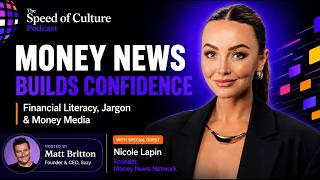
Nicole Lapin went from sending hundreds of VHS tapes to get on TV to launching Money News Network, a podcast platform that explains finance without jargon. She realized mainstream financial media ignored younger women, so she wrote Rich Bitch and built shows in English and Spanish to fill that gap.
Chapters
Up today, we're thrilled to be joined by Nicole Lapin, founder of the Money News Network. You may know her from being a news anchor on CNN, CNBC, and Bloomberg. Today she's the host of her daily show Money Rehab and also co-host of Help Wanted. Nicole, so great to see you. Thanks so much for joining.
Great to see you again. Thanks, Matt.
Thanks for having me. Yeah, this will be interesting cuz you're normally on the other side of the table, so to speak. Week and interviewing other people. So, um, this will be a welcome relief where you actually get to talk about yourself. And we'd love to just start by diving into your background. You know, you came out hot out of the gate, um, in the financial news and just general news category on TV. Like, how do you go from being an aspiring journalist to being on TV? Uh, walk us through that story.
Oh my gosh. I, so I think you and I originally met when I was at CNBC or at Bloomberg. Yes. And I started in broadcast news a million and a half years ago. Honestly, I was 18 when I needed a job and I stalked a station chief in Chicago. I went to Northwestern at the time and wanted to work in local news. Uh, but the station chief said that they didn't have a job for me at this market in Milwaukee that I thought was going to be like the end-all be-all for my career. And they said instead, do you know anything about business news? And I, you may know, I grew up in an immigrant family. So first-generation American, never learned anything about business news. Didn't work at a bank, didn't get my MBA. So I was super clueless. My boyfriend in high school said he wanted to be a hedge fund manager. I thought the dude wanted to be in gardening. Um, so being in business news was like my biggest nightmare. Uh, but of course I said, yes, absolutely. I love business news because I needed a job. And I figured out that money is just a language like anything else. We just don't have a Rosetta Stone for that. That language growing up, whether you learn it in your home or don't. We don't learn it at school. And so once I could speak the language, I never expected to speak it to the world, much less teach other people about it. And once I got to the business news networks during the financial crisis, uh, I realized that there was a whole audience of my former self that I wasn't able to reach. We were reaching the richest, most powerful men, uh, in the country. And, and that's not editorialization. That's what the Nielsen ratings show. But I wanted to talk to my former self, that girl who was super scared about talking about business news, who was smiling and nodding, and her boyfriend dumped her because she couldn't hang out with the Wall Street guys. Uh, and I wanted to make this information accessible. I realized that there's an epidemic in financial literacy, and, um, my mission after launching Money Rehab with iHeart, I wanted to create Money News Network, which is a champion for financial literacy, and we aim to bridge the wealth gap, the wage gap, the homeownership gap, all the gaps through podcast-first content.
So, I mean, that's an amazing story. And for you, like in the rearview mirror, it probably like, oh yeah, I took this step and went to that step, et cetera. But for most people, even the notion of you're graduating college and next thing you know, you're on TV. Like, how does that happen? Because it's not like anyone can just raise their hand and have it happen. Do you remember maybe some of the initial meetings or events that took place that allowed you to kind of open up the opportunities that you would one day get?
So back in the day, 20 years ago, there was no YouTube, there was no skipping steps. I went to local news markets, as you remember. This is how you did it in broadcast news. So I actually started in Sioux Falls, South Dakota, in Lexington, Kentucky. You probably know like the, the media market numbers for those, but they're like 100 or something, 200. I mean, teeny tiny places where the idea was you make your mistakes and then you work your way up and ultimately get to network news. Now, I went to Lexington, Sioux Falls, CBS stations there. Palm Springs was a CBS station. And then I interviewed and I just—
Like cold called them? Like how did— when you say you went to Sioux Falls, did you just pick up the phone and say, I want to be on the news?
I sent out a VHS tape.
Like I just— Now we're getting to what I wanted to know.
So I sent hundreds of VHS tapes. You and I remember those very well. Um, and back then, like, I went to Medill School of Journalism, so focused on the broadcast news track, and everybody was sending out these VHS tapes with like their name written on the side. And I thought, okay, well, everybody's sending these out, I need to stand out. So my big idea for that was to get a red box. So I spent a cent more per submission where I sent my resume and then a little, you know, cover letter of some of the stories that I would do if I got the job there, and this red box. And I was like, I'm gonna stand out in a mountain of tapes if I have like a red box. And that actually worked. I got more calls than, uh, you know, some of my classmates got because of that. And then when I got my first and second job, I upgraded that to like the plastic cover VHS. Do you remember like we had the Disney VHS tapes with the plastic covers and the insert with, you know, what was on the tape? I did that, but for myself. So I created like this, you know, now it looks ridiculous, but I got a graphic designer. I think like a friend of a friend was graphic designer and put my name and, you know, the contents of it. And I don't know, I just came up with like a little thing to help me stand out back in the day.
Well, it's amazing because right now in a world of YouTube and Canva and all these tools, it's so easy to have the tools accessible to you. Where back then, you know, the message in a lot of ways was the medium because you had to figure out how to stand out, whether it be the red box or the way that you designed the COVID Or whatever it may be. The world's just changed. It's so much more accessible now.
So much more accessible. If my former self knew Canva, whew, she would be even more dangerous.
Exactly. So when did you know that sort of the financial sector was your calling? So you talked about you going to news and, and when, when you went on these financial news networks, you quickly realized that there was an underserved demographic, which was younger women. Like when did you get that insight And it was sort of like a light bulb that went off that this is where you're going to double down.
Yeah. So when I was at these business news networks talking to old rich white men about money, again, like that is, as you know, the real audience that watches these networks. Uh, I realized that during the financial crisis, a lot of my, uh, former classmates, a lot of my friends growing up were super scared, super confused. And of course. You know, the audience that we were reaching at the time needed to know a different set of financial information, but financial literacy was something presumably they already knew. And so once I realized that there was this white space in the market— I mean, Suzy Orman at the time, if you remember, so this was over a decade ago, uh, was the only financial expert, you know, that anyone knew. And she's amazing. And, uh, you you know, she had a very specific shtick. She had a very specific audience. She, you know, told people not to buy a latte.
Very hard-hitting, right?
That's right. Like, told people to buy a house, not to rent a house, you know, all of these things that reached a very specific audience. And I looked at it and I said, well, gosh, I now know, and I can speak the language of money, and I, I Never imagined I would be teaching other people about it. But now that I understand this, like, you can buy a latte and still get your financial life together. You can rent and also still move ahead with your financial goals. And so I thought that there was a different set of advice for a different audience that was maybe not appropriate for Suzy, and she had her niche. And I thought, well, if she has her niche, I think there could be other niches. And so I set out to do that and I wrote my first book, as you know, um, Rich Bitch, which is set out to be the Bible of, uh, financial literacy that I wish I had when I was getting my own financial life together. Like, I got into my own debt, I got out of it the hard way, um, and so I never had, uh, a resource even when I was going into CNBC and, uh, and Bloomberg and, and CNN, I had hired tutors. I remember because I looked at Investopedia at the time and I was like, I need a definition for the definition. Like I need a dictionary for this presumed dictionary. And so I thought, gosh, there has to be a better way. There has to be a way that the way you and I are talking right now, other people can learn about money. So there wasn't, and, uh, that's what I set out to create.
Create. Yeah, I think your, your, your initial book, um, Rich Bitch, I, what I loved about the title is it really kind of from a, from afar kind of captured your—
what, you didn't read it front to back? Many times over.
Many times front and back. Ask me anything about it. But it, it basically, you know, what, what you, I think you tried to convey, or at least from, from where I sat, was like empowerment. Um, and yet you're still gonna be able to maintain who you are and you're gonna have a sense of self and it's okay that you're in a world with all these rich older white men to speak, but it doesn't mean you can't be successful and do it your way. And I think just, it's a message and an overall brand that I can see why just a lot of people gravitate towards in terms of your target audience.
Thank you. Yeah. You know what I realized, Matt, at the time, this was after 4 book proposals, 4 false starts, different agents. Uh, I had started a decade earlier. It took me 10 years to get my first book to deal. And what I realized is that in media, as you know, uh, you'll forget that what most people will ever know, um, about it is that you can't be all things to all people or you're nothing to anyone. And especially in media, especially in books, uh, and so I wanted to speak to a very specific audience. And you're right, with the title like Rich Bitch, it was either going to fail miserably or it was going to be super successful. There was no gray area. People were going to have feelings about a title like that. And that was the point. I actually wish there was more controversy at the time. I remember the only pushback I got was from Mika Brzezinski, who was a mentor to me when I was at NBC. And I went back on her show, Morning Joe, and she said, listen, I really love what you're doing to teach women about money. I hate this title. Because I was called a bitch in a derogatory sense. And I said, so was I. But what I'm doing is I'm taking it back and owning it as a badge of honor. Because what people meant when they called me a bitch when I was rising through the media ranks really, really quickly, never had a silver spoon in my mouth, barely had a spoon of food in my mouth growing up. So did it the hard way. No connections, no trust fund, none of that. And they meant that I was strong and powerful. And not only did I want to see at the table, but I wanted a voice. And if that meant I was a bitch, then damn, I'm a bitch. And I own it as a bad mother, along with so many powerful women out there. So I said to her, you know, I think the ends justify the means. If we can get a woman to pick up a money book who never imagined she would care about money or financial literacy, then we all win. And so if I came out with a book called like Five Steps to Financial Freedom, Matt, it would have been dead on arrival. Like, I even looked back at some of my older book proposals. One was called Making Bank, which was like all things to all people, fun finance. That book would've sucked. It totally would've just been dead on arrival. It didn't know who it was talking to. It tried to be like all things to all people. And you know, that's what I realized really quickly in media, that you don't have to be all things to all people, but you need to know who you're talking to and have those people be your biggest fans.
Absolutely. And in terms of the people who you're talking to, you've been doing this for quite a while now. What are the same mistakes, the personal financial mistakes that you see your audience make over and over again over the years? Like, what are the common themes of the advice that you're giving when you're interacting with your audience?
I, I think the biggest thing, as you know, is the jargon. You know, it, it keeps people out of every industry. And, you know, there's jargon for all industries. Marketing has its whole other set of CPMs and God knows what. Like, I don't even know all of the acronyms. Um, But every industry has that, and I think it keeps people out of the conversation because they think this is above their head. But the truth is, like, if you didn't speak Japanese and you went to Japan, you would be really confused until you spoke the language, and then you're like, duh, that, that was so obvious. How did I never know that? Well, you didn't learn the language. And so the same thing goes with money. I think that jargon is what keeps people who have figured out harder things in their lives out of this conversation. You know, we— you and I have figured out harder things than like dealing with fidelity to transfer, you know, a 401k to an IRA or something like that. But somehow when you say stuff like that, it's like, ah, I mean, I know I used to break out into hives, like my armpits would be sweating and I would be like, I have no idea what this means, but The truth is, like, I just didn't understand the language. And as soon as they were, you know, like, oh, you know, 401, it's, it's, uh, it's a retirement plan. It's not an STD or whatever, right? You know, it's obvious. Um, but until you get to that point, I think that's what keeps people out of the conversation. I think it's what has increased the gender wage gap and wealth gap and, and all of those gaps because, you know, I think the language and the jargon is the thing that's most intimidating.
Yeah. And I bet with a lot of wealth management, there's a lot of predatory behavior too, where they take advantage of the fact that maybe younger women don't understand the language and maybe they're being charged higher fees or getting involved in the more complex financial products, which they wouldn't normally, normally need to, right?
Yeah. And there's, you know, there's a language at every step along the way. So even when I was interviewing CEOs, uh, publicly traded CEOs at CNBC, I remember QE2 was happening at the time. And one of them said to me before we went on, like, hey, um, because they— we would have guest hosts and stuff like that, so talking about different issues in the news, not just their particular industry or their sector. And they said, well, I've heard of this QE2, but like, what does it mean? I was like, oh duh, it's a bond buyback program. They're like, oh, okay, I understand conceptually what that means, uh, from the Federal Reserve and whatnot, but like, I didn't know that it was called QE2. That was jargon that didn't come up in my industry. And I was like, that's so interesting. Even the bond guys didn't know what the equity guys were saying. It's a whole other language. Not all finance is, you know, something that every area of the financial world understands. Right. And so even when I was writing my last book, uh, my fourth book, uh, Miss Independent, I snuck in like NFTs and crypto and stuff at the time, right? Because it, it continues to evolve and it continues to change. And so the language that you and I figured out as we were getting our financial lives together and rising the ranks in our careers, and, you know, whatever industry you're in, you're going to learn a different set of acronyms. Like, those continue to change. They should change. You should evolve. It should change. And so once you have a baseline, uh, in the back of all of my books, I rewrote financial dictionaries. Uh, this is why I was single for so long, I guess, because I would rewrite financial dictionaries. Uh, but it continues to evolve and change. So, right, like, NFTs was not something that, uh, was even, you know, in the zeitgeist, uh, or even invented when I was first starting out in this. So I think it's, I think it's really important to have the baseline and then understand that you can learn and grow, rinse and repeat on top of that.
Absolutely, totally makes sense. As someone who spends a lot of time in the financial world. What do you see as the state of the consumer heading into 2024? Because I can't remember a time in history where you had so many differing views of where we're headed. Because on one hand, you have record high, you know, interest rates and credit card debt, record low savings, yet the consumer's holding up pretty well in 2023. Do you have any thoughts or predictions in terms of where the economy's headed next year?
I, I think that, you know, what we've seen in the last year is that women have controlled the spending and the power in the households. And brands are spending so much money, as you know, marketing dollars, uh, to women to, to take that, that market share. Uh, and not enough brands, I think, are focused on helping women invest in themselves. What we've seen is that while we're making more money as women in the workforce, uh, we have most of that in our checking accounts.. And so I think what we're gonna see moving forward is a big push from brands, from marketers to take that money out of our checking accounts and start putting it into work and start investing not only in ourselves, but actually investing. And so I think that's what we're gonna see in my space more so in the upcoming year.
Okay. Totally makes sense. So let's switch gears a little bit as we wrap up here to the business of Nicole. So you obviously now have your own Money News Network. Um, you know, you're still writing books that you spoke about and seems like you're doing a million different things. You're also, um, excellent on, on Snapchat and TikTok and social media engaging your audience. So where's your focus right now, uh, with Money News Network and all your other ventures and, and, and where do you see it all heading into the future?
Listen, Matt, I just wanna say that I was on TikTok pre-pandemic, so there you go.
I saw the trend.
You always were a trendsetter. Yeah, you're the best. Thank you. Uh, you know, I, uh, when Money Rehab hit, uh, the top of the Apple podcast charts during the pandemic, I realized that there was a whole other medium that I wasn't like nailing, and that was the audio space. Uh, and during the pandemic, there were so many questions, uh, you know, and young people would get all of their information on Instagram and TikTok and whatnot. And so I saw a huge growth in our audience, and I saw this need continue to expand. And the podcast, as you know, is very intimate, uh, audience engagement, right? Like, you could be in their ear hole, right? That's very intimate. Like, you're talking to them. And it was a space that, that truly, when I came up in television, I thought about visuals, right? Or like what the box looked like. I didn't think audio first. And so once Money Rehab, um, you know, really hit the charts, um, and, and took off, I wanted to expand that into other genres of finance. I saw again the same white space I saw when I was leaving network news and getting into talking to women about financial literacy in the podcast space. We don't have a CNBC of podcasts. Now we do, uh, it's Money News Network. And I aim to be that, where we could create a slate of shows in different genres within finance. So I had personal finance, I have a show with the editor-in-chief of Entrepreneur Magazine, Jason Pfeiffer, as you know. Yeah, we have an investing show, we have, uh, a show in English and in Spanish because that audience is really underserved. And so what I found within podcasting to create higher growth is to create a flywheel effect where you're essentially promoting and cross-promoting to the same type of audience for other shows that they would want because they're already on the app. It's really hard, as you know, to go from social media or Instagram to podcasts because it's a whole other app. Like, you're not consuming it in a way that yields conversion. And so I saw that we were going away from, like, the celebrity-driven podcasts that, uh, ended up charting, uh, that, that was sort of no longer the formula. I think we even had shows where celebrities would come on and they would do less good as the ones that we would just answer advice for because every celebrity then had their own podcast. And so, uh, really we found that listeners were looking for the information and not, uh, not another celebrity that they heard on 50 other podcasts. And so as the market was changing, I wanted to be on the forefront of that. Of course, and, and create what that network would be as a CNBC of podcasting. And so that's what I did last year.
So I would imagine a big part of your job is basically figuring out what are the next verticals you want to go into, how do you keep the quality of the different podcasts, as well as continuing to build your audience. Like, how does your pie chart of your day split between those things?
Well, right now I'm primarily focused on scaling Money News Network and growing the impact that we have through champion financial financial literacy. Uh, and so what I spend my time thinking about is how to reach this audience who may be a new podcast listener or maybe somebody who's looking to expand the slate of podcasts that they're listening to with really targeted advice. When I was at iHeart with my show at the time, I think my biggest nightmare would have been to read an FTX FTX ad. I didn't have control over that at the time, and you know me, I really do like control. But especially around this, it's so, so important, right? Like, uh, it's more important than if you vet a t-shirt company or, or something else. Like, this is your financial life. And so thankfully I never ran an FTX ad, but I didn't have control or the due diligence that I now have where I'm able to say No, we're only going to promote brands and companies that I care about, that I believe in. We're going to have less ads because I think a lot of the ads that were smushed into my show when I didn't have control became almost audio debris. I think of it as like audio pollution. And as I became more and more immersed in the space, I realized that that doesn't do well for the listener. The host, the brand. If you're just going to have a ton of stuff like shoved into a short episode, nobody wins. And so I wanted to rethink what that looks like and rethink the marketing and the advertising and the integrations that we were doing as a network. And then just take more care and take more due diligence because our audience chooses to come to us, right? Like you have to hit subscribe, you have to actively and with intentionality come to me. For financial advice and to all of our other hosts. And so I take that responsibility so, so crazy seriously. Um, and so being able to call those shots, uh, finally was of ultimate importance to me. And I think it was the best way that I could serve this audience that I, I feel for so long was underserved. And now we've nailed it and we just want to continue, uh, to help them learn and grow. I have.
That's amazing. And, you know, and best of all, you're an entrepreneur and you're calling the shots and, you know, you're in control of your destiny, which is always a great thing.
So to wrap up, some days, most days, some days.
Exactly. Uh, what advice would you give 20-year-old Nicole getting started out, trying to get the confidence, entering the world to where you are later? You maybe, maybe you wish you had known then. Um, you know, obviously you've had a great career. Um, and you're clearly just getting started, but what are some of the things maybe you wish you knew earlier in your career?
So many things. You know, what's crazy is I started CNN when I was 21 years old, and I had this whole complex that, like, people were going to figure out that I was so young. And then one day my badge was not going to work at the turnstile to get into the CNN Center.
You'd be exposed.
I was— I thought, like, they for sure made a mistake. I auditioned when I was 20 to launch Pipeline, which was their digital offering that was ahead of its time. And I really was so embarrassed by how young I was. And to him, Matt, like my nearly 40-year-old self, if I could go back and tell that girl, like, embrace your youth and understand what an attribute it is, what not a deficit. It is, uh, I wish I could just like shake her and tell her how cool that was. And ultimately she did lean into, uh, her youth, uh, and, and took it back instead of being scared of it. I launched this really, uh, funnily named, uh, series at CNN called Young People Who Rock, where I interviewed young people under 30 doing amazing things. So I started to lean into it, but there was this time where I I wore shoulder pads and like teased my hair to try and look older, um, you know, and, and I wish I could have just told her to like enjoy that time.
I love that. And finally, is it— yeah, for sure. Um, is there a mantra that you like to live by finally that, that you wake up every morning, get you going? I'm sure you have so many. I've heard you say many on, uh, on social media, but what comes to mind?
I do, I do love some, some isms. My always go-to one, uh, is that it will be okay in the end. If it's not okay, it's not the end. Right.
I love that. So have faith and, and keep pushing along, would you?
But as you know, like as an entrepreneur, most days are not okay.
So it's true. It's true.
Yep.
You have to keep your head down and keep moving. So Nicole, thanks so much. It's great seeing you again. This has been a great interview and I can't wait for our audience to hear it. On behalf of the Susie and Adwee team, thanks again to Nicole Lapin, founder of Money News Network, bestselling author. Podcast host for joining us today. Be sure to subscribe, rate, and review the Speed of Culture podcast on your favorite podcast platform. Till next time, see you soon, everyone.
More from Matt




MikMak’s Rachel Tipograph on Consumer Spending, Retail Media & Holiday Shopping Trends



Jaguar Land Rover’s Charlotte Blank on Luxury, Purpose & Experiential Storytelling



