Nissan’s Allyson Witherspoon on Consumer Expectations & the Future of Automotive Marketing
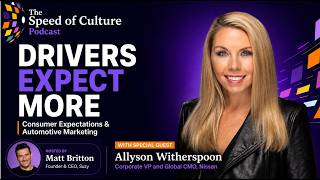
Nissan's global CMO Allyson Witherspoon explains how the automaker is shifting from raw power to connected, software-defined cars with over-the-air updates and a portfolio of nearly 50 global models. Marketing has moved from broadcast to personalized engagement using first-party data, while new business models like subscription features are emerging from software-enabled vehicles.
Chapters
Today we're thrilled to be joined by Allison Witherspoon, the Corporate Vice President and Global CMO for Nissan. Allison's career spans over 20 years working on some of the biggest marketing campaigns for the biggest car manufacturers. It's no wonder she's been named one of the top 100 women in brand marketing for 2 years in a row. Allison, so great to see you and thanks for joining today.
Thank you, I'm excited to be here. CES Vegas 2024.
You know, it's crazy, I've been going to CES probably now for 10 to 15 years, and when I used to go, it was really the Consumer Electronics Show. Yes. The auto always had a role here.
Oh yeah.
But now you see CPG companies, media companies, et cetera. What are your thoughts on CES overall and what made you decide to come all the way from Tokyo to be at the show?
I think, I mean, to me, I think the biggest thing is that technology is really underpinning everything that we do as consumers. So it's like the consumer piece of it is there. And then I think what we're all looking for for brands and even some of the partners is like, How do you actually leverage that technology? What's coming up next so we can be— so we can try to get ready for it?
Yeah.
So to me, I think it's evolved from, you know, more of a trade show into much more of like a strategic technology forum.
Absolutely.
More than anything.
Yeah. And I mean, this is how I feel, and I'm curious from your seat if you agree, that what consumers look for in a car— it used to be when I was growing up, it's 350 V6 horsepower, all this stuff that most consumers didn't even understand what it meant. And now most consumers, the millennials especially, they are concerned with the entertainment system. Oh yeah. And I mean, has that shifted a lot over time?
Yeah, it's completely shifted. And I think it's, you know, one, there's a little bit of regulatory that's kind of changed that. So like kind of massive engines, you're starting, you know, those are becoming much more niche than they have in the past.
Because for environmental concerns.
Right, exactly. Yeah, exactly. And then the biggest shift is actually inside. And it is about those connected experiences. You know, there's the active and the passive safety systems that are in there. But it's like, how can I— you know, like, how can the car— how can my phone engage with the car? How can I have a much more hands-free experience? How can I have a much more convenient and competent drive, especially when you think about the autonomous system? So I think it's much more focused on the inside in the cockpit of the vehicle than just about the engine. The engine will always be important. And we're seeing, you know, much more variety of what electrification is an example of that. You have at Nissan, we have this e-POWER, which is kind of this supercharged, you know, part electric, part internal combustion engine that you don't have to plug in that, you know, consumers are really looking for and interested in in different parts of the world. And so you're seeing a lot more variety, but really about what is that experience in the car.
Yeah. And if you think about the evolution of the automobile, You know, almost any car you buy can get you from New York to California, uh, that can go 60 miles an hour, fairly quick acceleration. Yeah. Like the basic needs of most car drivers have been met by even the most basic cars on the market.
Yes.
Right. And that used to not be the case.
Absolutely. And I think our, our, our head of design is Alfonso Albayza, and I love the way he explains it cuz he talks about mobility and there's this idea of mobility, but really what it is is like the world, we started first with our feet and then we jumped on a horse and then we jumped on, and then we created this car and then the car just kind of evolved and evolved and evolved, and we have planes and all these sorts of things. But, you know, it's still about how can I get from point A to point B in a really, you know, interesting, inspiring, convenient, comfortable way. Yeah. You know, in like, in all of the things that now with autonomous and the connected vehicles that we have, you know, it unlocks all of these experiences in the cars that didn't exist before. And I think that, that to me is what I get. So I totally geek out about that stuff.
I'm sure. And what's interesting about the automotive category is you have to plan. Oh yeah. R&D so far out. Yeah. Yes. Like there, there are, you know, you have digital companies that can change things that happen last week, this week, and react within a week's time. You have a 3 to 5 year R&D cycle.
Yeah. In some cases it's even longer than that. I think in, in a few years ago it was even longer, you know, like it, you know, when I first started in the automotive industry and I had, my whole career has been in 7 years was, was kind of the planning process for a vehicle. And think about how much changes in 7 years. Right. And so, and especially now. And so I think those timelines have really been kind of contracted. And, you know, the sheet metal is obviously important, always will be, because design is what captures people's attention and eyes. But it's what's inside and what are those experiences that you can provide? You know, how do you do that? And because of how quickly things are changing, that's where software-defined vehicles become so important because you have more flexibility, you have over-the-air updates that you can do, you can have, you know, more agile experiences and updates to the car. And that's also, that's super exciting. And, you know, we, you know, like the iPhone is, you know, like it's over 10 years old now. It's almost like more than that, I guess. 2017. I know. I was like, 2017.
16 years old.
It's like it can drive its own car in the US. But, you know, to me, I think it's, you know, that really changed everything when it came to how we engage with technology. And vehicles are an example of that. Yeah. Because there's so much, you know, it's in your pocket. You have accessibility to everything. And people, that becomes the experience theory. And that's what they want in everything.
It becomes your expectation. Yeah, exactly. Yeah, exactly. Especially Especially when you talk about the millennials, the first generation to grow up with the internet in the household. Yep. You know, and then you have Gen Z, the first generation to grow up with a mobile device. Yes. And they expect their car to be a docking station. Yes. Right?
Yes. 100%. And that it's thing, and that's why I think it's little pieces. The, the software-defined vehicles is a piece of it. The engine is a piece of it, but it's these little things. And, you know, I was driving a Nissan Ariya over the, over the holiday break and it was, you know, there's a charging pad right there and it's like, this is why, why would you not, why would you not have this? Right. You know, and it's like, all you have to do is just put my phone down and right there it is. And it's just the charging station for my phone. And it's, you know, why, why didn't we have that longer ago? And, you know, but that, I think that's what's interesting and that those are the things and some of them are very large and some of them are very small like that. But I, I love how we're becoming, you know, much more in tune and, and aligned with what consumers are wanting.
Yeah. So when you talk about software being so important in the vehicle, I've driven a lot of cars, rental cars where like the software's awful. Yeah. Right. Just like you, when you buy a lot of TVs, they try design software, it's terrible. And at the same time you have Apple that has their CarPlay and there's Apple TV where that, you know, they've obviously done a great job at designing software. What is Nissan's take on designing your own software versus partnering with other, you know, many partners like Apple, I guess?
Yeah. I mean, it depends on what the— it depends on what it is that we're talking about. 'Cause it's a variety of things. I think, you know, the entire, vehicle is not just one piece of software. It's hundreds. And to me, we have Apple CarPlay, which is a way for you to have kind of your phone experience in the car. We have Google Assistant, which is in some of our cars as well. And so I think we work with a variety, but I think it's a lot more about— again, it goes back to the consumer expectation. What are the expectations? Do we have that expertise kind of already in-house? And we have so— we have thousands and thousands and thousands of engineers. You know, are we able to do that in-house or do we need to kind of work with a partner? And so it varies by whatever— it varies by whatever the challenges that we're trying to solve. Right.
And I would imagine also varies by the consumer who you're trying to solve it for. Yes, exactly. So, you know, as CMO of Nissan, you have— I don't know how many different types of vehicles you have. 20, 30?
I think around the world. Yeah. I mean, around the world, I think we have over— it's almost 50 different vehicles. You know, I think the lineup looks very different, you know, depending on what market you are in the world. And so, you know, that is very much based on what consumers are interested in, what they desire. Some of it's regulatory. And so, you know, we have to be able to fit a variety of needs for our consumers. We want to be very inclusive and accessible for consumers. And so that's reflected in our lineup. Yeah.
And when you look at a segmentation strategy for the brand, because Nissan serves many different types of consumers, what does that process look like? And are you matching segments to cars or are you matching cars to segments in terms of your go-to-market?
From a go-to-market standpoint, I think we're looking at what are consumers looking for. So, you know, what are the types of needs that they have? You know, do they have a family? You know, are they looking for larger SUV-type cars? Are they looking for something that's a little— that's, you know, a little bit smaller? Are they looking for something that's sporty? And so I think it is based on, you know, it always starts first with the consumer. It starts first with that. And then you kind of define is there a defined segment that already exists? So, you know, kind of, you know, C-SUV segment is an example of that, which is probably the most popular in the US. Or is it something that maybe doesn't exist yet? And actually we've been kind of— we've been groundbreaking as a company with creating our own segments. The XTERRA, if you remember the XTERRA. I had an XTERRA.
My first car I bought.
Yeah, that was something that didn't fit neatly into a segment.
It's like a crossover SUV.
And we created that. And so I think, you know, it just It always starts first with what the consumers are looking for.
Which is how I think the best modern brands are built. I think a lot of brands have a hard time being truly consumer-centric for a variety of reasons. How has that been able to be embedded into the culture of the company at Nissan?
I think, you know, we— when we were founded and we just celebrated our 90th anniversary.
Oh, wow. Happy anniversary.
Yes. When we were founded, we set out to be a very different type of Japanese automotive company. We were the Challenger brand. We had this philosophy. Our founder kind of, you know, has this famous quote for us internally that says, "Dare to do what others don't." And that's the spirit that we hold. And so that's kind of translated in whatever it is that we do. There's so many world's firsts that we had. We were actually— we had the very first electric vehicle, which was in the 1940s.
Wow.
It was the Tama. And then we had the Nissan Leaf, which was the first mass-produced electric vehicle. You know, I think we're, we're not afraid to kind of go against the grain or be pioneers in something. And I think so we're matching that spirit now with everything is really consumer-driven. So how do we match that spirit with what consumers are looking for? And that, that's where we're trying to find our sweet spot. Yeah. And, and where we're trying to address the needs.
Absolutely. And then once you've identified those need spots and you have the go-to-market. Yep. Obviously you need to make sure that you can appropriately message. Yes. And drive consideration for consumers. Yes. So how is marketing a vehicle changed over the last 10 years in terms of how to drive that consideration and ultimately purchase?
I mean, it's completely different.
Okay, it's completely different.
Do tell. I mean, the biggest thing to me is that, again, kind of consumers are very much in the driver's seat and how they want to engage with brands. I think there are so many more choices that you have to insert yourself into their passion points and their needs. And it's, it's much more of a two-way conversation versus this one-way conversation, which, which I think is amazing.
Yeah.
So I think there's that piece of it. You need to meet them where they are with what they're interested in hearing, you know, about from you in a format that, that they want.
Where they are in the buying cycle.
I'm sure when they're least biased. The buying cycle, you know, it depends. It's usually it's around 6 months between when you start to think about it. Yeah. To when you actually purchase. And what you're doing throughout that entire process is very different from stage to stage. And it's not linear at all. You're going to kind of jump in, you'll be very active and then not active. Very active, super passive, and, you know, kind of changes. And so I think what's amazing now, and it's also the complication sometimes, is that there's so many different ways for us to meet and speak with consumers that we need to be ready for it. And we need to be, you know, we need to have much more personalized content. Contextual. Oh yeah. Yeah. Because it just, it performs better. And I mean, if you, and if you think about it as yourself as a consumer, it's like, I want to, when a brand, when a brand tries to engage with me, I want them to demonstrate that they know something about me.
Yeah. Which is harder than ever before with everything that's happening with the privacy changes. Yes. Google deprecating their cookie. All of that. All those things allowed brands to know more about the consumer. Yes. And now they're going to be left guessing.
Yes. And I mean, I think on that piece of it, I think we've known about this for a long time. We have been working, you know, for almost 3 years now and kind of getting ready for this. And what are the different tools that we can have so we still have insights about what consumers are wanting? So now it becomes how can we have personalization at scale in a privacy-safe environment. And so it's, you know, it's really about understanding what are those tools, what are the clean rooms, owning your data. You know, first-party data has never been more important than it is today. And so how do you make sure that that's ready? And that was a big undertaking that we took before the cookie, you know, before we, you know, we knew that this was coming, was really about how do we bring that data in-house? How do we make sure that that can, you know, once we have that, that can enhance and that can inform a lot of other ways that we can reach consumers.
And of course, the other thing that makes your business different is that you don't sell direct, you sell through a dealer network. Yes, correct. So, so how does that impact your ability to collect first-party data? How much of your time also, as a secondary question, is spent thinking about that dealership network?
I mean, and I'm in a global role now, so it's a little bit different. But when I was the US CMO, it was, you know, it was always about how do we make sure that our, our dealers are partners along with us on this? When it comes to the data, it depends how consumers are coming in. And if they're coming in through, you know, NissanUSA.com as an example, that's, that's information that we have at a, at a central level. If they're coming in from, to a dealer website, you know, then that's something that the dealer has and that data sits with them. I think no matter what, if they purchase, obviously that becomes part of our central data set. The biggest thing that we've been working on, and this is a big, big B, it's been a big undertaking, is how do we actually connect those data points and how do we make sure that we have a seamless experience between wherever consumers are engaging with the Nissan brand. So whether that's with us at a, you know, an upper tier one brand level or if it's with a dealer and I think it's servicing their car too. Yes, exactly. And yeah, and I think it's much more, you know, I think we're a big company like, like a lot of other big and even small companies. You can start to get into silos. And I think what the data piece has kind of changed is that instead of looking at, well, I'm the marketing department and the the service department is over here and the captive finance department is over here. Now we start to look at things as a customer lifetime value. What does that consumer need? And how do we each engage and when and how do we, what do we say?
Yeah. And I think the importance of that customer lifecycle is a lot, and you know this better than anybody, a big driver of consideration is ratings and reviews, right? And those ratings and reviews are often coming from people who own the vehicle, who are often experiencing the vehicle, not only being in the car, but with the servicing arm and other touchpoints within the Nissan experience. So I would imagine that makes it even more important than ever before that you're following through. It's not just about selling a car and say, bye. We're just trying to sell the next one.
Yeah, I mean, and I think it's kind of the average time— a lot of people are kind of surprised by this, but the average time that people have that keep their cars, 10 years. Because you have some people that are— they're in leases, so they're going to be turning over every 2 to 3 years. But you have other people who are keeping them much, much longer. It's, you know, it's, it becomes the second car, things like that. And so, you know, 10 years, you, you know, now you can't just talk to people at the purchase and then at the repurchase. You need to have that because there's so many choices now. You need to keep, you need to keep those owners engaged, create amazing experiences, keep them, keep talking to them, keep soliciting feedback. And they're, and then they're likely to stay in the brand. Absolutely. And I, and I think again, it, it's, it's hard sometimes because, The technology is always changing, behaviors are changing, ad formats are always changing, but it's the exciting piece of it too. Yeah. You know, it's fun, especially when you find like, okay, here's a new way to reach consumers. And when it's really impactful, you're like, ah, yes.
Right.
This is another tool in our toolbox.
Until it gets saturated and you have to move on to the next one.
Yeah, yeah, exactly. But that, you know, I think there's, I think now you're, I think we're all used to that now.
Yeah. So what are some of those, tactics that you found effective? Obviously, like television in the 30-second spot has long been very favored amongst auto manufacturers because you can capture that type of scale. But now consumers are streaming and that world has changed. So how are you looking at the channels today?
And yeah, I mean, I think again, it's where are consumers, where are they? You know, we always start first with that and then you adapt your, you know, you adapt your strategy. And then it's also like, where are we seeing, you know, kind of where are we getting the most impact? Where are we converting the most? And so, and obviously, you know, our broadcast TV, that has shifted completely, you know, over the last few years into much more digital streaming and online video. Yeah. So that shift is, you know, I, you know, I think we made kind of that— I think over the last 3 years, you know, it's actually kind of completely reversed where it was before. Yeah. And, you know, it's always consumer-driven. It's not— I think we as marketers, we can't be just like, well, I just want to do TV, so I'm just going to do TV, right? You know, it just— you're not going to be able to reach your audience. Absolutely.
And so you're a global CMO. So when you talk about consumer trends, it's obviously localized to each market. But one thing that wasn't localized, that was truly global was COVID, right? That was a global thing.
So, um, global pandemic.
Yeah, global pandemic. So what has changed about consumers' behavior globally and even specific markets like the US post-pandemic? Obviously you have a big work from home push. Has any of that changed the way that you look at your consumer and how you go to market?
I mean, obviously, I think this shift to streaming, you know, that, that was, you know, you saw profound changes in, in the shift to streaming and it was already moving that direction and COVID kind of became the catalyst for that. So I would say how consumers, you know, consume content. I think there's a transparency piece that we all just kind of— it became more psychological than anything is, you know, you're expecting transparency from brands, you're expecting things became, became much more brand-oriented as opposed to here's, here's what the deal is. Yeah, you know, I think, I think, I think consumers now are much more intentional about the types of brands and the products that they're looking for. And it's less just about, you know, purely about the price point.
Right.
So that's what we've been working on over the last few years. I think, one, there's the channel strategy, obviously, which that, you know, that changes as consumer behavior changes. But then also how do we position ourselves? And so we've taken a much more, you know, brand-focused approach, you know, less reliance on incentives and much more about building our brand. And we have We were, we were very fortunate. We had a huge product transformation kind of right during the COVID timeframe, which was its own complication and a hurdle. But it was a great opportunity for us because we could use all these new insights that we had and, and be able to connect consumers with this great new product that we have. Yeah. And, or that was coming out. So I think it's, it's changed. And to answer it quickly, it's, it's changed everything. Yeah. For the better.
Yeah.
And I also think experiential is becoming much more important because you know, as you're spending more time with screens, you're, you know, your ability to kind of go visit dealerships or what we used to call kicking the tires was an automotive phrase. You know, all the, all of that's now done online. And it's, you know, you're seeing what we are seeing is things like Facebook Live. We were, you know, working with our dealers to get our dealers to do Facebook Lives to kind of connect with consumers. In China, they're doing these really interesting live streaming on TikTok.
And it's kind of—
The dealers are? The dealers are, they were doing it at a brand level. And it's a way for consumers to connect and kind of learn about the cars in these quick segments, or sometimes it's long-form content. And so again, I just think it— I think it's keeping on the pulse of what's happening and what consumers are looking for, and then having the guts to test out some of these things and understanding some are going to work, some are not going to work, and that's OK.
What about subscription, subscribing to a vehicle? That was a big thing a couple of years ago, and it kind of went away. But I always thought that was a fascinating—
I think, yeah, I mean, I think subscription. Yeah, because, you know, for a little while there seemed to be kind of car sharing seemed to be what the growing trend is. I think that is, that has kind of started to, to come out of, out of favor a little bit. Car ownership is much more interesting. It depends on the demographic. I think what we're looking for is kind of more flexibility in how we offer services. As an example, we're looking at, you know, things like usage-based insurance, things like that. Those are all things that, you know, we're kind of talking about conceptually. But I think, how do you bring in flexibility elements while still enabling a car ownership experience? And some of this differs in different parts of the world as well.
Yeah, I've read some companies are toying with, you pay $10 a month to get the seat heating on, and you pay $20 a month to get remote locking. And that's interesting because it does give them that flexibility.
Yeah, and I think it's— the way that we look at it, and all of that is kind of empowered by software-defined vehicles. What we're looking for is how do you enable more and more connectivity as the technology changes? And I think that's where you can— that's where you bring in subscription, whether it's kind of— it used to be audio. Now the availability of things like that are actually more and more in the car now.
Absolutely. So we're here at CES in Las Vegas. And obviously, we kicked off by talking about why it's important. What are some of the trends and kind of future-facing innovations that you have your eye on as it relates to your—
I mean, obviously it sounds so cliché, but generative AI.
AI. In what way?
To me, it's the way that we're looking at it is how do we use it as an accelerator for what we're doing from a marketing standpoint? We're looking at it from a process standpoint, from a workflow standpoint. You know, it's like, how are we starting to look at this in a proprietary way? Because obviously a lot of things that we do are confidential and, you know, not all of it's really for the public. I don't expect you to reveal it on here.
Right, exactly. On the podcast.
No, but I think the biggest thing is how do you like, how do we use this as a tool, as an accelerator kind of throughout the process that we have? So I think that's been, you know, we've had some really interesting conversations around that specific in the automotive space. Connected car is really interesting. And I think AI helps that software-defined vehicles helps, you know, that, that, that will help empower that. Autonomous is really interesting as well. And, and what does that mean for your experience in the car?
Right.
Which ties back to—
How far away are we from autonomous?
I mean, it's It's right now the, the ability to do it is there. Yeah. It's more about the infrastructure around it. So, you know, I think it's, I, it's 20 years, 10 years. Oh, I mean, it's hard to say. It's, it's hard to kind of do these, the, you know, it's hard, it's hard to do the looking glass things because it's, you put these timelines to something and consumer behaviors are not different, right? Or, or it changes or your perception of that is different. In the US actually, consumers are not quite as comfortable with fully autonomous as, as we're seeing in other parts of the world.
I mean, I saw the Cruise in, in San Francisco and I'm like, there's no driver. And it's, it freaks you out a little bit.
I think there's, you know, there will become kind of this, you know, this early adopter, things like that. What we're looking at from a Nissan standpoint is how do you provide— how do you provide the moments where consumers want to lean in and have an attached experience and a connected experience with the vehicle? And at what point do they want to lean back and maybe be a little bit more convenient, maybe a little bit different kind of productivity? So we're looking about, you know, not it being fully autonomous or not, but it's more about how do we give both. Sure. And then it's up to the consumer to decide when and how they want to use that technology.
Yeah. The AI piece is interesting because I see a world in the future where you're just talking to your car. Your car's named Joe. Hey Joe, turn up the heat. I want to go here. You know, I want coffee. Like, why wouldn't we? I think the technology is clearly there today.
It's getting there.
Yeah.
Yeah. It's getting there.
So I would imagine that we're going to see a lot of that in the years ahead.
Yeah. And I think kind of audio-enabled things, it's, you know, I think where it was before from a few years ago where it's like, you know, play this song or call this person.
It never really worked.
Right. Yeah, I think it's going to become a lot more seamless and I think people will become much more— I think they'll become much more comfortable with it.
Yeah.
So, you know, I think sometimes here it's like we're at CES and so everyone's kind of on the, you know, we're the early adopters of things, but that's not the general public sometimes.
Especially when you talk about a consumer that holds on to their car on average 10 years. Yes, exactly. That's probably not the average of people at CES.
Right, exactly.
So we can get a little bit of an echo chamber here.
Yeah. And so, and I think that's where you'd It's always good. And that, that's why I like what our approach is. And it's the same thing with electrification. And it's very much consumer-driven. We're ready. We're going to be ready, but it's going to be, you know, like, how do you want it?
Yeah. You have to meet the consumer where they are. Right.
Yeah, exactly.
So shifting gears as we wrap up here and just talk about your career and your role, obviously, you know, you're in a very high-profile role at Nissan, a global role. You started off your career in the agency world. Yes. How has somebody who ran an agency for, over a decade, I know how valuable that experience can be. But, you know, from your experience, what was most particular in terms of your takeaways from, from your life in agency land that maybe helped you become the CMO you are today?
I think my agency experience, it allowed me to see, to, to get experience and exposure to a variety of things. I was— I started out as a consultant and I became kind of this like this consultant of all trades kind of thing at an automotive manufacturer. And I saw so many different sides of the business that I would probably not have seen if I had started the exposure at the brand side. So it's kind of being able to get that experience. I think the other thing too is that I was able to see, you know, what, what, you know, like what it looked like to be an automotive CMO. And there are some ones that, you know, I worked with that really stuck out to me about how to be good leaders, how to be good creative decision makers, how to work well with the agency, that all really stuck to me. And I, you know, when I think about agency relationships, the ones that work really well are when they're partners. And that means that you celebrate the great things. Sometimes you have to have tough conversations, but you're always fair. And I always, I always appreciated when I was agency side working for a CMO that was, that could be tough but was always fair.
Yeah. And that's all you can ask for.
Yeah. And that's, and I think that's, You know, that's kind of the philosophy in life. And it's, you know, it's always kind of finding that balance and making sure that you can try to deliver on that every day in every interaction. And it's hard sometimes, but that's the goal.
So what does a normal week look like for you?
Oh, I can't even look at my calendar sometimes. I mean, it varies. It's, you know, sometimes I'll be at our technology center, sometimes I'll be at our design center. I usually always have calls with our regions around the world. We have team meetings. Meetings. We have kind of, you know, key decision points. So it all depends. You know, we, we just celebrated our 90th anniversary. So right before the break, we had a big event that was there. And then we had, you know, kind of a big operational review meeting that we have every month. And, you know, it's, it depends. No day is ever the same. No week is ever the same. It keeps me on my toes. I'm sure. But, you know, you're talking about something, you're talking about it sometimes you're in one meeting, you're talking about a product that's going to come out in, in you know, 7 years and the next meeting is about how do we review the performance of the last 2 weeks.
It's like the dirt in the clouds, so to speak.
Yeah. In, in, in like in market XYZ. Right. And so it, you know, it's, it, you have to, you have to wear a lot of hats and kind of shift quickly between those topics.
Absolutely. Well, I really appreciate you taking the time today just to wrap up here. I mean, you've had an awesome career and you're in a really prominent role now. When you look back, um, and, and you could talk to say 20-year-old Alison and give her advice, on things that you wish you knew back then that enabled you to get to where you are today? What comes to mind?
I think the biggest thing, and it's been, you know, like totally honest, it's probably more personal, but like, be a little bit kinder to yourself. I never ever pictured my career taking this turn. And I think what I've learned is that your career will take so many different twists and turns. You have to have a little bit of confidence in yourself. You have to be kind to yourself to kind of just let the rollercoaster roll.
Be patient a little bit.
Yeah, and so sometimes I remember, you know, I was obviously, you know, like a go-getter and a, you know, kind of, you know, I was always very ambitious and it was, you know, and then a few years ago, you know, I kind of, you know, it was like, actually what I wanna do is I wanna stay in this seat and I wanna get really, really good at in this seat. And then I'm gonna be ready to kind of take on the bigger responsibility that we have. And it was that patience. And I never would've had that patience when I was younger.
It's hard for people to have patience to stay age when they're on Instagram, they're seeing everyone else flex and all that stuff. Everybody wants it now.
I think it's also people think it's so glamorous and it's like, you know, it's— it is. There are some parts that are— I am incredibly grateful for a lot of the experiences that I've had, but it's— it also comes with a lot of work and a lot of responsibility and a lot of, you know, a lot of things that will never show up on Instagram. Absolutely.
So lastly, uh, Allison, is there a mantra that you like to live by that comes to mind?
I would— the biggest one is Tom Ford had this quote that he said, "Figure out what you do well and do it so, so forcefully that it becomes unmistakable." I love that.
So just focus on your strengths.
It's market. Yeah, it's marketing. It's figure out who you are, who your brand is. And, you know, it applies to yourself personally, but it also applies to when I think about how to run a brand.
Fantastic. Well, I cannot wait to see how you continue to run the Nissan brand in the future. And thanks so much for taking the time today. Thank you so much. Absolutely. We're live here in Vegas. And on behalf of the Susan Nadewey team, thanks again to Allison Witherspoon. Corporate VP and Global CMO of Nissan, for joining us today. Be sure to subscribe, rate, and review the Speed of Culture podcast on your favorite podcast platform. Till next time, see you soon, everyone. Take care.
Bye.
More from Matt




MikMak’s Rachel Tipograph on Consumer Spending, Retail Media & Holiday Shopping Trends



Jaguar Land Rover’s Charlotte Blank on Luxury, Purpose & Experiential Storytelling



