NWSL’s Julie Haddon on Women’s Sports, Athlete Stories & Brand Growth
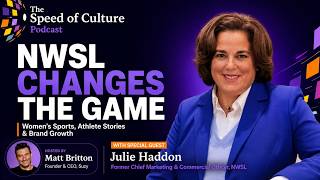
In this Speed of Culture podcast episode, host Matt Britton interviews Julie Haddon, Chief Marketing and Commercial Officer of the National Women’s Soccer League (NWSL). Haddon explains how the league, now 14 clubs expanding to 16, is positioned at the intersection of sport, culture, and disruption. She highlights that NWSL players are also influencers across gaming, fashion, fitness, cooking, and parenting, and how the league leverages their personal brands to attract fans. The conversation covers the league’s multi‑platform content strategy – four broadcast partners, the direct‑to‑consumer NWSL+ service, a docuseries, and culturally‑relevant social content that ties into events like the Met Gala. Haddon details strategic partnerships with platforms such as Overtime, and brands like e.l.f. Beauty, Bobbi, and Call Her Daddy, illustrating how these collaborations bring the “why to watch” and engage younger audiences. She reflects on her career path through tech (eBay, Twitter, Zynga), entertainment (DreamWorks), and sports (NFL), emphasizing data‑driven analytics, storytelling, and fan insight as core competencies. Haddon offers advice to emerging talent: be patient, learn from failures, and focus on how you can improve the brand rather than just expressing love for soccer. Finally, she looks ahead to the 2026 World Cup, emerging sport formats (7‑v‑7, short‑form events), and her passion for mentoring and creative development. The episode provides a roadmap for marketers, brands, and sports professionals seeking to grow women’s sports through influencer‑driven storytelling and innovative partnership models.
Chapters
What we love about this league is that we are comprised of players that are also influencers, whether it's gaming, whether it's fashion, whether it's fitness, whether it's cooking, whether it's parenting. It could be a variety of things. And these players make their home inside our league, but they're also very vibrant in the community and very focused on building their personal brands and telling stories.
To thrive in a rapidly evolving landscape, brands must move at an ever-increasing pace. I'm Matt Britton, founder and CEO of Suzy. Join me and key industry leaders as we dive deep into the shifting consumer trends within their industry, why it matters now, and how you can keep up. Welcome to The Speed of Culture. Up today on The Speed of Culture podcast, we are thrilled to welcome Julie Hadden, the Chief Marketing and Commercial Officer at the National Women's Soccer League. Julie's been instrumental in driving NWSL's explosive growth, leading innovative marketing strategies, building strong brand partnerships, and shaping the future of women's professional sports. Julie, so great to see you today. Thank Thanks so much for joining.
Amazing to be here. Thanks for having me, Matt.
Absolutely. So to those in the audience who don't know a lot about the National Women's Soccer League, why don't you just tell us about the league and where it's headed and why you're so excited about its future?
Yes. Happy to share. So the National Women's Soccer League is the leading premier professional women's league in America that features— right now there's 14 clubs, soon to expand as we are gonna be rolling out in the seasons ahead. So 16 clubs, but there's 16 teams around the nation that all make up the NWSL. What you may or may not know, and your listeners may or may not know this, but the Women's Soccer League in the United States does have the best in the world players that play here and make the NWSL their home. So when you think about the fact that the back-to-back World Cup winners from 2015 to 2019, or you think about the fact that the Olympics in 2024 had the gold medal winners, many of the players along the Olympics and the 4 World Cups play inside this league. So it's a fascinating and exciting, fast-growing sports league with some of the best players.
Yeah. And I think it really seems to be at the crossroads of just two huge major trends, one of which is just the growth in women's sports. So obviously we see the WNBA and women's collegiate basketball and so many sports that are just exploding. And then of course, just the overall growth in soccer itself. It's now the number one team sport among kids aged 6 to 12 in the US and obviously on the, both on the men's and women's side, just incredible growth. So you're really at the crossroads of what seems to be a big cultural movement right now.
So yes, I think the part that's exciting about the league right now is that we're at this intersection of culture and sport and disruption. I mean, there's a lot of new sports that we'll talk about later that are coming on that have different derivative ways of playing what has been a traditional sport. We've seen that in basketball, and we've seen it in other sports. What we love about this league is that we are comprised of players that are also influencers, whether it's gaming, whether it's fashion, whether it's fitness, whether it's cooking, whether it's parenting. It could be a variety of things. And these players make their home inside our league, but they're also very vibrant in the community and very focused on building their personal brands and telling stories.
I mean, that makes a lot of sense. I think obviously one way sports has changed from when I was a kid is that athletes weren't really as accessible. If you look at something like professional football, you barely even got to see most of the players besides maybe Joe Montana. You know, they're behind helmets on these huge fields and stadiums. And now fast forward to today, 'cause we just had actually Tim Ellis, the CMO of the National Football League, on the podcast. He was telling us that basically people are consuming sports differently, and a big part of it is the athlete engagement with the fan. They're sharing their interests, they're sharing their other ventures, and then ESPN is showing what they're wearing while they're walking into the stadium before a game starts. And I think all that What I think that does over time is it brings the athlete more in the center of the cultural zeitgeist and the conversation point. And obviously we know sports is ultimately about people and people's personal trials and tribulations. So I'd imagine your ability to extract those compelling stories from the athletes is gonna be incredibly important at you drawing people in again, then to essentially care more.
Well, what we learned a lot is that people know we've got 4 broadcast partners. Our games are accessible and you can watch any NWSL game, whether it's on ESPN, whether it's on CBS, Yes, whether it's on Scripps Ion or Prime Video, those are the when to watch and the where to watch that we do a lot with our marketing program. But the why to watch and the who to watch. So it's beyond just the competition or the athleticism or the dynamic real-time entertainment that makes soccer such a beautiful game. It's actually the players as influencers. It's the— what Tim called in that podcast, and I worked with the NFL as part of the NFL for many years, and Tim always would talk about this as helmets off. That strategy transcends our league as well. It's just as much about who these players are beyond the pitch, beyond what they're doing. You mentioned walk-up videos, you mentioned their fashion, their swag, what they're doing as, again, offline. And others follow them because they're such a great influence and a great beacon for so many people, especially young girls that wanna be pros one day. Yeah.
I would also imagine a big part of your success is how you package the content up to the younger audience. In ways that they gravitate towards consuming entertainment content.
Very much so. One of the best things, to your point, we always— we have a group of people that we have a social influencer group and led by one of then NFL colleague actually who has based in LA, runs this department for us. Her name is Jordan, Jordan Dolben, now Jordan Jones. And one of the great things that Jordan has done with her team is they find ways to be culturally relevant and pull into moments that are happening offline or off into other parts of culture that may not that actually have anything to do with soccer or our game. For example, last week with the Met Gala, I should say, there were fashion pullouts that came from, like, some of the greatest hits from that night. And then we made some content that showed how did these look like our kits inside the field. So there was a couple that showed, like, the Washington Spirit kit, and they have this one really interesting design, and how does that line up to something that's happening in the Met Gala? Or when we do releases, we make them tentpole moments. So every year Nike makes bespoke kits for us with all of our 14, now 16 clubs, where you do an unveiling of it. With the 14 that we've had last year and the year before, you're able to see the heritage, the culture, the story, the community that makes up what is part of the kit. Or what is germane to Chicago is going to be a lot different than what would be Angel City's kit, for example, has all about these fun places in LA that are cool and part of the community that makes LA such a rich, vibrant city.
Absolutely. And I know that partnerships are obviously incredibly important and some of the partnerships you guys have had, I just think are really great and frankly are like a blueprint for how any brand should go to market. Overtime, I know, is a media platform that you've partnered with, and we actually had Dan Porter, the CEO of Overtime, on this podcast as well. So we're getting a lot of the movers, shakers, and sports obviously on the podcast, but I know that you've partnered with Overtime to deliver exclusive content and behind-the-scenes access to over 100 million followers of Overtime. Why is a platform like like that important to building awareness for the league?
Yeah, I mean, first of all, Dan's an incredible entrepreneur. I had the chance of working with him years ago with Zynga when we acquired his app. And he's just such an interesting mind to have in the sports world right now because he brings innovation and new ways of gamification and engagement. And that's exactly what we love about a partner like Overtime. I mean, their game-changing content is with— this first time they've worked with a professional women's league. The second thing that we love is we give highlights and we're giving variety of content and moments that we're able to pull in from whether it's the regular season, whether it's the championship, the playoff, even the Challenge Cup. We're giving highlights to the audience at Overtime that has over 100 million social media followers and game highlights and behind-the-scenes content. So again, it's getting back to the point earlier. It's like you can understand the where to watch and the when to watch, but this helps infuse the why to watch. I mean, One of the best cuts and the best clips, for example, when you get to see the NWSL content, is in the partnership like Overtime. You're able to go in there and you're able to see how a goal like Marta's epic goal from the end of last season, which I will give you the access to, to share with your viewers because it is so iconic. But she juked past many defenders and she was able to score, which became the winner that took her into the championship. And so by able to see the athleticism and the— competitiveness of what a player who's from Brazil like Marta, who's iconic there and plays inside our league, it opens up the aperture to more people to become fans. You get to see it, you get to understand the game, and you get to understand that the best players do play inside the NWSL that are around the world inside our league.
Absolutely. I mean, Julie, as I hear you talk, I mean, as a father of two daughters, like, I just think what you are doing and what the NWSL is doing and WNBA and, and pushing women's sport is so important because when I was growing up, it wasn't really aspirational for women to be athletes, and it wasn't looked at the same way. And sports is so important, especially for young people, to develop a sense of self, a sense of teamwork, discipline, pride, leadership, all those things. And having a league like yours be aspirational for young women and girls to go in that direction, whether they end up in the league or not, really almost isn't the point because it gives them those lifelong skills. And the athletes that you have on the field really are the idols they look up to. Up to, to go in that direction?
Yeah. You know, it's interesting, Matt, you know, some of the early work I did in my career in sports earlier when I joined the NFL, we did a program which it was called In the Huddle, and it was all about how a lifetime of skills comes from playing competitive sports, whether you're in the boardroom, whether you're an executive, as a leader, as you make your sport into becoming a pro, or you become anything in business or government or community. There's so many things that you learn from being an athlete. In fact, when I hire people, it goes higher on my list of who would be a great candidate because I see that they know how to play team sports. You have to face getting your ass kicked, and you have to be resilient, and you have to face failure, and you have to face adversity. And these are skills that really help you with the grit and the knowledge for your lifetime. And so that's why I feel very strongly about a lifetime of skills because there actually is research from Ernst Young that talks about that. And again, I'm happy to link you to it. Madeline can get it. But the lifetime of skills that you get from being an athlete, there is legitimate research that is in this Ernst Young report from a few years back that shows how you are apt to be much more successful because of being an athlete early on.
For sure. Talking about women's success, another very successful entrepreneur that EuroLeague has partnered with is Alex Cooper, who obviously is behind the Color Daddy podcast and has become a cultural phenomenon in her own right. Obviously interviewing presidential candidate Kamala Harris before the last presidential election, showing her influence. How important is new mediums like podcasts and partnering with Alex and her properties in terms of diversifying your reach to reach the new fan and your future fans?
Yeah, I mean, what's exciting about the different forms of media that we're getting involved with, whether it's podcast or whether it's a docuseries. We had our first-ever NWSL docuseries that was part of— it's called For the Win, which was part of Crime Video that we worked with Connor Schell and Words and Pictures on. Or it's the full-fledged content of our games. It's the highlights. It's the social content. It's everything in streaming that we have our own direct-to-consumer property called NWSL+. All of these things are finding new ways to new fan base, new avid fans that are coming in. So I think that Alex is a great example of she's reaching people outside of the core. I mean, her partnership or her reach is millions. 20 million people a month listen to Call Her Daddy. And some of our players listen to it. And Trinity Rodman was on it. And you're finding people that may not have heard of NWSL but really like Alex. And so these are the type of partnerships that we're looking at is things that either strengthen our core fan or bring in new fans because as we grow, that's obviously what our strategy here is, growth and bringing in new people to experience our games.
So speaking of growth, I know a big initiative that you're behind is getting the league in front of brands who wanna reach your growing audience. Talk to me about your sponsorship platform, the benefits that it offers to brands, and what are some of the ways that you think brands can take advantage of your continued fan engagement?
Yeah, I mean, what's great about us is that we're small and we're nimble, so we can develop really interesting programs for brands. So one of my most favorite brands that we have just developed a partnership with recently in 2025 was e.l.f., for example, e.l.f. Beauty. And so the program with e.l.f. is going to be a mission. They're changemakers. We're changemakers. We have a joint vision, if you will, to bring in a diverse and equitable playing field for our fans and for their customers. And so we created a program actually called Glow for Glory, which we'll be launching later this year. It's an open tryout in key NWSL NWSL markets to find the next young talent. So I internally was calling it our American Idol, but it is a version of how do you get to be a pro, and it's gonna engage parents and engage kids and engage fans of ELF that may not have known about NWSL or people that know about NWSL but never thought that they can find a way onto the pitch and become a pro or get the exposure they need. So I think these are just a great example of things that we can work together. We're working with Futbolco on that program. Billie Jean King Enterprises is involved in that, but we're able to build really bespoke solutions options to potential partners. Another one that I love in bolstering our commitment to mothers both on and off the field is Bobbi. So we have dedicated on-site feeding and lactation areas for mothers at the championship game in 2024 in Kansas City. We're getting on-site activations that 2025 and '26 seasons where we're presenting an annual Parents' Day award to each season, one parent for each NWSL club. So I mean, our partnership with Bobbi speaks volumes because these are not really traditional type of sports. They're not necessarily a beer brand or a car brand or something. And by the way, I would love beer brands and car brands, but we are also looking at other ways to find new solutions for marketers that wanna try to do something that's a little more disruptive. 'Cause we have a very much a challenger brand DNA and ethos.
You have a challenger brand, but at the same time, I mean, I think there are very few paths to engage with consumers, especially younger consumers, because they are spread out in so many different places. They're on TikTok, they're at live events, they're streaming and doing all these things. And advertising on linear television doesn't traditionally work unless that you have live sports. I mean, live sports is the last bastion of live entertainment and you have kind of everything going for you in terms of being culturally relevant as well as having this live sports aspect to really drive that engagement, that watercooler discussion, etc., and put somebody's brand right at the center of it.
Of it. Yeah. It's funny you say that. MaryAnn Turk, who was our COO at the NFL, always used to say, sports is the last reality TV, or it's the ultimate reality TV. And I really like that. I say that and think about that a lot because it is not something that you ever want to be setting your DVR for if you can avoid it. Because I feel that the collaboration to be able to have the banter when I'm watching the Final Four and I'm seeing the last minutes of a game and I'm talking to my college friends, who's We're rooting for one school versus the other, or the ways that we watch our games, even at the league. So there's people in the stadiums that are there that are texting with me that are saying, "Oh, did you see this? Did you see this? How does it look on TV?" Like, this is not something you find in traditional linear or even some of the things you'll see with more traditional programming. So I do agree. I think the excitement, the electricity, the connectivity is so pivotal to what you see right now.
Absolutely. So let's shift gears a little bit as we wrap up here, just to you and your journey. So as you mentioned earlier, you spent some time at Zynga. Obviously you spent a good deal of time at the NFL, most recently heading their global brand and consumer marketing there. So big jobs, big roles, high-profile roles. As you look back on your career, what are some of the areas you think you focused on, whether it's personal or professional development, that put you in the seat you are today as CMO and COO of the National Women's Soccer League?
Yeah, that's a really good question. And the honest to God truth that I've been asked this before, like, hey, you had a great north star, you had a path. And I feel like that's not actually true. I would find things that I knew I really liked and wanted to do more of that. And at the same time, the things that I wasn't gravitating to as much, I found a way to do less of it. So often when I'm talking to students or I go to do the college visits or even sometimes times panels, I think to get closer to your North Star and what it is you want, you actually have to learn what you don't want. So in my case, it was along the way learning what I liked more, what stacked rank higher, and what I liked least. And what the common themes I could say from having been in kind of 3 distinct, if you will, but kind of connected circles would be spending time in tech, whether it was with eBay or Twitter or Zynga or SoFi even, what you learn in tech is relentless analytics data. How do you measure? How can you get down to understanding how your programs are performing and understanding the analytics that are unlocked in all of your work? What I learned from entertainment at companies like DreamWorks Animation, I learned a lot about how to be the ultimate deliverer of great creative. I mean, it's a creative industry to work on projects like Shrek or feature films like Academy Award campaign for something like an animated CGI film when it was the only film right after Toy Story that was CGI animated in feature. It was all about the creative. It was about the story. And I know that sounds cliché because marketers always love to talk about the story, but there's nothing better than the Hollywood world about it because you not only have to do stories, but it's stories around what is essentially the product is a story. And then I think the third part of understanding from sports sports is the ability to really know and connect with fans because the stories go nowhere if you don't understand your fan base. The stories go nowhere if you don't understand the data and the analytics of how everything you're doing is performing. So I think this intersection of tech, entertainment, and sports brings together this uncanny talent base of things that just make the home inside the NWSL such a joy to be a part of right now.
Now. Absolutely. And when you think about the younger professional that's entering, that wants to have a thriving career in the world of sports entertainment, what are some of the skill sets here in 2025 that you think people need to start developing at earlier stages so they can set themselves up for a lucrative career moving forward?
That is a really good question. I think being patient with yourself to know that it's not gonna be the first or second time out that you're gonna go get a home run. You're gonna have some failures.
You're gonna go out there and you're gonna whiff and you're gonna say, wow, that was a really bad job.
Here's an example. I took a stint one year that I thought early in my career that I wanted to be doing something for the world, and I worked in an environmental science company. I realized that I love building things that have a raw emotion and passion attached to it. So that was not necessarily a great fit for me because it's not an entertainment type of a property. It was much more of a very serious and, get to some the North Star, what they wanted. It just wasn't the right thing for me. But I did take that, and I know that I whiffed in it and at that experience. And so I think if people come in and they don't say, I have to fit in a box and it's got to be perfect, you go in and you say, I'm going to learn from it, and I'm going to learn the good, and I'm going to learn the bad, but I'm OK with taking from it— that may not be only the successes. It'll be some of the things that didn't work. You're better for it the next time around. So I think that's one. I think the other thing that I find when I talk to people and I interview— and I've never really thought about this in a more mass way to say it, so I'm really glad, Matt, that you're asking— is often when I interview a candidate and they say they want to work at the NWSL, and I say, why? And they say, oh, because I love soccer. I think one of the things I would tell young talent is, that's great. We assume you like soccer if you're coming in to talk to me about a soccer job. But tell us what you're going to do to make our brand better. Tell us what you're going to do to make our content better. Tell us what you're going to do with your unique skill set that's going to make our analytics or our sales pipeline or our creative give better? And I think that's one of the things that often falls short is like we sell ourselves so hard and say, this is why I love it so much in a job like this. But you don't realize we're so busy as professionals, everybody is, you always wanna know, well, what's in it to help the league get better or my brand get better? And so that's the one piece I would also share as advice.
Absolutely. And so looking forward for your career and obviously the league itself, what are some of the things you're most excited about in the years ahead in terms of personal and professional growth and what you're working on?
Well, I think I'll start with professional. So I think with the World Cup coming in 2026, it's gonna be so exciting to see soccer take over America or another kind of football here in the States, just as we've seen actually the NFL go into the international markets. And that's also been really fascinating to see the NFL in Germany or the NFL in the UK. I think it's gonna be It's gonna be thrilling to see the US hosting the World Cup. So I'm excited about that. I'm also really excited about some of these upstart new kind of interesting innovative sports that are happening, these rapidly growing things. Like I said earlier, I love watching what 7v7 is becoming in soccer, or Travis Scott recently did something with Nike at Coachella where they had this kind of one-on-one type of a soccer match. And so interesting, like I said, derivatives of what is traditional in today's AD AD generation with young people and with our share— all of us have short attention spans given so much attention is pulled into different directions with just life. I love these kind of short-form moments of new sports. I was watching Unrivaled, the basketball team. That is so exciting to see how that is a new way to do that. I'm becoming a fan of things that I might never have thought about before. Rugby is really interesting because, again, I think we're just looking for new ways to entertain and engage fans and athletes with the distribution. Distribution channels being able to bring it to viewers that is now so ubiquitous. And then I think the second part of your question about personally what I think and get excited about, I really love leading teams and mentoring and developing people. I know that sounds probably, again, corny to some extent, but, you know, I forget that I just think that I'm me, but I forget that I've been through the world of when tech became big or when mobile became big or when CGI animation was no longer a experimental form of filmmaking, and now it's the norm. So I love the idea of mentoring and developing young talent and also really developing creative at scale and seeing how different ways of creativity can permeate culture.
Absolutely. No, I mean, it's a fascinating time to be in the world of sports and obviously doing what you're doing. It's such a cultural fit at the moment. I think it's only gonna grow in the years ahead. So finally here, Julie, we always ask our guests to wrap up with a saying or mantra that helps define their professional journey? And just wondering what might come to mind for you.
I think I've said this before in— I did a talk in Germany about a month ago, and I had a slide with this on it, but it is attributed to Paula Balzer, who I met when I was in my 20s. And she was at Clear Channel, which then became Live Nation. And she said this, and it sticks with me, which is, "Don't tell me about the flood, build an ark." So I often do that. That, as many folks on my team will hear me say, it's really easy to say all the things that are wrong. But we know that. Like, we're having a conversation, but what are we doing to solve the problem? What are we doing to fill that arc and bridge it? So we'll be having a conversation. And that's one way I would say I summarize my career is because I'm a persistent and perpetual optimist, I will sit in a meeting and we'll be talking about something that broke down. We've analyzed it. We communicate what was wrong with it. But now let's move to how we're going to solve it and how we're not going to do this again or how can we learn from it. So I think that is probably my favorite saying is, "Don't tell me about the flood, build an ark." And I wonder if Paula Balzer even knows that she had such influence on me with that saying, but it's actually, I think, on my Instagram and on some of my social favorite quotes. But I do live by that.
I love that. Well, we're gonna leave you with that. This has been such a great discussion. I'm so thankful you took the time amid your busy schedule in a really high-demand role to share your story and what you're working on with us today. So thank you so much. And continue to be a huge fan and wishing you a great rest of 2025.
Thanks, Matt. I'm a big fan of your work too. I really appreciate you having me, and thank you.
You're welcome. On behalf of Susie and Ayoub Akim, thanks again to Julie Hadden, the Chief Marketing and Commercial Officer at the National Women's Soccer League, for joining us today. Be sure to subscribe, rate, and review the Speed of Culture podcast on your favorite podcast platform. Till next time, see you soon, everyone. Take care.
Hey!
More from Matt




MikMak’s Rachel Tipograph on Consumer Spending, Retail Media & Holiday Shopping Trends



Jaguar Land Rover’s Charlotte Blank on Luxury, Purpose & Experiential Storytelling



