Office Depot’s Kevin Moffitt on AI, Consumer Trends & the Future of Retail
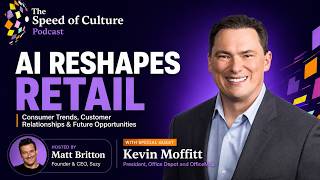
Kevin Moffitt, president of Office Depot and OfficeMax, explains how the retailer uses AI and first-party data for personalized shopping, built an in-house podcast studio to listen to customers, and targets three core segments: small-business owners, educators, and home-office workers. Office Depot guarantees 20-minute in-store pickup and 50% office occupancy has held steady post-pandemic.
Chapters
Up today, we're going to speak with Kevin Moffett, president of Office Depot and OfficeMax. Kevin has over 20 years of experience in omnichannel and e-commerce business management. Kevin, so great to see you today.
Well, thanks for having me. Appreciate it.
Absolutely. So I noticed, and we spoke about this prior to, uh, us recording today, that you have a fancy podcast recording studio there at the offices. Of Office Depot and OfficeMax. And just curious to know, what was the impetus behind that?
Yeah, I mean, calling it a fancy recording studio is definitely an over-exaggeration, but we know that our customers, and especially potential customers, not current customers, but folks out there who could leverage us and ways we could help them, they may not even know all of those capabilities. You know, I think it's really important that we meet those customers where they are today, and clearly customers' consumption patterns of content have changed dramatically over the last few years. For sure. Podcasting is a big deal now, you know, people, they may be driving to the office less, but they're still driving, and, you know, having on-demand access to content that provides value to them, not just as entertaining, but actually helps them achieve their goals, I think is really important. So we started a podcast series that we call Imagine Success a couple months ago, and I've had the opportunity to interview small business owners and experts in the areas of entrepreneurship and marketing. It's just been an amazing experience to directly connect and shine a spotlight on these stories that, you know, I think they're really exciting. They're very inspirational to hear about. You know, what are these moments where an individual decides, I'm going to take my dream and I'm going to go for it, right? I'm going to try to bring that dream to life. And, you know, the fact that we can play a small role in that story, I think is very exciting.
For sure. I mean, I think it's cool you're doing it yourself, Kevin, because I can tell, you know, I'm CEO of a software company and I'm obviously always focused on the business. But then this podcast has really allowed me to create relationships, dig deeper into our customers and potential customers in terms of what they're thinking and feeling, and really kind of puts my finger on the pulse of our business. And I imagine it does the same for you.
Well, that's— you just defined the magic of it because let's be honest, I don't have the same opportunities to interact directly with our customers than our store associates do, right? They meet with our customers every single day. You know, I am in a lot of meetings, and so I do get into the stores as often as I possibly can. I do talk to our customers in our aisles and at our point of sale, but there's nothing that can replace the opportunity to really dive deep and to take 30 minutes or 40 minutes really getting an understanding of the needs of that customer, the challenges they face. And so it has been incredibly helpful in that way. It's an in-depth focus group study of one, um, that we do every single episode, which is incredibly valuable for sure.
And who is your customer and how has that customer changed over time?
Yeah, so, you know, we define our customers, uh, into 3 core segments. The, the first, and, and let's— the core, the foundation of the business are our small business customers. You know, there's over 30 million businesses in the United States, and, and the very large majority of those businesses are less than, uh, 10 employees. Those businesses are our bread and butter, right? The person for person or account for account, they'll spend twice as much as our non-business customers and make up a good chunk of our file. But outside of that, we have what we call our education customer groups, which includes teachers and school administrators and PTA presidents, right? And also parents and students who are purchasing directly for their households. Major part of our business. Obviously, it peaks out around the back-to-school time period towards the end of the summer as schools come back online, but we have, you know, a steady flow of business throughout the year, and it's an area that we're really excited to continue to grow. We have really strong penetration in total teachers across the country, and they see us as a resource to help them do their jobs, which I think we could all agree is one of the most important jobs in the country. Yeah. And then the third group are our personal shoppers, and we call them home office. And, you know, as we think about it, it's tremendous opportunity. Talk about change over the last few years, right? Just how many— in fact, it looks like you are working in a home office right now, right? And we have, we have a lot of— we're learning more about people's personalities just by seeing the backgrounds that they have in their home office.
It used to be during COVID everybody had the weird, like, Zoom backgrounds, and then I think Zoom backgrounds have kind of gone away.
Yeah, to some degree.
They were really cool in March of 2020, and now people are kind of over it.
And let's be honest, the tech never really worked all that well, so it would chop off your ear or chop off half your nose and just never looked quite right, right? So, you're starting to get a little bit more of a sense of who people are, and I think that that's really interesting, you know, how your workspace and your home life— people always talk about the balance of work and, you know, your personal life. And clearly, those two things have blended together more seamlessly than they have ever before, right? And you're just talking about shifts in even our sense of privacy and transparency have occurred over the last few years. And I just find that incredibly fascinating. So obviously empowering home office workers through the convenience of office products and technology And certainly, we, you know, we have one of the broadest assortments of home office furniture and desks and seating and accessories. So just creating a workspace that will allow you to be productive and efficient at home as well as in the office. So all 3 groups, they're major opportunities for us right now. And it's just exciting to just see how work has evolved over the last 3 years and how we can challenge ourselves to evolve with those trends.
And what are you guys seeing in terms of the return to office? Are you seeing it kind of level off and kind of like a new normal, so to speak? Do you think that we are going to continue to shift back to where things were pre-pandemic just based upon— I'm sure you're seeing lots of data across those customer segments, especially the, the last one, the, the, you know, the work from home person that would give you kind of unique insight into that.
Yeah, absolutely. I mean, in education, obviously most children have gone back to the classroom, but in higher education we've seen a very large expansion into hybrid and remote classroom environments. Exactly. And seeing that sustained past the pandemic, right? Where many more people are opting for remote learning at the college and even graduate level. And that seems to be a trend that will continue into the future. When you talk about corporate offices, the external data that we see is that, you know, there was an increase back to about 50% pre-pandemic normal occupancy. But then it's leveled off fairly stable now at about that 50% range. And so just think about how dramatic of a difference that is if that continues to be the case over the next several years. It represents a new permanence, right? That there is going to be a much larger group of professionals who have needs that are very different from when you could just go in the supply closet or call your IT tech person to come help you with your laptop. I mean, we are now all our own supplies experts. We're our own technology experts. We have to deal with Wi-Fi problems, right? And so, you know, our 24/7 tech support program is just something that is an invaluable tool for many of our customers who now have to be their own tech support, which is not something that many people anticipate, not only for yourself but for your children, maybe even for your own parents. Um, you know, really it's, it's a different environment than it was several years ago.
So how does that change the way that, you know, you talked about the podcast, I'm sure there's other things you're doing as well, in terms of the way you're looking at building your brands? Because obviously the word office in people's minds connotates a different meaning now than it used to, right? And that's in, that's within the name of your brand. So how's that exactly the way you, your future kind of brand pillars?
You know, I just, I just think of us as we are proponents of success. You know, we are, call it if you would like, the success store. I think that's limiting. So I don't use that as our definition, but our brand platform of Imagine Success is obviously very deliberate, both words, both success and imagine, right? We want to support the process of you envisioning what success looks like for you as an individual, which could look very, very different. And I do think that there's been a diversification of definitions of success over the last few years too. It doesn't just mean climbing the corporate ladder, right, and achieving a promotion next year or even, even making more money every year. It really is more about self-satisfaction and wellness and, and, you know, connections, social connections, whether it's with family or friends and experiences. And so really trying to bring all that together so that we can be a proponent of success in all of its multiple forms. But certainly, you know, efficiency and organization and productivity and, you know, just alignment, being able to even chart down what does that look like for me? What are my goals, as diverse as they might be from the person sitting next to me, and how can I help bring those to life? So We're looking at different media patterns. We're certainly challenging ourselves to rethink how we connect with new customers and the messaging that we're putting out in market. One of the most important challenges for us is that we already today do so many things that people may not recognize externally, right? One great example, we have the fastest in-store pickup program in the world, 20 minutes guaranteed. If you don't get an email from me 20 minutes after you place the order that it's ready to pick up, we automatically send you a $20 coupon. And we don't send out a lot of those coupons because our operations are incredibly focused on the omnichannel customer and making sure that convenience factor of if you need it, you need it now, and we can get it to you faster than anybody else can. That really matters when you're in a remote hybrid work environment. If you run out of ink, you need ink now, right? You don't need ink in 3 days. Yeah, and you don't have time to wait around. Right?
Exactly. Get what you need and get back to work.
That's right. So just being able to tell the world— not everyone knows that. I mean, if you come to our website, you'll see it, but how do we get that message out to people who aren't our current customers, um, that we have these convenient capabilities? Another great example: every one of our stores is an extensive, fully featured copy and print center. And so again, if you're a remote worker and you're used to being able to print anything you wanted at your office, you don't have that capability anymore. How can we support you in transitioning those needs so that wherever you are, if you're at home, you're at an airport, you know, you're traveling, you're at a co-working location, that we can help provide those services that you might have typically gotten from a corporate building. And then just the range of products and services that we offer as well. I mean, we have a tremendous assortment of products and services to support multiple forms of professional and educational challenges. So how do we get the word out there that we provide things that, just like I said, the broadest assortment of office chairs that you can come and try yourself? And believe me, it is kind of important if you're going to be sitting in a chair for 10 hours at home that it is comfortable and also is not destroying your spine while you're sitting there, right? So being able to come in and actually try those products. We've all had bad online experiences at this point, right? And then trying to figure out how to return those products is often not the easiest process either. And so really focusing in on the assortment and the capabilities that we have and trying to get that message out there wherever our customers are, whether that's using streaming services, whether that's using YouTube, you know, whether it's listening to podcasts or, you know, however they're consuming media today, which is very different. I mean, short-form video, uh, really wasn't even a thing all that long ago, right? And now people are spending massive portions of their lives scrolling through short-form video.
Your future customer, exactly, Gen Z, who grew up with the phone as an appendage to their body, doesn't have, you know, a TV in front of them all the time. They're staring at their phone that impacts the way you're going to be building your brand in the next 5 to 10 years?
Well, the good news there is that I have a direct connection to that generation coming up because I have 4 children and they, believe me, they definitely are my focus groups many, many times. I leverage their knowledge and they're a pretty diverse range from 11 to 21. So, they are truly our future customers. And so, staying connected with them and just observing what they're doing., is incredibly helpful as well.
Yeah. I mean, I, I was saying on a different interview I did recently that my daughter went to college freshman year and the thing I noticed is that no one else in their dorm had a TV. And, you know, looking at your background, we were both in Boston in college in the late '90s and I remember every dorm room had a TV back then. And it's just, of course, the, the world changed so much. One thing I found is just you have this sort of like chasm of people that are in the C-suite of, of especially in the marketing side at these big organizations that are Gen Xers that did not grow up with the internet in the household and they build their brand accordingly. Even though the world is changing beneath their feet. And then you have these new companies that start up with people who natively just understand that they're talking to a new type of consumer. And I think it creates a huge disruption opportunity.
And it absolutely does. Yeah. But, but trying to find the balance is really important as well. As you can imagine, we have a very large core of customers who are Gen X. Gen X and baby boomers, you know, and even a significant portion of our customer file who are retirees. And, you know, people probably have a vision of what that is, but our retirees often look almost identical to a small business owner because of the activities that they're pursuing, the different organizations they might be volunteering for, maybe managing just their own household, their own expenses. Yeah, you know, they operate like a small business. And so, you know, it's very interesting. You can't go all the way over on the spectrum and be 100% TikTok all the time and then lose your connection to your core bread and butter customers. So for us, it's a constant challenge to thread the needle and make sure that we are doing things to bring in new customers, but at the same time keeping those connections very strong. With customers who've been shopping with us for decades, which is a relatively unique challenge, right? I mean, frankly, I think everyone has to think about that. But for us, having such an established base within the business community, which historically have trended a lot older, and now we're seeing though that the, the younger generation are becoming entrepreneurs. It, it may not mean that it's their full-time job, Right? They may have a business that they run as a side hustle or maybe even multiple businesses that they're running as a side hustle. Heck, even being an influencer, right? And having a revenue stream coming in from being an influencer. That may be a part-time job that supplements their income. But it's a very interesting and certainly changing professional backdrop that we're working in right now. But to me, that makes it exciting. Um, because we know what we need to do tomorrow certainly will look very different than what we did 10 years ago.
Absolutely. So let's shift gears a little bit to you because I was looking at your, your background and I see that, you know, you spent 7 years in really the in— infant stages of the internet from 1997, 2004. You know, I see that you're a web designer and developer in '97, '98. There were not that many people doing web design and web development at that point. That's correct. It was really the true early adopters. So just like, I know it's a little bit off a tangent, but I'm always fascinated by like, tell us what, what are some of the memories you have in working as a, as a web designer and web developer when the web was just getting started?
Yeah, so, uh, you know, I built my first website, um, while I was in grad school at Northeastern in, in downtown Boston. And, um, the, it was really interesting. The school was, um, it, it was their 100th anniversary. And so they had all this incredible archival materials that probably no one had seen, maybe ever, certainly maybe in decades for sure. And so I had this idea, I wanted to create an exhibit, a museum exhibit, but there wasn't any funding to create the physical space and all that. And so I had this thought of, well, could we create a virtual museum? Could we use this new technology, this new internet technology, to highlight these artifacts and to allow people to, to, you know, view them. And the more I thought about it, I said, well, could we create almost like a sense of space, like use Photoshop to create what a room would look like and let someone click on the item and then it would pull up some information? I truly believe this is one of the first virtual museums ever created in the world. It was in 1995. Amazon had just launched the year before, and so that was really the beginning of just doing something new. I was studying history and museum exhibit design and documentary filmmaking at the time, and this new technology, it just kind of— it was so fascinating from the beginning because of the two-way opportunity, right? That this wasn't just telling your story and having someone absorb it. This was an interactive medium. That you could get information out, but then people could respond to it and interact with it in new and different ways. And so that was the beginning. And really, if you took that basic idea, that's essentially what my entire career up until the last several years has been around, is optimizing the capabilities that are represented in that interactive medium to allow people to, you know, find information that they need, purchase products that they need, interact with people provide feedback, all of those things across multiple industries, whether I was working in financial services or in nonprofit, and now for quite a long time in the retail industry as well. But it's all centered around that idea that, you know, how do we use this tool to empower interactions? And I think it's just been amazing. Frankly, I tell people all the time, if you think you know what you're going to be doing, uh, 30 years ago from now, if you're in college, you're an undergrad Literally, when I was an undergrad, my job did not exist. The job that I was going to build my entire career around, my job did not exist when I was a freshman in college. So, it just shows how quickly things move. And I do think that that will be true for this generation as well. When you think about artificial intelligence and biotech, there's just going to be so many opportunities for people to do things that literally don't exist right now.
Well, and not only that, Kevin, but the rate of change with some of these technologies is faster than ever before. I mean, AI, literally every 30 days. I do a lot of public speaking on AI, and I always have to make my deck like 48 hours before I go on stage because otherwise it'll be dated. Uh, because what they do, and, you know, so, and I, you talk about young people and not knowing what their future's gonna hold. This, this technology is gonna create entirely new industries, entirely new opportunities that people have not even dreamt of, um, the same way the internet itself did. I would argue even more powerfully. So curious to hear what your thoughts are on AI, just given you obviously have a keen interest in, in the technology space. Uh, where do you see this all going? And if— are there any particular areas of AI that you have your eye on?
Yeah, so, uh, there are, you know, some really obvious use cases in, um, in retail. One is around customer service, you know, and just being able to provide really great experiences to customers and automate a lot of those interactions, frankly, the non-value-added interactions of where's my stuff, you know, all of that can now essentially be offloaded to artificial intelligence. And then you can leverage your human-to-human interactions for much higher level, much more value-added transactions. But another really important piece is people have been talking about personalization for decades now, right? I've done presentations, I could pull up PowerPoint decks on, on internet personalization that would be 20 years old at this point. But I don't think we've truly harnessed the power of one-to-one communications that we will over the next several years when artificial intelligence really comes into play. And we can take all of the data that's housed in our own first-person customer databases, which is incredible if you look at different retailers and organizations, how much historical information we have that we could leverage to truly create experiences that are designed for that individual. And what I'm really excited about is how we can use that information to empower our in-store associates as well. One of the things that makes us relatively unique is that when you come into our store, you can actually talk to somebody. It's really a nice thing, but it's something that is very rare. We're one of the few retailers left, large retailers, that you can actually go into our store and have a conversation with our associate, and they're happy to be part of that. It happens every time. If you walk into our store, you'll hear people talking. You go into a mass merchant, you're not going to be approached by someone. You're not going to have an interaction. You're not going to be talking about your business or your classroom, right? You're just not. You're not going to be talking about problems and challenges that you're trying to overcome. But that happens on a daily basis in our stores. So how can we use the power of artificial intelligence to— and bring that to bear for our associate in the store when they're in aisle, when they're interacting with the customer face-to-face? All of our associates already are empowered with mobile devices that are connected to the internet and to all of our core systems. And so leveraging that as a connection point so that we can tap into the power of historical information for the customer that we're talking to, bring to bear product recommendations, or even answer questions as simple as, "I'm not sure which ink I need to buy for my printer." Well, we can help you find that out pretty easily, right? And so those kind of things, and not only that, but just taking it to the next level. What chair really makes the most sense for you? What features or capabilities are you looking for? And how can we connect all of those dots for the associate, for the customer, both online, but also when they're in our in-store environment?
Yeah, for sure. It's interesting, like, you know, we're having this conversation in early November and OpenAI just announced that you can create your own GPTs now, like your own chatbots. And you can put in your own data sources. And one idea I had is like, what if I upload it? Speaking of business, like every, um, you know, tax return I've ever had, every past financial record, everything I've ever done, putting privacy concerns aside. And then I just knew whatever my history was as a person. You could even put all your personal spending data and then you'd have this bot where if you want to know anything about your past, financially or otherwise, you just asked it and would have all the memory that would be contained of your life.
That would be a very dangerous idea though. You'd say like, how much have I spent at my favorite restaurant over the last year? And that number is going to blow your mind. How much have I spent at Starbucks on lattes, uh, in the last year?
Right? Yeah. Where am I saving? Where, where can I save? And you start to think about ways, or, and then you put on the business contexts where if you're a small business owner and you're like, you know, where can I cut 15% of my costs this year? Or where can I find efficiencies? And if it had all the data, it could help you.
And I think that's one of the things that— I like where you're going and even thinking about it more proactively, right? And really just you start your day and your companion, your virtual companion.
Yeah.
Just says, hey, these are things you need to focus on today, right? By the time you get to the end of the day, you need to check off these 5 things. They're either due or they're really important. You have it— this person wrote you an email. We know that you always reply to that person, but you haven't in 3 days. You know, those kind of things I think are really, really interesting. And then when you apply it at scale to the size of our customer file and the size of our associate community, you know, there's tremendous power to be unlocked there over time. I love what you're saying about, um, you know, the PowerPoint slide and having to recreate it. It's almost like in Disney World where, you know, they create Tomorrowland, uh, but then Tomorrowland is no longer Tomorrowland in a few years. That's right now happening instead of 5-year or 10-year chunks. To your point, it's happening in monthly chunks. And, uh, I'm really interested in how that whole process, all of the advances that we can make, not just through a pane of glass, um, through the internet, but also what can that mean for physical environments? You know, what can that mean for the store?, and how can we connect the dots to make the store, uh, a better experience, um, for our customers leveraging technology.
Yeah. And I, I think what's interesting in, in some of the things you've been saying is it's a barbell, right? Like on one hand, consumers want, they want humanity, they wanna be able to touch and feel other people and, and, and get help and actually talk to someone on one end, which is very hard to scale, but incredibly important. And the other hand, They want things that are fast, that are efficient, that are personalized, highly digitized, et cetera. And if you have both, then I think you could truly deliver. But I think if you go too far one direction or the other, then you really find yourself at risk from being disconnected.
Well, that's it. And I think there is, um, what I, what I've seen, and even with my own children who clearly, you know, they don't remember a time without the internet, without an iPad, without an iPhone, right? All the connect— activity, they still have a tremendous desire to have face-to-face experiences and interactions. And I think as we become more digitally connected, it, it brings out some of those instinctual, you know, billion-year-old genetic impulses to say, I don't want to just spend my entire life staring at a screen, right? There's got to be something more out there. And so how can these technology be technologies be complementary as well to some of the physical interactions that we have. And I do think this is where social connections and even communities of like-minded professionals or educators, you know, coming together face to face, I think, will continue to be really important. I mean, you've also seen businesses that are growing around coming together, painting a picture, and having a glass of wine together, right? I mean, there are these, these physical interactions that I think are really important as well. So seeing that dual trend of everything becoming more connected and artificial intelligence increasing the efficiency of all of those interactions while also supporting more, you know, real face-to-face physical experiences, I think is, is really interesting to see how those two, uh, you could say opposite impulses, but how they remain connected together over, over the next several years.
Absolutely, absolutely. Well, to wrap— this has been a great conversation, and kind of to wrap things up, um, here, I'd love to just hear from you. If you look back on your career, you've obviously, um, have had a pretty, um, great and fun career, and you, you certainly seem to me as somebody who's still passionate about what they're doing, which I think is key, um, you know, in terms of continued success. What would you look back at and point to in terms of things that you feel you've done right throughout your career that maybe we can impart on some of our younger listeners here at Speed of Culture?
Well, I mean, the one thing that I continue to focus on is always be curious, right? And curiosity seems to be the common denominator of the people that I work with who are not, not even successful in, in historic terms, but just the people I like hanging out with, right? They're the people that I'm going to draw energy from, and they're the people who are going to inspire me and, and We're going to share new ideas. It's the curiosity that always draws us to what could we be doing differently? What's around the corner? What can I learn? How can I become better at my craft, whatever that craft is, over the next 6 months or over the next year? Really challenging yourself and also the diversity. I'm a big geek. I'm into so many different things. Not just getting so deep into what you do, but continuing to read and learn about other areas. You know, you never know where the next inspiration is going to come from. It could be from something very different. And I think it's, you know, Steve Jobs said something around, you know, the definition of genius is the ability to connect the dots, right? Or something to that effect. And I love that idea of just being able to draw from such diverse sources. So, just Be broad because you don't know what the opportunity is. We talked about you don't even know what your job title may be. It may not exist yet, but can you get yourself prepared for whatever that opportunity is, right, by staying as diverse and continuing to learn new things all the time?
Absolutely. Awesome. And finally, is there a mantra or saying that you like to live by in your career?
Well, Moffat is actually a Scottish clan. It's a border clan right in the south part of Scotland. And the family motto is spero meliora. It's Latin for we aspire to greater things. And I really like that. We aspire to continue to improve, always thinking about what's around the corner. So spero meliora, a little Latin for you for the day. How about that?
I love that. Well, I love that. Spero meliora. Won't forget that. And won't forget this interview either. So thanks again for joining, Kevin. Awesome getting to know you, and I wish you nothing but success moving forward heading into 2024.
Perfect. Nice talking with you as well.
Likewise. On behalf of Suzy and Adweek team, thanks again to Kevin Moffitt, president of Office Depot and OfficeMax, for joining us today. Be sure to subscribe, rate, and review the Speed of Culture podcast on your favorite podcast platform. Till next time, see you soon, everyone. Take care.
More from Matt




MikMak’s Rachel Tipograph on Consumer Spending, Retail Media & Holiday Shopping Trends



Jaguar Land Rover’s Charlotte Blank on Luxury, Purpose & Experiential Storytelling



