OLIPOP’s David Lester on Building a Healthy Soda Brand
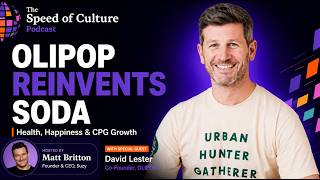
David Lester left Diageo to co-found Olipop, a prebiotic soda with low sugar. He raised half a million dollars on a PowerPoint deck, solved the distribution catch-22 by launching in 40 independent California stores, and scaled to Target and Walmart, hitting $200 million in revenue in 2023.
Chapters
Today we're gonna be speaking with David Lester, co-founder of the exciting health drink brand Olipop. Before starting his own drinks brand, David worked in global brand marketing and innovation roles for almost a decade, working with iconic brands such as Smirnoff, Gordon's Gin, and Johnnie Walker. David, so great to see you. Thanks so much for joining today.
Thanks for having me.
Absolutely. I've been really excited for this one. We, we've spoken to a lot of CMOs of major brands and people from media companies, but being an entrepreneur myself, I I love hearing about the entrepreneurial journey, which you are very much in right now.
Mm-hmm.
So I'm excited to talk about all things Olipop. But before we dive in, would love to hear about the earlier stages of your career working at Diageo for a decade, which is no short amount of time in someone's career.
Yeah.
What were some of the learnings you got? Because Diageo is obviously a market leader in the spirits category. So I'm sure there was no shortage of lessons you had there. What were some of the ones that I guess are top of mind for you?
I mean, it was a great experience. When I started at Diageo in the early 2000s, I think it was, they had a program called Diageo Way of Brand Building, or DWIB, as they called it. And so I came in as a grad student. I didn't know anything about marketing or frankly business in general.
Why did you take the job?
It's a good question. I think I came out of college and I wasn't, I applied for a range of different stuff actually. I think I was applying, I remember applying for like accounting jobs. I don't know why I did that. I would've been awful at that. Something about marketing seemed interesting to me and I think I, you know, I grew up in the northwest of England just outside of Liverpool and, you know, if you're familiar with England at all, there's basically London and then there's everywhere else.
Yeah.
So growing up, you know, my mom was a school teacher, my dad worked in a government job, local council, managing the parks and open spaces. My friend's parents were kind of nurses and firemen and things like that. So it was all very new to me, this idea of going to London and working in a corporation. Marketing sounded interesting because it was kind of, you had to understand about people and I'm kind of aesthetic and I, you know, I was interested in brands to a degree. And so it was a bit of a leap. Yeah, we, there was actually a, a graduate program that I got accepted onto, which I think there was like 8,000 applicants and they picked 2 of us. So it's one of those kind of sliding doors moments. You think if I redid that scenario 100 times, it probably wouldn't have worked out for me. So, you know, I'm very grateful for that. And as I say, they, they put me on this Diageo brand building course that was 2 week-long sessions where we got to, uh, learn marketing from some of the leading marketers at Diageo. It was like something they really invested in, went to a fancy hotel and got these presentations on the history of brands and how Diageo wanted to do brand marketing. And that was fascinating to me. Um, and then I had the chance to apply it to brands like Gordon's and Smirnoff. Um, so about half my career was brand marketing. I, I led the Johnnie Walker brand in Australia for a while. It's the, the largest, uh, market globally for that. Um, you know, I learned a lot about mass brands, which I think is interesting now on, on Olipop because, um, there is a big difference between niche marketing and mass marketing.
Sure.
And, um, you know, we started on Instagram like a lot of brands do and little bit sort of trendier LA type wellness vibe to what we were doing. And we've rapidly evolved into a more mass market brand. And, you know, you learn some discipline working on Smirnoff and Johnnie Walker, as you know, you can't do niche marketing on those brands.
Also probably had to appease the retailers and learn about distribution, which I'm sure is a big part of the work stream at Diageo?
Yeah, I mean, it's certainly interesting learning how a big company like that works.
Yeah.
And it's a very well-functioning company as well. So—
Of course.
You know, the other half of my career at Diageo was product innovation. So that's sort of launching new products. We ran a navigate process, same as a lot of large companies do. So you basically have to take your business plan to an executive team and they kick it to pieces, which, Again, it's quite helpful.
For new brands or new flavors or extensions. That's right.
Line extensions or new to world innovation. So, you know, have you scoped the size of market properly? Is this scalable? Is it profitable? Can we manufacture it through our system? And most of that failed. But there's only so many ways that a, you know, a consumer goods product can fail. You tend to find the mistakes repeat themselves. There's odd little lessons that you learn as well just from experience. Like, you know, I remember, um, just maybe a whiskey product we were working on where we had this amazing bottle for it. It was credible, looked super premium, researched really well, didn't really sell that much in the market. What we discovered was actually too premium. People didn't ever want to pick it up and drink it because it was for a special occasion that never arrived.
Right.
Um, so it's that sort of stuff that you learn just from you like get those aha moments from launching things and seeing how they work or don't work. Um, that has been extremely helpful.
Yeah, it sounds like it was almost like a second university for you. Imagine you learn about brand marketing, you learn about product development, and there's basically— that's basically what you need to know to launch your own drink brand, right?
A certain side of it. The bit I didn't learn was entrepreneurialism, which is—
We'll get into that.
Which is a huge part of it. But, um, But yeah, in terms of some of the kind of base skills and, you know, how to make something amazing, and I've got a great business partner who's an incredible formulator as well, you know, yeah, that, that kind of came together quite, quite well.
Yeah. So, and you left after 10 years in 2013, but you didn't launch your current brand Olipop until 2018. So it was 5 years in between. What precipitated your decision to leave Diageo? And then I imagine that's when your entrepreneurial journey started. So walk us through, you know, that journey to get you to launching the brand in 2018.
Yeah. I mean, so it was a great experience at Diageo, fantastic company. Yeah, I think there was two reasons really to leaving. One was I experienced a lot of my leadership lessons from my mom growing up as a schoolteacher. I saw the impact that she had on people's lives. Kids would go back and visit her 10 years after leaving the school.
Yeah.
And it'd been really fun, this journey with Diageo. And I'd got the chance to travel to Australia and to Brazil to live and work in those places, which I was very grateful for. But as I looked at the next 10 years of my life, I was like, I don't think I wanna be saying alcohol for another 10 years. And I was getting a little, sort of grumpy with the bureaucracy of a large corporation.
Sure.
I think like a lot of entrepreneurs, you know, I was probably more immature at that time in my life as well and wasn't managing the bureaucracy very well and just had a sort of defiant personality really. And so, you know, didn't love being told what to do by other people, you know, all those things that kind of lead you to to doing something kind of crazy in starting your own business. So I actually, my wife and I were moving from Brazil to the US at that time. We're about to get married and I told my boss I was leaving and she said, well, if your mind's made up and you definitely want to leave, you might want to speak to this guy. He's looking for a business partner. That turned out to be Ben, who I'm in business with now.
Wow.
So I met him at a coffee shop in Palo Alto. He had a little bag of sodas he'd made in SodaStream bottles. And he's a fascinating guy. He was the sort of guy that wakes up in the middle of the night in a cold sweat wondering what the meaning of life is and had a real purpose about what he was doing. Super intelligent guy, had intensity. You know, I also love adventures, so it seemed like an adventure to me, this. And so we kind of started out and we had an initial venture product called Obi, which is very similar healthy soda made with a water kefir base.
And, and what was the insight behind a healthy soda? Just 'cause there's demand for soda, but it's not healthy and there must be a healthier form basically.
Is that the— Well, I mean, Ben is really the patient zero for it. You know, his background is he grew up in quite a,, you know, a poor family in Monterey, south of San Francisco, had quite a challenging childhood. He talks about it a little bit on podcasts that he's done. And he was overweight and he was eating the standard American diet like a lot of people are.
Right.
And he just kind of realized about age 14, he was like, this isn't gonna work out very well and I need to make a change. And he did. And he got a job and started buying better food and he lost weight. But he also saw that his mental clarity improved, which he wasn't expecting. And he became very interested in the gut-brain connection. He dropped out of college, he taught himself microbiology.
Wow.
He had a mentor at a time. He was a civil rights activist, won a Supreme Court case by himself, this guy studying in the library. So he was in a very entrepreneurial world and, you know, really wanted to, was frustrated by the food that was available, you know, he grew up eating, you know, stuff that he was like, this is delicious. Like, I get it. There's a lot of empathy in what he was doing. You know, he was like, I understand why people eat this stuff. It's delicious. It's cheap. It's sometimes all you have available. But we gotta do better than this because I've felt so much benefit from making a change in my diet. And this was just his, his passion and his mission. So I was kind of follower number one. basically in behind him on that. You know, I brought my technical skill, which was helpful on the first venture, but I just, I didn't know enough about being an entrepreneur. And there was aspects we didn't know on capital raising and, you know, Yeah.
So what were some of those things when you say you didn't know enough about being an entrepreneur? What were the parts of being an entrepreneur that you didn't expect and kind of bit you when you went into this venture to begin with?
Basically everything. You know, I think I hear people going from their corporate career to, you know, an entrepreneurial venture. I'm not sure what your experience has been like that with yourself, but you know, there's, you know, corporate career can give you good technical skills, but in terms of the mindset of an entrepreneur, it gives you nothing.
Right.
So, you know, I've been fortunate not to have that much adversity in my life at that point. And then it hit me like a lot of it. We had two kids. At the same time.
Did you think about quitting at any point?
Yeah, I mean, sure. Like, it was very painful. I was just like, make it stop.
Especially with kids. Like, a lot of people start businesses when they don't have a mortgage, they don't have a family, so they don't have a safety net, but they're not gonna fall too far down, you know, because you don't have that much to lose. But once you have a family and once you have responsibilities, it changes the stakes dramatically.
Yeah, it's wild. And they're very demanding and emotionally demanding kids as well. You have to have emotional energy for them.
Oh yeah, right.
You can't just be present. So, and you know, entrepreneurship, I think, you know, I've learned to manage it a lot better now. I think some of the big things is like giving up the idea of control. It's like there's a lot of stuff I don't have control over. So I'm going to not swim ahead in the sand.
Have some faith in whatever leap you're taking and let the chips fall where they may.
To a degree, yeah.
Yeah.
Just know that I think frustration comes from the sort of gap between reality and expectation. So my expectation now is like everything's gonna be a mess, which is generally the case. So when you're trying to do your own thing, yeah, all kinds of random stuff's gonna hit you that you're like, really? Is that what's happening today? Okay, fine. That's, you know, it's gonna happen. And then what you have a choice around is your reaction to that. And maybe something comes along one day that you can't overcome and that's that. And so, but I think for me, like I've enjoyed this journey up to now. I would never regret doing like the, you know, this venture regardless of where it ends up. It's given me so much. So you kind of at peace with that to a degree. I think a huge thing for me was ego. You know, I grew up with a reasonable amount of privilege in terms of, you know, I had food on the table when I grew up. I had, you know, money, enough money to do the things I need to do. Very supportive parents, you know, went to a nice college, got a good job. And, you know, it breeds a sense of entitlement. Things are gonna work out for me.
Yeah.
And you realize as an entrepreneur, you're not entitled to anything, you know, you're only entitled to what you work for. And even then, you maybe don't get it either. Right.
Timing could be wrong. Something could go wrong. Supply chain, something that's completely not your fault and doesn't matter.
It doesn't matter.
It's always your fault when you're running the business.
Well, I think that's a great point. It's always, well, what I say is, you know, accountability is self-empowerment as I see it anyway. I mean, it's exactly what you just said. I realized anything that I was blaming somebody else for, I immediately just gave up control. Well, you can't control that, right? 'Cause it's someone else's fault. So there's nothing you can do about it. That's kind of nerve-wracking as an entrepreneur because, you know, the more stuff that you don't have control over, then the more powerless you feel. So I just learned the discipline of, and it's very binary, isn't it? Startup, you either have a business or you don't have a business. You know, when I was launching products at the Ad Show, some of them didn't work out and they were like, well, you did a great job on the, you know, on the launch and it didn't work out and that's fine. And here's another one and we'll go again. You know, you don't get that opportunity when it's your own business.
Of course. It's, it's, it's You kind of have to make it work if you're— the more you invest into it. So you did launch Olipop in 2018. You were here in 2023. We're just drinking a can of beautiful designed Olipop. And I mentioned to you before the podcast that I grab one almost every morning from my local coffee shop. So this is a business, right? You have crossed at least some chasm where you put something out into the world that people are adopting. How did you get from where we are today to just starting? Like, tell us the story of Olipop when it launched in 2018.
There is no clean way to start.
I think it's so with these things, it's like, well, how do you invent the product? Like, how do you, how do you make a soda? Talk to me about that. Because I, I don't even have the first idea. Someone says launch a soda brand. What do you do? Just buy different ingredients and tinker with it and come up with something that tastes good. Is, is that simple?
Pretty much. Yeah, it's pretty much it, right? So Ben is a product formulator, so he, Yeah. Put the flavors together. In a lab?
You like went into a lab and—
Yeah. I mean, in his kitchen.
His lab was his kitchen.
Yeah.
And did you come every day and say, mm, this tastes good, this doesn't taste good? Did you bring in other people to try it early on?
Yeah. So there's certain things, I mean, we rely on Ben's palate. So he has clear vision. He had a vision for the ingredients that he wanted to put into this. He had a vision of how he wanted to taste. He has a great palate. So like we're sort of relying on him putting that together. You know, we had packaging designers stuff and I actually ran consumer groups myself.
How'd you come up with the name?
I just thought of it one day. It's basically comes from oligosaccharides, which is a technical name for prebiotic fibers and pop. And naming is the most difficult part of product innovation.
Yeah.
For anybody that's done it. So it was—
Especially consumer products.
Totally. You know, most of the names are taken. And so you want something that's distinct and everything sounds stupid when you first, like imagine Apple or Yahoo.
Of course.
Yeah, Google, all those names.
Yeah, they sound stupid.
Yeah, until.
You have to build a story behind it and then it doesn't sound stupid.
Yeah, exactly. Yeah, you're like, oh, that's somebody's name. It doesn't sound right, you know. But, you know, icons become icons 'cause we imbue them with meaning over time.
Exactly.
You can't fast track that. Hey, silly. So, We certainly wanted something that sounded like a soda brand. It was kind of had a certain onomatopoeia about it. It rolled off the tongue distinctive and unique. And I was like, look, I don't know. I still had a lot of doubt around the name Olipop. It sounded a bit weird to me, but I was like, I think this has got enough of the characteristics of a good name to stick with it. So we did. But yeah, you're right. And then you've got to figure out where you're gonna manufacture it, and then you gotta figure out a distributor, and then you gotta sell into retail. It's just, that's the process.
So what was the biggest, I, I, so it sounds like you deal with more the business side, you dealt with more the, the, the packaging and the, and the branding, and he dealt with the actual product.
And we, we kind of backwards and forwards on a lot of stuff, to be honest. So yeah.
And then you had, I guess, a, an MVP, a minimally viable product.
Yep.
And then I guess the next step is to get retail adoption, right? So did you just go door to door to different retailers and say, will you sell this? How did that come to life?
Yeah, kind of. So we did raise money initially throughout the gate. So we raised half a million dollars in a, in a convertible note.
Was that challenging to do?
Yeah. Well, we had to do it off a PowerPoint deck basically.
Right.
Because you don't have anything at that stage.
Of course.
So you're selling off vision. It's the most difficult check.
Did people taste the product?
They could taste it, right? So we could make bench samples, but it hadn't gone into production. So, you know, some investors would be like, well, okay, this tastes good, but can you scale it?
Yeah, you just made it in the kitchen. How do I know it's gonna taste well? Exactly. Right.
When it goes into a manufacturing plant. So I think at that point there is no logic to investing in a company like that. So, you know, I say this to entrepreneurs all the time that are trying to get investment early stage. I'm like, look, if they start asking you for model of fund, models and like it's all bullshit.
Of course.
You know, the more you try and apply logic to it, the more you would talk yourself out of it because it sounds crazy.
You know what I mean?
So true. It sounds so crazy. So mate, you just have to find just one person that believes in you and what you're doing.
100%.
And the vision that you're painting and that's it. And that's all you're gonna get and that's all you need. So, you know, our guy was a guy called Pat Finn. He actually was our first investor on Obii as well, interestingly, our first venture. So, invested in that one and then he still—
Must have really believed in you guys.
He still believes in us in the second one. Like, you know, we're sort of 10 years in, this guy hasn't made, you know, any money out of us yet. And, you know, but he's really kind of stuck with it. He saw what we were trying to do. He believed in Ben and I as well. He was like, these guys are gonna do something cool. And, you know, he went off, I think the best early stage investors do go off their gut instinct a bit.
So you can't— They have to.
There's no logic at that point. You know, I don't know how they do it, to be honest. I wouldn't invest in—
Well, some, I think early stage investors say, oh, they worked at Google or Facebook, so they must be good. I'm gonna invest in them. And they just bet on the person's resume. Well, that's true. I would imagine your background, Diageo, had something to do with it, but it's a little bit different in the consumer product space than it is in technology. So yes, it is a big, you know, leap in faith.
And Ben and I had no connect. I just arrived in the States.
Right.
You know, Ben, didn't complete college. You know, we were not a very investible team in that respect, you know? So, so we got that and we knew we were like, just need to make this thing and then people is gonna really see.
So that's, so you took the half million, you said we're gonna make it and you, so you found the, the partners, the manufacturers to come up with essentially the product in the can and you had case X amount of cases of it at the end.
That's right. And then, you know, we're sort of selling in. So we started in about 40 independent stores in Northern California. How?
Door to door, like you just call them and say, will you sell our product? Like, is it on consignment? How does it work?
Yeah, it's a very tricky, like kind of catch-22 in food and bev startup because you go to a distributor, which you need to like deliver your product, right? And be like, hey, got this great product, will you take this on? And they'll be like, do you have any stores? We're like, not yet, but if you take this on, we can get some stores. And they're like, well, come back to us when you've got some stores. So you then go to the stores and you're like, hey, we've got this great product, would you like stock it? And they're like, yeah, who's your distributor? And they're like, we don't have one yet. And they're like, well, come back to us when you got a distributor. So you had to do this kind of sleight of hand where you sell into a couple and then we had to get the distributor over the line. So it was a, actually a dairy distributor called Dairy Delivery was our first distributor in Northern California. And that gave us this kind of base of 40 stores to get started with. Erewhon in LA was one of our first stores.
So once you're in those stores, you're just praying that people are gonna buy it and like it. Like, is there anything else you can do at that point after you're in those 40 doors?
Not a lot. I mean, you have to make sure you're visible on the shelf, right? That the product's available.
How do you do that? You just go, you go, you visit the stores and make sure it's merchandised well yourself.
It's pretty much, yeah, yep, yep. That's it. You just get in there and move the shelf around and, you know, and maybe do some sampling and that kind of thing. Right.
'Cause for all you know, some, some competitive products will be pushing yours like to the back of the shelf or it doesn't look as good.
Exactly.
And now all that matters.
Yeah. And if you've got 3 facings or 8 facings, it's gonna matter as well.
Right. The amount of cans people see on the shelf.
Yep.
It's just, you know, it's— Right. Inventory. Right.
It's all about visibility in, in stores. So, but you, you, you'll find out pretty quick if you, got something or you don't have something.
So how quick did you find out?
It was pretty quick. Yeah, it just, I mean, it's been a rocket since then essentially. So those stores—
Do you know why? Like in other words, like, so it took off right away. Were you able to talk to the consumers that liked it and they gave you feedback? Did certain flavors take off faster than others? How did you start to get that feedback loop to build from there?
Yeah, we, I mean, we had a hypothesis around, I mean, say Ben was trying to solve for a real problem. And so that was our hypothesis, like we're trying to solve for an actual problem here. And, you know, people were like, yeah, you're right. We love soda, but it's too much sugar in it. And, you know, so if you can give me something that essentially tastes good, you know, tastes like cream soda. Yeah, I'm in.
Yeah.
You know, and so that, that's essentially what happened, you know, People love, you're testing everything for product market fit at that point. The packaging, name.
Refining what you have out there.
Yeah. And so the, the couple of lessons we had early were this one, the Vintage Cola actually started out as Cinnamon Cola and it was in kind of like a brown can. And we found that consumers, 'cause we wanted to give it like a healthy twist on it. And we found consumers like, hold on, cinnamon, is that like spicy? Right. And we were like, no, cinnamon is just an ingredient.
But you're almost changing consumer behavior because when they buy traditional soda, they don't think of cinnamon.
You're right.
Right.
You're right. And so we changed the can to red and white and vintage cola. So the other one, you know, we started with cinnamon cola, strawberry vanilla, and ginger lemon. The ginger lemon was designed as a, sort of kombucha style product. And 'cause we weren't sure if like the sweet flavor's gonna sell that well in the natural channel where we were starting out. Right.
Right. Like a soda, a dirty word in a natural channel. So they're gonna go more of the kombucha. Yeah.
Yeah. Yeah. And, but as it turns out, like I think this is the case even to today, you know, in an uber health store in LA, like Erewhon, like that's, the health store of all health stores, their top selling beverage SKU outside of water is strawberry vanilla Olipop. Now I don't actually drink that flavor 'cause I find it a bit too sweet.
I love it.
And we found that just like everybody loves soda.
Yeah.
You know, that, that's the thing. It's like, it's, it's, I mean, it has 97—
There's a reason why the titans in the space are some of the, you know, most prolific companies in the world.
It's true.
Right.
Like it has 97% household penetration. So we found now that ginger lemon is one of our slowest moving SKUs because it's not actually designed on a soda profile.
It's almost a different category.
It almost is.
Yeah.
It almost is. And so everything, that's why, you know, we've got the confidence to do things like cream soda and—
And did you tweak the original ingredients after that first round and when you went out there, or is it still the same original?
It's still the same.
That's fantastic.
Essentially. Yeah. Yep.
So you start to get some scale, you move beyond the 4 years. I imagine that you had to raise more money at that point. To, to continue to scale, I guess, the inventories you could distribute to more places.
Constantly raising money. Right. Constantly raising money.
But it got a little easier each time, I would imagine.
It does. Yeah. Nothing will be as hard as I say is that first. Right.
Because now you do have a model, then you do have numbers and all of a sudden you do have a finished product to show people and it just becomes more and more real along the way.
Exactly.
So then the next phase, how many doors did you guys go to? Did the, You know, and when did you finally get to more of the big box chains where you are today?
Well, our revenue growth, so this is our 5th year in business. So it's gone 1 million first year, 9 million, 30 million, 75 million last year. We'll do over 200 this year.
Wow. Congratulations.
That's amazing. It's been a trip. It's very impressive. But I'd say a lot of it is off the mistakes we made the first time around.
It always is.
We wouldn't have gone this fast if we didn't make all those mistakes. So now when we get to that fork in the road, we're like, oh, remember that one drove us off the cliff last time. Let's go this way. So yeah, we launched nationally into Target and Walmart last year. We outsell A&W in Target. We outsell Pepsi in Target at this point.
Wow. And what was that like walking into a Target and seeing your products? I mean, it gives me chills just thinking about it from the journey you were on to seeing your product in Target. It's like you've made it at that point. I know you don't probably think you've made it 'cause I can see it in your eyes. You have a lot more to do, but that's a big moment for somebody who does what you do.
Yeah, yeah. I think it's, this has been my experience of entrepreneurship. I don't know if it's other people's experience, but it's almost like, I'm saying this to my wife, you never really get the chance to properly celebrate something.
Yeah, I know.
Because it's so painful to achieve like a financing or something. It's like you think you got it and then it gets pulled away and then you have to work harder.
Or even after you raise the money, you have to deliver for the investors. So the work's really only just beginning.
Mm-hmm.
Right? There's never really a point where, and that's what makes entrepreneurs who they are, is that you never take your foot off the gas. And that's why a lot of the incumbents in this space, you're able to catch up with it because they are taking their foot off the gas. They don't have people like you and me that are running it, that are sleeping with one eye open, always trying to drive it, right? So then all of a sudden they just stop innovating and the world changes and, and the consumer changes and all of a sudden you have an Olipop that's creeping up in, in the store shelves. Yeah.
Yeah, yeah, totally. So it's sometimes just feels like relief when you get to a point.
Yeah.
You know, rather than celebration. Yeah, well put. But I think I've got better at, put better boundaries in place. I think I'm calmer about this journey. I realize there's a lot of luck involved in how things unfold and, you know, societal measures of success is not a very good way to be measuring yourself. You know, it's interesting at the beginning of this journey, nobody was particularly interested in what I was doing. I was not doing any podcasts or anything like that at that point. But what I was doing was very impressive. I was a failed entrepreneur that got back on my feet, raised cash off a PowerPoint deck, managed to get a product to market. I was impressed with myself at that point.
For a lot of people, that's not enough. You know, and then you, and that what you see now is you have young kids 18, 20 years old that try to flex, like, and they spend all the little money they have on impressing people and posting stuff on Instagram and saying they're building a business, but they really built nothing.
Mm-hmm.
And then 5, 10 years from now, they're still not really gonna have anything. And then you have people who went through your journey where all you really needed is to be impressed by yourself.
Yeah.
And that was enough for you to keep going. And I think that's sort of the dichotomy we see in this Instagram era where people aren't patient. They want it now and they want to have the optics of it now, but that's gonna come in a lot of ways at, you know, the best of their future success.
It's true. And I've got a lot of empathy for people, like particularly, you know, young people coming through today. Like social media is such a—
It's so hard.
Can be a very difficult driver.
We both have children, they're facing it and they'll continue to face it.
Yeah. I mean, look, I'm very fortunate. I grew up in the northwest of England, you know, it's like, I mean, my summer job was like collecting the trash cans on the trucks. You know, like, I have entrepreneurialism in my family. My grandfather, my family's originally from Scotland. My grandfather was an entrepreneur in Dundee on the east coast of Scotland. He had a trucking and sand dredging business. There's no venture capital involved in that one. You know, his father passed away when he was 27. He had to run the whole thing. They lived in tenement housing, you know, and that was what allowed them to get out of that position and put my mom through college. So, You know, I actually have a picture of his truck on my—
That's amazing.
You know, when I'm having a tough day, I'm like, I think—
Perspective, right?
I think you'll be all right. I think you'll be all right. You know, so, right. But it, but it's, it is hard. There's a lot of distractions out there in society. I've been fortunate to have really good people around me who've supported me, whether I've been successful or not. They're always proud of me. You know, they were proud of me when I failed on my first venture. They're proud of me when I was getting back on my feet. They're proud of me now that I'm, achieving something that has a bit more societal success factors attached to it. But of course, you know, from my point of view, that doesn't make any difference. Like, I don't read anything more into that than I would do. So I'm probably more impressed with myself than what I did at the beginning.
Yes.
Than what I'm doing now. I mean, we have a lot of momentum.
And you're able to provide for your family. And there are, you know, obviously benefits of commercial success that impact you personally.
Yeah.
Especially when you're, you have a family.
Yeah, totally. And you know, some ways it gets easier. You know, I've got a lot of smart people working in our business now. And you know, we kind of accidentally overdelivered our plan this year. We just sold way more than we thought we'd have.
There's not many people that are saying that in 2023. So—
No. In the first year, I mean, that million dollars, like we scrapped it out to get a million dollars. Like now we're overdelivering our plan by tens of millions of dollars, just sort of without even realizing it. So, Um, you know, uh, yeah, some of those things get, get kind of easier to degree.
For sure. So $200 million this year, and I agree, like, you can't just measure it by revenue, but just in terms of the brand awareness and the consumer impact, it's certainly real. Where do you go from here? What, what are you focused on in 2024 and beyond in terms of continuing to build the business?
There's still a lot for us to grow. Um, you know, we're only in $30,000 at this point. So there's, there's lots of areas we haven't touched. We're not in any convenience stores. We haven't really done much with club. You know, we've only been in major retailers like Target and Walmart.
Club meaning like Sam's Club and Costco.
Sorry. Yeah.
Yeah. When you said club, I thought you meant on-premise, like nightclubs, which I would imagine that is also an opportunity for you down the line.
I'm sure it would be. Yeah.
Yeah.
You know, we've only been in Target and Walmart for a little over 12 months. So, so much opportunity to grow. And, you know, we're excited to take it on and say it's a real privilege to be able to, to do this and to get to take on these challenges each day with a, with an awesome group of people. So, yeah, I really don't know where it will go. And I, I kind of like that, you know, I didn't like when I was sitting in my corporate career that I could, I remember starting work in London., you know, on that ladder and I was like, I can see where this is going to go and I see where I'm going to end up. And I, that was not motivating or exciting to me. And so the fact, if I look back at the last 10 years, I'm like, that was crazy. But I would have no idea that I would have ended up in this place. And I kind of like that idea looking forward to the next 10 years.
Makes life exciting.
Yeah. It's been like, I have no idea where this is going to lead.
I love that too about being an entrepreneur. You just don't know how the story's going to play out. You have to, If you look at that as like an adventure, it makes life all the more fun.
Absolutely.
So we're here at the Brandweek conference in Miami, and obviously Brandweek's all about marketing and building a brand. Who is the Alipop consumer, whether it's by demographics or psychographics? How do you know who the right design target is for you for your product?
You know, soda is very ubiquitous category. I think the one— we have a term called happy seekers for our for our consumers. So really, if you're going to be interested in drinking Olipop, you have to care some aspect about your health.
Sure.
You know, so you have to care about sugar and/or digestive health. Otherwise you would just buy a can of Coke, right?
Right.
It's cheaper. It's a good brand. It tastes good. It's more available.
Yeah.
Like, why would you buy Olipop? So, but what we're finding is that group of happy seekers is getting bigger and bigger.
Especially post-COVID.
So true. Like, people, now people are like, look, I don't, I don't want to necessarily have a kale juice every day, but I am more conscious about, I'm conscious that the food I'm eating is perhaps not, not helping me. I mean, two-thirds of Americans report digestive distress. You know, it's like we all know somebody that's like, yeah, I was chatting to a lady earlier today who's, whose sister is struggling with MS. And so it's a bunch of stuff you can't consume, right? Ollie Pop Chicane. And I love those stories because soda is fun. That's what it's about. It's fun, it's refreshing.
Yeah.
It's about memories. Our eldest son is, has quite severe ADHD and anxiety. We, he's gluten-free, dairy-free. We have to control his diet quite a lot and it makes a big difference to him. But, you know, he wants to drink sodas 'cause his mates are drinking sodas. You know, I can make him, a root beer float if I want with Olipop and Ollie or ice cream or something. And, you know, not worry about the fact that he's consuming 60 grams of sugar or whatever, or dairy or—
But at the same time, not necessarily missing out.
Not missing out. Exactly. And I think that's a key thing. It's like, and that's our approach. We're like, look, we don't want anybody to miss out. We get it. And so just, we'll take care of the complicated part in terms of making sure it's good for you. And we do all our research. Done university standard research with Baylor and Purdue Medical Colleges. Everything else, you just enjoy the soda.
Yeah.
You know, and you know, I just say one of the areas we start to move into is emotional brand positioning, which is really important if you're gonna occupy that soda space. So, you know, we developed a brand territory of real love and we launched our first iteration of that campaign with Camila Cabello. Earlier this year on our sort of first national TV ad, which performed really well. So that's been fun to sort of enter into that space as well.
Yeah, for sure. So to wrap up, David, I mean, it's a great story and inspiring, and I'm sure it'll be inspiring to our audience as well, just in terms of how this idea came to life and where it is now. And I can't wait to see where it goes. When you look back on your career and you think about the things and decisions you made, right? To put you in the position you are today? And if you had to bottle them up, what were some of the things that you think, because right, luck happens to us or bad things happen to us, but also our decisions dictate a lot of that as well. What were some of those decisions that you can point to?
I mean, I think humility and vulnerability are two things that always give me a return on my entrepreneurial journey.
And you come across that way, I can tell you.
I appreciate that. It is humbling, this experience. And if you try and wrestle with that too much, if you can't get your ego out of the way, we're often tripping ourselves up. That's the problem, right? And I realized on our first venture, I was doing that a lot of the time. There's a lot of people out there that are definitely smart enough to start their own business, but maybe they're not humble enough. Maybe they're not willing to be vulnerable. If you are, and there's a foundational to a growth mindset, I'm sure you've discovered yourself, most things you can figure out, or you'll attract somebody that is willing to help you out. You know, human nature is an extremely fascinating and powerful thing. You know, groups of people gravitate where they see you authentically going after something with humility. It's incredible what support you'll get in doing it.
Absolutely. We're going to leave it with that. Thank you so much for joining. It was a fantastic conversation. Again, I can't wait for our audience to hear So on behalf of Susie and Adam McKean, thanks again to David Lester, co-founder of Olipop, for joining us today. Be sure to subscribe, rate, and review the Speed of Culture podcast on your favorite podcast platform. Till next time, see you soon, everyone. Take care. Hey!
More from Matt




MikMak’s Rachel Tipograph on Consumer Spending, Retail Media & Holiday Shopping Trends



Jaguar Land Rover’s Charlotte Blank on Luxury, Purpose & Experiential Storytelling



