ŌURA’s Doug Sweeny on Smart Rings, AI Health & the Future of Wearables
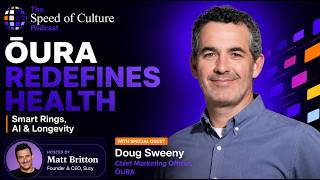
Doug Sweeney, CMO of Oura Ring, discusses how the smart ring evolved from sleep tracking to a full health platform with AI integration. Brand awareness jumped from 5% to 35% of Americans, and Oura now partners with Dexcom and Quest to create a closed-loop health ecosystem. The company uses AI in marketing too, from creative generation to rapid storyboard production.
Chapters
Up today on the Speed of Culture podcast, we are thrilled to welcome Doug Sweeney, the Chief Marketing Officer at Oura Ring. Doug leads global marketing for one of the most innovative brands in wearable technology, helping transform the Oura Ring from a breakthrough sleep tracker into a cultural symbol of intentional living and performance optimization. Doug, so great to see you today.
Matt Britton, great to see you too. Thanks for having me.
You know, this is such a fascinating time right now for the wearable category because not only do you have the proliferation of these devices, which seem like they're becoming increasingly affordable for people, but at the same time, the power of AI just unlocks a completely new utility for the data that these devices output. So we'd just love to hear from you the state of the category right now, and then we can dive into specifically what you're working on at Oura.
For sure, for sure. So, I mean, Oura pioneered this idea of a smart ring, a device that could sit on your finger. I mean, it shows the company's actually been around since 2000. 2013. So over a decade now. Why the finger? Incredibly accurate in terms of signals off of your body. So if you go into the hospital, the first thing they do is they check your pulse off your finger. So it's about 100 times more accurate than your wrist. There's actually a lot of noise there, but it's really become a companion for holistic health. The company originally was very focused on sleep and this idea that you could wear this device that you didn't need to charge every night and it could— 5 to 7 days on a battery charged, and you could track, track your sleep. But it's, it's grown into, um, we have a full suite of women's health services on the product, um, stress tracking, uh, activity, of course, uh, cardiovascular, uh, tracking as well in terms of your performance. So it's, it's very much holistic now in terms of what the product offers you.
It strikes me that your job is almost twofold, right? Because obviously there are other wearables in the marketplace, but I would imagine the biggest lift is just to get consumers to understand this new category, which didn't really exist at scale a decade ago.
You, you're right. I mean, the, the awareness, I mean, when I started in '22, our awareness was about 5% of Americans knew, knew of Oura Ring and, and what it was. Um, today that's up to about 35%. So we've really grown aggressively our awareness. Um, we actually don't, we don't think about the wearables as competition really. People do, uh, wear Apple Watches and Oura Rings or a Garmin and other products. So it's interesting. The use cases can be different in the way people think about these things. We see upwards of 50% of our users who actually do wear both. But I think you're right in that the awareness overall for the product has been, been one of our core missions. The product on the software side has really evolved too. So we, we've made a tremendous amount of updates over the last 3 and a half years on the product as we've added this, these new suite of, of services. So that the product has evolved. I would say our team is focused on evolving it, but it's been really following pace with the product changes on the software side.
And when you think about the tailwinds of your business, I mean, I think of and I mentioned at the onset just the notion of AI giving you so much more ability to unlock the data of your body. You know, a lot of people, myself included, will put like, you know, the annual full body scans like, you know, I use Prenuvo and I'll put that into, you know, large language model and I'll analyze that over time. That was something that wasn't possible prior. And of course, then you have this overhang of increased awareness and interest in just healthy living. And we're seeing everything from a dramatic decrease in alcohol consumption among younger people to obviously the GLP-1 craze. I would think all those things really point to a consumer that has a more healthy mindset that could unlock more value from products like yours. Are you seeing that translate into demand and where do you see this going?, you know, in the years ahead?
Absolutely. I mean, I think that, you know, the, the power of, uh, each of our own health, I mean, we quarterback that for ourself, right? I mean, that, that really started with the pandemic 4 or 5 years ago where when the world shut down, we were like, wow, I really need to be in charge of my own health. Now you have, through brands like Oura and Prenuvo as an example, all of this information. You may actually in some cases have more than your doctor has. Um, and, and we do believe we're moving to a place where we are all gonna have an, an AI doctor. We have an AI advisor built into the Oura product within the app. So it can— you can ask questions about, you know, while my cardiovascular age may be high, why is my HRV so low? Things that, like, that, that are relatively complex. But it's a closed-loop system within our product, and you can ask, um, you can ask the device. But the level of, of accuracy and the, the pure amount of data sets that we have, you know, just within sleep alone— I mean, we have deep sleep, REM sleep, um, awake times. Of course, we're tracking your resting heart rate, elevated heart rate. All those things are available in the product. You can sort of go as deep as you want to go to really understand what's going on in your body.
It's interesting because we are entering this sort of a GenTech world right now, and the notion that the data of your body can talk and interact with other platforms. Yeah, kind of like, you know, beneath the surface Yes, it's pretty interesting if you think about it, right? Because it could talk to, you know, it could talk to your Instacart, and based upon maybe you having high blood pressure, you ordering lower sodium groceries for you. Like, I could see there should be so many correlations in terms of where we're moving.
Absolutely. Actually, metabolic health is a good example. Like, not only are we off the device tracking all of these metrics in your health, we're also partnering with brands too. So we're not going to make everything within, within Oura. Um, we have CGMs through Dexcom you put on a CGM, you can track your metabolic health and look at your sleep, stress, activity, and all those other things going on in your body and see how they intersect. So it really does unlock a tremendous amount of information that you just, you just wouldn't be able to have in a prior time.
And when you storytell around, you know, the product, are you storytelling around certain use cases on the data they'll get and how they're using it? Are you storytelling around just the notion of the quantified self health, so to speak, which seems to be the overarching movement that we're discussing?
100%. Great question. So I mean, I think one of the things that Oura has done really well is to simplify. Like, you can be overwhelmed as a consumer with all this data and all this information. I mean, we started out with 3 scores, right? You get a— you get a sleep score, you get a readiness score in the morning, how ready are you to attack the day, and an activity score that changes over time. That's a good example of just simplifying the information, making it tangible and accessible. How do you actually drive some incremental changes in your health? Um, it's small steps, right? It doesn't have to be these really aggressive steps of, of working out really hard and pushing, pushing, pushing yourself. It can be more about balance and looking at what all these factors are. But I think at its core, we try to take these, these complex, uh, both data and, and, and health stories about what's going on inside your body. We're a translation device essentially for your body, what's going on. And we simplify it, Matt, right into the, into the easiest, most digestible things that you can use to, to create action and make changes. Yeah.
Is the company focused on the ring as a modality, or is there kind of a broader vision to kind of bring the power of this technology to sensing the body in a variety of different modalities?
I mean, I— we, we— so we don't talk about our, our future roadmap, but I would say just within the ring form factor, and, and, you know, and, and I give, uh, the credit to the founders and, and our, uh, our founding in Finland that they really did key off of something immediately that was the right form factor, like sitting on your body here It's an incredibly intimate product because you can wear it for a week at a time. It weighs as much as a piece of paper. I mean, it's incredibly light. It's one of the first things people see when they, when they, when they touch and feel it is just how light it is. It— the technology for the product also just moves right into the background. So within the smart ring form factor, we think there's a, there's a tremendous amount of opportunity for us to continue innovating within, within that alone. I mentioned these 360 products that we have that are, that are health panels is another one. So we work with, with Quest and you can go and get a health panel and get 50 biometrics, blood tests, and you can see how those things are interrelated with, say, your cardiovascular health. So these things are all interconnected. And because of all of the data we provide and insights in your body, these other elements can tell you things you didn't know, which we think can be helpful.
I just spoke recently for the retirement planning industry, like, you know, wealth managers and retirement planning. And I told them that I think this sort of technology should be something that's of interest to them because it does give you a good understanding of what your potential longevity is, which obviously is a huge input into your financial planning.
So you could see— absolutely—
for a person how you can kind of have this dashboard where it all kind of fits together.
Absolutely. I mean, we do— I mean, we cross the spectrum from, you know, 18, 20-year-olds to 80-year-olds. I mean, the product is, is very much about that. I mean, you may have seen the, the campaign that we launched, um, Give Us the Finger, was really about that. It was about this, this exact idea that you mentioned, which was, um, how do you live the, the happiest, best life you can even in your 70s and 80s? Um, and we think we can be a catalyst. We, we can help people, uh, achieve their, their goals there.
And do you find as you you look at older demographics, there's just more of a hurdle, um, and just getting them to understand this new technology and, and drive that first-time adoption?
We, you know, we see really good adoption. I mean, um, you know, I have family members, um, a bunch in their 80s who all use the product and, and love it. They, you know, I think they see it very much as, um, a guardian product. You know, they talk about a guardian angel. Like, I've even my mother, mama said that to me and it feels like somebody is looking after me. So they constantly have a sense. The product is so easy and intuitive to use. It's not, it's not complicated. You just put it on and it provides you the scores and it provides you the information throughout the day or throughout, you know, in the morning. There is a ritual in the morning that everybody goes through. You get up and we look at scores and how did I do last night and did I have a good night's sleep or not? Do I need— how am I feeling? We have, you know, product— another one, a good example, Symptom Radar, which gives you a heads up if you're, if you're if you're getting sick. So because of the sensitivity to this part of the body on temperature, it's incredibly accurate. If your body has increased a degree or two, uh, in the night, you're probably— some— your body's under stress. You could be coming down with something. So it's very much an early warning system to, uh, to what you could be, uh, could be encountering over the next couple days and how to prepare for it. Do you move— do you move into rest mode, for example?
So, you know, a lot's been made of what is the future of the iPhone, right? And, you know, this is something where when we look back in time, we see everyone at concerts like with this, you know, that would have seemed so foreign, you know, 15, 20 years ago. People don't realize that the iPhone itself 2 decades ago didn't even exist. Right, right, right. When you rethink about the future of the iPhone, a lot of people believe it's going to be wearables. Like I have these Meta, you know, devices with the cameras in them. Yeah. Do you think, and this is just a bigger conversation or just more given your experience and your role, where do you think the iPhone is headed in terms of like the personal devices that people have and where do just a range of wearables fit into that? Because I could, I think it could just be such an interesting way of sensing the world around you and interacting with it in whatever way that you, you know, get the most value.
I mean, I think, you know, I, who, who knows, knows what's on the horizon. I mean, hardware is, is having. Just generally as, as sort of having, starting to have a moment here. Brands like Oura, brands like Ray-Ban Meta that, that you mentioned, um, you know, OpenAI and their hardware ambitions as well. Like there, there's, there, uh, uh, Humane who, who, you know, is not here anymore but had the pin, you know, was one of the early ones. The thing strategically or what's different about Oura is we definitely think about the technology sort of moving into the background that it's becoming more and more discreet. There's no, there's no haptics or noise or a screen, uh, that we see on, on this device, uh, on wearables, that, that it's not, it's not, uh, challenging you, Matt, for your, for your, your time, right? Time to get up. You know, it's not, it's not constantly wanting you to engage. I think that is one of the things that's very different about Oura is that iPhone is a, is a device that we all spend a lot of time on, but it is pining for your attention. It's always wanting you to engage. Well, not like social media. So I think I think, you know, I, again, back to the company's founding, it was founded in Finland that, you know, frequently listed as the happiest place in the world. It's a country that's focused on balance, right? This idea of having an active day, but then also resting and being more subtle. The Nordic design is reflected across the whole product offering. I think that's different from the way many wearables or smartphones in general operate today in terms of their mission and their reason for, for being in the world.
And you mentioned, you know, social media and the iPhone. And while Finland's the happiest place on Earth, the, the Gen Z cohort, especially in America, is not the happiest generation in history, you know. And obviously they went through COVID, but you— all the mental health issues that are, I believe, are definitely correlated with just a constant demand of attention and, and, you know, the dopamine hits, etc. And the question becomes like, is how we're going to proceed in a world where it's becoming increasingly infiltrated by technology and AI. And I do think there's going to be a premium put on disconnecting. We've been saying that for a while, but it feels like we're reaching a tipping point as a species in that regard.
I totally agree with you. I mean, there's, there's, you know, bestselling books written about this and about the impact of these products. And I think, I think our consumers value that in a variety of ways. The way the product is presented, we're very, we're very thoughtful in the way, even on the design side, if you look at the app and the way we've designed it, it's not screaming at you. That's, that's everything from our UX to our color palette selection. Like we're being very thoughtful about the way we bring the product to market. It's not intended, you know, engagement is not like wanting you to come, continue to come back into the product is not something we're constantly driving. We want you, we want you to be in charge and you to drive it ultimately.
Zooming out a bit here, just in terms of your role as a CMO here in 2026, I mean, so much is made about AI's impact, you know, in the, on the marketing profession, from everything from insight generation to creative to distribution. How are you using AI in your everyday roles? I'm really curious to hear about how you're building a team around, you know, this incredible capability that has been unlocked.
I mean, I think once, one, we're talking about it all the time, you know, things like, you know, Agentic AI, like we onboarded a partner 6 months ago on that front, Athenium HQ. We've onboarding brand AI on, on the positioning. So we've, we've brought on board and looked at a variety of partners that we can, that can help us scale in this area because it is a, it is a new skill set that we're constantly learning about. I would even say, you know, in the sort of ways of working, we've also brought it forward in a big way. Storyboard development for when we're creating software videos and things like that, we would go out and it would take us, you know, a week or more to really figure out how we were going to visualize things through retouching. And it was very laborious. We can clearly do that through Midjourney or Gemini or any of the, the platforms in a very, very quick way that we couldn't. So it, it does our speed to market. I think, um, search in particular, we're constantly look at, looking at how are we showing up there. So I think it, it's another, uh, workstream, you know, on the MX side, um, which we're deep in as well on our team. We're also figuring out ways to scale this as the company has been scaling globally in terms of the sheer volume of, uh, consumer, uh, questions, feedback, whatever that may be as well. So it's very much part of our plumbing and electrical and heating and cooling in, in our team for sure.
Yeah. And when you think about just new people coming into the marketing and advertising world—
yeah—
how do you think the skill sets that they're going to need to develop are different from when, you know, you or I entered— yeah— the profession?
I mean, I think it's akin to digital with our parents. Like, we sort of grew up having to learn about digital, and they're learning from a very young age. So I think their just adoption of it and speed is important, but it is something that each of us are working on every day, even at a leadership level. I mean, it's deeply embedded in our workstreams. I mean, we have a product that is offering an AI advisor, and we constantly have to be improving that product and making sure it's delivering on what consumers need. So it's not only are we using AI in terms of our go-to-market and how we, we, we, we tell stories about our product or the brand, but then we're also actually, we have a product that is actually, AI is, is central to, to how, how it's built. I mean, we're talking about massive, massive data sets, right? Within, within our algos that are looking at Matt, your HRV, and if it's changing over time for some reason, why is is that happening? And in looking at the intersection of all these things. So it's central to how we, we built our product as well.
Yeah, I do believe that moving forward, the consumer, if they want, can have a dashboard of their body and it can have everything from their Quest lab results to information that they're getting from their Apple Watch, from your device, from a variety of other devices, and really get a holistic picture of what is the state of their, their being right now. And that is just fascinating to think about. It's almost like the Ray Kurzweil singularity notion coming to life through all these sensors. And, you know, I think that puts you guys in a really good position, having really established a leadership position in this particular part of the wearable community.
I think so, too.
Yeah. I mean, so when you think about brand building and just continuing to make sure that you maintain that leadership position, what has worked for you? You mentioned, you know, a new campaign that you guys have launched. I know that you have a partnership with Team USA as well, which is really interesting. Would love to hear about some of the initiatives you're working on and then how you feel like you're effectively able to reach your consumer set in an increasingly, you know, crowded and noisy world.
I mean, so one, it's a, it's a variety of different strategies and I think, I think, uh, Give Us the Finger was intended to do a couple things. One, there is this, uh, community of Oura users when you see a ring on someone and it's like, hey Matt, you and I actually value the same thing. There is a sort of shorthand trend in culture that is going on. You know, if you look at like how were consumers introduced to our product, 50% say through a family member or friend. Someone said to them, you should get this, or is that aura? So that's one, right? It's, it's recommended. And people, we have, those who know us love the product and, and, um, value it and want to spread the word. So that's one. Two, the form factor and where it sits is unique. So we wanted to tell that story. 'cause it is, it is unique in where it sits on the body. And 3, there is this, there's this cliché in, in sort of sports wellness of the 30-year-old person, male or female, doing yoga class and sweating profusely, or an extreme athlete. Like, let's tell extreme athlete story. If you look at the Nike playbook, and we wanted to pivot from that, we're like, look, what, what if it's not about that? What if it's about longevity and living the best years of your life at 70 and 80 and 90 years old? And we could tell those stories. So we thought, At a brand level, we could, we could tell that story. So that's, that's one sort of bucket, I would say. A second pillar, product storytelling is central to what we do. So that's software stories on, um, on, uh, women's health, cycle tracking, uh, fertility, pregnancy, um, menopause, premenopause, all of those stories within the product, stress, resilience, how your body reacts. We want to be able to tell both hardware and software stories. I think that's a really important one. I, on the on the athlete side, like pinnacle performance, Oura has been supporting— we support over 150 teams around the world, collegiate, professional, and a lot of the— and we're actually working with the trainers and providing product to those trainers, suite of products, both software and hardware that they're using for pinnacle performance. This really was about how do we actually create a formal relationship with Team USA Gee, our chief medical officer, Dr. Ricci, knows their chief medical officer really well, works with him. Gee, maybe we should actually create a partnership. We're already working with the snowboard team and the ski team and the speed skating team and the Paralympics team. So that, that became, I think for us on that side, it's about authenticity and telling pinnacle stories. So if you've got, you know, this brand campaign which was focused on the every person, right? Older people, people of all ages. You know, on the other side, we also want to be able to tell high-performance stories given we are supporting all these, these athletes around the world for Team USA for the Winter and Summer Games. So I do think it's multi-pronged. And then, and then another layer, Matt, I would say is international, is how do we show up in Australia, New Zealand or Mexico or Western Europe, because Oura and its impact on wellness and, and culture in that market may mean a different thing. Japan, as an example, has some of the, the weakest sleep scores in the world. Like, sleep is a real issue in, in that culture, which you wouldn't— like, you wouldn't really think about, but it's, it is, it is, it's a, it's a, a very corporate, hard-driving culture in Japan, whereas the Nordics actually has some of the, some of the best sleep and stress scores. You mentioned the US. The US has some very, very high stress issues that, that comes through in the data. So the storytelling, I'd say another, another function here is like, how do we support Oura internationally around the world in these different countries across those stories?
That's interesting. So are you able to analyze the aggregate anonymized like metadata data that you get in certain markets to really get kind of the pulse of the community. No pun intended, but yeah.
Yeah, no, absolutely. We actually had a, we've had press events. We had one in Mexico and we had one just a couple of weeks ago. We had one in Japan probably 6 to 8 months ago. And we, we actually automate it. It is anonymous data. So it's not, we don't, of course, because of HIPAA, we're HIPAA compliant. But the data, you know, we can look at where does a country like Japan stack up. And it's really fascinating. And then, then how do we— you know, our, our focus there is, is more sleep-focused than it is in other parts of the world. It— the brand is a little more immature in Japan, given our, given our size. But on the health side, it's also something that's really important to that, to that, to that marketplace. Whereas in the US, we may be focused on things that are more about longevity, for example, just given sort of where we sit, or stress-related as well.
So those— it's interesting. I wonder if like if like, you know, I'm from Philadelphia and when my Eagles are in the Super Bowl, I wonder if people in Philadelphia like have a higher stress score because they're following the team. There's probably some really interesting things that you can pull from that.
Totally. No, that's true. The, the World Cup match, we did do, do, do data and showed the goals between country. We looked at data from, I think it was England and France, if I have that right. And we looked at the data across each team after each goal set and we actually published it in a blog. We did something very similar, but we could do it off the Philadelphia Eagles too. Matt, we could— it's been, it's been a tough year.
So shifting gears a little bit to you and your career journey. Yes, Doug. So you obviously, you know, your career journey was like a playbook of how to enter, you know, Silicon Valley branding landscape. And, you know, obviously you worked at some of the great agencies and then you spent time at Levi's. And we actually had Kenny Mitchell, the CMO of Levi's, on our podcast recently. And, and, you know, two really interesting experiences that you had, as you know, is you were at Nest working with them through the Google acquisition. Position, and more recently you were at One Medical leading up to the IPO. So yeah, and now obviously, or you don't obviously get in those positions by accident. And just wondering again, for maybe some of our younger listeners here on the podcast, like, what are the things that you think you've done right over the arc of your career that's put yourself in the CM role and has put yourself, you know, in such incredible opportunities over the course of your career?
I mean, I think humbly there are those twists and turns in between there. So you can look at a LinkedIn and say, oh my gosh, this is like a playbook on how to do it. I think, I mean, I think one, I wanted to work— the brands I've wanted to work on are brands that I love, I know, and I've wanted to. So I've actively sought out brands like Levi's or Adidas or Levi's. I actually really leaned in hard because I was a user and loved the product. One Medical too. I've been a member forever. Aura. These are brands that I have an inherent interest in. I started out on the agency side, which I think is an amazing training ground, and I learned just a tremendous amount about the creative development process and positioning. And, and you get to work on a variety of different, different categories and get to explore those. I think that's really important. I've been hungry for are companies that are, are mission-based, that have a real reason for, for a, a, a mission that I can get excited about too, where they have a, they have a very audacious, bold goal. Um, and, and that, that always was something that was important to me in terms of, of seeking this out. I think, you know, I, I had worked on Adidas and, and Levi's, these amazing brands. If you live in San Francisco and this is where your home is, is you've gotta make a pivot into technology at some point. I would say it's, and I wouldn't even say outside of San Francisco, it doesn't matter where you are, you know, Philadelphia, New York, wherever you, you should, you need to make that pivot at some point. I think it's really important. And I've had some lucky opportunities. I mean, I got to meet Tony Fadell who created the iPod and got in at the ground level at Nest. Which, you know, was just an incredible, incredible experience working for an early-stage startup that was scaling around the world. But it had a, again, I think the similarities in these is it had a product that I used. I could deeply understand how to tell those stories and how to help scale it because of that inherent interest.
And I would imagine it's not like you had to fabricate create, you know, passion because you already had a passion going into it.
Correct. I mean, he gave me, you know, one of these things, right? This happens in a lot of job interviews. I interview with Tony and he says, okay, let's say you get the job, what are you going to do? And I've got 24 hours to put together a plan and present it to him. And like, that's what I, that's what I did, you know. And I presented this to him on a Saturday and said, here's what it is. I mean, you know, you— but again, to your point about you can't fabricate that interest if you don't have it. I also— the last thing I'd say is I do— I've enjoyed pivoting into different industries. One Medical is a service business, you know, uh, or as a hardware, you know, I've worked in, in denim and apparel and footwear. I've worked on cars. Like, I've, I've enjoyed that from, from an intellectual stimulation of like trying different categories because I think you— there's things you can apply in interesting ways and there's, there's parts of the, um, the playbook that you can apply in a different way that may not have been thought about if you're endemic to that category, which I think is interesting.
Yeah, I mean, you could— you obviously, you take little bits of inspiration. Yeah, throughout your entire journey, it's hard to compartmentalize those things. You learn things along the way and you're like, oh, I can use this for that. And that's kind of how it's built up. But I like what you said in terms of like, in the rearview mirror, sure, it looks like it was well planned out, but I'm sure there's so many twists and turns, things you didn't expect. And it's just important to realize that you don't always know at the time that your next move is the right one. That's right. One day you might look in the rearview mirror and say it made sense.
Yeah, that's exactly Right. I mean, it is, I do think I talk whenever I speak to, to younger people coming into their careers, I talk about it is a, it is a marathon, not a sprint. And there are stepping stones and you don't start and get the CMO job in your 4th or 5th year. It is definitely stepping stones about where do you want to go and looking out 4 or 5 years and sort of thinking about what do you want to be?
What do you want to do? Even though a lot of people seem to expect that CMO job in their 4th or 5th year, that's a whole different podcast.
It's all different. It's all different.
Awesome. Well, it's been such a great chat and obviously really appreciate your time. We always, we always ask our our guests to wrap up the pod if there's a saying or mantra that has helped encapsulate their career journey. So what first comes to mind for you?
I just think resilience, honestly. I think back to the, you know, the stepping stones and like, you know, I've personally been laid off a number of times where situations, you know, don't work out. Yeah, yeah, for sure. And people, you know, I openly tell that to younger people, like it's happened. Or in the case of Nest, it was hard merged into Google. Google, and they say to you, you know, it's been great, thanks for the 5 years, but, um, we're going to be taking this over now. And, and that's, that's, that's, that's hard. You got it, you know, you put all your heart and soul into something, and then, and then, and then it changes. It's not, it's not really a reflection on your performance, it's just the way it goes. But I was going to say resilience is important over the, over the long haul on these, these journeys, for sure.
100%. And right now, you know, this year, I think people, a lot of people are going to be tested for the resilience because there's so much change happening. But I think absolutely you just lean into what's next like you did and making the leap and focusing on where your interests lie, I think you can end up in a good spot if you put in the work.
So that's right. It could be the best move too. Sometimes change is, change is good, right? Change is, change is good.
Absolutely. Well, thanks so much for joining. It's been fantastic and, uh, can't wait to see what's up next for you and your brand and continue to be a fan from afar.
Thanks for joining. Really fun talking.
On behalf of Susie, I, we team, thank you again to Doug Sweeney, Chief Marketing Officer at Oura Ring, for joining us today. Be sure to subscribe, rate, and view Speed of Culture podcast on your favorite podcast platform. So next time, see you soon, everyone.
Bye-bye.
Hey!
More from Matt




MikMak’s Rachel Tipograph on Consumer Spending, Retail Media & Holiday Shopping Trends



Jaguar Land Rover’s Charlotte Blank on Luxury, Purpose & Experiential Storytelling



