Patrón’s Roberto Ramirez Laverde on Craft, Culture & Premium Tequila
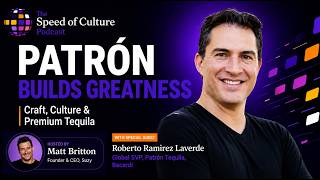
Roberto Ramirez Laverde, Global Senior Vice President of Patrón Tequila, discusses how the brand stays premium through transparency and craftsmanship. Patrón partnered with filmmaker Guillermo del Toro on "Perfect Pour" and uses music partnerships with Becky G and Live Nation to reach Gen Z consumers who want intentional, experience-driven drinking.
Chapters
Up today on the Speed of Culture podcast, we're thrilled to welcome Roberto Ramirez La Verde, the global senior vice president of Patron Tequila at Bacardi. Roberto leads the global strategy for one of the most iconic and pioneering brands in the super premium tequila category, helping shape how craftsmanship, culture, and transparency come together in modern spirits marketing. Roberto, I'm a huge Patron fan and, uh, so excited to have you here today, so thanks for joining.
Oh, it's great to be here. Thank you so much. And I'm very glad to hear that you're a Patron fan.
Love it. For sure. You know, you've led major categories across Bacardi, from rum to now tequila and agave. Like, what has transition taught you about where culture is moving and what premium spirits brands need to do differently today?
I think it's, you know, culture is evolving very rapidly. I think right now we have been immersed as never before with technology. And I think that's changing a lot how consumers are connecting with brands, how consumers are connecting with culture. And I do believe that is very important to ensure that you as a brand, we as a brand have an open connection with the consumers where we establish a dialogue with them. In the past, probably was a one-side communication where as a brand we communicate, they receive it, and that was it. Right now, we need to establish that dialogue.. And, uh, and we need to be, keep continuing listening to them to really understand where culture is evolving.
And obviously the tequila market has gotten red hot over the last, I would say, decade to decade and a half. You know, at one point it was all about vodka and, you know, it's been sort of shifting around. What is this, the state of the tequila market today? And where does the Patrón brand fit in that in terms of super luxury to mass market? Where are you trying to, I guess, aim the brand?
Sure. Like, I think as a brand, Patrón helped to define the super-premium tequila category, and that comes with our responsibility. We are seeing, as you were saying, like a great growth and great relevance of the tequila category. So today, our ambition is about protecting what made Patrón iconic in the first place, which was uncompromising quality, authenticity, and deliberated pace while still staying relevant and forward-looking. Everything we prioritize flows from that, from the bottles we make to the partners that we choose and the experiences and the campaigns that we create. I think right now it's all about earning our place in culture without lowering those standards. And for us, being true to who we are has to show up in every single touchpoint that we have with the consumer. That's a non-negotiable.
Right. And with that, obviously, to maintain your leadership, there's a new campaign which is built around the idea of the pursuit of greatness. And obviously, as you eloquently put it, I mean, Patron definitely helped, you know, invent the super premium tequila space. But obviously, in order to stay there on top, you have to pursue greatness. What does greatness mean for the Patron brand today? And how do you intend to keep the ambition real versus just aspirational marketing language? Like, how's that actually paid off?
Correct. I think for us it's very simple. It's about not cutting any corners. I think it's about showing who we are from our processes to, as I was mentioning, to the partners that we choose. And that happens in everything that we do. It's about transparency. And at the end, I think the brand has been, I believe the brand has been championing transparency for a long time. One example is our Additive Free campaign, and the sense for truth, which we were telling consumers who we are, how we are made on our— our process is very simple. Our tequila is made only with 3 ingredients, agave, water, and yeast. And we communicated that to consumers in a category and industry that is suffering from not being all— being as transparent as we are. So somehow that's something that we're championing and that we are communicating across everything that we do.
And speaking of product, obviously you have initiative, the Perfect Pour, which turned something simple, pouring tequila into something more cinematic. Just curious, like, what was the insight behind that and why was that narrative that you thought your brand was right to lean into?
Great. So I think it was precisely about telling who we are, how, how we can go from a simple pour connecting with one of the biggest directors, not only for Mexico, for the world, like Guillermo del Toro, who we the one that we have like across a long relationship, but also we see him as a director that really connects very well with the mantra of our brand because also Guillermo del Toro doesn't compromise at all. He's an incredible filmmaker. He's a global icon. But what really makes him like a natural partner for this campaign is that he shares something deeply important for us, which is that refusal of compromising on the processes. We have always admired him, the way he tells the story, how he's very hands-on, how he builds entire environments from the ground with real sets. He uses real light and real craftsmanship, even as you know, there are easier ways and little options available. And that mindset feels very familiar to us because as I was telling you, in Patron, we always believe that how you make something matters and the greatness comes from refusing to compromise on the process. Absolutely.
And when you talk about a campaign such as this, obviously we're talking about the realm of content and not advertising. It's about storytelling. And I would imagine in order for you to get great content like this in front of consumers in a world where everyone's obviously clamoring for the eyeballs and attention of the consumer you're going after, it requires just a lot of strategic planning and foresight into how to get into social media feeds, how to work with the creator economy and things of that nature. And we'd just love to hear from you the media side of this entire equation so you can get these great messages in front of consumers and obviously use it to drive growth for the brand?
Yeah, I, I, I think it's, it's very interesting because I think media, the role of media has changed a lot. When we look at how consumers have evolved, I, I, I would like to highlight 3 things. One, consumers don't want to hear about brands. It's tough, but it's a reality. The second one, Consumers have an attention span, which is very little. Like they say that is even lower, like humans have a lower attention span than a goldfish. And the third one— Is it true?
I'm guilty of that for sure.
Well, I'm probably guilty too as well. And the third point is that consumers and humans are now being bombarded by thousands of messages at a time. So it's really challenging to define how to connect with them if you don't develop an integrated approach, a full 360, where it's about, yes, the uses of media in the different shapes and forms from online video to social media, but also how do you create those experiences that will be relevant for them? And then we connect in a, in an integrated way and are able to deliver our message in a relevant way.
Absolutely. And when you think about the consumers, obviously, especially the, you know, the, the Gen Z drinker that obviously is changing their habits from prior generations, you know, they're drinking less, but they're drinking more intentionally. They're definitely seeking out more premium brands, you know, and the artisanal nature of spirits, but it's not— the volume isn't there like it used to be for a variety of, you know, factors post-COVID. How did you look at this generation differently? And in terms of messaging and making sure that you're capturing your share of a market that isn't growing the way it once was in terms of overall consumption?
You're completely right. I think the dynamic has changed a lot and younger consumers are really reshaping the industry and they are doing it by being far more intentional about how, when, why, and what are they drinking. As you were saying, it's less about the volume and it's more about the value. They're choosing also fewer moments, but better ones. What that means is that they're choosing quality over quantity. Craftsmanship over hype and experiences over excess. They really want to know what's in the bottle. They are more curious about where it comes from, who made it, and what it stands for. I think, like, exactly, like, really what's behind it. And because of that, precisely, drinking has become more thoughtful and in many cases, more social and ritual-driven rather than transactional. Also, what we're seeing in them is that they want to explore. They're open to discovery, but they are, they're very, very selective. They'll trade up for something that feels authentic, that is well made and culturally relevant. And for us, like Patron, that trend plays directly into our strengths. We always believe that if you lead with craft, respect the consumer, and honor the moment, people will definitely choose you.
Yeah, for sure. One, I think, big driver in your category I've personally seen over the years, just the growing importance of packaging, right? And you know, a lot of the spirits companies have come out with these outlandish packaging designs which stick out in the bar on the top shelf or stick out in the liquor store. And sometimes the packaging is enough to drive intrigue and curiosity from the consumer. I'm just wondering, as a marketer, how important is packaging for the Patron brand and how much time do you spend thinking about that?
Yeah, I do believe that packaging is key. Not sure if you know, but actually packaging is the second driver of awareness for any brand. Like just behind media, then you have the packaging. So it's really important. And for Patron, it's at the core and center. We have an iconic bottle that almost everyone can define. And we just actually renewed our packaging just by optimizing it. As again, we learned about what consumers were seeing, we learned what bartenders were saying as well. So optimize a little bit its visibility behind the bar, also on the shelf, but maintaining the same shape, the transparency of our bottle, which obviously connects very well with transparency that I was telling you about, that we're challenging about the overall process and the way that we produce tequila. And but also at the same time, we integrated key elements key tactile elements to the bottle that making a full immersive connection with the consumer. And we use the pattern of the silhouette of the agave pines to inspire some of the shapes that we added in our bottle. So while maintaining kind of the relevance of a classic and an icon packaging, we evolve it in a more modern, more tactile, and more storyteller option for our consumers.
Absolutely. And obviously with packaging comes distribution as well. You know, obviously where you're distributing the product, you know, that drives the importance of elements like packaging. And I know traditionally about 20 to 30% of sales of brands like yours are on-premise, meaning at bars and restaurants, etc., and about three-quarters is off-premise, meaning that people are going to buy them at retail or liquor stores, etc. But obviously the on-premise sales carries a lot of weight, especially when you're looking at influence, right? If people are, uh, if celebrities, for example, are at a nightclub and they're ordering Patron, that obviously has an outsized impact on people wanting to go to the liquor store and purchase it. And just curious, like, what does that dynamic look like for you? And, and how are you spending your time thinking about distribution? Because they are two completely different models and the volume of both off-premise and on-premise isn't necessarily correlated with its importance in building your brand.
Correct. You're right. The on-premise is where consumers have a full experience with our brands. I do believe that that's where we build the brand. So for us, continues to be a cornerstone of everything that we develop. It is kind of the activity that we center a lot of the activations and also where we center a lot of the advocacy that we do. At the end, the on-premise, not only because of the on-premise, but also because of the stakeholders like the bartenders, the waiters, and all the staff involved are key stakeholders for us. And at the end, they are our partners in crime that help us to build the brand in the right shape and form. On the other hand, when we plan any expansion or when we look at expanding to different channels, we make sure that we do it that, that we do it properly and that we guarantee that experience as well in the consumers, in the way that we show up, in the way that we display, in the way that we also partner with the retailers in order to ensure that the full experience is, is similar to what consumers are looking for also in the on-premise.
Yeah. I mean, it's really interesting and totally makes sense. I think, you know, before celebrity ownership was a playbook, which obviously we've seen like in the last decade where celebrities would come in and they would own or partially own a spirits brand and they would, you know, obviously explode really quickly and then it usually fades off. And if they're smart, they sell the brand before it fades off. But before that, there was artists that kind of took cultural ownership of a brand. Like Jay-Z put Patron in his lyrics over and over again before he was never, he was never an owner of Patron. People thought he owned it because he talked about it so much. Now I feel like in order for a brand like yours to be in a rap song, the artist needs to actually own the brand. And do you think that's sort of a fleeting trend? Like, do you think celebrities coming in and owning spirits brands is gonna be the case, you know, 10 years from now? Or do you think it's gonna shape in a different direction in terms of what is the core driver?
I think it's gonna shape in a different direction. Let me tell you why. When we look at the agave boom, it has been one of the, you know, it has been a record. Like, it has been one for the records. Right? So there were more like 720 new entrants since 2019, if I'm not wrong. And it has seemed like everyone has wanted to get into the tequila game and with very prominent figures, no? And you mentioned all the different artists that we were connected with this. I think it's going to be evolving because regardless on the name of the bottle or the person in front of the camera, I think consumers are getting more, are developing more expertise and they are discerning when choosing their favorite tequila brand. And it's coming back all to the product. So I think there's a change that people are looking more for the craftsmanship of the product rather than the endorsements that they have. So again, this plays in our favor because for Patron, our commitment to that traditional small batch tequila is unparalleled. Our process includes only using natural ingredients, which is tapping into that craftsmanship that consumers are looking to have. And as long as we stay true and time-honored to, to our tequila-making process, we know that we have that advantage, and we believe that that's what is driving now consumer preference in the tequila category.
And as somebody who's obviously responsible and overseeing such an important brand, just curious what the pie chart of a normal day or week looks like for you. What are you focused on to make sure that you're obviously moving the needle forward in such a competitive market?
It's very interesting. I think I can divide that in 3. The first one is thinking about how can the brand be and continue to be relevant in culture? How do we maintain that pace that we have with consumers? The second one is how do we ensure that the brand team continues to work in an integrated way? How do we continue to be a high-performance team? And the third one is how do we differentiate? How do we delight and surprise the consumers with innovations, with new campaigns, with revamping our packaging, et cetera. So, so we can continue to surprise and delight them.
And I know part of the way that, you know, you talk about, and we've talked a lot during this conversation about keeping the brand relevant in culture. I know you've done a lot of work to expand the world of Patron kind of beyond the bottle into areas like hospitality and travel and these kind of immersive brand moments. And we'd love to hear about some of your work in that. That area as well.
Absolutely. And I think one of the cornerstones of what we have been doing with Patron to precisely connect the dual cultural moments with the consumers is with music, one of the probably most relevant passion platforms for the consumer. And music has been part of our DNA for decades. We have been partnering in ways that really reflect our commitment to craftsmanship and greatness. Again, I believe that everything needs to be connected. And that is why Patron y Patron, we have been, you know, developing best-in-class partnerships within the world of music and culture. When we look at artists, for example, like Becky G, which is really connecting as proud Mexican and what we call a 200%, because she's 100% Mexican, but also she's 100% American. So somehow she authentically embodies the pride and cultural roots that are the heart of Patron. Another artist is Karan Aujoula, which is one of the most influential voices in global music today. He helped us to really drive a new innovation like Patron El Alto to India and regions in Middle East and Africa. And also the partnerships that we have with festivals like Live Nation that allow us to connect directly with Gen Z, you know, in places where most matter for them. And I cannot forget about the Grammys, which is our probably most recent kind of partnership that we became the official tequila partner for the Grammys this year. And that was a really natural progression for Patrón as this partnership really reflects our longstanding commitment to the craftsmanship, creative excellence, and celebration of the people that shape our culture.
Yeah, I mean, I think the Grammys partnership is a great one and obviously, it's not easy to, you know, when I ask how you, what the pie chart of your week is and, you know, you talk about making sure the brand stays deeply embedded within culture and that's just not an easy thing to do for a marketer because tastes change, culture change, technology changes things. I mean, AI is obviously one area that is reinventing the world and it is seeping into every culture, every crevice of business, of culture, of society. Just curious what your experience has been to date albeit it's an emerging category of integrating AI into the way that you and your teams work?
Yeah, I think we are living a time without precedent. When you look not only at AI, but the different technologies that are bombarding us, it's like, I think in the past there were 2 technologies every 10 years. Now we have more than 20 technologies impacting humans. So I think, I think it's very important to understand them, to really leverage them. And that's what we have been doing with AI. We, we use them as a tool, a tool that help us to be more effective, more efficient, to probably explore new routes in the ways to connect with the consumers. But at the end, what matters the most to us, and within this world of being bombarded by technology, is the human connection. And in spite of all these, I think the human connection and the ability for us to connect with the experiences with the consumers is super important. We know that consumers, and more than 70% of our consumers are looking more for experiences versus like gifts or articles. So for us being in the places that matter, giving them an added value to the experience that they're already having with Patrón is precisely what we're focusing on. And for example, in Live Nation, in some of the festivals like Lollapalooza, Tenerife, Tenerife, Santa Rosa— we have what we call the Hacienda Pop-up within the festival where we invite consumers to experience kind of an experience within the experience, a place where they can gather with people or gather with artists, have a great cocktail with Patron like a great margarita or like a Great Paloma. And that's kind of what we are trying to do to ensure that we keep that human connection in spite of all the technology that you know is bombarding humans.
Yeah, I mean, a lot of people believe, and I'm one of them, that in a world where it feels like technology is gonna disintermediate almost everything, there's gonna be just that much more of a premium put on authentic consumer and human experiences, right? And if you can create them and you can attach your brand to them, and obviously given the category you're in, that's very much, you know, a natural thing to do, it can be a real differentiator.
I, I, I fully agree with you. And, uh, and you were mentioning before is, is not only about these experiences are not only independent experiences, experiences, right? When we look at hospitality, travel, music, those, those can be connected. And I think is those immersive moments are where, where we can make the brand matter to the consumers by inviting people to participate in the brand rather than just observe them or trying to predicate the speech coming from the brand.
Absolutely. Switching gears a little bit as we wrap up, I want to hear a little bit more about you and your journey. Obviously, I've spent time working on some of the most prolific brands in the spirits industry. Also spent some time at Heineken and Mastercard along the way. And just as you look back on your career journey, what were some of the things that you think you did right along the way that have enabled you to continually elevate in terms of not just your title, but the type of work that you've been able to engage with? Ah, wow.
It's a very interesting question. I think I try to always be very pragmatic. And so maintaining this very simple and real, I think it was first ensuring that I was good at something. So without getting stuck there, ensuring that I developed that credibility of knowing what I was doing. Another component I think was to learn how the business was working. At the end, it was not only about creativity, it was not only advertising, it was really paying attention to really how ideas get how the decisions were made, and really what was driving the results. I would say a third component was to ensure that I build the right relationships. I think it's not about building your resume, but also ensuring that the people that you grow up with in your career really are mattering to you and bringing you added value. I think at the end, like the reputation of anyone would travel faster than what you do. And finally, I would say probably getting comfortable being uncomfortable, trying to stretch myself, getting into places that probably had a lot of questions, probably have more questions than answers, but it was about, you know, saying yes to those stretch roles, to that tough feedback and those assignments that probably I was not completely ready for.
Yeah, I mean, essentially it's about betting on yourself, right? I mean, ultimately you don't know what a new situation that's going to inherently make you uncomfortable is going to bring. But if you're confident in your skill set and your ability to deal with adversity, you can bet on yourself and dive forward because everyone's— everyone else is just kind of figuring it out along the way as well. Exactly. Yeah, absolutely. And for some of our younger listeners here on the podcast, if there's one piece of advice you were to give someone who's starting off in their career in terms of areas to focus on, or even something to do, to make a habit of rather, on an ongoing basis, what would that be?
Correct. I think without my career, something that I have been experiencing, and I will give that advice, is for younger marketeers or younger professionals to build the muscle of adaptation and pair it with resilience. You know, the only constant in our world is the change. And for example, the seat that you might be aspiring to have won't be look the same at the time that you arrive. And it's not about having all the answers, but having that humility to learn the course, to change the course, and the resilience to keep going when results are not happening the way that you're planning to have. So yeah, definitely adaptation and resilience are kind of the advices that I will give.
Absolutely. And with that, we always ask our guests if there's a saying or mantra that helps kind of encapsulate their professional journey. So anything come to mind for you?
Yes, actually talking about that, I, there's a quote that I live by, usually attributed to Darwin, but my belief is that it was not Darwin, which is the, it's not the strongest or the most intelligent that survives, but the one most responsive to change. And I really like it as I was explaining on the advice because it holds up everywhere. It holds up in the career, in creativity, in leadership, in life. At the end, talent and smarts matter, but they only take you so far if you are not able to adapt.
Absolutely. Adaptation, definitely the name of the game here in 2026. And it's inspiring to see how you've been able to adapt and continue to drive the brand forward. And thanks so much for taking time out of your busy schedule to tell us the story of what you're working on and about the Patrone mission today.
No, thank you. I really appreciate the time and it was a great conversation.
Thank you so much, Matt. Absolutely. On behalf of Suzy and the Adweek team, thank you again to Roberto Ramirez Laverde, the Global Senior Vice President of Patron Tequila at Bacardi for joining us today. Be sure to subscribe, rate, and review the Speed of Culture podcast on your favorite podcast platform. Till next time, see you soon, everyone. Bye-bye. Hey!
More from Matt




MikMak’s Rachel Tipograph on Consumer Spending, Retail Media & Holiday Shopping Trends



Jaguar Land Rover’s Charlotte Blank on Luxury, Purpose & Experiential Storytelling



