Pearle Vision’s Doug Zarkin on Trust, Care & Human-Centered Marketing
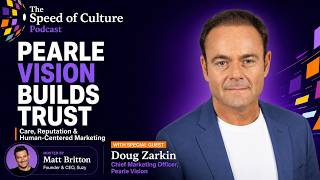
In this Speed of Culture podcast episode, host Matt Britton interviews Doug Zarkin, Chief Marketing Officer of Pearle Vision, about his 25‑year marketing career and his current role leading a franchise‑driven, retail‑healthcare hybrid brand. Zarkin explains how he blends the art and science of marketing, emphasizing that data informs but does not make decisions. He discusses the unique challenges of managing a brand that is 80% owned by franchisees, the need to influence rather than control, and the importance of empathy and frontline “hero” staff. The conversation covers healthcare‑related data privacy, the separation of patient and retail data, and how first‑party data can be used responsibly. Zarkin highlights reputation management as the new e‑commerce, describing daily monitoring of reviews and a dashboard that enables mystery‑shopping each location. He reflects on pandemic operations, noting essential‑service status, community communication, and a strong post‑COVID recovery that added new eye‑care centers. The discussion moves to future retail strategy, arguing that brick‑and‑mortar is alive because of the need for personalized frame fitting and community presence. Zarkin outlines family‑focused growth, targeting pediatric vision screening and senior care, and mentions tools like an online scheduler for multi‑person appointments. He defines “thinking human” as treating consumers as people with emotions and unmet needs, stressing observation, mystery‑shopping, and local video advertising. Emerging trends he cites include leveraging first‑party data ethically, local TV, experiential marketing, and careful partnership selection. Finally, Zarkin offers career advice: understand the pragmatic purpose of marketing, view yourself as a brand, demonstrate purpose and potential, and maintain personal balance through family and hobbies.
Chapters
Up today, we're gonna be speaking with Doug Zarkin, Chief Marketing Officer at Pearlvision. Doug, great to see you today.
Great to see you. How you doing?
Good. Thanks so much for taking the time in this busy back-to-school season to jump on the Speed of Culture podcast. We're gonna start by getting to know a little bit about you. You've been in and around the marketing space for over 25 years. Would love a little, to hear a little bit about your background.
Sure, that's like a backhanded, you're as old as dirt, but— Me and you both, my friend. There you go, there you go. So I joined the world of marketing at the end of the communications train right outta graduate school. I started out in media, worked my way through the agency world, and then ended up co-founding a partner company which within Gray Advertising called GWiz, Youth and Entertainment Marketing.
Yep.
And then made the jump to the dark side of the force and joined Avon Products as their founding director of marketing creative services for their young women's brand, Mark. Drove a degree of success there, went to Victoria's Secret to lead the national rollout for Pink, spent a little bit of time in the wholesale world, and then about 10 years ago joined SLO Exotica as the CMO of Pearl Vision.
Gotcha. And what originally drew you to the world of marketing? Like, when did you know that this was kind of the space you wanted to play in?
You know, I think marketing is that unique blend of art and science.
Yeah.
Like every child of the '80s and '90s, I went to graduate school thinking I wanted to be the next, you know, Bud Fox and Gordon Gekko. And I very quickly realized, even though I graduated with a marketing and finance master's, that I wanted to make a difference not just based on what my title was, but as a human being, as Doug.
Right.
And pre-LinkedIn, the only way you really figured out what you wanted to do with your life was talking to family friends. And a really good family friend said, listen, marketing is that perfect blend of art and science, data and gut. And wow, are they true.
And is there a side of that that you gravitate towards more?
So I'm a firm believer that data doesn't make decisions for marketers. Marketers make decisions using data. And that's because data is only as good as the questions that you ask. And so for me, I guess I emanate a little bit more towards the art than the science. But I think in especially in today's modern landscape, you have to be able to balance both skill sets. It's kind of like when somebody asks you, are you a performance marketer or are you a brand marketer?
Right.
Which I think is just like such a stupid question because you can't drive performance without appreciating brand and you can't drive brand without understanding performance. So it's one and the same.
It's so true, Doug. I mean, in our space, in the software space, so many of our competitors are just focused on bottom funnel and lead gen and nobody really knows who they are and they don't understand why they're not having success. And you need to understand, I mean, I think people buy software the same way they buy eyeglasses or buy anything. Else, they shop from brands they know, right? And, and brands they trust. And I think no matter what industry you are in, brand is incredibly important.
You just nailed it. I mean, it really does come down to trust. And, and how do you earn that trust? How do you strengthen and retain that trust? And obviously, how do you grow it?
Yep, absolutely. So what originally drew you to Pearl Vision?
So to me, Pearl is the most terrifying, exciting position I've had in the course of my career because it is the intersection of a whole bunch of different dynamics. So let's start out with the fact that we are 80% owned by franchisees and the majority of those franchisees are—
We'll get into that.
Eye care experts. So you have franchising, then you have high-end retail because of the assortment of products that we sell, both frames and lenses. Then you have this healthcare service element which brings in the whole world of insurance. And so then magnify that by the fact that Pearl Vision was really an iconic brand, you know, started by Dr. Stanley Pearl in 1961. That put that all into the melting pot with the challenge of reinvigorating and revitalizing the power of the brand. I mean, it was the opportunity of a lifetime.
Absolutely. And you know, you mentioned it was a franchise, predominantly a franchise-led business. How does that change your role as CMO? Because I would imagine that you have a lot of kind of push and pull in terms of control versus autonomy at building the brand that you wanna build, knowing how important you believe brand is.
So the degree of control that one has is important, but I think the degree of influence that one generates is even more important. And for me, it's really been about a journey of trying to generate influence and do it through leadership, through listening. Franchisees want to be heard. They want to be understood. You know, franchising is an inherently emotional qualifier of business.
Sure.
And you're dealing with the livelihood of small business owners. And so you have to have a strong degree of empathy, but a leader has to lead. And they're counting on me and the team that I have the privilege of leading they're paying for us. They, they contribute a percentage of dispensing sales, so they're asking and requiring for strong leadership. But certainly it stretches muscles that you don't necessarily have until you work in this world of franchising in terms of how to be successful and how to generate sustained success.
Absolutely. And so how much of your job is interacting with these franchisees and giving them toolkits and style guides and things of that nature versus focusing on the end consumer?
My number one job is to drive their profitability. And we do that through helping to fill their exam book, helping to ensure that Pearl Vision not only has strong brand awareness, but critically has even stronger educated brand awareness, and always keeping an idea of what they need to do in order to win. And so, yeah, constantly evolving the toolbox to provide them simple solutions to complex problems.
Yep, absolutely. And in that regard, you mentioned insurance and kind of the healthcare space in general, which is still very ripe for disruption, especially when it comes to the financial end of things. What are some of the challenges and opportunities you guys see within the broader macro healthcare space in relation to your business?
So I think with healthcare, you immediately go to the privacy laws. And so there is only a certain degree of things that we can do with patient data. And we have to keep patient data isolated from retail side data. Retail side data, we have a little bit of a greater degree of flexibility because they opt in to certain messaging incentives. But the patient really is preserved and protected in a way that I've never experienced with first-party data. And so we have to be very meaningful in our touchpoints. We have to be very calculated in our touchpoints. We have to ensure that we're communicating authentically, but also providing them information that's actually going to drive them to take the action that we want, which is to schedule their annual eye exam. Insurance is also one of those things that I think people understand but don't. You may know what your insurance plan is, but do you understand what your insurance plan covers? Especially for things like vision insurance. Does your vision insurance cover more than just a comprehensive eye exam? What is the benefit on frame? What is the benefit on lenses? So it's providing education as well as incentivizing those folks to take action. That is part of harnessing the power of the insurance consumer.
Yeah, absolutely. And Doug, you know, I follow you on Twitter and LinkedIn. I know that you're, very much in touch, uh, with the marketing space and all the innovations happening, which is probably has led to a lot of your success in the space. How do you spend your time? What's a pie chart of your day, given all the constituents that you seem to have?
So I couldn't quickly come up with 100%, but I will tell you the most important time that I spend is with my team of marketing superheroes, sort of providing them the leadership, but most importantly being a sounding board.
Yeah.
For me, this team is really staffed or casted, so to speak, by a team of folks that want to have the authority to make decisions, the autonomy to make the decisions, and the accountability for them. So a great idea can come from anywhere. And so it's important that I spend a significant amount of time with the team, both internally and externally. I spend a lot of time with our consumer and whether that's doing mystery shops, whether that's just simply surfing the net to really understand what messages they're getting. I'm signed up for every competitor's, you know, email distribution list under a variety of different email addresses because I've got to keep my ear to the marketplace. And then it's really staying in touch with our field organization and our franchisees. You know, if you think about what a brand's most valuable marketing tool is, it's their frontline heroes.
Yeah.
It's those folks that are embodying the brand. Within every one of our eye care centers, which is what we refer to our stores as.
Yeah.
And those eye care experts have a pulse on the business and can provide nuggets of insight incredibly important. Lately, something I am spending a lot of time on is our reputation. Reputation management is the new e-com for brands like ours because more and more, and it was maybe exacerbated by the pandemic, but more and more there is this intentionality that people have with where they're spending their money and where they're going.
Yeah.
And so more research is being done, more stock is being played in places like Google Reviews. And so ensuring that we're putting our best foot forward, but also being honest when we've disappointed and trying to take that adversary and turn them into an advocate by understanding what we could be doing better and if possible, doing better.
Right. And you mentioned a couple things. You mentioned your frontline heroes, the people who are basically working—
Yeah.
First line of defense with your consumers. You mentioned the pandemic. Pearl Vision is known as, at least I was growing up seeing in the mall, as a huge retail presence. What was that like operating a brick-and-mortar store franchise during the pandemic? Like, what decisions did you have to make? I imagine it was a crazy time for you.
It was crazy. I mean, fortunately, our eye care centers predominantly in the US are not mall-based, but they're in strip malls and lifestyle centers. So we had a greater degree of flexibility. We were very fortunate that we were not fully closed because we were deemed essential services.
Interesting.
However, we spent a significant amount of time communicating with our consumers in the community. Hey, listen, if you have trauma, if you broke your glasses, if you've run out of contacts, please come see us. Or if you're a frontline hero, frontline worker, and you need something, please come see us. But if this is about everyday eye care, we need you to wait.
Right.
And they waited. And we had an incredibly robust recovery in 2020. We had an incredibly robust recovery in 2021. You know, we added more eye care centers in 2021 than in the history of the business. And that's because the franchisees that are joining us, the investors that are a part of our family, understand the value proposition, which is a brand that is really deeply rooted in differentiation on how we do what we do, not just what we do.
Right. And in 2022, like, do you see consumers starting to pull back at all based upon the macroeconomic environment? Are they pushing off purchasing new eyewear?
So I look at the first half of the year and I call it a little bit of the drama of the three C's: COVID, casting, and climate.
Right.
First quarter in particular was pretty bad. You know, we had a lot of storms and look, you know, going to visit your neighborhood eye care center when you got 3 feet of snow or it's torrentially raining is not the highest priority.
Yep.
COVID, we had, I think, an unexpected degree of flare-ups. I think the world thought we had come out of it As the famous Godfather quote says, you know, just when I thought I was out, they sucked me back in.
Yeah.
And, and that's what happened a bit, I think, with the world and the US in particular in the first quarter. But then also casting, and I use that word purposely because finding and training eyecare experts is a skill. It takes a skill to help guide a patient into their perfect pair. And you know, for us getting that right degree of staffing and casting in our eyecare centers, finding doctors who are available, finding opticians that are available, that presents some challenges. I think we have seen a little bit of challenge as the market has struggled economically. But as we move into back-to-school season and as we move into the end of the year, it's all about using your benefits before they expire. And so we're very excited about what the second half of the year is bringing.
That's great. You guys, I think, have done a good job of leaning into the fact that you do have a brick-and-mortar network that consumers can touch and feel. There's been so much about the death of brick and mortar. I know, you know, you have strong feelings about that. What are your thoughts in terms of the future of yours as it relates to having a physical retail presence and strategy? Where do you think it's all going?
Absolutely. I mean, I can speak to it from a consumer perspective. The death of brick and mortar retail is fake news, just like it was fake news that Amazon killed retail. Amazon didn't kill retail. Amazon killed shitty retail. It forced retailers to think about experience environment, reason for being. I think for us in a category where it's really medical at its heart, sure, there are opportunities to do things virtually, but getting that perfect fit of your perfect pair is a science. It's also an art because while the lens can be scientifically measured to a millimeter of fit, which is really the difference between seeing clearly and having a massive headache, to manipulate the way the frames fit on your face is a manual process. Mm-hmm. You know, I wish everybody in the world was perfectly symmetrical on the left side and the right side.
Right.
Most people aren't. Actually, the majority of people aren't. So those frames need to be manipulated manually. You cannot manipulate the fit of a frame over the internet.
Yeah.
So, you know, much like taking a suit to get tailored, when that frame comes in, to make it perfect, it has to be perfect for your face. So again, I think we offer an essential service. We offer a degree of care that is unmatched. And I think most importantly, we really substantiate the trust in the communities where our eye care centers are because we're staffed by people who live in these communities. We're pillars of the communities. You'll find us at the Friday night light football games. You'll find us in the churches and synagogues doing screenings, cleanings, and adjustments. That's what the soul of Pearl Vision is, a brand that's committed to the communities in which we own and operate our eye care centers.
In that regard, you also talked about winning the family in terms of a big path for business expansion. Can you elaborate a little bit more on that?
Sure. You know, as we get older, our vision acuity softens, but 1 out of every 4 school-aged kids and 40% of Hispanic school-aged kids actually have an undiagnosed vision issue. And so a child who's 5 years old may have never seen clearly and may never know what seeing clearly is. It's impossible to know if a 5, a 6, or a 7-year-old is colorblind, for example, in a screening. A comprehensive eye exam is recommended for children 5 years and older. And with the pandemic, with virtual learning, we lost one of the first lines of defense to pick up on an undiagnosed vision issue, which is the teacher.
Right.
You know, you and I right now are talking behind a screen. I can lean in, I can make the fonts bigger, I can pull the screen closer to me. And that's what was happening during the pandemic with so many kids.
So interesting.
They were faking it. They were faking it. Not to mention the impact of blue light. And digital devices on the eye, which have been widely discussed and widely documented.
Yeah.
So for us, we want to earn that trust of that chief health officer, that head of household who's making the health and wellness decisions. And if we earn that person's trust, they're going to embrace the rest of their family, not only their children, but for guys like us, we're at the stage where we're starting to parent our parents.
Yeah.
And, you know, bringing those seniors who have real significant vision acuity issues in, that allows us to win the family. And we've developed technology like our online patient scheduler, which allows you to make multiple appointments for multiple people all at once. So you can come in from 2 to 3 and be seen, your child can be seen, your parent can be seen, and you can all walk out with your perfect pair. And we make that convenient through our Pearlvision.com scheduling portal.
It's smart. It's almost like you're putting yourselves in the shoes of, of your customer. I know you said recently marketers must think human.— to engage consumers. So what do you mean by thinking human?
So when it comes to your target audience, when it comes to opportunities, it's not about numbers on an Excel chart. People look at brands as a set of emotions, attributes, feelings, and perceptions. Why does it come to when brands look at consumers and they forget all that and they look at data points? For me, really understanding how to win with consumers is to really think about them as human beings. What are their needs? What are their wants? What are they saying? Most critically, what aren't they saying? And that's why the power of observation is a lost art. And it's something that we practice in our eye care centers. And that goes back to my point about our frontline workers, our heroes that provide great information. The importance of reviews and ratings has never been more important than it is today. And those are experiences, those are feelings, those are beliefs, those are perceptions that we as a brand have to respect. Mm-hmm. If you ignore all that and just simply realize that 42% of your patients are between 35 and 42, and that's a made-up number, you're missing the point. And you're most importantly, you're missing the opportunity to win.
So when you talk about observation, what does that look like? You talked about mystery shopping and going to some of your stores. Are there any other tactics that you engage in that are really effective in helping uncover the consumer more?
So we work with a company called Reputation on our reputation management platform. And it allows us through a very simple dashboard to get a holistic look, not only as a system, but at the DMA level and then at the eye care center level of how we're performing. That basically allows us to mystery shop every eye care center every day of the week because we're getting real-time feedback both on the patient side and most critically on the retail side. And so we're looking at ratings and reviews every single day. We actually publish out like standings in Major League Baseball, a top 25, bottom 25 internally because we wanna stress the importance of care. But most importantly, the fact that we live in a reputation commerce society and if you don't exercise that extra moment of care to that patient, not only are they gonna feel it, but they're gonna talk about it.
Right.
So it's just driving home the focus and importance on thinking human. Finding those small moments to deliver an amazing experience. And through our reputation management platform, we are virtually in every one of our eyecare centers every single day, which isn't meant to be creepy, but it is meant to allow us to have a real finger on the pulse of what's going on.
Right, which is hugely important. And speaking of consumers, do you guys look towards— and now I guess we're post-Labor Day, so we can start talking about 2023. What are some of the emerging trends that you have your eye on that you think modern marketers really need to understand heading into next year?
So I think we're all struggling with a certain purveyor of social media these days and trying to figure out how we're going to deal with that challenge of a more complex, harder to get results, more expensive to get results platform and what to do with those investments. From a marketing perspective, I'm incredibly bullish on the opportunity to use our first-party data for good and not for evil. It allows us to not waste people's time in having messages that aren't relevant to them. It allows us to get a greater return on our investment and allows us quite frankly to be a more authentic brand. Pretty excited about the continuing evolution of online video platforms. You know, Netflix, Paramount+, just as examples. HBO Max taking advertising.
Yeah.
I think consumers want to go where great content is and there's a lot of it online, but I also still am a very firm believer in the power of local video. Spot television to me is an incredible resource that we avail ourselves of tremendously. Not only because we're required to invest locally as per our franchise agreement, but you and I have relationships virtually with those newscasters that we watch every single morning, whose weather forecast we trust, whose perspective on what's going on with traffic in the Midtown Tunnel or on 495, what's going on at the airport. These are relationships that are built over time between viewers and their hosts. And so we want to be able to tap into that power of local connectedness through supporting them with our message. I do see a return to more event-based marketing in the future.
Yeah.
I think as casting starts to level out, we're able to get staffing levels back to where we want to be, as people have come to understand how to live with COVID in a, in a real-world experience sense, I do expect brands to take a more aggressive stature on experiential marketing because look, it's a great way to take what happens in the four walls of your brick and mortar or in your virtual world and bring it to consumers.
Exactly.
I also think there is going to be a settling down of what is happening in the world of digital marketing, meaning that everybody was throwing a tremendous amount of money in the last couple years into display advertising, for example. I think the market's gonna level off. And I think brands like ours are going to be approaching providers with more than just get me effective cost per acquisition. I think the company that you keep, especially in this age of fake news and questionable content, is more and more important. And so I know brands like ours are constantly monitoring where our advertising is to ensure that we're not implicitly or explicitly supporting messages that are inconsistent with our brand values.
Sure. And are you also looking at partnerships, collaborations with other brands to borrow their brand equity and vice versa?
We are. I think in our space is a little bit tricky because corrective eyewear is a medical device. So you can't give away like tickets to the Giants with everything you purchase, as much as you'd want to do that. Or maybe not the Giants, although as a struggling Giants fan, I hope it's the Giants. The kind of collaborations and partnerships we're looking is really into access. You know, we've done some great work this year in the Hispanic community with a few partners that have allowed us to really deliver an authentic message in an authentic way. We have a fantastic collaboration with Nickelodeon that involves the SpongeBob SquarePants asset and Pearlvision that we're in our second year of that is a great example of breaking through the clutter and delivering a strong message in an entertaining way. So those kind of collaborations that make sense for us are ones that we're always open to. But we're certainly not at a place where we're just going to throw money at them. We take a really serious approach because it's our franchisees' money with the must-dos and the need-to-dos. And then you get into the nice-to-dos if business is flying and you take a flyer every once in a while.
Absolutely. So Doug, to wrap things up, I mean, you're in a position as CMO of a huge brand. It's a spot that any entry-level marketer wants to end up in. So what advice would you give to people coming out of college wanting to go into marketing and wanting to someday be a CMO, what should they be doing? Where should they be spending their time and where should their focus be?
First of all, I think getting a really clear and concise answer to what is the purpose of marketing is super important. I graduated with an MBA in marketing, as I mentioned. I know what the textbook definition of marketing is, but when you're sitting across the table from somebody who's leading a marketing function, they want to understand that you understand the pragmatic definition of what marketing is. Is. I think understanding the difference between a product and a brand is really important because you as a candidate have to think about yourself as a brand.
Yep.
What makes you different? What makes you special? What is the reason that a brand should make an investment in you, right? Especially for entry-level candidates, it's not about what you've done, it's about what you can do. We hire for potential, we want passion, We require purpose. Those are all things. And yes, if you've done internships, fabulous. And I would encourage you to do those. But it's really about what we think you can bring to the table, the investment that we're going to make in you that hopefully you're going to pay back to us. That is the reason for bringing you on board. But again, think about yourself as a brand. Think about what separates you. And by all means, scrub those red cup pictures off your social media platform. We absolutely look.. And I've got several embarrassing stories of candidates who didn't, that, um, changed the perspective on them pretty quickly.
Get rid of the red cups, everyone.
Get rid of the red cup. If you don't know what a red cup is, Google it. You'll figure it out.
Exactly. Well, that was awesome. We covered so much. I feel like I definitely have a much better understanding in terms of where your head's at, where you're focused on. In this crazy fast-paced world, what do you feel is worth slowing down for in your life personally to get out of the crazy work mode and Get some peace.
So the hardest job that's not on my LinkedIn profile, it should be, is being a husband and a father of two teenagers. I take the time to be involved in my son, who's an athlete, and try to spend some time coaching him. With my daughter, just sharing her passions of music and art. I think we as marketers are so focused on delivering results that at times we lose sight of it's the how, not just the what. That is important. I'm trying to invest more time outside of the office, you know, improving my tennis game. Importantly, inside the office, I'm spending more time actually listening and having conversations with people and conversations that aren't about just, "Hey, did you do this?" or "Where's the status on this?" But "What's going on?" You know, "How you feeling?" Everyone's got a movie playing in their head as they're still navigating through this pandemic world. And it's important as a leader, if you want to lead and most importantly have people to follow, you got to care about the person behind the eyes, as we like to say. And I'm really blessed. I've got a team of superheroes that, you know, I go into battle with every day and that hopefully would follow me into the next battle down the line.
Amazing. Well, thanks so much, Doug. This has been an incredible podcast. I can't wait for our listeners to check it out. So thank you again for joining. On behalf of Suzy and Adweek team, thanks to Doug Zarkin for joining us. Be sure to subscribe, rate, and review the Speed of Culture Podcast on your favorite podcast platform. Until next time, see you everyone. Take care. Hey!
More from Matt




MikMak’s Rachel Tipograph on Consumer Spending, Retail Media & Holiday Shopping Trends



Jaguar Land Rover’s Charlotte Blank on Luxury, Purpose & Experiential Storytelling



