PepsiCo’s Mauro Porcini on Design, Innovation & Purpose-Driven Brands
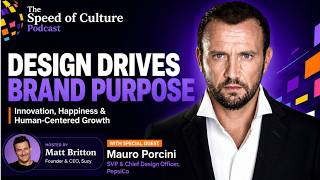
In this interview, Matt Britton talks with Mauro Porcini, PepsiCo’s SVP and Chief Design Officer, about the strategic role of design in a large consumer‑goods corporation. Porcini explains how his background in art, literature and philosophy shaped his view of design as a bridge between creativity and business, emphasizing human‑centricity and the need for mutual respect between design and marketing/finance. He outlines a design‑thinking framework that balances desirability, viability and feasibility, and stresses prototyping as a tool for alignment and sponsorship. Porcini describes how cross‑functional, ethnographic teams (often working 24/7) generate insights that feed into brief development, and how agency partnerships must be managed at the level of individual relationships. He shares concrete examples: the Pepsi visual‑identity refresh after 14 years, the Gatorade GX wearable and smart bottle that personalize nutrition, and the sustainability initiatives that leverage PepsiCo’s scale. He identifies three megatrends—sustainability, health & wellness, and personalization—and shows how technology unlocks new product opportunities. Porcini also reflects on maintaining passion over a 25‑year career, advocating a “people‑in‑love‑with‑people” philosophy, the importance of dreaming big, intrapreneurial freedom (the 15% rule), and empowering teams. The conversation weaves together theory, process advice, and real‑world outcomes, illustrating how design can drive purpose‑driven, profitable innovation in a legacy brand ecosystem.
Chapters
Up today, we're gonna be speaking with Mauro Porcini, SVP and Chief Design Officer at PepsiCo. The PepsiCo design function led by Mauro has been recognized with more than 1,700 design innovation awards. And Mauro himself has been named by Fast Company as one of the 50 most influential designers in the USA, most creative people in business, and GQ actually named Mauro one of the 30 best dressed men, which is really super cool. Haven't had that yet, uh, on the podcast. And in 2018, the President of the Italian Republic recognized Mauro as one of his proudest achievements, the knighthood. So what a great set of accomplishments and so glad to have you join. Great to see you, Mauro.
Thanks for having me. It's really a pleasure to be here with you today.
Absolutely. I've been really looking forward to this one. And you know, you have a unique role and one that we really haven't dived into as much on our podcast, which is the role of design. Have you always known kind of growing up that you wanted to be in the fields of design and marketing, or is it something you kind of just stumbled upon?
Uh, no, I had no clue at the beginning. Uh, I wanted to be an artist eventually. I love the world of literature and philosophy. The other dream was to be an author, a writer. Uh, but somehow I realize today that everything I was interested on was connected to this idea of creating something, uh, that will create some form of value for the people out there. Something beautiful, something useful, something interesting, something inspiring in a formal way that could touch the life of people in a formal way in the humanistic field. You know, you talk about literature, philosophy, art. And this is how I approach design today. You say design and marketing. For me, design is closer to the world of creativity and art and somehow finds a way to have a conversation with the world of business, marketing, strategy, finance, Marketing being the most creative expression, obviously, of the business world, but still being in the business world. And so our two worlds are colliding and sometimes they don't understand each other. My role is the one of trying to figure out to make them talk, you know, how to make them talk, to become a facilitator, an interpreter, a glue, an entity, myself, my teams, that somehow connect these two worlds with all the potential they can bring to the table if, if they respect each other and they start to work in full synergy together.
Yeah, and I imagine there's always a tension there, right? Because you have a lot of constituents. Not only do you have marketing, but you have your sales team, and then you have your retail partners. And to fit in some type of design aesthetic, which you may really believe in, I would often— sometimes comes in conflict with, I guess, their overall view of what design should be in your category.
Well, design, especially in CPG, in the mass market, has been for many, many years the prettification of packaging, eventually of products. It's not the design that they teach you at design school. It's not the design that eventually you do in other industries where design is more of a competitive advantage, is more established in the industry and the product category itself. And so, yes, there is— there has been many, many instances, a tension between the two worlds. But I realized over the years, already many, many years ago, that my role was exactly that. Understanding how to leverage the incredible potential of these corporations and the business leaders that somehow lead these corporations and the resources that they have, the access that they have, the knowledge that they have. So again, I'm using this word respect on purpose because often the design community, the art community doesn't respect too much the business world or vice versa. The business world doesn't respect too much the creative design art community either, thinking that they don't understand how to create real value for a company, how to create real value for the consumers themselves and so on and so forth. So trying to start from a base of respect, understanding what each of the different cultures and communities bring to the table, the amazing, amazing potential of what they bring to the table, but also the gaps that they have, and understanding, looking at the business world, looking at the gaps that eventually they had, how design could help creating value that was not there. As an example, something that is, I think, very tangible and very powerful in what design does for these companies Designers are driven by what I like to call human centricity. They love to create value for people. This is what they teach you at school. They teach you to observe people, understand their needs, their wants, their dreams, their frustration, and then creating some solutions for those needs and those wants. These solutions could be products, could be services, could be brands, but you're always driven by creating something meaningful, relevant, useful beautiful, something that creates some form of value for people. Then they teach you also that by the way, you also need to make some money with those solutions. You need to, you know, you work for a company, you create your own business and you need to understand the business world. But that's an afterthought eventually. In design thinking, it's something you consider from the very beginning. But in terms of inner purpose of these people, of these creative people, The first purpose is to create value for other people, and then you also need to make money with it. If you study business instead, they teach you to make money. They teach you, right, business. They teach you how to create financial value for a company, how to leverage an asset called brand to create value for the company. But the primary goal is always the one of creating business value. Marketers, strategists, uh, finance people, all the business community, the broad business community is there and they get the jobs that they get and the big responsibilities they get because they're really good at creating financial value for these companies. The big difference between today and 10 years ago, 20 years ago, is that for the first time in history, financial value for a company is almost totally aligning with human value, with creating real value for people. It was not the case 20 years ago.
Because consumers have more choice, right? Is that ultimately why? Exactly.
Right. Today, either you give them something that is extraordinary from any standpoint, the best product, the best packaging, the best communication, the best service, the best— Content.
Best content too, right?
Yeah. Best content. Everything needs to be extraordinary. And the definition of extraordinary, you can find it in the Maslow Pyramid because at the end of the day, we're all driven by that. You know, the basic is give them something that is functional, that fulfills a specific need. They are buying something, they are buying a car to move from A to B, they are buying a beverage to hydrate themselves. Give them the base. Then there is, you know, you go up and there is what the brand stands for, what it means for you. You know, it's self-expression, it's your role within a specific community, with your friends, how you look when you wear a Prada shoe, when you, drive an Harley-Davidson, when you show up with a LifeWater water bottle, and so on and so forth. This applies, you know, when I was mentioning the luxury brands, obviously, you know, Prada, of course, Rolex, of course, Harley-Davidson eventually, of course. But this applies also to mass market. Is the beverage you choose, is the snacks you choose, anything, anything is telling a story about yourself to the rest of the world. So that's the second layer that marketers and companies and designers of the world understood very quickly. You need to give functional values and you need to work on the emotional values as well. But what we're witnessing the past few years is the third layer of the Maslow pyramid, the top of the Maslow pyramid, purpose, something bigger than us. And so you start to hear in the past few years, purposeful branding. These brands, they stand for something, they need to give back, they need to help communities in a variety of different ways. There are a variety of social issues and brands need to take a position, need to have a point of view, they need to help the environment, they need to be sustainable. All of this goes up to the Maslow Pyramid to the dimension of purpose and essentially up there. So once again, is all about understanding deeply people, understanding their needs. The Maslow Pyramid is a good filter and understanding that today you need to give them something functional, something emotional, and something purposeful to really satisfy them. And this needs to happen at 360 degrees in every touchpoint of the brand, all the time.
So, but essentially what you're talking about is, you know, you're uncovering the consumer, you're decoding the consumer, you're identifying their needs. And it sounds like the next step would be to kind of translate those needs into some sort of design brief, right? 'Cause ultimately at the other end, you need to come out with some type of prototype or design. What does that process look like? 'Cause it seems so abstract to take consumer needs and then get it into something so tangible. So walk us through maybe what that process would look like.
Well, first of all, the best approach to this is the one where you don't have a project. You start the project, now you need to collect data insights, and then you translate them into, a brief, the best approach is when you have a team that is part of your organization and 24/7, these people, when they are at work, but also in their private life, when they are with their kids, when they are having fun in a trip or at a stadium, they are always in the back of their mind collecting insights, collecting data, and trying to understand what makes sense for the company and for the people out there, so for society, for the people you serve, in 3 dimensions, the 3 pillars, the 3 lenses of design thinking. So what is desirable to people, what makes sense for the company, how you can transform that in a business, and all of this, how can you make it possible, the feasibility component, manufacturing and then the, feasibility of the product itself or the service or whatever is the solution. So imagine this is the first step before the project. You have people with different background— design, R&D, marketing, all the different functions— that 24/7 their mind is there fagocitating insights. And if they are inside a company, they understand perfectly all the dimensions because they understand the business model of the company, the brands, the consumer basis, the manufacturing capabilities, the processes, everything. So you need creators within the company with that kind of background, cross-functional, to collect those insights. Now, it doesn't mean you need to do everything by yourself. You can and you should still work with agencies out there, as many as possible in all the different fields, from insights to design to marketing to R&D. It's really important because they come in with different perspectives. Maybe they are exposed to different industries. They bring diversity of thinking within your organization.. But if you have this richness of agencies around you, you don't have an internal team that does the same thing, a team of creators, a team of people that really understand the 3 lenses of design thinking, feasibility, desirability, viability, that scan the world 24/7 trying to collect insights and feedback and input and data to ignite the process, then you're gonna leverage those agencies that 5% of their potential because you're gonna give them the wrong brief. You're gonna judge their ideas in the wrong way. How many times for the people from agencies and companies of any kind, you know, working with big corporations, how many times you come with great ideas and you have a business team on the other side or a design team on the other side that is not understanding your idea, that is not understanding the integrity of that idea, that asks you tweaks and modifications that don't make any sense. Sometimes, you know, they do make sense. Eventually they have the right insights from a feasibility standpoint, from a business model standpoint. But, but by the many other situations they don't. And this is where people, the people that you choose, the way you grow them, the characteristics that they have for each of your functions within your company, and then the people in the agencies you partner with. Forget the name of the agency. You need to know the person, name, last name, and have really a relation with the person, understanding what is the person, because you're not buying the services of an agency, you're buying the services of human beings that are working with you. And this is why many years ago I came up with this list of characteristics that these people need to have. This is why a book that I released recently is all about the list of these characteristics. You know, what are those 24 characteristics that define these creators, these innovators, what we call the unicorns. 'Cause you can have the best processes, the best agencies working with you, the best approach to everything you do, but if you don't have the right people assigned to those projects, you go nowhere. And now again, to answer your question, it's project-based, but then you want these people to think 24/7, you know, over the years about what you need to do. Think in that way, then they will identify the right projects. They will have the right tools to drive the partners or their own teams in the right way in those projects. Everything will move in a different way, but you need specific kind of characteristics. And often we talk about processes, we talk about other things, but we don't talk about how these people behave, think, make decisions, and do everything, you know, in association to these projects.
Absolutely. And you started your career, you know, you talked about how the world's changed so much in the last 10 to 20 years. When you first got out, your first major role was head of design at 3M, which is, you know, a completely different type of business than PepsiCo. What did you take away from that role that kind of allowed you to become emboldened to eventually become in your role today?
Look, I found myself 21 years ago projected in this world of corporations. I did my thesis actually in connection with a corporation, with Philips, on wearable technology. And then I worked less than a year there, and then I created my own agency. But as you say, the first big experience was, you know, that was 3M. And I came in in a very junior position. I was, in the first few months, not even design manager. I was design coordinator. It's kind of funny, you know, even the title for the role I had. I was in charge of design for all Europe for all the consumer business. And I was the design coordinator. That tells you so much of what the company, how the company valued—
They didn't prioritize design, right? Design was an afterthought.
Yeah. And I was 27, and what the company was asking me was to work on the aesthetic of a series of products. My background is in industrial design for the consumer business. Tape dispenser, scotch dispenser, multimedia projectors, all the healthcare business, cleaning tools with the Scotch-Brite brand, and so on and so forth. Very quickly, I realized that if I was not helping, contributing, changing the culture of the company, the way the company was driving branding, innovation, I was going to fail. Because it was impossible for me to change the aesthetic of those products and connection to that, change also the functionality and be successful with that if we didn't change the packaging, the communication, the experience, the way we were doing everything in, in the company with those products and those brands. But obviously I didn't have the authority, the job description to do all of that. So what did I do? Well, I started to work on what the company was expecting from me. So I was giving them the aesthetic of those products. Obviously a lot of marketers and R&D leaders were rejecting what I was doing. It was not part of the business model of the company. There were no money to do it. There was not the appetite for the risk associated to that, to do those kind of things. But I realized that by finding few people in the organization that I came to call co-conspirators, I could actually bring to the market certain things that were really innovative. But that was not enough, once again. In parallel, behind the scenes, I started to work to change the culture, to broaden up the scope of the design capability. By the way, the design capability being me back then, you know, and then I started to hire a few interns, but literally trying to show the company that to be successful was not about the design of a product. It was about redesigning completely the way we were doing branding, that we're doing innovation, and leveraging design and design thinking as a way to do that. So what Triennale taught me and what I brought to PepsiCo 10 years later is the understanding that the chief design officer position is much broader than design. We call it design brief or design strategy, but at the end of the day, they are business strategies, they are brand strategies, they are product strategies. The R&D strategies. And therefore, as design leaders, we need to understand the vernacular of marketing, the one of R&D. We need to understand how to connect with them, leverage them, but then we need to bring something to the table. And then you need to understand how to call this thing that we were bringing to the table. And then I realized over the years that what we bring to the table is human centricity. Human centricity connected to the ability to make things happen. So is the ability to translate those insights right away into prototypes into products later on. And so this is a very useful kind of capability for a company because you have people collecting data, collecting insights, but also prototyping ideas. And those prototypes are very, very important to generate new, new thoughts, to help people from different functions work together. So to enable cross-functional work, to generate new hypotheses that then you need to test again. This is what design thinking is about, right? Is collecting data, insights, and then you start to diverge. You start to create many, many hypotheses and prototypes connected to that. And then you select a few and you start to test them. And you talk to people, you try to understand what is working, what is not. You test them both with external people, but also within the company. You create prototypes and you have R&D and marketing and all the different functions coming in and then you start to converge. An example I make in the book and I've been sharing for many years with my teams is this. Imagine if right now I say knife, you're going to visualize a knife. I'm going to visualize another knife. And many people listening to us right now, they're visual— they're visualizing many, many, many, many more knives. Yeah, but if I prototype the knife, so if I make a quick sketch of the knife on a piece of paper, all of a sudden we're all aligned on what the knife is. So the first value of prototyping is alignment. You align the entire organization around an idea. How many times you are in a meeting, we talk about an idea, we all think we are aligned, and then we get out of the meeting room and everybody goes in different directions because we all interpreted that idea in a different way.. But if you prototype, it could be a drawing of a product, but it could be a PowerPoint showing what kind of experience you want to create for your brand. Or, you know, it's visualizing stuff. The first value, you create alignment. Now, now we are all aligned around that idea of knife. We all see the same knife. The R&D in the room may come and tell me, well, I see that the handle is not very comfortable, it's not very ergonomic. He may tell me that the blade is not sharp enough. The marketing leader may tell me that eventually the brand is not visible enough on that blade. We should make the brand bigger. This is the second power of prototyping. Essentially, you are enabling the organization to work together. You, you, it's really an enabler of working together. It doesn't mean that if the marketer tells me the brand needs to be bigger, I should do a bigger brand. It means that I'm gonna have an opportunity to have a conversation with another function, with another kind of background, to create the best possible product. Now this happened in-house and then you bring it outside and you bring it outside at the beginning, just bring the knife. Well, in the right way because it's a knife.
Yeah.
Right. You know, let's say, let's make another example. Let's bring the packaging of Pepsi in the store in front of your office. You put it on shelf and you see how people react. You take it to your friends who,, people, you know, I've been doing this for instance with Pepsi when we're redesigning Pepsi, obviously, you know, there is trademark issues and everything. So you need to be careful. You show it too. But I've been sharing that the different ideas, the different designs with so many people over the years who are developing the brand because you again, collect insights. So internally, externally, and you start to tweak. So I'm mentioning this because then obviously at a certain point you have more formal tools. Qualitative research, quantitative research. But you need to arrive there with a lot of conversations already. You know, it's not, oh, I designed something on a piece of paper on a computer, and now I send it to somebody that is going to test it for me, and then I'm going to get the report back. That doesn't work. You need to— the nuances of the conversations from the very beginning is an iterative process. Prototyping helps so much. And then finally, prototyping— excites people. You know, you go to your boss.
Brings it to life, right?
Yes. So you bring it to your boss, your CEO, your investor if you have a startup. You know how many ideas these people see every day, how many requests for funding for a project, for an initiative, for any kind of thing they receive every day. But if you go there with something that is visible, that is beautiful, that is functional, that is tangible, People get excited. And most of the times when we arrive with prototypes, the problem is actually the opposite. They tell us, "Well, when can you make it possible?" But they just want the prototype, right? Yeah, they don't— So we call it the power of the shiny object. And this is very powerful when you need to unlock sponsorship or resources.
So taking that to your current role today, you know, you're designing for many iconic brands, Pepsi, Gatorade, Doritos, and these brands have been quite successful in the marketplace. But I imagine that, you know, you talk about constantly observing the consumer and understanding how that manifests into new design thinking. You know, is it more challenging to evolve from a design standpoint existing brands since they already kind of have staples of success and there's another tension saying, well, we don't want to mess up what we've already built. But then again, you have to contemporize, right? So what does that process look like?
It's very complicated and that's why going back to what we were saying earlier, you need people in-house that are ethnographers 24/7.
Yeah.
Because this is not one day you wake up and you're like, okay, let's see if this brand needs a redesign or not. This is a process that is going on. It's conversations with people. You need to, it's fine-tuning here. You need to really be in tune with the brand and with the people you serve to understand what to do with those brands. When is the time to push? When is the time not to push? You know, when to change, when to evolve, when to tweak, how disruptive you wanna be. And so again, it's culture, it's empathy, it's connection with people all the time. And like this happen in everything in our life. When things go well, when your company's successful, when your brand is successful, is so difficult to change. And this is the problem often for these big companies that are doing very well. Eventually they do very well because of other levers, because they have mass distribution, big barriers to entry, patents, you know, many different reasons. But eventually the product or the brand after a while gets obsolete. And these companies may be blind to the need of change because they're so successful. And when you are successful, it's difficult to take the risk to mess up the success. But you don't see that eventually by changing certain variables, you could be even more successful. And now comes the beauty of these brands. When you have a brand that is worth billions of dollars and reach billions of people every day, if you do the right change in design, in the design of the product, the brand, the uplift could be massive. You know, the potential is big, not just for the company. I mean, for the business people listening to us, obviously, yes, you're gonna create a lot of business value for the company. But if you're driven by purpose, if you're driven by human centricity, if you're driven by creating something positive for people, the planet, and society, the uplift could be massive for people, planet, and society. You know, look at, you know, our industry in CPG in general, has problems with the amount of packaging we generate. But I've been more successful in driving sustainable initiative, in removing plastic bottles from the environment, in really helping the environment through the platform of PepsiCo because the initiatives we were doing were at scale that I could have ever done with a startup if I was—
Worse.
Things from scratch. So this is, I think, a powerful example of the power of scale associated to purposeful innovation. And for many people that wanna do, you know, the right thing, that are trying to help society to create better products and so on and so forth, a bunch of them should keep creating startups because we need them. And they push also the big corporations to be more agile and do more things and everything.. But a bunch of them should consider be corporations too. Because if you find CEOs and executive committees that are okay with changing direction, we try new things, we be more purposeful, we be more sustainable, then you can have a lot of fun. I mean, under Ramón Laguarta in our company and Pep Positive, everything we are doing to drive purposeful branding and sustainability, it's been fun for us designers to be part of it and push something that we have inside. I mean, when I joined PepsiCo 11 years ago, I came in thinking, wow, I'm gonna help this industry be more sustainable. I'm gonna have this industry be more cool also, because that's a part of our, you know, design background as well. So, and I'm still here today because this is happening and is happening at scale. And so often people ask me, well, after 11 years in the company, where do you see yourself in the future? And, you know, and the truth is that myself, my team, especially my leadership team that's been with me for a while, most of them from the beginning, we're all driven by something that is so much bigger than our job description or specific projects or my performance review year on year. We see PepsiCo as an amazing platform to do something that is much bigger than PepsiCo, is much bigger than the industry, is to reach reach as many people as possible out there and create something valuable for them. And it goes once again from more sustainable, healthier, or eventually more fun, more enjoyable, elevating the entire industry, the aesthetic value of the industry. There are so many different things that we can do and that we're doing and that generate a lot of satisfaction and fun.
Absolutely. Very exciting. We'll be right back with Speed of Culture after a few words from our sponsors. So Mauro, you talk about ethnography kind of being a catalyst for change so brands don't get stale over, stale over time. What are some things that you've been observing, I guess, more recently with the consumer that have been those catalysts? Well, it's something that you or your team will observe and come back to one of the brands and say, we need to evolve. You talk about sustainability, how that's kind of a fast-growing point of concern amongst consumers. Are there any others that come to mind just driven by recent innovations in technology and culture?
Yeah, look, I think there are 3 main trends, let's call them that way. It's a word that I don't like too much, but it is the idea that somehow impact almost every industry out there. For sure, our industry, but somehow almost every industry. You mentioned one is sustainability. The other one is health and wellness. Creating something that makes you feel better. This means different things in different industry, but is the same root driver and cause. And then the third one is personalization. So I want something that is unique to me, specific to me, because I am different than you and different from anybody else. And so the customization that we see, you know, in the way you customize your car, you customize your shoes, you custom— More and more, we are starting to customize our drinks, we'll customize our food. And so now, if these are 3 different, you know, 3 mega areas of interest for people, the interesting thing to do for all the companies is to understand how technology can unlock new opportunities in these areas, especially when you don't expect the technology to play a role in your industry. As an example, in our industry, wearable technologies. You know, I did my thesis, as I told you, in 1999 in wearable technologies at Polytechnic of Milan. While I was doing my thesis applied to clothing and the way, you know, your body and your clothing interact with the environment around you, I was not really thinking about the world of food and beverage at the time of the thesis. And Philips, that was the company I was partnering with, was not either. Few years later, they started. They started to think about the kitchen and how, you know, you interact with food and beverage with technologies you carry with you or you have in your home. But everybody was thinking that that was just futuristic thinking. That was the nature of my thesis. And here we are 20 years later, and in PepsiCo, we launched now a few years ago, Gatorade GX. So it's this wearable technology, a patch that you put on your skin that measures your sweating, the composition of your sweating, and gives the info to an app, gives the info to the app that suggests to you the specific formulation of Gatorade for you. Then you drink, you use that concentrate, you get that concentrate with a specific formulation for you, you mix it with water in your reusable bottle, so sustainable bottle, And the bottle is a smart bottle that tracks what you are drinking, sends information once again to the app, so you have a full picture of what you need on the basis of what your body is telling you that you need and what you are putting in your body when you drink. This is one example of customization enabled by technology. We have a few more. SodaStream Professional is another one, but obviously, as you can imagine, What we're thinking of is a future where you will wake up in the morning and there will be something that will tell you in the house, a form of intelligence in the cloud. It could be Alexa, you know, or Siri.
Or Apple Watch, right?
Yeah, somebody will tell you, Mauro or Matt, I know you didn't sleep very well last night. You'll be like, what do you mean? I mean, I thought I slept like an angel. But intelligence in the house knows because you have your wearable device. It could be an Apple Watch, it could be even a tattoo, it could be a patch from Gatorade, it could be something you wear that is telling the house what you need on the base of how you slept, your health history— because they know your health history— the agenda of your day— they know you're gonna have a busy day, as an example. So on the base of that, you're still getting your lemonade that you really love. You know, you have a machine that will create your lemonade because that's what you love in the morning. But the lemonade that morning will be very different than the one you had the day before or the day after. Will have extra electrolytes, some magnesium, some vitamin C. Because your body, without even knowing, you know, you don't know, your body knows that you need something or is telling the intelligence that you need something else. So artificial intelligence then will start to order all the ingredients that you need because you need, because you will start to learn on the base of your history more or less what you need more than other things. So you will have everything you need available to you and so on and so forth. This is a beautiful example, by the way, pretty concrete because we have some products already market really successful.
I was going to say we're not that far away from this.
Yeah. I mean, Gatorade GX, the bottle of Gatorade GX has been the bestseller, the bestselling SKU in Dick's Sporting Goods. So one of the biggest retailers in America for sporting goods. It's been the SKU, the bestseller SKU for 2 years in a row, more than anything else, more than tennis shoes or rackets or, you know, all the other things that this retailer sells. The bottle has been selling the most. And we get it. We were in the retailer, but we were in the coolers. You know, you get your It's an afterthought during checkout, right?
Yeah.
We were that. Yeah. Now the bottle is the best-selling SKU.
Wow. So it just shows how design can kind of transcend the category in some ways and really become a hero at some of your key channels.
Yeah. Yeah.
So another project that you worked on that seemed, you know, like a huge one is with the Pepsi kind of mothership brand where, you know, you're working on the first new logo, visual identity system. On the Pepsi Globoglo for the first time in 14 years. When I first saw it, the first word that came to me was nostalgia. It just kind of reminded me of drinking Pepsi back when I was a teenager. I don't know if that's what drove kind of the design thinking, but talk us through a project like that, 'cause I would imagine that has such a, so many eyes on it and such a critical project for the company.
Well, look, you know, it's interesting. Nostalgia was our, biggest fear, let's put it this way. Meaning that obviously you look at the logo, it reminds you of the logo of the '70s, and immediately you will have that familiarity. And that's what we wanted, obviously. But we also wanted to make sure that connected to that, the logo felt modern, fresh, you know.
And so, and both can be true, right? Because I, I don't, I don't think it's dated at all. I think it does look contemporary and energizes me with nostalgia, if that makes sense.
You know, I, and I, I, I totally got what, where you're going when you say that, uh, because people are loving it. We have 99%, 99% positive sentiment on more than 7 billion impressions. It's just mind-blowing when you redesign a logo that is so familiar to people, so loved, and is all around the world. And so it was not easy. It was not easy. We knew that we needed to redesign the logo for, for years for a variety of different reasons. And as an internal team, we started to play with it many years ago, like, and play means maybe we will squeeze some idea into a limited edition packaging, into some experience for Super Bowl or for the UEFA Champions League or for some music events. We're testing ideas in a way or the other. We're doing other projects and in the research we're throwing in some additional ideas. And long story short, we were trying to figure out exactly not just what people were thinking about the current visual identity and logo, but what could be the right direction for the future. Something we realized early on was that most of the people, for instance, when we were asking them, design the current Pepsi logo, a lot of people were designing a logo with Pepsi, the wordmark, inside the globe. It was pretty weird because the current logo didn't have Pepsi inside the globe. So there was some connection and familiarity with a logo that was not in market anymore, but was still in the mind of many people. People, including people that were not even born when the logo was existing in market. So that was somehow mind-blowing. And instead of rejecting that insight, we decided to embrace it. So early on, we realized that it would have made sense to create something with the logo back in. And by the way, it was giving us a lot of additional advantages in multiple executions of our identity. Sure. And, and so we started to play with different kind of directions. And again, as I told you earlier, with— I personally and my team, you know, we started to talk with people internally to the company, externally, but literally conversations with close friends, people you can trust. And then again, starting some, you know, some research. And we started to be more and more confident that that kind of identity was something that everybody was loving. Now, the challenge was we didn't want to look too nostalgic, too retro, too, you know, projected to the past. We needed to project this to the future. And so this is where, you know, the fine-tuning of design is fundamental because you can get it wrong very quickly, very easily. So we changed the typography of the Warmer, we introduced the color black. And then we put that globe on a blue packaging, on a black packaging. We took the black, the black of zero sugar, and we made that black the protagonist of the entire visual identity, blending it with blue. Fast Company titled something like, "The new visual identity of Pepsi is a subliminal war on sugar." That was exactly the intent. When I saw that, I was like, "Yes!" Yes, you got it completely. It's exactly what we're trying to do. And so the challenge has been, and we think it worked out well, how to take something people love, are familiar with, and project it to the future. Creating also, for instance, we build this visual identity around this idea of the ripple, the pulse, these circles that emanate from the logo. Somehow gives you the idea of energy, is the ripple of the music, the pulse of the music that is so embedded in the DNA of the company. But mostly is an asset that you can use on static images, but also in the digital world. You know, that thing, you know, we are—
Very practical, right?
Yeah. So is, you know, you cannot design a brand today without considering how this brand is gonna live in the digital world. So if you can build assets right away at the core, at the core of your visual identity system that can take, you know, their— be alive in the digital world, that's great. That's fundamental. That's really, really important. So the pulse is that. The pulse today, you know, there are 4 or 5 different execution of the pulse, but we know that the pulse will change over time. Online more frequently than offline. We'll have different kind of manifestations. And this is what, you know, understanding how to be agile online, how to change frequently, how to create that energy that you expect from a hyper-accelerated world like the digital world. And then you have assets like, I don't know, our trucks, our fleet, our coolers and vending machines, then I'm not going to change for the next 10 years. You know, those are huge, huge investments. And so once you do them, they need to be timeless. They need to feel in 10 years' time, they still need to feel fresh. Yeah. So that was another challenge, how to create a visual identity that could live in the two worlds, change quickly in a world and be timeless in another one.
Yes. Have staying power. That's fascinating. Thank you for sharing that. So switching gears as we wrap up here, Mauro, I mean, one thing that strikes me about you after being in business for 25 years is you still have that passion, right? And I'd like to feel I do too. And I think a lot of people over time lose their passion for their career, and I think that ultimately makes them less happy in their career and really less effective. How have you been able to maintain the passion for what you do while still dealing with large corporations and all the red tape that comes with it? Uh, and maybe some advice that you can impart on some of our younger listeners who are just at the beginning of their career journey?
Yeah, first of all, not to lose that passion. Translated, the love for what you do is fundamental, not just to be happy in your career, to be happy in life. We spend most of our life through our jobs, in our jobs. So it's fundamental to be happy in what we're doing. In emotional design, sorry, Emotional Intelligence, the beautiful book from, what, 20 years ago? Emotional Intelligence. We are reminded that actually people— there is a study that they talk about in the book about high potential kids. Kids are gifted, kids, kids are really, really good at what they do. Musicians, mathematicians, you know, but still children. And they've been following the United States, many of these children, for their life. You know, when they grow and they start to work, and they realize that the people have been the most successful in their lives, statistically, were the ones that loved the most what they were doing. And there is a very practical reason. If you really love what you do, you're gonna have a predisposition to go the extra mile. Yeah. Put extra effort because that extra effort, that extra mile, that extra energy makes you even more happy. You love what you're doing and then you go home and you're happy because you spend the day doing something that you love. So these are happy people that do what they want. They love, they have a happy life and they produce even more. The people that hated what they were doing, some of them became even homeless and they had a very bad life no matter they were so gifted. So the first reminder for anybody listening to us, especially the younger people, is make sure you are happy doing what you do. Do not take trade-offs. Now, if you are not, there are a few things that you can do. The first thing to do, try to change your situation. Sometimes we think, oh, this is my job, this is my job description, this is what my boss wants, this is what the company wants, and we take for granted that things cannot be changed. And sometimes we will be surprised that just by asking, the company may change for you. Your boss may change a few things to make you happy. And let's say that, you know, so the first thing is ask. If they don't give you what you need, try to change it by yourself. Like if you think about me in 3M, but even in PepsiCo, I came in with a specific job description that is very different than what I did at the end.. And, but I knew from the very beginning when I was entering. So you come in, you ask, they will give you something, maybe they don't give you anything, but then you try to change things by yourself. At a certain point, you may find a wall. When you find a wall, leave the company. Leave the company. First for yourself, because you wanna be happy. Go after your happiness. Then also for the company. Because there is no company on the planet that wants people that are not happy because they don't produce, they're not motivated. So do not try to retain people that are not happy, you know, for them and for the company, let them go and find their ways. You know, we all find our ways, but there is risk. There is risk often. And that's why we don't abandon the comfort of something that we have for something that you don't know. You know, you need to understand how to manage the risk. How I keep all this energy? Well, by always having a dream, never stopping dreaming. Always have something, a plan, a vision, something. It needs to be big. And then that dream translates into a project that translates into some form of activity. So I keep myself busy doing things. And my dream, I told you earlier what is my dream, is not seeing not working on a project that the company assigned to me or working on specific things that, no, my dream is thinking about how a company at PepsiCo, a company at 3M could be a platform to do something amazing in the world. Now, why this is so valuable for PepsiCo, for 3M? Because you're gonna get people that are gonna do everything is in their power to transform that project, that capability, that function in the most extraordinary function, capability, project in the planet. It's not gonna be anymore the best in your company. I'm gonna do something better than what my predecessor did last year or what the other person in the other business unit is doing because I'm competing for the next job with that person. Your benchmark is the world. You wanna be the best of the world because your purpose is that big. And so it's good for a company, it's good for yourself. And so if you are a leader now, you're not a young person starting the— if you're the young person, have a dream and go after it. If you are a leader, try to first of all have a dream yourself so that you can excite the rest of the organization, you know, in following together the dream, because you cannot realize the dream by yourself. You need everybody together.. And then try to empower others to go after their own dreams. And so give them freedom. Give them the possibility to go after their projects. I brought in PepsiCo something that I love that I had in 3M, that it was the 15% rule. Anybody in 3M was able to do whatever they wanted with 15% of their time. And so this is how they invented Post-its. And Scotch and Scotchgard and a variety of other products. So what that really means is that if somebody in my team, let's say, works in Pepsi, but there's an amazing idea about Lay's, or you work in Mexico but you have an amazing idea about something that you could do transferring that kind of know-how in India or in America, and so on and so forth. If you have something that you love, you can go after that. And there is nobody can tell you, well, you have this never-ending list of priorities. You cannot even do that. Why are you wasting time in something like this? Nobody will ever tell you because that's part of the culture that we have. Now, there are, there are not many people that take that advantage because it requires a lot of effort, a lot of passion. But the people that need that, they want that, they love to go after their entrepreneurial ideas and projects. They have that opportunity. And there is a bunch that do. And the ones that did that, they built so much value for us over the past 11 years here in PepsiCo. Many of the projects we have in market, I mean, multiple of the projects we have in market were generated by proactive ideas of these people. And then you get the passion, the love for the, you know, what you do that is typical of the entrepreneurs. Because once again, if they go the extra mile to come up with an idea, push that idea, it's not charted, it's not part of the strategy of the company. Imagine the level of commitment and passion that they have for that idea and how they're gonna drive it once you start to grow it inside the organization.
Absolutely. Well, really inspiring. Finally, Mauro, is there a mantra that you like to live by? I see behind you, "It was all a dream," and you're talking about dreams, so I imagine that's a big part, but is there a general mantra you like to live by?
Look, I wrote a book about this. It's the love for people. The book is called "The Human Side of Innovation," but what I love particularly is the subtitle called The Power of People in Love with People. That was supposed to be initially the title, but I realized very quickly together with my publisher that that title could have been obviously misleading. What kind of book is The Power of People in Love with People? Is a romantic book? Is a philosophy book? This is an innovation book, but it's a book about people. And so it became the subtitle. Why I love those three words, People in Love with People, because they summarize everything I've been doing all these years and my entire philosophy at work and in life as well. There are three forms of, I mean, first of all, who are those people? The first people is us, all of us, innovators, people in companies, people outside of companies. The second set of people is the people we serve in a company, the consumers, the customers, the clients, but also the people we encounter in life, the people that surround us in our life. And love, there are 3 dimensions of the love. The first one is the love for the people you serve. So you are driven not by generating business value for your company. You're not driven by leveraging a new technology you develop or creating a patent No, you are driven by creating value for these human beings. This is typical of the design community, but this should be the culture of the entire company because that's the most powerful competitive advantage that you can create for your company. So first is that. The second form of love is the love for what you do. You mentioned it earlier, is that passion. You know, you need to love what you do because that's an extra superpower for you, for your company, for everybody, and it generates a an amazing generator of happiness, personal and collective. The third form of love is the love for the people surrounding you because innovation, business, and life in general is not a one-man or one-woman show. It's a collective effort. You need help from others surrounding you. And the best way to unlock that help is by helping others, by loving others, by spreading kindness, by spreading positive, feelings and thoughts and really, you know, being that nice, kind, loving person to others, these will come back in a form or the other. You do it in a selfless way. You don't do it because you want this to come back, but it will come back as well. And these three forms of love are, by the way, what really drive your personal happiness. It's the same thing I was talking about earlier. That is the most important thing in life. Often we talk about business growth, we talk about, you know, so many different things and we forget that we are in this planet, we invented the idea of work and companies and brands and we organize ourself in this way, we have politics and governments, we have all of this for one reason, to be happy, to fulfill all those needs of the Maslow Pyramid that once you survive the base, the more you go up, The more about is about being happy. This is the driver of everything, the beginning and the end.
Yeah. Well, we're gonna leave it with that. Can't think of a better way. And I must say, Mauro, you definitely lived up to the hype. So thank you so much for taking the time. On behalf of Suzy and the Adweek team, thanks again to Mauro Parchini, SVP and Chief Design Officer at PepsiCo. Be sure to join us, subscribe, rate, and review the Speed of Culture podcast on your favorite podcast platform. Until next time, See you soon. Take care, everyone.
Hey!
More from Matt




MikMak’s Rachel Tipograph on Consumer Spending, Retail Media & Holiday Shopping Trends



Jaguar Land Rover’s Charlotte Blank on Luxury, Purpose & Experiential Storytelling



