Pernod Ricard’s Pamela Forbus on Data, Gen Z & the Future of Spirits
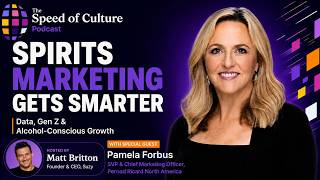
Pamela Forbus, CMO of Pernod Ricard North America, built her career blending data with storytelling. She's shifting the spirits industry toward Gen Z through RTD cocktails and low-ABV options, using 60,000+ consumer interviews to guide everything from product to retail.
Chapters
Up today, we're gonna be speaking with Pamela Forbus, SVP, Chief Marketing Officer, North America, at Pernod Ricard. Pamela, so great to see you. Thanks so much for joining today.
Thank you, Matt, for having me. Pleasure.
Yeah, absolutely. You've had a fascinating career and have worked with some of the most prolific brands in the world, and I'm really excited just to dive into your journey today. If you think way back to when your career started and you entered the field of marketing, Was that something you always thought you wanted to do or did you kind of just stumble into it?
Well, my parents are public school teachers and I had a lot of interests and almost went to art school. So my dad's an artist, art teacher, and I thought that creative field is where I wanted to go. But I had so many other interests and one of my friends' dad worked at an ad agency. And so we spent the day there when we were seniors in high school and I was like, this is it, this is it for me. I need to be in the space where it was just alive. And I saw the creative and I saw, you know, just business people. And I said, I need to be placed, be here. So I made it my mission to get to an ad agency, which I did the day after I graduated. I started in the mailroom.
Oh, wow. You actually started in the mailroom. I did. Hyperbole, but you actually did it.
It was a requirement. 6 weeks in the mailroom. And then traffic. And then it was about, you know, you had to get promoted out of traffic.
So that's funny.
The old days.
I know I have a lot of young employees at Suzy and they're all great, but you know, none of them want to work in the mailroom. They all want to be promoted every 6 weeks and they probably deserve it. But it's just a different world today in terms of level of expectation. But it's good to know you kind of cut your teeth there and you spent the first 13 years of your career in the advertising industry working basically on Madison Avenue for Young Rubicam and Chiat/Day and Campbell Ewald, some of the most prolific ad agencies. What was that experience like and what were some of the takeaways that you think helped you as you went over to the brand side later in your career?
It's great. Of course, you know, the agency business is definitely for the young. I'll just say that. Why is that? It's just, it's fast-paced. It's really fun. It's, you know, the offices are cool. The travel, the production. It's hard work. It's overnights because, you know, everything rolls downhill and any kind of timelines get compressed and you have to figure out how to deliver. I worked, I grew up in Detroit suburbs. And so all of those experiences were Detroit automotive. So I was in automotive. We had big budgets, you know, back then. And they were always at the top of the media spending. Right. So, and we were full service agencies, media, creative, you know, experiential. So I learned a lot. I think specifically I learned how to make great presentations. And I was, you know, on the forefront of when before PowerPoint there was a thing called Adobe Persuasion. And so we were the test to figure out how to build slides in this new software and that whole razzle-dazzle of, you know, wowing your clients and making great presentations and connecting them with storytelling, but also visualizing what you're trying to accomplish. So yeah, I think that skill was really honed. When I was at Shiseido is when I learned about account planning and I again fell in love again and I wanted to be an account planner. I wanted to be on the strategy side. I was doing account service at the time, so it was a hard transition when you're already pretty senior in account service to make a transition over to account planning and not take a step back. So it just didn't really happen for me. So I started thinking about, well, I don't know if I'm— the ad business is in it for me for the long haul. And I took about almost a year off and my husband was transferred. He was in the agency business too, to open an office in Dallas for General Motors. And I took some time and I said, I think I might wanna try this research firm strategy, you know? So I went to work for a couple of small research firms and that's where I started to kind of get experience. Went back to school a little bit, got, some new learning. And then I took a contract position at Frito-Lay, which was like a mile from my house. And I was a contractor just working on a couple of projects. And within a couple months, they offered me a full-time position. But I took a huge step back, huge cut in salary to start my career over. But it was the best decision I made.
Do you remember grappling with that decision, Pam, like saying, is this really right for me? Because a lot of people, they do think short term in Oh, I'm taking a paycheck back. Should I really do that? And you have bills and, or is that an easy decision at the time?
Well, so we, we, my husband's pretty smart, I'll have to say. He's like, when we moved to Dallas, let's figure out how to do it on one salary. So we just adjusted to that. I took some time off and then anything I brought in was extra. So, gotcha. I'm like, and I did have another offer at a research firm to be like head of sales and grow, you know, growth and My husband's like, no, no, no, no, you go to that Frito-Lay job and you've got to do it. So I said, okay. I took the ego hit, right, of the title and all of that. But I was there to learn. And I'm a voracious learner. You can see books in the background here. I'm always trying to stay up to date on what the latest thinking is in business books. So I felt it was a great opportunity for me to learn. And what was interesting, within 7 years I was VP of the whole department. And that happened because, you know, the 2 or 3 years—
Insights and Analytics Department.
Yes. So 2 or 3 years, 2 or 3 years I'm learning the functional expertise, but I already knew how to give great presentations. I knew how to create great decks and storytelling. So those two, once I finally brought them together, I sort of stood out, uh, among my peers, I think. And, and, um, I, I just loved being sort of that right hand to the CMO. I call myself the CMO whisperer.
Well, I think most people who sit on top of insights and analytics should be the CMO whisperer. And if you think about it, you know, you talk about storytelling and what you learned in your early days on Madison Avenue, and ultimately the output of insights and analytics is stories, right? It's not just graphs, it's not numbers, it's a story that people can believe. It's backed by data that gives people conviction to make a decision to move the business forward or in a different direction.
Yeah. And I learned some things from the account planners. You know, they were really good at talking about why the consumer, the person, was going to really be, you know, moved by this piece of creative. And so I worked really hard to always humanize data. I love data. I actually have a minor in computer science and just because I loved it and Math came easy to me. So that blending of art and science, or left brain, right brain, was, you know, really innate in me. And so humanizing the data storytelling also was something I learned from some of those account planners.
Yeah. And you joined PepsiCo in the year 2000, which is really the dawn of the internet. I tell my kids the same thing. I started my career when the internet was starting, and they look at me like a dinosaur. But The reality is the internet itself is not even that old in perspective with history. It's, you know, people who are born with it, I think, don't really realize it.
No.
But, right, but the world changed so much over the 17-year career that you had at Pepsi because, you know, you had very early in the 2000s the advent of social media and YouTube and, you know, fast forward to where we are today and it's a whole different world. How did all those advancements in technology change your role as overseeing the insights analytics function at Frito-Lay?
Sure. Well, you can imagine there were the early days of mall intercept research. Yeah.
Phone calls. I remember the focus groups at the malls.
Yeah. Yeah. Or the phone would ring. Can you take a survey? And, you know, moving to an online survey was like, there were old school people who were just like really afraid of that. Like, so, um, the discipline changed a lot. But I think where the career changed a lot is post the '08 crisis.
Right.
In what way? So I took the leadership role of the function in '07 and then '08 hit. And all of a sudden we were being asked different questions. It wasn't just about the consumer or, you know, the brand marketing. It was what's going on with our business? Is it going to slow down? Is it slowing down? Is this a consumer problem? Is it a demand issue? So that crisis, because we had taken quite a bit of pricing in the '08 crisis, and when you come out of that in '09 and '10, the business slows down because you can't take more pricing. Demand was returning back to normal, kind of like the COVID situation.
Right, right.
Sounds familiar, right? Huge demand splurge and then back to normal. When you're back to normal, The business leaders freak out. Is, you know, is snacks, you know, are people snacking less? Are we going to, you know, is this, you know, is it because of health and wellness? Well, what we learned was when we tore apart the business and I became more into business analytics, then we did a lot of it to ourselves. The pricing actions and other things we did kind of slowed the business. And we proved that there is a lot of consumer demand still, which clearly in hindsight you can say, yeah, you're right. There was a lot of demand. So we had,— I'm going to say invented, we kind of co-created and leveraged BCG a lot too, to really understand consumer demand. What are the choice drivers of each of our type, our products and brands? And do we really understand the drivers of choice? And it was a different type of research and it wasn't just research. It was a full-on consulting project. Like we changed the entire company, including our our manufacturing outlook. So for, I'll just give you an example that was the biggest one was through this demand work, we, and foresights of where the consumers were going, population migration, we said there's going to be a huge increase of small bags, multipacks, as well as, you know, convenience stores, dollar stores, small bag desire, not just the big party bags. Right. Well, we, we didn't have enough manufacturing capacity for the demand we were predicting. And so through that work, we were able to get more cap— capital expense budget and build more lines and drive more, more capacity for our small bags. So that's just one example how it starts as a little consumer research, but it impacts, you know, every part of the organization.
Yeah, it also impacts your retail footprint, your merchandising, probably promotions, pricing, go-to-market. So I think when you talk— when, when people talk about consumer centricity and putting the customer at the center, it's not just about having them give you feedback on a social media post. It's what you're saying, which is core structural feedback which changed the trajectory at like a tectonic level of your business.
Absolutely. I always say, like, I am a consumer data advocate. I call myself the Moneyball marketer, right? Like That is consumer centricity. The, the, all that data is consumer data. And if you listen to the data and you follow those, those data trails, you're, you're, you can see where it's going. Yeah. Um, a lot of it's very— humans are very predictable.
I agree. And it's funny, like, we— I talk often of the HIPPO, the highest paid person's opinion, and I think a lot of companies are plagued by that, right? That like they'll have a presentation, everyone's looking to the person at the head of the table who's often somebody who's disconnected from the core consumer, sitting in ivory tower, make decisions. And those are the companies that get blindsided by disruptors. But as long as you have your finger on the pulse of the consumer and you know what they're thinking and feeling and you're, and you're agile and active, well then you can kind of future-proof your business.
It, it was an incredible journey post the '08 crisis and it totally changed my entire way of approaching how to do consumer understanding. And we had a lot of success. And my CMO, who is my boss today, so Anne McCurdy was the CMO at Frito-Lay. Oh, wow. She got promoted to a global role at PepsiCo and brought me along. And we did this across 30 countries for snacks and beverages. And it was a great ride and it really left an impact. And, you Now we're back together. She went on.
The band is back together. Yes.
She went on, I went on, and then we got back together and we're doing the same sort of playbook approach, not the same exact playbook, but the same approach to demand-centric understanding.
So, let's dive into that. So, you joined Pernod Ricard in the year 2020. So, that was an interesting year, obviously, to join a company that's spells, sells alcoholic beverages. Yes. Um, some ways a, a boom time, right? I remember doing a lot of research during that period on the space and obviously the on-premise business went to zero cuz no one was going to bars and nightclubs, but then you had so many more people drinking and making drinks at home and, you know, Drizzly was a big, you know, delivery service that popped up that Uber would eventually acquire. I imagine that was a really wild time to join Pernod Ricard in 2020 as CMO. Talk to us about journey.
Yeah, it was. I joined in June 2020, so it was smack in COVID. And the first year I was at home, right, trying to lead a new organization. And my boss said, white sheet it, revamp the entire marketing approach and organization, and what do you think we should do? So, from reorganizing the team, bringing in new talent, Laying all the foundational work on the demand data took some time. COVID was definitely, had many gifts for us in that time. The fact that we shut down a lot of experiential and on-premise means we were able to take that money. Some put it in the bottom line, but we took that money and reinvested in media. And so we had to have better campaigns, better—
What gave you the conviction to do that? Like, why did you think that was gonna pay off?
Little bit of that might be secret sauce, but we had data.
Okay, fair enough.
We had data that said that, and when we do this demand data, we also do what's called path to purchase understanding. So, we know the touchpoints that matter for consumption, whether it's on-premise or off. And we were convinced many people make decisions before they get to the restaurants, before they get to the store. Sure. It's highly planned, right? If it's highly planned, media's gonna work. You're gonna stimulate demand. And, uh, the whole idea of that is to make sure you're there when, when, when they're looking for you and you gotta convert. So, um, we, we increased our media spend, which means our marketing and our creative had to be more effective and not, not sort of this nice marketing stuff to do, but actually really effective. So we put a lot of rigor into how we created our campaigns and, A lot of testing. We probably overinvest in consumer feedback, but we're now— I don't think that—
I don't think as somebody who runs a market research software company, I don't think there is such a thing as overinvesting in consumer feedback.
Well, yeah. So I won't talk about the past, but there's a lot of data gaps in, I'd say, in the alcohol industry even. You don't have the robust data.
You don't have first-party data.
You don't have first party. You don't have data from bars and restaurants. You don't have even, even some states because it's state by state. They're not in the Nielsen dataset. So you've got a lot of blind spots and that's really frustrating to someone who loves data. So we look for ways to create our own datasets and we did that. And so that, that took quite a bit, big investment. We have over 60,000 consumer interviews. Over the couple of years during—
In-depth interviews that you're doing with consumers, the—
During COVID post-COVID. So we know what shifted, what changed. And consumers were, they were stocking a bar in their home for the first time. Yeah. And some of those purchases are probably still sitting there. So there was a big surge in demand, right? And now it's about getting them to consume so they can replenish that bar. But we did have quite a tailwind and I think thousands of new households buying our brands for the first time, probably. And so it was a great opportunity in that regard. And now that on-premise is back, experiential is back, we're just trying to reinvest in that smartly. So we right-size those investments as we grow. But it's been a great— it was very challenging though to inspire a team and do all this change all through Zoom.
Absolutely. Yeah, it was definitely a case study in leadership and change management and all those things. So it's not lost on me, Pam, that also, you know, you joined the CMO seat from really having a background in insights and analytics. Most people take the brand manager path to get there. I happen to believe that your path is the one that sets one up for success the best, because I do believe a lot of this is driven by data. A lot of it's a math equation, etc. You know, how do you look at the CMO job maybe differently given your background? Because I can tell you already just by talking to you, you're not bringing up creative and you also oversee 240 brands. So you almost have to have a, you know, a very wide lens in how you look at things. Yeah, it's not just coming up with a big idea because you have such a wide span of, of remit in terms of going to market.
Yeah. So, you know, a couple of things. I have brand VPs who are doing brand marketing and are in the weeds, right? Doing that. So what's— you're asking what's the role of a CMO? Creativity is in my blood and I love creativity and I fight to make sure our creative is working. My remit is so much bigger. I think of myself as the integrator, whether I'm integrating cross-functional teams to get behind the new growth strategy. It's almost kind of almost changed the business model, or I'm integrating data and analytics to set a strategy and inspire the organization. So I think data can get a little bit telling you what a lot, but it doesn't necessarily get into the why. Sure. And you think about performance marketing versus brand marketing. So performance marketing is very much about the data and What works, and you just do more of that, you get more, and you do more of that, you get more. And someone says, well, why is that? And they can't answer the why. Right, right. That's really, it's really frustrating because if you knew the why, you might, you'd actually might see new opportunities, right? And things that you're not solving for the consumer. So the what, integrating the what and the why is an important part of the job. And then again, it's all about leading an organization to capture the growth. So, you know, my priorities right now is, is really, we've got the foundation, we've got the strategy, we've got the data in place. How do we operationalize it to make sure every pocket of demand is captured? And so we're working state by state level, creating some really unique datasets to help our sales and distributors know when you walk into this account, here's the portfolio we should be selling. Which might be different than the count, you know, down the street even. So how do you see demand at a store level and make sure you have the assortment? So when I'm stimulating demand with all this marketing that we've invested in, the shopper isn't frustrated when they get there and they can find what they're looking for. So we're spending a lot of time on that right now, which I don't know if that's a CMO's role or— I mean, we're looking at media impressions at a state and city level to make sure, you know, we— where we are stimulating demand, where we have the, um, stock, right?
Another big part of the CMO role I know is about innovation. And, you know, you talk about listening to consumers in all these interviews, and I know that probably also uncovers new ideas, um, for, for new product lines, etc. One of which I know Pernod Ricard has been investing heavily in is ready-to-drink cocktails. Yes. Which, when I first heard about that, I was a little surprised just because I look at Pernod Ricard as a spirits company and, you know, it's not really— they're usually an ingredient versus the finished product for consumers. That's right. And this is a big leap. You know, what did you— what were you hearing from consumers that led you to this decision? Yeah. And how does go-to-market with a whole new product line look different than your core business?
Yeah. It's a great question. I think it was the number one white space we saw, or I would say underserved demand when we did our— Yeah. First demand work. You know, there's a lot of different moments of consumption. And some of those moments require extreme convenience. I come downstairs at the end of a hard day on Zoom, what am I going to do? I want to have a cocktail. I'm just too tired. I'll just open a bottle of wine. It's way more convenient, way more convenient, right? Or beer, right? So if, if I, what I really wanted though, was maybe a nice gin or vodka cocktail, but I just don't have the energy right now. And I actually don't even think I have the expertise because every time I try it, it never tastes as good as that bartender that makes it at that my favorite restaurant, right? So if you can make it ready to serve in a multi-serve bottle or ready to drink in a can, so much easier. Of course, the typical convenience moments might be on the go or at a, you know, at a barbecue cookout, but there's a lot— there's convenience in every demand moment. And some, some are, you know, even take a look at B2B side, the restaurant and bar, bars are really hurting for labor. A lot of the great bartenders went off and did something else and didn't come back.
And so it's a majority of open, open jobs right now is hospitality.
Yes. So how do you make cocktails more convenient for, I'd say, lesser skilled employees, right? So we're solving for that. So it, again, it's convenience. It was table stakes in snacks and beverages, you know, where I worked, but it was so unserved, undeveloped. And we got to the table as fast as we could, but there were people who beat us to that, right? So we're trying to play catch up. But we were also launching— we stood up a whole innovation hub to go after that space immediately.
Because it's a completely different way of doing business, I would imagine. Right. And your retail footprint is different as well.
Retail footprint is different. Think of the whole supply chain. Many of these products have end dates or expiration dates or best-by dates. You can have a bottle of vodka on your, you know, in your freezer for years and it doesn't expire. So that making sure we're servicing those retail accounts as often as we needed to, it's all, it's causing a lot of change.
So absolutely. So I think, how involved are you? You mentioned you have brand managers that oversee the 240 brands that Pernod Ricard has in their portfolio. How involved are you in creative and the actual messaging versus just the medium and the data behind it? And what have you found to be the most effective creative strategies at building your variety of brands?
So let me step back. Pernod Ricard globally has 240 brands. We've got, I don't know, 80, 90, 100 in the US. Still a lot. It's still a lot.
Once you pass 10, it just becomes a whole different ballgame.
And we were, Some of those are, you know, we just deliver and distribute and some of those we do marketing again. So I, I work, I'd say on about 26, 28 brands now. We just acquired a few. So 28 brands have full media and team and creative and teams behind them. Some of these brands are US only. So we have American whiskeys like Jefferson's and we, you know, we own everything from strategy and the website to, um, you know, all the creative and content. Then we have global brands like Absolut. Out of Sweden or Jameson out of Ireland, uh, Chivas Brothers, you know, is, uh, so we, we are the US marketing arm of those global imports. Now, before we came, a lot of, before Anne and I joined the company, I'd say, um, a lot of that process was the global brands creating a lot of global content that the US would run. Uh, when I joined the company, had decided to flip that and they are putting creative content directors in the US to create bespoke US creative because we needed to be more relevant and authentic to the US consumer. Now, if some of those can be global content, great, but most often we have a global big idea with bespoke US creative. So we're very involved. We're very involved with all the agencies. Briefing them. And then, you know, the— we create thousands of pieces of content around a campaign. It's not just, you know, you've got— we do platform specific because what works in Pinterest doesn't necessarily work in Instagram, doesn't necessarily work on YouTube. So we are now— we have, um, very big spreadsheets of Hub Hygiene, you know, and Hero content that we create. And we work very closely with those brand companies on the Hero content. And then We have a full in-house studio as well as, uh, I call them tier 2 agencies that help us get all of the rest of it done. Production, right? Yes. So, um, there's about, uh, 200 people in the marketing department if you count field marketing, commercial marketing, shopper marketing, brand marketing. Then I have a marketing accelerator team that has media, the content studio, all the data and ad tech, martech. That's all in one center of excellence because they're so interrelated. We do a lot of dynamic content with our DCO. So it gets pretty advanced. All of that was stood up again post-COVID or during COVID And once it's great, now it's fully operating. I call it our modern marketing machine is up and going.
Yeah, yeah, totally makes sense. And so it sounds like a massive operation. Um, one thing I'm sure you have your eye on is just obviously, uh, I know you're a student of the consumer and consumer trends and, you know, the Gen, Gen Z is, is getting older. The oldest, uh, Gen Z consumers are 24 years old, so they're well into the legal drinking age of alcohol. And Gen Z, you know, has been proven to drink less alcohol than older generations. Mm-hmm. So that obviously creates headwinds for your business moving forward and just makes it harder for you to compete and drive growth. How are you thinking about Gen Z, especially obviously there's cannabis legalization in so many states across the country, which I'm sure is something to do with it. So how are you looking at addressing that moving forward?
It's true. I think, you know, when we were young, what did we start with? Beer. And then, you know, I don't know that they are, they're starting with seltzers or— Right. We believe these RTDs, And they are lower alcohol content, and they are a nice entry point into spirits as well. And so we're following the trends very closely. Pernod Ricard has bought some no alcohol brands recently globally, and we—
That's a big trend with that generation.
Yep, that's right. So that's definitely on our radar and in the pipeline. But it then, you know, beyond that, just really understanding what Gen Z is thinking about. 21, we say 21 plus, right? These are a bit more activist consumers, I'd call them. I happen to have a child who's a Gen Zer. So they are not shy about sharing their opinions about companies and brands. And they are, you know, I remember launching the compostable bag of Sun Chips back in the day. And I just don't think the consumer was ready for, you know, what was required because when you make choices to buy these sustainable brands, sometimes you have to make compromises. For Sun Chips, the compromise was the bag was very loud. You can Google it. Right.
Sometimes it's taste, sometimes it's cost.
That's right. Cost, taste, or some— something in the experience is compromised and consumers just weren't willing to pay more or to compromise. So, but that's not true with Gen Z. They're, they're looking, they're watching, they're holding companies accountable. They're calling them out. So we, you know, we work really hard to just stand in our values, be authentic, whether it's Absolut with the LGBTQ community, our American whiskeys, we're building a highly sustainable, probably the most sustainable distillery in the world will be in one of our distilleries that we're committed to spending $250 million over the next 5 years. So if you think about it, we sell wine, champagne, and grain alcohols. We are an agricultural company.
So— Yeah.
Pernod, very much the terroir, the sustainability, the environmental sustainability is very important to Pernod. And so that will ring true to the Gen Z as well, I think.
Sure, absolutely. So shifting gears as we kind of wrap up here and looking to the future, what are some other trends that you have your eye on in terms of the consumer related to the category or even, you know, the media world at large that, you know, you're really interested in and think may cause you to kind of maybe rethink things as you've clearly done so many times in your career to date in terms of making the right pivots.
Yeah. Again, following the data, following the insights, I think the shopping experience for spirits is really painful in many cases. Yeah. It— the store experience, whether you're going to that liquor store on the corner, or, you know, try— every state's a little different. Sometimes you can buy it in the grocery store, but the selection's just not what you wanted, and so you're having to make multiple trips. Like, just really thinking through how to, um, improve that experience, the omnichannel experience. So we're working really hard to think about how consumers use digital content during their shopping experience to just ease that path, whether they're looking for a gift or looking for, you know, where to buy. So spending a lot of time on that. Also just working with our retail partners to just, you know, consult and say, you know, here's, here's, let's try some new things. So that's one of them. We are, you already talked about convenience. It's going to be here and be a trend from here to come. So we've got lots of ideas in, in the hopper for that. Look for some really new exciting offers from Absolute this summer. And let me think, I think those are the big ones. You know what keeps me up at night though is just this fight for attention. It's just so hard.
Harder than ever, right?
Harder than ever. And so the stakes are higher, you know, we're thinking a lot about different ways to create content to capture attention. It's not just the 15-second ad anymore or a digital banner. Like we really need to get inventive there. So maybe even, and you saw the headlines, a lot of agencies are investing in entertainment or content. And I think instead of just product placement, you might see it's kind of back to the old soap opera days, right? Where the brands were creating real content that consumers want to watch. So yeah, I think that could be an area of the future.
Absolutely. Absolutely. Those are all big areas for any brand right now.
Matt, you notice I didn't say AI.
I know. Yeah. So let's get into that. Why didn't you say AI?
I'm glad you asked. Good question. I think AI is going to be an incredible tool. And it will help us do, break the paradigms of what we think is possible. So in the future, I believe we're gonna have a concept, a big idea, but then let's have AI take it way farther, you know, just really break some paradigms. So when I, that fight for attention, I think AI's gonna really help us. So what's the but? Well, it's a tool and tools can be misused. Any tool can be misused. So there's a lot of, you know, a lot of interest in how do you do it safely and everyone's going to— it'll get tackled, it'll happen. You know, when you train AI on, for example, a lot of these tools are trained on open data. If you train it on your internal data, It's probably a lot safer, right? Yeah. So I can see it being a huge productivity tool for humans to get our work done differently and faster. But I also think it's going to help us see things that we didn't— help us see things that we don't normally see on our own and just really stretch our imagination. It's like an added creative person in the room with your creative partners.
So yeah, it'll be— it's fascinating to see how quickly this is all unfolding, you know, where it's going to really impact the consumer and impact brands. So, um, so to wrap up here, I mean, I was saying earlier, you've had a great career, you've worked for so many great brands, have, have really had such a deep-rooted experience and understanding the consumer. As you look back on your career, what are some of the decisions that you think you made right? Obviously you talked about taking the, the the kind of half a step backwards when you first joined Frito-Lay. And if you hadn't, who knows where you'd be today? You probably wouldn't be on the Speed of Culture podcast today. What were some of the things you think you did right throughout your career that maybe you'd wish to impart on some of our younger listeners?
Yeah, thank you for that question. A career progression, and when you think about career progression, you're thinking about promotions, right? Rising through the ranks. There's a point, and I'm going to say maybe around the director level where it's not about your functional skills, it's about your leadership skills. So I had— taking that jump is a big jump. And there were things that I was passed over for some big jobs at a point. And my first advice would be, one, ask for feedback. People, everyone has a buzz about something. Everyone has something that they're not Blind spots. Blind spots. That's it. And everything from asking for feedback about what you could be doing better. But think about this, like one of the best things I ever did was I was giving a big presentation to a global team. I asked my best friend to watch the audience, see where I was connecting, where I wasn't connecting, where was I losing them, what should I have done or said differently. Give me advice. Brutal feedback. And that per— I knew that person was taking notes and I could engage with the audience and I didn't have to like think about it. And it was fantastic. And it, it, it led me to go get a different presentation coach. So that leads me to my second advice is we are professionals, just like a professional athlete. I follow golf. I'm a big golfer and a golf fan. All of those professional golfers have multiple coaches, swing coaches, trainers. Nutrition coaches, right? They're at the top of their game and they're still getting coaches. So why shouldn't we? I've had multiple coaches in my career that have completely changed my career trajectory. Whether your company provides it or you ask, you know, or you pay for it yourself, it will pay back. If you're looking to get these bigger, bigger jumps, you're not gonna be able to do it on your own. And it's not because of your work.
You know what's interesting is that as I think about the younger consumer, and I know you mentioned you have a, you know, a Gen Z child and I have two, so I totally get it, is that in this social media era, there's such a pressure to be successful. And there's also pressure for kids to like get straight A's. And I don't know if straight A's is ultimately the goal because you, you're amazing at data analytics. It doesn't mean that you had to be great at history, right? Because that you being great at that one thing propelled your career. And it's better to be amazing at one thing than sort of like a jack of all trades, master of none, right? And I think ultimately, because of that, I believe younger people are just scared to hear their blind spots because they feel like they have to be great at everything. And nobody really is.
It's the fixed versus growth mindset. Yep.
Absolutely. Absolutely. People will follow that advice for sure.
Yeah. Interesting. I think that Just last comment on that. The fight for perfection and grades, at least when we were in school, it was all about getting to the best colleges, right? And I'm thinking that is going to get disrupted. It already has. There's enough evidence now that some of the best people come from very small schools. You don't have to get into that big— I didn't go to a big school. You can look it up on LinkedIn. I went to a small state college. And, but I'm a continuous learner. I'm, I didn't rest. So, and I'm very connected in the academia world. I've served on boards for Marketing Science Institute and I know all the top professors. So I, and I can, you know, I was intimidated in my younger years, but now I think I could have a nice conversation with any marketing professor and on any, any marketing topic. Pretty much.
Yeah. I mean, I think what's changing that is that the access to information and education is, is, you know, it's everywhere. So you don't need to be inside a prestigious school to learn from the best professors in the world. That's right. And you also, access to people is so much more now than it used to be. You can get in front of almost anybody if you have good content, if you have something to say, where in the past, unless you went to, you University of Pennsylvania, you couldn't really connect with people at University of Pennsylvania. You didn't even know who they were. So I think the world has changed a lot. It has. Yeah, and I think it is sending people down the wrong path, maybe to learn the wrong things. And the other big part of it is college is more expensive than ever before. It's grown at such a greater rate than inflation. Kids go to college, and then when they leave, they can't pursue their passion because they have to pay down their student loans.
That's right.
Right? So it actually sends them to do maybe things they're not good at. And so I think the higher education industrial complex definitely needs to change.
Yep. And it is.
Yeah, it is. It is. Absolutely. Well, this has been an amazing discussion. Finally, I mean, is there a quote or mantra you like to live by? I imagine it might be something around data, but maybe there's another side to you that we haven't discussed yet.
It's on my LinkedIn. So my motto is life begins at the edge of your comfort zone. Yeah, I love that. So it's not because I live at the edge of my comfort zone. It's to remind me to keep pushing to my outside my comfort zone. That's where I learn. That's where new opportunities come to me. It's, you know, I'm not really a huge risk taker. I'm very contemplative. I need to have the facts. But once I have those facts, I'm fearless in going forward to, you know, where I want to go. So it's important even at this point in my career. Like, you know, I have all these ideas that you don't necessarily want to verbalize because you're afraid that what if that, you know, what if that doesn't come true? You know, someone says you should write a book. I'm like, oh, I get stomachaches, but there I am. I'm on the edge of my comfort zone. That's telling me something. That's telling me that's probably where life is going to happen.
Right, right. Well, I really hope it does.
I'll definitely be reading it.
So thank you so much. It's been a great discussion. Thank you. Gosh, I feel like it could go on forever. So I'm looking forward to keeping things moving and seeing what you're able to accomplish at Pernod Ricard. So on behalf of Suzy and the Adweek team, thanks again to Pamela Forbus, SVP, Chief Marketing Officer at Pernod Ricard, for joining us today. Be sure to subscribe, rate, and review the Speed of Culture podcast on your favorite podcast platform. Till next time, see you soon, everyone. Take care. Hey!
More from Matt




MikMak’s Rachel Tipograph on Consumer Spending, Retail Media & Holiday Shopping Trends



Jaguar Land Rover’s Charlotte Blank on Luxury, Purpose & Experiential Storytelling



