Philadelphia Eagles’ Jen Kavanagh on Fan Engagement, Global Fandom & Sports Marketing
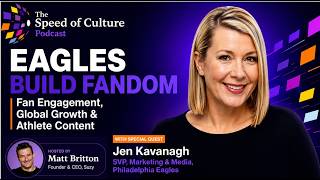
In this Speed of Culture podcast episode, host Matt Britton interviews Jen Cavanaugh, Senior Vice President of Media and Marketing for the Philadelphia Eagles, to explore how the organization leverages winning on‑field success to deepen fan engagement, expand globally, and innovate with technology. Cavanaugh explains her cross‑functional role overseeing media, creative, data, analytics, and consumer relations, and how the Eagles’ multigenerational fan base is reached through storytelling, player‑driven content, and NIL initiatives. The conversation covers the evolution of the in‑stadium experience, the integration of sponsors with community‑focused programs, and the team’s push into international markets such as Brazil, Ghana, Australia, and New Zealand. Cavanaugh also discusses the growing importance of immersive tech (VR/AR, dome experiences) and AI for asset management and content creation, while emphasizing the importance of trust and culture within the organization. The episode concludes with career advice—being deeply curious and prioritising progress over perfection—offered to younger listeners.
Chapters
Up today on the Speed of Culture podcast, I'm super excited for this very special edition with Jen Cavanaugh, the Senior Vice President of Media and Marketing for the 2025 Super Bowl Champion Philadelphia Eagles. Jen is a leading voice in sports marketing, driving the Eagles' global brand and fan engagement around the world. Jen, so great to see you.
Thank you for having me, Matt. I'm so excited to be here.
So Jen, you might not know this, but our listeners do, but I am a lifelong Philadelphia Eagles fan. I grew up outside of Philadelphia, uh, started going to games with my now late father when I was 8 years old. I saw the Eagles win the Super Bowl with my son. It's a huge part of my family and my life. So I'm just really excited to be on the call with you and have this conversation.
That is a surprise. A wonderful surprise. No, I absolutely love that. Well, this is going to be real good, isn't it?
It's going to be a lot easier because my last interview with an NFL executive was with the CMO of the Kansas City Chiefs. Yes. And that was actually before the Super Bowl. And if it was after, it might have been hard for me to gloat. But it was before the Super Bowl occurred. But this is going to— it's like I'm playing a home game right now.
Well, Lara's wonderful. I'm sure it was a good episode. She's fantastic.
And it was a great interview. So— and it was fascinating talking to her about just dealing with the whole Taylor Swift mayhem.
Yeah. How interesting is that, right?
I'd love to hear from you how you describe your role for the organization, what success looks like, and what a normal week looks like, you know, in a day in the life of Jen Gasol. Yeah.
Well, the way I I think about my role, I oversee several different business units. So in addition to marketing and media, I oversee creative, data and analytics, our consumer relations team. And so that being said, I think the best way to sort of characterize all of those groups in the simplest way is, you know, we are the groups responsible for sort of engaging with fans on the front lines, not just fans, but also our partners. And so Everything that we do and think about and ideate around and engineer is with the intent to engage, you know, fans, partners, our community, that sort of thing.
Gotcha. And, you know, I see you joined the organization in 2018. Yes. And obviously as somebody who's been a fan, I don't know, since, uh, the, the mid-'80s, I know that this period of, you know, 2018 through here in 2025 has been the the most winning and prolific period in franchise history. So I'm not sure what you had to do with that, if they just started winning because you're in the organization. But my question is like, what does winning do for your job in terms of allowing you to be on your front foot when it comes to marketing? How does it change your role versus if you were marketing a team that continually had a losing record and didn't make the playoffs?
Well, listen, winning makes everything better. We say that all the time. But the, The practical realities of winning frequently on the business generally means that, um, you do have a really engaged fan base. You are selling tickets. Partners are leaning into their relationship with you. And when you're not, in some cases, you know, that is definitely more difficult. What that means for us, um, is one, we have great partnerships, uh, many longstanding partnerships. We obviously have a great fan base. They're multigenerational. Our season tickets have been sold out for a very long time, and I expect will be, uh, for a very long time. And, and so for us, it means that we get to focus on other things than maybe some other teams in marketing do who need to sell tickets, right? Those are people who are focused on, you know, uh, moving that needle, very transactional. Not that they don't do other things, but, um, because that is not really a need for us, we get to really lean into I think the storytelling space, our content strategy, our content distribution strategy, maybe a little more heavily than some other clubs can. Yeah.
So let's talk about that. Because obviously the way that fans consume the game is so much different now than it was 5, 10, 20 years ago. The best way I like to describe it is a lot of younger Gen Z fans, you know, they love the song versus the album, right? They're, they're consuming highlights on TikTok, they're participating participating in fantasy football versus maybe just loving a team and only that team. Yeah. What have you found has worked in terms of driving engagement with the Philadelphia Eagles brand with both your current fan base and tomorrow's generation of fans?
Yeah, I would say it's not even always just the song. Sometimes it's the bridge. I mean, even to use your TikTok example specifically, you know, you can fall in love with that one snippet and that causes you to want to dive deeper. I think the best sort of analogy to that in our world are the players as individuals. So there's all kinds of doors and doorways into fandom. And, you know, I've heard other counterparts at different teams, sometimes in different leagues, say that, you know, fans are fans of specific players and therefore they move around when those players move around. That's not really the case for us, which I feel great about. But they do, they do connect with individual players in different ways, whether it's their personality, their interests, their values that may align. And so that to me are, those are the like micro moments that we have to connect with fans in addition to, you know, hopefully pulling them into our culture and what the experience is like as, as an Eagles fan.
Yeah, I think another thing that's changed is you used to never really get to engage or even see the lives of the athletes beyond them on the field or on the court. And now there's this whole kind of alternate universe of athletes where you can see what they tweet about. You can see what they're wearing walking into the stadium on game day or on ESPN or NFL Network. So there's so many different ways to interact with these athletes. And they have their own ventures in their own right. They're launching fashion brands. They're doing all sorts of— entrepreneurial ventures. So how does that sort of, you know, I guess, multi-pronged engagement strategy unfold for you at the organizational level?
Yeah, I think what you just described is a very recent and I would say seismic shift in the way that athletes think about their brand and how early on they are strategic about their brand. I think NIL has really changed that. So what— The way that we see that play out is where 6, 7 years ago, we may have had, you know, a group of players who weren't so interested in social media, really wanted to just focus on the game, you know, not particularly interested in making content. Now we have players who come in the door day one and they want to understand the community. They want to understand how to contribute. They want to understand how to connect with the fans. They're in the locker room with us, you know, having fun, which translates into great content, certainly for our social channels. And for YouTube. So there's just this like baseline appreciation, um, that doesn't require us anymore to so much explain the value of why it is we're asking them to do what they're doing. And the other aspect to it, which I would say is probably, you know, the, the most important part of the secret sauce and the thing that, you know, money can never buy us, then that's the trust factor. Between, you know, our teams and football. That's ultimately what gives us the ability to really lean in, to get the kind of access that we get. In many ways, that's unrivaled. So that cannot be accomplished without trust. And that's something we've been very focused on building over time. And I think you're really seeing the benefit of now.
Absolutely. Another thing I've seen the benefit of as an Eagles fan is just the, in-stadium experience. So I mentioned when I was a kid, I used to go at Veterans Stadium and Lincoln Financial Field looks nothing like Veterans Stadium. And the experience is, you know, is so much more upscale, is the best way I put it. And there's so much more going on. How much strategy goes into evolving the in-stadium experience and what are some unique things that you guys have executed more recently that you found success in?
Yeah, that's a great question. We spend a tremendous amount of time thinking about game day and I'll say, you know, the flow of the the game. So there's so many moments throughout game day that are designed to do something specific, whether that is get, you know, players really amped up right before a big defensive play, get the crowd really loud, you know, when the opposing team is on offense. And so the type of music for those specific moments that we lean into are the things that we sort of have in our arsenal, talk about a lot. We want it to feel like a party, and a party at a 1 o'clock game is different than a party at, 8 o'clock. So one is a little more maybe family-friendly, one is a little more, you know, adult. So everything from how we can leverage, you know, lighting and really amplify performances and be dramatic, um, everything, you know, how we use all the tools in our toolkit can vary based on things like time of day, um, or specific moments within the game. So we do spend quite a bit of time thinking about that. Some of the things we've done recently that I think have been fun, um, pulling in artists that are big Eagles fans that can be a part of the game day celebration. Like last season, you may have seen Gillie and Blow the Whistle was, you know, sort of became the anthem of our season. And so previously, you know, Lil Uzi and Meek Mill and just finding fun ways to connect fans that the other fans love because they're famous and well-known into the game day experience. So we love to do that.
Yep. And this past season, the Eagles kicked off their season in Brazil, and it was sort of, you know, it was on a Friday night, which was kind of jarring and different as an Eagles fan, and we won, so it was all good. But, um, it's interesting to see the NFL follow the path that the NBA has followed by trying to globalize the game and, and bring it to new markets. Obviously, the NFL's long played games in London as well. Um, what is the global landscape like in terms of fandom, uh, as it relates to both the NFL and the Eagles specifically?
Well, it's incredibly exciting, I'd say, and we're in many respects just getting started. So we have marketing rights in Ghana, so West Africa, Australia, New Zealand, and then very recently Brazil. And what that essentially means is that we are able to, you know, activate in those markets and countries. We're able to do fan development there, host watch parties. And that's really what, you know, the intent is. And different teams are in different territories. Uh, but ultimately I think between the growing number of games that you're seeing that are being played overseas and more teams going into more territories, uh, I think we're, you know, going to see more international fandom, which, you know, sometimes again starts with, uh, identifying or liking something about a team's brand or a piece of social content or a specific player. And sometimes it's, you know, because a game was played there and you had a chance to watch it. And other times it's because you have. DAZN, and therefore you have Game Pass, and you can actually watch football games, which, you know, access to the game itself can be a little challenging depending on time zones and that sort of thing. But I think the globalization of the sport is incredibly exciting. I was in Brazil. It was so— it was so cool. And what I remember the most about it was that it felt like this mashup of American football and soccer because there were like anthems that would break out and people singing. And to me, that was exactly how it should be, right? Because you go into a market, um, or a culture that is different from your own, and you want to be able to sort of like see yourself there and connect, but not at the cost of not integrating, you know, their culture. So that was, um, that was really special.
Absolutely. I'm sure. I know another part of your role is sponsors and integrating sponsors into the overall business. How has the, the needs of sponsors of NFL teams like the Eagles evolved over time as well? And, and what are some of the tried and true tactics that you're really leaning into for the team sponsors?
I think, you know, our partners' appreciation for the value of our digital and social assets has increased.
Because of the engagement, right? They're all looking for digital engagement. You're the conduit for it.
They've always understood, I would say, the value of, you know, signage in the stadium and the value of things that we do to connect with and improve the quality of our community. But really understanding the value of the stories that we're telling and the content that we're creating and the number of people that it's reaching. Has been, you know, very, very positive. I think, you know, they have also really embraced, you know, things that are important to us that are also related to growing the game, like flag football, getting more girls to play flag football, removing barriers for girls by making sure that they have the sports bras they need and the equipment that they need. And now we just, you know, every time we sit at the table, you're not only talking about sort of the assets you'd expect, you're talking about,, you know, community elements that, you know, have big impact that they want to make sure are included because they value those as well.
Yeah, for sure. And when you think about just contemporizing the brand, obviously you talk about new fans and old fans and NFL teams, especially those like the Eagles, they're rooted in tradition, right? But the story needs to evolve over time. So, like, how much time do you spend thinking about, like, the story of the franchise, everything from the words you're going to use the way you're gonna describe the team. Like I would, because like there's the, you know, as an Eagles fan, like you have the like Fly Eagles Fly fight song, which like, yeah, like kind of just like took on a resurgence of its own, especially with the team winning. And that's an example of like an old song that was written a long time ago that young people love.
Yeah.
But there's probably other things you wanna sprinkle in to have the team have an evolved identity over time. And I'm just wondering like what that process is like.
Totally. Well, you said it, we have some really special traditions and assets within our brand Fly Eagles Fly being one of them, Go Birds, as this kind of unified way of everywhere you see somebody at the airport, they're wearing Eagles hat, Go Birds, Go Birds.
You just walk around them.
It's like, yeah, it means hello. It means, yeah, have a good day, all of that good stuff. So those things are really core to the brand. They've been around a long time, but we love to embrace the moment. You know, every year we sort of sit down at the end of the season and say, you know, where are we and who are we? Because the identity of a team to a degree does change from season to season. You have different players, you have different things that have transpired. Culture, um, changes, you know, the external factors of the world can influence, um, where we are at any given time. And so we really do spend time sitting down, talking about assessing and writing a, like, a little bit of a story of where we are and what we look like going into the following season. I think we give ourselves permission to embrace things that come naturally, Um, Gilly and blow the whistle is one of those things, right? That wasn't planned. That was something, uh, that was very organic that fans embraced and we were like, man, let's have fun with this. Um, but conversely to that, you know, a few years ago when we launched It's a Philly Thing as the sort of, uh, slogan for the season, that was, you know, more intentional, but also a reflection of something new and different that might not carry on indefinitely from season to season.
How much testing do you do if you have a campaign like It's a Philly Thing with fans, like how much of that is consumer-centric or how much of that is based upon, you know, the internal people in the organization making that decision?
I wouldn't say that we do any sort of overly extensive testing on these kinds of things. Some of it is instinctual. There are ways to soft launch ideas and see, you know, how fans respond to it, whether that's, you know, on social or what have you. But we usually just make a bet. Let's make a bet based on what we know and what we've seen. We spend a lot of time listening to the fans and take a lot of pride in knowing where they are at any given time. So I'm sure we've had our misses. But for the most part, that tends to work out pretty well.
I'm sure. So the game has evolved a lot. And one thing that has proven true is the fans' insatiable need for just immersion in the game. So we see concepts like Cosm, which is like— almost like a sphere-like structure. There's one in Los Angeles where it's like this dome and you can watch a game with different cameras. Of course, there's the Sphere in Las Vegas, and then you can use like the Apple Vision Pro. And even though that's not greatly adopted yet, it immerses you in a game and, you know, in a virtual reality setting. How much of that type of technology, technological evolution, do you think is going to impact the fan experience over time? Like, do you see things changing in ways that fans watch and engage with the game both at home and maybe even in the stadium?
Yeah, definitely. So two things. One, I think it is going to have a huge impact because if you think about it, you know, there's only 70,000 seats at Lincoln Financial Field. That means a very fixed number of people who are Eagles fans are going to be at any, you know, one game. And yet we have millions and millions of fans all around the country and all around the world. So having that kind of immersive access to the game I think is really, really important. Maybe a little more analog than that, but very important are, you know, communities of Eagles fans who get together to watch the game. But, you know, people have a choice. They can stay home and watch it generally. But in many cases, they like to be together. So there's a lot of community within the community. And I think that that is an incredibly important part of having a healthy fan base. And we want to nurture that. Absolutely. So. Inasmuch as we can, you know, identify those watch parties and amplify those watch parties and send jerseys or send the mascot, or do things to say, hey, we see you and we want to make this, you know, little community that you've developed as special as possible. I think that, that matters a lot as well.
Yeah. And speaking of the future, how much time do you spend thinking about AI in your role? Yeah. As it relates to either the fan experience or your marketing or content or whatever it may be.
Yeah, a decent amount. I think the practical realities around AI and our sort of daily business operations look something like, you know, being able to manage our assets more efficiently. We have and traffic a lot of photos and videos to a lot of different people, media, colleges, etc. And being able to do that in a much more efficient way is, is definitely a plus. I think we follow what's happening in the generative AI space very closely. It's interesting, the idea of, you know, content creation independently via just AI, though I wouldn't say we've leaned exclusively in that direction, but certainly, certainly interesting to follow. Understand there will be an impact at some point for us down the road, but more I would say today it's a business operations benefit.
Yeah. And I think it's like when you talk about fan engagement in areas like fantasy sports and obviously online gambling, which has exploded. Yeah. In recent years is now legal in a majority of US states and, and obviously drives a lot of engagement in the NFL. AI seeing its way into those areas very quickly. Absolutely. With the startups in that space. And I think it's gonna continue to, you know, be part of the fan experience when it comes to stats and data and all sorts of things. So it'll be, Interesting to see over time for sure, but you still need players on the field to make the plays. So that one, hopefully we won't have robots replacing Jalen Hurts anytime soon.
Hopefully not.
So, uh, shifting gears a little bit. So, you know, there's so much that's been made about like the Eagles culture, uh, everyone from the owner Jeffrey Lurie to Howie Roseman, the GM, all the way down. Like, what is it like to work at the Philadelphia Eagles organization? And what are some parallels between a winning culture on the field and a winning culture in the office within the organization?
Yeah, I love that question because I believe, I know, and I say all the time that I think we have one of the best cultures one could ask for. It is extremely authentic. Everybody in this building is aligned when it comes to why we're here, and that's to fulfill our mission to inspire and serve the greatest football community in the world. We just all do it in our own ways, right? So, there's a, there's a unification that comes with that. I think we win and lose together. Um, everybody in this building is a fan and wants what's best for the team and what's best for our fans in the community. So I think that is, um, that's incredibly important and, and definitely translates in the work we do. And as you said, you know, with, with Howie and, uh, Jeffrey, I mean, it really starts at the top. So Jeffrey Lurie set a culture, I think of creativity and competition and innovation. And so everyone kind of lives that every day. And in, in the types of players that Howie brings into the building, and he's talked about that sort of publicly, you know, character is, is really important. And we believe that about our players. And as much as, you know, the people who work on the business side here. So it's, we're incredibly fortunate in that way. Yeah.
I mean, there are so many parallels between sports and business. I say it all the time, like you could have somebody at your company that is such a great individual contributor, but they, they, they take all the shots and they, you know, they don't make the other people around them better. Right. And maybe they complain and, and, and kind of, you know, denigrate everyone else around them and they think they're great. And even if they are great at what they do, it, you know, greatness is in the agency of others. And I think the same goes to being on the field. And I just think there are so many parallels every day where if you look at, in a lot of ways how winning teams are built, it, or winning businesses are built. It does start with culture. It starts at the top. It starts with leadership. And it starts with, you know, a certain philosophy. And over time that translates all the way down the organization. Yeah. And you see companies lose that script all the time. And you see teams lose that script all the time.
You do. And it's really important to have culture keepers, which I believe we do have in this building to make sure that that doesn't happen. But you sort of said what was Coach Sirianni's mantra for last season, which is, "You can't be great without the greatness of others." But it's a great example of what was driving, you know, the mindset on the football side of the building. And I remember my first day of work, my boss handed me the book Leaders Eat Last. And that, you know, said a lot to me about the culture of leadership here. And if something's got to get done, we're all getting it done. You know, SVP shovel snow. You just do the thing you have to do. I have never shoveled snow, but I've done other things, you know,, um, to pitch in when needed. And, and I think all of that does add up to great work, um, and certainly winning on the field.
Yeah. So I'd love to just talk a little bit about your career journey. So, you know, you spent time at NBCUniversal in digital media. Yeah. And you've spent time running your own, um, consultancies.
Yes.
And now you're ending up, uh, you know, running marketing for the Super Bowl champion Eagles. Had to throw that in again. Um, but tell me about your journey and maybe some of the, right decisions that you've made along the way that put you in your seat that you're in right now? Because we have a lot of younger listeners of the podcast that are maybe just getting started, trying to figure out where they need to lean in, whether it's relationships or skill sets, etc. And I'm just curious what, what's worked for you.
Yeah, well, I don't know if I thought I was doing the right thing at the right time always, um, but looking back, I I did manage to put myself in the right place at the right time with respect to being sort of on the edge of my business category. So early on that was digital. What is the impact of digital on linear television going to look like? And then it was social. And what's the impact of social on linear television going to look like? So on and so forth. So that was, you know, in some cases strategic and in other cases maybe a little accidental. I think that curiosity has really propelled my career in a lot of ways. I always want to understand sort of how culture is interacting with the business that I am in, and I tend to go maybe a little too deep there sometimes, but it has helped, I think, center me on the jobs and the roles and the areas that are right for me at the right time and the ones that maybe aren't so much. So I always say, you know, be, be deeply curious, um, understand, you know, where people's mindsets are, uh, what their values are, how they're prioritizing things, what their unmet needs are, uh, because, you know, you may be able to fill one of those, um, regardless of what you do, but you have to ask the question first in order to sort of produce the answer.
Yeah, absolutely. So we always wrap our podcast up by asking our guests if there's a, saying or mantra that kind of summarizes their career journey to date. I was wondering what might come to mind for you.
Ah, definitely progress over perfection. I like— I'm a recovering perfectionist and I've never heard that phrase before. Yeah, it's taken a long time to appreciate that progress and momentum and movement and staying in the flow of things is more important than saying that you did something perfectly.
Yeah. And I think that's another sports analogy, right? Sometimes you'll watch a team and, you know, they don't seem fluid and they try to make everything perfect and then you try to over-perfect things and then you end up playing bad. Where you just get in the flow of the game, forget about things, just go with your gut. That's usually when teams really start to perform at optimal levels.
Absolutely.
It's a great— Yeah, absolutely. Well, it's been a fantastic interview, Jen.
Me too.
Thanks. Today's NFL Draft Day, so I know it's a busy day. For you at the Eagles organization. And thanks for all the work that you've done stewarding and building the brand as a lifelong fan and family who's a lifelong fan. And I really appreciate the organization, and I appreciate you taking the time to speak with us today.
Thanks so much for having me, Matt. This was so much fun.
Awesome. On behalf of Suzy and I, the team, thanks again to Jen Cavanaugh, SVP of the Philadelphia Eagles, for joining us today. Be sure to subscribe, rate, and review the Speed of Culture podcast on your favorite podcast platform. Go Birds!
Go Birds!
That's it.
Hey!
More from Matt




MikMak’s Rachel Tipograph on Consumer Spending, Retail Media & Holiday Shopping Trends



Jaguar Land Rover’s Charlotte Blank on Luxury, Purpose & Experiential Storytelling



