Pinterest’s Martha Welsh on Creativity, Commerce & AI-Powered Discovery
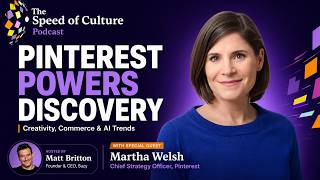
Martha Welch, Pinterest's Chief Strategy Officer, discusses how AI powers the platform's evolution into a shoppable discovery engine with half a billion monthly users. Over 40% of engagement comes from Gen Z. Pinterest's trend report hits 80% accuracy, and its Performance Plus ad suite doubled click-throughs.
Chapters
We're live here at Las Vegas at CES, and today we are thrilled to be talking with Martha Welch, the Chief Strategy Officer of Pinterest. With a career spanning finance, tech, and now leading strategy at one of the world's most creative platforms, Martha's diving into the future of consumer engagement and commerce. Martha, so great to see you today.
It's great to be here.
Thanks for having me. Absolutely. Pinterest has really, um, continued to grow in terms of its relevance, both with advertisers and consumers. For those in the audience that don't know a lot about Pinterest, describe what Pinterest is and why it has continued to gain popularity with consumers, and then we can talk about what it means for brands too.
Yeah, well, so Pinterest is an app and it's an inspiration platform. It's a place where you go to not just discover what you love, but it's also the place to take action. You know, we are the leader in visual search and discovery. And we have more than half a billion monthly active users across the platform. And people are coming there not only to dream, but again, to then realize their dreams, to take action. And so that can be anything from remodeling your home. It can be like finding that new recipe that you love. It can be fashion and figuring out what you're going to wear to CES and figure out some new looks and also discover all sorts of other things. I think the reason that it stayed so relevant is a couple of things. One, you know, it is inherently visual and it's one of the best places to shop. Yeah, I think that, you know, for the last 20—
what do you mean by shop on Pinterest?
Well, so I love that question because I think shopping is fun. Shopping is delightful. Shopping is discovering things. Shopping is walking the mall. Yeah, it's very different than buying. So if you think about digital commerce, the last 20 years, buying has been solved. But buying, right, buying is a utility and it's not always that much fun. Shopping It's just fun. It's inspirational. It's getting ideas. It's walking the mall. Well, at Pinterest for a long time, Pinterest has always been the best place for window shopping. Over the last 2 and a half years, one of the biggest changes that we've made is actually making the whole platform actionable. So you can actually not just window shop, but you can walk into the stores and find what you want and purchase it.
And a lot of that right on Pinterest, right on Pinterest.
And a lot of that is we're connecting to advertisers. Right. And so we're there to, you know, I think the relevance has been for users It's giving them more of what they want. They've always wanted inspiration. Inspiration is the urge to act. So now we're making it easy for them to take action. And for advertisers, it's also making it really seamless for them to find customers who are in market, who are undecided, who want to actually connect with customers. We're there to deliver a customer, not a transaction. And so that's what's been driving the, both the growth on engagement. It's been driving the growth on advertising. The last thing is, you know, one of the coolest things about Pinterest right now is Pinterest is aging down. When a lot of platforms age up and out. Yeah. Pinterest is actually aging down. Gen Z is our largest and fastest growing cohort. More than 40% of the platform and the engagement is coming from Gen Z. I think it's because we're also a really positive platform. There's a lot of toxicity out there in the world.
Oh yeah. More now than ever before.
And I think that people are just looking for a respite and Pinterest is a place where you get to be authentic. You're not trying to be on display for others. It's really a platform for you. And I think that that's resonating with users now more than ever before.
So like if you're remodeling a room in your house, you know, and you want to do like some online research, if you go and you type something in Google or Amazon, you're just going to find random products and it's not shopping. To your point, you're— it's very much you're laser-focused on trying to buy something where when you're on Pinterest through a series of creators and if you know your aesthetic, you can kind of see other people's It's visual search.
So if you think about Pinterest, part of it is this feed. And that's all based on what people— what your interests are, not just what you've told us, but also things that we understand from our interest graph of more than half a billion users, what people are doing in the platform that we can recommend things. But 2/3 of the platform is actually search. It's people typing in things. And it's oftentimes not like when you know exactly what you want. It's typing in something much— like you're remodeling your living room, and you're like, I'm looking for— oval coffee tables. I'm like, I don't know what style I want. I don't even know what my style is. I'm just looking. Well, that's a third of the platform. Another third of the platform is people clicking on pins, exactly as you said, and they're images. And that's how we all consume information. Like, we're incredibly visual species. And so we— this is the platform where you can actually just see something. You're like, oh, I like that. And then we can say, here's more of that, or see similar. And then when you're really ready to make a choice, you can be like, where do I buy it? Do I want the $5,000 one, or do I want the $50 one, or everything in between? And you can figure out your own aesthetic even when when you don't have the words for it. And I think that that's what's also resonating, is that so often it's like when you know exactly what you want, you know where to find it. But more often than not, we don't know what we want, and Pinterest is a great place to discover that.
Along with you, you know, continuing to gain momentum with Gen Z, has there been any use cases that have been emerging lately where people are using Pinterest in ways that they haven't in the past?
You know what we're seeing is that people are using Pinterest for more use cases together. So I think before, you know, you might go there for recipes, and some people are going for recipes, or some people might go because, you know, for home remodel. And then you're like, or, you know, I'm planning a kid's birthday party. What we're seeing now is that actually because of a lot of the AI models that we've been deploying, we're able to recommend use cases across. So we understand that if you're looking for new gelato recipes, for instance, you might also be really interested in like some cool new coffee makers. And that you might want that, you know, awesome kind of new espresso machine because you're like, yeah, if you're spending a lot of time, but you might also be thinking about, well, remodeling your home. Or your kitchen. Because if you're spending a lot of time thinking about gelato makers and like making your own gelato, you probably care a lot about the aesthetic of your kitchen. And so we understand these adjacencies. And so what we're seeing is that more and more people are using it across these different use cases as opposed to just one. The main thing about Pinterest though is people are there like, we don't have to divine intent. We're not trying to guess what you want and we're not trying to just do this like kind of super narrow. And it's like, it's really this curation platform. And part of that is, you know, I mentioned that, you know, two-thirds of it is search. Well, people are also saving on the platform. And so we have boards. And so that allows people to just click and save a pin, something that speaks to them. Well, they can curate those. And that all of that gives us massive amount of understanding of what you want, but also be able to associate other interests.
In aggregate, like you can say, like, this is how people group like-minded products together. So they correlate together and, and through aggregating that, And you really understand the consumer.
Exactly. You can say, for your style, you might want to, you know, have these shoes, but what's the bag that goes with it? Or, you know, for the house, you're like, increasingly we're able to take not just the image, but take the component parts because of our AI models. We can take the individual component parts. So through collages, you can take the image, but then you can say, oh, I actually really love that couch, but that rug isn't for me. And then you can take the rug from a different one, and you can create your own pin.
That's cool.
And then through that, we're making all that shoppable. So not only is it like, oh, I can see it and I like it, and that's a pretty picture, but it's like, no, make it all shoppable. And we're doing that by bringing on not just more products from organic, but advertisers are loving this. And we've grown the number of products on our platform from, you know, to hundreds of millions to now billions, because we're able to actually bring all of these products to make every pin shoppable.
Wow. So in terms of advertisers, you know, you mentioned them. What does an advertiser do when they execute on Pinterest the right way and are successful?
Well, Pinterest is truly a full-funnel platform. We are upper funnel, but we are also able to drive real lower funnel performance. And what we find is that when they do both, they get the best performance. And so, and we made it super easy through Performance Plus, which is our new suite of AI. Tools completely automated so they can just set their campaign objective and we can help them to deliver on it. We can also help them with things like creative optimization so that what we know is that when we deliver on relevance, ads are incredible content. We can help advertisers with that. We can make the pins feel native.
So rather than just a product on a white background, you need to be native, authentic to the user, fits in with their experience. Yeah.
And I think that that's where it's, you know, it's inherently visual. And so that's where we can drive performance and we're seeing a lot of gains. In fact, We've more than doubled the number of clicks out to advertisers year on year for the last several quarters. And so what we're seeing is that it's not only working for advertisers, it's also driving deeper engagement for users. And that's what you really want. That's what advertisers want. They want to be able to connect with customers. And I think that what we're delivering is a better experience for them, making it more actionable. And it's driving— it's driving the best product market fit that we've had for both users and advertisers in years.
That's great. I mean, one thing I really love about Pinterest and your approach from the marketing standpoint is that you've been able to successfully observe user behaviors and correlate them into trends because it makes sense because, you know, you, you guys can see at the very early stages if something's going to blow up because people are like, oh, wow, all these people are posting a certain type of design or chair or whatever it may be. And it allows you to kind of have a little bit of a crystal ball and you have an ongoing report that you, that you distribute called Pinterest Predicts. What is interesting for 2025 in terms of what Pinterest is predicting?
Oh my gosh, look, this is one of the coolest things that, that I think Pinterest does, and it's the trend before the trend. Yeah. You know, if you think about these other platforms, it's like everybody's chasing this ephemeral trend. These are enduring trends and it's all based on data-driven. It's all data-driven and it's based on what people are already doing on the platform. And it's through all this data of, you know, the curation, the saves, the boards, and seeing these associations that we're able to get these. For the last— we've had 80% hit rate for the last 5 years. It's just incredible. And so for this year, you know, one of the ones that I'm really excited about is Peak Travel, which is just like escaping to the mountains. And, you know, I just got back from Tahoe. I spent some time earlier this year in Vermont. I think that there's clearly something speaking to me about it, but I think there's a— there's something that's appealing to people about going to the mountains, probably a little bit of like our lives are also busy. So people are looking for simplicity. Another one that I think is really cool that we're seeing is just Cherry Coated. It's cherry red everything. We're seeing it in food, we're seeing it in cocktails, but we're also seeing it in outfits and what people are wearing in fashion. And that's the cool thing.
I've seen a lot more red recently. Now that I think about it, I really have.
And it's such a— and it's like it's one of those things where it's the trend before the trend. Well, we think not only, you know, it's, it's, it's the users on the platform who are, you know, through all this data that we're curating it. But we can also help advertisers to understand these trends. And it doesn't have to be, oh, you just sell, you know, the, the red lipstick. Or this, you know, certain, you know, cherry red lipstick. It's like, no, no, no, there's actually like, there's like this really cool men's blazer that's like that we can also offer to you depending on. And so we can deliver very personalized experiences for users. But with these enduring trends, I think the most important thing for these is that it's not about chasing that thing that's only going to last a week. And everybody has this FOMO and trying to catch up. These are trends that last for a year. You know, last year, one of my favorites was Eclectic Grandpa, which, you know, if you— it was like kind of these like, you know, sweater cardigans and kind of, you know, loafer shoes shoes. And it was kind of like you started then seeing all of these celebrities wearing this style, and you're like, nobody actually could put a name to it, but you start to see it. So interesting. This year, uh, get ready for fisherman aesthetic. So it's kind of stripes and wide leg shoes and those, you know, '90s fisherman sandals that, uh, you know, I certainly had and, you know, don't have anymore, but I'll get a new pair, right? Uh, and maybe we'll even see, you know, people headed to Santorini. You know, we see these trends across not just one vertical, we see it really across like a whole bunch of them. Rococo revival is another favorite of mine, whether it's Bridgerton. I don't know what's driving it, but a lot of that ruffle, that Baroque kind of seeing it in, in how people are styling their homes, but also what they're wearing. We're seeing it also in food, like with macarons and like kind of it's party styling that people are having. So it's, it's incredible to see these trends both endure but also cut across the verticals. And I think that's great for advertisers to be able to reach customers in many new ways.
Yeah, I mean, I often think about like, where do they really come from? Like, you know, red. Where does red come from? Is it something that's happening in culture? Is it that they're, you know, somebody, a couple people wore it during the Grammys or the Golden Globes and a woman wore a red dress and it got popular. I just, it's where it comes from is so fascinating to me.
It really, well, you're, you know, this is the speed of culture, right? And I think that that's where it's like, you know, culture, where does culture come from? And you have all these microcosms, but you start to see through the data. And this is where some of the AI models and Pinterest has always been this leader in machine learning and, you know, as a visual platform, we see how people are actually engaging with different content and you start to see these trends and there are trends before. And I think it's like, you know, where does it come from in culture? It's like we haven't always— in other platforms, you don't— people aren't there always curating content. They're there just passively kind of mindlessly engaging, resharing articles. Right. And it's like, but on Pinterest, they're curating for themselves. And so I think you get a more authentic understanding of what people's interests are.
Well, it's a place for creativity, and that's really what it's for. And creativity is where trends come from. Yeah, it's very much correlated. You've mentioned AI a lot in terms of how it's playing an increasing role in your product. What are some of the ways that you think AI is going to continue to evolve and improve the overall Pinterest product in the years ahead?
You know, first and foremost, it's like we're, you know, this creative platform, this curation platform. So we get so much signal of users. More than half a billion monthly active users telling us what they're interested in. And as they pin, as they save, as they curate, that's all feeding this understanding of Interest Graph. So we can deliver really personalized experience to you. And that's something that we've always done, but it's just getting better. Yeah. The other thing is on the ad side and for marketers, we can deliver better performance than ever before. And especially as we move to a more lower funnel, we're using that not only just to help them set up their campaigns and just take a lot of the effort out of it and automate it, We're doing it to make the ads feel more native on Pinterest. And we're also improving relevance. When we deliver on relevance, ads are great content. Ads are sometimes even better content because it helps people to actually take action to find that thing that they want or discover that brand they didn't even know about. In fact, using our AI models over the last 2 years, we've doubled the ads relevance on search ads or on our search property, which just allows people to be able to get a more relevant experience across the board. And so that's how we've been driving engagement and, and revenue. And we're going to continue doing that. It's— I feel like we've been a leader in this space and there's so much more opportunity.
Awesome. So let's talk about you and your role as Chief Strategy Officer of Pinterest. What does a day look like for you? Because obviously strategy can take so many different forms, whether it's how you go to market, whether it's how you position Pinterest to the consumer, the product roadmap, etc. So how do you prioritize what's most important on behalf of a really fast-moving, still what is a startup.
Yeah.
In a really exciting space.
Well, it is my happy place and there's a lot of context switching and a lot of navigating ambiguity, which I think is, you know, where my brain is happiest. There are 4 parts of my team, of my remit. So first, leading enterprise-level strategy and operations. So it's not just setting the most important strategic priorities for the business. It's also making sure you have the right operating rhythms and execution to ensure that you're delivering against them.
Yeah.
I think that, you know, strategy without execution is hallucination. And so there's a lot, there's a lot of that. The second piece is our global partnerships. You know, particularly, you know, as a smaller platform, but in just in general, partnering is one of the biggest force multipliers for executing against your strategy. And so a lot of my time here at CES has been meeting with partners and really figuring out how can we actually build, you know, something even bigger together.
Third, who's that type of partner?
Well, we have all sorts of partners across the content space. You know, we have ads partners, you know, all of ad tech. You know, measurement partners. You know, we, you know, there's, there's really, you know, every single person at CES is somebody that I'm talking to, right? The third part is all of our user support, advertiser support, developer support. That's important because that's your customer and you better make sure they have the right support models. It's actually a lot of ways that we can use AI to improve that. But the other piece that I really love about that is that is kind of your canary in the coal mine. It is the first place where, you know, if you don't have product market fit, 'Cause you're gonna see it. And so the reason for that is like, again, marrying strategy and execution. And then the last piece is one of the areas where I have the most fun, and it's our in-house incubation team. And it's a small product engine and design team that allows us to really disrupt from within, test ideas. This is actually where collages came about. So a couple years ago, we launched the side app, Shuffles app. We saw that people were, you know, this is where we can take the components of it. You know, you can take that one couch or that rug or that lamp bring it all together, take the outfit and you can put the shoes, bag. We're seeing that resonate so much. And this is one of these things where it's like, that was a really hard technical problem that this team came up with. And we've now incorporated it with collages throughout the entire product. It's one of the most, you know, we're seeing Gen Z engage with it even more because they get to actually curate in a new way rather than just saving pins, they get to create the pins. And then now we're making it all shoppable. So that, that's where I, you know, across all four of those. It's really about driving connective tissue across the business. Again, if you have a strategy and you're not executing against it and you don't understand what's working, not just across product and eng, but you also have to look at go-to-market, you have to look at what are the metrics and your operating rhythms and tracking those things and really drive that steel thread across the business. That's where I spend the bulk of my time. I really think I have the best job in tech.
Yeah, it sounds like. And obviously, for you to be successful, you need to be collaborative. You need to build consensus. You need to be somebody who people trust. Yeah. So what are some of the ways that you've been able to hone your own professional skills as you work across product and marketing and sales and operations and all the different parts of the organization?
It's— yeah, look, we don't run factories. It's just people.
Yeah.
And it's relationships. And I think that sometimes we all get really caught up in what we're doing and you can get heads down and just focus on I think just pulling back and just really understanding, kind of helping one, bring context to people. I just, I inherently believe that people want to do the right thing. They just don't always have the context. They want to actually deliver value. It's just when teams are not aligned, it's oftentimes because they didn't have the right context. So pull back, make sure that everybody's understanding what you're actually trying to solve for. But then to spend time getting curious, really listening, understand why they might have a different perspective and then how you can bring those together. I think one of the reasons that I'm able to be successful in this role is because I've actually taken the jungle gym approach throughout my career. So some people climb ladders and they do one thing. I've actually, you know, I started my career actually at a think tank in public policy. I'm from Louisiana originally, from, uh, far cry from, uh, from, you know, some of the places I am now. But I grew up just very mission-driven, wanted to change the world. I still do. It's just the vector has evolved, but started my career in policy. Then went to some time on Wall Street and investment banking where I got to work, you know, in policy. I was working on the biggest, hardest problems facing the country and the world, some of the smartest people. On Wall Street, I got to work on the biggest, hardest problems facing the biggest companies in the world. It happened to be during the Great Recession, working with CPG and retail. So really understanding their problems. Yeah. And understanding how they looked at their businesses. And then through tech, you know, I've done product roles, I've done strategy roles, done partnership roles. And I think that it's just, I always try to just put myself in somebody else's shoes and just assume that like, if they're, if you're not aligned, it's probably because I'm not understanding them as opposed to them not understanding me.
Yeah, that's a great point. And when you've gone through the jungle gym of your career and swung from one rung to the next, what has given you the conviction to make that next move? Like, how did you know it was time to go from one industry to the next? And because a lot of times people, they languish in their career, they're complacent, and then 20 years later they look back and like, oh, what did that, what did I really do? What did I accomplish? It's clearly not you. So I wanna know how you were able to get that conviction.
Well, look, I, I think, you know, a lot of it is I like driving big transformational change. In order to do that, you have to be willing to disrupt yourself as well. And I think that, you know, I, I mentioned growing up in Louisiana because it's so much of, you know, how I think about purpose. And, you know, Louisiana is such a special place in many ways, but it's also a state that has really struggled. And so growing up seeing that, I really wanted to have a career that was based, you know, through purpose. I also started to see that, you know, I like looking at things from a system level. And so anytime I just have to put blinders on and just do one thing, I realize, oh, I'm probably— this isn't my highest and best use. And I'm a big fan of, you know, whether leading teams or thinking about it for myself, this highest and best use— everybody's got purpose, everybody's got something that they're great at. And it's really just unlocking it. For me, it's looking at connective tissue and big problems and looking at it from multiple variables. And so anytime that it becomes, you know, too narrow, it's usually been a time where it's time for me to leave. I think in terms of industries, uh, you know, I, in the policy world, I really thought I'd spend my entire career there. What I learned is that I love working on really big, hard problems that matter with really smart people. What I also discovered is I really like having impact. Back to that strategy and execution. I like being able to drive impact. And, you know, in the think tank world, you don't always get that. On Wall Street, I had the opportunity to drive a tremendous amount of impact. And it felt, you know, especially during the time—
strike me as a Wall Street person.
You know, I think that it's, you know, you get to work on some of the biggest, most important problems. Yeah, totally. And I loved it. And look, I'm— I, you know, I tend to operate at an 11. I think a lot of times, you know, I'm very driven. And so it's a great environment for that. One of the most pivotal moments in my career is I had this incredible job in investment banking. I loved it. I actually, you know, um, had to, you know, was feeding all sorts of, you know, hard problems in my brain and, you know, getting to have a lot of impact. And it was also, there's a lot of validation that comes from it, a lot of external recognition. And then I realized I was competing for something I didn't want.
Right. Isn't that interesting?
And I think that that's actually the biggest thing. And it's the advice that I give to people on my teams, anybody that I mentor is like, you gotta sometimes listen to that voice, because we all have it. And when you listen to that voice and you realize that you're competing for something that you don't want, and it doesn't matter if you're great at it, because if you don't love it—
well, you know why people do that? Because they think that that's what's expected of them. Yeah, they think other people, whoever those other people are, and the reality is no one really cares. But, you know, people make decisions based upon, oh, if I left now, then they'll think that I was never going to get it, so I'll just stay here.
I had so many people tell me— so I actually quit my job. I was at Goldman Sachs, left. I had this amazing path and I just, you know, I had that hard conversation and I said, I've loved every minute of it. And I'm still very close to those colleagues. And I said, and this isn't my path. And I quit and I didn't know what I wanted. And I actually took some time off. My husband and I packed up everything that we had. We were living in New York, drove across country in a U-Haul, moved out to California and, you know, took some time to actually, and just started talking to people and again, getting curious. Yeah. And, uh, it's what led me to Google, which was actually a really beautiful marriage of kind of the policy world and, uh, the, the Wall Street world. But I think you have to be willing to disrupt yourself when you know, when you hear that voice and, and you can't drive, again, you can't drive big change across a business if you're not willing to change yourself.
I think, and when you say hearing the voice, I think you have to give yourself space to hear the voice. Yeah. Like if you're in the grind every single day, You know, then ultimately the voice could be there, but it'd just be so—
Oh, it's drowned out. Yeah. We're all, you know, back to peak travel. I think like really, I think everybody is so busy and I think people are craving some of that and I think people are looking for ways, you know, we certainly see it, you know, you know, it's why, you know, I think people on Pinterest are trying to find that respite from all that noise and find that place where it's really, you know, it's, it's creating the life that you love. Yeah. Um, and so, and I feel really fortunate. There were scary moments, I'll be honest, like when you take that bet on yourself and you say, I'm gonna walk away from a known thing and you're not sure what's next. Those were some of the scariest moments in my career.
And it was— that's why they say everything you really want's on the other side of fear. I mean, it should be scary.
I love that.
Yeah.
I love that. And that, and, and you have to sometimes take that first step and then, you know, and, and then I think you just keep moving to toward warmer. I think the other piece is that, um, you know, part of that jungle gym is I've never been somebody who's known kind of that, you know, that one thing and you're like, this is, that, that, that end state, but you know, more of like you're moving toward warmer. And it's as long as I'm getting to work on really important problems that I think make the world better, hopefully in some small way with people that I care about and that I respect and value, you know, you can get, you can get pretty far.
Yeah, I love that. So we're here at CES and obviously the time of year, it's beginning of the year. Everyone's like, fresh with a new approach for the year and big ideas. Is there anything here at the show that's particularly inspired you or a new idea that you're excited about for next year?
You know, I mean, it's, it's, I've probably spent too much time in meetings and not enough time walking around. But when I have walked around, what, what I'm seeing is just, you know, you use this word for Pinterest, but I'm seeing just a lot of, you know, desire for creativity.
Yeah. I think people are like, it feels more like counterbalance to all the AI stuff, right?
Yeah. I think creativity and, you know, the thing that I— the conversations that I've been having with people are authenticity. I think people are looking, and maybe that's the counterbalance also. I think people are looking for something that's real. And I think that that's, you know, as I talk to folks, you know, and partners and advertisers, I think that that's the thing that's resonating so much is that people are looking for authenticity. They're looking for something real. They want— they want something that speaks to them as opposed to this, you know, just kind of blanket thing that, you know, that everybody feels like they're supposed to be chasing.
Yeah, I love that. So we wrap up our podcast, as you may know, by asking our guests if there's a quote or a mantra that comes to mind that kind of sums up their professional journey. I was wondering what it might be for you and why.
Yeah, I think the one that really comes to mind is, it's actually, you know, Brené Brown says this a lot, clear is kind. And I think that whether you're driving, Being clear to yourself, you know, and listening to that voice. I think we have to be kind to ourselves. I think also though, leading teams, driving change, I think sometimes people think that you can't have the hard conversation and that it's better to just avoid it rather than being direct. It's better to just like kind of pretend that there isn't an issue. And I just think that that's not, that does everybody a disservice. I think people want to be treated with respect. And for me, it's just, just be clear, just be honest. Be authentic. And so I think, uh, it's a really simple one, but it, it applies to a lot of parts of my life. Um, and I think it's been a, yeah, it's been a good mantra for me.
Yeah. I mean, sometimes it's easy just to be like non-confrontational or sweep it under the rug, but you're really just delaying the inevitable. And then one day you'll blindside someone and they'll say, well, why didn't you ever just tell me that? I had no idea.
Right. Well, people pick also, I think people pick up on it. Yeah. People know, people know when you're not being genuine. And I think that they're craving it. And that's how we all learn. You ask about the, you know, the times in my career, it's like it's when people were clear and said like, hey, like, I don't know that you're going to be great at this, but you're great at— you could try this. And I think that that's where it just helps all of us. And I think that, you know, whether it's being authentic, I think, I think it's what we're all looking for. And kindness, kindness matters, especially in the world right now.
Kindness matters.
Yep.
It's going to be a wild year in 2025. So thank you so much for taking the time during your busy schedule to join us today and wish you nothing but a great year in 2025.
You too.
Thanks so much. On behalf of Suzy and Adam team, thanks again to the great Martha Welch, Chief Strategy Officer of Pinterest, for joining us today. Be sure to subscribe, rate, and review the Speed of Culture podcast on your favorite podcast platform. Till next time, see you, everyone.
Take care.
More from Matt




MikMak’s Rachel Tipograph on Consumer Spending, Retail Media & Holiday Shopping Trends



Jaguar Land Rover’s Charlotte Blank on Luxury, Purpose & Experiential Storytelling



