POSSIBLE’s Christian Muche on Building Events, Trust & Marketing Innovation
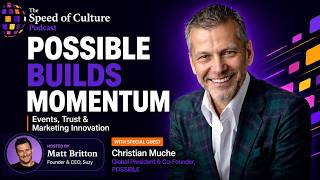
In this Speed of Culture podcast episode, host Matt Britton interviews Christian Muche, global president and co‑founder of POSiBLE, about the conception, growth, and future of the POSiBLE conference. Muche explains how the idea emerged during COVID as a response to stale, copy‑cat marketing events, leading to a quality‑first, decision‑making platform rather than a size‑driven trade show. He details the strategic selection of Miami Beach and an April schedule to exploit favorable climate, a less‑crowded event calendar, and the city’s burgeoning tech and creative ecosystem. The conversation delves into the anatomy of the event—balancing a few thousand highly curated attendees, mixing one‑to‑many keynotes with intimate peer‑to‑peer meetings, and emphasizing the right people in the room over sheer numbers. Muche describes the year‑round content curation process, listening to the market, and tailoring formats for CMOs, agencies, and creators, with a focus on emerging topics such as AI as infrastructure, Gen Z, the creator economy, and redefining creativity. He outlines POSiBLE’s community‑first platform strategy, including continuous engagement, trust building, and the Possible Connect matchmaking service that pre‑schedules high‑fulfilment meetings for sponsors. The interview also touches on event production innovations—design, AI, facial recognition, and potential robotics—while stressing the irreplaceable value of in‑person human interaction. Finally, Muche reflects on his career path from AOL/Yahoo to founding DMEXCO and POSiBLE, sharing his mantra that possibility is something you design, not wait for, and emphasizing bravery, risk‑taking, and building platforms that attract opportunities.
Chapters
Up today on the Speed of Culture podcast, we are thrilled to welcome Christian Mucha, the global president and co-founder of Pawsible. Christian is a visionary business leader operating at the intersection of marketing technology and culture, known for building industry-defining platforms like DMXCO and now Pawsible, where the world's top marketers and innovators come together to explore what's next. Christian, so great to see you. Thanks so much for joining today.
Thanks for having me. It's a pleasure.
Absolutely. So for those that are listening that I guess have been living under a rock and haven't heard of the POSiBLE conference, which has really taken the industry by storm over the last couple years, it'd be great to maybe hear about the conference and how it came to be.
So the POSiBLE idea came up during COVID I was approached by a lot of people, especially in the US market, that I was told that, you know, we would need something new, something fresh because we were all used to those events we are going for a long time and for many years. And then I saw for myself, okay, what could be the differentiator between, you know, existing events? Because I was, at the same time I was told, you know, we have enough events in our landscape and I agree to this. There are a lot copycats. Where you see same speakers, same contents all the time. So I try to combine my experiences with DMEXCO from previous years, which I created as a more as a trade show, right? Less than a conference. Conference was added at some stage, but it was designed as a trade show. I don't believe into this concept anymore. It's not about the size and the pure quantity anymore. It's all about quality. So That all came into my mind immediately and I looked into the US landscape and said, you know, we have boutique events, small events with 100, 200 people, intimate gatherings, which makes hardly sense. We have mass events, for example, like something like CS with tens of thousands of people. But first, they're too big to get the most benefits out of this as I can see it. And second, these are not marketing events. So I would want to create something for the marketing world as it is today, and it's broader and more complex than ever, as we all know. More, more parties, more, more companies belongs to this industry. And that was all the base for my, for my vision for POSiBLE. And then I started to share it with a bunch of people and they were all in from the beginning on, which was obviously a great commitment and also proof for myself that we might head into the right direction. And POSiBLE is now a combination of a massive activation space, space. A very innovative conference format in different ways, which allows one-to-many conversations, but also intimate peer-to-peer conversations. We are creating very targeted meeting opportunities, which goes beyond just content and networking, creates business opportunities, and it happens indoor, outdoor. That was one of the reasons why I've chosen Miami Beach as a non-so-common venue for, at least for our industry. We normally go to New York or to Vegas. Vegas, where I'm right now, you know, I'm at the Shop Talk event in Vegas right now and we all know this place very well. So I thought about a more interesting place which allows more creative execution.
Yeah, you took the words out of my mouth. There's two questions I was gonna ask you. Obviously before you even get to the content of the event and you decide to kind of plant your flag, so to speak, you need to figure out the venue where it's gonna be and then the time of year. And just one last point on it being in South Beach is obviously Miami has become a hotbed for tech, media, and advertising. You see people like Mark Zuckerberg and Sergey Brin and people like that moving down to Miami. And obviously the big crypto wave really took off in Miami, and it seems to be a really emerging spot for the advertising industry. So just any other thoughts on how has it been to work, uh, with the local municipalities in South Beach? And do you think that it's a place that you're going to continue to expand the event?
Yeah. Yeah. First of all, I, I believe that everybody will appreciate to be there because of this environment. You know, it's, it's a great spot to be there, maybe arrive a day earlier or maybe stay a day longer, which is, which provides additional benefits. Then as you said, over the time, especially during pandemic, a lot of executives in the industry, tech industry moved to Miami as well, to Florida. Miami itself, it's a, it's a great spot. Very liberal, open-minded. They host events like Art Basel, massive events across the entire city. So I felt this is the right spot for us. It brings fresh ideas. End of April, or sometimes being there in April every year, it's, it provides fantastic weather conditions. It's internationally well connected. So all the pros, all the boxes could be ticked for Miami. And yes, and then I realized that they, they have a strong local community. I mean, there are a lot of startups based there, which I wasn't completely aware at the very beginning. And a lot of celebrities, talents have their home there or a second home. So these are additional benefits for us to make it happen and to bring the entire community, but also beyond that to POSiBLE. I feel it now also looking to the fourth year now. That we, we see so much interest from people who are not necessarily working in the core industry of marketing, but a bit more connected to marketing in terms of celebrities, talents with their media companies, for example, agencies who are based there. We are lucky to have now more also creative agencies on site and being involved also on stage, things like this. And this is because of the of the, of the, of the environment being in Miami.
And the second question, obviously, when you're initially planning the event is what time of year to have that. And we talked about these big tentpole events in the industry, you know, and CES is a big gathering spot in January. You obviously have Cannes that happens in June. But I find that when— where this event is placed is sort of perfect in between the other tentpoles and, and it's in the US and kind of the industry need it. An event during this time of year. Were there other times of year that you were looking at to plan this event, or did you always know that this is the right spot for you guys?
No, I mean, at the very beginning we looked, you know, into the entire year, but then we realized immediately that due to the climate conditions, due to the event calendar, there are only a few spots available. And April made absolutely sense for us Ideally, it could be maybe more, 1 or 2 months earlier than that to be really at the beginning of the year. But honestly, a lot of partners and customers told me CES is not so much on their agenda in terms of, yes, we all go there to participate and get a sense of what's happening from on the tech side. And there are a lot of gatherings happening for marketers. Not for marketers, but for the ad tech, martech industry more. So therefore, the event makes sense, but it's not as much an event for marketers to learn, to connect with their peers, to really get the outcome for their daily work, you know, when they go back to the office tomorrow. This is therefore not a competition for us, and therefore, I believe that POSiBLE became the event for the first quarter, and that means for the rest of the year, when you plan your year, when you plan your budgets, well ahead of Cannes. For us, it's a perfect timing.
Yeah, for sure. So let's talk about the event itself. And you obviously, as I mentioned during the intro, are also behind DMXCO, which I spoke at once before, and it's an incredible event as well. Many people try to create kind of franchises like this and fail, and you're now 2 for 2. And just curious, like, what goes into the anatomy of an event like this? What has to be true for it to be something that people are going to want to come to year in and year out.
Let me say in general, um, also if it was a different timing, you know, and, and a different approach was the MEXCO. Um, I mean, think about, I've launched MEXCO in 2008, so it's a, it's a long time ago. Ah, but, um, at the end, which stays is I didn't build events, I build rooms where decision, where decisions happen. And that requires to bring the right people in the room. And therefore, what I've said at the beginning is it's not no longer about the numbers. You know, it's no longer, my goal is not to build another, the biggest event in the world. If you look around also out outside of our industry, what are the most influential events? Like Davos, for example, the World Economy Forum. It's not the biggest event in the world, but they bring the biggest or the most important people for their agenda, you know, politicians and scientists and all these things. So this is what I had in mind from the beginning on. Yes, it has to be meaningful. It has to bring a number of people to make it meaningful, to make it relevant. You cannot do this with, let's say, 100 people in the room. This is great to have peer-to-peer conversations with a very targeted audience. But if you embrace the entire marketing world, which includes media, advertising, tech, culture, then you have to go into the thousands, but not necessarily tens of thousands. So again, the goal is not to end up with 50,000, attendees in 2 years' time. That would be the wrong approach. Again, it's not pushing for numbers, having the right people in the room, and then you grow automatically. That's happened automatically, and this is what we've seen so far in the last 3 years.
And in terms of the, the programming and format of the conference itself, where do you kind of get your inspiration from or your ideas to understand how to editorialize the conference so people do get value from that content?
It is as simple as it sounds, Matt. You have to spend all year round and be with your network and sit down and listen. I spent most of my time when I'm on the road, not, well, with my team on one hand to think about execution and creative ideas based on these informations coming from the market. Otherwise, myself and my team, we are spreading out and sit down with our customers, with our network and listen. They tell us we are not, we cannot be the expert in every single area and every single topic. Our job is to take the most relevant information, put this together into a framework and make it understandable, make it visible enough, make it workable enough by choosing the right brands and by choosing the right speakers who are able to provide information nobody heard so far or have seen so far on another stage. This is our job and then put it into different formats, which our audience is required in terms of CMOs needs to be treated differently than, you know, the edtech world, for example. We have both plus agencies plus consultancies, et cetera, on site and you can put them into the same room for a great keynote, for example. But when it comes to Follow-up sessions, when it comes to meeting opportunities, when it comes to peer-to-peer conversations, that requires a more custom approach, which is exactly why I'm saying you can grow to a dedicated size, but you still have to work to be able to work with your audience to make things customized and to curate things in some way. Whereas honestly, you can't do this with 80,000 people anymore. You can't, simply can't. But with a couple of thousand, you can still do it.
What are some of the things that your audience, you believe, is gonna be excited to hear about here in 2026? Obviously, AI is a topic du jour, and AI touches everything. But I guess within that, what are some of the areas that you find there to be emerging attention towards?
We eliminated AI completely from our agenda. No, I'm kidding. I mean, of course, it's—
That would be bold.
It's all about— But I would say it's, I really hope, and this is our brief to our speakers and everybody on stage, it will be discussed more as an infrastructure than a tech tool. You know, I think this is what we already passed now for some time. Our audience wants to know, marketers want to know how they can use it, how they can use the outcome of all these things we've done so far with AI in their daily work. That's important. It's all about Gen Z, creator economy for sure. These are definitely topics which you can see across all stages, but also the term creativity. Our goal was to bring so interesting speakers and people on site who will help us to define creativity in and put this into the modern framework. Creativity, we have a sense of understanding what creative could mean, but in today's world, especially with AI involved, creativity gets to another level. In the same way that we, for some time now, we talk about creator economy as well. And when you have creators on stage talk about their work and the productions and what kind of content they create, this all involves creativity, right? This is part of the term. So our goal is also to push a lot on, in a positive way, push a lot on what really creativity means in today's world. Is it a next layer of what we worked on or what understanding was in the last 10, 20 years? I think that's a great opportunity for us as well to embrace even, you know, even broader community involving the influencers and the creator economy. More than in previous years. And if I think about these brands and companies being involved in personalities, that's, that itself creates so many creative outcome that the challenge is to channel this in some way to create this for our audience because otherwise you will be overwhelmed. But this is coming back to my previous point. This is our job. This is where we spend most of our time when we We're out there, listen to everybody who's telling us what they believe and how they see the future of marketing. Then we, yeah, we focus on the right things, hopefully, and to make it a surprising outcome for most of the people coming to Miami every year.
Yeah, I know a big part of your job isn't just lapses on site, but to make sure that you're continuing to amplify the event year round through content and just wondering like what your strategy has been to allow you to so successfully build the brand through a lot of the content that you're actually able to gather during the event itself.
That's correct. And building the brand, I mean, for our own, I think, or I'm interested in your opinion as well, whether you believe POSSIBLE is a good name. We thought a lot about that at the very beginning, couple of years ago. And I also do not believe into themes, you know, when event comes up with a theme every year, because I personally, when I go to an event, I forgot it already when I'm on site., and it's replaceable too quickly. And we believe possible is the theme. You know, we came up with that name. It's, it just not just provides positivity and optimism, which I think we need a bit more, despite all the challenges we have to solve as an industry, no doubt. But, you know, let's go out with the belief, you know, we can make things possible and, or the impossible possible. And this is exactly what we had in mind. So, and we believe, you know, this is a theme as well, which can stay forever at the end. You know, we don't need to replace this year by year.
Yeah. And another thing I think POSMOS has done a good job at is just really investing in community. I know that you have events year round where you get sponsors and VIPs, et cetera, together, and you're very active on social media. How has that been a big contributor? To the continued momentum and success of the event?
Yeah, so I'm saying more and more that we are not building just an event, it's more a platform. And what does it mean? Yes, our goal is to be in touch with the industry all year round. That doesn't mean that we have to become a media platform because there are plenty out there. We don't need another one. But it means that in terms of the outcomes, that this allows us to follow up with our audience more regularly around the year. And this could end up in some smaller formats around the year. This could end up in also getting feedback, working on projects for next year's event, things like this. This is what we have in mind. Also in terms of relationships, building that kind of trustful relationship is something very special we had in mind from the beginning on. I believe in today's world in general, to be honest, trust is the highest ranked value in today's time. I think everybody appreciates very much if you can trust somebody, trust what you propose, you know, when you deliver it finally. And this is what we are seeing as a massive benefit. We do a lot with more passion maybe than others. And that people see the difference. People that see the difference despite all the professional, you know, approaches and the framework we are setting up. I mean, we are event experts, but execution is relatively easy. It's more that you add passion, that you add trust and how to build trust. This allows you to connect with your audience several times a year. Uh, with your brand, um, and not just focusing on, on one event, um, over 3 days once a year. And this is what we have in mind. And this, it could include a lot of ideas, um, you know, launching other events, um, running smaller events all year round, but most importantly being in touch and also, and then the circle close, getting the information you want for the next approach, for the next event approach. And this gives you, always brings you also in, in a better position to know even better what's happening in the market and how, how you do need to things to, to present at, at, at the next event.
And for companies that are on the sell side, like sponsors that come to your event that wanna break through.
Yeah.
That want to stand out and have it be a successful, you know, ROI-driven, you know, activation. What are some things throughout all your experience in your career that you've seen be consistent with companies who really activate at events the right way?
I think everybody's far more sensitive on that and focused on that than before. I remember back at the Mexico time, we talked about, you know, our eyes and some were joining without knowing what the ROI could be. But that was at the very beginning of, you know, when our industry started with these kind of events activations. In today's time, it's more focused than ever. This is why we are focusing so much on the meeting opportunities because you should show up as a partner and have your own meetings set up. You should bring your clients, you should come up with some great activation to target new opportunities. But I totally understand that because of timing, because of resources, sometimes you need some help here, and this is why we launched last year the hosting meeting program. It's called Possible Connect. And what we are doing here is we are, we are prescheduling and confirming meetings between brand marketers and vendors and solution providers. So both sides will be in touch, will know about each other. They confirm that they're going to meet on site, and we are running up to 3,000 meetings this year at POSiBLE. It will be on the beach in a big pavilion. It's a very nice environment, by the way, not in a windowless trade hall.. And this provides, again, a positive energy for completely new relationships you can create. And this is an option, you know, we provide an additional option. And this is how we secure our eye from our end, providing this additional opportunity for our companies and those ones who are activating.
So you're almost playing a role of like matchmaker, right? You're trying to connect buyer and seller or companies that you think could have some type of potential together. Absolutely. So what goes into something like that?
Yeah, no, absolutely. It's highly curated. You know exactly who you're reaching out. You need to double confirm from both sides. If one side is not keen, then of course it won't happen. It's performance-based, you know, companies only pay if this meeting happens, but we have, I think, more than 95% fulfilling rate. So this is, this is good. Very good, I would say. And again, it's optional, you know, no, there's no obligation, but more and more companies and partners are taking advantage of this.
So there's a huge amount of innovation that's happened in just event tech overall, different types of technologies that make the participant have a better experience at large events like yours. Just curious, in terms of the production events and the experience that you're able to give your attendees, What are some areas that you have your eyes on? Like, are we going to have robots, you know, walking the hallways in the years ahead? And what are some other things that you're interested in from a production standpoint?
We started with the idea to invest more than maybe usual events in design, in on-site signage, in stage design, and things like this. We wanted to make it different than most of the kind of conferences or events, show events like, like this here in the US. Second, yes, I, I would say we have to, we talk about technology. I think we also have to use technology in a, in a way that what's proved, what's, what can provide value for marketers and the marketing world as well, we should use. And of course, it's a lot of, a lot of AI. It's face recognition, it's matchmaking technology and things like this, what we already do. You've mentioned robots. Yes, I mean, as we look around, you will see them, you know, as a demo at other events as well. I can absolutely imagine that this is part of, you know, a standard event very shortly. Things like this for sure. But we are coming together and please don't forget, we are coming together as an as a community, as an industry in person, because this provides still some value. And I believe today's events, especially newly events, newly designed events like us, our job is to combine all the tech opportunities with the human touch. And I still see, and this won't change, this hasn't changed because of the pandemic. And it won't change in the future that we appreciate in-person conversations and communities coming together from time to time. Yes, people are more selective, especially executives. Top executives are more selective in terms of their time, their time spent and money spent where to go. You have to be in that range. They're not going to so many events anymore like 10 years ago, which I totally understand. But the benefit being with somebody in the same room, going into a meeting, you don't know who it, but you know who are you going to meet, but you don't know each other yet. This can only happen and create this trustful relationship on site in an in-person event. And that's the reason why we as an industry, as an event industry, exist even stronger than before. This is what I deeply believe despite all the technology, but this comes on top.. And that makes not just fun, that hopefully provides a lot of benefits to make our life easier, to prepare a visit for an event, to be on site and yeah, have a good combination of both.
Yeah, I think relationships are gonna matter even more as we enter this AI age. And I think, you know, deciphering what's real and what's not and really leaning into authenticity is gonna have continued importance. So I think that you guys are in a great spot. Moving forward, and I think people are putting more priority on events for that reason.
I talked about trust and I think, call it old-fashioned, I don't believe it's old style, old-fashioned. I think it's an ongoing thing we humans appreciate. You create a different level of trust if you've met at least once in person, and this is all about.
Yep. So as we wrap up here, would love to hear a little bit about your career journey. Obviously, you have a very exciting role and you've been a very successful entrepreneur. And just wondering, when you look back on your career journey, what are some of the things that you think you've done right along the way, either skill sets you've picked up or areas that you focused on that set you up to be in the position that you are today?
Well, looking back, I've worked for AOL and Yahoo a long time ago, so I know the corp world. You know, I worked in the, in the advertising and sales business for a long time. Then I, I believed into that this industry at this time, relatively new industry, needs a platform. This is why the, why I created DMEXCO was one of the first of its kind as a big event for such an industry, which has no hardware, right? No products to show, but ended up in a trade hall, which was a bit weird to explain to people at this time. Now it's a common thing. I believe I was always stepping through the door or walking through the door, which just opened, you know, not knowing exactly what's behind that, but I could smell, I could see an opportunity there. So what I'm saying is I never chased opportunities, but I could see something which potentially gives me, you know, a chance to develop something new, relatively new, which was my motivation then in the last 20 years. Building environments where opportunities come to you, in this case, platforms where people appreciate, you know, that you provide something with opportunities for them and then they come back to you. And this, of course, every single conversation with partners, with individuals provides new opportunities. This is what I mean. You cannot wait for everything coming to you. You have to step forward and of course do also sometimes some some risky steps forward. But this is what I did for now for the last 20, 25 years. And I feel very good with that because obviously just turned out that it was the right decision for myself being an entrepreneur. But this would be also, yeah, some kind of advice for others.
Yeah. I mean, I think part of it is just you have to be brave. You put yourself out there, like Possible was a big audacious decision. And there was a ton of events when you came into the fold. And when I first heard of it, I didn't really understand why this event was happening, but now I can't see there being a year in our industry without it. And I think that doesn't happen unless the person behind it has vision. So you have to kind of see it come to life long before it does and then have a level of conviction to dive in and have an understanding what it could become. And I'm sure there are a lot of times along the journey where Maybe you weren't as sure, but you have to obviously persevere over time. Yeah.
At the end, your individual talent has to be, I think that's the biggest requirement. You have to count one and one in some way together where others won't see that opportunity and then take the risk. Of course, yes, it should be well planned and of course you need supporters and all these things, but at the end, it's first of all, it's your own decision and I think that's a beauty in today's world even more. There are so many opportunities, but they're not designed for individuals. So you have to take it and then you have to make it your own.
Absolutely. So we always ask our guests as we wrap up the podcast if there's a saying or mantra that has helped kind of encapsulate their career journey. So what comes to mind for you?
Mantra? Oh God, that's a good, it's a tough question. Maybe following up what I've said, possibility. Is not something you wait for. It's something you design. I think that's a mantra I could sign off with. There are plenty out there, but sometimes, and also in my early career, you think, okay, it has to be exactly the right fit for me, right? And you wait for that. I believe it's, that's not the case. It's plenty of them out there, but of course, how could it be designed already for you exactly for you, right? We have 7 billion people on Earth. You have to shake it up and sometimes with the help of, from others, which is not a bad thing at all. You should ask for help if you need or if you feel like this. But I think that's the mantra I think I lived for myself for the last couple of decades.
Awesome. Well, this has been a fantastic chat and I'm looking forward to seeing you at the possible event next month. And again, it's one of my favorite times of the year. And thanks to you and the whole team for putting this great event together for the industry.
Awesome. Thank you so much. I really enjoyed the conversation, Matt, and see you soon then in Miami.
Absolutely. On behalf of Susie and I would keen, thanks again to Christian Mucha, the global president and co-founder of POSiBLE for joining us today. Be sure to subscribe right via the Speed of Culture podcast on your favorite podcast platform. Till next time, see you soon in one. Take care.
More from Matt




MikMak’s Rachel Tipograph on Consumer Spending, Retail Media & Holiday Shopping Trends



Jaguar Land Rover’s Charlotte Blank on Luxury, Purpose & Experiential Storytelling



