Qualcomm’s Don McGuire on AI, Software Innovation & Brand Partnerships
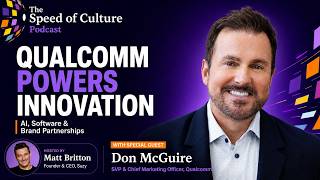
Qualcomm's CMO Don McGuire explains the shift from hardware to software-defined AI experiences, introducing the Snapdragon X Elite platform and AI PC as the next consumer wave. He details partnerships with Louis Vuitton, BMW, and Mercedes-F1 to build Snapdragon as a consumer brand, and discusses the 14 million-member Snapdragon Insiders community.
Chapters
Today we're thrilled to be joined by Don McGuire, the SVP and CMO for Qualcomm. Don was recently named one of the Forbes Most Influential CMOs, and we're so happy to have you here today. Great to see you, Don.
Great to be here. Thank you so much for having me.
Absolutely. So we're at CES. I'm sure this is a huge event for Qualcomm for a variety of reasons. Uh, talk to us about what you're seeing here at CES and what you hope to get accomplished.
Sure. I think for us as well as for CES in general, the show has sort of evolved. Um, you know, we had that little COVID thing happen in the middle, but I think over time it has evolved and, you know, new things have taken center stage. And I think right just prior to COVID, and I think carrying over even to today, CES seems to be, um, a lot about cars. Um, then there seems to be a lot of automotive news and a lot of automotive presence at CES. And then add on top of that this sort of constant narrative and hype cycle around AI. I think those are two of the things. And then traditionally you kind of see these, you know, the big TVs and the new displays. Yeah. And the new screens. And that's always been a sort of a mainstay of CES. So, you know, we see a little bit of that here today as well with the transparent displays. Pretty cool. So for us, it, the last couple years it's really been about automotive as a centerpiece with a sprinkling of other things around. And so I would say, you know, 80% automotive, 20% GenAI is kind of our recipe this year. And we've leaned in on GenAI across different product categories based on kind of what's being talked about here at the show. So there's like AI PC, which has been a topic here at the show. Sure. There's other things going on. And so we've kind of leaned in across those different categories. So that's kind of CES 2024 for us.
Yeah. Let's unpack there. When you talk about, the focus on auto, we can get at in a second, but also kind of the focus on Gen AI. You know, there was a time when CES was all about, this is 4K TV, right? It's a bigger TV. This is a, a smaller recording device. Right. And I feel like that hardware has kind of become somewhat commoditized because everybody has great screens, everyone has fast devices, and now it is much more about the software. And you kind of see that happen with the iPhone development cycle. Right. And, and the demand kind of waning. What are your thoughts on that overall?
Yeah, I think it's either— it's either been about other industries undergoing transformation. Sure. And that's either being driven by software, right? Like case of auto. Like the case of auto, right? I don't think there's any other industry that's undergone in the last 5 years more transformation than automotive, where cars are less about mechanics and MPG, right? And mph and, and torque and thrust and all this stuff. It's— and it's more about digital capabilities, right?
It had to be— become a docking station for my life.
Exactly. Or a new living space, right? Um, and, and so that has been amazing to watch and participate in. Um, and we're a huge participate— participant in that as well as a huge enabler of it.
Yeah.
So with our Snapdragon Digital Chassis, um, solution. So that's been super cool to see. But you're right. I mean, the software-defined vehicle is now what's driving the automotive industry. So software seems to be driving a lot of the innovation and transformation versus form factor, right? Right. Or, or even performance, or even performance. Right. Um, in some ways performance has become commoditized unless it's in the context of something new. Right. So instead of talking about, for example, I'll give you a PC example or even, um, another device where in the past what you looked for was CPU performance, for example, like how fast is this processor? How fast is my PC? And, and, you know, kind of. The ecosystem built a whole new narrative for years around, hey, CPU, CPU, CPU. Yeah. But then gamers came about and the conversation shifted in the gaming context to, oh no, no, no, it's all about GPU, right? GPU, GPU. Well, now in the advent of the AI PC, which, you know, has been kicked off sort of last year, we announced our Snapdragon X Elite platform at our Snapdragon Summit in October and the capabilities of that platform. We're gonna see that show up in PCs in, you know, June of this year and going forward. And then here at the show there's, you know, the PC ecosystem is talking about the advent of AI PC, Microsoft's launching the Copilot Key, right, on your keyboard, et cetera. But now when a consumer walks into a Best Buy to buy a new PC going forward, 2024, 2025, and beyond, or an enterprise CIO is saying, how do I upgrade my hardware, my devices for my workforce? It's less about CPU and probably even less about GPU and it's more about MPU. Right, right. What is the AI performance going to be on this PC so I can take advantage of all these great Copilot experiences that Microsoft has built on top of Windows? Um, so this shift is happening where, um, where, where the innovation, yes, it's software driven, but it's also what's happening within the device that's creating this new level of performance. Um, and so that's interesting to watch.
Is the power of AI beholden in the actual local device or in the actual servers delivering the AI? Because like, you know, there's a tool like Pika, uh, well, you know, which is text to video or Runway where it takes forever, but it won't for, it won't forever. Just like you just take forever to get on dial-up, right? But probably 2 years from now you'll just be able to type, show me a video of a cat running around the roller coaster and it'll just get it instantly. But is, is the holdup there the local device that you have or is it the servers that are delivering the AI functionality?
This is a great question because in order for AI to scale both from a technology perspective and a usability perspective, it's going to have to be hybrid, meaning not everything can happen in the cloud, right? In some cases it takes too long. The workloads are too much, right? The taxing on the data center is too much. The economic model doesn't work, right? You can't buy enough cards to put into your data center. You can't,, you know, overutilize water resources to cool your data centers. Right. So that you've got a sustainability problem, you've got an economic model problem, and you have a data privacy and personalization problem. Yeah. So a certain amount of computational work for that drives AI and the ability to deliver an AI solution based on algorithms or large language, small language, medium language models is where is it going to happen contextually based on what is it that you want to do? So on-device AI, which has been on device for 10 years, um, AI has been running in the background whether you know it or not on devices like smartphones for a long time, right? It's been making your photos better, it's making your music sound better, it's been doing things that you didn't probably know or realize that AI was actually doing that. Uh, and AI has been part of our Snapdragon platform for years. Um, it was really GenAI that thrusted AI into the spotlight. It was like the press release for AI, so to speak. Yeah, packaged it for packaging for consumers, made it novel and created the hype cycle. Mm-hmm. Um, but unlike other hype cycles, it's not gonna stop, right? It's not gonna go up and then go down. It's here to stay and it's moving very fast. Um, but in order for it to, to scale, the technology that enables it is gonna have to normalize across the spectrum of the device itself, the edge, which is really on-prem, Right. Right. So whether that prem is your home network or is your campus network or is your office network.
And does 5G play a role in that?
5G plays a role in that. Wi-Fi 6, 7, 6E, 7, 8, whatever plays a role in that. And then the cloud and the data center and the big cloud. So if you're talking about something like, hey, AI assistant, help me plan my day, most of that can be handled on device. Right. And that's instantaneous. It's information, it's interaction that you want. It's text. At low latency. It's text. It might be some some image, things like that. But we're talking about trillions of parameters, like help me solve world hunger AI, right? That is data center, big computing. It's gonna take some time. The latency is not an issue. It's really about getting to the right answer. So it's everything in between there. So it's gonna be contextual to what is the task. And if you normalize the technology stack across device, edge, and cloud, then it becomes more useful for everybody. You can actually do, you can actually load more tools and more experiences on top of that, and you can put them in the bucket that they need to go into to deliver the best experience to the user for whatever that might be. And then that's gonna enable the second part, which is the usability and the relevance of AI really has to move from prompted and reactive to anticipatory suggestive, right? And if, if it's gonna actually be useful and not just novel.
But that means that the user has to be able to let the AI know more about them. Exactly. Right.
But it's up to the user. Right, right. Especially in the case of AI at the edge, right? You're in control. The human element is always in control. So you allow it to learn as much as you want it to learn about you, and then you allow it to suggest or recommend in the context of your private network or dataset, whether it's on device and it never leaves, or whether it's in your home and never leaves, or whether it's in the cloud, protected, or hey, I don't care where this goes, train, you know, your algorithms on it, I'm cool, right? So it's everywhere in between. So I think that's the really the beauty, the excitement of it all. But it doesn't just stop with ChatGPT going to the data center. Sometimes you get a response, sometimes you don't, sometimes it says come back later. Yeah. Because it's taxing a resource. Um, because everything else has to catch up, uh, and that's where Qualcomm really plays a big role, is at that edge, right? So from the on-prem to on-device, um, it's our sweet spot, right? Been doing this on-device for years. Um, we make kick-ass processors and, and, and semiconductors and chips. Um, and we have this long history and DNA in wireless connectivity.
Yeah.
And Wi-Fi. So that high-speed—
that's how most people know you, right? For the—
what, historically?
Yeah.
But I mean, you know, since I've been at Qualcomm, what, 7 and a half years now, we, we, we, we we were already underway of this transformation and, and diversification of less about connectivity, still about connectivity and first class and world-leading connectivity, but more about on top of that connectivity computing. Yeah. Right. And which is why, you know, now what we stand for is really intelligent computing everywhere. So the everywhere is the nod to the connectivity. The intelligent computing is really the nod to the AI plus the processing power together in a really, um, energy efficient package. Yeah. Right. 'Cause that's another thing, right? You can't perform really large tasks, AI tasks, especially on a device that has a battery life of a day and a half. Unless you want a battery life of 2 seconds.
Yeah.
Right. You know, so that again, that's why this thing has to be hybrid.
One big balancing act.
Exactly. And so it's, it's, it's an ecosystem play. Everyone's involved. Um, and it's exciting. We have our role. Everybody has their role. No one's right. No one's wrong. Right. Um, it's not a us versus them. It's not a Qualcomm versus NVIDIA. It's not a Microsoft versus somebody else. It's really about everybody has a role to play. Who is involved in developing technology? Uh, and then where does that— where do all the puzzle pieces fit?
So even the content creators, like you see in New York Times and, you know, their lawsuits with OpenAI.
Yeah. Well, in technology, it's just technology until you put it to use.
Right, right. When it becomes commercialized and it gets a little murky.
Well, and you know, anything new, there's always trial and error. Yeah. Um, sometimes bad things happen.
Happened with YouTube. It happened with Spotify, Napster.
I mean, goes back, it goes back. Um, and you know, there are bad actors and, you know, and good actors in every category, in every category. And I, in my speakership I did earlier today, I talked about, look, if we could just, cuz I'm not a huge fan of regulatory oversight in general, um, because it's too slow. Yeah. And by the time they get something regulated, it's already moved beyond the regulation. Totally. Right. And so it's irrelevant.
If I can't keep up, how's the government going to keep up?
Right. Especially with AI, it's moving so fast.
Yeah.
And so, um, so it's really about standards and governance and practices that— and best practices that can be adopted and principles. Um, and if we can learn the lessons from social media where there was none of that, right? It kind of went untethered, so to speak, for years. Um, and you got a lot of good out of it. Absolutely. Um, it opened the world up to so many people, connected so many people, connected so many people. But it also created mental health issues or enabled the environment— geopolitical issues, geopolitical issues, bullying. Yeah. Um, you know, all these types of things. So if we could learn some lessons from maybe a little earlier in the social media technology evolution, um, we could have anticipated some of those things and said, hey, you know what, we're gonna have some principles.
Who's we though?
I think everyone involved, right? Right. It's not just like a consortium.
Yeah.
Like, yeah, it's not just Meta. It's, you know, because you can't just blame one party, right? Or can't point a finger because guess what? You may be— nobody's altruistic, you know, everyone likes to think they're altruistic, but at the end of the day, if you are advertising on that platform that's then responsible for enabling bad behavior, you're culpable.
And Meta has shareholders, and those shareholders could be endowments of colleges. It's like they need to deliver a return, right?
Pension funds, exactly, right, right. So it's like, it's this vast web, right? Right. And so it's like everybody has to kind of join together and just say, okay, how are we gonna operate this thing, this beast? Um, and I know that's not easy. It's easy to say, not easy to do. Um, but you know, we've, we've joined a bunch of companies in, in co-developing some basic principles for, you know, deploying AI and, and, um, you know, along with Microsoft and others and ethical principles about how we're going to create the technology. Um, I think those types of things, you know, you look at platforms like Reddit, which are kind of community managed, self-governed, so to speak. Wikipedia. Like Wikipedia.
Yeah.
And it's, it works in that context. Obviously I'm not saying it'll work everywhere, but if you take some concept of self-governance and then you add some other things to, uh, insurance policies, so to speak, um, I think we can get there. Yeah. And I think we can prevent some of the badness, right? That came along with social media, right?
Um, and every technological innovation had badness. There's car accidents, right? Still today, right?
Right. Um, it's funny, like, technology is funny. There's a lot of fear, right? And I know a lot of people are fearful of AI, and it's been used as a narrative, right? Uh, was used in the writer's strike and the actor's strike. Yep. Um, you know, people fear job loss and all these other things. A lot of that's just posturing. Um, because it's like, I use the analogy of the elevator, right? The elevator first was invented, nobody would ride it because they were scared. They were scared, right? They didn't want to plummet to their death, right? But then Otis came along, who didn't invent the elevator first, by the way. They, he, they invented the latch that caught the elevator, right? Interesting. Once that was invented, people are like, oh, it's safe, right? This thing's gonna catch it, right? And so they start riding the elevator, right? Uh, so it's like That is a natural type of part of process that we go through as human beings, um, and with any technology. Uh, so, um, so I think we're going to go through those same types of— yes, with, with AI as well as, as well as other things. Autonomous driving, that's another thing, right? That, uh, you know, whether we get to full autonomy and how and what context, it's gonna be very interesting to watch.
And you're gonna have people that point to, oh, see that accident? But it's like, okay, well, how many accidents do humans create?
Exactly, right? You're 80% of all accidents are human error, right? In some way, shape, or form. Right. So, um, and so will autonomy fix that? Will it cause more? I don't know, you know? Right. But, uh, it's gonna be an interesting, it's a wild ride. It's so fun to be in tech, you know, I've been a tech marketer most of my career, so it's always interesting. Yeah.
So it's one of the things that you said that really stood out to me is, so going into COVID, I felt like no one felt like they ever needed to buy a laptop. Like they had their work laptop and then COVID happened like, oh, I probably need a personal laptop at home. And then coming outta COVID, AI happened and now it sounds like Do you think there's gonna be a renaissance of demand in the laptop space?
Yeah, I mean, I think we're— the laptop is at an innovation inflection point for the first time in like, I would say, 15 years. Right. Um, and COVID gave the, the, the PC industry a nice bump.
Yeah. Dell had a great year.
Right. 2020, great cycle. Um, primarily because the use case shifted. No longer was the laptop something that sat on the desk collecting dust until I needed, until I needed a bigger keyboard and a bigger screen. Right. It became a communications device. It's how I connected with my world. Zoom. Yep. 'Cause I couldn't connect with them physically. So Zoom, Teams, the PC became a primary communications device. Less about surfing the web, right? Less about creating PowerPoints and on a bigger screen. It became a primary communications device like the phone had been for so many years. Sure. But I, but the context shifted and we needed to have meetings and we needed to look at multiple screens of people. So that gave this, the PC, a renaissance, a short-term renaissance, drove an upgrade cycle, was a good couple years, and then everyone upgraded their PC. Oh, I got a brand new PC, I don't need a new PC because historically the upgrade cycles of like 4 to 6 years, right? And very long, unlike the smartphone, which has historically been 11 to 24 months. So now, and that's primarily because there hasn't been a lot of innovation. Why do I need a new PC? This is fine, right? Um, and, and especially coming outta COVID, oh, I have a new one, I bought it in 2021 or 2020 or whatever, it's fine. Um, but now with all these new experiences that you're going to be able to extract from the PC because of AI, um, and because of our work with Microsoft and the ecosystem, um, things that you've never imagined you could do with your PC, and, um, and that you never able to do before with your PC are now gonna become real. And that's, I think, really exciting. And we're gonna see more of that later.
I'm getting excited just hearing you talk about it.
Yeah. I'm not gonna, like, I'm not gonna, um, uh, give away the, um, the, the surprise.
We'll come back to you for that when you're ready.
Yeah, you can come back to me, you know, later on, uh, this year. But there are really amazing experiences when you can take the power of our Snapdragon platform and Windows 11,, or just Windows in general and Copilot, um, and our friends at HP and our friends at Lenovo and our friends at Dell and Samsung and Acer and Asus, et cetera, that when we all come together, it, we're gonna deliver some really cool stuff. And, um, uh, we're just in phase one, you know, you gotta educate what is Copilot. Microsoft, you know, they announced the key, you know, which is great. Step one, hey, there's something physical, you know, push and magic's going to happen. Um, and it's gonna take some time. Um, so we, we've got about 6 months and then I think you're gonna see some real magic happen. And yes, I think that will create a desire for, even though this may not be old yet in that context of the traditional PC upgrade cycle, this is gonna offer me so much more that it's worth the trade-in.
Yeah.
It's, it's, it's like when you had to have the new smartphone every 11 months because there was so much new. Right. And the next one, I had Face ID, it had real things.
I couldn't. Much better camera. Yeah.
I couldn't. I can't get by with this.
Are you kidding me?
Right. This is old.
Right?
Yeah. Um, and so I have to have new. For the first time in a really long time, we think that psychological phenomenon is going to happen in the PC space, which we're really excited about.
So what does marketing look like for you? Is it mostly partnership marketing with those OEM partners that you just listed?
I mean, that's a— it's part— if you look, you know, if my marketing mix was a wheel. Yeah. Right. Or a pie chart. Partner marketing is a big part of my mix.
Of course.
Just because of who we are. I am so blessed and honored to have so many great partners that I get to work with and through across product categories. I mean, amazing brands from BMW to Cadillac to Louis Vuitton to Bose.
Louis Vuitton.
Yeah, we can talk about that. Yeah. To Samsung, obviously, to Microsoft. And these are big iconic culture brands. Yeah. And but we play a significant and important role in feeding their brand ethos as they move their products more and more into the space of delivering technology-driven experiences. And so by us working together with them and collaborating them, for example, in the case of Louis Vuitton, as you said, what do you mean? You don't work with Louis Vuitton? We are not yet putting chips in bags.
Right. That's what I meant.
But, you know, could happen. Uh, but we power all of Louis Vuitton's, um, smart devices. So their watch, um, their smart speaker, their earbuds. Got it. Has, has, has our technology inside. And they're a great partner. Um, an iconic luxury brand, but they're a luxury brand. They're not a tech brand. So what we bring them is tech credit, right? So people can feel good about, oh my gosh, these Louis Vuitton earbuds look stunning, but I still want good audio.
Yeah, they're gonna work.
Are they gonna work, right? Um, or this Louis Vuitton smartwatch looks stunning and it's definitely Louis Vuitton from an on-brand perspective, but it's still gotta work like a smartwatch. Yeah. So is it going to— is it going to deliver on my technology needs? Oh, it's powered by Snapdragon. Of course it's going to, right? Snapdragon stands for premium. Snapdragon stands for the best. Snapdragon delivers. Absolutely. So that tech cred is what we bring to the party for some of these brands that are— you would, you would ask yourself, what do you mean Louis Vuitton? Or what do you mean, you know, Peloton, for example? So that's really exciting. And I get to work with these CMOs and these, these, these partners all the time and coming up with really fun, interesting, cool co-marketing types of experiences.
That fits their brand equity pillars and also drives the messaging that you want. Absolutely.
It's not about disintermediating their brand ethos.
Of course not.
It's about amplifying it. And this whole idea that, oh, if I talk about your brand in the context of my brand, that takes away from my brand. That's BS. Yeah, I agree. I'm sorry. Right. And that's old thinking, by the way. And by the way, there's still a lot of people out there, especially in the automotive industry, that think that way.
Right.
But it's total crap. Right. And I mean, I was so excited. I was in the New York subway maybe 6 months ago or so, maybe more. And I saw an ad where a bunch of brands came together with a single message, but they were individual brands, but they were all marketing kind of the same thing. And so this whole collaboration idea and you see collabs happening all the time, right? Adidas and Moncler. Yeah, right. So, you know, it's happening organically anyway. I'm just so lucky that I get the opportunity to work with, with some of these amazing brands and form these relationships with these other CMOs and share best practices, which has been a good opportunity. So that's a significant portion of the mix. But, you know, there's traditional advertising, um, there's events, there's comms, PR, um, and then two of the areas that I've been focused on for the past two years with my team are building community. Number one, community, which is a, uh, community of consumers for Snapdragon, building affinity for Snapdragon through building community. And number two is, uh, brand partnerships. Um, not like customer brand partnerships like with Louis Vuitton or with Cadillac, But brand partnerships with brands and, companies/products/franchises that align with our brand values, and that we together can tell a joint story as well as our individual stories. And we— it's a win-win for them and it's a win-win for us. Yeah. So a perfect example is our relationship with Manchester United. And you, why are you doing something with Manchester United? Well, in the context of building community for Snapdragon, Snapdragon, which is now 14 million strong.
And Snapdragon is your, is your, is that your new go-to consumer brand? Like, is Qualcomm—
well, it's been around for a long time, right? But it is our, it is our B2C brand.
I've heard a lot more about it as of late, obviously with the AI.
And, and, you know, the irony is that the, the markets where Snapdragon has the least amount of awareness is in the US, right? Where we're headquartered. Um, and in Europe. Um, but you know, you walk down the street in Shanghai, you ask some, a consumer, Do you know what Snapdragon is? They're gonna, 90% of them are gonna say yes. Right. So I've got, you know, typical high levels of consumer brand awareness in Asia, in, in Latin America, et cetera, et cetera. And it's really been sort of the Western markets that, that we haven't invested in and haven't focused on. But that's going to change with the advent of PC. Um, we didn't really feel like we needed to do it for smartphone because some of those markets are duopolies. You know, there's one company, right? And then there's the other company and then that's it. Right. Um, and we, we're partnered with the other company and we do lots of co-marketing with them. Um, and so, uh, so we were good. Um, but now we do need to build affinity for Snapdragon because the PC space is a different space. Um, we're starting to see in automotive an openness and a willingness to give us attribution for what we're bringing to the table. 'Cause again, automotive companies historically are not tech companies.
And they try, sometimes they try to mask as them and they create poor software experiences for the user. Some of them just wave the flag and they do CarPlay and consumers love it and that's it.
And then they're, yeah, which is great for consumers. Um, and great for the company that makes CarPlay, but not so great for the car company. Right. Because then they lose that relationship connection. Right. Our platforms enable them to actually build something meaningful.
Right. Which is why they'd rather do that.
Which is rather why they'd rather do that. So, and then give us attribution for that, which is fantastic. So building community and brand partnerships are really important. We have 14 million Snapdragon Insiders around the world, which every day I'm astounded and amazed by the fact that 14 million people are interested in a product that they can't actually buy. Right. Um, but they are tech influencer, tech enthusiasts. They love talking about technology. They love—
well, they believe in the promise of what it unlocks.
Right.
Exactly.
Ultimately. And they wanna peel the onion back. Yeah. Right. They want to, they just, they don't buy into the, it's just the plastics and the display and the wrapper. It's what's inside that's making this happen. And it's kind of back to the Intel Inside Intel Inside playbook a little bit, but if in a brand new context, right? I mean, Intel did that brilliantly and I was part of that ride for the 5 and a half years I was at Intel of, of building Intel Inside as a meaningful, um, full funnel, right? Sort of thing where consumers were like walking into a store and saying, I really don't care if it's an HP or a Dell or I think, but it better be Intel Inside.
Yeah, they did, they did a fantastic job at doing that. Yeah.
Um, and then over time, obviously that device category lost relevance.
Yep.
With consumers. So thereby the Intel brand was so attached to that product category that the Intel brand started losing relevance. And then now anyone under the age of 35 may not even know what Intel is or care. Um, as the, as the primary digital experience interaction of humans moved from that big clunky, heavy device to something that fits in your pocket.
Yep.
And that's where our DNA sits. Right. And that's where we've been for several years. And so we have this opportunity, right, to kind of move into this next generation. And, and we're not, we're not a one-trick pony. It's just not about one product category. It's phones, it's, it's tablets, it's wearables, it's hearables. Cars. It's cars. Yeah. It's PCs, it's et cetera. So my berth is wide. Um, and, and I get to, to, to kind of play in this bigger playground. Awesome. Which is fantastic. Um, and so, um, so with all these goals to build Snapdragon as a, a culture brand, uh, consumer culture brand, it's a, which is a big ask from my CEO, by the way. I have an amazing CEO who believes in marketing for an engineering-driven company.
You can tell.
That is where we've struggled for years. My team and I have struggled for years just to make marketing like important. Cristiano is a huge believer in it. And so that's so, as a CMO, it's so helpful. And I also have a great relationship with our CFO., who also, you know, understands. Um, and I have a great relationship with our CIO cuz he's my great partner in crime and reimagining our digital experience. So, um, we have a great executive team and, um, and it's, it's fun, makes it fun, but it also helps me do my job, right? I wouldn't be able to do my job without that enablement, without that, that permission that he provides me. Um, and one of his tasks that he's given me recently is I want, I want Snapdragon to be a culture brand. Like that's a big ask. It is. So we're working on that.
Especially for a brand that people can't touch and feel.
Right.
I'm like, dude, really?
Right. I'm like, I'm good, but am I that good? Yeah. No, so I, it's, it's interesting. We're gonna take that on. We're gonna see how far we can get. And it's gonna help. It's gonna, it's a team sport, so it's gonna take help from everybody. But we're taking on that ask. So brand partnerships are gonna be really important to that. Specifically, attaching ourselves to brands like Manchester United, largest sports brand in the world, 1.1 billion fans. We want to build more community. We wanna attach to their community. We wanna co— we wanna cross-pollinate. Um, there's lots of overlap. Um, it's an amazing partnership. They're amazing. They're an amazing brand. They're premium. They're the best of the best. Snapdragon premium, the best of the best. Brand values are aligned. Um, and, and they provide me scale and reach that I would have to spend 4 times as much on traditional advertising methods to get that exposure for my brand than what I'm spending to become the new front of shirt partner for Manchester United starting in July of 2024, which I'm super excited about. Only the 7th front of shirt partner in Manchester United.
It's a big investment, I'm sure.
Yeah, big investment. And for us especially, a big step. But when I, when I showed the ROI and when I showed the efficiency of it and the popularity of the sport globally. Football is just— is exploding globally. But just the ROI and the efficiency versus, hey, you want to triple my marketing budget every year for the next 5 years, right? Or do you want to do this? It was like, that makes sense. So I'm super excited about that. Our F1 partnership, especially as it relates to our automotive business, is really important with Mercedes. The Mercedes team is amazing. Toto's amazing. All of the people at Mercedes-AMG Petronas are amazing. And innovation for automotive often comes from F1, right? So being in the heart of that innovation, right, with our brand makes sense. So our F1 partnership, our Manchester United partnerships, all those types of things are really important to building out the Snapdragon brand ethos. So they're a big part of my mix as well.
Awesome. So shifting gears as we wrap up, and one thing I just— I'm observing is that you obviously have a lot of passion towards the space that you're in. Sure. You know, there's some people who are in technology marketing who before that were selling soda or toothpaste. It's like, Oh, just plug in brand here. But I can tell that you really love what you're marketing, what you're selling, and you believe in it, which I would imagine makes you that much more effective at what you do.
I think anybody. Yeah, right. I mean, if you love what you do and if you believe in whatever you're, whatever you're, you're selling or whatever you're making or creating, you have to believe in it or else why do it? Right.
Well, some people just do it because it's a job.
It's the money.
Sure. Right, right.
Peace. You know, you know, I'm not built that way.
Right.
I'd probably like be heavily medicated, right? But, but, but I definitely love the fact that I've worked in this technology space for so long. And what we do actually does change the world. Yeah, right. We put the— especially now. Yeah, we put the internet in your pocket. Right, right. We've done all these amazing shifts, societally speaking, not just with consumers or businesses or enterprises or or, but it just societally we've driven this change. And yes, there's been good and bad, obviously, as, as a byproduct, as we talked about with social media. And you could blame us for the, for the, for the social media backlash because we enabled it, right, by putting it on your phone, um, and, and allowing you to connect, right? So, so I get it, um, but it's been really, really gratifying and rewarding. I can't imagine, like, to your earlier point about, hey, some people just going to work and clock it in and go home and It's fine. And, you know, again, no judgments, but I can't imagine working that way because you spend a lot of your time at work. Yeah. So you might as well love what you do.
Absolutely. So final question for some of our younger listeners is, sure, if you had a chance to speak with 20-year-old Don and give him advice entering his career to someday hope to end up in a seat in a role like yourself, what would you say?
What would I say? I would say When a, when a window of opportunity opens, jump first, ask questions later. Um, I think I've always been a, uh, a believer that you have to take your destiny into your own hands. No one is going to hand it to you on a silver platter, right? And if, when you lose control of your destiny, that's when you lose control of your path. Um, and, and you can't own your path anymore. And it happens to a lot of people because the corporate kind of entity, the corporate life tends to suck you in. Yeah.
And then it has a gravitational pull and kind of end up wherever.
And then all of a all of a sudden you feel out of control, but you don't know what to do about it. So if you can just keep your mindset in a place where it's like, okay, this doesn't seem right, I know I have a centered perspective on where I want to go and who I want to be and what I want to do over the next, you know, 2, 5, 10, whatever years, I'm, I'm going to make decisions based on that, and I'm gonna block out the noise, and I'm going to reject you know, the inertia or the gravitational pull when it's pulling me in a direction where I don't believe I should go. Um, I'm always celebrating, celebrating people who come into our organization and who leave our organization, um, especially if they're going on to something better for them. Um, right? Because I think that's amazing for them. Um, and then one of my mentors, Sue Swenson, taught me once, um, in a, in a performance review, because I'm, I'm very results-oriented, and as my team will tell you, and early on in my career, that manifested itself a little bit in a bull in a china shop type of behavior where it's like, I don't care what's in my way, the results over there, I'm going to clear the decks and get the result. Dead bodies be damned. Right? And I had a review with my, my boss at the time, Sue Swenson, and she said, your results were fantastic. Amazing. 'Um, but I'm rating you at a whatever.' I'm like, 'Well, wait a minute, I overachieved.' And she said, 'Absolutely, but how you went about it has some things to be desired.' And she just took me through it. She said, 'You can't leave dead bodies in your path. You can't have broken glass. You can't like—' And those are all metaphors for, you know, you can't do it in a way that neglects the human element, neglects empathy. Right, neglects collaboration, relationships to get to that goal. I mean, yes, some people can and it may get the result, but then the aftermath—
just like athletes with poor sportsmanship, same thing. Exactly.
And it could get you so far, right, for so long. So the how you do things is as important as the what you do. Yeah. Um, and that's a piece of advice that was given to me, and it actually helped me correct my behavior. Over time. And I would, if I could save the young Don from the bull in the china shop syndrome or anybody else out there, I would gladly go back and do that. I love that.
Well, I want to thank you for joining today. It's been awesome. Your passion comes out and I know that you're in a very exciting time at the company. I can't wait to see what's next. And hopefully we can have you back on at some point later this year, next year to see some of these new innovations that are coming out. Love to be back. Absolutely. Thanks so much, Don. On behalf of Susan and the Ivy team, thanks again to Don McGuire, SVP and CMO for Qualcomm. Gonna do it again. On behalf of Susan Avery team, thanks again to Don McGuire, SVP and CMO of Qualcomm, for joining us today. Please be sure to subscribe, rate, and review the Speed of Culture podcast on your favorite podcast platform. Till next time, see you soon. Bye-bye.
More from Matt




MikMak’s Rachel Tipograph on Consumer Spending, Retail Media & Holiday Shopping Trends



Jaguar Land Rover’s Charlotte Blank on Luxury, Purpose & Experiential Storytelling



