Rakuten’s Dana Marineau on Brand Transformation, Gaming & Cashback Marketing
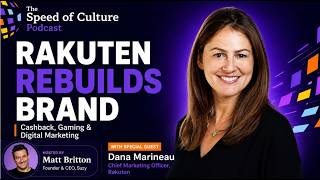
In this Speed of Culture interview, host Matt Britton talks with Dana Marineau, Chief Marketing Officer of Rakuten, about her unconventional career path and the strategic evolution of the Rakuten brand. Marineau recounts how an early fascination with news anchors turned into a love of storytelling, leading her to a marketing boot‑camp at the Austin startup Trilogy and a 16‑year tenure at Electronic Arts where she witnessed the shift from print and TV advertising to digital, mobile, and subscription models across diverse gaming audiences. Seeking performance‑marketing expertise, she moved to Credit Karma, a late‑stage startup, to learn growth analytics before joining Rakuten in 2020. At Rakuten she faced the challenge of rebranding the former Ebates with only 8 % brand awareness in the U.S., building a new visual identity, voice, and a full‑funnel “informed awareness” strategy. She explains Rakuten’s cashback shopping model, the importance of large‑scale activations such as the Warriors partnership and Super Bowl ads, and how research identified millennial women (the household CFOs) as the primary growth audience. The Super Bowl campaign leveraged 1990s nostalgia (Clueless) and delivered a 4.5‑point lift in brand awareness, 10 % increase in buyers, and 20 % rise in re‑activated buyers over a year. Marineau discusses the integration of an in‑house growth, performance, and analytics team, the “human‑made, machine‑delivered” approach to AI‑driven creative, and the balance of art and science in marketing. Her leadership philosophy centers on empowering creative and performance talent through radical candor, frequent feedback, and a “goldfish” mindset that treats failures as learning opportunities. She also defends a return‑to‑office culture, citing faster collaboration and innovation, illustrated by a last‑minute Super Bowl ad pivot that required in‑person teamwork. Looking ahead, Marineau highlights continued focus on millennial women, experiments such as fashion‑week partnerships, and the broader goal of making shopping on Rakuten feel like finding a $20 bill – optimistic and joyful. The conversation ends with her personal mantra of embracing failure and moving forward.
Chapters
Up today, we're gonna be speaking with Dana Marano, Chief Marketing Officer at Rakuten. Dana was recently recognized as one of Forbes' Top 50 Entrepreneurial CMOs of 2023. Her achievements also include 11 Cannes Lions, 13 Effies, and 11 Clios. Dana, so great to see you. Thanks so much for joining today.
I am so happy to be here, Matt. Thank you for having me. I'm a big fan.
As am I. And you know, in doing our homework for today's interview, I saw that very early on, before you jumped into this career of marketing, you actually wanted to be a news anchor. And, and just chatting to you, you, you have that news anchor vibe. So tell us about why you wanted to be a news anchor early on.
Thank you. Yes, I was, of course, you know, a child of the '80s, completely obsessed with the news anchors of that time. So Barbara Walters and Katie Couric and Connie Chung and You know, back then, all you could do was actually watch the news on live television. And so I would watch the news with my parents every night, the 6 o'clock. If they would let me stay up for the 10 o'clock, I would. I just loved it. I was so fascinated by those women bringing the news to Americans, and I wanted to do that. I even— I did go to Duke University, and I intended to be a journalist, a broadcast journalist. I, I went to college thinking I was going to be a journalism major and then a journalist, and then I I took my first journalism class and I had to be on camera. And you will laugh at this, I hated it. I was like, "Wait, I have to be on camera?" I hated it. I did not want to do that. So, the thing that struck me though is what I loved was the storytelling and inspiring of people. And I realized that actually that is what marketing is. So, I intended to be a news anchor, but really it was the inspiration and the storytelling that really got my juices flowing. And so, that is how I ended up. Introducing myself to marketing is, is, is that crazy route, but no broadcast journalism for me.
Yeah. And you started off your career, um, right outta school at a software company at a time when software was not sort of the, the thing that everyone wanted to gravitate towards. Software was still in early days. How did that come about?
You know, at Duke there were essentially 3 careers that they trained us to want to have. Investment banking, not for me, consulting, not for me, or law school, med school. That's it. There was no other path for the us liberal arts people. And, you know, to your point, it's 1997, 1998, this dot-com, you know, boom thing is happening in Silicon Valley and in Austin, Texas and places like that. And sort of the one thing that I was interested in was this startup technology concept. And there was this tiny little startup in Austin, Texas called Trilogy, and they were recruiting a bunch of liberal arts majors with this idea of, we're going to give you a marketing boot camp, come learn it real time in Austin, Texas. Cool place to live in 1997, '98.
Still is.
Yeah, that's why I went there, because there were— my only other choices were ones that were not interesting to me, like banking and consulting.
So, right. And so you're there for a couple years, and then you moved on to Electronic Arts, where you would spend the next 15 years. I'm a massive fan of Madden, play with my son all the time, as well as FIFA. I have a lot of heart for, for, uh, for EA. Um, tell us about that experience cuz you were there during the meteoric rise of Electronic Arts and you must have witnessed so much, um, in terms of how companies can effectively scale in a very competitive but huge category.
Yes. I, you know, I was there 16 years, loved every minute of it, you know, and people ask me all the time cuz it's different these days. How could you have stayed there so long? 16 years is a long time, and that is different than this generation of how they think of jobs. And the way I always answer that question is, when you're at a gaming company for 15 years, it's almost as if you changed jobs every 4 to 7 years because of the console cycle. So, when you think about it, when I first got there, you had to go to a store and buy a package, a disc, you know, from a package inside a store. And that was the only way.
I remember well.
Like, the only way To market to those people was two ways: television and print. That is it, right? Then fast forward, console cycle comes around, PlayStation 2. Now there's a little bit of this like digital marketing thing. I honestly remember the first time our ad agency— it was Wieden and Kennedy at the time— they came to us and said, we're going to advertise on the internet, here's what it looks like. I will never forget it. It was an NBA Street ad, like a banner this big, and I was like, What? We can do that? And I remember when they said, and we can retarget people. What? It's going to follow me around? And you can search on Google. What? I remember that, right? So you go from packaged goods to a very slow digital download to then a quick digital download to casual gaming, social gaming, mobile gaming, to subscription. So I lived that life at Electronic Arts across the sports games, Madden and FIFA, across the entertainment games, Need for Speed and Star Wars, against the mobile games, Bejeweled and others. So, you, I lived a life of 15, 16 years and it was like I changed jobs, not only in my own skillset, the teams that I needed were different, the way we targeted audiences. It's men 18 to 34 for Madden and FIFA, and then it's women 35 to 50 for Bejeweled. Completely different. Right. So, it's like I had 5 or 6 different jobs while I was there.
Yeah, for sure. I remember the first time I was with my son and we bought Madden, the digital version. I tried to download it and it said it was gonna be like 19 hours or something. And then my son's like, let's just go to GameStop and pick it up. And we just did them. So I paid for it twice. Uh, and so, right. But that's basically where we were. And to think now it's just, you know, it's a, that, that's a distant memory. So the innovation that's happened in this space is, is at the pace of almost any other digital industry. Yeah.
Yeah.
So, so. Go on.
Just an amazing experience within one company for me to go across those business models and those audiences and different kinds of marketing. I really had to learn along the way all kinds of new marketing. To your point about technology, started at print and TV, and then all of a sudden you flip to the other side of search marketing and, and Facebook, right?
Totally different. Yeah. So, you know, at your role, um, at EA, you know, you were largely sitting on top of global advertising design and creative, uh, for their, their own, uh, video game brands. And that obviously, you know, demands a lot of leadership from you in terms of how to direct the creative strategy, how to find the right type of talent, how to measure. What are some of the lessons you've taken away from being in marketing leadership? Because it's different than being in financial leadership or maybe some other verticals because there is that creative piece to it and it is changing so fast as you've mentioned.
Yeah, you know, I would say Managing and developing creative teams and creative people is something distinctive to marketing that is different than, to your point, finance and other places. It is a different beast, one that I love, but, you know, I would say a unique talent to manage that. And, you know, in marketing, and I'm sure we'll be talking about this, marketing has many sides, right? And, you know, I always say people will ask me brand versus performance or art versus science, and I will always say No, the way I talk about it is meaningful and measurable, right? You have to have meaningful stories, a great framework, meaningful inspiration, and right, and you have to create it. The people whose job is to find those nuggets and those insights of truth and tell inspirational stories, and then you have to measure the impact of that. And one of the things I always talk about is being, you know, I built an intel in-house team here at Rakuten, and you have to have people who respect both sides. You have to have storytellers who want to understand the impact. And you have to have performance marketers who understand the power of creative and storytelling. So that's a great lesson over my many years of learning of hiring talent and understanding what gets them going and what you need to do to be successful. Definitely unique to marketing. I agree with you.
Absolutely. And in terms of just to wrap up your, you know, your chapter in EA here, You know, I'm sure you still very much follow the video game industry, just given how much of your career you spent at EA. Where do you see the video game industry headed? Massive industry, bigger than, than Hollywood, which most people don't even know. Um, but you know, in, in, in a world of AI and the metaverse and the HoloLens and all this, what, where do you see, uh, the biggest opportunities in the video game sector?
You know, I, I still think esports is untapped in the way.
Of course, it has the big buzzword for a while, and then people kind of stopped talking about Legends.
I mean, it's incredible. League of Legends sold out the Chase Center recently, right? I mean, it's big, but I think not everyone, to your point, takes it quite as seriously yet. It is bigger than a Flightwood, 100%. So I do think there's a lot to be done there. I mean, if you recently have looked at FIFA or Madden, it is indistinguishable between a real game. You could almost not tell the difference. It is— when I got there, it was still that, you know, janky pixelated, and I, you know, I have fond memories of that, of just looking at the difference between when I got there in 2000 and now. Pretty amazing. So I do think your point about AI and how people are bringing the real world into the video gaming, it is almost impossible to tell the difference sometimes. I mean, my son was playing FIFA the other day and I honestly thought it was a Manchester United game. So I do think there's more— it's untapped there. You know, I don't spend as much time in gaming as I used to. And of course, my sons mostly play on their iPad. They play Fortnite and I mean, they'll play FIFA and Madden, but they want to play mobile because they love the microtransactions, which totally different now.
Yeah. Yeah, absolutely. So, um, before heading to Rakuten, you spent some time at Credit Karma, uh, which was a really a late-stage startup that had already been in business for 10 years and achieved scale and worked there for, for 3 to 4 years up until when they were acquired by Intuit. What was that like? Because, you know, I'm the CEO of a later-stage startup. I know the growing pains that come with, with scaling a business, and I'm sure that's something that, that you experienced firsthand leading up to a very successful exit. For that company?
Yeah, you know, I— the reason I went to Credit Karma after spending 15 years at EA is my DNA is in brand and creative and storytelling. And as I told you, I was learning the, you know, very so slightly, you know, come 2007, 2008, some of that what we then called performance marketing, right? Search and Facebook and, you know, some of that. But it was just the very beginning of that. And I recognized that I would never be able to be a CMO one day. If I didn't really understand the performance and growth side. And it was really shifting on the pendulum in that zone. And so I thought, OK, I've been at a big company for 15 years, publicly traded company, and all the awesome and not awesome that comes with that and a brand building company. I mean, EA has built some absolutely extraordinary brands. And so I wanted to go learn the other side. And I went to a startup, a very performance marketing oriented startup, to teach myself. And I will tell you, Matt, It was hard. It was not in my DNA. It was not something I loved and had like a true passion for the way I did for sports and gaming and brand building. But I had to learn it. So it's just one of those hard lessons. And I did. And in order to have the job I have now at Rakuten, I have to be dangerous enough in performance and growth and marketing analytics.
I have to be good, right?
So is it in my DNA and in my soul? No. Am I smart and good enough at it to talk to our founder and our CEO about what's, you know, what's going on in our forecast? Yes. Right. So I went there with a purpose. And, you know, you go to a startup, you do one of two things. You sell it or you take it public. And we sold it to Intuit and that was my exit out. And thankfully Rakuten came a-calling.
Yeah. And also I should say that not every startup is lucky enough to either be sold or go public. A lot of startups don't work out, but obviously— Yeah, a lot of the risk is off the table given how successful Credit Karma was when you joined. Yeah, you know firsthand.
I know.
Yeah. So, so after your, your stint there, you joined Rakuten in 2020. 2020 was obviously a landmark year for all of us in business. What precipitated that decision? Why Rakuten? And tell us about your role there as Chief Marketing Officer.
Thank you for asking that. I feel very lucky to be here. You're right, though. I started in May of 2020, maybe the worst time ever to start a new job. I am a people person and you can probably tell I'm highly extroverted. So starting a new job over Zoom is not my jam. Definitely, you know, one of the hardest moments of my career for sure. Starting a company, new people, don't know anyone, building a team, learning a new industry. Hard, right? But why I came here though, You know, right when I arrived, Rakuten had, you know, been rebranded from what was then called Ebates. So, you may remember Ebates. Of course. Millions, you know, a coupon and discount company, millions of consumers, very much towards that coupon cutter, you know, shopper. And Rakuten comes, a very large Japanese company comes and acquires, and Ebates sort of remained its, you know, name for a bit. And then the founder said, okay, it's time to be Rakuten. So, What's funny about that is in the moment, 2020, I arrive, Rakuten has 8% awareness, 8, 8% awareness in the US. And I was like, okay, if I'm ever going to take on a challenge, this is it. How amazing to be able to take on brand transformation, brand evolution. This is what I'm good at, right? That like, this is the thing I love. So, you know, I talked to the CEO and he says, well, there's 8% awareness of our name. And I was like, what? Oh my God. Right? So I say, okay, let's go. So they had just, You know, change the name right then. And here I come and say, okay, we're gonna build a new team. We're gonna rebuild our identity. We're gonna do a redesign. We're gonna invent a voice and personality that's never existed before. Let's go. And by the way, we're gonna try to do this all on Zoom.
Right. And, and what, what can you tell us also a little bit about just the product for those who don't know? Uh, many have heard of Rakuten, but maybe don't know exactly what the product does.
So you just named the thing. And we actually call what we go after informed awareness as opposed to just general awareness because a lot of people have heard of Rakuten, whether it's because we're a very large public Japanese company or from the Warriors relationship.
Yeah.
People have heard of Rakuten. And so, to answer your question, Rakuten is a shopping destination. We have about 5,000 stores, everything from Nike to Old Navy to Neiman Marcus to Uber. Anytime you make a purchase on Rakuten, you go directly to that store, but you get cash back every time. Your sneakers, your sunglasses, the AirPods you're wearing, anything you buy, you get cash back. It is amazing.
Cash back for that store or cash back across the Rakuten network?
Cash back on that store on Rakuten. So, you go to Apple on Rakuten and you get cash back when you buy those AirPods.
Right. So, it's like, why shop anywhere else if you can get cash back there and you don't have their bonuses? Correct. Yeah.
Why would you buy anything, whether it's the Uber you're gonna take somewhere Whether it's the takeout delivery at a pizza place, whether it's jeans from Levi's or a nice Gucci bag at Neiman Marcus, why would you buy it anywhere else when you, if you get it through Rakuten, you get cash back every time.
So fairly simple story to convey, but obviously you're fighting for attention and you're competing with the likes of Amazon. Um, when you talk about informed awareness, you know, I certainly first heard of Rakuten through the Warriors, um, cuz I'm a big sports fan. I imagine you hear that a lot, but that's not exactly informed awareness because it's just the brand. You can't communicate a story through a jersey and a logo. What has worked in terms of informed awareness and platforms for you to be able to tell your story?
Great question. So yes, one of the things that we do related to the Warriors is inside the arena. By the way, if you haven't come to a Warriors game, please do. Inside the arena, we do a lot of what I would call educating. Right? So inside the arena we have the LEDs and all kinds of things to help at least the, you know, 25,000 people in that arena understand why and what it means to have the players wearing our name above their hearts so that at least those people understand. Outside of the stadium, we do a lot of work as it relates to making sure people can see that badge and then understand what it means. So it could be as simple as a television commercial that is airing during the Rockettes game. That's a very simple thing as well as of course all very targeted, you know, emails and social that we do related to educating. We have, you know, I would say, as always, as all great marketing departments, full-funnel marketing. So there's, you know, the brand awareness, and then, you know, the, the consideration middle funnel part, whether it's— we call it education, or we call it informed awareness. We spend a lot of time in that part of the funnel. And then, of course, conversion. But we really do work hard across all of our campaigns, whether it's a Super Bowl campaign, something related to the Warriors, or just our holiday campaign too. We have full-funnel marketing across every possible platform.
Yeah, I was actually gonna ask you about the Super Bowl, cuz that's obviously always such a fascinating case study when it comes to a brand and marketing. It's a major bet that you're making and you're hoping that it pays off obviously with the pre-buzz before the game and the creative has to hit home and then you, how do you follow up and, and land the plane down the funnel, so to speak? Yeah. What is that process like to make the decision to activate during the Super Bowl and then going through to finally getting a campaign that you can feel good about pushing live?
So I love this question. I'm always happy to talk about this because you have to be ready to get to— for the Super Bowl, that is marketing's biggest stage. So my opinion was, you know, I started in May of 2020, and you can't just do the Super Bowl the next year. You have to prepare your brand, you have to prepare your members, you have to prepare your marketing and your product. It all has to be the right moment. So we took those 2 years, as I said, a rescaled voice and personality, new copywriting, elevated design, brand identity, all the basic fundamentals. We needed to be ready, and we had to have certain features baked into our product to make it a better experience for our members before we felt ready to say, all right, now we're going to do the case study and the business justification for why the Super Bowl is going to be meaningful for us. And so we went through that process. Thankfully, uh, you know, our CEO and our founder agreed that it was time, um, to make that kind of investment. And I feel really proud that— that's not an easy process, by the way. I mean, it's not just, oh sure, yeah, great idea, let's invest that kind of money. I mean, you really need to do the business justification and, and be clear with expectations, right? We had to be clear of what it means to move brand awareness metrics. What expectations do we have of signups and purchases that day versus over time, right? You have to be clear about that stuff because otherwise people get disappointed. So we really go out of our way to say, here's what we expect, here's what long-term brand awareness points mean, here's how we can do our best to tie it to revenue. Not easy, obviously. But we really worked hard to convince everyone that it is a long-term halo effect across the entire year. And by the way, Matt, since we've now done the Super Bowl twice, I can tell you our 2022 Super Bowl The metrics are amazing, which is how we easily justify doing 2023, right? Because we had over that year, so I'll just tell you February to February, right? We had 4.5 points index up in brand awareness. That is insane. 4.5 points, right? Wow. We had a 10% lift in buyers and we had a 20% lift in what we call reactivated buyers, someone who did not shop at Rakuten the year before coming back to shop with us. Pretty, pretty amazing business metrics. Now, again, it's over the year, right? So if someone were to say to me, what about the day of the Super Bowl? Yeah, okay. Yeah, we had more search than usual. We had a lot of press coverage. We had more signups than usual. But the point is not that day. It's the long-term effect.
Yeah. Yeah. And crafting a campaign that has that long-term effect, it's really where I think it separates the good strategies from the great ones. This past Super Bowl, I was just fascinated with— you guys tapped into, you know, 1990s pop culture and nostalgia. By featuring Alicia Silverstone from Clueless. A lot of people obviously have a lot of heart for that movie, as I'm sure you know, because I'm sure you've consumed a lot of research for making that decision. What was that process like to land on that across anything else? And what— talk to us about like the audience insight and who the audience was that was most important for that activation.
I'd love to. So we determined about a year ago with some very important consumer research that our growth audience was millennial women. Um, our core audience now, as I told you, because the Ebates acquisition was a slightly older woman, so our growth audience of course is that young millennial. So let's call it that, you know, young 30s into early 40s, right? And we can talk about Gen 3 later, but that was really the core of our growth audience, who really is the CFO of the household right now, making a lot of the big household buying decisions.
It's like a lot of people don't understand that millennials are now the people who are deciding what car to buy, what laundry detergent. And they actually grew up with the internet in the household. They're a different consumer than the Gen Xers.
Totally, exactly right. Totally different group of people. And people say millennial and people, you know, somehow hear young. They're not young anymore. They're 35 to 45. So you're exactly right. It's the CFO of the house and they have money to spend on shopping, right? And so we did a lot of research on millennial women and we have a lot of interesting insights One of them, though, to your point, was this concept around, you know, first of all, the nostalgia of the '90s, you know, millennials are not— has had returned, right? So we're talking sort of last summer right now. And if you, by the way, if you had logged out of Netflix and just logged in to see the number one movies, they were Mean Girls, 10 Things I Hate About You, and Clueless.
Right? Right.
And even things like bootcut jeans returning and kids wanting Polaroids for Christmas, like the '90s returned.
Yeah, my daughter's a teenager and she watches all those movies, right? She was not even through nostalgia, but just because the nostalgia has an impact on people who didn't even live through it, even for Gen Z. Yeah, 100%.
So that was sort of culture we were tapping into. Okay, then, um, an important piece that we all know about Millennials is they are inspired by influencers. Now I'm going to ask you, who is the original shopping influencer?
Cher Horowitz, of course.
Right, right, right. She is the OG shopping influencer. So that's where that came from. And this concept of, well, obviously in 2023 Cher Horowitz would shop and get cash back at Rakuten, obviously. So that's where that insight came from, is this concept of, um, we're hearkening back to the '90s nostalgia and influence, having such a major influence and inspiration on this generation, Cher Horowitz is the obvious choice.
So did you look at, did you look at, uh, Legally Blonde and Reese Witherspoon as well? Like, did you look at other movies or did you just always know it was Clueless?
Nope. No, because here's why. Clueless has a center on shopping, right?
And so we wanted to— you're right, it does.
Yeah, it is the part of the center storyline is around shopping, and we felt it was important. And we didn't do this in the first Super Bowl ad that we did, which of course I love which, um, used Hannah Waddingham from Ted Lasso, another show I quite love. Um, but that spot was not— and that campaign was not centered in shopping. So just an extra leap for consumers to have to make about what is and who is Rakuten. We felt that Clueless instantly telegraphed shopping. And so that was why. So I, we didn't actually look at any other '90s movies like that. We certainly did some other, other '90s stars and whatever, but that was the one. We, and you know, we presented, as always you present multiple pieces of creative and you obviously have a recommendation, but, uh, my boss, the CEO was like, nope, that's the one, go get her. We were like, mm, we'll try. So yeah, really great.
That, that's, that's fascinating. So in terms of like your role, obviously, you know, you're talking about these big campaigns, whether it's, you know, the NBA sponsorship for the Golden State Warriors or the Super Bowl, these are mass market campaigns that most digital-only brands don't have the luxury to do besides the massive players like the Amazons of the world. But at the same time, I would imagine you also are, and you mentioned this earlier, spending a lot of time thinking, thinking about things like SEO and social media marketing and all these sort of digital direct campaigns that do track acquisition, et cetera. And there's been so many changes in that realm with the Apple privacy changes and what we're seeing right now with AI and mobile adoption. What are some of the strategies that you're deploying now here in 2023 in the digital world that you're finding effective at driving the metrics of the business?
I, I love that question because so many people ask me about our in-house team and they tend to focus on the creative side of our in-house team, but we have a full growth performance and analytics team as well. And to answer your question, data really fuels so much of our decision-making, whether it's media planning our investments, our targeting capabilities and audience generation. I mean, it really is an important piece to how we make decisions about our campaigns. And having an in-house team allows us to be really nimble, really quick. You know, I always like to say, you know, some of our automation, people ask about it and I will say it's human-made, machine-delivered. That is something we talk about, which is the collaboration of creative writers and designers inputting into a machine for dynamic creative and subject testing and copywriting testing. Like, we learn a lot, but we don't let machines do all the work. It's human-made, machine-delivered. And that's something I'm very passionate about, to understand, again, both sides, the meaningful and measurable. So we, of course, do, you know, we have been using AI, of course, you know, before it was a buzzword, we, you know, we've been doing that kind of stuff. But truly, it is the most important part, and the magic of it is using both. And, and be smart about how you use both. Yeah.
You need to put a heart inside the robot, so to speak. I mean, when everyone's saying right now AI's gonna take over the world and you're not gonna need creative people, et cetera, you still need to know what to put into AI. It has to come from a core insight or an idea or, or, or a distinct knowledge piece about the consumer that will spit out something that's valuable on the other side. Otherwise it's garbage in, garbage out, right?
Which comes from insightful humans.
Yep. Yep, exactly. Insightful humans that understand their consumer, understand the pain points that they're, that they're solving on behalf of their consumer and, and then how to effectively communicate that. So let's shift gears a little bit, Dana, to, to your everyday role at, at Rakuten because, you know, you've talked about so many different things that you, seems like you have to oversee and be responsible for. And it's a heavy lift for a brand that obviously has a lot of potential, but it's not something that you can coast by any means. You have a hugely competitive environment. And when I say, why shop anywhere else? It, it sounds that simple, but we all know it's not. And you're fighting every day for consumers' attention. What does that mean for how you spend your time?
I love that question. And yeah, it does sound obvious to me when I say, why would you shop anywhere else?
Yeah. Well, I was the one who actually said it. Right.
And that's right. You know what I always liken it to? You know that moment when you find a $20 bill in like your jacket pocket. That's what it should feel like when you shop at Rakuten, right? That joyfulness. And by the way, if I hadn't mentioned this before, the Japanese name Rakuten means optimism. So, answering your question, we really try to create an optimistic and joyful environment. And you're right, it is hard. We are competing for mindshare and wallet share and brain space. And there are a lot of places you can buy things online, right? I do spend my time, of course, doing my best to mentor and develop and harness this very exceptionally talented team that we have and helping unblock and support and get out of their way. I once had this mentor at EA. She was my boss at EA. Her name is Carolyn Feinstein for many years at EA. And she once said something that landed with me, and I will never forget, which is, "You don't work for me." I work for you. My entire job is to unblock, support, and empower you. And that is how I spend my day, unblocking for these exceptional creatives and performance marketers that we have, to get out of their way, to allow them, to your point, to be able to do the Super Bowl, to be able to do their Warriors relationship, to be able to test and try new things and take risks with influencer campaigns we've never done before. That is how I spend my— just setting them up for success.
And what are you looking for in individuals who work for you that— because in order for you to get out of their way, you need to trust them, and you need to trust their skill set and their intuition that they're gonna be able to deliver the overarching mandate that you've set and your leadership has set for the brand. So what are you looking for in people who, who, who you feel confident enough to empower?
So exceptional talent Wants to be with other exceptional talent.
Yep, that's for sure.
And my job is to figure out how to assemble them together and create an environment for them, whether they're on the meaningful side or the measurable side, so that they feel safe. That is it. And there is— there are all kinds of things that we do to build that trust and build that camaraderie. By the way, one of them is getting them into this office, which is a whole other piece, but to create those shared experiences and that trust. And, you know, one of the things that I do is we have a monthly marketing meeting for, you know, it's a couple hundred people. And I ask every single meeting for one presentation that we call a goldfish presentation. And it is in reference to the Ted Lasso "be a goldfish" idea, which is simply have a short memory. When a mistake happens, when a failure happens, when something does not go as well as planned, You need to embrace it. You need to say it out loud. You're going to present to the entire team, if not the company, about what happened and what we learned from it, and we move on. And when you create that environment, there's an expectation that every single marketing meeting, someone is going to get up there, that vulnerability, and say, "Hmm, this thing that I told you about last time did not go very well. Let me tell you about that." That does create a safety and a trust back to the exceptional talent. They want to be with each other. We get them here together, and they learn from that. And it, it does work.
Absolutely. And, and you'd mentioned very briefly getting people back into the office. That's obviously a continual hot topic, um, in the business world today. Why is it important to you to get people back in the office and talk to us about that journey post-pandemic?
So I think COVID taught us that it is possible to get work done, right? I think that was a question in the beginning. It is possible to get things done, to make deliverables, to collaborate over Zoom. That is possible. Is it the best possible collaboration and work? Is it the best possible innovation? Is it the best possible inspiration? No. That is my opinion, and I have a strong opinion about that, and others absolutely disagree with me. And I do understand the love and desire for flexibility. I get it. But I think when it comes to the work environment, the work is better, the collaboration is better, the inspiration is better, the innovation is better together in person. So you can debate whether that's 5 days, 3 days, 4 days, whatever. It is better in person. That is my opinion. I feel very strongly about it, and I have seen it is better. Like, are we able to make an email with designers and writers and technology people and get it out Yes. Is it as good? It is not. Right. And you know, all kinds of stories, Matt, about the nimbleness that we've had to have that only works in person. Like, I will tell you, our very first Super Bowl ad that we greenlit, we found out about a month before we were going to shoot it that another company had a concept that was very similar. Wow. We had already gotten it approved. Through all the people you get it approved through. We were already in production with going to do it, and guess what? We decided to scrap it at the last minute and get in a room here all together in this San Francisco office over a 24-hour period and redo it. That would not have happened in that way successfully on Zoom, 100%.
Right, right, right. And, and, and I mean, has it been hard to get everyone to buy into that? Like, did you have pushback? Like, what did that look like?
I think people don't like to be told what to do. Yeah, I think people want to do it. So I actually don't think the issue is, I don't want to come to work. I think the issue is, I want to come to work when I want to come to work. It's slightly different. And, you know, I'll say we have done all kinds of things to make work fun and remind people why it's great to come to work. You know, all the traditional things. Whether it's happy hours and scavenger hunts or Warriors games or, you know, whatever it is to create a fun work environment. We do that and people love to be here. I just think people don't want to be told what to do, you know, and especially, by the way, the younger generation. Like, we came to work every day for 30 years. It was not a thing, you know, it's the younger generation. So yeah, it's been, it's been a challenge. There's been pushback, but we're getting there. We're getting there. We are now at a place.
Yeah, I see a lot of people walking behind you at your offices, so it seems like you're making some progress. We're here. So, um, so looking ahead, um, as you look at Rakuten's business and some of the opportunities ahead for 2023 and beyond, what are some of the new things that you're focused on, whether it's tactics or ideas to continue to drive the growth of the business?
So we continue to focus on this growth audience, this millennial woman, cuz you know, part of our research has showed us that we just don't show up on their radar, right? Yeah. So we've been doing a lot of things. Um, you know, I will say We need to continue to grow both that awareness and that informed awareness with this audience. So we need to do tactics and campaigns that address this. One of the things that we are looking at is Fashion Week, just as a, as an idea. And we dabbled in it last February as related to our Super Bowl campaign. So I don't know if you know this, but Alicia Silverstone is very close friends with designer Christian Siriano. So we were featured in his runway show as just part of a partnership that we had as an extension of our Super Bowl campaign.
Very cool.
That was awesome. So we were like, hmm, we got a lot of attention, press attention, social attention in Fashion Week. And by the way, we're a shopping platform. Fashion is our business. So we thought, you know what, we're gonna investigate that more. So, you know, I'll come back on your show and tell you how that goes, but we're working on that.
Okay. Awesome. Yeah, it makes a lot of sense, especially given your audience. So, um, to shift gears here as we wrap up, Dana, I mean, you obviously, you know, strike me as someone who's a really firm command on her role, on her purpose, and bring a lot of energy to the table along the way. When you look at your career journey, which is by no means at the end, it sounds like you're just getting started, but for what you've been able to achieve so far, what are some of the things that you can look back at besides deciding not to be a news anchor, which I actually think you do great on camera, by the way. You're on camera right now, but that's a distant memory. But what are some of the other decisions that you think that were the right ones that put you in the position to end up in your role right now as CMO?
You know, I would say a couple things. I really learned a lot from my mentors at Electronic Arts. When you're, you're at a place for 15 years, there's a lot.
That's a lifetime. We've only been running Suzy for 5 years and it seems like 5 lifetimes. I can't imagine what 15 looks like.
It, it's a lot to learn from and it's some to unlearn, right? So, you know, I would say there are people that I modeled my behavior, my leadership style around, and people I thought, "Hmm, I'm not going to do that," right? So, I'm a listener. I'm an observer. So, I think I did well for myself in that way. I also think I had a mentor who gave a lot of feedback. I give a lot of feedback. I subscribe to this concept of radical candor.
Yes.
It is a way to build trust. And back to this safe space and trust, you build trust when you give feedback. And I am a person who will give feedback all day, every day, positive affirmative feedback until I have some other kind of opportunistic feedback. And by the way, because I'm giving feedback all the time, no one freaks out when I say, "Hey, you know what? Let's talk about how that went. We could do that a little bit." People don't freak out when I do that because they're used to me saying, "Hey, that was great. I love that. Hey, the way you presented that was amazing." Hey, you know what? I really loved when you said this. You know, I do that all day.
And so they just don't— they don't think just the negative thing you say is the only thing you think about them because you've also given them lots of positive feedback along the way.
Exactly. That has been a pillar of my leadership that I think has served me quite well, that I'm very proud of. And, you know, I also think a hard decision I made was the decision to leave EA and go to Credit Karma, a place that wasn't in my soul, something I didn't know what I was doing. People— I mean, when you spend 15 years at a company and by the way, lot of lifers at EA. I mean, there was a group of probably 200 of us that were there 10 to 12 years together, but going to a place where I didn't know anyone, I didn't understand the business, the industry, and the soul of that company was not brand marketing. So I'm proud of myself, though it was hard. I'm glad I did that because it allowed me to be, um, you know, intelligent enough to see the entire scope of what marketing could be, to have this job, which I have to say, I feel very fortunate to be where I am today.
Yeah, absolutely. So, so, and, and, and to close out here, Dana, with all that, is there sort of a mantra or a saying that you can, um, think of that kind of embodies your career journey that, um, you like to live by every day?
You know, this goldfish concept is one that I use in my personal life and in my professional life. So, yeah, you know, I have two boys. They are 10 and 12. They play sports, they go to school, and at night, every night, we talk about, you know, the rosenthorn of the day. And we do talk about, hey, I didn't play well in basketball. Hey, I didn't, you know, I missed that free throw. Hey, I don't think I did, you know, as great as I had wanted on that math test. Like, we talk about this at home, this idea of not letting, whether it's a mistake, a failure, something not going well, rising above and finding your way through, you know. And, you know, it would say swim on, right? It's like, I, I do live that myself, and it's really important at work in our department that we embrace this concept of it is okay to take risks. It is okay to try something new. And if it doesn't go well, it's okay. And I use that in my personal life, in my professional life, because I think it's really important to move through adversity in whatever it is.
I think it's a great point. I think in this world, especially for younger kids who are exposed to this world of social media and FOMO and comparing and thinking everyone else's life is glamorous, and it just appeared that way for them. It's something that we didn't have to go through when we were growing up, and it creates undue pressure on kids and sometimes has the adverse effect at dissuading them from taking risks. Yeah. And, and having them have a fear of failure, which really can hold them back as, as they, as they grow and go throughout their careers.
And that's true for a 10-year-old as it is for a 47-year-old. 100%.
Right on. Well, Dana, I just wanna thank you for joining today. Um, I knew this was gonna be a great episode and, um, you did not disappoint. And I think your story is going to be one that's going to be both inspiring and educational to our audience. So thank you so much for taking the time, and can't wait to stay in touch and see what's next for you at Rakuten.
I love it. Thanks for having me. I could have talked to you another hour, so thank you.
Likewise. So on behalf of Susan Yadwytyn, thanks again to Dana Marino, CMO of Rakuten, for joining us today. Be sure to subscribe, rate, and review the Speed of Culture podcast on your favorite podcast platform. Till next time, see you soon, everyone. Take care.
More from Matt




MikMak’s Rachel Tipograph on Consumer Spending, Retail Media & Holiday Shopping Trends



Jaguar Land Rover’s Charlotte Blank on Luxury, Purpose & Experiential Storytelling



