Revealing AI's Impact on Music Industry | Live from Canadian Music Week | Toronto Canada
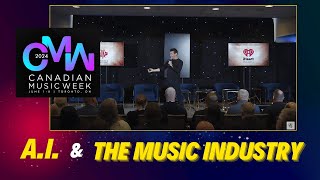
Matt Britton (Suzy) gave a keynote titled ‘Harmonizing AI and Gen Z: Reshaping the future of radio, music and streaming’ describing why AI represents a new innovation wave and how it specifically affects audio, radio and music. He explained the AI value chain (infrastructure, LLMs, datasets, applications), demonstrated practical examples (custom GPTs, voice cloning, Suno for instant music, DALL·E for images), highlighted Gen Z attitudes and radio usage, and finished with actionable steps: organizational adoption, positioning and product integration.
Questions this video answers
75%
55%
50%
20,000 hours
Two months
Good morning everyone and welcome to Harmonizing AI and Gen Z. Reshaping the future of radio, music and streaming. Please welcome your moderator, Matt Britton from Suzy. Thank you. I'm actually not moderating, I'm giving a talk and then we have a panel, I think afterwards. I'm Matt Britain. I have spent my entire career helping large brands understand the new consumer. When I first got out of college, the Internet was first becoming a big thing. My kids think I'm a dinosaur when I tell them that. And it was really about helping brands understand how to get on the Internet and market to young people. I was the first person to sell ads onto Facebook in 2004 and I saw that entire revolution, of course, the iPhone in 2007, 2008 changed the world in so many different ways. And now we're in a completely different era. We're in the AI era. And throughout my 25 year career, I have never seen such potential, such fear, such challenges, such opportunities. As I see now, to me it dwarfs any of those other evolutions that I've been able to witness firsthand. I've spent the last six to nine months spending 90 to 95% of my waking hours building an AI and understanding it. One of the beautiful things about AI is you don't need to be a coder to be able to understand and build it. I was finding within my internal company called Suzy, which is a market research software company, that my engineers are kind of pushing back on AI, telling me things that couldn't be done. And I was like, screw it, I'm going to do it myself. And I walked into a meeting and said, here, I just built a prototype and I'm not getting paid like you are to be an engineer. So if I can build it, you better get building it. And you know what? They did. And I think that's another great thing about it. So we're here to talk about AI. We're here to talk about, you know, the audio industry and the radio industry and what it means and this new consumer Gen Z. And what I hope everyone takes away from this today is A, understanding what AI is and its true potential, B, how it impacts the industry that we're all in and C, what are some practical things you can do when you leave to further yourself in this area? Because one thing is for sure, whether you like AI or don't, we are not going backwards. The genies out of the bottle. This cannot be regulated. You can fit most AI models on a thumb drive. So we are not going to be talking about AI being less important a year from now. And if you haven't kind of reoriented your career and sort of your professional development around AI, I actually think it's a very big mistake. And I'm going to be talking about that as well. So thanks so much for joining today. And let's just dive in. So there's something called the Gartner hype cycle that many of you probably know about. And it kind of goes when something becomes really popular, everyone starts talking about it, and then all of a sudden it becomes on the Today show or the front page headline on USA Today, your mother or grandmother starts talking about it and it kind of becomes overhyped. We saw that happen most recently with bitcoin, right, where all of a sudden everyone's talking about bitcoin. It hits this kind of peak of inflated expectations where people think it's going to change things even more than it actually. And then there's always the crash that comes out of it that happened with bitcoin, right? And people stopped talking about it. And my experience in my career and what's kind of proven to be the case is during this trough of disillusionment, after the kind of bubble burst, so to speak, that's when the real work begins. That's when it's not, you know, on the headlines of the USA Today, but the people are doing the real work to lay down the foundations of the rails. So this could be sort of a sustainable business trend. And then over time, it ends up in sort of in this plateau of productivity where it isn't as crazily disruptive as maybe you originally thought. But it's also not something that is a fad. It kind of has staying power on the long term. So the big question with AI is like, is this time different? Because obviously some trends, like the iPhone, for example, had way higher expectations than many of us even thought. 3D printing. I remember a couple of years ago, everyone said everyone's going to be printing their house and their toothbrushes by now. That obviously didn't, you know, take place. So we really never know where trends are going to happen. But I actually think that again, this trend is not a trend, it's not a fad. I actually think it's going to be a new paradigm and a new way of doing business. And if you look at kind of the context of history where AI lives, you had this first wave of water power and textiles. Fortunately, I'm not old enough where I was around for that. Right then you had steam power and the Industrial Revolution and electronics, which start to lead to kind of digital networking and software, which is really coming on board the, the start of my career in early 2000. And now we're in this new wave. And I believe AI does signal a new wave of innovation. I think artificial intelligence combined with the power of data, combined with 5G proliferation around the world is going to enter sort of a new phase of innovation that we're going to look back on and say, I can't believe I was doing that 10 years ago, right? I can't believe I was actually doing that type of technology. Because we are in a completely different world right now. So I think it is that big. And I think throughout the context of history, we will be looking at AI as a completely new innovation wave. So why do I believe in AI? Why is it different? Well, there's kind of a couple of reasons why. First and foremost, it's moving at an unprecedented rate. I speak about AI all over the world and I'm often asked to provide the deck for conferences three weeks in advance. And if I did that, my presentation would be completely dated because it is moving that fast. There are new models, there are new news, there are new innovations that come up in AI every single day. If you look at the iPhone, the difference between the iPhone One and the second iteration was huge. But it took 18 months for that second cycle to get out where now we're seeing new cycles happen in AI every three weeks, every four weeks. And the rate of innovation is only accelerating over time. AI is incredibly easy to use. You know, there's this misconception that AI is just for Gen Z and young people. I actually think baby boomers should be the biggest consumers of AI AI because they are probably most in need of understanding where the world's heading. And there's not a technological divide in terms of, oh, I don't know how to use this. Because the way that you use AI is just talking to it in any language you want. So there's a misconception that you have to be a sort of tech whiz to use AI, but you don't. And one thing I'm really thinking about lately is how older consumers, I can help them get on AI and help it help them change and better their lives because there's no reason why they should have a block to it. Unlike other technologies where you really need to adopt some level of new consumer behavior, there's minimal coding required. Going back to my example earlier, you do not need to code to use AI, and it really has unlimited potential. And I think this is what makes it different than other technologies that we've seen. So as I mentioned, the gender distribution and the age distribution really speak a different story. Where it does skew slightly male right now and it certainly skews younger in terms of the people who are adopting AI. And I actually think again, this is a huge opportunity. There's no reason why younger people should disproportionately be adopting AI right now, because it is not something that requires advanced technical knowledge. And I think you'll see that as I go through this presentation today. So the AI value chain. I'm going to try to unpack what AI is in really four simple terms so you understand where you need to be focused, what kind of acronyms and buzzwords you need to be thinking about and, and ones that you really don't. And the AI value chain is really four components to it. You have the infrastructure, the large language models, the data sets and the applications. So let's just try to unpack this. The first layer is the infrastructure. This is basically the technology power behind AI. And ultimately there's a company called Nvidia, who I'm sure many of you have heard of, which is about to be a $3 trillion company with a T that makes these H1 chips. The that essentially were originally made to power video games and they just happened to have these super powered components that were allowed to power video games at the beginning. But when AI came on, it was just a great coincidence that it also could power AI. And this company has just exploded in value. You don't really need to know anything about this because unless you're in this business, the infrastructure is really about companies like AI. I mean Nvidia creating AI powered chips that are going to power AI moving forward. And that's the infrastructure component. What you do need to know is that the demand for these chips is dramatic. And we are in a kind of intense geopolitical landscape right now. We're just talk about what's going to happen with Taiwan and China. And the reality is that we are more dependent upon chips than ever before around the world. And the demand you can even see right here, Microsoft's capital expenditures on chips skyrocketed. And that's kind of taking place across every company. The demand for this computing power, because everyone's seeing the power of AI, it's really unprecedented. So what you need to know about AI is that the demand is crazy right now. Costs aren't going up. If there is ever a supply chain disruption all of a sudden, AI could become cost prohibitive, although it isn't right now. The second part of it is the large language models. And I'm sure everyone in this room has now heard of ChatGPT. When I asked that question a year and a half ago, probably 10% of people have raised their hand in ChatGPT. I like to equivocate to the AOL of the AI era, right? We all remember AOL is get online, and without aol, we have no idea to get on the Internet in the early 2000s. That's kind of what ChatGPT has done about AI. It's commercialized it, it's made it readily available, like AOL. ChatGPT may be a topic or a company 10 years from now that we say, oh, do you remember that company? Because they are kind of up against some heavy competitors, namely companies like Facebook and Google and Microsoft, although Microsoft has partnered with Open A. But they don't have quite the ecosystem that these other companies do. And time will tell if they were just sort of like a Trojan horse to get AI adopted by the mass public or if they're going to be a company with staying power. But what ChatGPT is, is a large language model. So it sits on top of the application layer and essentially takes in inputs which are prompts, right? Crawls trillions of pieces of data and outputs content. That's why it's called generative AI. It generates things. And we'll talk about what it generates in a second. But it's essentially a large language model. Companies like ChatGPT or Crane, these larger language models are at risk of really being commoditized because a lot of other companies have gotten into the large language model game. You can see, despite the fact ChatGPT did have first mover advantage, it took them two months to reach 100 million users, which is just mind blowing because the technology was so good, it was so very easy to use, and they did have a first mover advantage. But. But now what we're starting to see is many other players are getting in the space. You know, companies like Google, companies like Facebook, companies like Elon Musk Xai, which just raised $6 billion to create his own AI model. These are all large language models. They all generally do the same thing. They take prompts from people like us saying, find me this. It crawls sources of data and outputs or generates information. Now, what's interesting, we talked about earlier, like the rate of change, and it kind of goes to my point earlier about like how fast it's moving. I actually need a new chart for this because now there's even a new version of ChatGPT called ChatGPT 4o O stands for omni, which is even more powerful than the last version of ChatGPT4. And this has happened in the last couple weeks. So this is how quickly things evolve. But just to give you a context of the rate of change, ChatGPT 3 and a half and ChatGPT 4 had about a six month gap between the two of them. And look at the leaps in some of these performance scores and things like the verbal GREs that went from being able to perform in the 63rd percentile to the 99th percentile, that type of jump that happened in the span of six months. So where are we going to be a year from now or two years from now in terms of the power and capability of a tool like this? It's just mind boggling in terms of the rate of innovation and what's happening. So the large language models are everywhere and again, I believe they're going to be quite commoditized. And to prove that point, Facebook recently announced that Llama 3, which is their large language model, is going to be open sourced, meaning they're not going to charge you $20 a month to use it. They're basically using sort of like a burn scorched earth approach, if you will, where they're saying, we're not going to try to compete in this game, we're just going to give it away for free and win in other areas. And as soon as you start seeing things that are open source, you start to question if a company like ChatGPT really has that long term competitive advantage. And this is a fabulous tool, large language model as well that Facebook has invented with Llama. So these are, those are two areas. The first two areas, the application layer with the chips, which many of us don't really need to worry about, just know they're going to be there unless they're not with the supply chain disruption. And the large language models, where to me, yes, some are better than others in certain areas, but this is going to be a largely commoditized game where it starts to be where everyone in this room needs to start thinking about how can I put AI to work, is in the last two areas, the data sets and the applications. So let's talk about what that means. So data sets are essentially the ingredients that you put into the large language model that make what you output different and unique. Right? So Coca Cola has its secret formula, right? And Burger King has its special sauce for the Whopper, right? That's what makes their products different than everyone else's. What will make your use of AI different than everyone else's use of AI is your secret ingredients that you sprinkle in, which is data, right? So at the largest level, companies like ChatGPT are saying, what data can we put in the model that other companies don't? And recently they start to strike deals with third parties to license their data. So Reddit, which many of us probably know about, a social network, they struck a deal with both Google and ChatGPT to license their data to their models. Microsoft hasn't yet. So Microsoft will not be able to crawl through the millions of comments that were on Reddit to feed their model. They just don't have it. If you created your own version, which I'm going to talk about how we do in a second, and you had business data, right? So, for example, here's a perfect example. Say you have a radio station and you have transcripts of every call in from a listener. And you have it. You can take all those transcripts and you can feed into a model and then it will spit out information for you that it won't for everyone else. For my software company, Suzy, we use a tool called Gong that has recorded over 20,000 hours of calls with prospects and customers. It's a massive file of transcripts of 20,000 calls over four years. We fed that into a model. Now, that makes our use of a large language model like ChatGPT different than everyone else's. We can start asking questions like what competitors are mentioned the most. Or we could ask it to make ads for us, or we could say, help us build our product roadmap, and it could pour through all that data. So if you had call transcripts from listeners, you could see the type of request they have. What promotions do they like, what type of music are they into that becomes a proprietary data source that you and only you have that's different. And there's all sorts of data deals going on. And not all companies actually want to do data deals. And not all large language models are playing by the rules. So the New York Times earlier this year sued OpenAI, which is the purveyor of ChatGPT, because it believed that ChatGPT was crawling the New York Times information without the New York Times getting rights for it. Sounds familiar, right? We all remember Napster, right? This is happening all over again. In the Napster era, you know, music was given away for free, and then along Came Apple and itunes and we entered a new world of music publishing. This is happening all over again. And this is kind of the landmark suit that we'll see. But I think what started to happen since this lawsuit is we start to see more and more licensing deals. I think the large language models at first just crawled the entire Internet and took. The challenging thing about it is when you put in a prompt and information is spit out, it's taking tiny pieces of information from thousands or tens of thousands or a hundred thousands of different sources to output. So it's very hard for the publishers to prove you use my content for this. That's what makes it different than the Napster era. So I think at the beginning the large language models kind of thought they can get away with it because it was just so confusing and so finite in terms of the use of data. But over time I think the publishers caught on and the publishers are worried because if I could just ask ChatGPT to summarize a story that the New York Times reporters got paid for writing and the New York Times gets no credit for it. How are publishers even allowed to exist anymore in that model? So that's where this is all kind of coming from. So you can see even this is recently, I think of last week, the Atlantic, Vox Media, more and more companies, News Corp. Are striking deals. They're, they're getting millions of dollars each year to basically license their data into these large language models. And this is a music oriented lawsuit that, that happened. Anthropic, another large language model, they're in the middle of a copyright lawsuit with Universal Music. Universal Music believes that Anthropic illegally is taking their lyrics and their song information and feeding their model in the way where Universal is not getting right. So data is an interesting thing. You have the large language models at the big level doing these type of deals are in the case of Universal, not doing deals, but they probably will. And then you can create your own version. So let me double click on that. So when I was mentioning earlier about the call transfers transcripts and I got my call transcripts for customers that you could with listeners, what does that mean? Well, these platforms have something called a custom GPT and what a custom GPT is is essentially it's your own little version of a chatgpt where you're taking everything it has and then you can sprinkle in your own data and basically you can tell it how to react. And it's incredibly easy to build. I cannot tell you how easy this thing is to build. You Basically, go on to ChatGPT and say, Create a custom GPT. It'll say, what do you want to create it about? So I created one where I download it statistics from NFL football games for the last 10 years. And I'm trying to train it to give me an edge on betting on games. I don't know if it'll work. I'll probably lose all my money, but I'm trying to do it. The best example of a custom GPT, which is way more healthy in more ways than one, is I created the Matt Britton healthbot. And basically what I did is I took my X ray information, my blood test results for the last 15 years, MRI and X Ray information, any notes I have from a doctor, and I fed it into the model and it now knows my entire health history. So if I have a weird symptom, instead of going on WebMD and ultimately think I'm gonna die, because that's what happens, you go on WebMD, right? It actually can give me information that's contextual to me. I actually say, if I'm gonna book a doctor's appointment, what's the most important one, or the five most important doctor's appointments I need to make this year? And it'll say, Dr. Jones, Dr. Smith, these are the people you need to book. And here's why I actually asked. If I'm going to die in 10 years, what is most likely to be the cause? You could ask it what you should eat, what you shouldn't. It is fantastic. And unlike a doctor who might be uneasy at telling you the real truth, this thing tells you the real truth and you don't always want to hear it. It is, to me, something everyone should have, right? Because what's more important than staying alive? And if you talk to a doctor, they're not going to have the benefit of every test result. Everything you have, they're having 20 appointments a day, right? But this thing knows everything there is to know about you, and it never forgets and it never is distracted, right? And that is incredible. Now, I can't have ChatGPT operate on me yet, right? So it's not like it's taking over the entire medical industry. But to me, that's a perfect example of a custom GPT. So there's so many iterations that you can build for your business, and essentially it's all about data. So the power of data is so incredibly important that no matter what business you're in, you should start to think about what data do you have historically? Call transcripts or reports or financial information or whatever it may be that you can actually pour into this thing to really allow it to be powerful in a customized, personalized way for you, either personally or in your business. And that is the area that most people don't understand. There's also free data sources out there. So this is called Data World, where you can search for a variety of different information. Demographic information, historical information, e commerce information. You name it, download the CSV file and upload it. And the thing about a custom GBT is you just have to tell it this. This is what this is for. Use this document for this, use that document for that. The crazy thing about building a custom GPT is you actually can talk to it. So you could say, how am I doing? What more information do you need to be able to. And you're just talking to it like you're talking to any other human being, and it's telling you, well, I actually need more information on this. And you go out and get it to try to round out the data source so it could deliver for you. And I mean, I have to tell you what's crazy is I've been doing keynotes now for 20 years, and sometimes I say things, and deep in the back of my mind, I'm like, no one in this audience ever gonna be able to build this. This is crazy. This is the opposite. It's like, if you take half an hour, people are gonna be like, oh, my God, you're an AI expert. Like, they're not gonna believe it. It's just most people don't take that step to really try to dig in. They think it's something that's beyond them and they never really dive in. So the last layer is the application layer, right? The application layer is essentially how you interact with all this information. So when I talk about custom GPT, it's a chatbot, right? You're typing into it and typing back to you. That's the most common form of an application. But there's all types of different applications for AI usage, which we'll talk about. So again, just to rewind, infrastructure is the chips that power everything. The large language models are the models that take what you input and output things. The data sets are what makes it unique. The large language model is unique. And the applications is essentially the interface, how you interact. Right? And the custom GPT is a chatbot, but there's many other interactions. So let's talk about the different interactions. The beautiful thing about AI and generative AI is it is not just text so yes, the map written healthbot will talk to me and that's a great application. It's giving me text back. But AI has gotten way more sophisticated where it's not just outputting text, it's outputting video, it's outputting imagery, voice, it's outputting graphs and charts and it's outputting audio. So it can basically output anything now that you want it to do. And I'm going to show you some examples. OpenAI has something called DALL E3. It's text to photo. I prompted it. Give me a picture of a raccoon playing tennis at Wimbledon in the 1990s. Pretty good, right? Any type of graphic that you need, you can actually ask it. And now it's actually integrated with ChatGPT. Ask it to output any type of image, it'll do it for you instantly. Text to image. This was sort of a new thing a year ago. Now it's kind of table stakes and it's fantastic moving forward. This is a tool called sara, which where you basically ask it to output a video in any form factor. You could be as descriptive as you want. This hasn't come out yet. This is a demo that OpenAI, again, the company owns ChatGPT demoed. But you can ask it to output a video of anything you can imagine, right? A pig flying over the Sky Dome, you know, eating popcorn. And it'll do it and it'll look amazing. So one thing the entertainment industry is grappling with, and you probably saw Tyler Perry recently announced that he's shutting down the studio in Atlanta after he saw this, because he's saying, how are we going to get paid for high end production if I can just put in a prompt and get something this good? So this is going to level the playing field. Entertainment companies are freaking out about this because you're just putting in a prompt. And what this is doing is it's crawling every video that's ever existed that it has access to and piecing it together and able to output something that normally would have cost millions of dollars to do a shoot. And now you're starting to see more and more companies use this technology for TV spots, movie creation. I believe a year from now we're going to be able to just create our own movie. We're going to say, I want my two kids to be in a movie where they take over Disney World with all their friends and it'll output a movie. It sounds crazy. Everything I'm showing you right now is crazy and would have seemed crazy two years ago. So this is happening this quickly and it's really fascinating to see. So what does this mean for the audio industry and future Radio and everything in here? So, first and foremost, and I've spoken a lot to this industry in the past, I've done a lot with Radio Masters and a lot Radio Inc. Rather and a lot of other companies in the space, iheart, etc. This stat always surprises everyone outside the industry and it's always the thing that everyone in the industry is pushing is that 75% of Gen Z listeners don't really want AI involved in music. They want things to be authentic. Right. And so we think that young people don't care about authenticity in music. They really do, and they don't want it involved. The other surprising stat is that they're still listening to the radio. 55% of Gen Z consumers listen to the radio daily. 50% of their car time is dedicated to AM FM radio. And this number's kind of held and a lot of people didn't think this number was going to hold. So we are talking about a consumer that still wants to interact with radio in the way that they used to, despite all this. So the question is, how can you take this interest of the Gen Z audience, apply everything we're talking about in AI and use it to further your business? Right. Because at the same time, there's still such an opportunity to leverage AI and your competitors and other companies like that are in streaming are going to be doing it. So we have to figure out how to get involved. So we've all seen the Spotify DJ AI. I think this is okay. I don't think it's great, but it is sort of a harbinger of where things might go. Where Spotify basically said, listen, we're going to have this AI generated voice. We know your listening history. Again, a perfect example of Spotify having data. They had my listening data, so they were able to create their own AI application based upon my listening data. And that's how they have this recommendation engine. Right? And over time, they may even know the type of voice of a DJ that I might want to know or how they should talk or, or whatever that may be. And it's a great example of sort of like a version 1.0 of how AI is kind of going to enter the realm of radio sound a little bit. All right, Spot the difference between this voice. Hi, it's Ashley Z. I'm Live95.5 and this one. Hey, Portland, it's AI Ashley on Live955AI Ashley is the newest radio voice in Portland, Oregon and she's artificial a product of Radio GPT, the voice cloning cousin of ChatGPT. Only from Live95.5 she sounds pretty similar to the real thing, Ashley Z. But the station isn't trying to fool anyone. We wanted to make sure that we are always transparent saying, okay, when she's Ashley Z, she's going to say hey, it's Ashley Z. And when it's AI Action Ashley, she will always address herself as AI Ashley. A little strange but and again we're it's early days here. My first question is like why couldn't Ashley, like was she getting paid for this? Was she taking off and they did it? Like why could, why couldn't she come in and do it herself? Like why does she need A.I. ashley? Right. You're going to start to see a lot of this voice is the next frontier for AI that you're going to hear a lot about. We all know Siri and Alexa really never delivered. Like how many frustrating moments have we all had with Alexa where it does not understand that you're saying Starbucks and it just sends you to the wrong place. Right. And so these companies, Apple and Amazon weren't able to crack it. But now the technology is kind of caught up and voice is getting better and better in a couple ways. First and foremost, voice training. So there are many tools out there that can do just this where you can have a DJ or talent speak for 20 minutes recording a variety of different words and you're essentially trained to model. And that's just another data source, right? Someone's voice. Right. So instead of customer data, it's somebody voice to train it to talk like whoever you want to talk to. And that's scary in terms of can people's name and likeness get stolen and used. Right. We all know it can be used for video as well with deep fakes. So there's a lot of sort of nefarious reasons that we could be scared of a technology like this. But this is an example of them taking an on air talent and scaling it. Applications that are interesting is the other thing AI does great is translate. So all of a sudden you could become a global radio station. And Ashley's voice can be in 100 different languages. Right. You could have Ashley record promos. You could have Ashley record a thousand different types of promos just for each individual market or zip code that you serve without her coming into the studio. So these are things I think in the audio world you're going to Start to see is very deep customization, the long tail of content creation using technology like this. So this is the company behind it called Futuri. But there's all these companies out there that are trying to take voice and allow companies to sort of build their own level of applications. So talk about some scary things around this. You probably all know this happened last year, but there is a hit track between Drake and the Weeknd, obviously, two global superstars that went viral that everyone was convinced they produced and they had nothing to do with it. Right. And this was the kind of beginning of the lawsuits coming in from publishers saying, this is not okay. And we're going to see more of this. We're going to see a lot more of this with the upcoming election, unfortunately in the United States, where I actually think that's going to be a big tipping point for AI and AI regulation this fall, because I think we're going to get bombarded with deep fakes and people saying things they didn't see and videos of people that weren't really them. And I think, you know, that's when the other side of this, the dark side of AI, I think is going to creep up and it's going to be fascinating and scary to see how the world, how society, how the government deals with this in the US and around the world. There's an amazing company. How many people in the room heard of Suno? Okay, Suno is incredible. And everyone, if there's one app you're gonna take away and you need to check out, it's Suno. Suno allows you, based on the prompt, to create a song instantly with any type of voice and any type of genre that you can think of. So this morning I actually had to create a song about me Talking to all of you today about a brand new age Gen Z and the AI flow Changing the way we go tomorrow Radio Dancer here to music's in a brand new face Teachers got a dazzle in case Innovation in the air Feel the heartbeat everywhere AI taking us so high just to reach so pretty, Pretty amazing. This took me a minute to do. What does this mean for music? What does this mean for a friend of mine produces songs for commercials for PNG and JJ and big brands. And I sent this to him, like, do you need a new job now? Because why? And you get the full rights to this, right? When you could download it, you could use it however you want. I pay like $30 a month for it and I make songs for everything now. My wife is so annoyed because I literally make songs about everything, every situation. If I get in the fight with her, I'll send her a song about it. Try it. It's incredible. And this is sort of. We're in this period right now where like, what, 10% of people raise their hand. So if you make songs for people, like, for their birthday, they're going to think you're a genius and you're going to send to them until everyone finds out a year later, oh, I could have done it. And I've been creating songs for everyone. I created one for my company. I'm addicted to this app. And it's incredible because it's taking a variety of different data sources, genres of music, and it's only getting better and. And better. And, you know, I don't think people are going to follow this and go see Suno AI in concert and fill up a stadium for this. Like, I don't think Taylor Swift is anything to worry about anytime soon. But there is a portion of the long tail of the music business that should worry about this. You could also do instrumental only. So the movie industry or, you know, entertainment industry that just wants audio beds, they no longer have to pay to get this produced. And it sucks if you're a real musician, it sucks if you're a real writer, it sucks if you're a real designer. Sometimes life sucks. Like, this is not going away, right? And that's just the reality of it. So you have to reinvent yourself. But how can this work? Whether it's a jingle for the radio station or for a promo or building this for brands, I mean, if I'm a salesperson on the radio station, I'm coming in the brands with this. Right away, I'm saying I'm gonna make a jingle for you and it's included in your buy. And they're gonna be like, oh, great. And, you know, they'll shift dollars over. So jump on this. Be first. This is a huge thing that. Think about it. I'm at Radio Days speaking to industry about an app that if I told you about 12 months ago, would have been the craziest innovation we've ever seen. And 10% of the people here even know about it. Right? That shows the opportunity that exists right now. That is why I'm spending all my time on this. Because you want to be in that period where you know things that no one else knows, you could leverage it. And again, I'm not a coder, and I was able to create this pretty quickly. I just said, make a song about Matt Britton. Speaking at Radio Days in Toronto about AI and Gen Z. Upbeat modern pop song generate. That's all I did. And this was that it was literally that easy. So definitely try it. Sorry, didn't mean to play it again, but I will be playing it. Some of them are really catchy too. Personal brands are huge. I think personal brands are going to continue to drive the audio industry. We've obviously seen it happen in the podcasting industry. Most of the biggest podcasts in the world are about the person, not about the brand. Right. We see it in publishing where it's about the reporter, not about the medium. And I think that this is an opportunity, especially if you could scale them like we showed with Ashley AI earlier. Leaning into personal brands more. I think personal brand matters more than ever in business, in entertainment, and the ability to scale this. Like I'm having this videotaped right now, this presentation, and I'm going to be able to use a tool called Rask AI to basically translate this in 100 languages and push it out all around the world so people can hire me to speak everywhere. Right? And that's it. So that's my personal brand. That's how I'm using it. How are you going to use it with your on air talent to scale their personal brands? Again, we've seen it with podcasting in a big way. The notion of podcasting, I just think is such an underused medium. So this is like the one kind of non AI point I'll make is that podcasting is still in the second inning. A lot of people think the world doesn't need more podcasts, but they kind of do, and you can use them for different ways. So as I mentioned earlier, I run a software company called Suzy and I interview podcast participants sometimes just to build a relationship with who I'm interviewing. Not even necessarily. I don't care how many people listen to it. But by me doing a podcast, I'm able to learn what they care about. I'm able to take that interview transcript, feed it to my own model to learn what these companies want. And sure, I'll publish it and I'll get social media clips, but you don't even really need a big audience to make a podcast worthwhile for you. And I think that's something that a lot of people don't understand. They think if I don't have tens of thousands or hundred thousands of listeners, not worth it. That's nonsense. It really is something that anybody who wants to build their own brand in business should be doing. Without a doubt and there's platforms out there. There's an AI tool called Opus Clip which is amazing. You can take kind of raw video of a keynote like this. I can drop it in the Opus Clip and it'll crawl the video and say these are 10 videos that you should cut up and push on social media. And basically it'll tell you why it'll cut them up for you. You could do minimal editing and you could output it. So a lot of production oriented stuff you just really don't need anymore if you know how to use these tools. And again, this is incredibly easy to use as well. You just upload it and it kind of tells you what to do. So I'm going to. We're kind of running out of time, so I'm going to run into some more very important points that I want to make sure you leave with. So My company is 300 people. We're a fast growing software startup. And the type of people now I'm looking for to hire is completely different than it was three years ago. And this graph I think shows the best way. So here the light green is what people are finding that they don't really need as much anymore. And the dark green is the areas where companies are realizing when I hire people, these skill sets they win. So let's kind of unpack this. What are the light green areas? So 70% of people saying they don't really need to hire people in data analysis anymore. That's. And I didn't show you this, but one other thing it does is you can drop in raw data and it can analyze it for you and push things out instantly in a way that'll blow your mind. That's another kind of output. Prompt engineering was kind of like what people thought you needed to know for AI. You need to know how to prompt it. That's bullshit. You just have to type in English and it'll understand it. So that's another thing that people don't want to hire for anymore. Software engineering and coding. Application development. Manual content creation. Right. These are things that companies really don't need anymore because AI is taking it away. What do you need? Critical thinking and problem solving. Creativity. Communication skills. Ability to work in teams. Emotional intelligence. What are they not teaching kids in school right now? Creativity, flexibility and resilience. Ability to work in teams. Emotional intelligence. The education system is not educating our youth to thrive in tomorrow's world. They're teaching them to understand and identify different types of leaves so they can regurgitate it on a science test. Right. That Information is not going to be needed in the new world, right? It's these soft skills, these skills where, you know, understand how to be creative, how to be a problem solver, how to be innovative. Because the tool itself that I just showed you today is taking care of like a lot of the other stuff that used to be in demand. So I say this to you, as I'm sure many parents in the room turns to thinking about, what do my kids do about this? How should they be learning? And it really is not about understanding information and regurgitating it, because ChatGPT can do that for you. And obviously there's, there's the discipline of studying and, and comprehension. I understand all that, but I think in the limited time that resources that the education system has, they need to be focusing on the areas that matter moving forward, which I think is a big opportunity. So where do you go from here? Right? Like, if you're running an organization, you're running the department, how do you actually action all this? Well, to me, there's like three levels that you need to go. The first is organizational adoption. That's like taking stuff like I talked about today and getting your team on board, getting them to believe that they can use tools like Suno to make a song. Like, once you start doing some of the little things or creating your own healthbot, everybody in this room should do that. And then you should have your family members do it and you should have your employees do it, because that was the first thing I built. And then my mom's like, wait, I can do this and I could do this and I could do this. And then I start to build those things. So use it for a personal application because you'll be more vested into it. Your health is probably the thing you're most vested to and dive into that, Tell your team about it, let them dive into it, and then your team starts to believe and the blocker doesn't exist. The second thing is positioning. So if you're running an organization, you're selling to other businesses or consumers, you want to position that you are on the cusp of this new technology revolution. How do you position yourselves? And the third is if you can build it into your product like the Ashley AI, those are kind of the three steps that I would kind of go down. Again, the first thing is, what data do you have? It all starts with data. So if you want to have your use of AI better than anyone else in a real way, because obviously making songs is fun, but everyone can make songs. So any tool that Anybody can use easily is not going to be a competitive advantage. It's only competitive advantage if you know before everyone else, which seems to be the case with that tool. But in general, if you want to build things that have staying power, you need to find out what data you can have. Again, to our company, the best thing we had was those customer call transcripts. 20,000 hours of customers saying in the wild what they love about my product, what they don't, what competitors are working with, what they're not, or the trends in every category. I can actually now ask it, what do food and beverage companies want from my product? And it'll tell me and that is incredible data. Or I can say, how did Joe Smith perform during the sales call? And actually tell me and it'll tell Joe Smith what he could have done better. It does all that stuff for you just by having this data. So having your own sources of data. In the case of the Healthbot, it's my X ray information, my blood test information, it is my WI FI scale information. So how my weight is fluctuate over time, or my Apple watch, you know, information about my heart rate, all that stuff you feed into it there. There's analogies to that across your business as well, right? Your business's heart rate, your businesses financial information, etc. That you really want to plug in there. Build a custom GPT. That's what the map Britain healthbot is on. That's where I'm going to have my football betting app that's going to lose me everything. You try to do this. If you really don't know how, go on YouTube and say how to build a custom GPT. Or you could even get this. My favorite thing to go into custom GPT and say, talk to me like I'm a 12 year old. Give me seven steps on how to build the custom DBT. Just do that. Ask it to talk to you like you're a 12 year old or a 7 year old, whatever level that you feel that you're technically adapt at and it'll tell you so. It's amazing at contextualizing information in a way that you could really understand. So definitely look at that. These are some more advanced ideas, but we've created something which is an SEO content engine where I told you about these 20,000 hours of call transcripts I now have where every time there's a call with a prospect or seller, it'll take that call and write a blog post about it, but it'll redact all the information about the brand and the product and publish it for SEO. So and now all of a sudden we have this SEO engine that's happening from every call with sellers that's kind of like, that's class 201, not 101, but just to show you, like, where this can go if you spend enough time in it. And a chatbot is it. So the custom GPT is something that you might want to deploy for your organization, and AI chatbot is something that could be external, it could be on your website. So you can basically create a custom GBT that you want for customers, consumers that go to your site to have information. You know, if you deal with customer service issues, etc. These things are really easy to build as well. So what's next? And I'm going to wrap up here a couple things. So first and foremost, very much in the US worried about the election. I think it's going to be a tipping point for AI. I think it could be the moment where a lot of companies sort of shut it down and then they're going to kind of try to build it back up again because it's going to be scary. At the Met Gala this year, somebody posted a picture of Katy Perry wearing an outfit that fooled her mom. Her mom texted and said, katie, you look great in this dress. She said, I'm in London, I'm at the Met Gala. She fooled her mom. So that's how good this technology is, and we're going to see this happen more and more. ChatGPT just announced memory. Memory is, is a big thing because now it'll start to remember information that you tell it about you, and then it could contextualize answers over time. So if you're using as an individual and you tell things, it knows how old your kids are, it knows what you do, it knows things over time. If you want it to, you could shut it off. But I think this is going to make it even more contextual and even more powerful. Like, think of like you knew a human being that had no memory and now you know a human being has memory. They probably would be a more valuable human being as a friend in your life, right? And this is basically what ChatGPT has now. It now has the memory, it can remember Ize things. You don't have to start from square one. And I think that's going to have massive applications and probably next year we're going to start to see something around AI agents. And this is where it's going to get really sci fi. And I'm not talking about 10 years from next year. And what a agent can do is they can take over your computer for you. So you can say, do these five things. You could say, I just heard Matt talk and here's, here's the video. Build me My Own Health will just do it for you. And that will be able to be done probably next year, where the AI agents are going to be able to build autonomously take over your computer and obviously they can book your hair appointment or they can book your trip to Cancun and things like that. That'll be table stakes. But it will be able to do things for you that are incredible, like take this whole video of an interview and spit out 10 social media videos and then post them at these times, it'll just do it for you. Go take over your computer and do those things. That's when I think the power of AI is really going to blow people away. What you're starting to see now is, is many makers of laptops like Microsoft and Apple starting to push out. It's going to create a whole new buying wave for laptops because a lot of the memory and power isn't just going to happen in the cloud. It's going to happen at the local device. It's actually going to drive the next big buying boom for Apple. Because right now, like, why do you need the next new iPhone? They're going to start to put chips in. It's called on the Edge, where the processing of AI is not just going to happen in the cloud, it's going to happen on your phone, which is going to allow you to output those videos so quickly that I showed you earlier. And that combined with agents, very scary, very powerful. I really don't know what's going to happen when this happens. We're entering a new realm of humanity and that's the reality of it when you start to look at the application. So again, organizational adoption, positioning and product integration are the three ways. I know I throw a lot at you guys, probably have your mind spinning. My information is here if you have any questions. And I really hope that everyone at least dives in, at least build your health, but at least does something that puts us to work for you because we're entering a new world. We're not going back, but it creates tremendous opportunities for everyone. So thank you. Do we have time for questions or we're just going to go right into the panel? I don't know what the form factor is. Does anybody have any questions? Okay. Yes. Did you see the 60 Minutes piece on AI and they talked about the AI that you're talking about of which is all database but deep AI. How concerned are you about deep AI where it doesn't need data and start thinking for itself and how close do you think we are? So the way I look at deep AI is that when different AI models can talk to each other and start to concoct things that you didn't ask them to do and they start creating languages that we can't understand, it's kind of reason to worry. The good news is we can always pull the plug. We can always unplug the machines. I'd hope. I mean, like everyone in this room, I have too much other shit to worry about my life to think about that. But who knows? I mean, it's a real possibility. I don't think it's hyperbole at all. It's just we're not there yet and hopefully the powers that be will kind of, kind of sway us away from that for sure. Any other questions? I think we're going to our panel now and then we can go through questions there. So thanks, Cancun. And things like that, that'll be table stakes. But it will be able to do things for you that are incredible, like take this whole video of an interview and spit out 10 social media videos and then post them at these times. It'll just do it for you. It'll go take over your computer and do those things. That's when I think the power of AI is really going to blow people away. What you're starting to see now is many makers of laptops like Microsoft and Apple starting to push out. It's going to create a whole new buying wave for laptops because a lot of the memory and power isn't just going to happen in the cloud, it's going to happen at the local device. It's actually going to drive the next big buying boom for Apple because right now, like, why do you need the next new iPhone? They're going to start to put chips in. It's called on the Edge, where the processing of AI is not just going to happen in the cloud, it's going to happen on your phone, which is going to allow you to output those videos so quickly that I showed you earlier. And that combined with agents, very scary, very powerful. I really don't know what's going to happen when this happens. We're entering a new realm of humanity and that's the reality of it when you start to look at the application. So again, organizational adoption, positioning and product integration are the three ways. I know I throw a lot at you guys. Probably have your mind spinning. My information is here if you have any questions. And I really hope that everyone at least dives in. At least build your health, but at least does something that puts us to work for you. Because we're entering a new world. We're not going back, but it creates tremendous opportunities for everyone. So thank you.
More from Matt




MikMak’s Rachel Tipograph on Consumer Spending, Retail Media & Holiday Shopping Trends



Jaguar Land Rover’s Charlotte Blank on Luxury, Purpose & Experiential Storytelling



