Rich Kleiman on Kevin Durant, Boardroom & the Creator Economy
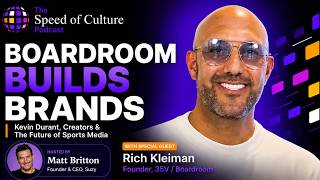
In this episode of the Speed of Culture podcast, host Matt Britton interviews Rich Kleiman, co‑founder of 35 Ventures and partner of NBA star Kevin Durant. The conversation traces Rich’s early fascination with sports, music, and entertainment, his shift from music supervision to Roc Nation Sports after meeting Jay‑Z, and the formation of his partnership with Kevin Durant that led to the creation of 35 Ventures and its media arm, Boardroom. Rich explains the pivotal March 2020 decision to double‑down on Boardroom despite pandemic uncertainty, describing it as an inflection point that cemented his commitment to building an enterprise rather than merely managing an athlete. He outlines his belief that the creator economy is the fastest‑growing industry, driven by technology, Web3 accountability, and community‑centric storytelling, and identifies NFTs as the next major product segment that bridges physical memorabilia with digital ownership. The interview delves into Boardroom’s business model—a platform that amplifies the venture fund’s portfolio through storytelling, strategic partnerships, and creator collaborations—while highlighting the importance of authenticity, long‑term brand building, and balancing relentless work with family time. Rich also shares his perspective on consumer fatigue with the flood of NFT drops, suggesting brands should focus on deeper, more consistent creator relationships. The episode concludes with a request for audience insights on consumer sentiment toward NFT saturation.
Chapters
Up today, we are going to be speaking with Rich Kleiman, partner and founder of 35 Ventures, longtime business partner of NBA star Kevin Durant, and longtime pal of yours truly. Rich, thanks so much for joining. I've been following your podcast forever, and it's kind of cool now to see you on the other side of the spectrum. Uh, but thanks for taking the time.
Thank you, man, I appreciate it. And I'm so used to, like you said, sitting in this seat recording my pod on Zoom over the last years that it's nice to, uh, turn the camera around on you for a second.
Exactly, kick back a little bit. So we're going to start by getting to know you, um, a little bit for those of you who don't know as much about you. Um, you went from being a producer, music supervisor for almost a decade to co-founding 35 Ventures. And, you know, you've had, I think, a meteoric rise. It's been amazing to see as a friend. But tell us a little bit about your career journey. I'd love to hear just how you got to where you are today.
Yeah, well, as a kid, I was instantly kind of obsessed with, like, the culture around sports and the music business and the film business. And it wasn't as much that I necessarily dreamt of being an athlete, which I did as a young kid, but as I got a bit older, I had enough knowledge of sports to know that I wasn't going to play professional sports. But in the same way, I didn't want to be an artist or an actor, but the energy around all of those kind of fields were exciting to me. I remember being at basketball games as a kid and beyond being obsessed with the game, I really always wanted to know like who the hell got those front row seats, you know, because it wasn't celebs when we were kids. It was all these like powerful media moguls. And it was always fascinating to think that like, holy shit, from your work, you can go get that seat. And seeing like the interaction between everyone on the floor and all that energy was something that I really always like just craved. I loved it. And I did pretty well in school as a kid. I went to college. I didn't focus in college, as you know, since we went to BU together. But I always had a very entrepreneurial spirit. It manifested in being a bookie in college also, as you know.
But I think I still owe you some money, but hopefully you'll let it slide.
You may, you may. But as soon as I left school prematurely, I definitely loved the idea of having your own business and doing something that, like, people knew you for and you were regarded for. And obviously music, sports, and entertainment were where I first started. So it was a hustle. I did so many things. I've managed so many artists and producers. I've produced different TV and film. I've music supervised, like you said. And then when I met Jay-Z, it was the first time that I was like, wait, hold up. I do want to be an entrepreneur and build my own thing. But the opportunity to go work for someone who at that point I saw him and I said, man, this is, this is the epitome of everything I've ever craved to be around. This like flawlessly cool energy and ability to have this like instinct to know how to make something fresh. And I, I really enjoyed my time there as a music manager. But when I finally had the opportunity to get back into sports, and all my experience through the years clicked. Um, that's really when I started to like get my, uh, mojo a bit, right?
And, and you, and you're talking about when you started to launch Roc Nation Sports under Jay-Z, right?
Correct, yes. And because I knew Kevin a little bit from an artist, Wale, that I had managed, he was one of the first calls that we made. And obviously, like everything in life, it's timing, and we caught him at a great point in his career, and we were just building our agency and he trusted in us and gave us an opportunity. And while I managed a handful of other athletes when I was there, I really realized at that point that, you know, not only was I ultimately going to want to have my own business, but I had now met this like friend and an incredible iconic basketball player that was at the point in his life where like a lot of other peers, Jay-Z, LeBron, people that he had seen build these blueprints around what now is called the creator economy, but then was, you know, incredible star at the center and all these different revenue streams. I caught Kevin and he met me both at times when we said, you know what, it's time to build something that's ours.
Yeah, and it's been amazing to see. Couple questions just to rewind a little bit going through your journey. You talk about meeting Jay-Z. I mean, not everybody gets to meet Jay-Z. How do you meet somebody like Jay-Z and what's the context behind that?
You know, it's funny that you ask it that way. I have to be more mindful of some of these things because I went to a Net game the other day in Boston and I was very fortunate to be able to fly with the owner of the team and also very fortunate to be able to sit on the floor. And I never could have imagined, you know, imagine that those kind of luxuries would be afforded to me and be available to me. However, I always did imagine myself being there and that I was going to find a way to be there.
And you never doubted it because you weren't always who you were. I mean, I've known you forever, and there were times when, you know, when you weren't as relevant, clearly, as you are now. But even during those times, you know, you always kind of knew.
Yeah, well, so it's— yeah, 100%. And the thing is, is like, I actually and really empowered by it because I wonder if I had had the confidence earlier in my life to break out of whatever insecurity kept me from, let's say, operating at 60% of my potential, um, maybe I wouldn't be where I am now. I wouldn't have the perspective that I have now to, to know how incredibly lucky I am to have gotten that access and what I did when I went to Boston and my friend said, yo, that That's insane 'cause I took a friend of mine with me. He was like, "This is crazy. We were in New York, now we're in Boston." I was living this and finding my way around this when I had no money. So the fact that I met Jay-Z when I was 25 and I was managing DJs and managing producers, it wasn't that I was super successful or like you said, relevant, but it was that like I was going to find myself in the middle of the action one way or the other. And I think of it as like I played a supporting actor role so much of my life when I was younger. And so that's why you saw me like that.
Yeah, in my mind, you're always at the clubs, you knew the DJs, you knew the promoters, you knew the people, you were at the center of it, but you weren't really driving it. You were just kind of there, right?
Exactly right. And I— but the thing is, is I knew that, because if I didn't know that, I would still be at Roc Nation, or I'd still be doing what I was doing.
Right, right. So that's amazing. And when you first met Jay-Z, were you starstruck? Because one thing, you know, about you that I definitely admire is you are yourself no matter who you're around. You're the same way around me as you are around a celebrity or an NBA star, whatever it may be. And that's a trait that you really can't teach people. And did you always have that? And did you have that when you met Jay-Z for the first time?
Yeah, I've always— yeah, I mean, it's funny because I don't think I don't think about who I'm talking to, right? I never thought about it in terms of like, I shouldn't be talking to this person, or I shouldn't be able to ask this person a question. I was nervous inside, but it manifests itself in that, like, I'm just going to be myself. I feel like it's the easiest person to be like, you know? Yeah. Every time I'm nervous or anxious, I just kind of fall back on the fact that, like, I know I can be engage it. And if I just act like myself, it'll work. And to be honest, it didn't work all the time when I was younger. And that is the truth, because I think that what, um, a lot of people may gravitate towards when we're younger are different skill sets or different things that, while I had them, it wasn't what I emphasized.
It wasn't right.
I wasn't going to be out— and I partied, I went out— but I wasn't necessarily going to be, you know, 7 nights a week or I'm flying all over the world. I got married early, so there was a lot of pacing myself. I wanted to start a family early and a lot of times growing as an unconventional entrepreneur, I had to say, all right, I'm going to go for the long run here. I'm going on the marathon because I can't sprint. A, I don't know if it's working. I'm not necessarily getting out the gate as fast as I wanted, but I know I can win this race. But I also want to start a family. So how long can everyone else stay in it? And I think that has a lot to do with what you see now is that, you know, the one thing is I have been doing this since I was 20 years old.
Yeah, an overnight success decades in the making, right? That's how it is. I was thinking both of us as parents, you know, it's something that, you know, we definitely need to teach our kids and young people is that just in this world of everybody's on Instagram, everyone wants to be rich, famous, part of that may be them leaning into the short-term personality traits that may be getting them ahead short-term, but not staying true to who they are. And ultimately, I think you're an example of how it can pay off as long as you stick to who you really are over time. Totally.
Yeah.
So we're gonna get into 35 Ventures and The Boardroom and all that stuff, but we're gonna go to a next segment of the podcast, which we call Culture Watch. So get the stopwatch ready. I ask you 4 questions. That delve deeper to understand what brands, technologies, and trends are driving growth in your perspective. You have 30 seconds to answer each, and then we'll dive deeper in each of them. So the first question is, what's the most important business decision you had to make quickly?
March of 2020, when everyone else had to make quick decisions, I realized that even though my business was important to me, that ultimately if I flipped the switch the next day, it could have all went away, that nobody was relying on it, and that it was at the end of the day me managing Kevin Durant. What I really wanted was an enterprise. And at that point I said, you know what, I could flip the switch, but instead I'm doubling down and I'm gonna lock in right now and I'm gonna build what exactly what I want this thing to be. And you know, at that point I think I made the decision to, you know, take advantage of something no matter what the circumstances in the world were that I've always wanted to do and not be scared by, you know, the landscape of what we were living in. You know, that to me was like a real inflection point.
And I remember being with you in Southampton the summer prior. We're having breakfast. You were telling me about your vision for it. And, you know, you were still kind of piecing it together. And, you know, you had to double down then. And now obviously it's paying off. Next question is, what do you think the fastest growing industry is going to be in the next few years?
The creator economy. And I think obviously it'll evolve and iterate, but ultimately the creator economy.
What about the fast-growing product or product segment?
Uh, fastest-growing product or product segment. I mean, ultimately, I think, you know, it's a very popular answer, but I still would have to say NFTs in general, right? Understanding how they'll fit both complementary to, you know, what we already know and the products that we already have come to understand, but how it's going to be in itself an entire economy.
Yeah, and I mean, it's popular to you and probably your world, but so many people are still trying to understand it. So eager to dig deeper there. And then lastly, what do you see as the fastest growing consumer trend this year moving into next year?
I think playing off of NFTs is that we have originally thought of NFTs as these kind of like worlds within the metaverse that don't make sense and have complete arbitrage. But I do think what you'll start to see now, and it'll make a lot more sense for people, are brands that we do know and brands that we have become accustomed to using their kind of longstanding trust with the consumer, what they have in the physical, and introducing NFTs and introducing the metaverse as a complement to what their brand is existing. And I think that'll then start to clear it up for a lot of consumers.
Okay, so let's double-click on all these things. I definitely see some common themes. So here we are, it's March 2020, and you were saying, so you had your core business, so to speak. Well, why don't you just lay out what the business pie chart is Rich Kleiman? What are the things that you focus on? Because you mentioned a few things, so it'd be great to give the audience idea of the different places where you have your hands.
Yeah, so 35V is the parent company. We renamed it as not to confuse Ventures, which is also a vertical of the business. So 35V is the parent company that Kevin and I own.
That's your umbrella?
That's our umbrella. We have a venture fund of investments that have been invested by Kevin as well as the company, and they all live on the balance sheet of including Susie, I might add. Including Susie, one of my favorites. We also have a platform in the middle of it because what I realized as we started investing and we started becoming what we wanted to be referred as, as a strategic investor, I wanted to prove value. I didn't want to just call myself strategic investor, so I offered up our extensive network. I helped with positioning and promotion and marketing. But the storytelling I could not do without my own voice, my own platform. So I looked at the landscape. Digital media was as saturated as it got. But the one thing that will never not work is something that's credible and real and that is like represented of the person creating it. And that to me is why I'm excited about the creator economy. And what Boardroom was, was it really embodied what Kevin and I had done to that point in our life, what we were seeing. And where the world was going. And I felt like the culture in and around sports, similar to what Hypebeast and Complex did in hip-hop and in streetwear culture, was becoming something that most people didn't realize was truly moving the needle, was what was moving the money in sports. So we really wanted to create that platform to sit at the center, to be, you know, a real, like, a real voice to what our venture company funds, companies were doing, the movies and TV shows we were making, the, the professional sports teams we were investing, all of it needed storytelling and a narrative and creation. So Boardroom became that, and now we're storytelling and creating and partnering with every athlete and musician and business leader, and, um, that sits at the center. And then there's a handful of other strategic partnerships and investments, as well as obviously managing Kevin's business, and it all sits under 35B, but I think the flywheel that we've created of platform as a resource to our venture fund, venture fund as information and visibility to continue to build our platform has worked. And now companies like Coinbase or Dapper Labs, who we had invested in, have matured and now investing back in our platform and in what we're building. Amazing. Yeah, it's been pretty cool.
And so in March 2020, you were saying, I mean, the world was so uncertain. And so the decision you had to make if I'm repeating you correctly, is do I focus on really managing Kevin and his business versus going into this somewhat unknown entity when people are saying that we're gonna be heading a Great Depression and ad dollars are gonna dry up? And is that sort of what you are balancing? And how did you ultimately have the confidence to make the decision to double down on Boardroom?
Well, I looked at my business and I said, "Okay, what is guaranteed here?" Kevin Durant is one of the most iconic athletes and people I've ever been around and one of the most iconic basketball players we've ever seen. And he has his own, his own way. He's not LeBron James. He's not Michael Jordan. And there was something beautiful in knowing that I had this unique one-of-one athlete who trusted me implicitly. I was building his foundation. We were investing in technology. We were working on certain films, certain commercials. And I managed him. So that meant his contract on the court. That's a beautiful business. That's something I could have done for the next 10 years. And sure, and I could have potentially added on other athletes and maybe created a certain model. Maybe I could have just been a sports agent or manager, but I knew that what I needed to do and what I wanted to do was to be creative and be entrepreneurial and build an enterprise and something that encompassed both of our skill sets and both of our experiences. But you can't get delusioned into thinking that an Instagram page or, you know, a repost here and there makes something real. So at that very point, I have to look hard at like, what are we? And what I meant by turning off the lights is you have to say to yourself, is there real value in what we're building here? Because if there's not, don't be scared by it. But now let's build this real value and let's figure out what it is that we we've started here and what it is we wanted to be. But at that point, I could have said, you know what, the safe thing is let me not increase payroll, let me not hire more and more people, let me not invest in content, let me not roll the dice on covering NFTs and collectibles, and let me just cut my overhead, streamline my life.
Yeah, be more— play more defense than offense, basically, and be a manager, an agent.
The problem is, is the best part of my relationship with Kevin is he doesn't love to do brand deals. So it, it really showed me that the only way we were going to build enterprise value was to build enterprise value, right? So at that time, I said, all right, you know what, we're going for it. And, you know, by going for it, there was weeks and weeks and months where it just means we're going for it, no one else really cares. And that part during the pandemic would have been really demoralizing, especially when I knew I had a safe bet here. But ultimately, I really, you know, this is what I love to do, man. I wanted— I want this. So You know, that was the inflection point. It was like, you know, I admired the guy who owned the stationery store on my block or the hot dog stand because it was theirs. The money that came to them was theirs. They worked for it. They had a product. They gave it to someone else and the person gave them money. And I'm fascinated by it. So I was like, this isn't enough. I got to build something. And, you know, I think we caught an incredible time in the world. And I had those— I had that network. So while the NFT world was starting to take shape and while crypto was starting to become so much more of a mainstream conversation, I had been in this world, I understood it. And I said, well, the one thing I'm gonna do is instead of trying to chase it all and keep up with it, I'm gonna cover it. I'm gonna be the one source that covers it all and threw ourselves in it. I think that really helped to start to define what we were building.
Yeah, and you talk about the creator economy and how you think it's gonna continue to grow. And obviously, that's a byproduct of this continued decentralization of media where now everybody has a voice. When we were growing up, there were 3 channels on TV. You could only listen to the music that was played in heavy rotation on Hot 97 or one of a handful of radio stations. And now you can get content from anywhere, music from anywhere. In some ways it's almost too much, but what we've seen happening, and I know that you guys have made several investments in this space, is the top creators are really starting to build, and you are, I think, included in that, audiences that are starting to become in demand and enviable of what only traditional media companies used to have. Why do you think the creator economy is gonna continue to grow? And what do you think brands should be looking at when thinking about how to sort of use the creator economy to propel their business?
Yeah, that's a good question. I mean, I think the creator economy will continue to grow because of the access and because of the technology and because of the evolution, because of the honesty of Web3. 3, because of the accountability of Web3, there will be a real reliance on a community that's in demand, a community that is like dedicated solely to the voice of the creator. And the problem is, is that when we're so saturated with content and choices, we still ultimately can only consume so much. That there's a belief and a trust in a particular brand, in a particular individual. The creator economy is brand. It's not as much just individual. It's a certain creator, creative, an entity that has a voice in a community that they can galvanize and give them exclusive experience and exclusive assets and exclusive whatever that may be that they will feel pride in. And I think that what you can't get from Web2 and Web1 is that ability to take from your community. And I think that ultimately is why the creator economy will prevail because you can continue to understand your audience and continue to give them what they want. And in general, we were never given 100% of what we wanted before, and now we can be.
And going back to Jay-Z, you know, he said, "I'm not a businessman, I'm a business man." I mean, that's basically what it's all about, right? It's about the power of the personal brand. And—
No, I was just gonna say that, I mean, hip-hop to me were the first creators, you know, the first creator economy. It was Puff Daddy, Dr. Dre, Jay-Z, I make music and in and around music, I distribute alcohol, clothing, film, TV. And this was in 1998, '99. Yeah, they reinvented it. That was Fat Farm, Russell Simmons. That was the creator economy.
Absolutely. So now we're in a world and moving on to the next session of NFTs where not only, you know, I had Sophia Hernandez who heads business marketing at TikTok and going to what you were saying in terms of people being able to leverage their personal brands, she's saying one of the biggest things you're seeing on TikTok is this kind of community-driven commerce. Where basically you have a creator, they have a huge audience, and they're interacting with their audience, and then they're starting to slot in products that they're selling. Um, and so you're seeing that kind of take place in more the traditional e-commerce sense. But now you have this whole world of NFTs where essentially somebody can mint or license memorabilia, collectibles, tokens for access, etc., into a digital token that you can buy and use with things. And I think a lot of people think about NFTs The reason why people write it off is because they look at, oh, why can't I just screenshot that JPEG? And we've heard that a million times. Why are NFTs more than just a JPEG that you can screenshot?
Yeah, I mean, I think like I confuse people sometimes when I answer it this way, but if you really tried to unravel the things that we've come to accept in the physical, you could, you could, your mind could go crazy. Yeah. Why? Why? I went to the Basquiat exhibit yesterday and it was mind-blowing. It was incredible. But when you walk around with your 8-year-old and your 8-year-old says to you, I could draw that, right? And I say, I know, but you need to understand what he was saying, what he made it with, the time that it was, who he was. And now you understand the value.
Right.
That's very hard to understand at 8. It's really hard to understand for some people ever. Right. Is this piece of art worth this much money? How is this piece of cardboard with Ted Williams' face on it signed by— with a pen from back then so much money? I can answer it by telling you what Ted Williams meant to people, how old this card is, what stories behind it, the stories behind it, what it took to be preserved this long. And you'll start to find the value. Ultimately, the same arbitrage exists in the metaverse, but when you can see it that way and go, well, you're spending 50%, if not more, of your time in this world, the same rules are going to start to apply. The same narrative and the same story that is going to elicit this emotional reaction and then in turn make you want to buy it is the same thing that we've been doing in the physical forever. Yeah, why did Bored Ape work? How I don't know.
It was the design, the first to market. Good, good story too.
Yep, good story too. But you know, at the end of the day, if it didn't work, none of us would have been confused. And that's the arbitrage. It wasn't a no-brainer. Yeah, I mean, how could that be a no-brainer? It was, it's, it was just, it's arbitrary, but it worked, you know. And I think that's actually the beautiful thing about it, because that actually allows everyone to know that you have a chance as an entry point, you know. But you have to ultimately tell the story and create a purpose. I think the purpose is the first line for everything. Like, if you can't answer yourself why you're doing anything or why it's important, then it's really not probably going to be received well, right?
And if it's just to make a quick buck, obviously, you know, you could rip people off, but ultimately it's not going to be lasting either. Yeah, right.
And the thing is, you can have a JPEG of it. Because I could, I took beautiful pictures of every one of those Basquiat, and it has value to me. I wouldn't, not dollar value because I can just delete the photo, right? At the end of the day, it's not the photo, and that can't be changed, right? And the only thing now that the metaverse and the blockchain allows you to do is 1 trillion percent confirm that. Because if I said I'm buying this one-of-one Basquiat and they said it's the only one, I really have to just take their, I mean, their stock and their word. But on the blockchain, I know for a fact that you're not lying to me. And I think that it starts to make a lot of sense.
And that goes to kind of the dynamic between physical and digital, because connecting a physical painting onto the blockchain, I think is interesting. I was telling my son the other day, I was taking him to Sixers game, huge Philly fan, shout out, that when we were growing up, we used to need a physical ticket to get in. And if I left without my ticket, I couldn't go. And then you were able to kind of screenshot a ticket, and now you have to add it to your Apple Wallet. And it's heading more and more towards— you have this connection between physical and digital. And I think the sports world is a place, whether it's access to events, access to athletes, um, access to their actual memorabilia, where you're seeing it right now with sports cards, obviously, where there's signed versions digitally, signed versions physically, and it's all melding together. So I, I think that that is really where a lot of this unlock is going to, you know, be present in the years to come.
Yeah, I mean, you know, I went to the Nets game the other day, and I— someone that was with me had a ticket. I saw them with a ticket. I looked at this ticket like it was gold, right? I haven't seen an actual ticket in 3 years. Yep.. So all of a sudden I thought to myself, oh shit, if they win tonight, it's a cool ticket. Right. KD goes for 53, this is a cool ticket. So now all of a sudden the physical is bringing this incredible value to something that we so quickly just got used to in having a digital ticket. Yeah.
I mean, now, yeah, ticket stubs from like Michael Jordan's first game are like going for $10,000, $20,000, $30,000 now. And people used to be throwing them out. You never thought of that.
So imagine you sat on a courtside seat, or you sat in a random section, and every night you sat in a random section, that group got the physical ticket, that ticket's an NFT, all of a sudden the value of a paper ticket.
Yeah. And again, because it's the story behind it, which I think is great. So, so this has been amazing. We covered obviously a lot, and we talked a lot about kind of speed of culture. But tell us, in this crazy world, what do you actually slow down for? What slows Rich Kleiman down on a day-to-day basis? Because you're obviously going nonstop, which I know But what do you slow down for?
Because I have like my, like the game time. Like I have my time where I look that I'm playing, you know what I'm saying?
And yeah, on the field, on the court.
Yeah. And I have a balance because what experience has taught me is, and being, being someone that had to wait my turn in some ways, it's taught me that working 24 hours a day, 7 days a week actually doesn't work. Being the killer and needing to step on people and needing to get the edge always and win and dominate works, but not with that tone and not that spirit and not that energy anymore. So I'm really somebody that balances my time, spends my time that I'm not working with my family, but I've also, you know, never taken my eye off the pulse. I've never taken my eyes off what was happening, who was young, who was fresh, who's new. And even though I'm with my family and maybe not working, my consumer research is happening 24 hours a day. My brain is spinning and thinking of things. And being with my family and being balanced actually allows me the freedom to see all of this opportunity and to see through all of the, like, wild day-to-day craze and go, oh, okay, Cool, I get it. I'm going to do that Monday. If I did it that minute on Saturday, it either A, wouldn't work, B, I may have needed 2 days to pause and realize, you know what, not a good idea. And that time is imperative. But ultimately, like, you know, we love what we do. So, if you love what you do, you're not necessarily ever turned off, but you can rest at times.
Yep. Just like an athlete, you need recovery. Get ready for the next time you tip off. So, To wrap things up, so in our last episode, we had Ken Ohashi, who's the CEO of Brooks Brothers, and we asked him what you wanted to know from our Suzy network. And he asked us which post-pandemic trends consumers feel will continue to come true or grow. And what we learned from our Suzy network through that is that nearly two-thirds of consumers feel that online shopping will continue to dominate over in-person shopping, which to me makes sense, because ultimately the one thing consumers can't create more of his time. And I think e-commerce is something that helps. Over half feel that telemedicine will continue to rise, and nearly half feel like online events will continue to dominate, um, over in-person events. So I'd love to ask you, Rich, coming out of our conversation today, is there something you'd want to know from our Suzy Consumer audience which we can then cover during the next episode?
Um, yeah, actually, that's interesting. I'm gonna try this one.
Okay.
I've been thinking about Because on Boardroom we cover all of these incredible collaborations and all of these brands and crypto exchanges and all of these big Fortune 500 companies that partner with creator, partner with athlete, artist, brand, you know, smaller niche brand. And they start to create what they think is like cool, exclusive, proprietary content and all of their, you know, all of their own collection capsule NFT drop. I would love to know if the consumer thinks it's just all too much, right? If it would be better if brands built longer equity relationships with their partners, they created a little bit more consistency. I just like am starting to feel like as a consumer myself, it's way too overwhelming and it leaves you sometimes consuming very little. Yeah, because you're actually spending 90% of your time sifting through the weeds.
Right.
I wonder if people also feel that way and would love to see a little bit less and a little bit deeper.
Got it. So is less more basically is the question.
Yes.
Succinctly put. Love that. Awesome. Well, we will definitely be asking that during our next episode, sharing the results. So Rich, I just want to thank you for a couple things. First, I want to thank you for your belief in me and the team at Suzy. When I came to you, we were literally just launching. Your name meant and still means so much in the industry. And you deciding to invest in us gave us, and Kevin as well, gave us such sort of like validity as we went to the market. So I just wanna thank you for that as we continue to grow. And I know it'll be a great investment for you guys. And just wanna say congrats on all your success and continued success in the future. And I can't wait to see what we can both accomplish together. So thanks so much, Rich. Thanks so much, team at Suzy. And on behalf of myself and the team at Adweek as well, I want to thank you for joining. Until next time, we'll see you soon on the Speed of Culture podcast.
Thank you so much, man. I appreciate it, Matt.
Hey!
More from Matt




MikMak’s Rachel Tipograph on Consumer Spending, Retail Media & Holiday Shopping Trends



Jaguar Land Rover’s Charlotte Blank on Luxury, Purpose & Experiential Storytelling



