Roku’s Dan Robbins on TV Streaming, Advertising & the Future of Media
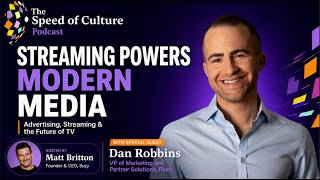
Dan Robbins, Roku's VP of Marketing, discusses the company's expansion from software to branded TVs (11 models, 24-75 inches) and its 70 million active accounts. Roku's vertically integrated approach combines its OS, hardware, and ad platform to offer precise, shoppable advertising through partnerships like Walmart, while content discovery tools tackle streaming's paradox of choice.
Chapters
Welcome to the Speed of Culture podcast. We are live here in Las Vegas at the Consumer Electronics Show, and I'm super excited today to introduce our guest Dan Robbins, who's VP of Marketing and Partner Solutions at Roku. Dan, great to see you.
Excited to be here.
Absolutely. Uh, before we get started, we'd love to hear a little bit about you and your background and what led you to your current role at Roku.
I had a sort of interesting journey into marketing at Roku. I started my career at Nielsen in measurement and analytics, and then moved to Roku to help launch our measurement and analytics function, and then moved into marketing. So I'm sort of one of the people who has gone from numbers into the creative side, as opposed to the other way around.
Yeah, we find that, you know, I've done a couple of these interviews already here at CES, and actually that seems to be a common theme, that a lot of people are coming from about the science side versus the art side. Obviously, in this economy, as we enter some uncertainty, a lot of brands are looking further down the funnel, and with that, I think math comes further into play than maybe it did in boom times where people were just running ads for the fun of it. So, I do think that there's certainly more of a focus on performance marketing in this world with large brands. I'm sure that's played really nicely for you in your role at Roku.
Yeah, and there's more data than there's ever been. Right. And so, what you can do with the science side of marketing has changed tremendously in the last 5 or 10 years.
Absolutely. So what made you decide to make the jump from Nielsen to Roku?
I was really excited about the shift from traditional TV to streaming TV. I've been at Roku now for about 6 years, and Roku was founded almost about 20 years ago now, really on the vision that all TV and all TV ads would be streamed. Yeah. And when you look at what the internet has done to every industry, it was clear to our founder and CEO Anthony Wood, that that transformation was gonna come to television as well.
Absolutely.
And so Roku started by building originally players and sticks that plugged into your television and helped you watch movies and TV over the internet. It then expanded into televisions where we actually gave our operating system out to TV manufacturers. And then most recently has expanded into the Roku Channel We make our own originals, Roku Originals, and so I had no idea at the time that this was gonna be the arc that we were going on. Yeah, yeah, yeah, yeah, yeah. But it just seemed clear to me that this was gonna be such an exciting place to be, particularly in consumer electronics.
Yeah, and a lot of people know of Roku as the Roku Stick. So as you kind of have engaged in your role at communicating your story to consumers, has that been something you've been focused on in terms of communicating that broader vision of the company?
Yes, the mission of Roku is better TV for everyone. Mm-hmm. And, you know, what does that mean? The idea is that ease and choice and convenience is the name of the game in television, and that giving consumers the ability to choose what they want to watch, to get it easily, to do it in a way that doesn't require you to read a manual to figure out what to do, that that was going to be incredibly important in entertainment. And even though our, our business has grown from players and sticks, as you mentioned, to TVs, to audio, to services, to advertising, content, and more, our goal has always been to connect the consumer, the content owner, and the advertiser on one platform. And as we've done that, you know, that sort of key pulling that all together is what has gotten us to be the number one TV streaming platform in the US, Canada, Mexico, and, you know, increasingly across the world.
That's impressive, especially given the competitive set. That you have because streaming, obviously the big guys are in streaming. Amazon's there, Apple's there, all the major players. So to compete amongst that land of giants, uh, it's pretty impressive. Why do you think the company has been successful? Just from the culture of the company, what do you think has led to its success?
I think two things. The first is that we are singularly focused on better TV for everyone. Right. We are not in a bunch of other businesses. That means that everybody at our company wakes up every morning across the world focused on that goal. And focus is, I think, both in marketing but also just in business, incredibly important. The second thing is that our operating system is purpose-built for television. And what we mean by that is we actually designed the whole software system for TV streaming.
Yeah.
We did not start with a mobile or a desktop operating system that then got, you know, ported over years later. Into television. And the reason why that matters is that a purpose-built operating system is going to be, one, more efficient and better suited for the actual consumer need. Two, it's gonna be more cost-effective because it's designed for lower memory televisions. And three, again, it helps keep us with that focus. Yeah. So I think those are two key things, but, you know, it's a very dynamic and fast-moving market, which is why it's exciting.
No, I mean, I've been speaking for over a decade about how I envision one day the TV is going to be a giant iPad hanging on your wall. And we're kind of getting in that direction. And it's just amazing to me that we haven't gotten here sooner, you know, because ultimately you look at the consumer and this is what they want. You know, they wanna be able to instantly access the content they want in easy ways that mainstream America can understand. And we're still at a point where many people across the country don't even know how to access, how to get Hulu, or they forgot their password or something. So I think making it easier for consumers is an incredible opportunity. You talked about the operating system, and I feel that, you know, companies like Samsung and some other companies that make TVs, they make beautiful TVs, but they struggle to build their own native operating systems, and they're just clunky because it's not the focus of their company. What's interesting to me is I've always thought that just like how Apple has so much power with the mobile device because they own the rails, they have the operating system, but they also have the physical device that goes in the hands of consumers. There was always a huge opportunity for a company that not only created the software, but also owned the, the same version of the rails of the television, which is actually to create a physical television device. And I read on the way out here to Las Vegas that Roku has announced that you guys are launching physical TVs, and I was like, "Yes! Finally a company is doing it." What was behind that decision, and what do you see the big opportunities are with that?
Yeah, so we had two big announcements this week here at CES. Consumer Electronics Show. The first is that we've launched our own Roku-branded TVs. We have 11 different SKUs ranging from 24 inches all the way up to 75 inches.
Who's manufacturing them?
It's our own TV. You're manufacturing your own TV? And so up to this point, our TV program has been in partnership with more than a dozen TV manufacturers, where we provide our operating system with a partner manufacturer. So this is the first time we're actually launching our own TVs. And really for us, it's an extension of just finding a new and different way to be able to reach the consumer and create that better TV experience. And so it's both new for us, but also, you know, an area we've put a lot of thought into. And so we're really excited about it. The second big announcement we had this week is we've just surpassed 70 million active global accounts. And so that's, you know, roughly more than 70 million homes across the world on a monthly basis that are using Roku. And so streaming is really now mainstream. Yeah. And what's exciting about both of those announcements is I think actually gets to something you mentioned, Matt, which is how do you create a better consumer experience in the ecosystem, right?
Exactly.
And so that's really where our focus is going to be going into the year.
So what about advertising? What role does advertising play in Roku's business model?
Advertising is a huge part of our business, and we launched an ad business a little more than 5 years ago. And really it was focused on kind of one primary vision, which is that not only will all TV and all TV ads will be streamed, but also that streaming has this real opportunity to take the best of the digital world, all of the precision and the measurement and the data, with the best of the television world. Largest screen in the home, 100% full screen, sight, sound, and motion.
When people are like, TV is dead, what they meant is People aren't gonna be tuning into musty TV on Thursday night to watch Friends, right? People want to watch content on a big screen in their living room. That will never change. It's just the form factor and the ecosystem behind television that's gonna change. And that's what you're getting to.
Yes, exactly. And so we've been then focused on how do we take that to create a better TV ad experience? And we've really focused on that with a couple different things. The first has been really our data. We have a direct consumer relationship with each of those 70 million active accounts. So that means that ads can be more relevant. They can be measured more accurately. They can be customized and personalized. The second has been that we've really focused on going beyond the 30-second spot. And so, you know, if you think about ads and television, for decades now, they've really been that same 15 or 30-second box. We now have a canvas, an opportunity to do whole a lot more. And so we recently launched the Roku Brand Studio, which allows us to go beyond that 30 and take advantage of the entire streamer's journey from the moment they sit on the couch, not just the moment they see that first ad break. And then a third focus for us has been really on making it easier to pull all of the pieces together. We launched OneView, which is our ad buying platform built for TV streaming.
It's like a programmatic ad buying platform?
Exactly. And so it allows you to take all of the best of Roku and buy ads not just from us but anywhere on our platform as well as other streaming desktop and mobile platforms and use our data and our tools again to do the same sort of measurement and precision and optimization.
So it's basically like for a while it was, you know, Facebook programmatic or Google and then YouTube where you can do it with video, but now you're basically taking that approach and you're putting it on the big screen in the living room where theoretically Joe's Pizza can target consumers in their market during a big NFL game where they would have been sort of left out of the picture in the past if they weren't a national advertiser.
Exactly. It really opens up access to all sorts of advertisers, which is really exciting.
Yeah, levels the playing field and what was for a while just a very, you know, out of reach opportunity for smaller businesses, which I think, you know, the internet was the great sort of equalizer, But TV is still the place where most eyeballs are, and I— and it's the biggest opportunity. How about commerce? So, obviously, people are watching this, and I read something about a partnership that you have with Walmart to try to go all the way through the funnel, and I was fascinated with that as well.
Yeah. So this is something we're really excited about. As we were talking earlier, Matt, streaming is really full funnel. It allows you to reach a wide number of different audiences. It also allows you to measure Did the product actually get somebody to change their opinion, to move the product off the shelf, what have you? Our sort of next vision in that full funnel world is commerce. And we wanna make TV as easy to shop on as social. And we started by launching shoppable ads with Walmart. How this actually works is you'd see an ad on your Roku device. It's promoting a coffee. You click OK with your Roku remote., and you get order confirmation to your email with shipping information fulfilled by Walmart. And so what's exciting about that is it's actually, to your point, bringing that promise of shoppability onto the television screen.
So I have a big question for you. Why not just give the TVs away for free? You can't be making it— the margins must be razor thin on television. Obviously, you have tremendous upside and high margin on ads and commerce, etc. Is there a world where you either subsidize or give away televisions for $50 as long as people sign up for your service and you basically own the interface? It seems like a no-brainer.
Yeah, I mean, I think, you know, for us, we view all parts of those businesses as important, and so hardware and devices is really important, part of our revenue. Advertising is an important part, and so we look at them all together. We don't look at, you know, one as separate.
I guess the reason why I say that is hardware is, it could be a loss leader for you. You know, hardware is— making televisions is a very low-margin business. It's known for that. And it's really hard to differentiate in that space. And the way you guys are doing it is you are creating an ecosystem. You are creating an operating system, et cetera. If you had your TV in every household in America, all of a sudden that's so 70 million accounts become 300 million accounts. You have programmatic. You could take over the entire television advertising market. I believe that's ultimately what someone's gonna do. Is they're gonna start to give away the television for cheaper. It's almost like the Gillette model, right? You give away the razors for very cheap, and then you make the blades, and you charge more for the blades, and you know what I'm saying? So I think, to me, I see that's where things are going over time, because the recurring revenue is on the advertising side, and that's the higher margin revenue. So it's just, it's fascinating to me. And, you know, I even think if I was a company like yours, I would look at hotels and other places where it's like, okay, we will replace your TVs, with a cheaper solution, because that's another pain point for consumers when they're traveling, and all of a sudden you can reach travelers. I just think it's a massive opportunity.
Yeah, I mean, one thing I'd say to that is, as the number one TV streaming platform in the US and Canada and Mexico today, that 70 million active account number is more of a proxy for a household than a person.
Sure.
And so we're actually, when you look at both the US, but also the dozens of countries that we operate in today, We really, as the number one TV streaming platform, have moved to a world where most folks actually already have Roku devices in our stream. More ads run on the Roku operating system than the next 6 TV operating systems combined. Wow. And so to your question on scale, what we often say is that that scale is already there, and that's what makes things like—
like Apple TV— like, like when you say streaming platforms, are you counting Apple TV in that bucket? Correct.
Any operating system. Okay. —And so when we, when we say, you know, that scale's already there, that's what's exciting, both to content owners, to marketers, to the ecosystem, because these things are not emerging. They have arrived. —Yeah, they have. —And again, we're now in a place where, at least in the US, 1 in 3 homes no longer have pay-TV. That is down from 90+% just 5 or 10 years ago. So it's a huge, huge change.
—And I gotta think it's disproportionately the case on the coasts, where when you have to get to middle America, and where maybe there's less tech-savvy consumers, maybe older generations. I think get— having a television is a way to fix that because they don't have to switch the input or plug something in. They just turn it on and then they have your operating system. So I do think it's going to be a way where you make it even more applicable to more audiences.
It's been a big focus for us, coming back to the idea of ease and choice and convenience, is that streaming should be accessible to everyone. It shouldn't just be for a specific audience. And when we look at that user base, it really does reflect the countries in which we operate by age, by income, by ethnographic and so forth. And so that's something to me that's really exciting because streaming is for everybody.
Yeah. So you had mentioned the studio earlier, and I've been speaking to several execs here at CES just about how when you talk about a connected TV or OTT approach, it's not like during upfronts where you'd have to spend so much money on one or two big spots. You need multiple different spots if you're going to be addressing these ads to multiple different audiences. So when you mention the studio, is that what that's about? Is it about helping advertisers create content in all different form factors so they can actually be more applicable to their audiences?
So the Roku Brand Studio is about going beyond the 30-second spot, right? We think about that in a couple different ways. Okay. The first is owning the entire streamer's journey. So not just the ad break, but when you turn on the TV, bringing the screensaver to life and the home screen to life. Offering a free movie for somebody who's trying to figure out what to watch. Creating custom ads and content that fit through the entire, again, viewing and streaming experience. So that's one whole area. The second big area is, to your point, new creative. And so that's interactive ads, shoppable ads. You're helping advertisers do that. Exactly. Right. Helping them create things that are purpose-built for streaming. And then the third is we work on true full-fledged built-for-streaming entertainment in partnership with brands. A couple good examples of that. The first is a show we call Roku Recommends, which was born of this insight that streamers are often looking for what to watch. And we have really great data about what's actually popular, what the hidden gems are. And so Roku Recommends is a weekly show hosted by Maria Menounos and Andrew Hawkins that goes through the best bets on our platform. Brands can get involved and bring their creative into that show. We've also started to create, again, entertainment for or in partnership with brands. Most recently, we did a 3-part docuseries called The Lesbian Bar Project with Jägermeister that was focused on the 20 or so lesbian bars that are remaining in the US. And again, we know looking at the data what homes might be interested in that sort of stuff, and so there's a whole canvas to explore.
Wow. And I'm sure you recently saw the announcement, YouTube with the Sunday Ticket. That's something I've been, again, talking about forever, because it just makes sense. And companies like Google have much deeper pockets than DirecTV, which is now part of AT&T, does. How does an announcement like that, and live sports in general, impact your business? Because obviously, if you look at the top 30 most watched live shows every single year, 28 of them are usually NFL games or maybe NBA Finals. So sports is a huge part of the television viewing experience. What is Roku's strategy in that area?
We're really excited about both this announcement but others because it really speaks to the shift of sports into streaming. Yeah. And as you mentioned, Matt Britton, live sports has long been a bastion or one of the few remaining bastions of traditional television. I can't think of anything else, maybe news. Yes, but news and sports are now really, really growing in streaming. And one thing that we launched recently was our Sports Zone, which was designed to help the consumers with a key thing, which is, I know there's sports on streaming, where do I find it? So we pulled together all of the games, the shoulder content. We recently launched a Roku Original with Rich Eisen really talking about sports, and we're bringing that all into our home screen, pulling it forward so that it's super easy to find sports in streaming. We're very encouraged though, because it is a yet another step into a world where truly all TV is streamed.
Absolutely. So let's shift gears a little bit and talk about you and your career and kind of how you got to where you are. You obviously strike me as somebody who is very knowledgeable and passionate about the field that you're in and have a really great handle on what is a very complex industry. How do you spend your time and what things do you do to make sure that you stay your finger on the pulse of what's next, because that's incredibly important, obviously, in what you do, and you've always been very successful at doing it.
Gosh, you know, it was interesting. I was talking to a younger person on our team recently who was asking about career advice. Yeah. And I wasn't really sure what to say, but one thing that really strikes me is that curiosity is just so important in whatever career that you go into. And I just find media and entertainment and technology so fascinating. And to your point on how you spend your time, I spend an inordinate amount of time reading and listening to things and exploring and looking at papers, doing all sorts of stuff.
And then what? What do you do after you read something that's interesting? You write it down. Do you take notes?
Like, how do you— Yes, I'm a highlighter and an underliner and a note-taker and a Post-it, you know, all of that. But to me, being curious about what you work in is so, so important. And if you're not curious, there are other people who are going to be more interested and energized by it. And I do— again, I find we're in such an exciting time for television because it's changing so quickly, and that doesn't come along all the time.
And were you always as curious, like, ever since you left college and you went to Nielsen, and you were— were you always just this intrigued by the line of work you're in? And do you feel like that's a mandate to be successful, is to be really curious and passionate about what what you're doing?
I think it's hard to be successful if you're not curious in what you do. I have always been interested in media and entertainment. I thought when I was in college that I wanted to be a journalist and realized that, you know, I really love the team aspect of working together, building something new, and very much have kind of stumbled into the worlds of streaming and measurement and analytics and marketing and so forth, but media has always been interesting. I started a newspaper in high school. I was an editor of a newspaper in college and did some freelance writing on the side, so all of that has always been, you know, very exciting.
Speaking about curiosity, we're all here at CES, and CES is— what I love most about CES is it's in January, first week of the year, fresh start, and everyone's eyes towards the future. Like last year is done, what's next, where are we going? What excites you most about either what you're seeing at CES or things that you're working on as it relates to 2023? Obviously you've had so many announcements that actually still have to go into market, but are there any other kind of bleeding edge things that you have your eye on?
One thing I'm really excited about is discovery. And so we again live in this world where there's so much to watch, so much to stream.
Although, Ed, there's so much to watch, but everyone also says there's nothing to watch at at the same time, right? Yes. Used to be you went to Blockbuster, you picked one, you picked one DVD, and you came home and you were happy with that for a night or a weekend. Now you have millions of things to watch and people feel like they don't know what to watch and there's nothing to watch.
Yes, there's a bit of a paradox of choice. Yeah. So we have started putting a lot into how do we make that discovery experience as seamless and as easy as possible. So we've launched Featured Free so that you can find free content on our platform. We've added save lists, we've created zones that curate different types of content, we've created the Buzz, which actually is sort of like a social part of our platform that allows studios and talent and others to share clips and what's going on. I think there's so much more to do in content discovery because there's so much great stuff out there. So that's an area I'm really excited about— bringing data, better user experience, and also Giving the opportunity for marketers to be part of that journey, that's one thing this year that I'm, I'm really energized by.
Yeah. And, and another thing obviously everyone's talking about right now is the leaps that have been made in artificial intelligence. Mm-hmm. With ChatGPT and, and similar tools. When you talk about the long tail needed to effectively create content and connected TV, do you see a role down the line with some of these tools at helping your advertisers create, you know, video-based content that more impactfully connect with their audience?
I certainly think in the future there will be ways that generative AI and some of these models play a role in, one, creating advertising, two, creating actual television content. You know, I wouldn't presume to know what, what that will be. Who does? But I mean, it's so exciting. It's where we are this year versus a year or two ago is drastic.
Yeah, I mean, it's funny because last year at this time, everyone was excited about Clubhouse, right? And if you even think about the things that everyone was saying was going to change the world going into 2022 in the business world, whether it be maybe like blockchain— what people I think figured out over time is blockchain is an incredible technology, but the application isn't there, the infrastructure is not there, so the applicability isn't there. And, you know, we're probably a ways away from from many businesses operating on the blockchain. But when you think about AI, people already are figuring out applications for it. And they're already putting the business within weeks of when some of these new tools come out. So I think to me, that's a signal that this is going to be a real thing, unlike maybe some of the other head fakes that we've had in the past.
Yes. And one thing we haven't talked a ton about is the Roku Channel, which is our owned and operated streaming service. It is— really started from an insight a couple of years ago that the the number one searched for term on Roku was free. Right. People were looking for stuff that they didn't have to pay for. Yeah. And so we launched the Roku Channel years ago licensing movies and television, and it's since expanded really rapidly. It's one of the top channels on our platform. It includes live news and live channels, Spanish language, kids and family, and most recently Roku Originals, where we're actually creating movies and television built for our platform entirely free, no sign up, no strings attached. The reason why I bring it up in the context of what you were saying, Matt, is we've brought a lot of machine learning and artificial intelligence to the Roku Channel to customize the experience so that when you go in, it becomes a place that can pull together a lot of different parts of entertainment. So we have premium subscriptions that actually allow you to sign up for subscription services right in the Roku Channel. And centralize all of that. To see the ways that machine learning is very quickly being deployed in that environment, to me is a signal, to your point, that this stuff is moving very fast and we can expect it to continue to evolve.
Yeah, I mean, I have to say, as I hear you talk, when I think about some of the other companies that make televisions, and they just create components, and maybe they have kind of a weak version of an operating system, I just don't see how they're going to be able to compete against a company like Roku who's creating a vertically integrated solution, where you're talking about operating system, content, an ad platform. You have this data, which makes it a better, more seamless experience for consumers. So, you know, and to be honest with you, I had no idea. And I think that's probably a challenge for you and your company moving forward, because I'm pretty well-versed in the technology scene, definitely more than most Americans are. And I still did think of Roku as— just the stick that you plugged in. I just did. I'm guilty of that, right? And for whatever reason. So I just think there's such an upside opportunity if you guys can communicate your story effectively and, you know, and get your product in as many consumers' hands as possible. So it sounds like a really exciting opportunity for you and the company.
Yes. There's nothing more exciting than having an awesome product and an awesome business and one that still has a lot more run.
Yeah, obviously, clearly. So we're going to wrap it up with that. I just want to thank you for joining Obviously you guys are very busy here at CES and you clearly have a big year ahead of you. So on behalf of Suzy and the Adweek team, thanks again to Dan Robbins from Roku for joining us. Be sure to subscribe, rate, and review the Speed of Culture podcast on your favorite podcast platform. Until next time, see you soon, everyone. Hey!
More from Matt




MikMak’s Rachel Tipograph on Consumer Spending, Retail Media & Holiday Shopping Trends



Jaguar Land Rover’s Charlotte Blank on Luxury, Purpose & Experiential Storytelling



