Roku’s Sarah Harms on Streaming TV Advertising, Targeting & Measurement
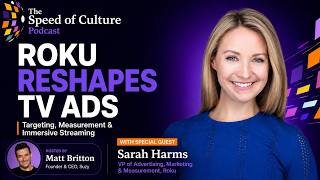
Sarah Harms, Roku's VP of Advertising, explains that Roku powers 90 million U.S. households and delivers half of all streaming via sticks or Roku TVs. She discusses new ad formats like Action Ads with QR codes and Roku Ads Manager, a self-service tool that lets small businesses run CTV campaigns.
Chapters
We're here live at CES in Las Vegas, and today we are thrilled to welcome Sarah Harms, the VP of Advertising, Marketing, and Measurement at Roku. With an incredible career spanning top roles at companies like GroupM and Microsoft, Sarah now leads at Roku, where she's at the forefront of shaping the future of streaming and advertising. Sarah, so great to see you.
Thank you. That was a lovely introduction. Of course. Thank you. I'm happy to be here.
Yeah, it's great to have you. Um, Roku is such an interesting company because You know, the people that have a Roku as a customer, do you love it? I don't, but I, I know how it works. Yeah. You should have brought me one. Yeah. But, you know, the people who have it love it. The people who don't use it aren't as familiar with it. For those in the audience who aren't as familiar with it, describe what Roku is.
Sure. So we often say we're the best story never told. Yeah. Especially if you don't have a Roku television. And it's funny, though, increasingly we continue to see Roku sticks being put into other television operating systems because ours is so simple. And so for those that do not have Rokus, we're the largest operating system, television operating system in the US. We have 90 million households that we announced this week. Half of streaming happens on a stick or a Roku TV. And so we very much have a very interesting advertising business and media business because we have our platform, which is again, the biggest, which allows for all this amazing data. We're also a publisher as well with the Roku Channel, which continues to—
because of that— that you have.
Well, it has everything. It has FAST, it has originals, it has branded content, it has sports. And so that's a lot of more education we have to do, not just about Roku, but also all the facets within it.
Yeah, I mean, a lot of the kind of component companies that make TVs, right, the Japanese companies that that they're trying to create their own software because the margins have gotten compressed. And you can buy an 80-inch TV now for like $300. It's crazy. Yeah. So, you know, it's very hard for them to make money doing that. They've— they're trying to create services and software. Traditionally, it's been hard for them to do because it's just not in their DNA. And I find that, you know, it's the software companies, the companies that know how to do that, the great user experience are the ones that customers like Roku are switching to despite the fact that the component companies are offering it. How do you look at the competitive ecosystem for Roku given all that?
Yeah, so there's obviously the Roku competitive ecosystem. Then from my seat, kind of the advertising ecosystem. And, uh, obviously we look at the other TV manufacturers and we tip our cap there.
Yeah.
And we think of the other kind of big streaming publishers. So the Disneys, the Netflix, the Hulus of the world, and we keep a close eye on them and the gauge and, really understand our positioning as really the largest AVOD player where they're amazing, kind of big, beautiful content, but maybe their advertising scale is not as big. Right. And so we think about that and then obviously we think about us as a platform as well. And a lot of the evolution we'll talk about today, we used to have our own platform and now we're much more kind of operable with the key players in the space.
And so we started advertising.
Yeah, yeah, yeah. So we previously had OneView, which is our kind of demand-side platform. And we still have our own technology and we continue to commercialize it. We also acknowledge the need to partner with the key players in the space. And so we think of ourselves as a huge player, but also one that's really not so much of a walled garden, but open and collaborative and interoperable with other big players in the space. So the sum is greater than the parts.
Gotcha. So if I'm an advertiser and I'm advertising on Roku, am I advertising within your custom channels and custom content? Is that where the reach occurs?
There's a few places. And so I think what's— what excited me about Roku is we really have two complementary media businesses and advertising propositions behind that. So we have our home screen. So 120 million people see that every single day. Yes. So 90 million households, 120 million, primarily US. Yes. So we're in US, Canada, Mexico, Brazil, the UK. But really a lot of it is the US with a focus of kind of ongoing growth in outer markets. But sticking with the US, that many people come into our experience every day to decide where they want to go and watch content. Finding content is harder than ever. And so that's why our UI is so compelling and complementary of what am I going to watch it and how do I discover content. So we have advertising opportunities on our home screen. We talk about Super Bowl size reach every single day. So you're seeing big, beautiful custom creatives.
High impact.
Yeah, beautiful. Born out of the media and entertainment business where we are driving tune-in for the Peacocks, the Hulus, the Disneys of the world. But now we have brand advertising there. We have our kind of immersive experiences like Roku City, which is our interactive screensaver. It's viral. People love it. It's just really fun. And so brands like we had Taylor Swift in Roku City, we have stores in Roku City, we have cars in Roku City. And so it's just such a fun experience. And so think of that as custom, beautiful, kind of high-touch inventory in the home. Correct. Yeah. And continuing to test and learn and iterate those advertising opportunities because everything has to be consumer first. So we're never going to be the obnoxious kind of in-your-face bothering you all day with annoying ads. We want to make it more seamless and fluid with the rest of the OS. So think of that as our Roku experience. But then to your point, We have tremendous video inventory scale, either through our partnerships of the apps that we host or more than ever, just the Roku Channel. It's the second biggest app on our TVs, which is maybe crazy for—
That is crazy considering there's Netflix, Hulu, all these other platforms.
Yeah, yeah. But we'll talk more about it. We just, we want to make TV easy and the Roku Channel is easy with fast and discovering content. And so we continue to climb the gauge. The gauge just represents the Nielsen gauge, which is kind of illustrating TV consumption in the US. And that's just our space within the Roku channel. And so if you think about the other side, which I just articulated, the Roku experience, we're massive in terms of an advertising proposition.
So what makes platforms like Roku interesting is that you have the immersion of TV watching, right? But in addition, you have the addressability and measurement that traditionally did not come with advertising on TV. Correct. Talk to me about, A, how brands can specifically address the right types of consumers, 'cause we've come a long way from 18 to 49 cookie cutter demographics. And then second, and I know this is in your title, measurement. Yeah. Attribution, what type of attribution you're offering?
Sure, sure. So we like to help our clients with playbooks for whatever their goals are. And so we talked about those big beautiful experiences, mass reach, big launches, But also we understand that because we're the largest operating system in the US and because every single household has to have a Roku account, all of that is underpinned by our amazing data. And so using that throughout to kind of build playbooks for the consumer journey through our platform. And so to your point, addressability, targeting, sophisticated data collaboration with key partners. We announced the Roku Data Cloud this week, which is really just that, which is our amazing data assets across viewership or PII that we can share confidently with clients, but also measurement companies and data companies. And so it's really the encapsulation of everything we have to offer from data and measurement. And so you brought up measurement. We of course have first-party data.
Yeah.
And we think we know a lot and we do. But again, going back to us being interoperable, collaborative partner, we know that we can't always be the source of truth. And so how do we kind of strike the right relationships with the measurement companies that matter to our brands to make sure they're investing with confidence and collaborating with confidence with us?
Are you seeing a rise in brands wanting to do bottom funnel conversion? So you show an ad and you can kind of click through to it or QR code to drive transactions?
Yes. And I think the Roku experience and operating system and specifically the remote has made that very compelling. So we have special formats called Action Ads, which has a QR code or a call to action. We have showrooms where you can kind of look at the latest car model and look at all the configurations. We have kind of Roku Pay and payment company integrations to do kind of direct purchases. And so we certainly think maybe CTV and video in general has been misconstrued as just as a branding vehicle, right? But it's very performant and we're so eager to use our measurement and collaborate to tell that story. And then this year we announced the Roku Ads Manager, which is our self-service platform for kind of SMB and direct response advertisers. Interesting. Yeah. I mean, if you think about it, the television upfront was a high barrier to entry. Yeah, right. And so we think CTV specifically can democratize and lower that barrier. And so Roku Ads Manager allows small mom-and-pop shops to use their credit card to buy beautiful CTV experiences experiences and also drive performance for them.
How targeted can you get?
Very.
Yeah. Can you match data with your own?
Yeah, yeah, yeah. And so, and we provide action ads there with call to actions. And so we certainly think these kind of challenger direct response brands are going to love it there.
Yeah, for sure. So Roku recently outlined its 2025 predictions on the consumer, and one of which was the resurgence of lean-back viewing experiences What is that and why does that matter?
Yeah, it's so interesting. It's always kind of what's old is new again. Yeah. And we're really seeing that. I have a personal anecdote. I'm much more of kind of a streamer in the apps, but I love the red carpets. And so I watch the Golden Globes red carpet on our FAST channel and you can't tell the difference. And so I think there's a few things. I think we've made the experience lovely and almost you don't even know you're doing it.
Right.
And that's kind of great. It's not like we're tricking them. We're just making it easy. But also, I talked about content's really hard and sometimes you have a brain-dead day and you just want to turn on your TV, lean back and let them choose your adventure. And so I think it's really just addressing the market that content is getting complicated and complex. And so that's where, where Roku shines. It's like, let us help you find the content you care about and we're happy to help with some fast channels as well.
So we're here at CES and you're working with lots of brands, lots of agencies. What are they looking for this year to stand out and differentiate it using platforms like Roku?
I think there's a few things. I think they loved seeing our innovation, both in the fact that we're so consumer-led, but also these kind of new, exciting mass reach experiences. And so testing and learning again to see how these video or rich media-like assets interact with the rest of their funnel. So I think there's that and just testing and learning. I think they're also starting to understand how do I invest more in some of these— is it fast, is it women's sports, is it these challenger sports— just to kind of test.
Women's sports is huge.
Huge. And female athlete here. And so I'm very proud of it. And I think as a kind of tangent here, the media math wasn't mathing for a long time. It was like the nice thing to do to invest in these sports. But that only is half the problem. You need it to work and you need the eyeballs. And so I love to see that it's actually happening and the eyeballs are there and the performance is there. So really kind of clients asking us like, well, how do we start? And then again, I think there's the ongoing maturation of our business. So more accountability, more addressability. More infrastructure of data collaboration, unique measurement. And so they come to us with questions and we're happy to help.
That's great. And are you primarily having conversations with brands, with agencies? How does it work?
Both. Both. Yeah. I mean, we serve it all and we serve big. And then we talked about Roku Ads Manager. And so we very much support agencies and their businesses and their products, but also acknowledge that brands are increasingly making very big decisions with or without their agencies and We do everything in between.
So where are you focused on 2025 to make sure that you continue to bring your vision for Roku's ad platform to life? Where are you spending your time? Where are you spending your time learning and growing as a professional to make sure you can continue to excel?
Yeah, I think there's the business angle and there's the people angle. Obviously, we're recording today and a lot of our team is displaced and confused. And so as a leader, I want to support our team today and in the future of kind of growing at the company, uh, which is how we do great work. But also on the business side, I think again Roku is on a big evolution. Like, the things we talk about now we haven't talked about in the past, and that was really where we weren't so open for collaboration, or we weren't so interoperable. We were pretty inflexible. And so talking about different DSP integrations, or even the fact that we talk about Roku Data Cloud, it's a big evolution for the business. And so We need to make sure our teams understand the step changes we need to do to kind of execute on that vision. But that's really what brought me to Roku. I was very excited to see this modernization of the business and it's paying off. We're doing very well.
What works for you just personally in terms of being a good partner to clients? Like what types of behaviors have you been able to hone over time and skill sets that make you an effective professional?
Yeah. At Roku, we used to talk about platform, not the pieces. We had amazing pieces that came together again to a pretty rigid platform, and that's still compelling and we can still be your one-stop shop. Great. But increasingly our clients and brands, they're building platforms. Yeah, we understand we're just a really big piece of it, but not the only one. And I think that's important to kind of change that mindset that we know they're not only buying Roku. Right. But we want to be their best, most collaborative partner. And so helping them solve problems, helping them build products, helping them understand reach curves and the ecosystem and doing research together. And so it's being very much collaborative, consultative, empathetic, I think, is really where we're winning.
Yeah, because if you're just selling them impressions, well, then you're commoditized. Everyone has that. And it's like, why? Because you need to stand out. I mean, everybody is selling advertising here. It's like PayPal has now advertising product, Chase does, Walmart does, which is kind of crazy if you think about it because those are also big advertisers themselves and they're also selling advertising. So one thing I've been thinking about as I've had all these interviews at CES is like, how do you really stand out? How do you really add value? How do you differentiate? Because there's only so many buyers out there and everyone wants their dollars, everyone wants their attention. So I think being able to add value, create relationships, differentiate is probably table stakes now to be able to succeed.
Yeah, we're very excited and proud of the fact that one, our OS is just great, right?
The product has to be good.
They love it. Yeah, consumers love it. And we're being so thoughtful about how we introduce advertising more and more and in a very elegant way. And so that, that, that's check one. Yeah, consumers love our product and we will always be consumer-led. But off the back of that, we don't only have content, we have the platform, which is sticky. We didn't really talk about churn, but churn is real in kind of the streaming landscape.
More than ever.
Correct. And so 26 days out of the month, people come on the Roku platform and we see that drop significantly for each individual app. So we are a sticky—
You're saying so they could sign up for name the streaming platform and who are also selling advertising, right? But they might not be there. No. Yeah. That they might sign up for a show and they might cancel. Yeah.
Or be there 3 days out of the month. Right.
You know, you're the platform layer. Correct. Which makes more sense to invest over time.
Correct. So not only do we help their businesses, we continue to help Peacock or Hulu or Disney or whoever, their content get discovered because again, it's hard. And so that is a service we provide to them, but also consumers. But also I think we have the platform, we have the data, but we also have content. And I really think of that Venn diagram to really be differentiated and be future-proof. You have to operate somewhat in the middle, and we feel very good about the fact that we do both very well.
Absolutely. So I want to shift gears and talk about you as we wrap up here. So you've worked at a lot of great companies that are kind of, you know, innovating and emerging on the ad tech side. What are some of the reasons for your success over your career? What do you think you do particularly well and how have you been able to nurture those skills over time?
Yeah, so I was very lucky. I started my career— my whole career really has been in ad tech and programmatic. And so I think what did well for me was a thirst for knowledge and becoming an expert in it. And that was back when it was nascent and it was like, oh, it's just Remnant. Or that's just kind of cheap inventory. But now it's the way we work. And so one, I think just no question is a dumb question and just become an expert. And so that's just done very well for me. But also I think interpersonal relationships matter. Yeah, and people matter both on your team, on other teams, and externally. And so I try to be direct but also very collaborative and pragmatic. And I think that's really important. I think the people thing is really important.
And for some of the younger listeners, what are some of the things that you think they should do earlier in their career as an ad sales professional to set themselves up well for success?
Yeah, become an expert in something. Yeah. So one of my old bosses was such a mentor and he talked about being pie-shaped, like the pie symbol. So don't be good at just one thing. Build extra legs to your career and just continue. Yeah, it's great. So that's one thing. Again, no dumb questions. Find mentors internally, but also externally that will give it to you straight. And feedback is absolutely a gift and always ask for it because a lot of managers, especially early in their career, don't do it.
Yeah. And you have blind spots and there's things you're doing that you would definitely want to improve if you knew about it, but you just don't.
Correct.
Yeah, I definitely—
No one is perfect. I agree. And so I think It's so important. And I hope our young talent, especially as we all kind of return to the office, just they get much more comfortable and actually excited about these conversations for their career.
Yeah, I think it's important. So we always wrap up our podcast by asking our guests if there's a quote or mantra that sums up their professional journey to date. I was wondering what comes to mind for you and why.
It's from Bambi with Thumper. If you don't have something nice to say, don't say anything at all. Right. So my mom always said it growing up, and it goes back to kind of a lot about how I feel about the people thing. And so I think that can be the interpersonal thing, but also in a meeting, it's okay to be quiet.
Right.
You know, and so maybe not being nice or not saying anything nice, but also if you don't have anything to add, listening and observing is also okay.
Yeah, sometimes people just like to hear the sound of their own voice.
Yeah, earlier in my career, I'd be nervous, and when I'm nervous, I'm like, let me, let me fill the void. Right. You know, but sometimes it's okay. And so I think, again, going back to, just learning and observing, but also always doing it so in a very gracious and nice way.
Awesome. Well, I want to thank you for taking the time today out of your busy schedule at CES to, uh, tell us about Roku and yourself and the journey you guys are on. Wish you nothing but a successful 2024.
Thank you. You should get a Roku.
Oh, on it, on it. On behalf of Susan and Ivy Keene, thanks again to Sarah Harms, the VP of Advertising, Marketing, and Measurement at Roku, for joining us today live at CES. Be sure to subscribe, rate, and review the Speed of Culture podcast on your favorite podcast platform. Till next time, see you soon. Bye-bye.
More from Matt




MikMak’s Rachel Tipograph on Consumer Spending, Retail Media & Holiday Shopping Trends



Jaguar Land Rover’s Charlotte Blank on Luxury, Purpose & Experiential Storytelling



