Samsung SmartThings’ Mark Benson on AI, Smart Homes & Seamless Connectivity
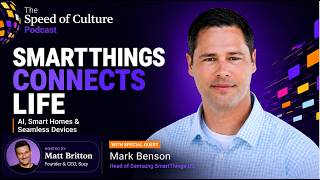
Samsung SmartThings head Mark Benson says the smart-home market is moving from niche to mainstream, powered by AI-driven voice commands and interoperability standards like Matter. Samsung embeds SmartThings hubs in TVs and refrigerators to turn them into the home's brain, while AI agents will soon automate chores like inventory-aware grocery ordering.
Chapters
Up today, live from CES in Las Vegas, we are thrilled to welcome Mark Benson, who's the head of Samsung SmartThings in the US for Samsung Electronics. Mark has been a leader in the technology space and has some great visions of where the smart home is headed. And we're really excited to dive in today. Mark, great to see you.
Yeah, it's great to be here, Matt.
Absolutely. So, you know, the smart home has been something that's been so frustrating for consumers. Over the years just because the promise of a smart home and basically walking into a home and having it know what you care about, what you like, have the lighting, the mood, the sound is so appealing. But often it's been frustrating for consumers to actually pull it all together. There's also been so many different brands and the ecosystems have been all over the place. Where is the state of the smart home moving forward? And why are you confident that we're going to be able to give consumers a better experience moving forward?
Yeah, great question. I've been in the smart home for a long time. And SmartThings has been really a pioneer in the space for a long time. And we've seen the changes over the years. And it really has shifted. Early on in the smart home journey, it was really about innovators, early adopters, people who were super comfortable with tech or even programming things. And they would seek out the technology, get it to work, get through barriers that— the, the everyday person really wasn't able to do. Yeah. And that has shifted now where, you know, if you're familiar with like a diffusion of innovation curve where there's like these like innovators, early adopters, but then there's this big part of the bell curve of like the, the mass market.
Yeah, we're seeing with crypto right now, with crypto, right?
Yeah. And the smart home is really reaching that early majority of the mass market right now. And so the, the users who are experiencing the smart home now and buying devices, and they want it to work just like you said, and, you know, to be interoperable. They are comfortable with tech relatively, but they're also not going to just buy something for the sake of buying it. They're going to do it to solve a certain problem or to make something better. And so to answer your question, to make it better and easy to use, we've been really focused on interoperability. Number one is just making sure that devices in the home really work well together because that's what I think consumers expect. But it hasn't always been there over the years. And then secondly is just the simplicity of the user experience and just making it easy to use, easy to set up, easy to use. So we've been really focused on that.
So one big piece of the consumer adoption habit of smart home technology has been voice, right? The premise of walking in and talking to your Alexa device and saying, turn the lights off or on or turn your alarm on. Voice has— arguably not taken off to date the way that we thought. I remember 10 years ago there's always articles like the future of voice is here. People aren't— because Siri and Alexa ultimately I don't think paid off the way that people thought. But now they're getting a lot better. And now with AI, it's so much more reliable. I know that, um, you know, Alexa had talked about partnering with, um, Anthropic in the AI front. Where do you look at voice, the evolution of voice, and is its role in the overall smart home?
We have so many users that use voice to control their smart home. And, you know, one of the common things is to be able to use voice, you know, whether that's Alexa or Google Home, you know, or Bixby, to be able to trigger smart home routines. So if you have multiple brands in your home, like a Ring camera and Philips Hue lights, you know, in SmartThings, you can easily set up a routine that says, when there's motion on my Ring camera, turn on my lights. Something simple thing like that. But that routine can be triggered with your voice as well. Or you can set up goodnight routines. So you can say, you know, goodnight to your voice speaker, and then it can just initiate all these routines in your home. So we've seen that even though voice commerce and like that, the more complex interactions with voice have really not really worked out the way that people have thought, it's still a very useful tool for triggering smart home actions. And you're right, it is getting better with AI. Much better. And much more— conversational. And I think we're going to see that more and more in the coming years.
So what are some other ways you see AI accelerating the smart home?
So one of the big ways is through personalization of the smart home. So being able to look at patterns and activities in the home and then be able to suggest, you know, with AI routines that can benefit users. In the SmartThings app today, there is that feature right now where you can see suggested routines based on what you've been doing in the home, how your lights have been turning on and off, and then will suggest using AI these intelligent routines that are just easy to set up. So as a user, you don't have to say like, okay, I gotta get in a different headspace, like think about this little recipe I need to create and do that. It's like the AI is actually suggesting that for you. And then as a user, you can say, oh yeah, when I go to bed around that time when I trigger this routine, I would like to close my garage door, shut off the lights, turn off the TVs, lock the doors. Thank you very much. And then that routine just gets created right away without much work or cognitive effort from the user.
Yeah. And of course, Samsung's in a unique position because your company has so many different devices that are in the home. You have, obviously, a huge assortment of televisions. And you have refrigerators and other appliances in the home. How in your role are you leaning into that infrastructure to make sure that SmartThings becomes the kind of de facto platform of choice in driving the smart home?
Yeah, Samsung has a vast portfolio. And we, since the acquisition of SmartThings, which was just over 10 years ago by Samsung, it's been a wonderful partnership of combining the breadth and power of Samsung's portfolio with the SmartThings software platform and being able to have that come together. Samsung's portfolio of products has so many fixture devices. They have, you know, long cycles in the home where they're not being replaced every year.
Right, durables.
Yeah. They're durables and they live for a long time and they're really, homeowners depend on them to, you know, wash their clothes, wash the dishes, you know, the TV that's in the center of their home. And so those are so foundational. And the smart home is also all the things around that, like locks and lights and thermostats and cameras. And so we've really worked on making all of that interoperable together. And by in, in putting more SmartThings technology into Samsung products, for instance, the SmartThings Hub is available in Samsung TVs, Family Hub refrigerators, smart displays. And so by doing that, consumers can have their Samsung products be the brains of their smart home. Without buying a separate smart home hub, which is like a separate thing. So we've worked on integrating those to make the user experience be not only just on the mobile app, but also on the Family Hub refrigerator, also on the TV so that that experience is consistent across all those surfaces in the home.
And I would imagine the proliferation of 5G is only going to accelerate the efficacy of all these individual tools within the home.
Yeah. I mean, just the, the spread of just available network, low-cost network, and being able to, you know, connect all these different devices is really big. And also not only 5G, but also low-power wireless mesh network technologies like Thread. Yeah. And I don't know how familiar you are with the, the CSA or the Connectivity Standards Alliance, but it's an alliance that has built a new standard called Matter, and it's a certification standard. You can think of it like Bluetooth or Wi-Fi. But what it is is it makes smart home devices be interoperable together. So if you buy a smart home device that has that Matter logo on it, then you can know as a consumer with high confidence that's going to work with the rest of your stuff and be interoperable. So that is really a big game changer in the industry. But it's in the middle of adoption within the industry. The standard is there. It's mature. It's also developing. There's new device manufacturers that are adding support for it. SmartThings is Matter certified, of course. And so any Matter device you have just works with SmartThings already. But that is a— that's a really big thing that's happening in the industry right now.
Yeah. And of course, the key to adoption— I mean, you and I are here talking about just advanced technology here at CES, but we don't represent mainstream America, right? And a lot of people— are still trying to figure out how to change the input on their TV or they have it still DVD players, et cetera. So, you know, to accelerate this to the masses, ease of use and simplicity has to be everything. And ease of use and simplicity starts with the interface and the software and the form factor and the things people touch. How do you look at user experience for the consumer when it comes to how SmartThings is, you know, basically has a surface area for consumer interaction?
Yeah. So for people who have been, have had a smart home for a long time, they might think of all kinds of really advanced sort of things they could do or what happens when the weather changes and what's going on with their lights and the curtains and everything. And all those things are possible, but the everyday user is not thinking about those things. Right. They're like buying a TV and then they're like, how do I set it up?
As quickly as possible.
As quickly as possible. And then, oh, I have a Ring camera. How do I get that to work together with that? And it's just the ease of use and onboarding and initially starting to use those devices that is so important to the growth of the smart home. So we focused on things like we call calm onboarding, which is like the onboarding process. We don't want it to be frustrating, like where it's like, how does this work? I gotta go read the manual, this, but that it's just, it's calm, just works. You just have the device, easy, set it up and you're using it. And that, that process being simple is really foundational to creating a great smart home so people don't get frustrated right out of the gates.
I don't think manuals are going to exist for much longer. I think families are going to have family chatbots, and every device that's in the home, that manual will be loaded in the chatbot. And you could just say, why is my refrigerator blinking or doing this? And it'll just tell you. Like, what's the point of having manuals? No one knows where they are. No one wants to read through them. I think you're seeing that in the automotive industry where you can talk to your car. I think ultimately it's just about accessing data the right way to help you make decisions to get done whatever you want to get done.
Yeah, I think you're right. I think those, um, hard copy manuals are a thing of the past for sure.
So a big discussion point here at CES in 2025 within the realm of AI is agents and AI agents. So obviously we've gone from 2024 where you're talking to AI and giving you information and writing you blog posts or etc., but now AI is kind of delving into areas like computer use where you can have AI take over your computer and do things for you. And over time— and when I say over time, I mean the next 3 to 6 months, people are going to be using AI to do things for them, whether it's do grocery shopping or book travel, et cetera. And when I look at the combination of AI agents and the smart home, I see some pretty kind of amazing possibilities for consumers, like sensors in your refrigerators, which I know kind of already exist, where if your milk is out, it'll reorder milk for you. And it'll know if it can connect with your calendar that you're on vacation, so it might not order it for you. And all of a sudden, a lot of these household chores slowly get taken care of. Maybe sensors in your lawn will see if you need the landscaper to come. Where do you see that all headed? 'Cause to me, the technology has now arrived with 5G, with AI to make, you know, the whole notion of the Jetsons really come to life.
Yeah, I think you're absolutely right, Matt. And in the smart home, so here at CES in 2025, we're showcasing a lot of things around AI for the home specifically. You know, we call AI for all.
I gotta check it out.
Yeah, you gotta definitely check it out. And there's so many things in the home that are interesting with AI that are not just an AI agent that you interact with, but also like what's going on in terms of like spatial intelligence in the home, sensors that are sensing where are you, what sounds are happening, whether there's a baby crying or not that can trigger alerts and notifications on that. Being able to take care of your pets remotely. Also things like family care service where you may have an aging loved one that wants to age at home, or someone who needs care that you can watch out for them. And then using AI to look at sensors like how often that person opened the fridge. And normally they would do that maybe 15 times a day, but then today it's been only 3 times. And that can trigger an alert to the caretaker that's used based on AI, but trigger that alert to the caretaker to check up on their loved one and make sure everything's okay. So there's all of those use cases that are just exploding right now. And we're showing so many of those um, here at CES, but it is definitely an exciting time for AI in the home.
Yeah, what's interesting is that you have this ecosystem, as we talked about earlier, of appliances, of durables in the home that you can kind of use as sort of like a foundational layer to how consumers interact. And then you have data that comes through these appliances in terms of how they use it— use— that gives you a picture of the consumer and allows you to build on services on top of it that make their lives easier and better.
Oh, absolutely. And using data to be able to make decisions or things in the home that really matter to users is like game changer. So one example is SmartThings Energy. So we have a service that's called SmartThings Energy, and you can get it right in the app for free. And what it does is it builds better awareness to the user of where energy is being consumed in their home and then gives them tools to be able to manage that and reduce that energy. I don't know, Matt, if you're like me, but at the end of the month when I get a utility bill, if it's higher than normal, I rarely know why. And if I think back to like 3 weeks ago, like what was I doing on that day that made it spike, or someone in my home or my family, I have no idea.
You also know maybe it's just rising energy costs.
It may be that too, right? And so with SmartThings Energy, what we're doing is giving more real-time feedback to users about what is going on in their home right now. And then they can schedule routines to like turn the lights off when they're not in the room or change the thermostat settings when they leave the house or sign up for demand response programs. Like, uh, we have SmartThings Energy Flex Connect where you can sign up to use SmartThings AI energy mode to save energy in your home. And then, and then for that you get, um, uh, energy stamps which can be converted to Samsung Rewards. So it's ways that can really benefit the consumer in their home, in their own pocketbook, but also benefit utilities and also benefit the world through these sustainable innovations.
Moving forward, obviously, the power of AI is just obviously mind-blowing. And already, Jensen Huang here at CES talked about some incredible new innovations that NVIDIA is bringing where consumers are going to have their own AI-powered personal computing device in the home. One area I think that's highly relevant to the smart home that might not be here today but will probably be here in the next 2 to 3 years is robotics and in-home robotics. Like, I think we're gonna be at a point very soon where everyone's gonna have their in-home robot that's gonna do everything from cleaning to security monitoring. What are your thoughts on robotics? Is that a place that Samsung's playing in?
Yeah, so I mean, robotics I think is an exciting new area, and I agree with you, we're going to see more and more of that, um, coming forward. Um, we have some AI-enabled, um, robot vacuum cleaners from Samsung that are really exciting that do things like, um, intelligent object detection and avoidance, you know, things like—
it's also a sensor, another sensor too, of the home in terms of—
yes, right, another sensor in the home that also can work with things like, uh, pet care, detect water leaks, detect water leaks. Yeah, all of that stuff. I think to answer your question, it's, it's a very exciting area, and I think it's one of the things as we look forward in the smart home, robotics is something that will be a, a big player. And it's probably like other new tech where there's some early adopters that will welcome it into their home right away and love to have it. And then it will take a while for the mainstream user to come down and the cost to come down. So I think we'll see that, and that will take some, some time, I think, for that to happen. But it's definitely an exciting use of AI that can really benefit people's lives that's coming for sure.
So shifting gears, we wrap up here, Mark. You're the CMO of SmartThings, and obviously what an amazing role and what an amazing opportunity Samsung has and yourself has to really, you know, drive innovation in a really exciting space. How do you spend your time every day in your role and what's most important to you in driving success for your brand in 2025?
Well, the biggest thing that I spend my time on is the same thing that has motivated me to even get into IoT and even in this career myself, which is the driving passion to simplify technology to enable meaningful connected experiences for users. And that drives me. That is the mission of SmartThings, and that drives everything that I do. So in terms of what a day-to-day looks like and how I spend my time, there's everything from finance and resource planning, strategic planning, platform architecture and design, support processes, things we do with developer tools, partners and ecosystem expansion, business development into new services. All of these things, but all of them are with that singular focus of really simplifying tech, enabling interoperability in the home, and making that possible for users to have meaningful connected experiences in their home to make their life more secure, that the things around them are easier to use, that their wellness and care for others is promoted, and that they can live a better life. And that's really what drives me every day.
And I would imagine being— somewhere like CES, and there really is nowhere like CES, you can walk the showroom floor and just see so much applicable innovation that's happening with companies of all different industries, whether it's automotive, whether it's healthcare. There's probably things that are happening that are giving you new ideas, whether it's new partnerships or new initiatives that you want to undertake on your own for Samsung.
Yeah, absolutely. There's so much innovation here that's shown. And we're showcasing a lot of new innovation ourselves too here at CES. One of those things, just as an example, that I'm really excited about it is, is the advent of what we call SmartThings Pro. Okay. And so that is essentially extending SmartThings beyond just the home to commercial enterprise and industrial applications.
So what are some of the use cases for that?
So, so one of the use cases is with ships and commercial vessels and being able to monitor the operations on that vessel, whether that's a, a private vessel or a commercial vessel for the captain.
It could be like a cargo ship going across the Atlantic.
Like a cargo ship. That's right. Or it could be a passenger ship where then there's also a passenger experience through smart things that they can have while they're on that ship. And it's just one example of many, Matt, that's like commercial applications with like multifamily unit buildings or retail or hospitality, staying in a hotel and being able to have some of your smart home experience travel with you in your hotel room when you come.
And that, that should be the case anyway. It should be able to walk in. When I go into hotels, I literally rip out the HDMI cord from the back. I plug in my, my, you know, Samsung stick so I can, you know, watch TV. It's just that, that should be in every situation. Like, it should just appear for you.
I agree. You want to bring that, bring that with you, whether, yeah, whether you're at home or whether you're traveling or in your vehicle or in your vehicle, right? That's right. And we're, we're showcasing, um, a big part of our Hyundai partnership here at CES as well this year. And that's just all about using the smart home in your car, being able to trigger routines at home even while you're in your car, or being able to have your home react to you when you arrive at home to be able to turn on the lights or open the garage door or things like that. So it's very exciting, not only inside the home, but also more and more expanding outside the home and into you know, industrial applications, commercial and enterprise.
You can imagine companies that have many office locations all around the world and they want to manage that and be more efficient and, and pull data from that, and it could save you money, it could save you time, etc. It would make so much sense. And there's so much outdated technology in the home and really everywhere. I mean, I just know buying a beach house, like, like some of the technology hasn't changed in 20 years, and there you can't even update it on your own. You have to call somebody to come in and fix it. And I'm not going to mention any names of companies, but, um, you know, that all has to change. And the consumer is way more savvy now. The, the homeowner is becoming a millennial who grew up with the internet in the household. They are not somebody who's necessarily as fearful of diving into some of these things as they used to. 5G is everywhere. So the world needs to change and, and be catalyzed by easy connect experiences.
Yes, I, I completely agree.
Yeah, absolutely. So to wrap up here, um, when you look back on your career, and you know, obviously you've had a great run, and it sounds like you're just getting started in some of the innovation um, at Samsung. What are some decisions that you think you made right along the way to put you in the CMO seat today that maybe we can impart on some of our younger listeners?
As a younger boy, I was really, um, I was really driven by wanting to do something that made a big impact in the world. But when I grew up, in my family and the people that I knew, it was, it was very much about art and music and psychology and the humanities, essentially. And I did not see myself ever getting into tech. In fact, it was one of the careers that when my teacher, I think it was in 4th grade, said, what is the one thing in the world that you do not want to be? And I said, an engineer. I still have that thing at home that was like, I don't want to do that because it didn't, at that time, it didn't seem to connect with me on, um, ways that I could make an impact. But fast forward to college, I took some classes on computer science and computers, and I had always been strong in math.. And I realized that software really runs the world. It's everything from train scheduling algorithms to implantable pacemakers and defibrillators to all the appliances and devices in your home. All kinds of stuff. And my eyes were totally opened up to the fact that you can make a real impact in the world. So throughout my career, that has really driven me as I've worked at different companies and gotten different promotions over time, has really been laser focused on trying to make an impact, not just trying to play whatever game needs to be played to like get it, get the next promotion or something like that. But to actually focus on like what makes the consumer's life better or the partner that we're working with and staying unwaveringly focused on that. And that has really driven me and guided me in all the steps in my career. And it's something that I don't, I don't ever want to lose sight of. And I talk to our SmartThings team all the time about being just obsessed with like, what is the customer experience? Yeah, have empathy for like, what is it? Try it yourself. You make sure in your home you've got a smart—
put yourself in the shoes of the customer.
Yeah, what is this like for them, you know? And if we lose sight of that, then we lose sight of something really important.
That's right. It sounds like passion is really at the heart of, you know, your success and, and what drives you.
Yeah, absolutely.
Awesome. So to wrap up here, is there a quote or mantra that comes to mind that kind of guided your professional journey to date?
Well, number one is stay obsessively focused on the customer. Number two is always remain curious. Yeah. And just, you know, where you don't know, ask a question. If you have an assumption, maybe that assumption is not true. Get curious. And that's something I think that's really important for relationships, but also in the development of tech for consumers. And the third one is just collaboration, is that we are better together, you know, when diverse ideas come together and when you surround yourself with a team of like really smart people who are focused on the customer and curious and they're collaborating together, there's some really special things that happen. Without a doubt. Yeah.
Awesome. Well, thank you so much for taking your time during your busy schedule to join us here today during CES. It's been fascinating to hear about your journey and all the great work you're doing at Samsung.
Great.
Thanks for having me.
Absolutely.
On behalf of Suzy and I, we team, thanks again to Mark Benson, the head of Samsung SmartThings US, for joining us today live here in Las Vegas at CES. Be sure to subscribe, rate, and review this Feed the Culture podcast on your favorite podcast platform. Till next time, see you soon, everyone. Take care. Hey!
More from Matt




MikMak’s Rachel Tipograph on Consumer Spending, Retail Media & Holiday Shopping Trends



Jaguar Land Rover’s Charlotte Blank on Luxury, Purpose & Experiential Storytelling



