Samsung’s Allison Stransky on AI Living, SmartThings & Connected Technology
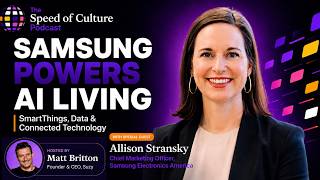
Samsung's CMO Allison Stransky explains how the company's phones, watches, appliances, and TVs work together to deliver AI experiences that save time and manage your home. The Family Hub refrigerator uses AI Vision, the Galaxy Ring tracks health data, and Samsung acquired Zelf to connect health information across devices.
Chapters
We're live in Las Vegas, and today I'm thrilled to welcome Allison Stransky, the Chief Marketing Officer at Samsung Electronics America. Allison, who's a repeat guest, is a dynamic leader with deep experience across Google, L'Oréal, Unilever, and J&J, and now she spearheads Samsung's AI for All vision, bringing connected AI-powered experiences to millions of consumers across the US. Allison, so great to see you, and thanks so much for coming back again.
Thank you, Matt. It's great to be here.
One of my favorite guests here on the Speed of Culture podcast, and really a a CMO who seems to truly understand that we are entering a new AI era. I think we're in an industry where there's a lot of buzzwords and jargon thrown around, but you seem to be someone who's taken the time to truly understand how it's going to impact consumers' lives and what it means for the Samsung brand. So with that, what are you most excited about for Samsung and the products you oversee headed into 2026?
So CES is a great time of year because, you know, you start the new calendar year with some big tech announcements and we are in an AI journey. As you, as you set up this vision of AI for All is going to be a many-year process to get to the future state that we're all really super excited about. But what we've shared this year at CES is that Samsung is going to be your companion for AI Living. And what that means is we are going to help you in getting the best in entertainment, home and home management, and care for yourself, your family, your pets. And all of that is unique and really more powerful from Samsung because we're the only brand or company that has the ecosystem that we do, the mix of phones and wearables with appliances, televisions. So we're really proud of where we're going, and I'm personally really excited to help shepherd that story. And, you know, we're marketers, so bring that to the consumers who we're really passionate about. Also bringing into this AI journey.
So let's unpack that a little bit. So what would a future day in the life look like with a Samsung customer who has a variety of your products in their home or maybe on the go? How does this sort of AI strategy come to life for them and make their lives easier?
In the farther out future, we are working towards a place where your appliances are doing your chores for you.
Right.
Your— health tracking is completely ambient and your life is being optimized by electronics and tools all around you. So that's not—
save people time, make their lives easier.
Yes, because we really believe in, you know, you're going to save time. We really hope and believe that you'll use that time to do something that you love, spend more time with your family, read a book.
That's what True AI unlock. Yes. Saving us time.
That is— that's the vision that we are working towards now in 2026. What it's going to look like is more more connectivity between your devices in a more seamless way. So one of the products that I've always been the most excited about is our bespoke refrigerators with the Family Hub. In that hub, you have AI Vision inside, which has tracked the ingredients in your refrigerator.
Oh, that's awesome.
That has existed.
But it has cameras inside and understands everything you have.
So that has existed since '24. In '25, we featured this as a part of our SmartThings meets AI Home campaign and talked about how, you know, these features can help you save time by meal planning for tricky families. You know, your kids all want different things. You've got what you've got. Now in '26, we just shared that it's been optimized with Google Gemini. So the steps towards the things that you can see are just getting bigger and better. And when you know more of what's in your fridge, you can make healthier meal solutions. You can reduce food waste even more.
Right.
And so this has been, for me, an exciting journey, but this is what consumers are going to start to see a little bit more of. We talk a lot about the health space because it is not just— we got your refrigerator, we got your wearables, but all of the connectivity and interoperability just continue to improve.
It's interesting because, you know, having your device touch the consumer, kind of like the last mile, just opens up such a competitive advantage because especially in the age of AI, because you have all this data now and I would as you'd imagine, there's just ways that you can monetize that as well. So like where my mind's going when I think about the vision inside the refrigerator is, A, you have data into the food that people are buying. You can trigger if you're out of milk one day, and I know that you're not in the business of selling milk, but you could partner with a Target or whoever, you know, food getting delivered when you're out. And then obviously you can get into the nutrition space. And if you pair that with the wear— the fitness-based wearables, you can help consumers improve their health by connecting what's in their fridge to what— how their body and the data of their body. And I can see it kind of how it can all come together in that way.
Absolutely. And the thing I think you just nailed is that we are a device company. However, it's the data backing all of it that is also our differentiator, right? So our data between all of the devices creates, enables solutions. And it's really the solutions that our consumers are in market for. Like a phone is a phone, but a phone is— it's about the connection to the world. Your part— your friends, your family, your everything.
Right. And obviously there's probably a lot of consumer education that has to happen on this. I mean, you and I live on the edges of AI and we're talking about it, but when we look out there to the mass consumer, they know AI is like asking ChatGPT for the best lasagna recipe, right? They don't really understand how it can be a data layer and an operability layer for the consumer. So what does storytelling look like? And I know you're not there today. You said it's a vision for the future, but you obviously want to bring consumers along the journey. So what does kind of storytelling storytelling look like and what's your plan to start to unveil that?
We've been early in the, I guess I would say, device AI storytelling because you're right, when people think AI, they're thinking ChatGPT and the LLMs. But we've been talking about breaking it down since '24 when we launched it on our S24 series. That was our first AI device. And the initial demonstrations of what AI was, was Circle to Search, AI Translate, and finding things that consumers are actually going to use and saying, you No, this is, this is AI powering this. Then in '25, we did our first ever cross-product campaign, which was the SmartThings meets AI Home campaign. And that was the first time that we said, you know, it is all better together. And if you have that phone plus your TV connected through SmartThings powered by AI, you have the best, most immersive entertainment experience because that's the benefit that you're working towards. So it's been a little bit of a puzzle piecing these— these together. We know it's a journey. We have moments like CES where we can be a little bit more visionary. But then when we leave Las Vegas and go back to our jobs, now it's like, what are we going to talk about today? How are we going to show that this is real right now? And that is through the design of these vignettes or use cases of telling stories about how this works together in the three areas of—
You're selling the dream, kind of.
You have to. Exactly. That's what we want to get to, because once you get the product in your home, you're going to learn more about what works for you. Also, it's AI, so it's learning about what works for you at the same time. But we are seeing an increase in year over year. Consumers are getting to those features faster. And I think it's been a little bit of this storytelling journey. So in 2025, the AI, the Vision AI benefits on our TV got significantly better than where it was in '24. We saw adoption exponentially increase in terms of consumers using AI benefits on your TV as we're telling a story of TV's not a leaned-out experience. It's actually a leaned-in, interactive family and friend time. And all of that is— they're getting there little by little. I think it's about finding the benefits that are easy to understand today. Yeah. Demonstrating those. And I think it's an unlock to get us on a journey to, you know, someday it doesn't matter how to access it. You're just going to talk to your device and it's, it's going to come together. But until we're at that point, we're going to break it down in, in easy to understand steps.
Yeah, I think that's definitely a challenge of the marketer here in 2026 is that things are moving so fast, especially from where you sit, where, you know, there's a kind of product development lifecycle for the things that your company creates to get out into the market. And so you could snap your fingers and have it there, but you want consumers to understand where you're you're going towards, but there's not gonna be a moment where it's all there because if it's all there, you're almost like then already behind, behind the timing game, right? So you, you have to be practical in terms of here's what you can buy, Lei, here's what you can Lei, but you also need to be visionary in painting a picture of where it's headed. And I would imagine, imagine it's a balancing act in doing that.
It is. It's a little bit of a balance, which is where we're talking about some of the, the pilots and other interesting things that we have going on. So for example, we are piloting the concept of, your smart appliances getting you home insurance discounts.
And—
I love it.
This is awesome because I've been talking about this for so long. I love this sort of connection of—
So we are in pilot right now in Florida and Tennessee with 2 local providers. And it's really positive results. And so you, through SmartThings in your app, say you may qualify for home insurance discounts. Right. Follow this path to understand if you do. And then— it's working out. People are very curious. So we're, we're slow rolling that out because we really do believe that smart appliances are more than even food recommendations. They're going to protect your whole home. Yeah. So this is a little bit of a step into that journey. Likewise, we shared, we have betas where we are experimenting with how can our devices help measure cognitive change. Like this is a much farther out consumer solution. So maybe not that far out. But—
Right.
Right. Much far to me, it's 2070.
Exactly. Right.
Right. Or we'll see when it comes. But yes, because everything is accelerating at the rate of change. But we also have a couple of interesting, like Claire was saying, pilots and betas that we are testing how and when we're all ready to get to the future. Because, you know, the device has to be ready, the consumer has to be ready, and we'll bring them together.
Yeah. It's interesting because we're here at CES in Vegas, and the organization behind this used to be called the Consumer Consumer Electronics Association, and now they're called the Consumer Technology Association. And I've been coming to CES for 25 years, and it used to be all about the hardware and the components. And you had a lot of companies like Samsung that were selling relatively low margin components, and the marketing of those components were about features and benefits like our washing machine dries faster, you know, our TV has a clearer picture. But I think we're now at the place where 4K TVs are very inexpensive and they're manufactured everywhere and it's somewhat commoditized that just that one aspect. But to decommoditize and differentiate, you have to look at the business differently. It's about services, it's about data, it's about ecosystem and all these things. And it just dawned on me that like the role of a marketer today, especially in your industry, is so much different because you have to have a platform-based approach. You can't focus just on features and benefits of the actual products you're selling.
That's so true. And we've been— we're excited for this shift that consumers are getting there because one, it means the products are so good, right? We have the ability to take it to these higher order benefits. So that is step one in the journey is make the best of everything in every category. And now that's what some of the best work that my team does is we're the one that gets to stitch that story together, right? Because we do have this oversight of the whole portfolio as our differentiating benefits. And now we can sell a feeling, we can sell solutions, we can sell things that are more than tech specs, which are, you know, that's going to mean more to the consumer, those things.
It's going to have a bigger impact on their lives. So of course, for you to bring this to life, a big piece of it is data. Absolutely. So how much of your role is understanding the data that you're able to get from your consumer, understanding how to structure it, how to use these models to unpack experiences that are personalized for your customers.
I feel very fortunate that Samsung has been a great keeper of data since long before I got here, so I didn't have to start or build that.
Many people do that come into the CMO role.
Yes, absolutely. So right now, data is the ultimate differentiator. I heard an advertising executive say that data is going to be more important than your brand. And if we are on that journey, I think Samsung— I'm a brand person, right? So I think there's always going to be value in the brand because you're going to connect with the brand. You're not going to connect with how Samsung is optimizing my experience based off of their understanding.
It's EQ and IQ, isn't it? Yeah.
Yeah. But I aspire to show off my newest phones. I feel very excited when people walk into my house and love my Frame TV. So that, I think, is the brand will live on. But I thought it was a really interesting take because it's not untrue that data is becoming the most important asset that you have to build that brand. So that I agree with. And we— the big data team sits within corporate marketing, my group at Samsung. So we are the keepers of making sure your data is safe and used responsibly. And so to answer your question about how much of my role is data, a lot, right? But in a really special way, because we are at a really exciting tipping point where AI solutions are going to make that data work even harder for us. So in '25, we did a little bit of team changing and building of infrastructure in order to be set up to use data for marketing even better. And within not just now the big data team, within my group, we have a media center of excellence, we have the Connected Experience Center, and these are teams that are going to be working very much internally and across all of our product teams to make sure data informs better media for better outcomes, data informs better product insights for better outcomes. And so, yes, data everywhere, every day.
And how do you think about like interoperability? Because obviously with the smart home, the consumer has had a lot of frustrations. I would argue the promise of the smart home has never really paid off for most consumers just because you have different kind of appliances and devices in your home from different companies that aren't all using the same systems. How do you think it's going to evolve over time?
I think this is where AI is actually going to make a really big difference because Samsung made a bet by acquiring SmartThings. SmartThings includes connected devices. Anyone who's built on the Matter ecosystem, right? Because we also said it's not just our advantage is all of our products from all of our categories. It's a matter of bringing in more too. You can connect your doorbell and your cameras and all of these other things. So that is the foundation that we really still believe there is. The smart home is on an evolution, and it is more, to your point, more than the interoperability, more than this can talk to that. I think we need to shift the storytelling to the benefits that come with this can talk to that. Yeah, we saw the The biggest increase in device-to-device connection last year for us was your TV and your oven. And so that was the biggest growth was seeing those. I would hypothesize it's because you can now see the status of your oven on your TV.
So, oh, so you're watching a game or a show or something and then you don't want to—
Exactly. Don't burn within there or pop up because it's preheated and you're ready to go. So those are the benefits.
Did you market that use case or did consumers just stumble upon it?
We, a little bit of both because we talk about a lot of these things, but not in a big way. That wasn't like a long, that was not the big budget first thing that I told you about, but they were, we've always known that notifications on your TV is actually one of the best benefits that you've gotten from connecting your devices because go change the laundry over, go pop that out of the oven. Those are little peace of mind solutions.
So useful.
So we don't talk about all of them in terms of marketing because there are so many, right? That what would you— that could be our social feeds.
Well, it's interesting. That's what my mind was going is like, if you have access to the data of how your products are being used and connected in the home, that almost creates your content calendar. Because now if a group of people are doing that, then you can create content of that use case to have more people do it. Exactly. It almost like creates your roadmap for you.
So last year we shot what we called the SmartThings 101 series, and it was 101 videos. Oh, very cool. About everything, the first level of everything you can do with SmartThings. And we're talking about doing the 201 series because there continue to be so many things that you can do. Let's just show you. Let's just show you how. Let's make it easier.
It's interesting when you think about appliances and you think about electronics in the home. Obviously, there's been traditionally like this adoption barrier where a lot of people don't want to read the manuals. They're not technical. They don't care to mess with the knobs and dials, et cetera. I believe that product manuals are not going to exist moving forward, and it's just all going to be driven by voice and chat where you're going to say, fix this to your oven. And if it can't fix, it'll automatically bring in authorized service person for you and nobody will ever have to play with knobs and dials ever again. And I think it's a good analogy for AI in general, which we can get into. But just curious your thoughts on that.
Completely agree. Also don't read manuals. We talked about this last year. I have not started reading manuals in the last year.
All right.
Gotcha. I've used other solutions to learn too, which I think I think we know which ones we're talking about.
Yeah.
But we have 100% agree that your devices are going to do even more helping you to take care of them. We have device monitoring that already exists within our appliances. So if your refrigerator door doesn't close, it can notify you that the temperature has changed and you might want to go check on that. So those little steps are here. We also won a CES Innovation Award for an accessibility feature in our TV where you can use voice to help with the setup. And as with all things, or many things that we know in the accessibility space, if it is started as an accessibility feature, it's actually probably better for all of us. Right. And so I think this is also another step on the way to just voice interaction to monitor, fix, set up your appliances too.
Yeah. Obviously, while helping consumers save time is a great benefit, I would argue even a bigger benefit is helping them stay alive. I know in that regard, Samsung has really leapt for— made a big leap forward into wellness. Areas like sleep, movement, nutrition, mental well-being through Galaxy Watch, Galaxy Ring, etc. Would love to hear about the efforts in the tech and health tech space.
Yes, we completely agree that health is probably the most important thing. Honestly, all of us, isn't that the most important? It's length of life, quality of life, all of that. So all of our evolution into the wearables business we have, as you said, the watch. I love my ring. I talk about it constantly, especially at CES when tech people are comparing their stats at every dinner So we— that was the first step is your wearables start to connect to your phone. You have your device tracking through the Samsung Health app. But then we're also looking for partners in other spaces. We acquired Zelf last year, which is a company that adds a layer of data aggregation monitoring to hospital and health systems. So this was a great step into— there's more health data out there in other places. If we think about data as our biggest advantage and differentiator, health really starts with data too. You collect it, AI comes in to understand it. SmartThings and the Samsung ecosystem connected from your, your wearables to your refrigerator, that's going to be giving you better health solutions. So, right, it is— this is really a future space that I think that you can start to see the evolution that we are on too, because, you know, my ring tracks my stress level, which is an indication of heart health and cognitive health and all those things that are much more than, much more than just stress. Yeah.
And it's not really a new thing, right? For years, when you go to get your annual physical, your doctor will take blood tests and they'll read the data and they'll check the levels against benchmarks based upon your age and your gender, et cetera. And they'll tell you if it's something you need to dig deeper into. Now, I think we're entering this era of Quantified Self where, and that's why I love what you're doing with the refrigerators as well, because if you think about your personal dashboard, whether it comes to your finances or your health or your business metrics or whatever. Devices like the ones that we're talking about from Samsung allow you to collect this data, but now more importantly, with AI, you can do something about it. You can see what it all means, and AI can help you make better decisions on what you can do to improve your levels. But the key is having the data to begin with. And I think if the devices are connected in the way that they are, I think it can really drive this Quantified Self movement.
Absolutely. And we would love to be a part of that because we know we've seen so many of those devices at CES. There's a a lot of innovation coming in that space. But I think back to the power of the brand, you know, Samsung, you know, the Samsung brand. And so I think that gives you some authority and some credibility as a great place to start.
Yeah. You know, there's a bigger analogy that's kind of brewing in my mind as we talk in terms of what I like to talk about with AI is that it's a lot about figuring out the problem you want to solve versus knowing how to solve the problem. And the analogy that comes to mind in our conversation is knowing how to solve the problem would be going into the manual. Having the settings and dials. But if now you can just talk or you have these accessibility features, you don't need to worry about that as much. And now you can focus on how these, how these devices can make my life easier. And I think this analogy in business as well. So if you think about like graphic design in the past, if you wanted to create something beautiful, you needed to know how to operate the knobs and dials. You needed to know how to actually be an expert in Photoshop. And now even Photoshop has Firefly where you could just say, say, I want to make this design of this image, and it makes it for you, which changes the skill set of you being a creative to someone who's technical and knows how to produce to somebody who really just needs to figure out what to produce. I'm just curious how you think as a professional, as a CMO, AI is changing what's important to make somebody effective in the modern workplace.
I think that at the end of the day, as a marketer especially, because that's kind of where You know, if I was the engineer building the AI models or the devices, I might have a different perspective. But as a marketer, I think our North Star remains the same. We are here to connect with our consumer. You always need to start with your business objective. And then once those things are clarified, AI is a tool that's going to help you get there in a different, more efficient way. So I do think for a young marketer today, the skill set that you can work on is changing. It's not the same as it was when I was starting out when I did. Right. But there are so many tools out there that you can start playing with to learn these things. Like Prompt Engineer was not a thing that we talked about 3 years ago. Even when we think about when that concept came on, except everybody has to have a little bit of Prompt Engineer in them now because as natural language solutions are coming to media management and everything that we're doing, you need to understand how to communicate with the tools. Right. So that is a whole new skill set. But I am really passionate about making sure we all remember that at the end of the day, people are still people and people are still our target. So how we get there is going to be different. And I'm excited to be at this tipping point right now. Are we in a marketing renaissance where all everything about how we work changes? But I think the, the question is in the how, because the end goal is going to remain the same. Yeah.
So how do you think your time is spent differently now than it was 3 years ago as a result of AI?
Right now, personally, my time is spent in a lot of the organizational and operational changes that have needed to happen to be ready to adopt these changes.
It's a big company. Like, you and I can talk here, prophesize about these big ideas, but ultimately you have to go back to your offices with the layers that a company like Samsung has and navigate through it to drive change and transformation.
We are a very big company. Yeah. And I know that that smaller companies have probably moved faster in some of these spaces, but we also want to do it in the most responsible way. And we are so passionate about making sure every piece of data is protected. So there's been a long learning process that has been a part of getting to building these changes. So I think, yeah, the thing that has changed a little bit is like what the work that I focus on 3 years ago was a little bit more of the work. And right now it's a little bit more of the operations, the the team, which sets me up for the team to be able to focus on the work because that all still exists, but it isn't necessarily my day-to-day focus. I'm glad it is somebody's because we have to get the whole team set up for creating great content every day and continuing that consumer engagement.
So let's talk about that. So obviously we spend a lot of time here talking about product, which I think is great because because a lot of times when I interview CMOs, it's just more about their new TV or marketing campaign. But it's clear that you focus on the consumer, you focus on product, and that ultimately does make you a better marketer. But then you do need to piece it all together into a storytelling framework so consumers know. So what does storytelling look like in 2026? And what are some initiatives you're leaning into, whether it's via partnerships, creators, or otherwise, to build the brand?
So a couple of things that are evolving in '26, and I think our strategy is kind of— it just continues to be an evolution of something that we talked about a little bit before, this idea that it's not only about features, it's about those higher-order benefits. Now, how we're telling that story is 1.0, 2.0, 3.0. We kind of get into that evolution. So that is one, is what— how can we inspire you differently in '26? Our campaign that I mentioned, the SmartThings meets AI Home campaign, was hugely successful. Some of the best tech testing creative we ever made at Samsung. Awesome. And one of the things that makes me proud is not just that it did well, but that it was based in an insight that tech and AI can make your life better. That's one avenue of storytelling that we're going to continue to build on. This idea that all of the Samsung ecosystem makes life better is— we feel like we finally started to crack that storytelling because it's a complex story. And especially in a world of a 6-second video, that's a really complex format to tell a complex story in. So we're starting to get that stronger in terms of our storytelling. And then another area that we're really passionate about, creators and influencers. That authentic voice is still one of the most important ways to connect with consumers.
More than ever.
More than ever. And we are leaning much more into creator affiliate programs because I think this is the next evolution, as well as we're focused on figuring out live commerce. This is an exciting format that has dramatic growth.
We've seen it in China and overseas, like, really take off. And now TikTok is TikTok Shop, and we're seeing Whatnot, and this is how consumers want to buy. I mean, what a lot of people don't realize is that this year, for the first time ever, the average age of first-time mom is Gen Z, which means that they grew up with the smartphone in the household, which means the way that they consume content is by looking down on their screens, not looking at a TV as much. And when they are looking at their screens, they're getting content not from traditional media sources, but from other people. So this should be, I think, front and center into the planning cycle is going after creators because you're not just going after kids with creators anymore. You're going after the head of the household, the person who's making the buying decisions, the people who are buying those smart refrigerators.
Absolutely. And this is another interesting area 'cause creators aren't new either. I don't know when we started probably more than 10 years ago at least, but still so much room for growth. And it's such a different partnership-based model of having conversations about creators using AI and how all of this comes together with the brand. But the other thing, in addition to the unique audience and the unique connection, language, voice that creators bring, we're also at this— maybe this is not the tipping point, maybe this is just the way of things— we endless appetite and need for content. Yeah. Brands cannot produce enough content on their own, even if they wanted to and it worked. The real value is reaching people through all of those different voices. And I think we're looking at a flywheel of creator content informing LLMs, informing consumer connection and decision wherever you're looking for that information. It could be the video.
That's well said.
You watch it directly, or it could be in the LLMs. It could be here comes Reddit back in the biggest way ever. Crazy, right? So there's— that is so much part of our focus because like I said, we're this flywheel of it's not just the video, it's how the whole world of it works together.
And I think standing out is going to become increasingly challenging just because, like, the barrier to entry to creating content is lower than ever before. And these AI avatar-powered creators are going to become increasingly indistinguishable from real people and people are going to start to create these engines where there's going to be content everywhere. You're not going to know what's real and what's, what's, you know, truly AI-generated. I don't know if consumers are really going to care, but I think there used to be a barrier to entry to creating video content and that is slowly going to go away. So just curious, like, what your thoughts are, not even necessarily through the lens of Samsung, but just as a marketer who really focuses on the future. What this all means.
It is fascinating that as AI is moving so fast, so is everything. Everything is changing at a new exponential rate. So for me personally, I'm more drawn to— I want a creator to be a real person because I trust whether you said something good, bad, or flubbed your delivery, you are a real person saying that. So, but that's me. I'm not an alpha, so I would predict that the younger consumers are going to continue to see through and demand more realness in different ways, but are probably going to be a little bit forgiving of—
I love that you said that.
Not— it's an avatar.
You understand that you have your POV, but you also didn't grow up in an age of AI. Yeah, Gen Alpha is. And for them, they're going to know no other world but a world where you can talk to your technology. And they are going to have have deep relationships with AI chatbots and they are gonna look at AI-powered content differently. The same way that a baby boomer or even a Gen Xer doesn't understand electronic dance music. Yet here in Las Vegas every year there's the Electric Daisy Carnival that has 500,000 people watching DJs press buttons. So it almost doesn't matter what we think, you know, and there are people be like, oh, the Beatles and I like real instruments, but obviously there's a new generation that doesn't really care about that. So we have to understand that things are changing.
Absolutely. I love that music analogy, but to keep it going, at the end of the day, each of those audiences are coming for what they value in music, which I think is synonymous or parallel to however you get your information in the future. You still want it to be real information. Yeah. So I don't think there's ever going to be a world where it is acceptable to be lied to.
100%.
So I think we need the machines. Disclosed.
Exactly. Yeah.
Yeah, the machines and the ways of learning these things, you have to make sure that you know the truth as a consumer, but what it, what it looks like and how it's delivered to you is probably going to change and evolve.
Yeah. So shifting gears as we wrap up here, and, and you and I could talk forever, so, but I understand that we're at CES and you got a lot going on. Um, you know, you are somebody, when I, I mentioned this at the onset that, that's really continued to improve both their personal brand and, you know, I think your overall impact on the industry over time. And I'm just curious, like, what do you think the steps that you've taken over the last 2 to 3 years that have put you in a position that you are today to be like a true leader in how large enterprise brands need to transform in the age of AI? Like, what were the steps that you took? Because I do think a lot of marketing leaders aren't going down the same path as you are, and I bet they want to know how.
I appreciate that. Yeah, I think I've always looked forward. I've always been a little bit curious about what is next, which is how, if you look at my career path, I started in traditional CPG. I, at Unilever, I went to L'Oréal. It was a very significant zig and a zigzaggy resume path to go to Google and work with data and video in a different way. But I think it's been curiosity that has driven me in a lot of these changes. Likewise, optimism. I've been running around CES telling everyone I'm an AI optimist because from the beginning I've really thought it's going to make things better. So when you combine from a marketing lens looking forward with that innate optimism, I think I felt like things had to change. And then you embark on this journey of figuring out what it is. So personal learning agenda has been like, learn all of this as fast as possible, even though I think I acknowledge I can't. Possibly keep up with it.
Only so many hours in a day too, right?
Yes. And the speed of the change. So there's that curiosity and then the bringing it together in a— I feel very fortunate to be the head of a team in a large organization so that I can go work the organization to make these changes, can advocate for what I think needs to be done. And it's a many-step process, but some of that has happened. So I'm really proud that that, you know, Samsung is steering a really big ship, but that ship is turning in what I believe is the right direction.
Yeah, for sure. That is, um, not something that I don't think anyone could argue, especially going through the examples we have today. So to wrap up here, and you know this because you are a return guest, I'm so appreciative of that. Um, we wrap up our podcast asking if there's a saying or mantra that helps define someone's professional journey and just curious, and maybe this is more of a 2026 version as we're here at the beginning of of a new year, what comes to mind for you?
I would say I'm still living by the same mantra I shared last year, which is to say a quote that always stuck out to me was Tom Hanks in A League of Their Own. If it was easy, anyone would do it. It's the hard that makes it great. Yes. And I still think, you know, a year later, even since high school, so many years later, that resonates with me because change is hard. AI understanding and where we're going is hard. Yeah, the kids graduating from college right now thinking they had a different career path, that's hard. And so this continues to be my mantra because I think if you are open to change, flexible to change, resilient with change, that's what's going to get you through. And if we're talking to the young aspiring marketers out there, I think that is a mindset and an attitude that will get them through too. So learn what is is learn what's happening now because the tools of today are not at all what I used when I was 22 and starting. But you're going to have a whole new toolset that might not be there 20 years into your career either. But if you keep adapting and being excited to face things that are hard, it's going to be great.
You also can't fight change. It's here. There's a lot of discussion of is AI good or bad, but it doesn't matter. Like, it's here. Absolutely. No one's going to put the genie back in the box, so to speak. And companies are going to be adopting it and consumers are going to be adopting it. So it's like, what What are you gonna do about it?
Absolutely. We're gonna thrive in it.
Awesome. Well, it's been a great way to kick off the year, um, speaking to you and getting your optimism and, and, and expert insight. And I just wanna thank you for coming back again. I cannot wait for listeners to once again, uh, hear this episode.
Thank you so much for having me. This was great.
Absolutely. Thanks, Alison. On behalf of Suzy and I, we team, thanks again to Alison Stransky, the Chief Marketing Officer at Samsung Electronics America for joining us today. Be sure to subscribe, rate, and review the Speed of Culture podcast on your favorite podcast platform. We're here live in Vegas at CES. See you soon, everyone.
Bye-bye.
Hey!
More from Matt




MikMak’s Rachel Tipograph on Consumer Spending, Retail Media & Holiday Shopping Trends



Jaguar Land Rover’s Charlotte Blank on Luxury, Purpose & Experiential Storytelling



