Samsung’s Michelle Crossan-Matos on Gen Z, AI & Connected Experience
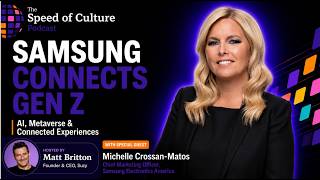
Samsung's CMO Michelle Crossan-Matos spent 16 years at Procter & Gamble before leading marketing, communications, and corporate citizenship. She's building a connected ecosystem across phones, TVs, and appliances, recycled 100 million pounds of e-waste, and uses AI for content creation while staying skeptical about whether every brand belongs in the metaverse.
Chapters
Up today, we're gonna be speaking with Michelle Crossen Matos, the Chief Marketing Officer at Samsung Electronics America. We're live here in person at Samsung's beautiful space at 837 Washington, home of the 837X experience. For those of you that haven't been here yet, it's in Manhattan's Meatpacking District, first opened back in 2016, and it's a space where tech, culture, art and gaming collide and consumers can see the latest Samsung innovations. It's just awesome to be here and it's great to be here with you, Michelle.
It's so great to be here too, talking to you. It's such a pleasure to meet you. Thank you for coming here.
Of course. I'd love to get started by learning to know a little bit more about your background and what led to you to your position where you are today as CMO of Samsung.
Ah, smashing. So as you can probably tell with this accent, I'm Scottish. So I originally grew up and was raised in Scotland. And I tell you that circus is pretty important when I give you some context later. I then joined P&G. I was there for 16 years. And then I moved to a private equity-backed luxury brand. And then I joined Samsung. I haven't always been a marketeer. You know, I started out in IT, supply chain. I ran corporate strategy and transformation. But I would say in my DNA, I'm a marketeer. I love consumers. I love to understand their dreams, their hopes, their pains and how we as brands can really help them live their best lives. So it's really important for me that whatever brand I work in has a role and a place in the world that's going to make it better. As a kid coming from Scotland and humble background and very humble beginning, i.e., very poor, you know, the brands around me at that time were very inspirational, very inspirational. Mm-hmm. And I think that's what is exciting about brands like Samsung and other brands, that they can help kids dream. Yeah.
Yeah. And so many people who have had prolific careers in marketing and advertising started off at P&G.
I know.
And that's been a common theme here at the Speed of Culture podcast. What is it about Procter Gamble and their culture and the way they conduct their business that you think is so very special and valuable to people working there early in their career?
Yeah, I've written about it actually. The leadership that we nurture, regardless of your level in the company. You can be the assistant, the receptionist, right up to the CEO. We are expected to deliver personal leadership regardless whether you have a large team reporting to you or not. And then the focus on consumer first, first moment of truth, second moment of truth, is in everyone's DNA.
Of course.
Everyone. And that doesn't matter if you're marketing or product supply, we all care about the consumer. So I would say that That really is what set, you know, P&G apart in that time versus, you know, their peer companies. When I look at now Samsung and I look at what sets Samsung apart, I think their focus on innovation is what really sets Samsung apart.
Sure.
Versus their peer competitors. And I think it's great that all these companies, they know what they stand for and they know what to expect from their employees and they train and nurture that in their employees. Yeah.
I've heard the same from others as well. And you talk about how you're not a marketeer at heart and you started in all these other areas. Are there specific elements that you've extracted from the other parts of your career that now are very valuable to you and differentiate you as a marketer that you can point to?
Absolutely. I'd say leadership will never leave.
Right.
You know, I think actually every day I study leadership. I'm one of these people that wake up outrageously early in the morning. I'm a 5:00 AM person. And I'm literally reading every day how to be a better leader. I read a lot about Stoic philosophy and how to be measured and thoughtful and reflective. So leadership will never leave. You know, that comes from—
You're saying regardless of the category, you need to be a leader.
You need to be a leader. And you need to know how to motivate and inspire people 'cause no one can do the job on their own. And so I think leadership is critical and being able to make decisions. You know, of course, yeah, everyone needs to be thinking of solutions, whatever, but to make decisions, to have a framework, how to make decisions fast, thoughtful, and hear people's input, and to stick by your decision, and then knowing the moment when to change a decision. I always remember that moment. It was a P&G moment, and it was, uh, Gina Drossos taught it personally one-to-one with me. We were looking to name a skincare. It was a new launch, and we went to her and we said, okay, here's the proposal. She's like, great, sign it off. An hour later, I had a brainwave and I ran up to her and I was like, "I have another name." And I remember her saying, "Hold on, it could be a great name, but what data has changed since the last time we spoke an hour ago? Now, what new data do we have on the table that means that we should revisit our decision?" I was like, "Mm, true, it's just a feeling." She's like, "Well." Right. And I always remember that discipline in decision making was really critical and that stays with me today.
Yeah, 'cause sometimes your emotions can obviously overrun the rationale decision-making framework you make. And some leaders go with that to their dismay. And I think taking a step back and asking that question is really valuable for sure.
And I think marketeers, the leaders of marketing, we should be able to tap into emotion. You know, you should be an emotional individual that can connect with others and have empathy. Like I said, like, you know, understand people's dreams and fears so you can help them. But you cannot bring that emotion in your decision-making. But you do have to have it for your other parts of your job. And I think that's the magical beauty of CMOs. You know, if you can—
It's art and science, right?
Art and science.
Right.
And if you need to be human, but you also need to be a very disciplined leader as well. And it's knowing when to tap into both. And sometimes you have to do both at the same time.
Yes. And I mean, you know, and I think that's a big part on how marketing has changed. You know, when I walked into this incredible complex here at 837 Washington, one of the first things I said to you is, you know, this is an expensive space, you know, how do you gauge your ROI? And you went through a whole framework on how you do so. So I imagine a lot of your, you know, mindshare goes to numbers and number crunching.
Yeah.
But at the same time, you can't lose the art and the creativity and ultimately the innovation on what you said yourself makes Samsung different.
Yeah, I know. I remember that breakthrough when, because I used to do, you know, brand delivery, it was called then. So that's the go-to-market performance marketing side of things. And you're very number-focused and crunching away at numbers. And then my next assignment was on the creative side. And I remember thinking to myself, how can I take that strategic thinking into creativity? Surely you're born with it.
Mm-hmm.
And I always remember looking at a brand equity pyramid and being able to assess where we were playing, where competition was playing, and seeing that space that was untapped and just having that light bulb moment going, creativity can also be strategic.
Yeah.
And that was my big aha moment. And I think that's when I unlocked my creative side, realizing that it's not just, you know, a big idea comes to you in the shower. Actually, there's a process. And if you know your own framework and process to get there with your consumer insights and that emotion, you can have such beautiful creativity.
For sure.
That touches people.
Yep. And not a lot of people can do that, for sure. So, I wanna move on to your role here at Samsung. So, you joined Samsung It looks like you had a couple stints, but ultimately you were here for the better part of the last 8 to 9 years. And I'm sure that both your role has evolved and this organization has evolved. You know, talk to us about, I guess, your journey at Samsung and where your focus and goals are today as CMO.
Yeah, so I started out in Samsung 7, 8 years ago in our European office overseeing corporate strategy and transformation. And then I moved over to the US with a similar mandate, However, in the US, things were moving even faster. So, I was responsible for opening our Samsung Experience stores. I oversaw our product innovation team out in the West Coast, created an incubator team, and then finally, I took over marketing, corporate marketing, and became the CMO. And then most recently took over our communications and our citizenship as well. And so, it's such a really large and broad role. Multiple stakeholders. Most marketers only care about consumer, right? That's easy peasy, right? How about you care about the communities that we live in and that we operate our business? How about you care about the media, the journalists that we talk to? You know, so many, you know, the government, the DC angle, the consumer. So internal employees, I care about motivating internal employees, making sure they get the right communications that make them understand the priorities but also feel Samsung Pride, Inside Out. And so that's pretty much my journey, you know, since Europe, coming over here and really expanding my role. I would say that the recent 6 months, I think, has been the most exciting time in my career in Samsung when I've been able to bring the citizenship arm into the marketing side. Oh, that's so fabulous because it goes right back to the beginning when I was a kid growing up in a council estate. Mm-hmm. And being able to, I don't know, see opportunities because of social outreach programs. Guess what? I'm now behind the social outreach programs of Samsung. I'm actually helping kids. And that was how I was able to be given the chance to go to college.
Sure.
So it's actually full circle. And that part is such a meaningful and very emotional journey for me. So that's why, you know, if you come to 837, It's more than just a showroom. It's a space to inspire kids so that they can dream bigger and really fundamentally achieve their dreams.
Yeah. I mean, you can tell walking in here to be inspired of really the promise of technology and what can be unlocked and how, you know, younger people have such an incredible opportunity ahead of them if they can seize it.
Yeah.
For sure.
Yeah.
So in terms of the Samsung business, you know, the consumer electronics, consumer technology space obviously has a lot of heavy hitters and competitors, right? You have companies like Apple and Amazon and Google Apple, all of which— and Microsoft— all of which have leaned in to sort of create an ecosystem around the consumer, right? They have products in consumers' hands. They try to get physical products in their home. They try to create software and services surrounding that. And I look at Samsung as a company that has equally as big of an opportunity, right? You have your phones in people's hands. You have your TVs in people's homes.
Yeah.
But where the company doesn't seem to leaned in as much in the past, where it seems to be getting more into now, is creating that ecosystem, creating kind of the consumer interface to almost like lock them in to a Samsung ecosystem. Is that a big part of what you think about in terms of the strategy and bringing Samsung to market?
It is a huge part. 1969 is when Samsung Electronics started just making TVs.
Yeah.
You know, and if you fast forward from those very humble beginnings, you know, we're in 72% of households in America. And I think 1 in 4 households claim to have 3 or more Samsung products. That was the moment when we realized actually there are people with multiple products and actually they need to learn how to connect them.
Right.
And now we're in an environment where people are saying, okay, I want much more customized products, products that really help me, you know, shine as an individual. And then I want these products to connect so that it can make my life much easier. So we've been embarking for a very long time now to really think about building, creating sustainable products so that people can live a much more connected life. I would say that you see this best if you come into 837, you can see that we do a lot of sustainability. Discover Samsung's a quarterly sales event that we have every quarter where we bring all the use cases that people— people say, "I have a pain point on ABC," and we'll have a use case. And then what we'll do is we'll share how people can buy into that use case in a much more sustainable way, in a much more cost-efficient way. So we do all that, that good stuff, but really it fundamentally comes down to what does the consumer want.
Yes.
We know, right, so there's general consumers and then you've got your Gen Z consumers. We know that they genuinely want products to really reflect their personal needs and styles. So if you go upstairs, you'll see that we have a bespoke home. And so there's a whole line of home appliances where you can actually change the colors, like our refrigerators, you can create your own designs in the doors Or you can go and pick a watch which, you know, has multiple faces and colors as well.
Customization.
Because that is where people are going like, you know what, I really don't want to look the same as you.
Right.
I really want to be different and to be celebrated for that. So that's a huge priority for us. I think, I mean, sustainability, everyone talks about sustainability, but not everyone has the same impact on sustainability. When you're a company like Samsung, I mean, we have an obligation because we're so large, We have an obligation and thankfully it's in our DNA to really want to do a good job here. And so I don't think consumers know as much as what we're doing. I would even argue internally when I quote some of the numbers, what we're doing in sustainability, people are like, "Really?" And I'm like, "Did you not know?" Ba ba ba ba. Like I tell them, I'll say to them, "How much recycling do you think we do in the US alone?" And they're like, "Well, I don't know." I'm like, "We're one of the leading recyclers in the US." I mean, people don't know that, that we're recycling, I think it was like 100 million pounds of like e-waste every year. You know, like you'll buy a washing machine or a refrigerator and it says it's energy efficient.
Right.
You're like, yeah, okay. But actually all the products that we've made since 2009, we were tracking it and we were seeing how many we had sold. So, okay, if we were to actually have those efficiencies, how much CO2 emission would we actually save? And it was something like 300 million. Tons of CO2 emissions we would have saved.
Shocking.
65 million cars off the road. People are like, wow. And so we need to do a better job of telling people so that if we can help people understand that, then they can make better decisions when they're buying their appliances or their phones so that they can make a sustainable choice. Now, I am— anyone who's got kids, anyone cares about the environment, they'll go, yeah, yeah, yeah. But really, every company needs to get behind this because it really is The climate crisis is real and it's escalating. And yeah, the people think about it's global, but I don't know, I just sat through a hurricane. I was in Puerto Rico when the hurricane hit. It's scary stuff. We didn't have electricity for a week. West Coast, all the fires that they're having, you know, Ian, Fiona, it's tragic. So that's why collectively all the companies are, you know, should be working on this. And this is why I'm so proud of what Samsung's doing and the efforts that we're making, not just in products, but Even your operations, making sure you're using renewable energy. In the US alone, we are 100% renewable energy. No one's telling us we have to do that. We know it's the right thing to do for the planet.
Right, it's taking a leadership position.
Yeah, and if you're such a large company, I mean, we're number 5 interbrand company, you really have to do this.
You have responsibility.
Yeah, an obligation.
Yep, and lots of recent studies have come out that shows conscious consumerism is increasingly important, especially to the younger consumer, Gen Z. So it seems to fit really well with a renewed focus that Samsung has on youth and Gen Z. Can you talk a little bit about why Gen Z is such an important audience for Samsung and some of the initiatives you have around that particular demographic? Yeah.
I mean, Gen Z's grown, right?
Yeah.
So they're definitely gonna own much more, you know, many more of the dollars that are coming through our tills.
Sure.
So, but Gen Z also is an inspirational generation, which is, you know, hailing on other generations. And so their desire for equitable brands and much more inclusive brands is inspiring us all. And so I always joke with my daughter, thank goodness you came along because you're gonna make the world a better place. They're obsessed by gaming, gamification of anything and everything. And so actually from a marketing viewpoint, it's really encouraging us to think differently when we create experiences.
In what ways?
Well, right, so you're sitting 837, I have a metaverse called 837X because at one point I'm looking at this space and I'm thinking about, okay, how are my consumers engaging with the brand? Gen Z in particular, they're very hungry for experience-based connection, really hungry for that. I'm like, okay, but not everyone can be in the Meatpacking District in New York. Yeah, we're fortunate we can be here.
Sure.
What about the kid in Columbus, Ohio? So with this whole dynamic of my citizenship arm, caring about the youth of tomorrow, caring about how we can educate people on topics they care about, but in an engaging way. So we created a new reality called, you know, Samsung 837X. And I don't think we would have done it if Gen Z weren't so brave and embarking on these new experiences because they are telling us what they want and we're listening and we're like, okay. And then we start to dream big, then they dream bigger. And then, and then for, you know, you've got AI creativity, you know, it's very exciting time. Yeah. So I give a lot of credit to Gen Z.
I mean, it sounds like a very innovative initiative. How do you see the metaverse, I guess, playing out with this young generation? Like, do you see a world where, you know, younger consumers, really all consumers, are spending more and more time in a metaverse-like environment? Because it has, you know, companies like Facebook, it's been, you know, widely published that they've really struggled with trying to get consumers on the metaverse despite investing billions of dollars into it. You know, when do you see something like this taking off mainstream? And I know it's hard to predict. But how do you see the future of the metaverse evolving?
Well, I will tell you one of my big learnings when I was looking at 837, you know, getting into Decentraland, you just think you'll take a building and put it in there.
Right.
Well, it was never gonna happen. And I remember thankfully Publicis and Razorfish are my agencies and they were like, no, no, no, no, no. Take a step back and really think about the experience. And it's like, okay, let's think about the experience. And then they're like, no, no, no, no, it's not just that. He's like, you gotta gamify it. And for people of my generation, I'm 45, gamification doesn't come so naturally for me. We wouldn't come— I had to learn a whole new skill of gamification.
Sure.
I had to learn. And so all these crumbs and these quests and, and being able to explore and having high emotion points, I was like, oh my goodness. It's the next best skill that a CMO must learn is how to gamify experiences in non-gaming contexts. And so for me, I think if people crack the code of the metaverse, which is fun, engagement, education, gamification, the metaverse will take off. Right.
So it's about the applications ultimately.
No, I mean, it really is about also not all brands should be in the metaverse. I think it really depends on your brand and consumer. Our consumer wasn't in the metaverse. Now we're Samsung, we're, you know, consumer tech. When we went at Discord and we're looking, should we launch in Discord? We already had fans sitting in Discord, so it was like a no-brainer for us. But maybe there's some brands where their consumers don't really go into that space, and so maybe it's a bit premature for them to go in. So I really think metaverse doesn't work for everyone, and it'll work for the brands that are like us. We're in AI, 5G, IoT connectivity. That's our DNA. So it was very natural for us. That's why we went into Decentraland, Roblox, and, you know, and Discord, it just— people were like, thank goodness, about time. In fact, we were the first tech company, consumer tech company, to go into Web 3.0. So that's pretty cool.
Yeah.
And that was just a dream we had. That was me in 837 going, hmm, I wonder what this would look like in Web 3.0 so that all kids can experience Samsung regardless of where they live in the US.
And that's ultimately the unlock, isn't it? That's the unlock. Giving people accessibility that normally wouldn't have it.
Yeah.
Yeah. So in terms of some other ways that you're looking to drive business, obviously we're in a shaky macroeconomic environment. You know, we went through a period in the pandemic where people bought a TV for every room in their house and their bathroom, right?
Yeah.
'Cause they were stuck at home. And now you're hearing in stories, stories with rising costs, consumers making harder choices as we're heading into the holiday season. What are some of the trends you're seeing from your consumers and how is that impacting your product roadmap and whether you're discounting or looking at a different overall retail footprint? To basically seize this new world that we're living in now.
Yeah, and this new world is scary.
Yeah.
And I get why people are scared. And I read the same reports everyone reads and watch the same news. But what is clear is that people will always need these products, but they will look for different things in these products. So be much more energy efficient. Like actually, you know, Samsung launched their first eco-conscious product in the '70s during the oil crisis. Because people obviously couldn't afford.
And so— Right.
So that was our first sustainable product. So now we know that actually if we can help people make savings in their day-to-day costs—
With rising energy costs.
So we're doubling down on sustainability and energy efficiency. We know consumers really care about that. We're doubling down on our customer care. We know that people want durability in their products. They want to learn how to look after their products. And our customer care Our customer care division is fabulous. It wins awards all the time because of how we look after our consumers. So actually, we should take you upstairs so you can meet some of our customer care. So we're doubling down in care, we're doubling down in sustainability. And another thing as well, we have all different entry points into our brand. You know, so you do have entry point, mid-tier, and premium. And we do ensure that the sustainability, the benefits are right through our whole line. So it's not just for someone that's buying a premium. That should never be the case. It should be you can have these benefits very accessible. And again, we will keep doing our Discover Samsung events. We will keep educating our fans, our consumers about the latest products that'll give them benefits to solve their problems. So yeah, so there's a lot to come from Samsung in 2023, I would say. Yeah, so watch out, see what's to come.
Awesome. And then in terms of how you're communicating the brand and the equity pillars of what Samsung is, you talk about, sustainability, you're talking about giving back to consumers, you're talking about innovation. So I would imagine as you work with your agency partners, 'cause this podcast is in partnership with Adweek, so obviously we wanna talk about that angle, what is your process for coming up with the storytelling behind the brand and using some of these social platforms to let people understand what the brand Samsung should mean to them?
Yeah, I know, it's a great question. Storytelling for me is emotional, it's about people, it's about for the people, by the people. And so being on platforms that allow that authentic storytelling, you know, like TikTok, for instance. So here in 837, I mentioned to you earlier, we create mega weeks where we invite all our partners in, we amplify in social. The key thing there really, really is about people being able to create content that really is about celebrating what they're doing and that our technology is enabling them. Right.
Right? That's authenticity at its core, right?
Oh yeah. And but doing something that's really different and that inspires people. So in Climate Week, we actually had a fashion show here, but the fashion show was like no other fashion show. It was called Recycle Up. So literally, your fashion designers were using recycled fashion. But the cool thing was, is that in the metaverse, at the exact same time we had those models, was digital avatars. And so that we were streaming this fashion show, you know, worldwide, so that people could have accessibility to that fashion show and be inspired. Wow. And so for me, that was really cool because we're all over TikTok, we're all over multiple metaverses called a Simulverse. It was really cool. And I think that's when people were like, I want to be a part of that storytelling because it feels like it's coming from fans talking to other fans, fan to fan. And that is the most authentic message that you'll ever get. And I am really exploring this AI angle of creativity too. I am exploring that. I'm quite quite intrigued about this emerging trend and how the, you know, UGC was big years ago.
Sure.
Well, let's see how it's going to evolve in a big mega brand like this. So I'm excited about dabbling in that.
So when you say AI meets creativity, you're talking about there's technologies now that we can tell a story and then the video will be produced, right?
Yeah. So I'm exploring that as something that should we dabble there. And that's the whole thing about the metaverse, it's test and learn. Don't know. Yeah, you can hedge your bets, but I think every responsible brand should try new stuff. Yeah. And you know, and if it works, it works. If it doesn't work, what your learnings and try something different. And so right now I'm thinking about 2023. What are the things I want to learn next year? What's my learning plan and how can I scale up if it's successful? And so yeah, I want to invite fans to be a part of our journey.
And how about some of the tried and true tactics, whether it's social media marketing or even linear television. How are those channels playing into your overall strategy moving forward? Are you seeing better ROI from some than others as you move forward?
Yeah, I guess the closer to the consumer you are, the closer you are to lower funnel, you're gonna have higher ROI for sure. But we are dabbling in spaces right now that wouldn't follow the standard playbook, you know, like the metaverse.
Right.
So you're gonna be much more of a social-based type of business.
Right, but at the same time, that's bleeding edge, so I imagine you still keep your core going.
You still keep your core, so we'll still do obviously TV and all that good stuff, but more social. You'll definitely do more social because that allows you to tap into that emerging generation.
Yeah.
That really wants to be a part of the storytelling because they don't just want to be— it's, it's not about storytelling, it's about story living. And the old ways of doing that is pretty much storytelling.
Absolutely.
Is less effective. We know that the ROI is very low. And so that doesn't make sense. And everyone has a responsibility as we go into 2023 to make smart choices and drive in return on investment. Everyone. We won't make it through 2023 if we don't do that. And so that's where you'll see us being a little bit more choiceful.
Yeah, absolutely. Well, that was great. So to wrap things up here, it's clear that you have a lot of passion towards the youth and empowering them.
Yeah.
And to give people accessibility. And it's clear that that passion of yours has already had an impact on a, huge global brand, so congrats to you on that. For young people coming into the advertising and marketing world, what are some pieces of advice you'd give them based upon your experience where they should focus on and what skill sets do you think they should hone? You talk about leadership. Are there any others that you think are important so they can set themselves on the right path so maybe one day they can be sitting in your chair?
Yeah, it's such a good question. So I go back and forth on this. You know, I think about, 'Oh, you should learn leadership,' or, 'You should learn how to build strategies.' You know what? You need to learn who you are. I mean, true happiness comes from knowing your superpowers, being able to get in the flow using your superpowers, and connecting that to something bigger than you.
Mm-hmm.
That's why I'm at Samsung, 'cause, you know, I like the job I do and I get in the flow. I can be on stage and I wouldn't even know what time of the day it is. And I feel like I'm contributing something bigger. I find my kid, let's say I'm talking to someone who's 18 years old, and you're thinking, well, I'm gonna be interviewing in the next 3, 4 years, ask yourself now what's your superpower. And if you're brilliant in numbers, then get in market research. Really understand what the consumers are thinking. Really understand the AI in market research and really finesse that and have a track record of being able to show results in your superpower. Because when someone interviews you, you're gonna say, well, my superpower's ABC. Mm-hmm. And here's what I've done in the last 3, 4 years. And you have a track record and it's undeniable. I wish someone explained that to me a lot earlier on. So now I talk to my kid, my daughter, she wants to be an actor. I'm like, great, so what are you going to do for the next—
My daughter wants to be an actor too.
I know. And I'm like, great, so what are you going to do for the next 6, 7 years before your college interview?
Yeah.
What are you going to do that's going to prove that you have a track record? She's like, I never thought that. And I went, I never did either. Don't worry, I wish someone had explained this to me. Get a track record that proves your interests and really figuring out your superpower and your strengths. So it is not about this skill, that skill. I would always say though that leadership, regardless of what job you do, will set you apart. And learning leadership, not through the angle of getting things done, is about inspiring people so they want to do things differently.
Yep.
Wow, that's the holy grail. People don't like to do things differently. They're fearful, they're scared. We're all scared, we all have fears. You have to inspire them so they realize thinking out the box is the path forward. And that, and I always, I always talk about Ryan Holiday. You ever read him up?
Yep.
The obstacle is the way.
Obstacle is the way, yep.
When it's hard, that means it's good, and chase it because you'll become better for it. So I mean, I think that's a whole other podcast on its own.
It sure is. Maybe we could schedule that afterwards. No, I mean, I think you, it's a profound point where You know, I think the whole, you know, jack of all trades, master of none, which lands people in middle management and doesn't really give them that superpower to lean into. I think in a world where companies are trying to shrink their balance sheets and you can outsource and offshore and find people with specialized skill sets, if you wanna compete, you really need to have that superpower to differentiate. Otherwise you're gonna kind of wallow in the middle forever.
Yeah.
And I think too many people, maybe they're scared to make, to look themselves in the mirror and uncover that superpower. And I think the earlier you learn that and the more you double down on it, show results, as you said, I think that's the path.
And you know, like, once you figure out what your superpower is, sometimes people are afraid. Is that good enough?
Yep.
Is that good enough? No, it is, of course.
You know what's authentically you, and that, that has to be good enough.
Exactly. And what is it, the 3 emotional needs that we all have as human beings? What we want to be seen, we want to be heard, and we want to be appreciated.
That's right.
And trust me Anyone that sees your superpower will appreciate you.
Amazing. Well, we're gonna wrap up on that. One last question I have for you is you obviously move fast. You have great energy. It's one thing that, you know, I've done a lot of these podcasts remotely and you can't really feel people's energy when you're virtual, but being here in person, maybe it's the space and it's definitely your energy, but I can tell why it's definitely a huge boost to your leadership style and quality. So thank you for that. But you know, you obviously move fast, but what are some of the things that obviously slow you down in this fast-paced world personally, that allow you to kind of get away from the craziness of Samsung, to let you kind of refresh?
Right, so I wake up at 5 and I meditate every morning, I journal and I read, and I get into nature. So I split my time between Puerto Rico and here, and I believe in forest bathing. Have you ever heard of forest bathing, the term?
I haven't.
So it's getting into nature and boosting your immune system and just overall your calmness. Because you need to have your A game ready. But how can you have your A game ready if you're frazzled?
Right.
So you need to find that downtime and guardrailing your downtime, but also giving yourself to, like, if you have kids, oh, there's no downtime there. But there is actually, that's why you get up early.
Right.
So if there was one thing you can do, if those are listening, get up early. And I mean, I can't get up at 5, 5's outrageous, still nighttime. Yes, it is, it's pitch black. I didn't understand what you said. Then just get up an hour before your family gets up and you just have an hour to yourself.
There you go. Wake up early, find the time. Find the time. I love that. Awesome. Well, thank you again on behalf of Suzy and the Adweek team. I'd like to thank Michelle and her whole team again for hosting us today at Samsung's beautiful facility here at 837 Washington. Be sure to subscribe, rate, and review the Speed of Culture podcast on your favorite podcast platform. Until next time, see you soon, everyone. Take care.
Hey!
More from Matt




MikMak’s Rachel Tipograph on Consumer Spending, Retail Media & Holiday Shopping Trends



Jaguar Land Rover’s Charlotte Blank on Luxury, Purpose & Experiential Storytelling



