Shopify’s Jessica Williams on AI, Creators & the Future of Commerce
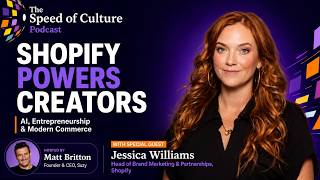
In a live interview at the POSsible conference in Miami, host Matt Britton talks with Jessica Williams, Shopify’s Head of Brand and Partnerships. Jessica explains how Shopify positions itself as an all‑in‑one commerce platform that serves anyone from a side‑hustle maker to a midsize enterprise, emphasizing AI‑driven tools that act as a “chief of staff” for merchants (product‑description generation, image editing, tax‑chat, sourcing assistance, and a best‑in‑class checkout). She describes Shopify’s internal AI‑upskilling mandate – a company‑wide letter from CEO Toby insisting every employee use AI daily, the creation of internal AI agents for contract review, and the cultural belief that AI is a baseline skill. The conversation then shifts to Shopify’s creator and celebrity partnership program, which began with early adopters like MrBeast and now includes hundreds of niche YouTubers, TikTokers, and mainstream celebrities. These creators build stores on Shopify, leverage native integrations (TikTok Shop, Instagram, Roblox, StockX) and drive a surge in 18‑35 users. Jessica outlines the strategic advantage of creator‑driven distribution, the importance of authenticity, and the evolving blend of creator and celebrity roles. She also shares her career path—from Visa to Coinbase to Shopify—highlighting lessons about brand vs. performance marketing and the pull of a mission to inspire the next generation of entrepreneurs. Finally, she reflects on Shopify’s founder‑led, fast‑decision culture, the company’s omnichannel integration strategy, and her personal mantra that “a rising tide lifts all boats.”
Chapters
We're here live at the POSsible conference in Miami, and today I'm thrilled to welcome Jessica Williams, who's the head of brand and partnerships at Shopify. Jessica's at the forefront of one of the most dynamic shifts in modern commerce as she leads Shopify's efforts to deepen cultural relevance and support the next generation of creators and entrepreneurs. Jessica, so great to see you.
Thanks so much for having me. Absolutely.
This is so fun. Yeah, I'm a, I'm a huge fan of Shopify and I have been for quite a long time, and I was excited when you joined, um, to tell me a little bit about your role and where you're focused on here in 2025.
Sure. Um, well, you said it, uh, our job as a brand team is to inspire the next generation of entrepreneurs. Um, when you think about what Shopify does best, is it's the right hand to any entrepreneur from day one to midsize. Now we have a very fruitful enterprise business, and so we really want to make entrepreneurship attractive to anyone who's thinking about a change. So the next generation of entrepreneurs. Many think about Gen Z, but we're also talking about over 50 who's thinking about the next phase of their life, someone who got laid off, someone who's always got a side hustle but wants to turn it into the main hustle. Um, so we do this a lot through partnerships. Um, so many exciting brands on the platform, and we love to tell their stories, founder stories, brand stories. Um, and just a really fun, exciting role. You said it, Shopify is at the forefront of commerce everywhere, from all of the platforms to AI to many other places. And so it's really fun to be sort of the backbone of everything that's happening.
So let's say I'm 47 years old, I just got laid off my job, and I've always made t-shirts that people love. Yeah. What, what should I know about Shopify in terms of the features and benefits that maybe most people wouldn't know?
I mean, I think the reality is, is that Shopify is for everyone, and it is So easy. I mean, the stories that you'll hear from the team, not our internal team, but the many founders on Shopify, is that they had no idea what they're doing. And if they can do it, anyone can do it. Right. And that really is the message, is that Shopify will do all the hard work for you. We've got so many amazing AI features built into the platform that it really is a choose your own adventure, but a choose your own adventure where we are with you every step of the way.
Yeah.
We like to say we're your chief of staff, we're your head marketer, we're your head ops person, your head of finance, your head of accounting, like we'll do it all. Um, and so really all you have to bring is the ideas and we'll—
even the sourcing of the product.
We'll help with the sourcing. Sure. We've got a million—
you have a marketplace too, right? Yeah.
A marketplace. We've got a million partners. We've got the, um, freight all worked out. We've got the supply chain. You can do all of your B2B, so all of your wholesale inside Shopify, as well as your B2C commerce. We've got a million—
marketing as well.
Yes. 100 million people on the Shop app. So you can find new customers through marketing on the Shop app. I mean, it really is like an all-in-one platform. In a way where you still get to own your own data, so you're not giving up your data to a third party. You can still own your entire ecosystem, you can, but then you're a part of the Shopify ecosystem, and so we really love to also present that. You get the number one converting checkout in the world. Like, the benefits are really endless, but the reality is, is that we try to be the team for you, and so we do, we are the best commerce platform, so we have large, large businesses on there, but many of them started as day one entrepreneurs.
So you had mentioned you already have some AI features in the platform. What are some of the ways it's helping your users, you know, make their lives easier.
Yeah, I mean, I think really we've seen so many use cases, but product descriptions, you know, if you have hundreds of SKUs, you don't want to be writing— it's the laurier, right?
Exactly. You want to spend time doing that.
Exactly. Um, product, uh, photos, if you've got just the picture of the product but you need a better background, I mean, we've got lighting. Yeah, all of the features to do that. Um, we're really sort of rebuilding the platform from the ground up to be AI for everything, and that is chat features that is helping you understand the tax implications of shipping internationally in a way that's like just talking back to you. Right. Hey, here's what you need to do in order to lower your prices here. So, it really is, we really want to make it as easy as possible and for you to be optimized from day one.
Yeah, I mean, that makes sense. People are interacting with technology like humans. So, the more that you can humanize the experience where if you have a question, you can talk to a chatbot. You have ways where you can get things easily done, it reduces friction. And one thing you said that I completely agree with, and I wrote about in my book, is that this world is now gonna be for people who are creative because, oh, but at the same time, it's gonna create a lot of pressure to upskill for people who are not. Because if you, there's so many different skill sets that people have learned that AI can or will be able to in the future do better, right? So when you think about, I guess, your organization and maybe your team, what are some of the important places you think upskilling is needed?
Well, I mean, I'm sure everyone read Toby's letter about like AI being an absolute necessity. Yeah.
So I think the first one is— That was amazing. Like maybe we should talk, I mean, what was the letter in your words? Because for people who haven't. Oh, sure.
Yeah. We had already heard it so many times internally. So it wasn't shocking at all. But he basically said like, no, AI is the baseline now. Like you must, as an employee of Shopify, be using AI in your everyday life and continuing to learn. So, if you're just using ChatGPT now, we need you in, you know, all of the other places, in Perplexity, in our own internal tools to be creating images, to be creating AI agents. Like, optimize your life through these. Take all the tasks that you don't want to do anymore. That way you can focus on building the things that you are uniquely positioned to build.
How'd you feel when you got that email?
I mean, like I said, you're already there. I mean, there's so many things that we're already signaling that, including, you know, there's a question on our yearly review now about your use of AI. And while it's still very new, and so, you know, the scale on that, but I already have team members that have built AI agents to help them with contract writing. We do all of our own internal creator partnerships. And so we have hundreds and hundreds of creators on our roster. And you can imagine that's a lot of contract work. So, you know, I have guys that were sick of doing that. So they just built an AI agent to help them read contracts to flag, you know, legal team was okay with that. Yeah, because they're still doing the final look, right? But it's pretty standardized. But, you know, this way can catch, you know, red lines that are problematic that can input the finalized contract into our SIP Pro. I mean, it's just, you know, stuff that like was really rote and kind of mind-numbing for them. And now they can focus on building better partnerships, finding new creators, building relationships with them, which is much more useful to us. Yeah, for sure. I think internally, like it's been such a useful tool for us to better brainstorm. We are mostly doing our brand marketing through the lens of partnerships. And so we're whipping through sort of like what a brand looks like together with Shopify. Whether it's Fenty or Siegelman Stable or Eastside Golf, or we just did something with Serena Williams' brand and Wynn, um, all the way up to like the biggest brands in the world. And each one of those needs to feel unique and interesting and fun, and Shopify sort of has to fit into theirs. And so it's helped with a lot of creative brainstorming, um, and certainly, I mean, has optimized everyone's life.
Yeah.
Uh, but I really do think the partnerships piece, like Shopify is a relationship business. We are helping you with the tools, but also with the people. So to me, having people spend more time with people is where I want them to spend their time, not on the rote tasks that we—
That's well said. And I do think, as I hear you talk, like Toby is a founder-operator. And I think in a lot of ways, those are the people are saying what everybody else is thinking. So like, if you are a hired CEO that maybe doesn't want to rock the boat and wants a golden parachute, like you may know what's happening, but you'd be worried about saying, "I don't know," like that, because you don't want to piss— where it's like, He built this business and, you know, he, I've spent a lot of time studying like how he pivoted Shopify from selling skateboards or whatever it starts with, just saying incredible story. Yeah. But he's saying what everybody else is thinking. He's saying what everyone else will eventually say. Yeah. Down the line. But for a lot of companies it could be too late. And also what dawned on me as I hear you speak is that the contract example is an example where when he sends a note like that from the top, it kind of gives you guys air cover. To do things where if that didn't come from the top, you may have your general accounts be like, why are you doing this? This is my territory. And that's what's happening in a lot of companies right now is people worry about their own fiefdoms at the expense of what's best for the company long term.
Right. And that I think is the wrong way to think about it. I heard from a friend recently that their company actually like, um, bans AI use inside.
And I might as well ban the internet.
I literally was like shocked because I, I feel like it's a detriment to the employees because how will you upskill if you're not thinking about these things?
What if they leave and go somewhere else and they're going to be unhireable?
Exactly. Right. And just why would you want people spending their time on these tasks, on writing emails, on, you know, like calendaring, on things that you literally now can automate? Like that to me was such a freedom builder. So now you have the time to do all the stuff that was always on the back burner. Yeah. It's such an exciting time for me. The thing about founders— this is my second founder-led company that I've worked for. The first one was Coinbase.
So, oh my, who really— like, yeah, the stuff he wrote during COVID like, I personally— like, what he said was, this is a company, this is not a place that— and this is what I personally believe, other people listen to the podcast might disagree, but a company is not a place to, to push social issues. We're here, you know, our constituents are shareholders, this is what we're doing.
Yeah.
And That's another perfect example. In fact, like, I conflated the two when you brought it up because I'm like, oh, but Toby didn't write that, Brian did. But yeah, so tell me about that.
Well, it just— I think it, to your point, it is this sort of go direct, like founder-led, and they don't need to worry about, you know, the consensus of everyone. And I love working for founder-led companies because there's only one opinion that matters versus the consensus of 100 people, which gets nothing done. Nothing done. And then the people that work there really under— like, we're all sort of in it together. You really understand because it is coming from the top. Like, this is it. And I hate saying this because I don't feel this way, but if you're not on board, like, you got to leave. And so it really is a very tight-knit around the things that are most important. And you know crystal clear what is most important.
Yeah, I mean, I think in times of swirl, and uncertainty, people just need a leader to say, go this way. Yeah. Take my hand. I, and, and even if it's not exactly the right way. Yeah. Going in a direction is better than just flailing. And there's another saying in all your towns and all your cities, there are no statues of committees. And that's for a reason. Yeah. Right. There's no statues of committees. And yes, that's because, and I've seen it, I mean, consensus building's really hard and ultimately you'll have some people that want to, you know, kind of lean in, not because it's what's best for the company, because it's best for them or they're scared. Yeah. And I think you're seeing that a lot right now. And the companies that don't move fast and pivot quickly, there might not be companies anymore in 3 years.
Amen. I really do feel like the founders— and you've already seen it, Duolingo came out with the same thing today about the AI piece.
Um, well, them especially, because you could translate anything on— exactly.
Um, yeah, we have two things internally. Um, the disagree and commit, which, you know, like, we all may have our opinion, but if this is the way, you're going to say it and then you're going to commit, right? And then strong opinions loosely held, like, you got to be able to get on board and We're here to hear it and we're here to think about it, but you gotta get on board.
The other thing I hear a lot in AI is, oh, it's so like, I had somebody send me a message the other day like, well, you should address the fact that AI is bad for the environment. I'm like, and it's like, well, okay, well nobody having a job will probably be better for the environment too because you won't have to travel to work. And it is, should we just fire everyone? Like, right. There's always a reason. The reality is like, I'm not responsible for AI. I wish I invented it, but I didn't. But the reality is it's here, right? And whether it's good or bad or it's gonna add jobs or lose jobs. There's— it doesn't matter, right? Like, this is the world we're in, and you just have to adapt it. This is not something that you can fight, right? And people don't really understand that, right?
And I— what I believe is that AI will accelerate innovations in other places. Like, I do believe that the AI acceleration will help with a sustainability, sustainability conversation, and the innovations in sustainability and in you know, all of the climate technology that we need. Maybe curing cancer. Yes, 100%. Like, there are so many things that will come from this. So, I'm hoping that the environmental protection will be part of that.
Yeah, agreed. So, you'd mentioned creators. I'm just curious to hear, like, what does it mean to have a creator partnership with Shopify? Yeah. And why has that been such— I can imagine, but why has it been such a successful channel for Shopify?
I came onto Shopify almost 2 years ago now, and they had already the most sophisticated creator program I had seen. And I think they were way ahead of their time in that they saw that creators were the next big brand. Yes. Um, and so they had partnered with MrBeast when he just had 3 million fans. I mean, he's got over 150 million fans worldwide. Yeah, it's insane. Um, but understood the power of the creator brand and understood that, um, you know, the, the world was really moving into social channels and YouTube. And so they have a— we have now like a probably 250 YouTube creators that we work with who are niche creators. They work in gardening or in DIY car repair.
To have an audience around your content.
Yes, and so they have a niche community audience, but that community listens to them. They watch their YouTube channels every day and they want to buy their stuff. And so each, every one of them has built a store on Shopify and through the YouTube integrations or the TikTok integrations or the Instagram integrations, they're telling their story of entrepreneurship and how they built their brand on Shopify. And we've seen over the last 2 years that our number of 18 to 35 on the platform has almost doubled. And that is coming straight from the creator program. They're saying, "Oh, I joined Shopify because my favorite influencer or, you know, YouTube creator uses it." And I just think we're moving into a place where it's harder and harder to find distribution that isn't fully paid. And creators have built a distribution across, you know, hundreds, thousands, hundreds of thousands, millions of people.
Hundreds of millions. Yeah. Yeah.
And they will be the most successful brands. And we've seen it over and over again. I mean, we've launched so many creator brands at this point and people will line up around the block to come see them. They will sell them out almost immediately. And it is truly, I think, the, the funnest part and the most interesting sort of like shift in e-commerce.
And are they selling their own products or are they selling in some cases like they're getting affiliate fees for selling other people's products or both?
There's a ton of different ways. It's definitely affiliate fees. A lot of them have launched their own products. Now it's hard, like most start with merch, um, throw your face on a t-shirt, like do the thing that's right, easy. But then they've graduated into other products. And, um, we've seen this a lot. I mean, Jimmy obviously with Feastables, um, we just had a pop-up with Ashley Alexander a few weeks ago. She sells matcha. She was obsessed with matcha. She built her own matcha brand. I'm not kidding, there were people lined up for 6 hours to meet her and you know, get a matcha drink from her, buy her matcha. Mikayla on TikTok just launched her beauty brand. It's a primer brand before you put on makeup. She's a makeup creator, sold out immediately, will sell out again the second she goes back online with it. Now, you know, she'll sell it in Ulta, it'll sell out. Right. And so I think there's a stepping stone of, you know, let's test the waters. Yeah. Let's do affiliate, let's do merch. And then it's sort of like the aha. And what we love to see is that it's authentic to who they are. We've seen plenty of brands that have gone kaput because they were just sort of slapping their name on something. But we really see creators understand their audiences and they know that if they don't choose the right product and just try to hawk something, like they'll lose the fan base that they have so carefully crafted over the years. And so we really see that they spend a lot of time and effort, energy putting out products that they truly love and care about.
Yeah, I mean, if you think about it, we've seen it with George Clooney and Casamigos. We saw it with Dr. Dre and Beats, right? We, we see it more recently, Kim Kardashian and Skims and Kylie Jenner and what she did with— so you're seeing it everywhere. So it starts there, right, where there's celebrity, and now it's kind of pushing down. And it really does call in the question, like, is that sort of the cost of entry to create a new product? Because not only do they have reach, but they have tremendous influence. Like, 4 out of the 5 last places I took my family on vacation has been because my wife follows somebody on Instagram that's an influencer, and she's there, and she's there with her family, and my wife envisions our family being there. And because of that, she's like, we're gonna go there, and I'm not gonna say no, right? So it's like, right, ultimately that's, that's where I think the whole world is headed. And I think empowering these people— I also think, so do you know Ryan Serhant? He's like a big realist. So he launched a, um, a software platform in the real estate industry. He's doing incredibly well. Wow. The functionality of that software, it's called Sell It, right? The functionality of software exists in 50 other products. Yeah. But his is selling because his name's on it. Of course. So I think one of the next big evolutions we're going to start to see in a world where it doesn't require a lot funding to build a software product is celebrities actually being attached to tech products. Yeah, right. Because I think then they have the distribution and yeah, they don't really need a big engineering team to build it anymore. Just like how like Kim Kardashian might not know how to knit the clothing, right? Right. A creator doesn't have to know how to code.
Yeah, I totally agree. Um, I think, you know, to be seen, the impact of tariffs on supply chain, but certainly technology.
Who knows? Can't predict that.
It's certainly easier to build. Yeah. I think the other interesting shift is that they won't need to build it themselves, but they'll be on the cap tables, they'll be funding it from the background, they'll be, you know, helping to distribute it. Figure out distribution. Even if it's not, yeah, exactly. But I think the difference, and we also have so many celebrity brands that launch on Shopify and we love also supporting those, like again, hundreds and hundreds and we love that. I think the thing that we've found with creators that celebrities are now moving into is that, um, sort of two-way engagement. Of course, it really feels like they are with their friends there, and they will stay. We do a lot of pop-ups with them. They will stay for 6, 7 hours, meet everyone, take pictures with everyone, because they really feel this connection to the community that they have painfully— not painfully, but like very carefully built over years and years of content production. Yeah, and these people have been with them for years and years, and so it truly feels like like, you know them and they know you. Yeah, exactly. Um, and that feels really different from like showing up because you want to take a picture with a celeb that you love. Of course.
Now, to be fair, somebody like Taylor Swift, I mean, I got interviewed in New York Times article in 2012 saying she's building a community the right way. And she is the most, one of the most famous people in the world, but she actually did it through scaling the unscalable. She has people that will run through a wall for her.
Without question. But she was the one in the comments from day one. She was the one. It's the same thing with Selena Gomez and Rare Beauty. Like, you don't— I mean, you need Selena because she's amazing, but you don't need her anymore. Like, the community runs itself because she was in there sort of engaging with them, doing Zooms, doing all of the things to cultivate this brand love that now lives on without her. But you're absolutely right. Like, Taylor Swift was the OG of this stuff, doing all of the Easter eggs and the comments and, you know, the one-on-ones. I mean, that can't be replaced.
Having fans at her house for an April 13th or whatever it is, like, yeah, you can have— I have a daughter, so, um, my big Swiftie. Yeah, me too. Um, but, you know, and the other interesting thing is, like, I think the lines are being blurred. Like, what, what is celebrity? What is it? Especially in a world where now with AI, people are going to be able to put themselves in video games, in movies. The, the Hollywood industrial complex where you have to get to Hollywood, you have to get a studio in order to actually to make lifelike content that is at the Hollywood level doesn't really exist. So MrBeast can literally create an action film with him in it.
Yeah, absolutely.
Or you or I could. Like, that's, that's going to be crazy in terms of how I think it's going to literally like melt the lines even further. Because the difference between a celebrity and a creator is a creator is kind of like bottoms up, so to speak, right? And a celebrity's tops down. Hollywood pushed by big corporations. But the only reason you need those big corporations, they have the production capability. Right. And that production capability actually is accessible to everybody.
Absolutely. We have a, I have a creator partnerships team and a celebrity partnerships team, and we talk all the time how they're going to just meld into one at some point because they're one and the same at this point. But you're right. I do like what you said about like one is built from the bottom up, like brick by brick versus, you know, sort of like getting the scale that you need almost immediately because at some point television or movies or, you know, whatever did it. But even podcasters now, I mean, we, we're in this whole journey now where podcasters are the biggest creators in the world and they are the biggest celebrities and they have the biggest distribution. Exactly. But you know, the Theo Bonds and the Alex Coopers and the Alex Earls, like, they are the new age celebrities. They are the most influential people in the world. I mean, look at Joe Rogan and his influence over the course of the past, you know, 2 years. Um, so again, like, where does that sit? Is that creator? Is that a celebrity? But it's all coming together as just multi-platform creator and thinking about, you know, where do have the most influence in it.
Yeah, I think ultimately, like, and we saw this with like the advent of reality TV in the '90s, like Real World on MTV, is that people are more interesting than scripted characters, and people love people. And if the person on the creative side is really authentic, revealing, you know, and they really care about their audience, to your point, you're just going to want to follow their life and root for them and through the ups and downs. And then if they really believe in something, that's also why it's important that a creator doesn't just have fly-by-night deals, that if they're gonna— they can't just push one vitamin gummy one day and something else the next. They have to really believe in something so they're— they maintain that authenticity.
And that's hard, I think. And really, we have seen, I think, a good slowing down of creators really choosing wisely— celebrities too— on where they put their energy, what products they're gonna— because you don't want to be like— you don't want to be hawking products that you don't believe in. And really, any audience now will see right through that. So we've really seen a good writing of athletes, celebrities, creators spending their time and building in the design rooms, in the supply chains, in the testing beds, these products and actually showcasing those stories. I mean, we tell everyone you should always build in public because your fans want to see that. 100%. Ups and downs. And then they will feel like you really put your blood, sweat, and tears into it and want to purchase it versus all of a sudden you have a product that came out and they like, where did that come from? You know?
Yeah. Are you privy to like what channels are driving the most sell-through and conversion? Like, is there channels that are better or maybe ones that aren't as much anymore for creators in terms of driving messaging and drives commerce?
I mean, I think TikTok Shop has totally changed the game.
Is that a competitor to Shopify though?
Um, not really. Okay. Certainly TikTok is building their own commerce ecosystem, but so much of TikTok Shop is leading back to Shopify.
Got it.
Right. Um, because people don't want to have two different e-commerce systems.
Oh, their data's there. Yeah. And TikTok's a great partner.
Of ours. Same thing with Meta. We just integrated into Roblox so that there's a native commerce experience inside Roblox. We're really building into everywhere. Same thing with StockX. Like we see com— we just want to be everywhere that commerce is and allow people to purchase and engage with commerce wherever they want. So, but I think TikTok Shop has really changed the game because it's pretty immediate. It's very natively integrated and you know, if you're seeing something and it's Got a great sale.
Modern day QVC.
Yeah, exactly. It really is the modern day QVC. And I think, um, you know, we've just seen so many creators like really test into it, doing lives, doing sales, doing bundles, and it has seemed to work over and over again. Absolutely.
Yeah. So shifting gears a little bit here as we wrap up here, Jessica, I'd love to hear like what a, a week in the life is for you, where you're focused, uh, what are the things that you love doing and where do you think you're driving the biggest impact at Shopify?
Oh, I love that question. I, well, we spend a lot of time on creators and partnerships. That's where a lot of our brand marketing is going. I think we like to tell the stories of those. I think we want to tell better product stories inside Shopify. So, again, how entrepreneurs can use our products, use the new products coming out. We've got so many amazing things in there, so we're really working on our product storytelling and we have a and additions. It's sort of our big product release coming up, and I'm super excited about all the products that will be released there. We continue to build big partnerships with creators.
Um, is that hard to get to the creators, or—
no, I mean, most of the time they know Shopify. We have a pretty good reputation in the industry that, like, if you're going to do business, you want to do it with Shopify. Um, so instead of just buying ad integrations on, we'll say, Theo or the Giggly Squad or others, like, we really want to build these partnerships because we want to help them build their brands and and, um, we have a unique set of skills— website optimization. We have a store in SoHo where we can throw pop-ups for them. We've got a huge media buying team, like, really things that we can support them on versus just cutting them a check. Um, and so we like to spend a lot of time there. Um, growing internationally, uh, we've seen a lot of hockey-sticking happening in EMEA, so we're growing our brand marketing team there. Um, and then I think just really supporting entrepreneurs as they go through this tough time. Um, you know, there's a lot of uncertainty and So I know Toby's been doing a lot, Harley's been doing a lot to really help understand what are you worried about and then how can we build our products best?
Yeah, just a partnership-driven approach. Yeah. Awesome. So obviously, you know, this isn't your first rodeo, so to speak, here at Shopify. And as you mentioned earlier, you spent some time at Coinbase and of course spent 7 years at Visa where we first met. As you look back at your time at Visa, which obviously— and we were talking about— it was a great platform and very much connected to your world today. Yeah. What are some of your learnings from your time at Visa And what gives you the conviction, whether it's when you exit your time at Visa or Coinbase, to make the leap to go somewhere new? Like, how do you know it's time to actually try a new adventure?
That's a great question. Um, at Visa, I knew I needed to leave because, uh, there was so much more marketing to learn. Visa is an amazing brand, but it's almost got 100% awareness everywhere, and, um, everyone knows how to use it. And so it's really about— they're trying to work on feelings and like big brand stuff. I wanted to learn more about direct response marketing, performance marketing, things that— yeah, yeah, because I do think those things work together and need to. I mean, at Coinbase, the same with Shopify, almost all performance marketing and then shifted to a lot more brand, and I see the beauty of the two working together. Um, so those things excite me. We've got a consumer app at Shopify, the Shop app, a lot of amazing innovations happening there. And so really wanting to push people to use that more. It's a lot of fun challenges with getting people to download an app and, you know, start to shop in a place they're not used to shopping in. So I love the marketing challenges that come with a new company. Um, I don't know, I feel like it's always just a feeling around, are you really learning everything? Are you as useful as you once were? You know, Coinbase was in a downtime when I left, and you know, it was one of those things where it's like, hey, I want younger leaders to be able to take some of the ownership here. I think there are other challenges out there that I, as a marketing lead, want to take on. Um, so those are the decisions. Truly Shopify's brand promise was what brought me here, um, to inspire the next generation of entrepreneurs. I just saw so much opportunity in that, and so I know it's time to come here.
Awesome. So lastly, we're here at the, uh, Possible conference in Miami. Why do you come to conferences like this? What do you hope to get out of it? And how's your experience been here?
Experience has been great. It's a little crazy down there. Um, you know, first of all, it's like a yearly reunion here where you get to see a lot of the folks that you may not at some of the other, you know, places like at Super Bowl or others where I might see. I feel like all of the marketing leaders and the people in the ecosystem that I know and love are here. There's definitely a few meetings that I wanted to take that I thought would be interesting, a couple new advertising platforms that we want to be on, and so what better place to do it than here. So yeah, I think it's just a good sort of melding of the minds and getting to hear the speakers, their There's so many good ones. Um, I'm excited to, uh, join your book launch tonight. Um, so yeah, I think it's just a fun reunion, but also, you know, I come away inspired on so many different fronts.
Fantastic. Lastly, we ask our guests always, wrapping up the podcast, is there a saying or mantra that comes to mind that drives a professional journey? What comes to mind for you?
Um, my personal one, and I feel like is more prevalent today than, uh, any other time, is a rising tide lifts all boats. Like, I really don't believe in competition. I think there's room for everyone. I think there's room for every platform. I think there's room for every person. Um, and really, uh, I feel like doing the right thing and sort of lifting everyone up together is better, um, and will prevail in the long run.
Yeah, I love that. And I do think so many people perseverate over what the competitors are doing, and ultimately you're usually in control of your own destiny.
Without question.
Yeah. So awesome. Well, thank you so much for taking the time. That was a great conversation and flew by, but so many incredible insights. I'm excited for our audience to hear it. Thank you so much. Absolutely. On behalf of Susan and I, we team— thanks again to Jessica Williams head of brand and partnerships at Shopify, for joining us today. Be sure to subscribe, rate, review the Speed of Culture podcast on your favorite podcast platform. We're here live in Miami at the Popful conference.
See you soon.
More from Matt




MikMak’s Rachel Tipograph on Consumer Spending, Retail Media & Holiday Shopping Trends



Jaguar Land Rover’s Charlotte Blank on Luxury, Purpose & Experiential Storytelling



