SmileDirectClub’s John Sheldon on Healthcare, Growth & Customer Experience
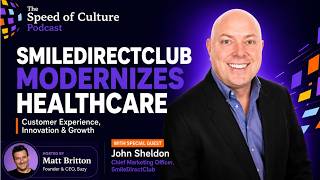
In this Speed of Culture podcast episode, host Matt Britton interviews John Sheldon, Chief Marketing Officer of Smile Direct Club (SDC). Sheldon recounts his 25‑year marketing journey—from agency work at Ogilvy and BBH to in‑house roles at eBay, MasterCard, and finally SDC—highlighting how a stint at eBay Enterprise Marketing served as a bridge between agency and brand side. He explains why he joined SDC despite no dental background, citing three draws: the consumerization of healthcare, the chance to blend quantitative CRM expertise with branding and digital transformation, and the company’s purpose‑driven impact on customers’ life milestones. Sheldon describes the broader trend of direct‑to‑consumer (DTC) disruption in healthcare, positioning SDC as a modern orthodontics solution that puts patients in control while still involving clinicians. He breaks down his time allocation across four pillars: (1) building brand awareness (moving from 16% to 61% aided awareness and now focusing on unaided awareness), (2) performance marketing and CAC management, (3) shaping the digital customer experience (app, CRM, video guides, orientation calls), and (4) innovation to shorten the lengthy go‑to‑market funnel and expand into traditional orthodontic markets. He discusses the challenges posed by Apple’s iOS 14.5 privacy changes, which reduced signal for retargeting and email tracking, prompting a shift toward first‑party audience identification and mid‑funnel tactics such as OTT and YouTube. A substantial portion of the conversation covers SDC’s TikTok strategy: early adoption, a three‑part approach (brand‑aligned content, creator partnerships, and the rise of employee‑creator Emily Watson who transitioned from model to brand face). Sheldon emphasizes authenticity, rapid newsroom‑style content creation, and the importance of creators being actual customers. The interview also touches on the balance between art and science in marketing, the need to tie creative ideas to measurable business outcomes, and SDC’s recent pivot toward free‑cash‑flow generation amid higher capital costs and inflation. Finally, Sheldon shares personal reflections on what slows him down—intentional parenting and his passion for sports—illustrating his broader perspective on work‑life balance.
Chapters
Up today, we're going to be speaking with John Sheldon, Chief Marketing Officer at Smile Direct Club. John, thanks so much for joining us today.
Thanks, Matt.
Thanks for having me.
Absolutely. So you've had a long, storied history in the marketing space, over 25 years, starting off on the agency side, uh, brands like Ogilvy and BBH, and moving on to places like eBay, MasterCard, and of course where you are today Smile Direct Club as CMO. Um, tell us about, first and foremost, I'm always interested in this, your, your challenges of going from the agency side of things to the brand side.
Yeah, I mean, the good news is I had an opportunity that was a little bit of a way station in between in my— the work that I did at eBay. I actually worked in an area of eBay called eBay Enterprise Marketing, and we did, um, we ran the performance marketing for about 120 e-commerce retailers. This is before retailers all realized they needed to own this themselves. And so they had been outsourcing it. And one of my clients actually was eBay itself. So it was my parent company. And so I always felt a part of that marketing team. I was kind of an inside-outside person as part of that process. And so it kind of served as a bit of a waystation for me on my way to being an in-house, you know, client-side person.
Was that the original GSI Commerce business that eBay acquired? It was.
I was with GSI Commerce for about 11 days before eBay bought them. They didn't buy, obviously, because of me, but it was a really fun transition to be a part of that. And that, yeah, GSI Commerce was doing really interesting things for e-retailers who at that time wanted to outsource that work.
Yeah, I'm from Philadelphia and that was one of the original Philadelphia tech companies and a lot of my friends Actually, a high school, um, a classmate of mine, Michael Rubin, started GSI Commerce.
And yeah, Michael's done quite well for himself.
Oh, that's for sure. Um, and a lot of, a lot of folks, um, I've known throughout the years have worked there and then obviously became eBay. Huge success story. Uh, so really interesting. So now you're, you know, CMO at Smile Direct Club, and obviously we're in a very interesting time and we'll talk about the macro, but why did you join Smile Direct Club and did you know anything about sort of the dental industry when you joined? Like, what was the kind of drivers of that decision?
Yeah, it was funny trying to explain to my friends why I was joining a dental company, uh, because I've had no background in that whatsoever. Um, you know, for me, what drew me to Smile Direct Club was really 3 things. Number 1, um, you know, getting to participate in the consumerization of healthcare, which is an amazing macro trend, um, that's been going on. 2, it really brought together a lot of the different skill sets that I've been building up, right? I kind of started on the quantitative side of CRM and then ultimately started just adding and broadening my skill sets with branding and digital transformation, etc. And then third is really the purposefulness of the company. I'm really attracted to the impact that we can have on people's lives, right? I think I would have a hard time selling something I didn't feel awesome about. And the fact that you know, Smile Direct Club, we're part of a customer's, you know, broad-based transformation in their lives. We're just one part of that. And so being able to be alongside of them as they're losing weight, taking control of their life, handling their divorce, going to college, whatever that thing is, you know, we can also, we can be a really visible part of what that transformation they're going through looks like. And that purposefulness, I kind of, I projected that onto the business when I said yes to join it, but I've seen it come through in spades and I feel really great about that part.
So when you talk about the consumerization of healthcare, obviously the healthcare space still is so dated, has taken so long for it to digitize and disrupt itself, uh, you know, when compared against almost every other industry. What do you mean by the consumerization of healthcare and what role does SmileDirect play in that overall transformation?
Yeah, so direct to— the direct-to-consumer world is infiltrating healthcare, um, you know, all over the place. Whether you think about businesses like Q Health with their at-home testing work or, you know, some of the— Telehealth. Right, obviously all of the telemedicine efforts that have gone on in the last 10, 12 years, but then you start taking pieces like SmileDirectClub where you're taking a 112-year-old industry of orthodontics and completely upending that because you're basically putting the consumer, enabling them to kind of start the process and initiate that. Obviously, there's still a doctor involved end to end, and you need that doctor in every part of the process. But now, you know, it's not just like I ran that lab because the doctor said so. It's, hey, I've got this concern about my, you know, I might have COVID. I'm going to run this test. I'm going to— and all of that has been kind of pushed out back to where the consumer has much more control of the process. And that's also true with SmileDirectClub, where we're, you know, asking the consumer to identify when they want to get their teeth straightened and then to work in collaboration with that doctor to make sure that happens.
Yeah, and obviously right now, obviously growth is such a huge driver of technology businesses. Now, more recently, profitability has taken center stage as well with all the macroeconomic changes that we've seen unfold. All that being said, where are you spending your time across the overall funnel in terms of the overall brand hierarchy of Smile Direct Club, in terms of how you communicate your unique selling proposition down to performance marketing and making sure— you talked about quant earlier, how numbers work. What's the pie chart of your time in terms of where you're spending it and where your efforts are focused?
Yeah, it's, it's, um, it's really, uh, I would say my time is broken into 4 key categories. The first is build— is building the brand, right? We're still a young business. We've only been advertising for a little over 5 years. The great news is we've got terrific, uh, aided awareness in the business. When I started, it was about 16%. It's now 61% aided awareness in the United States. So that's great. However, once you cross that 50% mark, you really turn your guns to the unaided awareness. I might have misspoke before. I think, yeah, aided awareness is 16 to 61%. We're turning our guns to unaided awareness. So people unprovoked will know that our business does what we say we do. And so, spending a lot of time thinking about how to build that business. I'm a big believer in Byron Sharps, how brands are built, you know, being mentally and physically available for customers on a broad basis. And so just making sure our name continues to be out there, that people continue to feel positively about our business, that because we're in the healthcare space, that we're building credibility for our business in all the ways that we need to. And so that's about 25% of my time. The second is the day-to-day performance marketing stuff, right? Just looking at the conversion funnels and all of the efforts that we're putting into our media there to just make sure that our CAC stays exactly where it needs to be and that we're able to have a profitable business.
And how does that change? Sorry to interrupt, John, but just to double-click on number 2. How has that changed with all the recent, you know, evolutions in Apple's privacy policies and your ability to retarget with cookies? I mean, has it made it incredibly harder?
It's harder. I mean, no doubt it's harder. I think we were probably one of the first public companies to actually talk about the impact that iOS 14.5 had on our business. It was over a year ago when we started talking about that in our quarterly reports. And, you know, no question that it impacted our business and it's shifted our our media mix strategy pretty dramatically because, you know, we are no longer able to see some of the key signals that we used to be able to see. So that's definitely been a pain point. And by the way, the same things that they're doing on the CRM side of the business are having some impact, you know, as well from a privacy perspective. And, you know, we just know less about what emails were opened and so on.
Right.
You know, on the flip side, what we were doing is we're trying to find other new first-party ways of kind of identifying critical audiences and building out from there. And we're actually, obviously our paid social, you know, took a big hit in terms of its efficiency about a year ago and we've built it back and we're now operating at the same levels of efficiency as we were a year ago. However, albeit at a much lower volume. The ability to incrementally, you know, spend the next dollar and have it be, you know, at the right levels of profitability, I would do it if we could. But we're at much lower spend levels than we were, you know, at that time.
And so, and you mentioned a shift, you said, had you shift your spending, where has it shifted towards?
Yeah, I mean, we're really, you know, trying to do more, I'll call it mid-funnel consideration work. And so things like, OTT, things like YouTube, where we are targeting audiences explicitly, you know, retargeting audiences explicitly. However, you know, with the ultimate goal to kind of drive them, you know, back in through things like, you know, organic and paid search.
Got it. Got it. So you talked about brand building, you talked about performance marketing. What was the third area?
Yeah, the third key area is in really defining the customer experience. And so my team owns the digital experience app. Site CRM. And so just making sure that we're continuing to optimize that customer experience to ensure we're pulling people through all of the right ways. And so, you know, right, you know, we're looking at how we go to market. We're looking at, you know, different elements of that process in its own right and how we can leverage that new technology to make that better. And that kind of leads to bucket 4. Which is really innovation, right? And so, you know, broadening our audiences, broadening, you know, creating a much better go-to-market strategy than the one we have today, which is actually quite long, right? We acquire a person, they have to buy a kit and scan, they have to return that kit and scan, they have to then, you know, make sure that that's accepted, then they get a treatment plan, and then they buy. And that process is lengthy. We joke all the time about nobody wants a cold hot dog. And so, you know, we have some drop-off in that process.
And so So I'm spending a lot of my time thinking, what are all the ways that we can shorten that window to get a person to understand what they're going to get in working with us and our doctors and making sure that go-to-market isn't 2 to 3 weeks. It's, you know, ideally I would like to say 2 to 3 minutes, but we're not quite there yet, right? How do I shorten that window of the go-to-market? And that's just one of the areas of innovation I'm spending time in. And then obviously, There's a, you know, when we launched our business, we thought about the market that had never been able to access orthodontics before, right? People who couldn't afford $6,000 to $8,000 for braces or Invisalign. You know, we're out here at $2,000 making that accessible to people who'd never had it before. Well, in the process of building this business, what we've come to realize is that 80% to 90% of the overall market would benefit from using our model. The convenience, the cost, the outcomes are all better than what we've— that we're seeing from other folks. And so we're now trying to go to the traditional orthodontics customer, right? High household income, parents of teens, and saying, hey guys, there's actually a better way. We've proven it. And we're out. And so all the ways that we can make sure we're hitting on that audience are— it's a priority for us. And, you know, a year ago we launched a Challenger campaign specifically to, to hit on that. And there's more coming in terms of product offering and beyond that that's going to really make sure that that traditional orthodontic customer actually comes to benefit from all the things that we've built for the folks that we gave access to this in the first place.
Yeah, I mean, it's such a huge addressable market. And you're right, so much of the market is still to be opened or addressed. And if you can bring it to the right price point, make it convenient for consumers, there's just so much growth there. So it makes sense to back up a little bit. We talked about the first two areas, brand building, and then you talked about performance and you're shifting to more mid-funnel. I know your company has done a lot with TikTok and I was reading a little bit about the Emily Watson story, which I thought was fascinating. I can tell you every, obviously every single big brand I'm talking to these days and even smaller companies are fascinated with TikTok. Our very first episode had Sophia Hernandez, the head of business marketing of TikTok, on it, just talking about how important authenticity is. And now that's something brands still in this day and age struggle with because they're trying to be too controlled, too contrived. You've had some early success on TikTok. Would love to hear about your efforts there and more specifically about Emily.
Yeah, great. Thanks. TikTok, we were early on TikTok. Over 3 years ago, we were making investments there. And it's been a really strong category for us. And actually now it's now basically at the top of our leaderboard, if you will, on you know, where we're spending some money on, certainly on the digital space, it's because our audience is there, right? Our primary audience is 18 to 35-year-old women, you know, and that's where they're spending their time, right? And so what we've really done in TikTok is a strategy that really has 3 components to it. The first is we're adapting our broad-based marketing to the things that we know work in that environment. So what we're doing We have our character Didi that does our TV work that compares us to our challenge, the company we're challenging, and she's doing bespoke work specifically on TikTok based on some of the things that we're seeing, trends that we're seeing there, etc. The second piece is probably the biggest piece of what we're doing is we're leaning into creators, right? And working really broadly with creators on, you know, because they know what works in that space. They're the ones who've mastered how to create eyeball-worthy, you know, content.
That's where authenticity lives, right? They're doing it for the love of what they're creating versus trying to be a paid shill for a brand.
And for what— and this, you're dead on— and what we care about most is they have to actually be a customer. If they're talking about aligners, they have to go through treatment. If they're talking about our whitening product, they have to use it for a week for real. And we're being very explicit about that. And because we don't want We're not trying to borrow equity to borrow equity. We're trying to build credibility. And that credibility comes from the authenticity.
Right.
And then the third piece, which you've alluded to, is the great story about, about one of our team members, Emily Watson, who really is the primary face on our TikTok channel. You know, the great story about her was 4 and a half years ago, she was a model in a photo shoot. That's when she got introduced to the brand. She then became a customer. We straightened her teeth. She then loved the experience so much she wanted to work for the company. She came in and has worked her way to a place now where she's actually running the face of the company in that TikTok environment. And she's so great at spotting the trends and working with the— we have a broader content team that she works extensively with to help say, hey, here's this thing that's going on. How can we make our brand relevant to that and just help tie our brands into that? TikTok is an environment. I always talk about content creation having two styles. There's the studio work that's long-lasting, high-risk, and you have to really think about it for a long time. And then there's the newsroom, right? This is the stuff that's fast-moving. It's low-risk as long as you, you know, obviously with certain safeguards, guardrails, and you need to be able to be relevant to what's happening right now. Most brands struggle to connect themselves to what's happening right now because the guardrails are too tight. And so, you know, the work that we've done with that team and, you know, Emily and Nikki Harmon, who's on that team as well, leads that team, you know, the work that they've done to help us be responsive to what we're seeing, you know, in TikTok, on Twitter, what have you, you know, has really helped our brand become more and more relevant.
And I think, you know, that story is so inspiring to me because I think it should give young people a lot of hope because it's so much about what you do versus what you say. You know, people can have a resume and they can go to a great college and they can interview with you and say, I'm going to do this, this, and that. That's one, you know, candidate. And candidate two is somebody who's done all these things, who's actually built a brand, who's built a following, who's shown passion. Who are you going to hire in this new world? And I think, you know, that whole notion of having people, you know, really prove their worth, I think could be so impactful.
Listen, my career has been a scar-ridden career of, you know, helping startups that didn't make it and, you know, having your businesses break away and then get re-sucked in. And, you know, I had my own company I started in 2001, not the best time to start a company, but actually it's still around, you know, up in the Boston area. And so just having scars, you know, experience you can bring to the table is so incredibly valuable. And just trying stuff, even if it's, you know, low risk, if you're in, you know, something you do with your fraternity or your sorority, but you've out there and you've had your fingers in whatever, Facebook Ads Manager, because you were trying to drive people into your sorority website, that means something.
It means so much more. You know, I mean, one thing I've always had success with again is asking people, what have you done? What have you built? What have you created? Versus telling me what you're going to do. Because you have every opportunity at early ages to prove that you can put hands on keyboard and do things. And that's definitely one piece of advice I'd give to young people starting out is to go out and do things. And to your point, even if it fails, you're at least showing initiative. And initiative is so key. You know, you talk about things like, you know, expanding the business and innovation. Innovation comes from ultimately somewhere, someone in your organization taking initiative, doing something that they're not told to do. And next thing you know, you're identifying a whole new business opportunity.
Yeah, that's right. And my time at MasterCard was loaded with that, right? I headed up innovation management for the company worldwide and it just being able to see hundreds and sometimes even a thousand or, you know, ideas, you know, from all over the company that you can like think about, rank, rate, say, we've seen that before. Hey, that's something new. You know, that's a good idea that we're not going to get to. That's a great idea that I want to invest behind. And managing that innovation pipeline, you know, was a role I played. And just the ability to filter through ideas quickly and understand, you know, where the ones that are the great ones that are worth investing in is critical. And that's a challenge I think a lot of mid-growing companies face. Is there's so many good ideas laying around, they try to do them all. And the hardest part is to basically stop doing the good ideas so you can execute the great ideas. And, you know, I would say even in Small Record Club, we're still working through that. But I actually think, I think we kind of got there. And that's been a really cool part to see this business mature over the last, you know, my tenure here, which has been the last 4 years.
Super helpful. And, you know, the last thing I'll ask you about is customer experience. You talked a lot about that in terms of really trying to optimize the way that your customers experience the service that you're offering. You know, how do you get feedback from those consumers in terms of what's working and what isn't? And what have you found have been some of the big unlocks in optimizing customer experience?
There's no better 2 hours that I spend every week than 1 hour watching videos of our customers in our Smile Shops, obviously with their permission, where we watch them go through that journey with the Smile Guide, the questions they ask, the places where there was a lack of—
Every week.
Every week. Every week I'm watching these things for an hour. I've seen thousands of our customers, well, probably about 1,000 customers go through that journey. We take clips and show, hey, here's where this thing happened. They were really uncertain here. Is there something we can do to communicate earlier how this works? All of those elements and finding the ways to say it just the right way and when we should be communicating in their overall journey, how we can use CRM better, all of that. You know, that hour is great. And then the second hour is we're doing calls, sales calls, customer care calls, again, all with permission, just listening to, you know, what's the customer struggling with? What are they facing? And so on. I'll give you one example. We got to a place where we heard one call where the customer asked our team member to help explain all the things that came in their in their box, you know, you get one big purple box with all your aligners in it. And also we're like, what if we just did an orientation call with every customer, right? And so we experimented with that and actually went quite well, although it's hard to get a hold of people. But then we realized we're just saying the same thing over and over again. Why don't we just make a customized video for that customer's experience? And now every customer gets that customized video along with their box so they can understand what's in the box, why is it tailored to them, How does it work for them? And by the way, what we find is those people call less frequently, complete treatment successfully more, all of those things downstream. So it's the little nuggets that you pick up with being a customer-obsessed person, you know, help you create better experiences, better outcomes, more referrals.
Across the whole funnel, right? It's a game of inches.
Yeah, it is. We talk about this all the time is, you know, and that's the big challenge is in one hand, in customer experience, you're playing a game of inches game. You have to make sure you create the space for the innovation, right? Because you can tweak and tweak and tweak and polish. And we've done an inordinate amount of that. But we also had to step back and say, okay, we've polished that thing amazingly. How can we break it and make it way better? And so it's that combination of those two things that help, you know, really become excellent at customer experience.
Yeah, I mean, we live in a world where everybody wants that instant gratification and those huge big ideas. But I think the best businesses are ones where little ideas like the orientation idea you just talked about, which turns out to be actually a huge idea, right? But if you look at across the entire funnel of when somebody first hears about you to when they're finished using your product, if you can incrementalize every touchpoint throughout that and do a little bit every single day, next thing you know, all your conversion numbers are better, your NPS is higher, your business is growing faster.
Exactly right.
And that's really the game is connecting that. So this is super helpful. And, you know, I think My observation of you is that you're somebody who really understands the benefit of both art and science in marketing. I think right now the Cannes Festival of Creativity is going on, which celebrates big creative ideas. But one thing I've found over the years is a lot of these big ideas aren't really connected to real business metrics. So I think there's such importance of amazing creative without real metrics connected to them. It almost doesn't matter. So I think understanding the mix of art and science is incredibly impactful. It seems like that you've done a good job of balancing the two.
Yeah, thanks. Yeah, I always think about this— the work that gets done at Cannes, the great stuff is, you know, the top-of-the-line great stuff. But there's a lot of pieces that get celebrated in that environment that are breakthrough creative concepts that aren't connected to the actual brands in meaningful ways, right? Yeah. I say this to, you know, my wife sitting next to me all the time. She's like, oh, that was so funny. And then 3 minutes later, be like, that spot that you said funny. What brand was that? She's like, I don't know. She's like, I don't know. And I'm like, there you go. So, you know, it was breakthrough. It connected with you, but they didn't connect it to the brand. And like, that happens so often.
Yeah, absolutely, absolutely. And that often happens when you give agencies the keys and you don't really keep them connected to those business results. So they're, you know, their interests necessarily aren't aligned with the bottom line of the business. And I think in this world, that's obviously going to change because companies are going to be more and more focused on driving the bottom line. You know, in that regard, in this world with rampant inflation, more pressure on the consumer, how is SmileDirect sort of reacting to that in the marketplace?
Yeah, I mean, I think we're— again, we're— I think we feel our finger is on the pulse sufficiently that we were reading these two mixed metaphors, but we were reading these tea leaves about the focus on cash flow free cash flow generation, you know, early on. And so we started making moves on this in Q4 last year. And so we are refocusing our business on ensuring that we can get the business as quickly as possible, safely as possible with growth to that scenario with where we're just floating on free cash flow as opposed to anything else. You know, the last several years with interest rates as low as they've been, money has been like getting more capital has been cheap and easy. And now I think capital markets are drying up. I think you're seeing getting money costs money. And so, you know, this focus is now shifted toward ensuring that you don't need to go do that. And so having a business that is now free cash flow focused as opposed to EBITDA focused or as opposed to top line growth focused is really where it's at, particularly for, you know, the class of businesses that Smile Direct Club is all in, you know, these, I'll call it, 6 to 12-year-old companies that are all, they all had tremendous growth. They all, you know, generated great brand awareness. They've built honestly phenomenal businesses, but now they've got to turn those phenomenal businesses into something that generates the free cash flow they need.
Yeah, back to the fundamentals, right?
That's really what it comes down to. And we're all over that as a business.
That's great. That's great to hear. Well, this is super, you know, informative for me and I'm sure it will for our audience. And, you know, we covered so much in a short period of time. And that's really what we want to do with the podcast, The Speed of Culture, is cover a lot of sort of deep-rooted insights in a short period. So that was super helpful. But just a personal question for you in this fast-paced world, you obviously— I can tell your brain moves a million miles a minute. What are some of the things that slow John Sheldon down in this world?
Oh goodness, uh, you know, I think being intentional with my kids, um, yeah. So I have two daughters. One just graduated high school and the other one is going into her senior year at my alma mater at Penn. And so they're older. And it's funny, I always joke that golf and parenting are the two most challenging things you can do for the opposite reasons. In golf, you have to forget everything that happened before and everything that happens after this shot, right? With parenting, it's the opposite. You have to take everything that happened before into account and all the potential implications downstream from what you have to do in this moment. And so I spent, I'm much more focused on being very intentional in dealing with my kids. And so that slows my mind down a little bit while I explore like, okay, take a breath. How do we get here? What could happen if you do this wrong? And so, or right, obviously want to be positive there. But that's one thing. But, and the other thing is, I'm a completely rabid sports fan for both the Patriots. And then I'm a Man United fan for Premier League.
And I watch almost all of their games on both teams.
And it's so weird how you can let some group of random men, you know, completely make or break your mood. You know, people come in, they're like, how was your weekend? I'm like, both the Patriots and Man U lost. I had a terrible weekend.
Right?
Right. Wait, why did I let that happen to me?
I don't know.
But that's part of my personality. I just like the ride.
Me too. I'm an Eagles fan, uh, so sorry about that 2018 win, but we deserve one.
I'll take the other whatever it is now.
Exactly, take the other 6 ranks. Um, well, thank you so much for joining. This has been amazing, um, and a lot of insights I think that our audience can take away. So on behalf of Suzy and the Adweek team, thanks to John for joining us. Um, happy Father's Day, by the way, John.
Uh, thank you.
Be sure to subscribe, rate, and review the Speed Culture Podcast on your favorite podcast platform. And thanks again. So on behalf of myself, we'll see you next time. Take care, everyone. Hey!
More from Matt




MikMak’s Rachel Tipograph on Consumer Spending, Retail Media & Holiday Shopping Trends



Jaguar Land Rover’s Charlotte Blank on Luxury, Purpose & Experiential Storytelling



