Sonos’ Deirdre Findlay on Audio Innovation, Culture & the Future of Sound
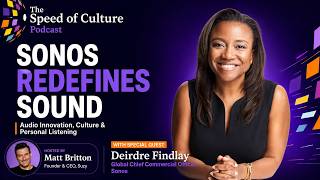
Deirdre Findlay, Chief Commercial Officer at Sonos, discusses the company's expansion from home speakers to portable devices and new Ace headphones with 30-hour battery life. She explains how Sonos competes on premium sound and design rather than hardware specs, and shares how she evaluates career moves by prioritizing curiosity and knowing when to walk away.
Chapters
Up today, we're excited to be joined by Deirdre Finlay, the Chief Commercial Officer at Sonos, one of my personal favorite brands. Deirdre brings her wealth of experience from leading marketing initiatives at giants like Google, Stitch Fix, and Condé Nast. Deirdre, so great to see you.
It's great to be here, Matt. Thanks so much for having me.
Absolutely. You're taking time out of your busy schedule in New York, and we were just talking before the podcast that you're on the road a lot, that, that you're running around. What's it like to be an executive that is constantly on the go, and how have you managed to sort of balance your time and yet still have sort of a structured approach to work.
Yeah, it's exhausting but exhilarating all at the same time. And I think for me, what's great about it is it keeps me connected to culture globally in a really impressive way. And so just for context, I spend a lot of time in Santa Barbara where Sonos is headquartered, which is a lovely place.
Yes, it is.
To be headquartered. I also spend time in New York and we have some folks from the team in the New York area. And this is home for me. I am a New Yorker and my My partner lives in London, so a lot of time in London as well. And we do have an office there and actually a pretty decent-sized team of product folks based out of London. And so for me, I just love the opportunity to connect to culture. I love the opportunity for when I'm in London to also take time and visit our other offices. So next week I'm going to Amsterdam and I'm visiting the team in Amsterdam. So whenever I'm there, it enables me to stay connected to our global teams in a meaningful way. Absolutely.
And just to kind of wind things back a little bit about your career. So did you always know that you wanted to be in the world of sort of marketing and consumer products? Or is that something that in your earliest, say, college days, you thought you had a passion towards?
I wish I knew. You know, it's funny when I reflect back on it, I think I knew, but I took the path that I thought everyone else wanted me to take, which is finance. So I actually started my career.
I did the same thing. I took my LSAT, so I wanted to be a lawyer because my dad was a lawyer and that's what I thought was the path.
That's what you do, right? Exactly. It's like, are you gonna be a doctor, a lawyer, or can do finance? And so I went into finance., and I'm highly analytical and definitely loved that side of it. But what I realized after doing that for a few years is I really missed the creativity, which should have been obvious. 'Cause when I think about college, like I majored in political science and economics, but largely economics with a minor in political science. But the classes that really made me think and feel were in architecture. And so I took a lot of art history, a ton of architecture classes. And so it wasn't until I went to business school that I figured out what the perfect intersection was for for me, interned at Pepsi, and that summer really crystallized that I'm like, wow, I can do all the analytical work, I can be a GM, but I can also really lean into creativity and marketing in, in a fun way. So that was the beginning of my marketing journey.
It must have been an amazing experience. So many of our guests here on the podcast kind of cut their teeth at Procter Gamble or PepsiCo, and I think just the brand building mentality and discipline that those CPGs have really teach you so much.
It was amazing. It was such a fertile training ground. And to their credit, I kind of joked that I didn't want to spend the summer couponing. They created the perfect internship for me where it was my assignment was to come up with the next new non-cola carbonated beverage. So a lot of research and development working across the company. So really getting to know Pepsi and all the different functions within Pepsi and culminating in this amazing presentation to the leadership team there on my recommendation.
That's awesome. And you mentioned going to business school and when you look back at your experience of business school, was it worth it? Is it something you'd recommend to today's sort of aspiring professional?
I feel like it's a very personal decision. For me, 100% worth it. On my time, I went to Dartmouth, so the Tuck School at Dartmouth, and it was a general management program. So it enabled me to take strategy, finance, marketing, really figure out what I wanted to do and what excited me. And frankly, it really built the foundation for the executive that I am today. The coursework and that range of different disciplines. So I think it was a defining moment in my career. But, you know, I look at other people that I have worked with over the years, and there are some folks that didn't need that moment. So I think it's really personal. I think because I wasn't sure exactly what I wanted to do next, it was the perfect opportunity to explore and kind of find myself and frankly build an amazing network. Frankly, that's how I ended up at Condé Nast. Roger Lynch and I, who's the CEO of Condé Nast, we both sat on the board of Dartmouth for the business school for a very long time. And we built a relationship through those board meetings. And when he reached out to me about the role, I was like, I've always wanted to work with you. And that was ultimately how I ended up there. So I think the power of that Tuck network is kind of amazing.
Yeah. A lot of people say the number one thing coming out of business school is the network, the people you meet.
Oh yeah.
And to keep them with you. Oh yeah. When you finally got into the real world and you started getting real jobs. Yeah. What were some of the things that you learned that maybe you weren't prepared for that you had to kind of learn on the go? Because there's a lot that's not taught in school that you have to then dive in and figure out. Is there anything that kind of comes to mind?
And there's a lot that's not taught in business that you have to figure out. Yeah, exactly. And that was lesson number one for me. So after I graduated from Tuck, I went to Digitas, which is an agency.
You know it very well.
Yeah, it was such an amazing time period. Like I call it the Digitas Mafia. There's so many amazing Digitas alum that are in really, really interesting roles. I spent 11 years there. But I wasn't a marketer yet. I had spent 3 months interning at Pepsi, but that did not make me a marketer. And in my time there, what I realized is no one was gonna tell me how to become a marketer. I learned through exposure, but I also learned just by being super curious. And so that's number one. I think there are a lot of times where people are expecting all us to do the hard work of the training. And yes, there is a responsibility that we have as leaders to bring up that next generation of talent, but it's, I think, almost more important to be really curious, to be self-motivated and to roll up your sleeves and figure it out. Because those are the people that I actually wanna lean in and help are the folks that have already done the initial stab at like, this is what I think, or here is my opinion, and now let's brainstorm and let's refine that together.
And I think there's also something to be said about spending time early in your career at an agency because you get exposed to all these different brands and sectors and you learn what is common across all sectors and what makes each individual industry kind of nuanced. And it kind of, I think, is a great training ground when you go deep into one of those sectors.
Absolutely. I would not be the leader I am today if I hadn't spent my first 11 years as a marketer at Digicast. And I think that agency ground is absolutely critical to both understanding a lot of the different industries, but also really understanding a lot of the different types of marketing that you can do. Started with digital, did direct mail, did telemarketing, learned measurement, learned media. I can't think of any one place where you have that much exposure to all the different functions within marketing more broadly, and then also an opportunity to apply that to lots of different categories.
Yeah. And then you, in 2013, joined Google at a time when the company was really starting to establish its dominance. They had acquired YouTube, I believe, at that point. Yeah. What was it like to work at Google? What was it like to interview, get the job, and be in that type of environment?
It's one of my favorite places that I've ever worked, but I will say this in full transparency, I was terrified. Like, they had been calling me for years, and I'm like, oh, I don't know. It's Google. Like, am I ready? And I actually went to eBay first. It was my first out of the agency world, where I kind of got my client-side chops, was at eBay. And to Google's credit, they— the recruiters there are wonderful. They just like, well, that one didn't work. You weren't interested in that. How about this? And I eventually had the courage to interview. And that process was— it's definitely intense, but it's not nearly as difficult as I had created in my mind. You know, you have this vision. Of like doing lots of public math, and it wasn't that. And what I love also too about the Google process, it's a combination of your marketing or your core skills and competency plus cultural fit, which for me, because I just landed at such a great cultural fit with Digitas, I think I didn't fully appreciate how important culture was in your job satisfaction. And so going through that Google process really shed a light for me on just how important is not just the work, but are you working with the right people in the right culture for your long-term success.
And you were at Google for 5 years and then made the decision to jump to Stitch Fix, which was an emerging startup in 2018 as CMO. So you found yourself finally in the CMO role. Shouldn't say finally because you got there pretty quickly. But what goes behind a decision like that to leave Google? Because a lot of people, when they work there, it's such a comfortable place and you know that the company's not going anywhere and there's limitless upward mobility. Why did you decide to leave?
Yeah, it's stable, right? Yeah. And believe me, Google is a hard place to leave, but I never like being too comfortable. When I think about my journey, I spent 11 years at Digitas. I would argue that I probably spent 3 more years than I should have. Mm-hmm. And so given that lesson, I've been really thoughtful about, have I accomplished what I can accomplish here? And before jumping, 'cause I'm also a big believer that you don't necessarily need to jump to the next thing. A lot of times if you ask for what you need or what you're looking for, you can find that within. You can jump while staying where you are. Yes. And Digitas was amazing at that. You know, I had some great mentors who said, well, Deirdre, why don't you go lead this account? Why don't you try this category? Yeah. So the Google decision was a tough one, but when you're in a big company like that, I was kind of a CMO within a bigger organization, but no one saw me as that. And so the Stitch Fix opportunity was the opportunity for me to prove to myself that I could actually do the CMO job outside of the safety net. Of the Google— in a much smaller company with a lot less layers, in a much smaller company with a lot less layers. And frankly, just a really fascinating business model, right? So before everyone was talking about AI, my whole thought process around that decision was, gosh, they're really leaning into data science to solve what I call paradox of choice, which is how do you use technology and machine learning to synthesize just all of this information and help people choose, right? And they just happened to solving that problem within the fashion category. And so that was really appealing to me. And then how do you market that and sell the magic that is the end product of that experience to consumers? Yeah.
And 2020, you joined the board at Sonos. I've always sort of been fascinated with what the process is to join a board of an established— Yeah. I don't know if it was publicly traded at that point, but soon to be—
It was.
Publicly traded company.
It was.
How's that work? How do you end up becoming a board member at a place like Sonos? Do you reach out to them? Did they reach out to you? And what was that experience like in terms of being on the board?
Well, you pick up the phone when Patrick calls, right? So I don't know who gave him my name, and Patrick Spence is the CEO of Sonos. Yeah. But he reached out and just wanted to have an exploratory conversation, and I said yes. And that is advice that I give to everyone. It's okay to pick up the phone. It doesn't mean you have to say yes to the opportunity.
Exploratory about potentially joining the board.
Exploratory about potentially joining the board. And we just really hit it off. I was just inspired by his passion for where he wanted to take the business. I really believed in like where where the company was going. I was a Sonos product user, but I was also really honest because I was in Google hardware. Google Home was my product, right? It was like, I am both a Google Home family as well as a Sonos family. I was really honest during the process and here are the pros and cons. And we had a really healthy and rich debate around that. And then culture to me was really important. So as I think about in joining a board, I don't know that I had this calculus then, but I certainly do now. I think about it much like I think about a company. Is it a category where that I'm passionate about? Because you spend so much time at work. Same thing with boards. You spend a lot of time reading hundreds and hundreds of pages of materials.
Mindshare too, even when you're not in the boardroom.
Even when you're not in the boardroom, right? The meetings in between the meetings. And so it has to be a category for me that I'm passionate about. And Sonos definitely checks that box. Is it a company that needs my, like, secret sauce? And as I think about what I'm really good at as a business person and definitely as a marketer, for me, when I was thinking about what Sonos needed, I'm like, wow, They are great business, really leaning into both brand and direct response, like full funnel.
Yeah.
Needing that full funnel also could benefit from the experience that I had from my Google days. Really understood that magic of hardware and software, which is a sweet spot for Sonos as well. And then is it a culture working with people that I really respect and admire? Because same thing, you spend a lot of time in these board meetings. In between board meetings, are these people that I want to spend time with and ideate I can associate with in a culture that I respect and admire. So the good news is Sonos checked all of those boxes, and I ended up spending almost 4 years on the board until I decided to come in-house.
So basically one day you got a call from Patrick, the CEO, and said, would you ever think about possibly joining Sonos full-time? And I guess, were you surprised by that? And what gave you the conviction to then make that leap and become the global chief commercial officer of Sonos?
I wouldn't say I was surprised. Definitely, you build a relationship with the CEO over time when you're on the board, and there was a mutual respect there. And when you think about where Sonos is in its journey, there was a desire to kind of bring on senior marketing talent to help us with this next wave of growth, this next chapter of growth that we're in. So there was always a little bit of, oh, I think he's dancing around this. But then I was looking to make a career change, and Patrick knew that I was exploring opportunities and the time just felt right. And so we had conversations over a number of months, but I had a really candid conversation with him about where I am in my career and wanting a role that was beyond marketing. Yeah, right. When you think about what I did at Condé Nast, I was the CMO, but I ran all of consumer revenue. So basically all non-advertising revenue was under my purview. So I had gotten that taste of P&L ownership. Up driving business growth and having direct ownership of that. So the opportunity to have marketing but also have sales under my purview and then customer experience, which I also had at Google. Basically I had the full funnel. Yeah. And so we eventually got to a place where we arrived at that kind of full funnel remit, which was a lot more exciting to me than the marketing only.
Yeah, I actually feel like it should be the future of what the CMO role is.
I think that is the future of the CMO role. Like, and I look at what's happening in the industry, so many people that I know that kind of started their career as marketers have expanded into roles where they have either partial or total P&L ownership. They own things.
If not, you kind of become expendable, don't you?
Or you become expendable. And so my big thing is, as a marketer, you have to speak CFO and CEO. Yeah. And so the best way to do that is to have that direct ownership and responsibility for business outcomes and tie everything that you do. Yes, we're laser-focused and in service of the customer, but we also need to be in service of the customer with business outcomes in mind. 100%. And so this role—
and the shareholders—
you have shareholders that we need to be accountable to. Exactly.
I mean, it's interesting because we're in a world of rising and perhaps sustainable higher interest rates. So the cost of capital is higher. We're also in the world of dramatic attribution really across all marketing channels.
Oh yeah.
No longer can you be disconnected from that and say, oh, we're going to make a cool TV spot with a celebrity and run a Super Bowl ad. And if the business doesn't do well, well, maybe the product's not good enough. Like, I think that's what makes marketers and sometimes in tougher environments a little bit more expendable because when people are cost cutting, they're like, well, what is this person really doing? How are they really driving the business? So you kind of went the other way and you're like, I want that accountability.
Yes, I love the accountability. And my mom has always said to me, she's like, you want to be in the seat where you're driving business outcomes. I'm like, she's right.
And it gives you a different lens of every decision you make.
Yes, right. It really does.
You have to really think, is this really going to move Is this gonna drive volume or are these dollars better spent somewhere else that can?
Right. And I think it also, when I think about my career journey on the agency side, you're one step removed from that accountability. But once I went on the client side, it's like I've managed really large budgets and really small budgets. And the level of accountability that you have, especially when you're running smaller budgets, it's like the best training ground cuz it forces you to be scrappy.
Yeah.
It forces you to think about how you're gonna about every single dollar that you spend in a way that you don't necessarily have to do when you have larger budgets. So I credit my time with smaller budgets as just kind of really helping me hone that measurement and accountability to the business.
We'll be right back with the Speed of Culture after a few words from our sponsors. So let's talk about the business of Sonos. Yes. As I mentioned earlier, before we started this interview, I'm a huge fan of Sonos, a big customer, and also an evangelist. What I found is when friends of mine buy homes and they have sort of some smart home system in the house, I don't know how to work. I'm like, no, you just get Sonos. And it's just amazing that a lot of the world hasn't caught up with the new way of doing things. We live on the coast, we're in tech, we sort of understand it. But there's a lot of people even that do live on the coast that maybe are in finance or real estate or other industries that aren't tech savvy and actually don't understand that something like Sonos even exists, which just shows the potential upside of the business.
Yeah. So thank you for your loyalty. Of course. I always love hearing these stories of people. It's like, oh, I have Sonos in every room. Yeah, thank you. And yeah, Yes, our technology not only sounds great, but it is easy to use. And we kind of created this market of like how you take sound and move it throughout the home. Like that's where we started. That was chapter 1, right? And then as I think about the second chapter for Sonos is when we launched our portables products. So we went from speakers and soundbars that largely lived inside the home to now portable speakers.
Sonos Move.
With Move and Roam, which is the smaller side. The number of people I know who pack Roam with them when they travel. Is amazing. And so that was kind of like that second chapter and just showing that like we have a really viable model outside of the home and you can take us with you. And then chapter 3, as I call it, is coming in June where we will be launching our next product, which really allows you to take Sonos everywhere you go. It's our first personal product.
So tell me more. What is it?
It is the headphone.
Oh, wow.
So we've had over Over 50,000 requests for like, when is Sonos going to make a headphone? Well, it's finally here. And there's been a lot of questions around like, what took you guys so long? Everything has its place, right? We meticulously crafted the sound quality. I feel like every time I listen to it, it gets better. It truly is just best in class.
As someone that travels a lot too, I'm sure that you—
I travel a ton. And not only is it brilliant sound, brilliant design, it's really comfortable. To that point around travel, that flight from London to California is 11 hours, and you want something that is going to be comfortable for that duration. We have 30 hours of battery life, which is best in class.
Tremendous.
Yeah. It's tremendous. We have a feature where you can get 3 hours of charge in 3 minutes. So it's just made for that on-the-go lifestyle. And then for those owners who already have other Sonos products, namely our, our soundbar and Prime our Arc soundbar for launch, there's a connectivity between the headphone and the soundbar. So you can do sound swap. So if you're at home— Somebody— watching a movie—
Your significant other's sleeping and you wanna just throw it, right? Right.
And your daughter's like not interested. Right. You can just do easy sound swap to the headphone and the sound is brilliant. The tooling is brilliant. You're totally immersed in that sound.
Wow. So what goes into a decision like that. I know you had, sounds like a lot of groundswell demand from your customers. Yeah. But obviously it's a competitive market. It takes a significant capital investment to launch a new product like this. How long did it take to give your company conviction to launch this? And I guess what were the big drivers of it?
I think the biggest is the consumers were asking for it.
Yeah.
So we knew that we have permission to play in this category. It is kind of crazy that we weren't here. And then we just dedicated the resources to building what we believe is the best product from Sony. That is true to our ethos as a brand, delivers on all the things that you would expect from Sonos. Talked about brilliant sound, which you've come to expect in all of the products that we have today. Beautiful design. I tease the team, it's like, it's our quiet luxury moment. The product is absolutely beautiful. But I know as a consumer of headphone products, especially the over-ear, some of them are so big and obtrusive that they take away from you as the individual. And our product does a really nice job of being low profile, really comfortable, stunning, but it doesn't detract from you. It really adds to your essence and your persona. So I think that the team did a really nice job of striking that balance. And then we're also known for the systemness, right? And so we do pay that off, especially for our owner audience that has our soundbars already.
Yeah, I think that provides a huge lock-in. And frankly, if I wanna buy a new sound-oriented device, at least in the home, yes, I can't go anywhere else because I'm locked into the ecosystem and I want to be able to operate it all from one app. And I think being able to lean into that ecosystem in the home has given you a distinct competitive advantage and a moat where even when some of the bigger players tried to come in and have competitive products, I don't think you were able to break through that ecosystem. I guess for you to be able to take that notion of connectivity outside the home, do you believe that that requires, I guess, additional consumer education so they understand how the ecosystem they built in the home connecting Spotify and all their other apps can actually make life easier when they're using the headphone or when they're using the Roam or the Move?
Yeah, I guess I think about it in a couple ways. Mm-hmm. I think about it as we've evolved as a company, our take on just how important that systemness is has evolved. Yeah. Right. It was very important at the beginning cuz that was the magic. It served the company well. And it served us really, really well, but we need to evolve just as the consumer needs evolve. And so what I love about especially Sonos Ace, which is the headphone, what I love about, what I love about Sonos, thank you. What I love about Sonos Ace is it works without the systemness. So it is a brilliant product in and of itself for all of the reasons that I just said. And then the connection to the soundbar, the way I talk about it with the team is that's the cherry on top. Like it's the added value that you get if you happen to also have a soundbar today, but it is a magical experience whether you do or not. And why I think that's really interesting is I think about where we're going as a company. One of the first things that I thought about is who is our audience? And when you think about our owner audience today, it's older, it tends to skew male and highly affluent. But Sonos really is— if you love music, if you love podcasts, if you love watching video content—
It's for everyone.
Sonos is truly— products are for everyone. And so how do we think about using Sonos Ace as a way to expand our total addressable market? So for me, that was like the big unlock as I was thinking about marketing this product, distributing this product, right? It really impacts all—
It's an entry point. Even people who don't own homes or maybe live in an apartment, they can buy that. And then when they do buy a home, they're already in the portfolio.
Exactly. And with that, we introduced two new younger segments into the mix. For Sonos Ace launch. So we have a female, younger audience, affluent, professional, cares about style, is willing to pay for products that she loves and cares about. Similarly, we have a slightly younger male audience to our owner audience that is same general profile as the female version, but it's bringing us younger. And for some of those guys, this might be their first sonos product. And so we don't want it to be something that they feel like, oh, I can only get the benefit of it if I have other Sonos products. No, it is magical if this is your first product. But my hope is once you realize how amazing Sonos is through our headphones, that you're gonna want to extend your relationship with us and buy the Era 300, which is the amazing Atmos speaker that we launched last year. By the soundbar to give you that amazing home theater experience with the sound swap between the headphones and the soundbar and so on. Yeah.
So, and what are some of your launch plans for the Ace? What do you guys have up your sleeve? Yeah.
So we have some exciting things planned. So it's a multi-pronged strategy. You can imagine that there are a lot of people that we can talk to just within the Sonos family. And so phase 1 is really about speaking to that audience. Yeah. We're leaning into CRM, we're leaning leaning into our direct-to-consumer channels. We have a pre-order window that is exclusive to our D2C channel.
You have all that first-party data, right?
We have all that first-party data. We have our communities where we know that people have been asking for this product. So how do we lean into the community and talk about the fact that this thing that you've been asking for for years is finally here and it is better than you could even expect? So that's really phase one, and it leans heavily on owned assets and our retail partner assets to drive conversions. And then as we move into phase 2, this is when we start to introduce Sonos Ace to our new audiences, both the younger male and female audience. And as I was sharing before we started recording, I'm actually in New York this week, and we shot some video assets for this portion of the campaign that I'm super excited about because one of the things that I've been talking about is reconnecting Sonos to culture. Yeah. And really leaning into music and fashion and sport in a way that we haven't done probably in the last 5 years. And music feels like a no-brainer. And there's a song that I picked that I fell in love with for our track. And the artist was actually interested in being in our film, which at first I was terrified because I'm like, well, we've locked, like, the concept. Right. We have this script.
You're like, we're just planning on using your music, but it— Right.
Music, but I'm like, oh my gosh, she's the perfect embodiment. It's Suki Waterhouse.
Oh wow.
That's great. And she's the perfect embodiment. Yeah.
Very trendy.
Very— Yeah. And honestly, an absolute delight to work with. Having just spent the last few days working with her and her team on this, I can't wait for you guys to see it.
Is this the first time Sonos has worked with a celebrity in this way? Because I can't recall seeing anything quite like this before from the brand.
It's not the only time we've had celebrity. So we have in the past Janelle Monáe. So So that was probably the most recent, but we don't tend to lean in and go— Right. It's not like we're just going for that. Yeah. No, we don't start celebrity first. And I actually think the beauty of this is we were really true to our brief and the concept for our brief. And Suki just— it worked. So I wouldn't have said yes if it wasn't true to what we were trying to accomplish with the video asset and also true to who the customer segment is that we were trying going to reach. Yeah. With this asset. So we got lucky that it just worked. And I do think having some star power is always a nice boost. We were in Page Six yesterday, which I don't think someone else has been in Page Six. Right. In a while. So Glamour featured us. So it's just exciting for us to see the pickup in some of these media outlets that we don't normally get picked up.
Yeah. Exposure to a wider audience. And like you said, provide more entry points into the brand.
Exactly.
So it's interesting because just to zoom out, it's gonna be really interesting obviously to see what happens with the launch. It sounds like a fantastic product, I'll definitely be picking one up myself. Thank you. Sonos is a company in a lot of ways that really many probably would think wouldn't exist given the competitive threats that you have from big tech. So if you look at the home, let's just put the headphone aside, you have components manufacturers that almost in a race to the bottom. Mm-hmm. Right? So, and that's why a company like Vizio could come in and underprice everyone TVs and be effective because people don't really, yes, you can maybe with a fine eye tell the difference between a high-end flat-screen TV and a lower end, but who really knows the difference between 4K AK, not a lot of people. So that becomes sort of a race to the bottom, a commodity. And on the other side, you have these large tech companies that have some type of ecosystem, whether it's Microsoft with the Xbox or Apple with their TVs or Amazon even with their Alexa device. And then you have Sonos that really is neither, right? Because you're not just a component. And while you do have an ecosystem, you certainly didn't have the heft of big tech. So what was it about Sonos and what is it about Sonos that gave it the ability to survive and thrive in a highly competitive environment?
Our CEO might have a different answer than mine, but what I attribute our success to is focus.
Yeah.
At Google, I worked on Google Home amongst other products. There's so many things that Google's trying to do. Yeah. So many in Apple. Apple has also dabbled in the space and yes, they're deep pockets, but they were not as laser focused on this category as we are. And we are laser focused here. And I do think that that really helps. I think we've been very clear on who we want to be. This ruthless focus on best-in-class sound. We continue to lean into the premium nature of our products. That comes through in sound quality, but also comes through in design. Our products are beautiful.
Software design too. I think a lot of companies that can build hardware, and you see this with a lot of the TV companies that try to build their own interface, they're terrible. Sonos has done a great job at designing beautiful software, I mean hardware, but also easy to use software.
Yes. And getting easier to use. Yeah. Because we know that there's an opportunity for us to continue to do better in that space. And so we are continuing to lean in there. And as I think about like where we wanna go from a storytelling perspective, and I'm trying not to do the work of, for my new CMO, so I'm gonna leave this up to him. That's cool. Right. But one of the areas that I've had a lot of energy around is how do you really lean into that Sonos magic? And which is the software. It's like the Sonos inside. How do we lean into that to really sell the promise of Sonos at this macro level? And then it almost doesn't matter which product you buy. It is— you're buying the Sonos magic. The brand promise. And it is the brand promise. And that's executed either through a soundbar or a speaker or headphones or a portable speaker or dot, dot, dot, whatever is next as we continue to expand into new areas. Absolutely. That to me is our magic relative to the other players in the space. Yeah.
And it's been fantastic to see. So shifting gears as we wrap up here, Deirdre, just about you and kind of your journey. Obviously you wear a lot of different hats right now at Sonos. In order for you to thrive and continue to thrive in your career, you have to keep your finger on the pulse of the consumer and continue to evolve and develop yourself as a professional. Given that, how do you spend your time on a weekly basis besides being on airplanes?
Yeah.
And how are you able to make sure that you feel good about the fact that you're continuing to develop and grow as a professional?
Yeah, no, I love this question. Number one for me is, I and the teams know this, I schedule my workouts. It is so important for me to make sure that I have that time. And look, I, the reality is I can't do it every day. Yeah. But if I can get my workouts in 4 to 5 days a week, and it's usually 2 to 3 during the week and both Saturday and Sunday.
You have to put your personal health first because if you're not healthy, you can't be good for anyone.
But it's, but I can't, and I know this about myself, when I've missed a workout, I get grumpy. So I give to myself and if I don't calendar it, it doesn't happen. Yeah. And I used to feel guilty about that, and I don't anymore. And I do it first thing in the morning so that it happens. So that is number one. Number two for me is I'm a naturally curious person, and it's so easy, especially in moments like this. I'm 6 months into this new job and it is—
Doesn't seem like it. Well, I guess you're on the board, right? I'm so glad I could be on the board.
But yeah, it's very heads down. We're trying to do a lot in a short period of time, and that can be overwhelming. But making sure that I carve out time for outside inspiration. I have an amazing network of of CMOs, presidents, CEOs that I've become very close with. And whether it's our Zoom calls, we've got a Facebook group, we will try and do dinners and lunches when we're in the same town, and we just talk about what's happening in our respective companies and categories. And that's definitely a source of inspiration. And then podcasts. So I'm a big podcast listener. And so when I'm trying to stay on the pulse of what's happening in the world, a lot of times when you're on the go, It's the perfect way. It's harder to read when I'm like walking through airports and all this stuff, but I always can have time for a podcast. And so that's been a major way for me to stay connected.
Yeah. Someone right now is probably walking through an airport listening to your great advice and it's making them better.
I certainly hope so.
Yeah. And you mentioned team a lot, and I know you do oversee the full funnel and obviously you wouldn't be able to be successful like anyone else without a great team behind you.
Yeah.
What do you look for in people to bring onto your team and what have you found to be the hallmarks of a great employee over your Raw talent is helpful.
Yeah. But honestly, I don't think the be-all end-all. For me, curiosity. I love people who are naturally curious. I ask a ton of questions to the point where I do think I drive people crazy, but I think it's really important to be curious. Yeah. And constantly in search of learning and what's that next thing.
Because you don't know what you don't know.
Because you don't know what you don't know. Even I do. People say to me like, "Dudu, you just said you didn't know in a meeting." I'm like, "Because I didn't know." And that's okay. But I'm certainly gonna leave this room and go find out. Yeah. Right? And so I think that's really important. And then I do think also just being self-motivated. And some of the best people that I've worked with are people that are not only curious, but also go and like, I don't have to tell them what to do. Yeah. They're already onto the next thing.
You don't have to beat them up 'cause they're beating themselves up in terms of pushing themselves.
Exactly. They're bringing me gifts. They're like, I was thinking about this thing, taking initiative, and like, what do you think? I'm like, oh my gosh, this is amazing. So initiative, curiosity, yes, raw talent is helpful, but if you have those two things, you can go really far.
Yeah, I agree 100%. I would agree with all those things. And when you look back at your career, 'cause it's been such an amazing career, and I can't wait to see what you continue to do with Sonos and beyond, what do you think were some of the decisions that you made right along the way that put you in the position that you are today?
Number one is I wasn't hyperfocused on up at all costs.
I hear that a lot.
Yeah. 'Cause I hear this like, "Oh, I want to get up to this." I'm like, sometimes lateral— Sometimes lateral is really good. Really good. Sometimes a step back is really good. When I went to Google, I had a huge team at eBay. I had 7 people when I first got to Google. But it was so important to me that this was gonna enable me to check the right box to make me better in the long run. And so I think just really being thoughtful about what you need in this moment that's ultimately gonna set you up for where you wanna go. And then that last piece is critical. You kind of have to know where you where you wanna go.
Yeah.
Well, you have a vision and that might change, but I'm like really clear usually at every phase, like, okay, this is that next north star for me. And knowing what that is enables me to make the right decisions along the way. Being super intentional about like, is this the right thing for me? And then the last thing I would say is being able to call it when you've made a mistake. I haven't made a ton of mistakes, but I have made a couple. And it's really hard to walk away from something when you decide that it's not right for you. And it's taken It took me a long time in my career to get more comfortable with just saying, you know what, this isn't meant for me. Right. And it's okay to walk away.
Yeah. I think that's great advice. I think so many people just try to figure out a way to make it work and then you're losing time and other opportunities with that. Yeah.
And you lose yourself.
Yeah. Right?
Absolutely.
Yeah. So is there a mantra or saying that you like to live by?
It's so funny. I don't think I really have one.
I mean, there's— Is there anything that comes to mind that pops in your head?
Seize the day. It's so cheesy, but—
There's no such thing.
That is, that's the one that always comes to mind for me cuz I'm such that person. I was like, okay, what is it that I need to get done today and how do I make the most of today?
And it goes back to being intentional, right?
It goes back to being intentional. And it's great to have a long-term view, but if you're not capitalizing on every single day, it's really hard to get to that end state goal. Absolutely.
Those are the steps that you need to take along the way towards the top of the mountain, so to speak. Absolutely. Well, awesome. Well, can't wait to see your continued ascent from afar. Thank you so much for taking time outta your busy schedule to join us today at the podcast.
Thank you so much, Matt. I really enjoyed this chat. Absolutely. Likewise.
We have to Susie and the Adweek team. Thanks again to Deirdre Finlay, Chief Commercial Officer of Sonos, for joining us today. Be sure to subscribe, rate, and review the Speed of Culture podcast on your favorite podcast platform. Till next time, see you soon everyone. Take care.
Hey!
More from Matt




MikMak’s Rachel Tipograph on Consumer Spending, Retail Media & Holiday Shopping Trends



Jaguar Land Rover’s Charlotte Blank on Luxury, Purpose & Experiential Storytelling



