Square’s Lauren Weinberg on Marketing, Small Business & Self-Made Boss
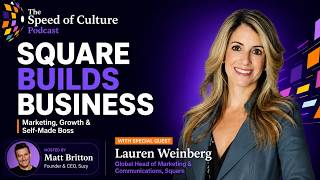
In this Speed of Culture interview, host Matt Britton talks with Lauren Weinberg, Square’s Chief Marketing and Communications Officer and author of Self‑Made Boss. Weinberg walks through her career—from early roles at Advertising.com, Media Metrics, and Nielsen, through a pivotal stint at MTV’s Fusion incubator, a move to Yahoo during its later years, and a brief consulting venture—culminating in her 2022 hire at Square. She explains how Square evolved from a simple card‑reader to a full‑stack fintech platform offering payments, banking, payroll, and marketing tools for merchants of all sizes. The conversation delves into Square’s marketing philosophy, balancing performance acquisition with brand storytelling, ecosystem campaigns, and channel experiments across YouTube, TikTok, podcasts, and streaming. Weinberg describes Square’s flat, non‑hierarchical culture shaped by Jack Dorsey, the shift to permanent remote work post‑COVID, and her leadership practices that prioritize junior voices. She discusses current priorities: helping merchants diversify revenue, leveraging first‑party data, and exploring AI for marketing and customer service. Weinberg also shares the motivation behind writing Self‑Made Boss, the challenges of building a consulting business, and her personal mantra “Life begins at the end of your comfort zone.” The interview offers insights into career navigation, fintech marketing, culture building, and the evolving needs of small‑business owners.
Chapters
Up today, we're gonna be speaking with an old friend, Lauren Weinberg, Chief Marketing and Communications Officer at Square. Lauren was named one of Brand Innovator's Top 100 Women in Marketing for 2022, and is the bestselling author of a book called Self-Made Boss. Lauren, so great to see you today.
So good to see you too.
Absolutely. I've been wanting to do this for so long. Uh, you've had such an amazing career and I'm super excited for our listeners to hear a little bit about your journey. Um, just looking at your background, I mean, you, you've sort of been at all different sorts of companies. On Your Rise. And what kind of stuck out to me is you were at Advertising.com right after sort of the dot-com bubble burst and there was sort of rebuilding again. You know, how did you end up, I guess, in the overall career of marketing advertising and what led you to there as sort of like a launching pad for you to where you are today?
Well, it's interesting that you picked that place in particular because I will say that Advertising.com is a very special place in my heart. It was an amazing— many people say that who were there, just like a very typical like startup, loft in SoHo, but so many of the people that I met there have played a really important role just in my career. But I will say how I ended up there. Um, when I graduated from college, so when I was in college, I thought I wanted to be a journalist. And so I did a lot. I mean, I think I was in a program there where we had to do over 200 hours of internships. So I worked at CNN, I worked at the Atlanta Journal-Constitution, I worked at Jezebel Magazine in Atlanta, and I graduated and thought, I don't wanna be a journalist.
Interesting. Right.
I wanted to move to New York and I needed a job that I could afford to pay my rent. And so I had a cousin who was working at a company called Media Metrics, which was one of, was a competitor to Nielsen and a measurement company. And it was really early dot-com days of just kind of looking at all the up-and-coming like dot-coms. I remember when Google just first arrived on the scene and everybody was talking about Google and what is this? And we would put out a report there called the Top 100, which was the 100 biggest sites that all the advertisers would then go and buy advertising on. So that was my foray into just like measurement and the digital world. And after doing time at Comscore and then going to Nielsen, I wanted to be more on the client side versus being in like a research kind of measurement vendor. And so I had some people that I had worked with at Comscore and Nielsen that went to Adcom. They all had great things to say about it. So I went there and it was an amazing like 4-year experience being there.
Yeah, I think working at a startup in like the heyday, a lot of people who have worked with me, you know, when my company was on the upswing at MRY or even Suzy now, they all say just the learning, the hands-on experience they get there, the camaraderie, the connection to people is really like nothing else. And a lot of those relationships do definitely carry you through your career.
Yes, I'm still really good friends with a lot of people that work there and it felt like a utopian society going to work every day was so much fun there.
Absolutely. And then you went on to MTV, which really was at, I would say that almost like the peak of TV's power. If you look at sort of the timestamp of when you were at MTV from 2007 to 2010, really since then, that's when streaming started to take hold and Netflix and TV has never been the same way again. What were sort of your learnings there being part of such a cultural institution as MTV is?
So yeah, that was a really interesting time to be there because I think for MTV at the time, all of their revenue was still coming from the TV side of the business, but they knew consumer attention was shifting to digital. Right. And so it was really interesting for me, I think, just always being in the digital world, going there, I was on the digital side of the business and just seeing them struggle with how do you navigate that, knowing that the future is gonna be over here, but all of your money today is still over in this other area of the business. And so I think for me it was really, interesting to be there. There was a lot that we— I was part of a really interesting team there called Fusion, which was like an inside incubator unit building out like marketing programs for the biggest advertisers that worked across all of MTV Networks. So things on the digital side and on the linear side. And so that was, was really fun. I think the hard thing honestly about being there was just their own confusion about how do you invest in the future when so much of your money still in linear. And I think for me, after being there for a few years, I thought, I just wanna be at a company that knows digital.
It's all about the future.
It's all about digital because that's like where I kind of grew up and that's what I wanted to go do. So then I left and went to Yahoo.
Yeah. So you headed west, you actually moved, uh, yeah, to San Francisco and you went to work at Yahoo. Really, you know, at the, I guess the, the latter stages, uh, of their heyday. But you know, 'cause they were a dot-com darling and they went through so many peaks and valleys, but obviously, no shortage of excitement and interesting things. I'm sure you worked with at Yahoo. When you look back at your time there, what are some of the highlights that you think helped shape who you are today?
Yeah. So Yahoo was just an amazing experience all around. I think if you talk to people who worked at Yahoo, they all say they feel like they bleed purple. And I think that is definitely true. So I think Yahoo— met amazing people there and it was It was a hard time for the company, but a great time to work there because I felt every like 3 to 6 months my job changed like significantly. So I think when I reflect back on my time at Yahoo, Yahoo's really where I made a leap from being on the strategy insights and analytics side to actually working on marketing and being part of the marketing team. And that was like an amazing experience for me. And I went from the B2B to the consumer side of the business while I was there. And so it just was, this amazing evolution in my career where I met great people who gave me a chance to do things that I don't think I would've been able to do if I hadn't had those relationships with people. And I think the best thing that I learned at Yahoo was just how to handle change.
Yeah. I'm speaking of change, I mean, making that leap early in your career from going from New York to San Francisco, somewhere where you probably didn't have a lot of roots. Um, you know, was that a hard decision to make? And is that something that you struggled with, um, over time and Also, like, is it different working for a company in San Francisco? Is just the vibe and culture different? And what, in what ways?
I know it's a— There's a lot in that question. So I will say, yes, it was hard. I moved there with my family. We did not know a single person, not a single person. So I knew some people that I worked with, but I did not have any friends there. And I think at the time, you know, my husband and I both thought, well, we've always been on the East Coast. Everyone we know has always been on the East Coast. And so, you know, we're definitely kind of adventurous and we thought, we should do this. We thought it would only be for a year. It ended up being for 7 and a half years. And we thought if it's the worst one year of our lives, like we'll deal with it and we'll still get the experience. So it was scary. But at the time, and I had delayed that decision, so I had been at Yahoo for a couple years and when Marissa Mayer came in, she hired a new CMO. And when I met with her, I pitched her on this idea for a role that I wanted to have. And she said, yes, but you need to move to California. And I said, okay, well, I don't really know you. You don't really know me. So let's have like a 6-month trial period just to make sure that it's a good fit for both of us before I uproot my entire family and move across the country. So that stretched into 9 months. And after 9 months of basically commuting to San Francisco from New York, 2 to 3 weeks a month with a 2-year-old and a 4-year-old, I was like, we gotta move. And so I think we were ready to go at that time. And yeah, it is very different there. I'm really glad. That I have had the experience of working at Yahoo's headquarters and then when I went to Square at Square's headquarters, there's definitely something about being there. Yeah, that is different. And it's like a nice to be a part of like where the action happens and conversations in the hallway and all the things that they say about Silicon Valley, they do really matter.
Yeah. I mean, and also in this day post-COVID, you know, many companies will never capture that vibe again. Yeah. Or worse. I remember our company, you know, March 2020 and every single employee up until COVID hit was there. Every day. And when you're building a software company, much like, you know, Square or Yahoo, whatever it may be, you're not building a physical product you can touch and feel. So the only physical manifestation of your business is the office, and that's how you can see the progress of the business. So I definitely feel that that is a void that we all face now. Obviously, it comes with some benefits and much more productivity and, and all of those things. Yeah. So, yeah. So you were at Yahoo. You obviously— and I also want to say, like, Marissa Mayer at that time was one of the most iconic CEOs in the world. Like, what's it like to work for such a high-profile CEO who really every move they— she made at that point was widely publicized? In some ways she was controversial. I'd love to know just what your experience was with her.
Yeah. So it's interesting. I mean, I do— I had a lot of empathy for her, right? Because everything that she said or did was just like so highly criticized. I think I always say this about her role. She had a really hard job to do coming in to turn around Yahoo and I, I think in some ways, like, she came into that job pregnant, which was really amazing. Um, she had more children during her time there, and I think, like, she did what she needed to do for her family. And there was a lot of criticism around that. And so I will say I learned a lot by watching her, and there's definitely things that she said and did, um, that I think will stay with me forever. Um, so definitely lots of empathy for just how hard that role was for her to come in and really try to turn Yahoo around.
Absolutely. Absolutely. And then you made a decision to do some consulting for a bit, and then you joined on at Square. And a lot of people don't know how powerful of a platform Square has built and how important it is for so many businesses. If you had this— I'm sure that you run into friends all the time. You're like, oh, I'm at Square. It's not like you work at Coca-Cola or even Yahoo or MTV, where everyone knows what it is. How do you usually describe what Square does to the common person who's not in tech?
Well, so for common people, I'll usually ask them if they like have ever transacted using Square, right? If you say like, have you seen the white iPad device in businesses in our town? Or like if it's people who live in Milburn, I'll say, have you gone to Live Bread? And you can order online. That's Square. And every— oh yeah, Square. And so I think a lot of people know it that way. But when I'm asked to describe it, I think, you know, our platform has evolved so much. It's so much more than just a payment technology. It it really is like a software and hardware solution that helps businesses run their entire platform. So I think when I, people ask me about it, I try to help them understand like there's banking, you can do payroll, you can send marketing campaigns, invoices. It's really everything. And I think for me, I left Yahoo, I started my own business. I didn't know about Square Solutions. I knew about Square. And when I got there, I thought, wow, like I just ran my own business. I really wish that I had known about all these things. That Square offered. And a lot of that really had to do with just Square's early days marketing strategy was really built off of the little light reader. Yeah. And so the strategy was bring everybody in for that. It's free, so you give it away for free and then it's just cross-sell, upsell. When I got to Square, you know, it was about 7 or 8 years into their journey and no one knew about the other things that they had and they already had a lot of other solutions. And it was just super interesting for me because I think when I started my consulting business, I knew how to get clients.
I knew about the work. When did you start a consulting business? How did that come about? I didn't even ask that. Yeah.
Well, so I decided to leave Yahoo. I mean, I was there for a little over 6 years and I would say like all around just an amazing experience for me and so much of where I am today, I really attribute to things that happened while I was there, to people who gave me opportunities and all of that. But when Yahoo decided that it was ready to be acquired, I decided that I was ready to leave. I think for me, like, it was a hard 6 years there. And I think one day I was sitting in my driveway just kind of like hesitating to put my seatbelt on and start my car. And then I thought, you know what, like, it's not a time where the company's interested in making changes. They just want to keep everything status quo so they can get acquired. And I never— I had kids. I did not take a lot of time off. Things were not as generous in that area as they are for parents today. And so I was just ready to, to just do a little, like, recharge my battery. And so I left Yahoo over the summer. I took the summer off, which was amazing. Spent a lot of time with my kids, really, like, felt grateful for things that probably lots of stay-at-home moms find annoying, like driving carpool. But those were just things that I never got to do. And then just, like, really recharge my battery, like a lot of self-care. And then my kids went back to school and I thought, I'm bored. I didn't wanna be in media anymore. And I think that was like the big thing for me. And I knew I wanted to go work for like a mission-driven company. And I wasn't sure if the skills— I'd always been in media and I just wasn't sure if the skills I had would translate into other industries. So I thought, I'm gonna start consulting and I won't take any media clients. And it was sort of a test.
So what did that look like? You just started calling friends or people you knew?
People called me when I left Yahoo and said like, I wanna— will you do a project? Or I want you to come work here, which was really nice. And I said, I need 2 months. Of not having any conversations with recruiters, with people at companies. I just need 2 months to really like reflect and think about what I wanna do. So I called some of those people back and said, okay, I'm ready to start doing some stuff. And I mean, it happened. I'm very lucky. It happened very fast and I had clients. Right. Then I thought, I have clients, I have to do the work.
You think maybe that was gonna be your thing and starting your own company at that point?
I really didn't know how it would go. Um, and it was hard. It was hard. I mean, my husband's a lawyer, so that was helpful because there's a lot of things. I mean, you know, cuz you started your own business multiple times. There's a lot of steps in that process. Yeah. That no one really tells you about. That's why I wrote the book because the book is about all those things. Right. And so I'm like, I don't know how to, I had to create an LLC. I didn't, I had a bank account.
They didn't teach you any of that stuff.
I know.
No one. At Emory, right? No.
And so I think that was like one of the funniest things about the work is that I would sign up clients, have a statement of work and all the things that were gonna get delivered. And then they said, how should we pay you? Right. And I was like, yeah, I don't know actually. Like, how do I wanna get paid? And so just kind of figuring all those, those things out. And so I did that for a little bit. It was fun. It got really busy really fast. And I think I very quickly realized that I, like, I couldn't scale this more with just myself. And I didn't really want to bring anybody else into what I was doing because I, I didn't think that it would be a long-term thing. And so after a couple of months, I think I started in September and by January I knew that I didn't want to keep doing that. And so I had a bunch of clients, but January I said, okay, I'm going to start like looking for jobs again. And then by March I had had a job offer from Square.
And why? You know, I know that you said you wanted to get out of the media world, but Square was a company which is really a B2B. Business, which you hadn't done. You've been more on the consumer side.
Yeah.
What made you decide to go there?
So I, so I actually think about Square as being like, now I think about it as being B2B, but also like B2B2C in a lot of ways because, you know, I have done a lot of B2B stuff in media. A lot of the work I did in media in the early days supporting advertisers on the B2B enterprise side. So then going to Square was kind of like this interesting combination actually of consumer and B2B because SMBs, are more like consumers than enterprise B2Bs. And so a lot of the marketing tactics were much more like consumer tactics. Now that Square has been growing upmarket and focusing on enterprise solutions, we have a combination of both of those things. But honestly, for me, Square, it was— I wanted to go into fintech. I was excited about that. I felt like there had been a lot of disruption in media, obviously with digital media and everyone, and I wanted to be part of kind of the next wave of innovation. And just I was in Silicon Valley, so I thought thought like, I want to go work in this area. I don't know anything about it. So I knew it would be a really steep learning curve. And honestly, I was excited just to start something new and to learn a lot. And I loved the culture and the mission of Square. And then coming from a place where I was running my own business, it was kind of just like a perfect match.
You were just there. Yeah, I was living the life that Square exists.
I went into their office and it was just this like feeling where, you know,, and I knew when I left there that I wanted to work there.
And when you talk about the feeling, ultimately what you're speaking about is the culture.
Yeah.
And, you know, another great leader who you now work for is Jack Dorsey. How much, you know, input did he have towards the culture and what were some of those tenets of the culture that made it and make it so special?
Yeah, I think he still plays a really important role in the culture. I mean, he's very humble, Jack, and he's just like constantly like learning and growing. And I really appreciate like his style of leadership just because like he has so much humility and also confidence. And I think the balance of those two things is really hard. And so he sort of operates with this level of transparency and accountability that trickles down into everyone in the organization. And it's the— one of my favorite things about Square is that there's just not this sense of hierarchy there. We don't really use a lot of titles or any titles or levels. And whoever does the work is the person who's talking about the work at Square. And I love when really junior people on my team challenge me and say, I think you're thinking about that the wrong way, Lauren. And I'll say, okay, yeah, tell me more. And then I'm like, yeah, you're right. I was thinking about it the wrong way. Thank you for pointing that out to me. And I love that about—
Yeah, because the opposite is we make fun at Suzy of this notion of the HIPPO, the highest paid person's opinion. And I've pitched in my, in my agency days so many companies where we'll pitch an idea and everyone's just looking at the boss at the end of the table for what they think. And if they like it, everybody else likes it. And if they don't, it's a bad idea. And yet I could be talking about a campaign that's targeting, you know, Gen Z and maybe somebody on the side of the table is a Gen Z or they have a kid who's Gen Z that knows more. And I think there's this misconception at big organizations that higher title means smarter, means they know better. And I think that ultimately is what can lead a lot of companies to become disconnected.
Yeah, totally agree. I have a rule with my team, which is whenever somebody someone's showing me creative or work, my opinion is last. Right. Because if I go first, I love that, then everyone, it sort of makes it really hard for other people. And so now, to speak their minds, right? Yeah. Yeah. So now my rule is like, everybody has to go and share their feedback.
I'm gonna adopt that from you if that's okay. 'Cause I think it's a great, absolutely. Yeah. As a leader, sometimes you think that you need to be the first one to jump in. You need to help set the direction, but ultimately you really could be myopically driving the future of the company. In ways that might not serve you or your, your company best in the, in the long term.
And I feel like I know I have like a loud voice and I have a lot of opinions about things. And so now I'll make sure if anyone has— everyone that has something to say had a chance to say what they think, then I'll share my feedback because it used to be that everybody would just start with me and then I didn't feel like we could have an honest conversation.
Absolutely. So, so today you're Chief Marketing Communications Officer of Square, obviously a very high-profile company. I'd love to know what you're focused on and what success looks like for you. I'm sure, you know, you think about in the beginning of the year— we're now in mid-February, time flies— but like, you know, beginning of 2023, it's like, okay, what does success look like this year? And I imagine that you have a framework that drives the way you work every day. Would love to hear a little bit about that.
Yeah. So I think this is going to be an interesting year. I would say every year since COVID started has been an interesting year for us, and it's been good and bad. I think we've learned a lot about like agility and flexibility And to be honest, like, I don't know what this year will bring for Square because COVID came and we thought, wow, there's going to be such headwind for small business owners. And it was the opposite. Right. And so, you know, I think the last 2 years have been just way less predictable. So heading into this year, so Square was born out of the last economic downturn. So this is really the first economic downturn that we face at this stage of the company. And what we saw during COVID was a lot of businesses really embracing technology. I think we'll see that again, which is, you know, businesses are worried about surviving, about how they can sort of reduce costs but also add new revenue streams. And I think those are areas like for us at Square, like we're really focused on helping businesses of all sizes because now it's not just small businesses, it's big businesses to think about how they can leverage Square's platform to help them automate certain tasks, there's definitely for some business owners just this resistance to really embracing technology. Yeah. It's scary, it's unknown. A lot of businesses are still operating today using pen and paper. And so I think that, you know, a lot, we saw this like massive adoption of technology during COVID Like I think the cycle that we would see, which was typically 3 years, was happening in 3 weeks during COVID Right. Like gotta move online, setting up online orders, QR codes, all of those things. There's another choice. Yeah. You had to, right? It was kind of just like adapt or die at that point. And so I think we'll see more of that. And so we want to make sure that businesses understand like that, what role we play for them. I think one of the interesting things that we're really hearing and feeling is that, you know, it's kind of like the one of the most basic rules of just finances, which is you need to have diversification. And so for business owners, you know, we're really talking a lot about diversifying revenue streams and we, We just did a study recently and 87% of restaurant owners are telling us that they either are or have plans to have some type of revenue stream that's not their core business, whether that's selling merchandise, cookbooks, cooking classes. And we see this as like a common theme across the boards where businesses really need to have multiple revenue streams. And Square's in a unique position because we serve so many verticals, like we have a lot of competitors in different spaces that are, have very niche solutions. And because we're broader, we're sort of uniquely positioned to really help our customers with that diversification strategy. And so there's going to be a lot of like financial literacy and education on what that looks like and what that means and just really helping them understand how to weather whatever's coming. Right. Yeah.
And I also imagine a lot of your role and given what you said earlier about people thinking Square is this white box, and I remember actually getting one of the first iterations where something you actually plugged into your iPhone. Yeah, you could swipe. And now obviously there's much more sophisticated hardware product that. But when you talk about Square being much more and being a true platform, is communicating all the different features and benefits of that platform to small business owners who may be, you know, unaware of it a big part of your overall role? Yes. I mean, storytelling, right?
That's the biggest part of my role. And actually, I would say when I got to Square, because the strategy was just about the little white reader that plugs into your phone, you know, and also I think like 99% of the budget that I got to Square and had from marketing was for performance marketing. Right. And so it was just not a lot of room for storytelling, right?
It's all about acquisition, storytelling, cost to acquire a new merchant, basically.
And I think, you know, when I got there, I said, there's all these amazing products and solutions. But if you ask people about Square, they would say, I love Square, especially bigger businesses, because a lot of our strategy is really around growing upmarket because we have a much more sophisticated set of solutions for large businesses. Upmarket by going to a franchisee. Franchise, franchise restaurants, but we're also in SoFi Stadium. Wow. So, I mean, we really go all the way up to really like enterprise-level businesses, and that's where we start talking about API integrations and how we work with other solutions. And it's not just like you're ripping and replacing what you have with Square. It's how Square can be additive to what you have.
And over time, hopefully they see the benefits of the ecosystem and you're plugging more solutions in.
Yes. So it's been a big, I think, pivot shift to, A, helping everyone at Square because it is true that like many Silicon Valley companies, people don't really understand all of the value of all the facets of marketing. And so when I first got there, CFO said brand is fluff and I said brand is not fluff, right? Brand is actually a huge like competitive moat for companies and an actual driver of value in your company in the long term. And so it was just the way we have been doing some things over time. And so we started actually doing awareness campaigns that we call our ecosystem campaigns. And we've had multiple iterations since 2019, but that do just that, explain, you know, obviously as much as we can in a 15 or 30-second spot, just that we have this entire suite of solutions that all work together to power your business. And so it's really like, how do we do it in a way that's both emotional but also functional?
So people understand what the use case is. How is it applicable to me? Yeah, don't use fancy words, but—
and also that doesn't feel like a laundry list, like, and we have this We have this and we have this, because that's very overwhelming for people. And so there's certain key things that I think access to capital is something that we always try to mention because most people don't realize that we have that.
I didn't know that either.
Yeah, that we have that kind of product. And it's something that I think a lot of businesses are thinking about, that they want access to that, right? At some point, even if you don't need it right now, you know, it's something that will be on their mind at some point.
So that's the message in terms of the media. Them and getting the message out. So you have an addressable market. It starts— it sounds like small business was the core and now you're moving upmarket to midmarket and even enterprise. What have you found to be some of the most effective tactics at getting that message out and landing the message to the decision makers at these companies?
Yeah, so we— a bunch of different things. So I will say I think Square does a lot of storytelling and we use our organic channels to really like highlight specific communities. We have a bunch of different series, like we've had a series a couple years ago called Black Owned that just talked about Black businesses in and the roles that those businesses were playing in their community. Last year, we had a new series called Only In, where we feature different cities. So we had Only in Austin, Only in Denver, and in Austin, we were talking to LGBTQIA business owners and talking about the role that they play in their community. In Denver, it was around Latinx business owners. And so we do have a very long story, interestingly, for being a fintech company, of doing really emotional storytelling. YouTube still, I would say to this day, plays a really big role. We had a bunch of new series that we launched on YouTube last year, Career Day, You Two Should Meet. These are kind of more geared towards like Gen Z audiences. That is really important for us as well. And then for some of our paid campaigns, you know, all the digital channels, I think we have found streaming to be a really effective channel.
Targeted streaming.
Yeah.
Wow. Towards small business owners.
Yeah. Yes. And, but we also use podcasts a lot. Yeah. And for podcasts, we go more, we've tested B2B-focused podcasts versus just consumer-oriented podcasts like sports and entertainment and have found that the consumer-oriented sports and entertainment podcasts with really influential hosts actually perform better for us than more business.
I hear that all the time.
Type of content. And so we like to have our relationships with a host and kind of have that relationship for a long period of time. But yeah, I mean, I would say for this year, like we are experimenting in on TikTok. We know there are billions of small business owners on TikTok. We've done some really fun things outside of the US with business owners in TikTok, especially in Australia. And so I think for us this year, like we have to keep experimenting on that platform until we figure out like what's the right way for us to engage there. Because A, I think TikTok is interesting from other platforms in a lot of ways, but You know, we hear this about like from book authors and just businesses alike that TikTok drives sales. Yep. And so we see this for businesses, like we'll sometimes help them with their TikTok content and then we see their sales go up.
I mean, it reminds me of when I was trying to get big brands onto Facebook and Instagram and they were like, oh no, only the kids are on it. And then all of a sudden you realize, wow, everyone's on it. It's getting bigger. People who were the kids are now the decision makers. We can't ignore it. It seems like it's the cycle's happening all over again. Happened with Snap and it feels like it's happening with TikTok now for sure.
Yeah. Yeah. So I think for us, like, we need to figure out how to do a better job of really like just what's our strategy there and how do we unlock it? And I think we have to just keep experimenting.
Right. Which is interesting because many people would think a company the size of yours, experimentation sort of out the window. Now you just have to optimize, optimize. But it sounds like Square and the parent company Block is really— you still maintain that sort of startup up scrappy vibe to it.
Totally. Especially I would say like that is the theme for this year, which is like we, you know, I think are operating with a little bit less budget than we had last year. And so it's all about experimentation for us this year and not taking huge risks, but taking a lot of calculated risks and trying to find ways that we can really punch above our weight in terms of what we have. And I think we really want to like find those like breakthrough activations, more local activations. So things that we can do in specific cities And so this year, I think the big theme for us will be all around experimentation.
And are there other trends that you have your eye on in 2023 in terms of where business is headed and some of the things that are coming out in the world of like AI that you think are applicable to being able to maybe land for your merchant base to make their lives easier?
I mean, AI is going to be really interesting and we're thinking a lot about that right now. And how do we— like, there's, there's definitely a ton of potential use cases for us and there's ways that we use it already today. And so I think that one's going to be really interesting.
It's like customer service and how does a merchant handle questions from customers? I can think of so many integrations.
Even just like we have marketing products for our customers, right? Marketing, when you run your business, is one of the hardest things for business owners.
Intuitive to you, right?
And for most people it's not, or they feel like they're spending just like an inordinate amount of time really on their marketing strategy or just trying to figure out what channels to be on, how do they create content for those channels. And so I think there's going to be some interesting amazing developments in terms of how do companies like Square and others use AI to help, you know, small business owners and business owners like generate content, even if it's just a starting place for them. I think it'll really help, right?
Yeah, I think it's incredibly powerful if you think of— I mean, I imagine Square allows merchants to capture first-party data. I mean, and that ultimately obviously is the new oil, right? Yeah. In a world where you can't target the way you used to on platform. So I'd imagine that's ultimately unlocks this entire full funnel approach, is getting that first-party data.
Yeah, absolutely. And I mean, we talk to a lot with our customers about just like encouraging them, how do you do that? How do you capture the data? I mean, they do that a lot at the point of sale, right?
Right. But I mean, traditionally it was easier, much easier online than the retail establishment. Yeah, people might come and go. So let's switch gears a little bit to your role as Chief Marketing Communications Officer in terms of what that means in terms of how you spend time, because a lot of people who are listening to this podcast, they want to end up where you are in the C-suite at a prominent, exciting brand, but they don't really fully know what that means and how it manifests to kind of the pie chart of their days. I'd love to hear from you. What does a day in the life of Lauren look like?
It's very interesting. And I feel like whenever people tell me that they want this kind of job, one of my first questions to them is usually, do you know what that even means? Right? Because I think that there's a lot of stuff that happens in my role that most people don't see. So I would say There's definitely like, depending on the time of the year, a good portion of my day where I'm looking at work, looking at creative, looking at plans, just approving it or, or reading feedback, giving feedback. And that's the most fun part of the job, right? But I think everyone thinks that is the job. I would say there's a lot of time that I spend with our finance team, with our CFO, really understanding how we're measuring the impact of our work, especially in 2023, right?
The CFO's the star of a company right now.
I wouldn't say every square is the most data-driven company that I've ever worked at. And I think we have an amazing team of just like incredible marketing analytics folks that are always trying to like just push the envelope in terms of how we measure the impact of what we're doing. But it's hard, right? The challenges that we have as a brand, everyone has as a brand. And these are the things that all CMOs are talking about, especially right now, right in this time where everyone's kind of looking at every dollar that you spend with extra scrutiny. Mm-hmm. And then there's components of marketing that are harder to measure. There's things that you do for your long-term that don't show up in the short-term. And so it really is like, how do you find the right balance? So I feel like I spend a lot of time in my day meeting with executives and people on the finance team to explain just like, how do we think about that? And just sharing a point of view ahead of these decisions, getting everyone aligned on What's our investment strategy and are we aligned there so that if they come to me and say, we need you to cut your budget, we already know how we're thinking about where we would make cuts from because we've already aligned on how we think about it. It's a ton of repetition, education, just constantly looking for new data points to reinforce the points that you're trying to make. Yeah. And validate some of the more long-term brand-driven strategies that are really important for companies today.
Absolutely. And, and, you know, we were also talking about how during the pandemic you made decision to move your family back from San Francisco back to the East Coast. Talk about that decision and, and also how it's changed the way that you manage your team now in a remote environment where your company is based still in West Coast.
Yeah, so that decision was really driven based on family and just wanting to be closer to everyone in my family that was here. And my kids were at an age where I thought I could move them back and they could still adjust, but that was— that clock was ticking on making that decision. So it kind of got down to like a now or never for us. Yeah. And so, yeah, I mean, I loved my time in California, but it's nice to be back and it feels just like being home and being around everyone that all of my really, really good friends are here and everyone in my family is on the East Coast as well. So that part's been really nice. And in terms of managing the team, I would say, you know, Square's a work from home or work remotely forever company. And that was something that they decided really early on in the pandemic. And that was a huge impetus for me to move. Right. Because I thought, okay, like I had thought about it before. Square's had offices in New York since the beginning of their time as a company, and it just— I thought it would be too hard. But then everybody started to move all around. And so I thought, okay, I can do this. And I do think for the most part, it's been a pretty like seamless pivot for us. And there's a lot of benefits, I think, to working remotely. I mean, in terms of like diversity and inclusion, it's been tremendously helpful for us to not be so limited to San Francisco and New York, um, in terms of markets in the US. So now we've got people all over the US, and that's better for us because that's actually a better representation of who our customers are. So that part's really good. I think we're getting to the point in time now where Sometimes we're having hard conversations and I just wish we could all be in the same room together because there's this, you know, etiquette of not wanting to like talk over people on video and just like, how do you have conversations with divergent perspectives? And sometimes it's like, I just wish we could all be in the same room. And I also have a lot of empathy for just more junior people coming into the workplace because they're not getting like, it's, I think it's just a little bit harder from the mentorship angle. So we try to go out of our way to do a lot of like Like I do like, I do like one-on-ones called tea times where anyone can get time with me. I mentor different people every quarter on my team and we kind of have this whole signup sheet of just what's a skill that you wanna learn? And then people say, here's a skill I think I could teach somebody, but really trying to find and foster more of that sense of how do you drive that with intention.
You can't just be reactive. You have to say, this is, I'm gonna set to do, you have to be really intentional about it or it won't happen.
And then it's not great for people who are just starting out in their career because 'cause all of those kind of just like chats that would happen organically in the office, you don't have that anymore.
Yeah. The serendipity. Absolutely. So we're gonna wrap it up here. Just, you know, I thought it was really interesting that you decided at this stage of your career last year to, to write a book. So you wrote a very successful book called Self-Made Boss. Where did that idea come from? Obviously you have a very busy schedule. You're managing family, you're managing this exciting career. What gave you the time to do it and, you know, what drove you to, to, to publish a book?
Yeah, so I had an amazing co-author, Jackie Reese, and to be honest, we, during when COVID first started, when I was in California, she and I would kind of walk around in our neighborhood because like there was really nothing else to do at that time. And we thought a lot of people are gonna start businesses now, right? Anytime you kind of have these like really disruptive moments in time is usually the spark for innovation and a lot of new companies. And we already could see the data right? Like new business starts starting in like April of 2020 really were kind of like going through the roof.
And you've been there, you as a consultant, you knew what it was like.
I knew that. Yeah. And then I think, you know, Jackie had left Square, was starting her own business. And also we had spent time talking to hundreds, if not thousands of business owners throughout both of our time together at Square. And we thought there's so many things that business owners don't know that they all are kind of like, feel like they're reinventing the wheel each time. And what if we put together a book that was a guidebook for them and we could interview business owners and it's told through their perspective. So it's not a very academic kind of book at all. It's really just like talking to people who have been there, done that, been in their shoes. Practical, pragmatic advice from business owners of all types and sizes. We cast a lot of real business owners in our stories, in our commercials. So we had a good starting place of, of just business owners that we thought are really interesting, compelling, have very interesting backstories and that people would wanna hear. About. And so that was really the idea for the book, which is people are gonna need this information. We both know what it feels like. I had no idea how to set up an LLC and like I had to do hours of research, spend hours at the bank trying to figure out how to set up my own account. And so we said we could write this book as a guide and you could read the whole book through, or you could literally go in and just read the chapter on marketing or just read the chapter on navigating roadblocks. And at the end there's like tips for business owners. And we just thought this, if there's one thing that one person gets from this book that makes their life a little bit easier and enables them to be more successful, then that's success to us for the book.
Very cool. And what was the experience like in writing a book and what do you think you got out of it? And it's something that you'd do again or recommend to others to do?
I would do it again, but not with a job like the job that I have now. So I think for me it definitely like pushed me to an interesting point. So I also had my son's bar mitzvah. So it was kind of like my son's bar mitzvah, the book, and my job all at the same time. And I very rarely feel like I get to the end of my capacity level where I said to my husband, like, I'm there. I feel like I'm stretched really thin. And I think that, to be honest, like writing the book and doing the interviews I thought would be the hard part. And ironically, the hardest part was promoting the book. Yeah.
And I think everyone thinks if you have a publisher, they're going to do it for you, or ultimately it rests on your shoulders.
Or I thought it would be a very short thing. I thought it was going to, like, naively, I thought I'll promote the book for 2 weeks and then we'll move on. And so that's not how it works at all. It's a really long kind of burn. And so I think for us, what we decided early on is we're going to pitch this book to companies because there's so many companies that care about this audience. Audience and try to go that way and go to like their events where they're talking to small business owners and then have them buy the book that way as opposed to trying to just like sell individual copies of the book to all the consumers. And so, you know, it was, it's an amazing experience. I'm really proud that we did it and of what we did. I would definitely write another book, but I would have to do it either like when I'm retired or in between roles. 'Cause it definitely was a lot to take on.
Yeah. I mean, the great thing about writing a book is the permanence of it. Like, you wrote a book, it will always be there, people can always find it, and I just find that to be super cool.
Yeah.
When all said and done, it's something that really, um, will withstand time.
It was— I'll just say it was definitely on my bucket list of things that I always wanted to do, and I'm really glad that I did it.
That's amazing. Well, this has been, um, really such, um, incredible time with you, learning about your journey. Uh, to wrap it up, is there kind of one mantra or quote you like to live by you think has driven your career? Because obviously there seems to be so many common themes in your ascent. I'd love to know from you if there's one thing that kind of sticks with you.
There's one thing, and it's a magnet that's on my toaster oven, and it says, "Life begins at the end of your comfort zone." And I think that's something for me that, especially when it comes to my career, that I really— whenever I talk to people about my career, I say I've always navigated my career by taking a role that's somewhat rooted in something I know and 50% probably really like. Like scares the shit out of me. I don't know if I'm going to be successful. And that's how I know it's the right thing to do.
It takes growing, right? Yeah. And learning. So that's amazing. And I have no doubt that you'll continue to do it throughout your career. So thanks so much on behalf of Suzy and the Adweek team. Special thanks once again to Lauren Weinberg, chief marketing communications officer at Square, for joining us today. It's going to be a great episode. Can't wait for everyone to check it out. Be sure to subscribe, rate, and review the Speed of Culture podcast on your favorite podcast platform. Platform. Till next time, see you soon. Take care, everyone.
Bye-bye. Hey!
More from Matt




MikMak’s Rachel Tipograph on Consumer Spending, Retail Media & Holiday Shopping Trends



Jaguar Land Rover’s Charlotte Blank on Luxury, Purpose & Experiential Storytelling



