T-Mobile’s Mike Katz on 5G, Sports Partnerships & Customer-First Marketing
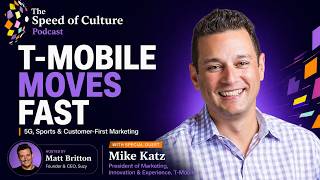
T-Mobile's CMO Mike Katz discusses the company's growth to 110 million customers through customer-first culture and strategic partnerships with Formula 1, MLB, and Delta. He highlights 5G's 10x speed advantage over 4G and its role in home broadband and enterprise networks, while stressing AI's importance for processing first-party data and real-time support.
Chapters
Welcome back to today's episode of Speed of Culture here in Las Vegas at the Consumer Electronics Show. And I'm super excited for today's special guest. We have Mike Katz, the Chief Marketing Officer of T-Mobile. Thanks so much for joining. Great to see you, Mike.
Ah, good to see you too. Thanks for having me.
Absolutely. We're gonna dive into T-Mobile, such an incredible, you know, run T-Mobile's had and lots of exciting things going on for T-Mobile heading into 2023. 3. But before we dive in, love to hear a little bit about your 25-year career at T-Mobile, kind of all the different paths that you've had there to lead you to where you are today.
Yeah. How long is this podcast? I've been really fortunate and one of the few people that's essentially spent my whole career at T-Mobile. I did have a job before T-Mobile. I worked at Sherwin-Williams and delivered paint when I was in high school. So that was my pre-T-Mobile experience. But it's been an incredible journey and opportunity for me. And I— and even though it's been 25 years at one company, it really feels like I've worked at 5 or 6 different companies because, you know, I technically started with VoiceStream, which was the predecessor company to T-Mobile before it was purchased by Deutsche Telekom and became, became T-Mobile. And then we've gone from periods of fully owned subsidiary of Deutsche Telekom to in 2013, we did a reverse IPO when we bought MetroPCS and became a publicly traded company in the US. So, and through a bunch of different CEOs and stuff. So it feels like I've been with a bunch of different companies, but You know, one of the couple of reasons why I've stayed with T-Mobile as long as I have, first and foremost, is T-Mobile has an incredible, very, very unique culture that I think when you see and interact with the brand as somebody that doesn't work there, you can kind of feel, you know, we are a company that doesn't just talk about being customer-centric and putting customers at the middle. It literally permeates through everything that we do. It influences who we hire and influences who we promote. It influences the way that we manage programs. And it just attracts a very unique, different kind of person. And for me, and I think for most of us, people is the number one thing that keep you around a company. And I just feel so fortunate I work with just such an incredible group of people. Everybody from the people that work in headquarters, the people work in our stores, the people work in call centers, just incredible people with a really unique culture. I've also just had the good fortune of just getting the opportunity to work across a lot of different parts of T-Mobile. I started my career on the front lines I worked inside big illustrious retailers like Circuit City. Circuit City was a distributor for T-Mobile, and I would park myself inside Circuit City and trying to sell cell phones to people. Sears was another big one back then, and went from that to working in corporate strategy at T-Mobile, which is essentially a small internal consulting organization, and then started my marketing career at T-Mobile probably in like 2009, 2010. When I had the opportunity to take over T-Mobile's prepaid business, which we ran as a marketing GM sort of role where I had responsibility for the entire business and the P&L and the positioning and all the advertising. I then worked— I ran our consumer acquisition business. I most recently, before I was in this job, I had the opportunity to run our B2B business, which a lot of people don't look at the T-Mobile brand and think of it as a B2B brand. Which is exactly why I went over and started working on it, because we had historically been very under-indexed in the B2B segment, and we worked for the last 5 years not only to get ourselves into it, but start going and capturing disproportionate share. So I, I led all of our B2B activities for the last 5 years, and then at the beginning of last year, I took over as CMO. And, and CMO at a company like T-Mobile is a probably a little bit different role than it is at most large-cap companies. I do have responsibility for all of the traditional marketing functions, but I also run, like most CMOs, almost all of IT. I run supply chain, and I run our whole wholesale business and product. And the big reason for that is T-Mobile has, is, and always has been a marketing-led organization, always. And marketing's kind of at the center of everything that we do. It leads the strategy at T-Mobile, and helps guide the different business groups into execution. And therefore, the CMO role tends to permeate beyond kind of the traditional bounds of marketing. So, there's my very short summary of 25 years at one company.
Well, I mean, it's incredibly unique, and it's definitely a first at the Speed of Culture Podcast that we're speaking to somebody with your prominence and your position that's only been at one company. And I think it's rare. This day and age, especially, you know, I have a lot of Gen Z, younger employees, and they're very ambitious. And sometimes that means younger people jump around from, you know, job every couple years. I think it's going to become increasingly rare, much like it is in sports, right? You have athletes that want to jump around from team to team. And I think that there's such a benefit from the journey that you've had, not only the continuity of just being at the same company, but all the different places where you've had your hands. And now that you're in a position of CMO, how do you feel that the experience you've had being everything from on the, you know, retail floor to having experience in sales impacts, I guess, your ability to command the brand and move it forward?
Yeah, it's such a great question. And I honestly don't think I could do this job unless I had those experiences. You know, for a company like our brand, like I said at the beginning, the thing that makes us unique and different is our obsession with the experience that customers have, our obsession with it. Like, we obsess over every detail of it. And I think not having the experience working in the front line and working directly with customers, it's very difficult to put yourself in those shoes if you haven't done it before. So I think for me, first and foremost, that the experience working in the front line of the company, critical to success in this job. I also think my time working in corporate strategy, which is one of the few places— T-Mobile is a matrix company with lots of departments, but corporate strategy is one of the few places where you actually can look left to right at the entire company and understand how the entire business model works. And for me, in being the CMO, it's one of the only other jobs where that's a big part of my responsibility. And so not having that experience and also kind of gaining a foundation of strong corporate finance and understanding our business model would make it really difficult for me to do this role successfully.
Absolutely. And now that you're in the role of CMO, I mean, you know, the wireless services space is really— I look at it as like 3 main players. Obviously, T-Mobile is now the second largest wireless carrier with over 110 million customers. When I saw that number, it was, and I know that a byproduct of that is the recent merger with Sprint. But as I look at those three players, you know, the other two I kind of look at as the incumbents, and I look at T-Mobile as still like a challenger brand, and they're always shaking things up. Everything from the look, tone, and feel of the brand, how you do your marketing, et cetera. You know, is that something that you feel like a heavy responsibility to continue to play as a company, even as you have such scale that you've achieved.
Absolutely. I mean, it wasn't that long ago that this was a 4-player category, and we were 4th by a long margin.
Distant 4th.
Distant, distant 4th, and we had to be the challenger, and we had to be punchy, and we had to be scrappy, and one thing that we've always said, and Mike, our CEO, has always said this, is from day one, he always said, "We aspire to be as big or bigger than the other guys, but we can never become them." We can never become them. It's so important that we maintain this unique personality that this brand has, that the one that's always looking out for the customers and feels like an underdog. And yeah, I mean, we've, we've been really fortunate that we've been able to scale our business the way that we have. We are number 2 in terms of customers. We're actually number 1 in terms of value. We became the most valuable telecom, not just in the US, but in the world last year. So there's a bigger target on your back and It definitely puts more challenge in continuing to raise the bar on experience for customers, but it's a challenge that we love. Like, we really love that. It kind of forces us to, you know, think about new and unique ways we can make experiences better for customers. We also can benefit from the scale in doing things for customers that we couldn't do when we were a smaller company. But yeah, it's something we think and obsess about a lot.
Yeah, and you've made clear that the culture of the company and the people is so important. I'm sure they all sort of embrace those tenets. Of sort of the fighter spirit, et cetera. But you also obviously have to bottle that up into storytelling and content for the consumer.
Right.
How do you look at doing that in this day and age where there's so much fragmentation? You know, you have Gen Z, a whole new generation that grew up with basically the phone as an appendage to their body. You know, that actually, I would think, is continually challenging to accomplish.
Yeah, it is. And people are distracted. Right. I mean, you know, it's a lot of articles have been written about this, but, you know, you used to be able to— not even that long ago, we could run an ad on TV like on Thursday primetime and then wake up on Friday morning and watch people just rushing in. Must be TV, ABC Thursday Night. You could get millions and millions of eyeballs on a program. And it's a lot harder now. People are distracted and content is very fragmented. So I think there's a couple of things that are really key for us. One is— it puts a much bigger burden on you for good storytelling, powerful storytelling, storytelling that will cause people to pause for a second and actually look at what you're saying. So it's really forced us to be much more clear with our message and have delivery vehicles that can draw people in. And for us, a big part of that is, you know, a big part of the tone of our brand is clever humor, you know, tongue-in-cheek humor, and things that people actually enjoy watching when they're seeing video content of ours. But the other big one, and I think this is— we've taken steps here, but we've got a lot more runway in front of us, which is how can we make our messages to customers much more contextualized? You know, how can we take information that we know about, about you? And rather than the next time you talk to us, it feel like the first time you've ever had an interaction with us. You know, we make, we make our message a little bit more personalized, a little bit more relevant to what you do, regardless of what channel you come in, whether it's you're seeing us in a digital ad or you're seeing— going onto our website or you're walking into one of our retail stores. You know, the last— honestly, the last thing a lot of people want to do is deal with their wireless company. And we should make that process easy every time you come in to interact with us. We should know why you're in the retail store and say, yes, we understand why you're here. Here's your upgrade and you're good to go. Right. So again, we've taken some initial steps on that journey, but that's where myself and my team are really focused is how do we build that experience in a way that raises the bar on the overall experience that customers expect from us.
So I would imagine that all starts with 110 million customers. It all starts with the first-party data you have on those people, because I'm sure you have very deep customer segmentation across your customer base based upon the products and services that they tap into.
Yeah, for sure. You know, we do have a lot of customers, and, you know, we know, you know, when and where our customers interact with us. So it definitely starts starts there. It also starts with being transparent with customers about when and how we're going to use that data, which is also a really important principle for us. So, only doing things that customers agree beforehand that they're, that they're willing to have us do. But yeah, for us, absolutely, this journey starts with looking at our existing customers and helping them through the next step in their journey with us and just making it a lot more simple.
In terms of continuing to drive growth for the business, I saw that T-Mobile stock was up 20% last year, which is, you know, nothing short of a miracle based upon the bloodbath we all saw in the markets. But obviously, I'm sure there's continued pressure to grow the customer base. What are some of the channels that you're looking at from an advertising and marketing standpoint that are compelling to you here in 2023?
You know, we do have the burden, but also the huge benefit of being the growth company in this category. And in my opinion, you always want to be the growth company. It's a lot more fun to be growing than just trying to grow. Or having somebody else nip at your heels. Yeah, somebody eating you.
Yeah.
Right. We have several big growth vectors in our business that are big focuses for us. And some of these are new areas for us, which cause us to think differently about how we market to customers. The first big one for us is T-Mobile, in its history, historically has been mostly focused on urban and suburban areas. You know, think about the top 100 markets in America, and in fact, If you look at average in the top 100 markets, we have the number 1 share position. Also, historically, in small-town rural environments, either T-Mobile hasn't been existent or we've had really low share. And a lot of that is because we've had massive development in our network even over the last 4 or 5 years. And just, there's a lot of these places where we didn't exist. Right. They saw, you know, we're a national advertiser, so they saw a lot of our TV advertising. But, you know, there was no other presence really for T-Mobile in these areas. So that's one big growth vector for us. The other one that I'll mention is business. I mean, I know I talked about it in the preamble a little bit, but business is another area where T-Mobile's historically been under-indexed across all business segments from small business to enterprise to government. And we now have, you know, businesses buy different than consumers in this category. You know, first you have to demonstrate to them that you have a great product and then you can talk to them about the other parts of your proposition. And we now feel like we've got a product that's as good or better than our competitors, which has really opened the door for us to have permission to win in B2B. So given those, those two growth factors, you know, for us, there's a couple of different things that we've kind of introduced into our marketing mix. One on the local side is getting a lot more local with our marketing, going down into communities and starting with like community outreach, you know, showing up at, you know, the Friday night football games, you know, doing ribbon cuttings with mayors in small towns, like, like showing a connection to these communities. And then localizing our message, you know, like not using like the big national claims that we use about our network, but, you know, come to, you know, northern Minnesota and talk about how T-Mobile's here and what our specific benefit is in that area or that county or that state.
Incredibly powerful. Also difficult to scale sometimes.
It is. It is. Yeah. And that's— and it's been a process. We're not fully scaled with this yet, but it's been a new muscle for us to build to do this this much of localization in our message. And then on business, it's probably the combination of two things. It's one, picking the right parts of our message that we know is going to resonate with the people that have influence in business decision makings. And a lot of that starts with the thing that I said that is prerequisite, which is building confidence in our network. So we've had to shift in our communication the focus of message when we're talking to businesses. And then we've really started to develop some of our ABM capability, account-based management capabilities, where, you know, we can identify and then communicate directly with the people that we know influence and make decisions in organizations and serve them with relevant content that can help them through their decision process. And the decision process is elongated in business as well. So it is a much longer journey. It's not a considered— it's definitely considered sale. So, the journey and the number of touchpoints that we need to have with businesses is quite a few more than it typically is with consumers. So, we've had to change some of our technology that we use, and then certainly the delivery that we use when we go to businesses. So, I'd say those are the two biggest examples.
And I know, you know, Gen Z continues to be a big focus of T-Mobile, and you guys have had partnership, you recently announced a partnership with F1. Major League Baseball has always been a big focus, at least as long as I can remember. Talk about some of those passion points that T-Mobile likes to align with and why you think that's important for the business?
Yeah, I'm really glad you asked that question. One of the first principles that we have in any of these kinds of partnerships is we don't love to just come and slap our brand on something. We don't think it's really value-add either for us or the partner necessarily. So one of the things that's critically important to any partnership that we have is it's predicated first on a technology partnership. And I'll use F1 as an example because we're sitting here in Vegas. We are one of the sponsors of next year's Formula 1 race here in Vegas. It's gonna— I'm telling you right now, it is going to be the biggest sporting event in America next year. It's going to be unbelievable, running right through the Strip, 10 PM at night. It's gonna be insane. But that partnership started first as a technology partnership, helping solve some very, very specific technology needs that Formula 1 had, both in the paddock areas and the garages with connectivity. But also, you know, this is a— this is— this— I'm looking out the window pointing at the Strip, but this is a difficult environment already to cover and provide bandwidth to, but becomes exponentially more difficult when you pack in hundreds of thousands of people. Yeah. And so they have a real challenge that they needed help solving, which is let's make sure that the people that show up at this race have a great experience and can do all the things that you want to do in a race, which is capture, post, share content.. And that's where our partnership started, was solving those problems for F1. And then it made a lot of sense for us to expand into a, you know, a broader partnership because, you know, both we could take advantage of the fact that F1 is this growing sport in America and people that love F1, we want them to love T-Mobile as well. But we've got a great story to tell too. Sure. That F1 with this really complicated use case, an organization that could have picked any provider in the US, They picked T-Mobile.
Well, you have a right to play there.
Yeah.
It goes back to not just slapping your wallet.
Exactly, exactly. It's a torture test use case for why other people should consider T-Mobile, because this very discerning organization that has any choice that they want in America picked T-Mobile.
And then Major League Baseball is another one where, obviously, America's pastime, and you guys have been involved in that for a long time.
Yeah.
Both Major League Baseball— are there any other passion points that you guys are also focused on?
Yeah, I would say entertain— like music and entertainment. We sponsor a lot of different tours, and we also do a lot of festivals. And the reason for that, one, is like we want to reach our customers, but we also want to create these moments for our customers where in these times when they're having like huge enjoyment because they're seeing an artist that they're passionate about, they're thinking about T-Mobile. And so if you go like here in Vegas, we have T-Mobile Arena, and we obviously have hockey, and you've got lots of concert events there. If you're a T-Mobile customer and you go to T-Mobile Arena, there's like a special line for you to walk in. If you go to one of the big festivals that we sponsor, there's a special space, hospitality space in those just for T-Mobile customers. So what we want to do is create more and more of these unique experiences for being a part of the T-Mobile family, privileges that you only get because, you know, we love you and you're one of our customers. Yeah. And so you see that permeate through our sponsorships. The T-Mobile Tuesdays, which is our version of a loyalty program, is probably the is the best expression of that where, you know, we didn't want to do a thing where you gain points and you've got to spend more money to get things from us. We said all those programs, we don't like any of them. We want a program where we show you our love and we thank you every single week for being a T-Mobile customer by logging into that app and getting access to a bunch of free stuff. And our customers love it. Millions and millions use it every single week.
Absolutely. An announcement just came out yesterday which surprised me in a positive way is the announcement you had with Delta where you're going to be offering free Wi-Fi to all Delta flyers regardless if they're a T-Mobile customer or not. When I first saw the announcement, I was like, "Oh, T-Mobile customers get it. That totally makes sense." But when I saw that second part, I was like, "Hmm, I wonder why they're doing that. Is that as a customer acquisition channel? Is that just overall branding?
What was the thinking behind that?" Yeah, I mean, a little bit of both of that. You know, we've— over this last summer, we announced a big expansion to one of our big famous uncarrier moves. We do these things called uncarrier moves, which are big game-changing, not promotional, but like long-term paradigm-shifting things that we put into the market. You know, it started with things like getting rid of contracts and allowing people to upgrade their phone whenever they want. And we announced one of those moves over the summer, which expanded one of the most popular benefits we ever had, which is Wi-Fi on planes. And we expanded to all the— pretty much all the major airlines: United, Delta, Alaska, American. And it was a— it was a benefit for T-Mobile customers as they went onto those planes. And we love that generally because we feel a responsibility to keep you connected no matter where you are. Right. You know, whether it's on the ground, on our network, in the air, on the plane, overseas with, we think, the best international roaming capabilities. And then in the future, we also made a big announcement this summer with SpaceX. In the future, in these places where no mobile network is ever covered. But the Delta thing, you know, we worked with them to take it a step further. Which is, you know, let's not just have this benefit for T-Mobile customers, but for all customers. And it's a great opportunity both for us and Delta to create a unique and really wonderful experience when you're captive and sitting, you know, in a metal tube for 5 hours. But yeah, it's also an opportunity for us to introduce the brand to people and talk about our proposition and talk about some of the unique things, show customers some of the unique benefits you get as T-Mobile. Like, how great would it be if you're sitting on a Delta flight and you're a T-Mobile customer or you try and be a T-Mobile customer and you get access to your Netflix subscription or your Apple TV+ subscription. So, yeah, I think it's a really great vehicle for us to introduce those kinds of things to customers.
It's very cool. So at CES, a lot of people are talking about things like AI and blockchain, etc. And the one technology that I do not think is discussed enough is 5G.
Yeah.
And I think a lot of consumers don't quite understand the gravity of this technology. Technology and how it's gonna improve and impact their lives. So I'd love to hear from you why 5G is important and why T-Mobile obviously is focusing on it.
Yeah, 5G is an exponential increase from the previous technologies that existed in terms of the amount of capacity it has and the kinds of bandwidth that it can provide to customers. You know, just to give you an example, on average, you know, our— in 4G, customers at T-Mobile, you know, experienced 30 to 40 megabit download speeds. What we're seeing right now on 5G, especially as customers get on our mid-band 5G, which is the most powerful band that we've deployed on 5G, you know, they're seeing like 400 megabit download speeds. So you're seeing an order of 10x greater than what you saw with 4G. Now, how's that translating into like real customer benefit? I think one of the first killer use cases we've seen is what's happening with our home broadband business. You know, we essentially launched our home broadband business last year at the Super Bowl. We launched a big spot with Zach Braff and Donald Faison, and that really marked our big national launch of home internet. And we pre-released some of our results for Q4 in 2022 the other day. And one of the things that we said in there is last year we acquired 2 million net new customers into home broadband, which made us the fastest growing broadband company in America with more new customers than than every broadband provider in the US combined.
So you're using 5G to talk right now?
And yeah, that's— you can only get an experience that's equivalent to what you would get like with your cable internet on a 5G network, you know, with download speeds, you know, well over 100 megabits.
But you don't have to have the wiring in the house.
No wiring. Literally, you take a router and you plug it into power and you're done. So it's— we think it's one of the big first killer use cases.
Especially as you look at what's happening with streaming and TV. People are gonna be cutting the cords increasingly. It's a sea change in the way that people wire their homes, basically.
Absolutely, yeah. I mean, we could spend a whole other podcast just on all the pain points with traditional cable and broadband, and this one really gets after all of them.
It kind of redefines cord cutting, doesn't it? Because cord cutting used to be, I'm no longer getting cable, I'm just streaming. But now it's no longer, I'm no longer getting traditional Wi-Fi.
Yeah, it's literally coming from the wireless network. It's— I think it's a real game changer, and customers are voting with their switching with that. But I think on the horizon, you're starting to see a bunch of these other 5G-driven technologies emerge. There's a bunch of stuff happening in enterprise on 5G where, you know, we're deploying private and hybrid 5G networks that allow enterprises to get after some of the big technology challenges that they've had with Wi-Fi. Sure. Wi-Fi has got reliability and interference problems. And if you're like— I know we've been talking about airlines. I'll use airlines as an example. If you're an airline and you are using mobile for like all of your operations, like think about an airline, they're using it for ticketing, you know, they're using it to check your baggage. They're using it for the flight logs in the plane. You know, the flight attendants are using it to manage food services. It has to work. Yeah. And it has to work as well at gate 1 as it does at gate 20. And Wi-Fi is like very inconsistent. So it's a good example of where we're using 5G to create private networks where they've got dedicated capacity so that their experience at gate 1 is exactly the same across the entire gating system. So I think that's a big one. And then, you know, I, I think one of the things you're going to see here over the next year or two is a big expansion of things like VR and AR. And those technologies, for them to be good, need a very fast network in terms of download speeds. And very, very low latency. And that is one of the big step change things that you see in 5G is really low latency.
Huge in gaming.
Yeah, huge in gaming. But, you know, VR or metaverse or some of the things that you're seeing there, you know, you can't really do a VR conference or a VR gaming experience with high latency. One, you'll get sick. And two, it's just, it's not, it doesn't feel real at all. And I think you're gonna see a lot of applications like those being powered by 5G over the next couple years. Absolutely. Yeah.
So to wrap things up, I mean, we're here at CES. Obviously, it's all about innovation in the future. Are there other new technologies, new things that you've seen or spoken about over the last couple of days that have you excited in terms of how you look at your go-to-market plans in 2023?
Yeah. Yeah. I mean, we hit on some of this before, but the power of AI is something that I think is, is, you know, for marketers that don't start thinking about it and adopting it, they're going to get left behind.
Couldn't agree more.
And, you know, the reality is there's so much— most companies have so much first-party data. And then when you combine that with all the third-party data most companies have, it's virtually impossible for human beings to process and then use the insights and, you know, some of the decision capabilities that come from that. And I think AI has already proven across a bunch of use cases that it can be much more effective. It can create better experiences and it can create a lot of efficiency for marketers. Marketers. Some of these experiences that our customers have, like if you, you know, whatever, if you drive to an area and drop off of our network and you don't understand why, you want to know those things real-time. And, you know, I think it's difficult to do those things manually. AI can really help identify those, communicate with customers, and provide solutions to them in a more real-time fashion. So I think it really helps improve experiences while also simultaneously creating efficiencies for marketers.
Absolutely. It's really exciting —time and scary time. You have to get your arms around it. So, you know, to close out here, you've obviously had a really successful career. We have a lot of younger listeners, Speed of Culture, who, you know, aspire to be in the CMO seat one day, let alone the seat of a company as prominent as T-Mobile. What piece of advice would you give to younger people starting out in marketing or sales to really focus on so they can one day end up ultimately where they want to be?
Yeah, you said that like I'm an old guy or something, so I'm just gonna forget that part of it. There are two pieces of advice that I would give to everybody. One is, I think, in this— and this goes to any, any job, whether it's a marketing job or another job that you aspire for— one is, I think it's so important for great leaders to have great self-awareness, you know, to not pretend like they know things and be very, very open to constantly, constantly learning. And man, in marketing, like, just think about some of the things we just talked about in this conversation. Yeah. You know, marketing today looks entirely different than it did 5 years ago. And if you're a marketer and you're not willing to go learn and you go pick up a book and learn about AI, if you're not going to go, you know, understand, have a much deeper understanding of data, like it's going to be difficult to be— it's going to be competitive long term in a marketing career. So I think having the self-awareness, understanding the things that you're good at and having the openness and humility to go and learn, I think is really important. I think the second one that I always tell people is take risks. I know it's always weird when people that are in executive roles say this, but I wish I personally had taken more risks and bet on yourself. And, you know, I think I always think that sometimes the job opportunity that you take, whether it's with a new company or a, you know, lateral move in your existing company, if it doesn't make you like a little bit scared, then maybe it's not the right job. Right. And so I think take, take some of those risks where you bet on yourself. Do things that make you feel uncomfortable because you will get the most growth out of those kinds of opportunities.
I love that. So is there a mantra or something that you like to live by that you wake up every day and kind of get you going?
Don't be a bad dad. Yeah, I have 4 kids. And so, like, for me, I think one of the things that's always important too is to, like, have the right perspective and prioritization in your life. And for me, I know that my legacy— like, I love what I do and I love T-Mobile, But at the end of the day, my legacy will be, do my parents think that, or do my kids think that they had a good dad or not? And so that's the thing I try and prioritize.
I love that. That's fantastic. Well, thanks so much, Mike. This has been amazing. I know that you're really busy here at CES, but I feel like we've covered so much and our audience is gonna get so much out of this. So on behalf of Suzy and the Adweek team, thanks again to Mike Katz of T-Mobile for joining us. Be sure to subscribe, rate, and review the Speed of Culture podcast on your favorite podcast platform. From here in Las Vegas. We'll see you soon, everyone. Take care. Bye-bye.
More from Matt




MikMak’s Rachel Tipograph on Consumer Spending, Retail Media & Holiday Shopping Trends



Jaguar Land Rover’s Charlotte Blank on Luxury, Purpose & Experiential Storytelling



