Taco Bell’s Sean Tresvant on Lifestyle Branding, Loyalty & QSR Growth
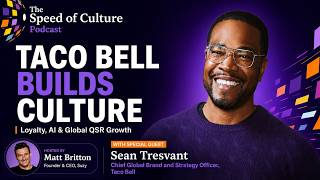
In this Speed of Culture podcast episode, host Matt Britton interviews Sean Tresvant, the Chief Global Brand & Strategy Officer (and incoming CEO) of Taco Bell. The conversation traces Tresvant’s career—from early sales at Campbell Soup, through Pepsi, a brief stint at Sports Illustrated, and a 17‑year tenure at Nike—highlighting the lessons he learned about brand building, curiosity, and staying ahead of consumer and technology shifts. Tresvant explains how Taco Bell has evolved from a traditional quick‑service restaurant into a pop‑culture lifestyle brand, leveraging digital and first‑party data to create personalized experiences and loyalty programs. He discusses authentic partnerships with figures like Doja Cat and LeBron James, the need for agility in budgeting and execution, and the transition from TV to digital media. The interview also covers international expansion challenges, the role of AI in operations and creative work, and Tresvant’s leadership philosophy, hiring criteria, hybrid work model, and emphasis on team culture. The episode concludes with reflections on key career decisions, a mantra for the brand, and a look ahead to his upcoming role as CEO.
Chapters
Today we're gonna be speaking with Sean Tresvant, who brings extensive branding and marketing experience, having worked for major brands such as Pepsi, Sports Illustrated, and Nike. Some of my favorites. Sean's currently the Chief Global Brand and Strategy Officer and Lead of International Growth at Taco Bell. And it was recently announced that in January 2024, Sean will be taking the reins as CEO of Taco Bell. Sean, many congrats. Welcome to Speed of Culture Podcast, and great to see you today.
Thanks for having me.
Absolutely. Well, thanks for joining. I was looking through your background and you really, have had some of what I would probably have had my dream jobs growing up. And we're going to get into some of them. And I really want to hear a lot about your journey. You joined right out of school and worked at Pepsi as one of the first places you worked at. And that's sort of a common theme with many of our guests here. It really seems to be a great breeding ground for understanding how to build brands, the CPG space, etc. What were some of your main takeaways from your 5 years there?
Yeah, like you said, Matt, has an incredible alumni, incredible alumni. For me, When I came in, I just wanted to learn brand marketing.
Yeah.
I, I started very early in my career in sales. I went to Campbell Soup as a salesperson. I saw the brand managers talking and I said, how can I do that? They would say, hey, to do that, you have to go back to get your MBA. I went back, got my MBA. Prior to finishing my MBA, my sister moved to New York and we're really close, so I decided to move to New York and that's how I got the Pepsi job.
Yeah.
Incredible company, incredible brands. My first brand at Pepsi was Pepsi One. I think I killed that brand quickly, but I, I learned learned a ton. They have incredible intellectual horsepower. Pepsi, they have incredible brand knowledge, brand acumen. So just being part of great brands, great people, great leaders, great coaches kind of put me on trajectory of where I am today. Yeah.
And, and we had Frank Cooper, who you probably know, who, um, Yes.
I know Frank very well.
Yeah. And, and we worked closely together when I was running my agency, Mr. Youth, and we did a big launch for Mountain Dew.
Yep.
And we were talking about when we did that campaign, it was Mountain Dew's first user-generated content program.
Sure.
And when I look at when you were, at Pepsi, 2000 to 2005, it was a different world. People don't realize the internet just started in 2000. There was— Facebook was just starting. There was no YouTube. There was no iPhone. So when you think about our career, which is we were both in the workforce a similar time frame, the changes that we've encountered since your time at Pepsi and, you know, early in your career has just been dramatic.
Dramatic.
And it's really hard to— how have you been able to, over the course of your career, keep your finger on the pulse of just the changes in technology and consumer behavior?
I think for me, the biggest thing is staying curious.
Yeah.
As you said, change happens and it happens fast, whether it's consumer change, whether it's technology change. And for me, I pride myself on staying curious. So whether it's listening to podcasts like yours, reading up on data, having mentors and coaches who are teaching me. But for me, you have to stay current, you have to stay curious because the consumer moves fast, technology moves fast. If you're not staying up, you fall behind. And for us, one thing I've learned in my career is you have to stay at pace with the consumer.
Yeah.
It's hard to stay ahead of the consumer.
Yeah.
You don't know what's coming, but you have to stay at least at pace with the consumer. Yeah. So I, I'm hearing it.
Excuse me.
Yeah, the chair. All right. Oh, no worries. Oh, no worries.
Yeah, I didn't want it to pick up. All right, cool. We keep moving. And then, you know, after a, a short stint at, at Sports Illustrated, you went to join Nike where you would spend nearly the next 17 years.
Yeah.
And Nike, obviously iconic company, iconic brands. What precipitated the decision to join Nike? I assume you moved to Portland.
Yeah.
For that role.
Yeah.
What was that experience like if you had to bottle it up? I know it was so long.
Yeah, I would, I would tell you I'm a kid from the Pacific Northwest. In the Northwest. So grew up in Seattle. So obviously Oregon's really close and growing up in sports, I played sports my whole life, played basketball at Washington State. Nike was always a dream job. It was a job that if one day I can work at Nike, I have made it.
Right.
I knew a guy, I was playing in a summer basketball league in New York. He said, hand me your resume. So that's how long it was. I handed him, I didn't send in my resume. And about a year later I got a call and about a year after that I was working at Nike. So it was a dream come true. It was, for me, it was the, you know, when you look at what Nike, it is the PhD of marketing, you know, the brands, the people, the legacy, the storytelling. It was everything that, that, you know, growing in my career I achieved to do. And it was a great 15, 16-year run at Nike.
Yeah. And towards the end, you, you really focused specifically on the Jordan brand. I'm sure you saw the movie Air. Yeah, for sure. For sure. Great movie. Great movie. And obviously, that it's never all 100% true. But one thing that is true is that the Jordan brand has withstood the test of time.
Yeah.
And it still is a lifestyle brand. My kids still want Jordan's, and it's, you know, you wouldn't think that when I was growing up, I didn't want Wilt Chamberlain shoes, right? But my kids want Michael Jordan shoes. What is it about the Jordan brand that has allowed it to stay so core to the center of pop culture and the zeitgeist?
I think two things. One, there's a lot of barbershop arguments. He was the GOAT. He was the best of all time. He was one who changed the game off the court. With his style and his flair, and he changed the game on the court. You know, winning 6 NBA championships, I don't know if that'll be done again. So it's a little bit about who he was off the court, who he was on the court. He created basketball culture, which turned into hip-hop culture, which turned into music culture. And then the Jordan brand is just a scrappy brand, and that comes a lot from who he is as a person. It's a brand that has a little bit of a chip on his shoulder, They're the little brother to Nike, but incredibly entrepreneurial, incredibly scrappy, and, and wanna win. And not only in basketball, if you think about you and I growing up, it was a basketball brand.
Yeah.
Now, it has women's, it, it has streetwear.
Yeah.
It has culture, it has apparel. It's becoming a, a multidimensional brand, which is just helping it, you know, stay relevant with consumers.
And, and when you were at Nike, I imagine you had to sort of walk the fine line between performance because it is a, a sports shoe, but also you want it to be something that people can wear leisurely and, and as a fashion. Is, was that hard to do? Because there's the core ideals of Nike as a, as a performance or athletic company. And was there sort of tensions to kind of pull too far away from that at certain points?
Yeah. And, and I think for Jordan, Nike's, you know, is the, you know, the V12 engine, it's performance and it goes. Jordan, you wanna have a little bit of, like you said, 50/50. A lot of performance, but a lot of style.
Yeah.
It's the brand that when you put it on, people say, "Hmm, those are Jordans." Yeah. So it has this style element, but absolutely 100% performance as well.
Yeah, for sure. So after being at Nike for 17 years, you decided to leave. I imagine that wasn't an easy decision.
Probably the hardest decision of my life.
Right. And you see athletes doing that. And, you know, Joe Montana left the 49ers before his career ended. And so did Michael Jordan himself.— you know, and not to compare you with Michael Jordan, but maybe you're the Michael Jordan of marketing. You know, what precipitated that decision and what was behind that?
Yeah, it was a lot of things. Like I said earlier, I like to stay curious. I had an incredible 16-year run at Nike. I grew up there. I had a lot of friends there. But I found myself not running into work anymore. And I'm one that wants to run into work, stay curious, and continue to learn. And I got a phone call. And I picked up the phone.
So you weren't looking.
I wasn't looking.
Right.
I got a phone call. I picked up the phone. Uh, at first it was recruiter talking about, would you be interested in a job? This job's in the QSR industry and happens to be Taco Bell. Hmm. I've never thought about that. I never thought about QSR. Uh, okay, great. Uh, we want to meet, want you to meet some people from Taco Bell. One of the first person I met at Taco Bell was the current CEO, Mark King. And I don't know if anybody's met Mark King, but he's an incredible personality. Uh, we had about a 2-hour conversation in Portland. And it was just about the magic of Taco Bell. You know, people don't realize how big Taco Bell is, how global Taco Bell is. But it was a great conversation. Mark and I hit it off. I met a couple other people. It has incredible culture. And I took the leap of faith. I took the leap of faith as becoming the global chief brand officer at Taco Bell. Great run, 2 years later. And things worked out where I have a new position as the CEO in January.
Yeah, and Taco Bell is an interesting— QSR brand because they really did a great job, probably even in the years leading up to you joining, where they established themselves as sort of like a pop culture lifestyle brand. They had the Taco Bell Hotel, they made a movie. So, and I don't know if every QSR brand can kind of play in that space. What is so unique about Taco Bell where it can actually establish itself as a lifestyle brand in the QSR space?
Well, I'll take you back any further. Taco Bell, 61 years old. Uh, uh, obviously the founder, Glen Bell, Um, he was tacos in a burger's world, and that's different.
Yeah.
And that DNA has, um, kind of lasted for 60 years. And that's the way we think about Taco Bell. It— we wanna embrace different. We want it to, to, to tap into culture. We don't even consider ourselves just a QSR brand. We just consider us a great brand. And that is the mentality of a lot of people who create the, the, the magic in Taco Bell that we wanna embrace different. We wanna push cultural forward. We always wanna be doing something that's zigging versus just doing what the competition does. Yeah.
And, and And part of that is obviously about the, the experience of Taco Bell.
Yeah.
And when you joined, it was right at the tail end of the pandemic, really.
Yeah.
And one thing that we saw during the pandemic is a lot of progressive QSR brands and retailers really embrace digital as a more core part of the experience, whether it be Starbucks or whether it be Walmart and Target. How does the digital experience play a role in how you look to build the consumer.
Yeah, it's a huge part. It's a huge part. Not only digital means a lot of things, it, you know, could mean in-store for us, which is really important with 7,500+ restaurants. So it could mean in-store, it could mean digital on your phone, or it could be how you access the brand. Like you said, when you go on a Taco Bell, there's a kiosk, which is a digital experience. And obviously there's third party, which is becoming ubiquitous within the QSR space. So we look at it through all those lenses and you're right, it is an experience, capital E. So whether it's the team member's experience on how they are making their life easier the Taco Bell, whether it's the customer's experience as they come into Taco Bell physical locations, whether it's a drive-through experience, or whether it's just great digital content on your app, or whether you're ordering Taco Bell through a third-party aggregator. We're, we're focusing on all that because that's what matters to the consumer. It makes the, it makes the transaction a lot easier for the consumer.
Yeah. And the good thing about your space, it's probably a little bit different than certainly when your time at Pepsi, which was a long time ago, or at Nike, is you have a lot of opportunities to collect first-party data, right? You have a vertically integrated solution. And I imagine that you're probably leaning into that given all the changes in the digital landscape as of late. How important does first-party data play in your overall strategy?
It's really important. And probably one place we want to really leverage it is this idea of loyalty.
Yeah.
So loyalty, it will be big for us. We're, you know, we're learning on the fly. We're good. We want to be really great at loyalty because to your point on, we're such an amazing brand that has a lot of assets, a lot history, we can tap into culture, really leveraging loyalty to our advantage is the next step for us.
Right. Because consumers expect personalization. Absolutely.
They— Personalization at scale. Yeah.
And especially if you have digital as a core part of the overall consumer interaction at your locations, I would imagine it provides opportunities to provide that personalization. You know, the type of food somebody tends to order, if they're a family or they usually come with a group of friends, then maybe that will customize their experience.
And we know you ordered a taco last week and Taco Supreme is your jam. So we're going to make sure you get that. We have relationships with LeBron James, we have like Devonta Adams, we can feed the beat, we can serve you on multiple different levels. Yes, of course, the food, but then also what other experiences can we give you from the Taco Bell brand?
Yeah. And what roles do partnerships play as well as you kind of execute promotions? Because I know that's traditionally been a huge part of—
Yeah. —your strategy. And from partnerships, I think they're just extensions of the brand. And the word I'd use is we think about partnerships, whether they're current or futures, is this word authenticity. I heard it a lot at the conference today.
Yeah.
For us, it has to be authentic. I'll give you a couple examples.
Please.
Doja Cat was great. She brought back the Mexican pizza, but the way that whole thing came about was that she tweeted us that, "Taco Bell, bring back the Mexican pizza." So it wasn't us—
Completely unprompted.
Completely unprompted. It wasn't us going out and say, "Hey, we'll pay you X amount of money." Really authentic relationship. She loves Taco Bell, wanted the Mexican pizza back. So we created a partnership, a collaboration around how to bring it back.
So how's that happen?
You tell someone in your team, get in touch with Well, you see the tweet and as great marketers as the team are, how do we leverage this? Doja Cat just tweeted at us, bring back the Mexican pizza. And the team went to work on a really great journey of how to, from that tweet all the way to bringing the Mexican pizza back, how that works was really coordinated, cadenced at the right level to make sure it was a great story on how, you know, went away during the pandemic, it came back and she was really the person who brought it back. Or you look at a person like LeBron James. As you know, during COVID him and his family celebrated Taco Tuesday. Little did we know at the time that— little did a lot of people know at the time Taco Tuesday was trademarked. So you couldn't effectively use it if you're a business, you're a person, because it was trademarked. Not by Taco Bell, by another entity, right? Not by Taco Bell, by another entity. And we got in touch through some mutual connections. Hey LeBron, would you like to help free the Taco Tuesday trademark? Of course I would. So that was another—
Such a cool idea.
Yeah. Such a, it was a great, another authentic. So they're, they're people who love the brand. Let's partner how we can do stuff together that are really, really exciting for the brand. And, and yes, there's sometimes you go out and reach out to people, but for us it's all about authent— we wanna work with people who are authentic to our brand, enjoy our brand, and not just somebody off the shelf.
It's interesting, Sean, because it, you know, it used to be in the world where decisions about the future of brands were made in the boardroom.
Yeah.
And now it's made on the sidewalks or on X, formerly known as Twitter.
Yeah.
It'll always be Twitter to me. Me, but it's, you know, you're almost playing the brand in real life and you're choosing your own adventure based upon your interactions. But I would imagine it's hard to execute in a world where you probably have to have budgets for the fiscal year far in advance and you probably didn't budget to work with LeBron or Doja Cat. How are you able to be agile to be able to shift your spend or where you're putting your resources based upon these things that pop up?
It's a great question. I think what, what the team and I talk about a lot is be nimble.
Yeah.
As we talked about earlier, technology changes, consumer changes, new platforms you know how new platforms go. And we like to say when there's a big idea, let's not let it go to waste. And LeBron was a big idea. And lucky enough, it was early in the year where we could shift some things around. We could, it's all about the game, as you know, is all about delivering.
Yeah.
So if this opportunity is bigger than that opportunity, let's do that opportunity because we think it'll deliver more than the opportunity we currently had on the calendar.
Absolutely.
So the team is great, nimble, and for us is take advantage. And if you're gonna be, center plate of culture, you have to take advantage when it comes real time.
Absolutely. Another way that brands like Taco Bell traditionally built their brand and built awareness is TV. TV shifting. You know, it's not lost on me that this year the NFL has their partnership with YouTube TV. Used to be on DirecTV. I think it's a shift where linear TV, it's continuing to go away, right? There's not many things that people tune— in fact, I just moved my daughter into college and—
Congrats. Congrats, by the way.
Thank you very much. Time flies.
I moved my son into college. Oh, congrats to you.
You probably know it's the same thing that there's not a whole lot of TVs that kids are— as freshmen are bringing to the dorms. And when I went to college, everyone had a TV in their dorm room. Young kids aren't watching television anymore.
They're watching that, right?
Yeah, they're watching their phone. You're pointing to your phone. How does that impact, I guess, how you think about building your brand and the mass channels in which you can— because you're a mass brand, you need widespread awareness.
You know, I'll put it like this. TV is dead, long live TV.
Right.
Now, as a brand, we are shifting digital. Of course, we have to be digital because that's where our consumer is. Of course. But when you look at kind of how we're gonna reach consumers, there will be amount allotted to TV.
Yeah.
It's mass. We're on a lot of sports TV. It's where our consumer is. But we're getting a lot smarter on how we reach different audiences at different times and different platforms. So digital is the way. And so when you think about how we come to life, yes, we'll have films on TV, but when you think about social, paid, audience segmentation, all the different platforms, we're being really, you know, connected TV, we're being really smart how we allocate to that, the dollars for the biggest return on our consumer.
Yeah. And speaking of consumer, I imagine you have to constantly listen to them as well, not just listen to the LeBrons and Doja Cats of the world, but your everyday consumer, especially Gen Z, which is so fickle and changing their, you know, their habits really every day, it seems. How are you guys able to do that? How do you go about doing that?
Yeah, well, our social team has done a great job listening to micro-influencers, not the Doja Cats, right? Not the LeBrons of the world, not the Devonta Adams. But we involve them in the brand. Like you said, the brand lives, you know, on the sidewalk. And so we do a lot of great things. This is my son calling right now. You got it?
No, no. Okay.
No, no, no. We do a lot of great things with micro-influencers. So we actually did a campaign a while back. We included our micro-influencers where we said it's free delivery, $0 delivery. We used them on the campaign at TikTok and it was our highest performing TikTok for the month. So while we're gonna play at a lot of different levels, the mass level with mass influencers, you know, the cult of the brand, the fans of the brand are really, really important too. So using them to drive the brand is important as well.
Absolutely. And I know that Taco Bell has really stepped on the gas recently in international expansion. Cultures are different around the world. So it might be a cult following in the US, maybe not in other markets. How was that experience as a building the brand internationally? And what are some of the nuances you have to keep in mind as you go to new markets?
Matt, somebody told me a story that if you're human, you've ate a piece of chicken a hamburger.
I love that.
Or, or a piece of pizza.
Right.
People probably around the world haven't tasted Mexican food. So our big challenge in the countries we're playing in today is awareness. It's to teach them the cheesy, saucy, melty spiciness of Taco Bell. UK, for example, we're in the UK, they're starting to get it, but a place like India or China or Malaysia, it's a little harder. You have to, you know, drive education, drive awareness. How do you even eat a taco in some of those countries? Is it sideways? Is there Is it a lunch thing? Is it a dinner thing? How many do I order? So the team, we believe Taco Bell as a global brand is doing really well in the US. How do we continue to gain momentum internationally? You know, all be through education and awareness of the brand. It has such a magical cult following, like you said, in the US. How do we translate that firstly about the food and then about the brand? Because those two things together, we can be very successful internationally.
Yeah. I mean, you talk about about the Gen Z consumer being different, but once you overlay these international markets, it just adds a huge layer of complexity in terms of what you're trying to accomplish.
And huge, huge opportunity for us.
Yes, for sure. What are some of the other trends in the marketing advertising since we're here, you know, media, Brand Week.
Yeah, yeah.
Can't, I confuse all these trade names, but Brand Week here in Miami. So you're here obviously, and lots of brands here talking about AI, for example. How is that playing a role in your overall strategy right now?
It's good. It's, for us, We might not be first mover advantage, but we want to learn quickly.
This idea—
And that's probably okay.
Yeah. Yeah. I don't want to be first.
Yeah. This idea of curiosity, I think for AI, I, I do believe it will change the way we as marketeers view the world, interact with the world, interact with consumers. But for us, when you think about a QSR, there's many applications you could use it. You could use it creatively.
Yeah.
You could use it in the kitchen, you could use it for franchisees, uh, and all those things in between. So for us, um, We've got some things working and testing on, you know, how does it relieve, you know, stress in the kitchen, right? Ordering. Is there stuff we can do in the kitchen that, you know, voice ordering on, on, on the drive-through menu board? Really good application. Those are things that we're looking at. We're also looking internally, how does it— how do we drive and make sure we're staying up to speed on what can we do with it creatively?
Yeah.
What is the RGM in the restaurant? How can they use it to, you know, with their staff? And so many different applications. That's why you don't kind of rush to one thing because, you know, for our business, you have to look at how to use it across multiple different venues or applications to make sure it is effective.
Yeah. And one thing we're hearing a lot is there's just personalization at scale.
Okay.
So it can really allow you to have the long tail or you can use AI's functionality. You have the core brand pillars and whatever content you create, but then you can personalize it. Absolutely. Go across. So, I'd love to shift gears a little bit just to you in terms of how you spend your time. I know that you're, you're entering a new role next year, but just even as of today, how are you looking at the pie chart of your day?
Yeah.
To be most effective. You're relatively new in this role and obviously it seems like you're juggling a lot.
Yeah.
How do you know where to spend your time and how does that impact your leadership style as well?
Yeah, that is a great question. Let me unpack it a little bit.
Yeah, please.
For me, one of the most important platforms that I came into Taco Bell with that I want to continue in my next role at Taco Bell is this idea of leadership. Yep. I think leadership separates good companies from great companies and great companies from extra—
100%.
I think a lot of people miss the plot on leadership because they worry about the function. If you don't have great leadership, you're not gonna be a great brand or business for a long time. That is my belief. So I spend the day a lot with the team, a lot. How do I block and tackle for the team? A lot. What can I do to clear the path for the team? Where can I work with the franchisees? Where can I work with the different functions to bring people together? So leadership is probably where I spend most of my day and just making sure the team is inspired, they're confident, and they're ready to go do magical things for the Taco Bell brand. My day role now is I oversee brand marketing, I oversee innovation, oversee architecture and design, which is our assets.
Yeah.
And oversee fit, which is, which is our food. So days are— no day is the same in my world, but a lot, a lot for me is continually Drive the brand. It's about results, whether you're a marketer or CEO or like you have to deliver in this new world order. So how do we make sure we're hitting our numbers? What can I do to help the team hitting our numbers? And then a lot is at work on the franchisee. We have an amazing— I think we're Entrepreneur of the Year 3 years running.
Yeah.
So making sure that we keep a great partnership, at least in our business, with the franchisees. So I spend a lot of time with the franchisees making sure we're on the same page, making sure we're moving forward together.
Because that's very much where your strategy lands, right? You can have the best PowerPoint decks and the best creative agency, but if the franchisees don't deliver the experience for the consumer, it doesn't really matter.
Yeah. And, and that's why it's such an important partnership on what we're thinking about at the RSC, Resource, uh, Restaurant Service Center, or what they're thinking about in their regional markets that they're meshing together. And 9.5 times out of 10, it's our— but it's when they're not that we need to make sure we're on the same page. And here's how we're thinking about about, you know, current day in the future, that's where I spend a lot of my time.
And do you have a mystery shop? Like walk into a random Taco Bell and just see what the experience is?
No, we got— well, you know, in Portland and now LA, I go into a lot of Taco Bells, but we, we go a lot with the franchisees and we just make sure how, how are we feeling about the brand, how we feeling about the experience from a consumer standpoint. And then probably the most valuable part is that is hearing from the team members.
Yeah.
When you think about the size of the Taco Bell brand in the market, when you think about how many team members we have in the marketplace, they're our probably biggest brand asset.
Huge asset.
Huge asset is team So hearing from them is really inspiring. And you have Taco Bell brand, we call it a family. And you have team members who's worked at that same Taco Bell for 25 years.
So what sorts of things will they tell you?
Well, they will tell you it's a family. They will tell you, hey, I've left Taco Bell maybe once, and I always come back because the way this brand teach me. They take pride in their work. It is such a sense of pride to work for Taco Bell. It is truly inspiring. And when I first started at the brand, I went out to store. I went out to stores with a couple of friends, like a learning tour, a learning tour, and worked in the kitchen a little bit and talked to whether it's an RGM or a team member or somebody, you know, at the drive-thru. And family came up consistently in this pride working at Taco Bell. It was just like nothing I've ever heard before.
Wow, that's fantastic. And going back to leadership, so obviously you're only as good as your team and you want to be a great leader. But in order for you to do it, you have to hire great people around you. What are you looking for? In the people who you hire? Like, what's your interview process like? How do you know when someone comes into the room that they're the right person to join your team?
That is a great question. I'm probably different than most.
Okay.
I really don't look at the piece of paper.
Right.
Yes, I know you—
You mean like their resume, where they went to school?
Yeah, and I do. I know it's a thing to get in your door, but I know you went to Harvard and you speak 6 languages and you had 15 internships. That is all great. But as you know and I know, once you walk through that door as an employee, What kind of teammate are you? Do you like to roll up your sleeves? Do people like to work with you? It's the intangibles to me that, that get people farther than tangibles.
Yeah.
There's a lot of Princeton, Harvard, Northwestern— nothing against those schools— MBA grads that when they walk in the door, maybe they don't wanna roll up their sleeves, maybe they don't wanna come early, maybe they don't wanna stay late. And I always tell people, the, the resume, the piece, piece of paper is great, but it's the intangibles that— How do you see that when you're interviewing them? You, I, I don't know. I have a gut feel for it. You know, it's how they speak, it's how they talk, is how bad do they want the job? Job? Yeah. Uh, do they expect you to do all the talking, or they tell you about themselves other than all the, you know, work experience they had? To me, the intangibles get— get people further than the—
than the tangibles. Yeah, it's just going back to your Nike— it's just like sports. You can have so many athletes that have the same physique or raw talents, but what separates the great people, it's that grit, it's the hustle. Yeah, leadership, all that stuff. 100%. And the same thing. And how do you feel about, um, in terms of leadership, like work from home and like, is Taco Bell in the office?
Yeah, we're, no, we're a hybrid model.
Okay.
And I think today we, we, well, me personally and, and the Taco Bell philosophy is work from home. And I'm, hey, you're gonna get your work done. And, and similar to how tech has changed the workforce, working from home, I don't think you need to be sitting in front of computer. It is probably not effective as anymore.
For sure.
I, I do think you need to be in, there's something about team and culture and being together. So we tried to do that through Think Weeks and Clap Weeks at Taco Bell, which has been really effective when everybody comes in for a week. So, they're offsites. Yeah. And they come in and we come in and we talk about the business, the brand, we have guest speakers and that's really helped to bring people together and gel people together so you can see and meet and work together. But again, it's not 5 days a week and it's not every week.
Yeah. And do you think that's kind of, I mean, I'm hearing that a lot. Do you think it's kind of the new normal, so to speak?
Yeah. Yeah. I had a, my daughter just graduated college and I—
Congratulations.
Thank you. Thank you. And I asked her, so where's your headquarters? And she looked at me like I had had 4 eyes, right? Yeah, we're virtual dads.
Yeah. And I— we were just talking, like, for us, like, once the pandemic hit, we just started hiring people all over the country. So now, like, the genie's out of the bottle. Even if we wanted to not be remote, there's nothing you can do. You got to figure it out that way. I do feel that for the younger employees, they need exposure to senior leaders. They can learn. Yeah. And, and I think fostering that is incredibly important.
And that's why I think the collab weeks and the think weeks, bringing everybody to Irvine, to the campus, where they and see people and everybody's encouraged to come in. So I come in and everybody comes in and, and that, to your point, they learn, they see, we can talk. There's, there's the, you know, in the office time, but there's also a lot of social time, you know, before work, after work, which is, which is to your point, really, really important I think for, for everybody to make sure that, that they see what the culture can and should be within, with the brands. Hard to do that over teams.
Yeah. So as we wrap up here, Sean, you know, you've had a great career and obviously you have a whole new challenge ahead of you. As you look back on your career to date, What were some of the decisions that you think you made right along the way that put you in the seat that you are in right now?
Yeah.
In retrospect.
I think if you, if you ask my team, uh, some of them are here today. I think if you ask my team, um, I'm, uh, approachable leader. Uh, I'm a curious leader and I'm an empowering leader. And I think those 3 things, um, I, I try to talk to everybody. I try to teach everybody. I try to talk to everybody. I try to treat everybody the same. I feel like I'm very approachable. I feel like no matter what level you're in memorization, let's talk. I want, you know, to teach you and I want to learn from you. I want to see, you know, how your experience is at Taco Bell and I want to give you kind of my journey at Taco Bell. I also feel like I'm empowering. I don't have all the answers, especially as I step into my new role. There's things I need to learn and I'm vulnerable enough to ask people the things I don't know. Hey, I'm 2 years into the QSR industry. The franchisees are teaching me a lot. The people at Taco Bell corporate are teaching me a lot. So I'm trying to be vulnerable and learn a lot from this experience. Yeah, I think that's great.
Advice is to be approachable because I think a lot of people look at the big boss with the C-level title and they just turn the other way in the hallway or don't set up that call. But that really harms them and it harms the leader because you're not able to hear their ideas and it could change things in a whole new direction.
Absolutely.
Yeah, absolutely. If you could change your marketing strategy based on a tweet, surely you could change it based upon feedback from somebody who works for you. Yeah, right. Yeah. So, and lastly, is there a quote or mantra that you live by? Well, if you had to think of—
It's funny, there, there, when I started at Taco Bell, there was a tweet The tweet said, Taco Bell at 1:00 AM has a $200,000 G-Wagon, a Chevy Cavalier, a moped, and a minivan that never had its oil changed. And they're all craving the idea of Live Más. And I think that defines our brand so perfectly. It inspires me every day. It's what we all strive for because Taco Bell is that perfect brand that is mass. It's a melting pot that everybody wants to enjoy. Yeah. Joy.
That's awesome. Love that. Well, I want to thank you for joining today.
Thank you.
Busy schedule. I know you're going to continue to do huge things at Taco Bell in your new role and can't wait to watch what you're up to. Thank you so much. Thank you.
Thank you.
On behalf of Susan and I, we team. Thanks again to Sean Trezvan, successor CEO at Taco Bell and current Chief Global Brand and Strategy Officer. Thanks for joining us. Be sure to subscribe, rate, and review the Speed of Culture podcast on your favorite podcast platform. Till next time, see you soon, everyone. Take care.
More from Matt




MikMak’s Rachel Tipograph on Consumer Spending, Retail Media & Holiday Shopping Trends



Jaguar Land Rover’s Charlotte Blank on Luxury, Purpose & Experiential Storytelling



