Taylor Lorenz on Extremely Online, Creators & the Future of Media
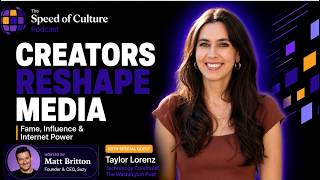
Washington Post columnist Taylor Lorenz traces social media's evolution from Tumblr and Vine to TikTok, explaining how creators became central to the news ecosystem. She discusses the economics of platforms, the legal risks of covering online personalities, and why treating your journalism career like a business matters in a volatile media landscape.
Chapters
Today we're gonna be speaking with tech journalist and author Taylor Lorenz. Taylor is a columnist at The Washington Post covering technology and online culture. Her debut book is called Extremely Online: The Untold Story of Fame, Influence, and Power on the Internet, and it's now available everywhere books are sold. Her writing has appeared in New York Magazine, Rolling Stone, Outside Magazine, BuzzFeed, and so much more. And Taylor was named an Fortune's 40 Under 40 list of leaders in media entertainment in 2020. Taylor, I'm a huge fan. So excited to have you on The Speed of Culture. How are you today?
Thank you so much for having me.
Absolutely. You know, you've had a really a meteoric rise in your career and, and have had no issues, it seems like from the outside perspective, making a name for yourself. When did you know that you wanted to have a career in journalism?
Well, I kind of got the idea, I was popular on Tumblr and I had sort of built up an audience on Tumblr. I had never really met any journalists before, and I met a journalist who was around my age who at the time was working for the New York Times. And I thought, oh, well, if that guy's a journalist, I should be a journalist 'cause I can write. So I don't know, it just gave the idea in my head. That was like 2010.
What were you doing on Tumblr when you said you, you started on Tumblr? Like what types of things did you write about and what inspired you to write those things?
Tumblr gave me everything. It was, I, I mean, I was writing about stuff and I had dozens of Tumblrs. I had a lot of single serving Tumblrs and Yeah, I mean, I got on Tumblr in 2009 and sort of began building audiences on there through different sort of theme accounts and meeting people and getting sort of into the internet world. And then I started doing social media for brands and blogging about this stuff. I was writing about it. I really hated how the mainstream media was like talking about it at that time. It was like even worse than it is today. Just that it was like very boomer sounding and no hate to the boomers, honestly., but it was just very like, it sounded very out of touch and it was clearly written by people. Like these articles were clearly written by people who hadn't really spent time on these social platforms. So I was like, I'm gonna write about this stuff from the perspective of somebody that actually uses stuff and understands it.
And speaking of the mainstream media and just the landscape of the world that you play in, you know, we've seen a shift and the best example I can give is like Bill Simmons, who you may or may not know, is a huge sports podcaster. And you know, he used to work at ESPN and he got unceremoniously fired and then he started his own podcast and now, you know, he ended up selling it to Spotify. But to me, he was one of the sort of trailblazers in saying, my personal brand is more powerful than the brand of the publisher that I work for. And I just want to know what your thoughts are on that in terms of how do you bifurcate building the brand of Taylor Lorenz versus really leaning into the brand of the Washington Post or any other publication you might be working for? And how do you kind of look at managing your brand over time, knowing that you could be writing for, and you already do, multiple different places?
I mean, I think as a journalist, you know, media is always sort of like a very talent-driven business. So journalists have always had personal brands. I mean, Woodward and Bernstein are brands, Barbara Walters, Anderson Cooper, you know, these really iconic journalists. But I think nowadays because of the internet, we all have to kind of have our own brand. I mean, I guess I kind of think about it in two ways. I mean, I want to support the brand of The Washington Post because I'm very proud to work there and I try to, I support it by giving them great journalism, but I want my readers to have a direct relationship with me. One, because I want them to come to me with story ideas and become sources and stuff like that. But also because of just from a trust standpoint, I mean, the way that the media climate is going, this is what I report on in my book, is this more distributed personality-driven media ecosystem. I mean, this has totally happened in sports and entertainment and—
Right. Look at Tucker Carlson, for example. I mean, it really is happening everywhere.
It's everywhere. It's just that like, I think legacy media has been very slow to adapt to it. And I understand, you know, from a business perspective it's hard because they of course want to prioritize their corporate brand above all else. I don't think the two have to be necessarily mutually exclusive, but I do think from a sort of trust standpoint and reader standpoint, like I'm very responsive to my audience and I want my audience to follow my work no matter where I am. And many of them have followed my work. I mean, for a decade I, they had a lot of followers that have followed me since the Tumblr days. So no matter who I write for, they know, okay, Taylor's a trusted journalist.
I guess what I struggle with in terms of the traditional media model is if you look at a major event, let's say it's a political debate, let's say it's a sports event or whatever it may be, you know, every single news publication is sending their own photographer there and they're all fighting to get the same picture. In some ways, access to, on a broad basis, not the insights behind the access, but access itself is somewhat commoditized. And the real differentiation is what you just discussed. It's the relationship between the writer and the readers and the trust that exists there. So I guess over time, the question is, are we gonna be entering a world where basically almost like influencers, we're gonna get into that in a second, where the individual harnesses more power than the publications themselves and they lean towards platforms like Substack, which we're already starting to see. Have you thought about writing a Substack and have you thought about going off on your own?
Oh yeah, I have a Substack.
Okay, you do have a Substack.
And I've done my own thing for a while previously. I mean, I've been freelance and I've done, I mean, I've sort of done my own thing and flipped back and forth between like traditional jobs and my own thing sort of throughout my career. And obviously I started as a blogger, totally independent. I mean, I would say like, I think we are already in this completely personality sort of person-driven media landscape. It's just very hard, you know, different publishers are better or worse. I think Washington Post has always been a very talent-driven, company, they've always facilitated their reporters doing books and they're very encouraging of projects and things. Other places that I've worked, it's the exact opposite. You cannot— Well, you cannot even do a single thing outside of work. I mean, you, they own your life like to an insane degree. And that I found to be incredibly restrictive. And for someone like me, that's very entrepreneurial, like extremely limiting. And they really just want those reporters to like, sit in your chair for 40 hours a week, write your stories, file your 800-word stories, never use the internet and go home.
Right. And then you see BuzzFeed laying off whatever percentage of their staff because they're using AI. So you're basically at the behest of their success and if they evolve their business model, then your career goes down the tubes and you don't wanna risk that.
Exactly. And BuzzFeed, by the way, was always really great about outside projects too. I think that the New York Times and other places are the ones that certainly I think are so incredibly restrictive. And look, I get it from a business standpoint. Of course, if I was the CEO, I'd want the same thing, a bunch of faceless drones that I could fire at any point that don't have their own power. But again, you also get treated better. I mean, like, I think a lot of, you know, that the power dynamics shift. And if you have a big online brand, I mean, look at certain names in journalism, they have a lot more negotiating power at the table because of the audience that they bring with them.
Absolutely. So you talked about writing for Tumblr in 2009. So We're now 15 years removed from when you first started. How has the overall landscape of news and journalism evolved over the last 15 years if you had to sum it up?
Oh my God, it's been transformed by the, the social web. I think a lot of people thought that this like BuzzFeed, Vice, and all these other sort of websites that I grew up writing for would bring this digital media revolution. I think now they're seeing that the business models were flawed and that that's not really happening. But I think what truly has sort of upended the digital media landscape and what is the truest sort of digital media revolution is this content creator ecosystem, which you mentioned, like a lot more people turning to platforms like Substack and stuff. I think what's lost, especially in the media world, like the journalism world, is resources. You know, like these big companies, and same thing with like Hollywood actually, what you're seeing with entertainment industry, like traditional institutions have a level of resources to dedicate towards content that just individual internet creators—
And investigative journalism, and they can pay for your travel and help you uncover things.
Absolutely. And prevent you— I mean, journalists are constantly sued out of existence. This is the biggest problem, is actually journalists You know, who are the fiercest defenders of free speech. It's very impossible for them to do a lot of in-depth reporting on Substack because they don't have the legal protection. And legal protection is sort of like the number one thing I think that's keeping a lot of journalists from not going independent.
Then again, you see a lot of, and I know you've had your fair share of attacks on you and, you know, on your reputation based upon the fact that you want to conduct what you believe is honest journalism.
Not what I believe is honest journalism. I'm an honest journalist.
Honest journalists, exactly, exactly, put better. And there's others who just believe that they should be able to report on themselves. And, you know, obviously, you know, you talk about the biggest change, I would argue Trump is one of the biggest catalysts of change that we've seen because he was really the first person in an authoritative position that openly just attacked the media and tried to discredit them. And I think what that started to do is give rise to others who want to basically tell their own story and not be exposed for the truth because it might not be truth that they want to get out there, right? So I think, yeah, so I guess that is an interesting juxtaposition against the rise of the individual because now you see what's happening. You know, I'll always call it Twitter. I'll never call it X, but what you're saying happened as what's formerly known as Twitter, where, you know, now the verification system is kind of wonky and you really don't know who's saying what. I guess what's your take on that in terms of people who want to create their own brand and don't believe in, third-party journalism to do so. And I guess, how are you dealing with that moving forward?
I mean, I deal with this on a daily basis and have for a really long time because I cover YouTubers and content creators who inherently have an audience. So anybody that I write about, and I think this is why people are always like, oh, why are your stories so viral? Or why am I always seeing your name? And it's like, because every person I write about has millions of followers and responds to what I write. So like, yes. And they want to control their own narrative. And I often report very critically on content creators and they wanna respond. And so I think it's a very tricky landscape to navigate. And I think, you know, you have to conduct journalism very like, you know, in a different way. You have to sort of like know, anticipate that sort of like public backlash and prepare for it. And obviously it comes with a lot of online harassment. That's again why newsrooms need to support their journalists. And there are certain newsrooms that are legacy newsrooms that will throw their reporters under the bus because they don't care about the reporter's personal brands. Like they don't care about the reporter's safety. They just care about their— brand.
You know, I think the rise of ad-supported media is really, I think, in my opinion, what's to blame, because a lot of these companies, whether they're venture funded or they have pressure from Wall Street, ultimately it's about revenue. And what drives revenue? Clicks. So they're going to write for clicks. And when you write for clicks, you can lose your journalistic integrity along the way.
Oh, 100%. I mean, I came up in the time when we had to file like over 10 stories a day. And trust me, the quality of the stories that you're filing—
Whatever's going to drive the click, doesn't it?
Yeah, I mean, I worked at the Daily Mail, was my first media job, so I know those incentives well.
And what is your take on what, you know, companies like BuzzFeed, I mentioned earlier, have announced where they're leaning into AI more to create, you know, content at scale in a much more cost-efficient way? Are you encountering AI in your role and how do you think it's going to evolve relative to the world of journalism?
Yeah, I mean, I wish it would help me. It doesn't do anything. It's so— I tried to get ChatGPT to do the endnotes for my book and it made up a bunch of authors for links that didn't have authors. It's so notoriously unreliable. Look, I mean, I think AI can be an incredibly powerful creative tool and, you know, if it can help generate like lead ideas for a story, I'm all for it. Although I don't think it's very capable yet. I do worry about, you know, the replacement of work. I think a lot of the AI-driven stories are more like SEO content. And I do think it should be reviewed by a human editor, 'cause I think it, you know, you don't want a lot of like low-quality AI content spreading misinformation on the internet. There should be a disclosure as well. You shouldn't mislead people into thinking that the content generated is human. But I don't know, I think it's like, it comes with pluses and minuses. I hate to see journalists put out of work, but I say most of what journalism is is reporting. It's calling people, it's chasing people down, it's getting people to talk to you, it's getting people to send you documents when they otherwise wouldn't, you know, like, That's what journalism is. It's not writing like 10 holiday movies coming to Netflix soon. Like, that can be automated. So the sad thing is that was— those jobs were bridge jobs in journalism.
You mean it was a way to get you from when you're starting out and you don't have the clout to maybe do the more investigative journalism. So the entry-level kind of work product is what could be disintermediated.
Yeah, exactly. And so it's very hard. I talk to a lot of young journalists now. They just— they don't know how to break in because it's so— media is so stratified. So I think that's a shame, but it'll, they'll figure it out.
We'll be right back with the Speed of Culture after a few words from our sponsors. In a world of like real-time reporting and influencers sharing their lives in real time, what I guess inspired you to write a book, which is a form factor. I know I wrote a book myself and by the time it came out, the world had already kind of changed. But the good thing about it is, is there's a permanence to it that you look back on and I'm definitely happy I did so. What inspired you to write the book and talk to us about your process in going from the phase to actually getting the book published and, and out?
I mean, I wanted to write a book that sort of told this alternative history of the rise of social media. I think so many of the books, things like The Social Network, right? They tell the story of social media through the lines of these corporate narratives. So it's like, you know, the Facebook story or the YouTube story or the Instagram story. And I love those books. I read all of them, but I think it's only half the story. And I wanted to tell the story of the user side of social media because I think actually users had a profound effect on these platforms, specifically power users and content creators. And yeah, I also wanted to talk about how this half a trillion dollar content creator industry emerged, you know, over the past couple decades. 'Cause I think a lot of people think it started with MrBeast and that's not the case. So I started writing the book in 2020 and I did it on top of my job. It was kind of dumb 'cause it took me 2.5 years, but that's what I did. And—
Mm-hmm.
It's mostly historical. So I mean, luckily I wasn't up against the clock, but I do incorporate some recent sort of stuff, like since 2020 as well.
So it's historical and it's called Extremely Online: The Untold Story of Fame, Influence, and Power on the Internet. So you're looking back to kind of the shift to this, I would call it the social web or Web 2.0, where when the internet first came out in 2000, it was really a publisher-driven model, much like television was. It was just people sold banner ads and it was based on impressions with companies like Yahoo and Lycos. And then 2004, Facebook came out and basically consumers had a voice, and that was the beginning of the shift of power from publishers to individuals. What are some of the kind of landmark moments, I guess, since that shift and the dawn of Web 2.0 that you point to in your book?
I mean, I talk about the rise of all these different platforms and I start with sort of the mommy blogger universe and how they kind of disrupted media. Talk about the earliest content house in 2009 of YouTubers. My book has tons about Vine and the rise of Vine and the sort of the role it played in the social media landscape.
Which was acquired by Twitter, right?
Yes. Vine was acquired pre-launch by Twitter, actually. And I think honestly it was kind of Twitter's culture that ultimately led to its downfall and a very hostile relationship with its own talent. And then, yeah, I mean, it gets onto everything. It goes through YouTube platform, you know, Snapchat, like it sort of talks about these interplay between these platforms and how they competed for talent. And evolved. And then of course it gets into more TikTok more recently.
And who were some of the most influential or impactful influencers? If you basically were creating an influencer hall of fame, uh, of true influencers, so you can't name Kim Kardashian because she, I would say, is like more an A-list celebrity, right? So if you were just to stick it to influencers, who would the 5 that come to mind be?
Yes. I mean, Heather Armstrong, who was the mommy blogger, sort of the most iconic mommy blogger, uh, put ads on her blog and 2004 and changed the game. I talk about Julia Allison actually in my book excerpt, who was this woman who was truly one of the first multi-platform content creators making a living full-time in New York in the late aughts. I would say members of The Station, that's kind of a group, but that's that first YouTube collab channel that became Maker Studios. The 1600 Viners, I mean, again, this like collaborative collective of content creators that reshaped Vine. And then I would say maybe Charli D'Amelio for TikTok, just in the sense that she was TikTok's first— grown star.
Yeah. And then of course more recently you have MrBeast, and I'm surprised you didn't mention people like Logan Paul and people like that who really—
Well, Logan Paul was in the 1600 Viners.
So that's where they got their start.
And MrBeast is up there, trust me. He's one of the most— and same with PewDiePie. I mean, there's so many.
Yeah, I mean, you know, the list is almost— yeah, too big name. If you had to pull some, I guess, common themes across that short Hall of Fame list, like what I guess are the ingredients that makes an influencer or creator successful?
So much of it is luck. I mean, so much of it is luck. I mean, a huge amount is luck. I would say it's 90% luck because people can be doing the exact same thing in different time periods and it doesn't matter. It's all about hitting the right time, right place. So, but I would say the 10% that they can control, it's a lot of, I would say uniqueness, like that they really have to have like a lot, like a very strong sort of like meet the needs of an audience that hasn't been served. And then you have to have an insane work ethic. I mean, just unbelievable work ethic, uh, to produce content consistently.
And really combine your personal life and your work life into one, which isn't always easy, especially these fashion influencers who now have grown up and have kids and, you know, they're obviously including their kids, which I personally don't love that you use your kids to create content, but that's a whole different podcast.
Well, I will remind people that the majority of kids' content on the internet is actually teenagers putting themselves online.
Right. That I'm not referring to that. I'm talking about the bloggers, the fashion bloggers who have a 3-year-old kid in the bathtub and they're putting them on their Instagram story. And I just think that the kid hasn't signed off on that. They're using that for their own per— that's my personal opinion.
Sure. I guess like there's been so much weird backlash to stuff like that lately, and I'd like to remind people that again, the majority of kids' content is kids putting themselves online from age 4 to 6. I mean, these are very young kids often putting themselves online. The panic over the moms doing it, the dads are doing it too. So let's just remember that.
Yeah. 100%.
I mean, I totally agree. There is no privacy on the internet and it's terrifying.
But you were mentioning work ethic.
Oh yeah.
It really is. Your life is your work. You're thinking about it 24/7. And I think a lot of people overlook that and it's so easy to attack and point fingers. I mean, I'm sure you've seen these Reddit forums that basically are just built to just tear down and, and just, you know, it's crazy that people, I think there's a good bit of jealousy too. I mean, there is this notion. That people are only sharing their highlight reels and then everybody else is comparing themselves to people's highlight reels. You know, I found that some of the most impactful influencers are ones that have a little bit of vulnerability and share not just the highlights of their life, but also the lowlights. Is that something that you've seen as well from some of the more successful influencers?
Yeah, just share— you said sharing the highlights and the lowlights?
Exactly. Not just showing when they're made up and, and looking good, but like, what about when life doesn't go how they think it's gonna go?
Absolutely. I mean, I think authenticity is key. So you have to be relatable, but you don't wanna be too sort of depressing. So you have to kind of like constantly walk this line of relatability. I mean, I think people wanna feel like they're engaging with an authentic person. And I think the days of, I write about this in my book, of sort of like the bubble popping on this like hyper-curated version of influencing. It's just, it's ultimately unrelatable. It's aspirational and there's still aspirational content online, but you know, people need to seem human to generate an audience. Absolutely.
So we're gonna do something interesting here because you know so much about this space and we're gonna create our own listicle and we're gonna do it in real time and I'm gonna throw out different social platforms and I want you to tell me what the state of those platforms is right now relative to the creator economy and where you see them going. So let's start with, with Snapchat. Where is Snapchat today? Where do you see it going in terms of its popularity and effectiveness for influencers and brands?
Good question. I mean, Snapchat is still kind of chugging along. Well, Snapchat's important in the sense that it's allowed a lot of content creators, I mean, David Dobrik and others, to monetize short-form content really effectively through Discover. So I think there is a place for it in the creator economy, but I think it's always gonna live in Facebook and Google's shadow.
Interesting. So when you say Google and Facebook's shadow, let's talk about YouTube.
Look, YouTube remains the gold standard for monetization. They are the blueprint. I mean, they are the most stable platform. From a revenue standpoint, it's incredibly hard to grow on there. It's very saturated, very difficult to grow.
And break out, right?
That, that's what I mean. Grow in terms of grow an audience and be successful. But if you're successful on YouTube, you can make a real living on there. And you can't really say that for a lot of other platforms.
Right. So, and you also mentioned Meta, so Instagram, do you feel like that is gonna continue to hold up in terms of its popularity over time? It's, it's been a powerful force in the creator economy for so long. Do you see it continue? Do you see it losing steam in the wake of some other newer platforms?
Unfortunately, look, Meta spends so much on lobbying, I think, and squashing their competition. I don't think that they're going anywhere anytime soon. I don't think they're really innovating very much. They just seem to be running around copying every viral feature on the internet.
Like Reels did to Snapchat, for example.
Oh, everything. Yeah. I mean, they, they do this to everything. I mean, Threads, obviously, but that's fine. I mean, they're gonna be around for a while. They're not going anywhere. But you know, I think people are increasingly frustrated.
What about Twitter/X? Where do you see that heading?
RIP. Oh God. Straight into the ground. Straight into the ground. It's actually shocking how useless it is. And I'm not saying this from my own experience of it, but just like I talked to so many content creators and it's just like, I mean, some meme accounts are like monetizing through Elon's weird program, but there's a lot of YouTubers that meet the threshold for monetization and have applied for monetization on Twitter and you'll get it. And it's just a very political platform. And I think it'll be carried through by the next election 'cause political people are so addicted to it and it's so politicized. But from like a pop culture standpoint and everything, like stuff doesn't happen there anymore. It's all about TikTok.
Right. So lifestyle influencers who maybe are in the early days built their brand with Twitter being part of the mix, don't really look at it as an important platform anymore, which I would imagine has a huge impact on Gen Z 'cause Gen Z is essentially going there for creator-based content. If it's not there, it's not being prioritized. I would imagine over time it's gonna have to hurt their performance, that important cohort?
There's no lifestyle influencers on Twitter that are relevant. I mean, the Twitter is relevant outside of politics. It's still relevant for sports, but increasingly, like, people are turning away even from the sports conversations on there.
Any other platforms that are relevant right now, whether it be Pinterest or other emerging platforms that you have your eye on, uh, looking to the future?
No, I mean, just TikTok. I think it's all about TikTok for the time being.
So is TikTok now the central force where any influencer— it's the more— and how do you see, I guess, the TikTok world, or how has it evolved over time, and why do you think it's been so popular?
It's gotten very saturated and very competitive on TikTok as well. TikTok is still the number one place for audience growth because it breaks this follower-based model of American social media. On all of our social platforms like Instagram and, you know, Twitter and stuff, it's like you, the user, have to seek out people, manually follow them, you know, to get content in your feed. That's just an incredibly ineffective way of delivering content. And TikTok is, you know, delivers content through this algorithmically generated for you feed that constantly gives you new content, exposes you to new accounts. Audience growth is very hard on TikTok. Like it's all about more of like your distribution in the feed versus your follower count. But, uh, yeah, that's where culture happens. That's where the celebrities are. That's where the pop culture moments are. That's where journalism is increasingly moving. I think it's— Yeah, it's all about TikTok for now.
And what's interesting is TikTok recently has made a big push to roll into commerce and basically have this content-to-commerce model. So do you see that impacting the way that influencers think about their business, not just trying to drive eyeballs and views and clicks, but also drive sell-through and purchase? So talk about that. Like, who are some of the influencers that come to mind that are doing a good job at that?
Oh God, I don't know. I try to swipe past the shopping streams. I mean, I love this girl Lauren Wolf. I buy anything that she sells. She's a lifestyle influencer in New York. I mean, a lot of them were already moved very heavily into the Amazon Storefront program. Yeah. And so now people are just selling every single phone accessory through TikTok Shop. Yeah, I mean, I think it's turned it all into a giant mall.
And is that a good thing for the consumer and the creator economy?
It's a new way of shopping. I think it's exhausting and overwhelming for people that don't want to shop. But again, you know, TikTok won't only deliver you that type of content. It kind of depends on the content that you engage with. But if you are the type to shop I mean, it is. Yeah. I mean, I don't mind shopping on there. I buy stuff off there all the time.
Awesome. Well, I'm sure the book is gonna be incredibly successful 'cause it's such a hot topic just being in the advertising and marketing world. It's really, and rightly so, the only thing brands wanna talk about because in a world where the only thing people are tuning into live TV for is really sports, it's like the only way to garner eyeballs is on social media. And social media is largely driven by creators. So if you wanna build your brand, you really need to understand the creator economy and how to work your way into it as a brand.
And also, I mean, my book is so much more than even just like, I think that you'll be surprised to like readers, like there's just a lot of lessons for brands, for tech companies, and just for like entrepreneurs and sort of how these people built their businesses over the years on the internet and sort of how things people adapted and look at a lot.
And speaking of brands, like what are some of the things you think brands do well or not well when trying to leverage this movement to build their own business?
Oh God, you have to read my book 'cause I have it all in there. I talk about certain brands like Nordstrom that like really sort of effectively used content creators to drive sales early. I talk about different brands. I mean, DKNY, there's a whole sort of chat to talk about sort of DKNY PR girl, this woman Elisa Licht and sort of her branding strategy online. Like there's so much in the book and I really hope people pick it up and read it 'cause it's, There's a lot in there and I talked to tons of really smart marketers and business people.
Awesome. I'm aware of the big push for your time as you're in book launch mode, but just to wrap things up here, Taylor, just about you. So if you look back on your career ever since you first started writing and you were to point to a couple of main drivers of your success, maybe for some of our younger listeners here at Speed of Culture Podcast, what's some advice that you'd impart on our younger listeners in terms of the things that you've done in the rearview mirror that kind of unlocked your success to date?
Corporate people don't like to hear it, but I came of age during the Great Recession in 2008, and the one thing I learned is a company will never be loyal to you, and always make sure that wherever you're working, that it's mutually beneficial. Look, you're not gonna make a lot of money right out of college, but make sure that you're getting something out of your job. Make sure you're learning, make sure you're improving, make sure you're generating connections, but like, always be making the job work for you. Don't just work for your job, make it work for you. And I think it really, I always think about that because I'm always like, what am I getting from this job? And what is the, you know, what am I giving? Yeah, just don't be afraid to leave a job, you know, for a better opportunity. And don't, you know, a company would— you have to approach your career as a business, you know, and grow that business.
The brand of you, so to speak.
Yeah, the brand of you or whatever. Even if you don't like public-facing person, like just make sure that you're getting something from your job. Because I see a lot of people that drink the Kool-Aid of these corporate places and put their life into the work and then they get laid off.
Even the most prolific companies in the world have laid off tens of thousands of people in the last year.
Washington Post laid off a Pulitzer winner, you know, a few months ago during our latest round of layoffs. It's just, it, you can be the best at your job and it still happens 'cause the reality is the economy.
Absolutely. So finally, Taylor, is there a mantra or, or quote that you like to live by that if you had to sum up your career and the way you look at moving forward, it comes to mind?
Oh God, I don't know. But my favorite saying is, it is what it is. Because every time I get it, I don't know, sometimes I'm dealing with something crazy and I'm like, you know what? It is what it is. So my mom always said that to me and it's always in the back of my head.
Well, this is great. I, I can't wait, uh, for our listeners to hear this. And to all of our listeners, please check out Taylor's debut book called Extremely Online: The Untold Story of Fame, Influence, and Power on the Internet. It's now available everywhere books are sold. Taylor, thank you so much for joining, uh, the podcast today. It was fantastic catching up with you.
Thank you. Have a great day.
Absolutely. Be sure to subscribe, rate, and review the Speed of Culture podcast on your favorite podcast platform. Thanks to Taylor and the Suzy team for producing this. Thanks again, everyone. Take care until next time.
Bye-bye.
More from Matt




MikMak’s Rachel Tipograph on Consumer Spending, Retail Media & Holiday Shopping Trends



Jaguar Land Rover’s Charlotte Blank on Luxury, Purpose & Experiential Storytelling



