TD Bank’s Tyrrell Schmidt on Omnichannel Banking, Customer Insights & Convenience
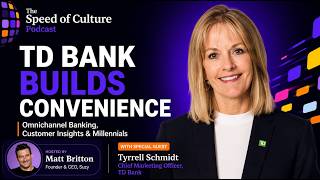
In a Speed of Culture podcast recorded live at CES 2026, host Matt Britton interviews Tyrrell Schmidt, Chief Marketing Officer of TD Bank. Schmidt walks through his global career—from early days at Discover Card to leadership roles at Standard Chartered, Cigna, and finally TD—highlighting a startup mindset and the value of diverse, international experience. He discusses the unique challenges of marketing in the heavily regulated financial services sector, emphasizing the abundance of customer data and the need to blend innovation with compliance. As CMO, Schmidt focuses on people leadership, aligning marketing strategy with business goals, and leveraging brand equity built on convenience and an "unexpectedly human" proposition. Consumer insights are gathered from social listening, transaction data, and proprietary research, guiding a target persona he calls the "driven optimist." TD’s omnichannel approach aims for a seamless, personalized experience that balances physical branch community ties with robust digital capabilities centered on ease, value, and advice. The marketing mix follows a 70/20/10 model of proven tactics, incremental innovation, and experimental channels, employing full‑funnel tactics across digital, connected TV, TikTok, Pinterest, and more. Schmidt also shares thoughts on storytelling—human, conversational tone at scale—and on emerging fintech trends, including a watchful stance on crypto and strategic partnerships with fintech innovators. Career advice stresses openness to new roles, mentorship, and a lattice‑style career path. He concludes with a personal mantra from Maya Angelou about making people feel valued, tying back to TD’s human‑focused brand.
Chapters
Welcome back to today's edition of the Speed of Culture podcast, live from Las Vegas here at the Consumer Electronics Show. I am so excited today to be joined by our guest Terrell Schmidt, who is the CMO of TD Bank. Thanks so much for joining us.
It's great to see you. I'm thrilled, thrilled to be here. Absolutely.
How has CES been for you so far?
Yeah, you know, it's big. It's really big. It is my first time here, so, uh, but really enjoying it and meeting people. And I've been part of the Brand Innovators. We have publicists here, so a lot of our partners are here, which has been terrific. And I'm excited to go to the expo, which I heard a— I heard a speaker last night talking about some of the, the big new launches, and so I'm excited to go see them.
Fantastic. Well, we're going to start by getting to know a little bit more about your career and background and what led you to where you are today as CMO of TD Bank?
Good. Great. So you just want me to jump in? Okay, we'll do that. So I've been at TD for about 8 years, but before that I've had a very global career, which has been terrific, mostly in marketing. And so I started my career at Discover Card. I was one of the first 5 people to join the company, which was fascinating. Interesting time. We had no cardholders, we had no merchants. And so trying to get each other to sign up was a super fascinating thing. I think what was great about that for me was just ability to dive into everything. We had to do everything.
Like a startup mindset, right?
It was a total startup mindset backed by Sears. So, you know, 60 million cardholder base that they had. So it was a kind of—
Is that how Discover got started?
It is.
I didn't even know that.
Wow. It is. It was when Sears was doing selling socks to stocks.
So who would have thought that their spinoff would have outlasted actually the company that started it?
Yeah, right? Yeah. Super interesting. That is true. But yeah, really, really fascinating story to watch them. And from there, I I was with Discover for about 18 years, and the last 5 years I went over to the UK and stood up the marketing function and ultimately ran that function for Discover. And so they actually made a go. We launched a card in the UK, and that was another startup. That was a little bit different because we were really starting from the beginning. So, you know, super fascinating learning experience, first cultural experience that I had from there. Went to Hong Kong and Standard Chartered Bank where I led, ran the customer, the cards portfolio for them. And then to Cigna in healthcare in Singapore and then ultimately Philadelphia and then TD and here I am.
So what drove you primarily to the financial services space? What about it interests you?
Yeah, I think it's a really fascinating space. I mean, to be honest, it wasn't something that I sought out initially out of college.
Which is usually the case with most people.
Right, totally. Totally. You have to take some risks, you know, decide what you're, you know, where you want to focus. But for me, what I found over the years and the reason why I've stayed in financial services with the exception of a 9-year stint at Cigna, is really, it's just, it's a fascinating— people think of it as a stodgy industry.
Right.
Or they used to.
It is highly regulated. It's harder to make changes than other categories.
Highly regulated. Highly regulated. And, you know, which is very important. So you really have to blend that, you know, innovation, speed to market, etc., with the regulatory environment. But I think what's fascinating about it, it is really an advanced marketing environment. Financial services, you know, you've got different customers, very different segments.
Customer data, lots of data.
Lots of data. Lots of data. More than most industries. So, so it's just a, it's a great place and it constantly evolves. Financial services and marketing. And so being able to stay up to speed with all of that is, it's a challenge and it's just fascinating and fun.
Absolutely. So in terms of your current role as CMO of TD Bank, what are your core priorities and where do you focus on a day-to-day basis?
Yeah, you know, a couple of things. I think first is people. You know, as a leader, I think it is my responsibility for, particularly with my team, being there, you know, working with them on, you know, setting the vision, setting the strategy for the function, which we've, you know, done. I think we've got a really clear strategy of both from a business perspective but also marketing's role within that strategy. So a big part of that is just making sure that we are constantly constantly aligning to and prioritizing against that strategy. Beyond that, you know, certainly sitting at the management committee and being part of kind of where the bank is going overall. It's a very exciting time.
You can't be disconnected from the business goals within marketing, which often gets lost.
You can't. You can't. And I think that's been a big opportunity, as it is with any, I think, marketing organization, is really, you know, demonstrating the growth potential that marketing brings. And fortunately at TD, you know, there's a great belief in brand, there's a great belief in customer experience, which is great. Because that's not always true. But beyond that, we have such an opportunity to contribute even more to growth than we already do. And everybody sees that and, and frankly wants more. Yeah, more and faster. And great problem to have.
Absolutely. So, you know, you talked about the people, you talked about your role with the business. What about the consumer? And how do you go about understanding the consumer's changing needs when it comes to their personal banking and How does that, I guess, play a role in how you focus your go-to-market strategy?
Yeah, consumer and the customer is absolutely critical. It's at the center of what we do. And I'm a big believer in insights, so we've got a great insights team, and we get our insights from a lot of places. We're, you know, whether it's social media and social listening, whether it's from our customer experience data, which is incredibly rich, again, because we're a high-transaction business, so we have a lot of data that we can look at. We can look at, you know, external, benchmarks, we can look at external spending and all of those sorts of things. So, you know, I think it really guides us in terms of where consumers are going, and we do a ton of proprietary research as well. We, you know, we're a believer in leveraging customer insights. So I would say that's a really big part of it. The other thing is kind of evangelizing across the business for the customer. And so once you have a sense of both your brand, and we know for TD roughly 65% of our brand health comes from customer experience. So, you know, really—
Online, offline, the whole thing?
The whole thing. So, you know, if your brand is your promise and your customer experience is delivery of that promise at every interaction, we have a huge role to play in making sure that that's not just a marketing responsibility.
The bank teller is marketing, right?
100%. And if they do something that's not, you know, in line with the brand or customer experience and they are at the front lines. So we need to make sure we're enabling them, but it is, it's so important.
Yeah. So with the millennial now being the CFO of the household, right? Those are people who grew up with the internet growing up. Yes. So it's a different customer. It used to be that the millennial was your bleeding edge younger consumer who ordered in pizza and played Xbox all day. Now the CFO of the household.
Right. Right.
How has that changed the needs of, you know, your current customer, and then how is TD Bank evolving to meet those needs?
Yeah, it's a really good question for TD. I think TD historically, and we still have a value proposition around being America's most convenient bank, and that used to mean longer hours, more days open, those kinds of things. That's still incredibly important to us. We think that our—
That's what I think of TD, yes.
Yeah, exactly. And that's— And very community-based. And very community-based. And then part of that is, You know, by having those longer store hours, you're creating this community relationship with your customer, which is incredibly powerful. I don't— we will never walk away from that. Like that—
that's your core brand equity pillar, right?
It is. And having that relationship then, you know, is critical. That said, you know, we obviously with, as you said, the new, you know, digitally native customer coming up, we also have to have a great digital experience. And we've seen digital adoption increase incredibly rapidly. I think the stat is vaulted 5 years in 2 weeks during the pandemic. And that has been the case. So it really is about how do we think about, you know, number one, we don't want to alienate the customers who come to us because they love to come into our store. They have a long relationship. So what we do, we really look to make sure that we're not doing things that would alienate that group. At the same time, we've got a younger cohort of consumers that we also need to appeal to. We call them the driven optimist. And that's the core bullseye target for us. And so we design around them, you know, increasingly expanding constantly our digital capabilities and ultimately having an omnichannel experience that's seamless, connected, personalized is the holy grail. And we do know that even the younger consumer, you know, often people think, well, they're never going to walk into a store or branch. And we do have to make sure we're making it less scary, less intimidating. And that's what TD does. We were very— it was seen as an approachable bank, which is great. But they do look, and sometimes they're like, if I'm getting a mortgage, I want to look across the eye at somebody, and I need help. And so thinking about how we leverage our physical footprint in a very different advice-based way while we're building digital capabilities and continuing to expand them is, for us, our strategy.
Makes sense. And what are some of those digital capabilities? I mean, when I think of what a bank provides online, you want to be able to check your balance, you want to be able to transfer money easily. What are some of the other things that consumers are asking for that you guys are focused on in terms of what you're going to be delivering to them?
For us, it's really around 3 things that we know from our insights. So ease, value, and advice. And that is what consumers are looking for.
The advice piece is something that I hadn't thought of.
Yeah, and advice can be, you know, what we call small "a" advice. It can be guidance, it can be tips, you know, that you get through content and things like that.
Like savings advice and things like that?
Yeah, I mean, you know, how should I, you know, what tips do you have, what tools and capabilities do you have that enable me to save more easily. So it can be something like that, up to and through, you know, advice for the high net worth customer or a small business customer. So it really, really ranges, but we do know that people look increasingly, you know, and you think about the landscape we're operating in right now, people, you know, they need help in certain areas, and when they want help, they need us to be there. So, but ease on, you know, particularly from a channel perspective in terms of how you work across channels. So not just, you know, they're looking for an easy digital experience. We're all used to what we get on Amazon and so many other places, so we have to meet that, but it also has to feel seamless to the customer. And then value, you know, they're looking for value for money. What are you doing? There's a big focus obviously in financial services.
Now more than ever, right?
Totally.
Yeah, absolutely. So obviously a big role of any CMO is to drive growth and ultimately not only expand your current customers but win new ones.
Yes.
What are some of the go-to-market channels that you've been focusing on at TD that you found successful in previous years that maybe you're really zeroing in on here in 2023?
Yeah, we've been, you know, we're constantly testing and learning. And so what we try to do with our marketing just generally in terms of our philosophy is 70% tried and true. So what we know works, 20% kind of small i innovation and, you know, continuing to iterate and then 10% that we're trying new channels and all sorts of things. So we always do and we learn from that and then You know, that mix evolves. So for us, I would say definitely, you know, obviously the whole digital channels in terms of how we find people online who, you know, where we can get the right product to the right customer based on their needs. Huge, you know, huge.
It's a big—
More performance-driven, bottom-funnel acquisition channels. Yes. Yes. So we— and that's probably the best way to say it. We really are focused on full-funnel marketing. So, you know, moving from brand and we look market by market to understand where do we have really strong awareness. And, you know, if we have really strong awareness, for example, we may use connected TV instead of linear TV. If we don't have a base of awareness, then we might use linear and then, you know, other channels.
Right, more top of funnel, whatever's driving. Yeah. Broad-based, right?
Yeah. And then as we go down the funnel and to your point earlier about the next generation, not really the next generation, current generation of customers, you know, TikTok picture, Pinterest, all those sorts of things are absolutely things that we're focused on.
And is the way that you have to storytell now different? I mean, you've been in the space for a long time. The financial services space has evolved dramatically. Is the way that you have to storytell and differentiate the brand different now? And if so, in what ways?
Yeah, if I think about TD specifically, because I think it's, you know, it's what I think about most these days, I think firstly everybody does because you're evolving with an evolving consumer base and evolving competitive landscape. The personalized, relevant communication and content is just—
It's hard to execute though, isn't it?
It's hard to execute, yet it's like such an expectation. So, you know, I think that's broadly across. But if I think about TD specifically, so, you know, to the point that I made earlier around convenience, we've been, you know, the unexpectedly human bank, and that is our brand proposition. So we, you know, our what is convenience, but our how is being incredibly human and understanding that there is a human behind every single transaction and every single interaction that we have. And that is what, you know, it fuels us. It's what makes us special. It's how we recruit people into TD and it's how we attract customers. So that's really been the focus for us. And we're evolving that to, you know, to understand kind of people, our customers and consumers' expectation, as I said, around convenience is very different. But human is— we know that that still really, really resonates.
And I would imagine the challenge is really to pay it off at scale, right? Because humans are ultimately unscalable. Yes. They're not machines.
But it's also— yeah, I think it's also about— and we have this challenge internally as well. Everybody's like, oh, well, that's our people. And it is our people, but it's our people who are doing web development and who are doing—
They're putting their touch on everything.
Basically, even how we show up in digital channels, you know, using influencer— influencers who are relevant, how we communicate. We have a conversationalist tone. All of that really brings a human touch to what we do, regardless of whether it's a face-to-face or a digital experience.
Absolutely. So let's shift gears a little bit. I mean, you're sitting in the role of Chief Marketing Officer of a renowned financial institution. CMO is sort of the pinnacle of title of anybody that wants to get in the marketing role. What can you kind of attribute your personal career success to? You know, where have you focused that you found have really paid off for you? And with that, what advice would you give to younger people who want to end up in the CMO seat one day?
Yeah, so I think a couple of things. One, for me, and I don't perceive myself as a big, like, risk taker in the, you know, the way of being risky. However, I was open in my career, open to trying new things. Open to moving and, you know, taking on new roles and getting new experiences. And I think that's really helped me. Number one, it's actually given me so many different perspectives. So for me, you know, the international experience, the global experience, has been really important in terms of when you think about empathy and when you think about different customers and, you know, diversity segments and all of that. You know, just, I feel like I've gained personally—
just all different cultural— different cultures, different insights.
And what makes people different, but what makes them the same. And there's a lot of that too. So I think for me, that's been just a critical part, I think, of how I've gotten to where I've gotten to and the career that I've had that I've loved. But beyond that, mentors. I think the role of mentors is really important. And it's not only people who will tell you all the good, but it's people who are gonna give you some hard messages.
I've heard the same exact thing in the recent interview as well. Yeah, you say that.
Yeah. And I, you know, the ones that stand— the things that stand out for me and the people that stand out for me are those people. And, you know, on the positive side, they've always done it in a kind way and, you know, with the goal of, I want to help you be, you know, your best self. Yeah.
But I think because we all have blind spots, right? There's all things that we do that we're not seeing, we're missing opportunities, right? Usually, you know, the people who work for you aren't going to tell you that. The people who you work work for might not feel like they can tell you that if you're generally doing a good job. So where you— how are you really going to improve? Who's going to really show you what you're not seeing? Yeah. And good mentors can really do that.
Yeah, that's right. And typically, I think, you know, in the back of your mind, you tend to know. So it's just somebody reiterating and say, hey, by the way, right?
You have to be open to it as well.
You do. Yeah, you do. I really do think that openness and all of that, you know, is, uh, is just such an important thing. Finally, what I would say is for anybody, I think, you know, being willing to have a lattice career as opposed to just ladder, you know. What do you mean by that? Meaning that you're not just constantly worried about, well, I have to go from this level to this level to this level. But you know what? In order to do that, I'm, you know, A, I really want to get there, but I also might need this experience over here. And so I'm going to go sideways.
Sometimes people are too opportunistic. Maybe they get a pay raise or a promotion title and they're going somewhere where maybe the opportunity long-term isn't as good or they don't have the expertise there or something and they find themselves maybe thinking that they're going forward but you're taking one step forward, maybe two steps back at the same time without seeing it.
Yeah, and again, it comes back to mentors and leaders who are also fostering that. For me, when I worked at Discover, I worked for a CMO who, and maybe this was a little too frequent, but every 18 to 24 months he called the whole team in And he's like, okay, you have now this job in marketing, and this is your new boss, and this is your new team. And we would all change roles.
And so— P&G does that a lot too.
They're famous for doing that. Do they? Yes. It's great because actually you often think, ah, that's not that interesting. That's not kind of where I want to take my career. But the sum total of those things is really powerful when you look back.
Gives you diversity of thought. And I love the global angle as well. I think too many people are— don't understand that when you talk about the consumer, there's a whole world out there of consumers all experiencing things differently.
Totally.
Totally. How do they, curiously, TD, look at the sort of whole crypto craze? Had you guys ever looked at getting into that? What are your personal thoughts on cryptocurrencies and other alternative financial assets and the boom and bust that we've seen? Maura, what do you think about it?
With the industry? Yeah. I mean, you know, there probably is room for crypto. I think, you know, we have— of course, we've looked at it. It's, you know, it's very much in our space. Yes, for sure. And so, you know, we constantly are looking and tracking and, you know, assessing opportunities, assessing, you know, is that part of our strategy or is that not part of our strategy and when and how. And so, you know, I think you have to, you have to be open, especially when you look broadly at the category in financial services and you have neobanks and you have all these specialist banks. You have fintech. You have fintech. You have crypto, you have NFTs. And so you really have to be choiceful in your strategy. So I would say that's really how we think about it is keep a watchful eye and decide when, if, and how that is part of what we want to do.
Yeah. And speaking of fintech, I mean, there was a lot of deregulation, as you know, that happened for a period of time in the financial services industry, which opened up the path for many new emerging fintechs, whether it be companies like Square or Chime or so many others out there, Plaid, et cetera. To really gain a lot of momentum. How do you work with some of these emerging players in this space, whether you're just learning from them or partnering with them, etc.? How does TD sort of open itself up as an interface to work with these emerging platforms?
Yeah, it's a— I mean, it's a good question. And we do— we have— we do both. Number one is we study them. We understand where they're really good and where, you know, what we can take from that and learn. And there— I mean, of course, there are a lot of learnings that you can get from those various players. And then we do, you know, we do partner with some. We have, you know, pretty big innovation team that sits up in Canada with people, you know, obviously in the US as well, who constantly are looking at, you know, who and how do we want to partner to further advance our capabilities. And again, in areas that are really in focus for us from a strategic perspective.
Absolutely. So we're here in Las Vegas at CES, a place where, you know, I've been coming here for several decades, and it used to just be the Panasonics and Toshibas of the world, the companies that made actual consumer electronics. Right. And now you have companies from apparel and fashion and financial services all here, which is fascinating to me in terms of how it's evolved. What made you want to come to the CES show and what are you looking to get out of it here?
For me, it was really more about outside-in perspective. And it's really easy, especially in today's fast-paced world. And as we're all, you know, online constantly, it's really easy not to look up and look out. And I think you really have to make a concerted effort to get out, meet people, learn from people, as you said. And so that's why I came. And also had a great opportunity to meet a couple of people and to, you know, to have an opportunity to speak with people like you. And so it's been great so far. And I agree, it's— it was fascinating to me listening to about some of the innovations in cosmetics. Right? Where you're thinking, well, what really? Like, what could—
what's the applicability?
Right.
And, um, really fascinating consumer though, right? And sync totally the trends of the consumer are going to impact how they shop, how they access their money, what they buy, etc.
That's right.
Absolutely. So to wrap things up, is there kind of a phrase or kind of quote that you like to live by in terms that's driven your career, sort of like your mantra, if you had to pick one?
Yeah, I, you know, I always say, and this is— it might sound trite, but it really is how I try to live my life, is Maya Angelou's quote around People won't remember what you say or did, but they will remember how you made them feel. And at the end of the day, you know, my view is we all get a chance at this, you know, once, and people really matter. They really matter. And it's why I'm actually so passionate about the TD brand and being unexpectedly human, because, you know, it's just at the end of the day, that's what we all are, human beings.
It's also a differentiator too.
Totally.
Absolutely. We're gonna wrap it up with that. On behalf of Susie and Adam team. Thanks so much to Terrell, CMO of TD Bank, for joining us at this busy CES. Be sure to subscribe, rate, and review the Speed of Culture podcast on your favorite podcast platform. Until next time, we'll see you soon. Take care, everyone.
Bye-bye.
More from Matt




MikMak’s Rachel Tipograph on Consumer Spending, Retail Media & Holiday Shopping Trends



Jaguar Land Rover’s Charlotte Blank on Luxury, Purpose & Experiential Storytelling



