Telemundo’s Romina Rosado on Streaming, Diverse Audiences & the Future of Media
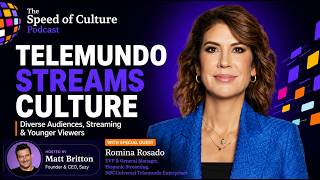
Romina Rosado, who runs streaming at Telemundo, explains how the company shifted from subscription-only to a mix of ad-supported models. She describes two Hispanic audience segments: traditional Spanish speakers and bilingual U.S.-born "200%ers," each with different viewing habits that shape Telemundo's strategy across platforms and devices.
Chapters
Today we're thrilled to be joined by Romina Rosado, the Executive Vice President and GM for Streaming at Telemundo. Great to see you, Romina. How are you?
I'm great. Thanks for having me.
Absolutely. So we're live here at CES in Las Vegas, and it's really interesting because CES, I've been coming now for about 15 years, and it used to just be about consumer electronics. There were companies that made components and TVs, and now it's really become the heart of innovation. It's at a great time of the year when, you know, we're just getting back from, from the holidays and everyone's thinking about the year ahead. Why are you here at CES and what are you looking to accomplish?
Well, I'm here because, as you said, it is the hub of innovation. So I'm here to listen to, you know, industry leaders talk about topics that are of interest to us. And also, I, you know, I'm speaking, you know, with a few people about, you know, the future of streaming and where the media business is going. So I'm excited to be here and to hear from different people.
So 2023 was an interesting year in the streaming markets and in the entertainment world overall. Obviously, we had the writers' strike. We still had a lot of production lag coming out of COVID you know, and consumers very much got out, you know, of their homes and started to do more stuff. So obviously we had an inflated peak during COVID Yet consumers love content. They love watching it on multiple devices. Given all that, where do you think we're headed? What are some of the trends you have your eye on in 2024?
Yeah, I think let me just start by saying that 2023 was a difficult year. Yeah, right.
For many categories.
For many categories, not just because of the strike, but also because of the fears of recession and, you know, the market in general. I do think that the issue in the media space oftentimes is that we're very zero-sum, right? So for many years it was all about streaming SVOD. And then obviously the economics are tricky. Streaming video on demand. Streaming video on demand. Yes. And the economics are tricky. So then now there's been a pullback and everyone is talking about AVOD and FAST. I think the right approach for legacy media companies such as Telemundo, which is where I work, is really to diversify your offering in a portfolio approach, if you will. Right. In other words, you have to be where the audience is and the audience still has an insatiable demand for content that's not going away. And good content is good content and will continue to be consumed. It's just, it's happening on different platforms, especially when it comes to younger audiences, which I know is something that, you know, you have a particular interest in and have written a book about. So for Telemundo, that is even more so because when you look at the Hispanic consumer overall, there are a lot of them. They're being underserved in the US by most media companies. It's a very nuanced audience, but it's also a very young audience because two-thirds of our audience are under the age of 34. So you can imagine where they're accessing and discovering content and it's not particularly linear television.
Yeah. Well, in that regard, I mean, different platforms also require different content form factors, right? Because people aren't going to watch a 2-hour movie on their phone. Yes. So how are you addressing that as well? I imagine you're getting in the short form in different formats.
Yeah, absolutely. And also, you know, the trick is also monetization because, you know, at the end of the day, we're a business. We need to make money. And the traditional TV business is still on in the Spanish language side. It's still very healthy, but obviously our audience is, is consuming content on a variety of different platforms. So that means that as a programmer, you really need to think, okay, I have a piece of content that, A, I have to greenlight. In order to greenlight it, you have to have digital windows, whether that's, you know, TikTok, Reels, any other short-form platform. YouTube is massive for us. And then what are some of the other long-form windows that are out there, whether that's AVOD, um, FAST, uh, or even SVOD in terms of licensing it to other platforms.
Yeah, I mean, I dropped my daughter off at college for the first time in the fall, um, and the thing was striking to me is nobody had TVs in their dorm room. When I was in college way back in the day, we all had little TVs. So, you know, it's almost like if you're— if the audience is young and the TV business is healthy, one, something's got to give, right? Which is why the diversification's happening. Yep. One of the benefits of more programmatic television and addressable media is it can provide a lot more value to the advertisers who I think this year are going to be increasingly interested in new media channels given all the changes that are happening with Google's cookies, etc. It does, I think, breathe new life into more awareness, upper funnel Yeah. Tactics, which where you guys fit in.
Yeah. And that's also because obviously Telemundo is part of NBCUniversal. Yeah. Um, and our ad sales team rolled out NBC Unified 2 years ago at CES. Um, and that was really an attempt to get ahead of that whole, um, cookie situation and ultimately find more information about our audience. Yeah. So we can track them.
First party data.
Correct. And know where they are and then can give advertisers access to the 226 million engagements that are happening on a monthly basis across across the NBCUniversal ecosystem because, you know, again, going back to the Hispanic user base, which I'm, you know, obviously very focused on in what I do right now, there is a— it's very nuanced, right? So you have the traditional Spanish language fast media consumer who watches Telemundo live in Spanish, but also during COVID we saw that they became big, big streaming AVOD consumers, right? And they were in many cases binging a very old library on our fast channels, on our TV Everywhere app. And then you have the second segment, and that's what we call the 200 percenters. So US Hispanics who are 100% Latino, 100% American, probably a lot of them go to college with your daughter. They're born here. They identify strongly as Latino or Latina, but they grew up in this country. So they're fully English speaking, right? And we kind of need to reach both of those audiences. And on the second audience for NBCUniversal, if I can, if I mean, I'm not a salesperson, but if our ad sales team can sell that person, whether it's coming in through Bravo's Real Housewives of Miami on Peacock or a Telemundo clip on TikTok or Sunday Night Football, which is obviously, you know, super successful on linear. Yeah. Then that is an offering that, you know, is very valuable to an advertiser.
Yeah. We're taping this in early January, it's actually before the weekend where Peacock is going to be streaming an NFL playoff game. And we were just talking before the podcast. I mean, that's a big deal. It also is going to, I think, really expose some of the consumer frustrations with like how to find what's on because that's— it used to be 3 channels and it was cable. And now, you know, especially the older consumers, but all consumers in general, I think, have a hard time just finding stuff. Where, where do you think the role is of a company like NBCUniversal and Telemundo in helping consumers sort through the noise to make their viewing experience easier?
Yeah, I mean, I think two things. Yeah. The, the ultimately there's going to be a bundling happening, right? A big rebundling. We're seeing it. We're seeing the beginnings of it, right? One of the benefits of a service such as Peacock is that it already has a very broad content offering.
Because, because NBCUniversal is a large conglomerate.
Correct. Because of the brands, right? So you have, you know, Spanish language content, Telemundo, Next Day airs on Peacock. You have the cable brands, you have live sports. We had in 2022, the World Cup in Spanish on Peacock, which drew massive audiences. Even though it was in Spanish, many people who are not Spanish speakers watched it on Peacock. We have the Olympics coming up.
Yeah.
And then obviously the, the, the game, as you you mentioned next weekend. So I think it's all about scale. And then it's also about really marketing to the right audiences, which brings me back to, you know, the point we were mentioning earlier, data. You really need to understand who your audience is. Yeah.
And in that regard, I know that, you know, your audience, Telemundo's audience, is growing, has a growing purchasing power that is disproportionate to the normal US consumer. And I would imagine there's an increasing demand from advertisers. In that regard, when you are speaking to advertisers, what are some of the things that you're telling them to really whet their appetite about investing more against this segment?
Yeah. So I will tell you, I wish that the Hispanic consumer were fully understood by the marketing community. I don't think we're quite there yet, unfortunately. I think we will be there in the not too distant future because of the demographics, right? Again, 70% of the Latinos in the US right now are US-born. So, what I would say is you have to have a very—
And that's a misconception, you think?
I absolutely. Yeah. And I think you have to have a very nuanced approach, right? You have to have investment obviously in Spanish language content on linear as well as streaming, but then you also have to invest in the 200% as I was mentioning earlier and really from a content creator standpoint, create content that is relevant to them. And, you know, I hate to use the word in this context diversity because I think oftentimes people think, It's just a, you know, I have to create content that is politically correct. Right. I'll slap on a Latino and that's it.
Nothing's easy these days. Every word has deeper meaning.
Yeah.
I know.
And it's not really that, right? Yeah. Because if you think about a 34-year-old US Hispanic in this country, they consume content in English and Spanish across a variety of platforms. Latino households are also more likely to be multi-generational and increasingly the demographics in the US are much more multi-ethnic. Yeah. So you have a bunch of people in the household and if you want your product or service to be a must-buy, you really need to hit all of those nuances. Yeah.
And I would imagine advertisers are also looking for kind of new modalities to actually market the consumers across your network. Like, it's not just a 30-second spot anymore.
Correct.
So are you working with advertisers in new unique ways to kind of bring your audience to them?
Yes.
And differentiate it from—
again, one of the benefits is that we're part of NBCUniversal, right? I think we'd be having a very different conversation if we were a standalone company.
That's where the bundling will probably happen.
And then the bundling and also the scale, right? Because we have that massive scale across NBCUniversal with NBC Unified. We have information about the user and we really understand that the, you know, young viewer who's consuming Telemundo archive content on FAST, what their journey is, a traditional linear consumer. And then, you know, we have massive viewership on TikTok, right? So from a programming perspective, and that, makes this job fun. Yeah. Is how do I create content that can be monetized, right? Because that's the key. How do I create content that can be monetized across those platforms in a way that is authentic and makes sense for our brand and for the consumer? Because I also don't believe in just creating stuff, chopping it up and putting it on a variety of platforms. It needs to be original. How do I do that? And at the same time, give advertisers and marketers the ability to connect with that audience, not just on Telemundo content, but across the NBCUniversal ecosystem.
It's funny, I was just about to ask you about TikTok because ultimately in a lot of instances you're not competing against other networks, you're competing against TikTok. But they're also a frenemy because they also can help you. So when you talk about you need to monetize content, is there a monetization strategy for Telemundo when you put content on TikTok?
Yeah, there is.
Yeah.
NBC, again, NBCUniversal has monetization agreements with most major platforms, including TikTok.
I was unaware of that. Yeah. Yeah.
So we are able to, you know, monetize. It's a revenue share, basically? Yeah. And we are able to monetize the views that we're having on TikTok. There are also some special content partnerships that we do, especially when it comes to live events, live pop culture events, which makes a ton of, make a ton of sense for TikTok and similar platforms.
Yeah. One area I thought would be a great, I always thought would be a great growth opportunity for an organization like yours is commerce. So you're watching something on TV like, ooh, I want that couch. Yep. Is that an area that you think your company will be going into in the future to drive growth?
Yeah. And we actually already doing it. Okay. The, again, you know, advertising group, which is fantastic, NBCUniversal's advertising group, has worked on very shoppable solutions that we're rolling out across Peacock, but also across our linear platforms. The Today Show, which is part of the NBC News Group, which Telemundo is also part of. Has a thriving e-commerce business. And then we're rolling out similar programs across Telemundo on linear as well as digital.
Yeah, because when you think about home furnishings, fashion, you name it, like you talk about Real Housewives of Miami and— yep. You know, it's like, I want that, that dress she's wearing. I love her couch. And, and it should be easy. And I would imagine it's just a massive revenue opportunity because Amazon, you almost have to know what you want and there's so much there.
Yep.
And I, and, TikTok is obviously a new player in the commerce space as well. I think they're going to have huge growth in 2024 with their commerce. So let's shift gears a little bit to you. So, you know, you obviously have a really impressive background and you dove right in in your career into the entertainment space. Was that something that you always knew you wanted to do?
No, not at all. And I actually, I, you know, half of the time I can't really believe that this is what I'm doing.
Why is that?
Because I really wanted to work in politics and international affairs, right? And the first decade of my career, that's very much what I did. I was always in communications, but it was advising government agencies like the State Department, the World Bank, the DOD, UNICEF on their video communication strategies, right? And I was very happy doing that. And then someone who I'd worked with in the past became Chief Digital Officer for WennerMedia, which at the time was the parent company of Rolling Stone and Us Weekly. And hired me as the first digital executive producer for Us Weekly, which at the time was obviously a thriving magazine making a ton of money on, on with newsstand sales and subscriptions and didn't really have a digital business. It's a different era. Completely. And I'm talking about 2009 just to make sure that people—
2007.
Yeah. Just so people don't think that I'm, you know, 80. And at the time I was not really knowledgeable about the entertainment business, to be honest. I took the job and I didn't really know anything about the online advertising business. And then obviously the next 15 years have been in media brands. What I think is interesting or maybe unique about my job is that I've always been the digital person in legacy media companies. What's that like? So it's, you know, it's, it's interesting, but it's tough because at the beginning, I mean, imagine I went from print, then I moved to E!, which cable brand, E! News, and now Telemundo, which is broadcast. Fast, right? So coming into these organizations that are making a lot of money in traditional ways. Legacy business. Correct. But that don't really have on the traditional business side a massive growth trajectory and trying to really pivot them to digital without hurting the core business, right? So it's a very interesting challenge. You have to be a change agent. Completely, right? Completely against a lot of resistance and in some cases and always, unfortunately, I've never been in a business where I've been given carte blanche and money to spend. Hopefully that's next. So it's always really been managing change within existing infrastructures.
Yeah. I mean, one reason why big companies in general lose their market foothold is that the people that are running the businesses— and I'm not suggesting that your company, but in general, you know, they have incentive to keep things status quo so you can milk the cow, so to speak. And then retire. Yeah. And then they don't have to worry about what happens in 20 years.
Yeah. And one of the things, again, going back to the youth point, right, because I'm a big believer and have been so in my entire career, you really need to understand your audience. You need to really dig down. And this is something that we did very well at E! News. I knew exactly who I was creating content for.
Right.
I knew exactly who I was programming for. She had a name. I knew where she lived. I knew what shoes she would buy. I had this profile of this person. Exactly what your advertisers wanted. Correct. And that's very much something that I've also tried to do at Telemundo where I have audience profiles for the people that we're trying to reach. Because what is sometimes also very dangerous is that you start programming for the audience you wish you had or you think you have, but not for the audience that you actually have. Right.
Right. Why do, why, why do networks do that?
Well, sometimes it's because that's what you've always done. Right. And it's hard to change. People don't like to change, especially if what they're doing is working for them. Yeah. And also because, you know, I mean, most decision makers, we're of a certain age, so we're a little bit removed from what some of the younger generations are maybe doing. And I think that's dangerous, like very, very dangerous to not keep your finger on the pulse of what, you know, younger audiences, what the consumer who's coming after the consumer you saw is right now, what they're doing, how they're consuming media, what their interest points are. And, you know, I'll tell you, TikTok, not to plug TikTok, but I use TikTok as, and media about TikTok as a discovery mechanism for trends and things that are bubbling up.
Every exec in this industry should be doing that. Yeah. Not enough do.
Yeah.
So curiously, like, do you— does your organization ever have conversations in terms of like, when is going to be the end? Like, what's going to be the last day that somebody has a linear TV, you know, application in their home? Because there will be a day that it will come to an end.
I'm not sure about that. Really? No, I really don't think so. I think it's, you know, there's— I mean, from a Telemundo perspective, there's actually more Spanish language media consumption than ever in the US, right?
On linear TV.
On any platform. Right. The difference is that the platforms are different, right? Yeah. And when you look at even in, in the non-Spanish language world, the top 100 broadcasts of 2023, 96 of them, I believe, were live sports, right? So there's always going to be the need for that live component.
There's also local, which is a huge, you know, because live sports is streaming though, right?
Not necessarily. I mean, on, you know, recently it is, but you still have a massive broadcast audience because, you know, I do think that as humans, not to get into psychology, but we are communal beings. Right. And at the end of the day, you do want to have communal experiences. We all disappear into our little bubbles, whether that's on our phone or our connected TV and stream what we want. And certainly, you know, with technology, niches have exploded and, and, you know, you're able to really dial into what you, your particular interest is. But there's still like big moments like this year we have the Olympics, we have the elections, right? World Cup. People will go.
Award shows. Correct.
Yeah. People will go to that platform.
Correct. Right. Yeah. Yeah. I, you know, the communal experiences is definitely a thing. And I think, you know, I would imagine bringing communities together around that content.
Yes.
Is really important for your, for your network as well. Because it allows you to have deeper engagement with your audience. Correct.
And also how can you, how can you that fandom that exists that you, you know, we are lucky to have for quite a few of our properties. How do you not only, you know, tap into that, expand it and monetize it on digital platforms, but then also how can you turn that into a live experience?
Right. Like BravoCon.
Correct. Yeah. That's my favorite example. Number one, because I'm obviously a massive Bravo fan, obsessed. But also because I think it's such a wonderful case study of what that team has done, of taking a cable brand, um, and a linear TV show, then having it live very successfully on Peacock to the point where they're launching new versions of some shows on Peacock First. Real Housewives of Miami is an example. And then building, tapping into that fandom to create a massive event that, uh, sells out within minutes and that really doubles down on the experience and that ecosystem that they've built. So I think that's a wonderful case study.
I remember Real World first came out on MTV and it was like the first reality TV. It was, I think, the first indication that we saw that people are way more interesting than scripted characters. And it's just fascinating that if you— whether you talk about, you know, Bravo's programming, Real Housewives and things like that, or you talk about TikTok and the whole creator economy, I think that's a— or if you talk about sports, right, it's the realness and authenticity. Not to say there's not some scripting in reality TV, but, but it's ultimately people who then you could run into on the street and that's who they are and you feel like you know them. And I think that's gonna be an area that's gonna continue to grow. And I'm just wondering if that's an area that you're seeing within your market and an area that you continue to double down on. 100%. Yeah.
To the point where, um, we, so Telemundo has very thriving reality, especially competition reality business. We have, um, Top Chef VIP, which is an adaptation of obviously an NBCUniversal format that was very successful. We have Exatlón, which is a competition reality, and then La Casa de los Famosos, which for those who don't speak Spanish, is the House of the Famous People, so to speak. And it's so successful that we've actually turned 2 to 3 hours of our grid over to that fandom because it has exploded on every platform, not just on linear. And, you know, what we're seeing is that this conversation, chatter, people are very invested. Yes.
Because then those people there'll be some scandal and then they'll be in the news, or you can follow them on social media, or you can see them at Bravo concerts. Like a normal show, like I love Succession, but when it's over, it's over. Yeah. And there's nothing else. It never really is over with these people. Even when the show ends, you could still follow them. Yeah. Which is what makes it really compelling.
And again, from a programming perspective, I think you kind of need to do both. Yeah. Right. You need to have— ideally you have sports, which is live sports, is that's just the gift that keeps on giving. Having said that, sports rights have also become incredibly expensive.
That's for sure.
Yeah. Then you need to have news because people are just very interested in news where again, big opportunity and big difference between national and local. You need to have some scripted entertainment because that's oftentimes what pulls people in. You've just mentioned Succession. There are many examples of that. I mean, HBO built their entire brand on that. Netflix in many ways started taking off I signed up for the first time when House of Cards came out. Yeah, interesting. Because that's a show I'd watched on the BBC, so I was familiar with it.
With a novel orientation. Signed up.
I have never, you know, unsubscribed from Netflix. And then you have to have some unscripted, both competition reality as well as, you know, documentaries, true crime, all of that.
Sure. How important is the ecosystem and the form factor? Because, you know, with the Rokus of the world and, you know, Apple TV, and then you have, Samsung and LG building, you know, their own software. Is that a big part of your job, making sure that you're placed on all these devices, which increases viewership and streaming?
I would say yes, but on the right devices. Right. I'm very— I'm a big, big believer that— so number one, I need to monetize my content. Right. So I'm going to put it on platforms in 99% of the cases where I can actually monetize the viewership. But I'm also a big believer in brands and in really being authentic to the audience and the content that I have. And I think that that sometimes does not really happen. So you just slap— and again, as a digital person in legacy media companies, I've lived through this for 15 years where people think, oh, I'll just take the linear product, cut it up in bits and bobs and put it on all of these different platforms and make a bunch of money. And I don't think that that's really how it works. Right. And there are certain— like, for example, Telemundo has a very deep library of great titles titles that are, you know, in Spanish, some of our great IP. That makes sense on— it makes sense to create FAST channels and make them available on Roku and Samsung and whoever else. But it needs to be in accordance with the audience that is already on those platforms.
Right. So you need to understand that. So curious, how are you spending your days? And what are your plans for 2024 in terms of maybe new initiatives that you're specifically focused on?
How I spend my days. So I spend, I always make sure that I have a lot of time for reading.
What do you read?
Well, you know, again, a lot of newsletters nowadays, a lot of newsletters. The latest one that I've discovered and really like is called After School by Casey Lewis.
Okay.
It's a Substack and it's all about the TikTok generation. I find it interesting. I'll check that out. Fascinating. And, you know, a lot of newsletters because I'm trying to understand where is the business going, what are some other people doing? And, you know, based on that, form obviously my own opinions and strategies. Managing people, I have a wonderful team. And as you know, at a certain level, managing that team becomes, you know—
Big part of your job.
Big part of your job. And then in terms of priority this year, it's really continuing to expand our streaming footprint and monetization. And that means continuing to drive as big of an audience as possible, finding out more and more about that audience, really having that data piece in place. So we can then monetize it better and better. And my overall, my overarching objective and why I joined Telemundo, really, because, you know, I, when I joined, I had never worked in Spanish language media. I don't think I'd ever watched a Telemundo show, to be honest, because I also didn't grow up in the US, as I'm sure you guessed from the accent, was that I started looking at the audience. I was like, this is such a young demo. So how can we make sure that Telemundo reaches the second and third generation in different ways. And what does that look like? Yeah. And that's my, you know, my mission and what I, you know, when I wake up, that's what I want to do. Makes sense. Is really how do we future-proof this brand and our content and how do we make sure that we have a foothold in the next generation that is consuming content in a completely different way.
Yeah. And when you talk about managing a team, I mean, what are you looking for in people who you want to bring onto your team? And what are some proven attributes over time which are bankable where you have a good feeling, okay, 5 years from now this person is still going to be with me, they're going to be making an impact?
I mean, aside from the obvious, you know, I really would rather have someone who is hardworking than someone who's super, super smart. Ideally you have both, right? But I do think it's important that you work hard and, and I don't— by working hard, by the way, I don't mean that '80s mentality of you have to be in the office 80 hours a day. Not at all. Right. I don't mean that at all because I don't— I think you can be in the office physically for 14 hours a day and be super unproductive. Yeah, right. But I think other than that, it's adaptability because we work in an industry, as you know, that is changing. It's continuously changing. It will continue to change. If we had this conversation at the beginning of 2025, my priorities might be very different. And having that adaptability in both your day-to-day as well as your career is key.
Yeah. And obviously something you've had and just kind of wrapping up here, I mean, you know, you've sort of reinvented yourself. You thought you wanted to go more in the political sphere and now you're in entertainment, but doing really meaningful work for a really meaningful audience. When you look back at your career and maybe do impart some advice for some of your younger listeners here, what are some of the decisions and strategies that you took that you think put you in this position you are today? What were the right things that you did along the way?
So I think the first one is being flexible. Yeah. And that means what I oftentimes see with young people is that we get— and I'm sure I was that way too— we get very stuck on this is what I want to do, right? And I need to be here by the age of 25 and here by the age of 30 and here by the age of 35. And the reality is that unless you're a doctor or lawyer, that doesn't really happen. Especially not in the media business. So, you know, my advice would be to be as flexible and open to opportunities. They may come in very unexpected ways and in unexpected cities and unexpected brands. And, you know, obviously, you know, learn about your industry and continue learning about the business that you're in. And I would also say that it's important to you know, really stay true to who you are. And if you have the opportunity to work in a startup at some point of your career, but ideally at the beginning, I would take it.
Yeah, because you get your hands dirty.
And even if it's not successful, I mean, the startup I worked at ended up not being, you know, not having a successful exit. So I'm not sitting here as a multimillionaire, but the things that I learned in my 20s are still things that I apply today. I love it. And that's because it's a very hands-on environment. Yeah, absolutely.
So finally, here's Is there sort of a mantra that you like to live by or something that comes to mind when you think about your general corporate or business strategy?
I mean, this is going to be very old school, but there is a, you know, forever is composed of many nows. Yeah. Is I think an Emily Dickinson, you know, quote, if you will. And I try to keep that in mind both professionally as well as personally because it's really about what you do in the moment. And that's, you know, doing that consistently is what really drives the end result.
Yeah. One step at a time, right? Awesome. We're going to leave with that. Thank you so much for joining us. Thank you for having me. It's been a great conversation. I can't wait for our audience to hear it. On behalf of Suzy and Adweek team, thanks again to Romina Rosado, Executive Vice President and GM for Streaming at Telemundo, for joining us today. Be sure to subscribe, rate, review the Speed of Culture podcast on your favorite podcast platform. We're here live in Las Vegas at CES, and we'll see you soon, everyone. Take care.
Bye-bye.
More from Matt




MikMak’s Rachel Tipograph on Consumer Spending, Retail Media & Holiday Shopping Trends



Jaguar Land Rover’s Charlotte Blank on Luxury, Purpose & Experiential Storytelling



